Blog

  • Orbán heads to Visegrad Group-Merkel meeting in Bratislava

    The meeting begins at midday at Bratislava Castle and is scheduled to last for one and a half hours. The preliminary agenda of the meeting consists of the 2021-27 budget of the European Union, the future of Europe with focus on the upcoming EU elections and an overview of the regime change that swept through the region 30 years ago. The leaders will hold a joint press conference afterwards.

  • Renaissance codices exhibition ends with rare show

    Normally such a treatment of the rare and fragile books would be the privilege of a select few researchers and with very good reason – these books are kept in air-conditioned cases and also protected from direct sunlight that could bleach their colors.

    The rare show was in the National Széchényi Library – the country’s largest such repository – which currently hosts a unique exhibition of the surviving books of King Matthias, one of the most renowned libraries of the Renaissance world.

    Renaissance library

    Matthias Corvinus was the King of Hungary and Croatia between 1458 and 1490. Born in Kolozsvár (Cluj-Napoca, now in Romania) in 1443, he is best remembered for his professional army, military conquests and sweeping tax and administrative reforms.

    But he was also a great patron of the arts, the first to promote Renaissance art outside Italy. This was partly due to his upbringing but also to his third wife, Beatrice of Naples who brought a large retinue of scientists and artists to the royal court in Buda.

    One of the most famous cultural achievements of Matthias was his library, the Bibliotheca Corviniana, which at his death in 1490 consisted of 3,000 codices, some of them containing the only surviving copies of works from Greek and Latin antiquity. At the time it was the largest library north of the Alps and second only to the Vatican library in Europe.

    During the Turkish invasion of Hungary in the early 16th century most of the library was destroyed and the surviving 216 codices (or Corvinas) have been scattered across various European libraries.

    Now, as part of “The Buda workshop of the Corvina Library” the Széchényi library has loaned a majority of the books that are known to have been printed in Buda – from Paris, New York, Leipzig and various other libraries.

    The exhibition closes this Saturday.


  • Poland out of the graphene race

    The “father of Polish graphene” Włodzimierz Strupiński, raises alarms that while Poland’s graphene is nowhere to be found, other countries are investing gigantic sums.

    The company responsible for the commercialization of Polish graphene – a super-material which can revolutionize the global industry – was Nano Carbon. The company had strong advantages: a unique production technology from the Polish scientists of the institute of technology of electronic materials (ITME), tools of the highest quality and a rich, state-funded owners such as the Polish Armaments Group (PGZ). 

    Meanwhile, the enthusiasm for politicians has waned and Nano Carbon is missing money to begin large-scale production.

    What has happened to our institutions which were meant to mass-produce graphene and commercialize it?

    “There is a graphene frenzy throughout the world and countries are investing massive sums into it,” claims Strupiński. “What has happened to our institutions which were meant to mass-produce graphene and commercialize it?” He argued that it seems like Nano Carbon is closing down.

    “The company put up its greatest treasures, specialist tools, for sale. ITME, when I still worked in it, created unique materials with those tools. In some cases, they were the only such materials in the world. I’m sure that they could be further developed, but changes came – first, the director was changed and then political changes which brought with them all sorts of turmoil,” Strupiński explained.

  • Hungarian retail trade rose 6 percent in 2018

    While data adjusted for working days showed that there was a slowdown in the growth of Hungarian retail trade in the last two months, the annual growth was still a significant 6 percent, compared with 5.7 percent in 2017.

    Analysts said there was a somewhat surprising slowdown towards the end of the year. Takarékbank analyst Gergely Suppan said that the slowdown was a result of two factors: a stagnation in food purchases in December and a high comparison base due to the fact that growth was very high in December 2017. He added, however, that there was still a noticeable growth in hospitality services.

    Suppan expects real wages to increase by 6 percent this year, but a slowdown in retail growth to around 4.3 percent. The growth will be mainly attributable to an expected rise in the number of completed apartments as well as hospitality, tourism and leisure activities.

    K&H Bank chief analyst Dávid Németh said last year the increase in internet retail came in above expectations. For 2019, he expects a retail growth of 4-5 percent, with the somewhat lower figure resulting from a slower growth in real wages.

    Erste Bank macroeconomics analyst Zsombor Varga said demand will continue to be supported by high employment levels, growing real wages and modest inflation. He expects a retail trade growth of 4.6 percent this year.

  • Why is PiS hated?

    Their rage, hatred, disdain and aggression towards PiS and its supporters can be seen in parliament, in the media and street protests. For years they slandered Radio Maria and its sympathizers in the same manner. What can be easily seen, which is confirmed by research, the view that treating PiS in such a manner is irrational and wrong: the emotions of the enemies of that party have their specific sources.

    One of them is the deformed by propaganda view on reality. The rage against PiS is also a reaction to lost goods: lost elections and deprivation of a monopoly on what’s right. Convinced that they are the embodiment of all intellectual and moral values, they cannot accept that the “worst sort” is in power. 

    Convinced that they are the embodiment of all intellectual and moral values, they cannot accept that the “worst sort” is in power

    They feel struck by criticism (destruction, according to them) of their authorities and their secular religion: WOŚP [charity action] and their media, which they see as the source of truth, wisdom and fairness. Their negative emotions are fueled by the fear that they might lose the next elections. 

    Yet, they do not need to transform their negative feelings in to acts of aggression. Why are they doing so? They have one goal in mind: to retake power.

  • Szíjjártó meets U.S. National Security Advisor Bolton

    Szíjjártó was attending a conference of the coalition against the Islamic State and also met U.S. National Security Advisor John Bolton and Assistant Secretary of State for European and Eurasian Affairs, Wess Mitchell.

    Szíjjártó said Hungary has about 1,000 troops serving in international missions in the fight against global terrorism, fostering stability in various regions and maintaining peace elsewhere. He added that one of Hungary’s most sizeable contributions was to the forces of the coalition against the Islamic State to which his country provided 200 troops, mostly performing tasks such as protecting military convoys, training and advisory roles.

    He said that while the fact that the Islamic State has been driven out of 98 percent of the territory it formerly occupied does not mean the end of the fight but new challenges. In the past years some 42,000 mercenaries joined the Islamic State in Africa and the Middle East – 5,000 of them from Europe.

    “The terrorist organization has switched tactics and intends to send those back to Europe and our task is to prevent that from happening,” Szíjjártó said.

    He added that Hungary has always been a reliable ally of the United States in matters of security policy and Washington appreciates that.

  • The age of GAFA

    This is not our space. You, who created a profile in it and therefore believes that it at least partly belongs to you. Nothing farther from the truth. They can tell you, that Facebook and Twitter are our home and we should care for it and feel well in it, but we aren’t its owners. We aren’t even guests, merely users.

    But the fact that we are mere users does not mean we have laws and rights to them. After publishing posts or videos, we stop, according to the terms and conditions, being their owner. There’s nothing we can do.

    GAFA today is much more powerful than traditional states

    GAFA today is much more powerful than traditional states (have you seen the tables putting those companies on the axis of GDP growth of countries?). Today, the struggle for the rights and public space, the influence over human minds happens on this axis: between the unmovable institutions of nation states and the lively, agile and determined to do anything “titans of the innovation industry.” 

    The lobbying power and influence of GAFA is much stronger than the pharmaceutical, tobacco and armament industries combined.

    The state is meant to make sure that my data on my spending, my illnesses and my personal data cannot be connected

    The first duty of a state is to protect its citizens and not allow corporations to conduct good business. The state is meant to make sure that my data on my spending, my illnesses and my personal data cannot be connected. The state is meant to make sure that a primary school student will be informed about the dangers of the internet.

    The state should also introduce such legal, anti-trust and pro-competition mechanisms so that neither the citizen or the state should become the hostages of their own unconsciousness, incompetence and stupidity. 

  • EU decision-making process has to be simplified

    The EU costs every citizen 235 EUR each year, out of which 24 EUR belongs to administrative costs, which is not a big deal, just a dinner for two in a decent restaurant in Germany. The problem is that no one can calculate the expenses of the member states caused by the EU’s wrong or just redundant decisions.

    Tightening of ecological norms, alcohol as a fuel additive and an economic race against the US are some examples of wrong decisions made by the EU. Eco-certification on properties, chimney sweeps monopoly and GDPR are those ‘just redundant’. Meanwhile, there is one positive regulation – the abolition of roaming charges, which again cost a lot of money.

    The EU and its bureaucratic apparatus follow an interesting principle. They say that only the difficult solutions are good and vice-versa. That’s nonsense. Solution is neither good or bad. The EU is just in favor of the complicated solutions, which brings it many benefits. If nothing else, no one has enough time to look into what the EU is doing and interfere.

    Overall, the efficiency of superstructural political and economic activities, i.e., all except the free movement of people, service, goods, and capital, is questionable. The member states should have a right to promptly and without any sanction leave this superstructure and its funding.

    Even though there are three kinds of competencies within the EU, in reality, the EU has a right to impose obligatory regulation on anything. Moreover, it has a strong impact on things that should be solely in the competence of member states.

    According to some sources, there are 30,000 lobbyists employed in Brussels. And it is not surprising that such a complicated decision-making process suits their needs. Thus, they will do anything to block its change.

    Instead of never-ending debates about a reform of the EU and the decision-making process, we should call for budget cuts. A 15 percent cut every year for at least five consequent years could help, so that the superstructure would cut itself down to an acceptable size. 

    Also, we should go for a rule that with every new regulation, an old one has to be terminated.

  • MEP Zdechovský: I cease to believe in democratic principles

    Last week, the French court tightened the sentence of 18 months to two years in prison for the Czech driver in whose truck the officials found a group of Iraqis in the port town of Calais last year. On Monday, several dozen people protested in front of the French Embassy. They also believe in Sagan’s innocence and demand his release.

    Tomáš Zdechovský is very engaged in Sagan’s case. He points out that it is a unique case, as the French authorities caught a Spanish and a Dutch driver with migrants at the same time. Both of them were released immediately, while the authorities told Sagan that they do not want to search for him somewhere in Chechnya and arrested him immediately, although similar cases ended with a fine and an arrest never occurred. The authorities are also well aware that the Albanian mafia is behind the smuggling.

    “Everyone knows that migrants climb into trucks, as evidenced by thousands of Youtube videos or drivers´ posts on social media. When we shared our case, there were hundreds of comments from people who had the same experience as Mr. Sagan (…) It is total nonsense. The French have not arrested anyone from non-profit organizations, even though they are proven to have worked with smugglers,” says Zdechovský.

    According to Zdechovský, Sagan was in the wrong place at the wrong time. The incident occurred after President Macron said he would tighten on the actions of smugglers. Zdechovský ironically adds that all politicians, including MEPs, are responsible for the migration crisis, so they should also be arrested.

    The next step in Sagan’s case will be a request for his release to the Czech Republic, so he can see his family. Other legal and diplomatic steps are planned for the case, but Zdechovský did not specify exactly what.

    The purpose of Zdechovský´s activities is to point out the fact that even in developed countries there are judicial errors, and to achieve Sagan’s liberation. France also needs to know that it is not possible to treat the Czechs as Chechens.

    “At the moment when the French made a gross mistake of the long-term undermining of the problem of migration and are unable to secure the problematic parking lots, then why should an innocent person be responsible for it?,” says Zachovský, and states that Sagan´s lawyer assured him about the driver´s innocence. As a politician, he ceases to believe in democratic principles when he witnesses such helplessness of an ordinary, innocent man.

  • Babiš to attend V4 summit in Bratislava

    PM Andrej Babiš will attend the summit of Prime Ministers of the Visegrad Group in Bratislava on Thursday.

    Chancellor of the Federal Republic of Germany Angela Merkel also accepted an invitation to the joint summit. The main topics to be discussed with the German Chancellor will be EU affairs, such as the forthcoming European Parliament elections, the new multi-annual financial framework, the EU’s external relations and the digital agenda.

    As part of the separate talks with Prime Ministers of the V4, PM Andrej Babiš is going to talk about the priorities of the cooperation inside Visegrad Group. The Czech Republic is preparing for its presidency, which it will take over after Slovakia on July 1st of this year.

  • President Zeman understands problems of the Czechs

    According to the survey by CVVM agency, 62 percent of Czechs appreciate Zeman for being in touch with citizens and understanding their problems. Sixty-one percent of respondents said he fulfills his duties determined by the Constitution well. At the same time, 31 percent responded negatively regarding Zeman’s approach towards citizens, and 33 percent don’t agree that he fulfills the duties of his office.

    In terms of Zeman’s impact on domestic politics, 50 percent of respondents think his influence has a positive impact, while 43 percent see it negatively. When it comes to how Zeman represents his office and the Czech Republic abroad, both shares of positive and negative responses equal to 48 percent.

    As the survey shows, half of the respondents don’t think of Zeman as an authority. 55 percent were critical about how he heeds the importance and dignity of the President’s office, while 41 percent evaluated that positively.

    If compared to his predecessors Havel and Klaus, the biggest difference can be seen in Zeman’s approach towards the people and their problems. On the other hand, his actions in the office and representation are evaluated more negatively than they were at Havel’s and Klaus’ times.

    Zeman is seen positively mainly by voters of the Social Democrats, Babiš´s ANO and Communists. On the contrary, the least positive responses were from voters of the Civic Democrats and Pirates.

  • Poland in need of foreign workers

    The newest data confirms what was known a year ago. The tightening of the system of drawing workers from the East since early 2018, relying on distributing worker’s permits for a maximum of six months over the course of a year has taken its toll on statistics.

    The rising number of invitations in previous years to workers mainly from Ukraine, but also Russia, Belarus, Georgia, Moldova and Armenia raised concerns not only in the Polish government but also in the EU, which forced changes in terms on which seasonal workers were employed. 

    Construction is in need of over 100,000 workers. Several hundred thousand hands are needed in trade, services and industry

    In addition, the government introduced a system of registering the start and end of work by foreigners in Poland, so that they could not use the ability to enter Poland as a way to further escape into the West. The compensation for this tightening of the system was to be the facilitation of the ability for foreigners to gain permits to live and work in Poland for up to three years. 

    Bureaucracy clogged the Voivodship offices considering applications for permits. Meanwhile, construction is in need of over 100,000 workers. Several hundred thousand hands are needed in trade, services and industry.

    We must finally ask ourselves the question, whether we want Ukrainians to build Poland just like Poles built Germany several years ago

    Meanwhile, the current government is delaying in adopting a clear migration policy. The great announcements of the facilitation of invitations for Poles from the East to return to the country ended at nothing. The same goes for bringing the masses over from the Philippines.

    The only thing that remains is to hope that a hard Brexit will force the return of Poles from the United Kingdom, who will be complimented by Ukrainians who cannot go to Germany due to cultural and language barriers. Meanwhile, Germany and the Czech Republic are inviting more and more workers from the East. 

    And in Poland? The deputy minister of economic development lost his job when he outright stated that without foreigners, Poland’s economy will slow down. 

  • Europe will gain from the US and China trade war

    “Our analysis proves that tariffs are not efficient in protecting state companies. They become instead important instruments to limit trade from a particular country,” said Pamela Coke-Hamilton, the Director of the Division of International Trade and Commodities at UNCTAD.

    “The trade between the USA and China will drop and will be replaced by trade with other countries.”

    From the 250 bln USD Chinese export to the USA with imposed duties, about 82 percent will be taken over by companies from other countries, about 12 percent will remain in Chinese entrepreneurships and 6 percent will go to American companies.

    The trade between the USA and China will drop and will be replaced by trade with other countries

    85 percent of the American export to China worth 85 bln USD will be taken over by foreign companies, about 10 percent will remain with American companies and 5 percent will go to Chinese companies. 

    This data concerns all sectors, from machinery to woodwork, chemical and telecommunication equipment.

    UNCTAD warns, however, that although some countries will see an increase in export, the trade war will damage the global economy. More countries may join the conflict, initiating protectionist policies. 


  • International Investment Bank moves headquarters to Budapest

    The relocation of its headquarters, the International Investment Bank (IIB) further increases the role of Hungary and Budapest as an international financiel center, Finance Minister Mihály Varga said after signing the relocation agreement with IIB Chairman Nikolay Kosov in the Hungarian capital.

    Varga said the new headquarters has multiple advantages for both the bank, its shareholders and Hungary, while also creating new opportunities for the Hungarian financial and economic sector.

    The IIB is a multilateral development bank established in 1970 in order to promote economic development and cooperation of the member states with a total equity of EUR 1.3 billion (US$1.48 billion). Its member states include Bulgaria, Cuba, the Czech Republic, Hungary, Mongolia, Romania, Russia, Slovakia and Vietnam.

    Title image: IIB Chairman Nikolay Kosov (L) and Hungarian Finance Minister Mihály Varga after signing the relocation agreement (photo: MTI/Finance Ministry)

  • Conservative Hungarian publication changes name

    Magyar Nemzet (“Hungarian Nation”) first appeared on August 25th, 1938 founded by Sándor Pethő and in a symbolic gesture chose the same font as used in the Proclamation of the 1848 anti-Habsburg revolution.

    “In this spirit, the paper has always stood on the side of the endangered national sovereignty and against war,” the new site said in an editorial. “The paper, restarting for the third time, is again declaring its standing for conservative values, with an eye on European humanist culture, Central European traditions and national interests.”

    Magyar Nemzet founder Sándor Pethő
    Magyar Nemzet founder Sándor Pethő (image: Fortepan)

    Editor-in-Chief of the paper will be Attila Ballai, graduate of the Budapest Economics University, long-time sports journalist and recently communications director of the Hungarian Handball Federation.

  • The start of the Spring party

    On Sunday, Warsaw’s Torwar convention center saw Biedroń’s Spring convention take place. The main issues discussed were abortion, same-sex marriage and the limiting of the role of the Church in public life.

    Kazimierz Kik evaluated that Spring is an attempt to overcome the division into the social Left and the worldview Left. “We are dealing here with an initiative undertaken by the representatives of the worldview Left, who at the same time take into consideration many social postulates,” he said.

    The new group has taken its stance to directly oppose PO. Everything points to the voters of that party being Biedroń’s targets. 

    The main casualties will lie with the Civic Platform (PO) and the post-communist Democratic Left Alliance (SLD)

    “The main casualties will lie with the Civic Platform and the post-communist Democratic Left Alliance (SLD),” Kik argued. “We can see that SLD is trying to stick themselves to a liberal group, feeling Biedroń’s party’s breath on their backs. If SLD will make such a decision, then it will be a capitulation and a final absorption of SLD by the neo-liberal mainstream.”

    The recent speeches of PO politicians prove that they themselves believe that Biedroń will steal a few percentage points from them.

    The political scientist also noted that Biedroń is being promoted by the environments of “Gazeta Wyborcza” and liberal TVN. 

    14 percent in recent poll

    14 percent – this is how much Spring is given by the newest survey conducted by Kanter Millward Brown for TVN. 

    “We have proven to everyone, that we are doing well and that we are not a part which balances on the edge of the election threshold. What is more, the combined results of Spring and the Civic Coalition [PO and Modern] would give us the mandate to govern,” said Krzysztof Gawkowski, Spring secretary and former deputy head of SLD.

  • Budapest cancels 2019 Red Bull Air Race

    “Taking into account the opinions and interests of Budapest residents, mayor István Tarlós (…) notified the organizers of the Red Bull Air Race that due to the unsuitability of the conditions the capital cannot give its consent to the event planned for this June,” the mayor’s office said in a statement.

    It added that as an alternative location Tarlós suggested the Danube bend (some 50 kilometers north of Budapest) or one of the country’s larger lakes.

    The Red Bull Air Race was first held in 2003 in two capitals of the world and – except for three gap years since – it has grown continuously and Budapest was on the event calendar every year. While the race was very popular due to the victories of Hungarian aerobatics pilot Péter Besenyei and attracted a large number of tourists, many residents complained about the excessive noise of the small propeller airplanes.

    Tarlós’s decision was probably made with an eye on municipal elections due in Hungary later this year.

  • EP report critical on Nord Stream 2

    Anna Fotyga, PiS MEP and the head of the European Parliament’s Subcommittee on Security and Defence (SEDE) and a member of the AFET, said that in terms of concrete actions towards Russia the EU lags behind the US who much more decisively plays the leader’s role in opposing Russian imperialism both militarily, economically and politically. 

    “Almost four years ago I was the co-author of the last document concerning EU-Russian relations,” Fotyga said after the vote. “Unfortunately, the outlined threats from back then have become today’s reality.”

    Fotyga believes that the West should not only oppose further Russian aggression, but also “force Russia to cover the costs of its aggressive actions so far, till they retreat to the state before the aggression in Ukraine and the illegal annexation of Crimea.”

    Almost four years ago I was the co-author of the last document concerning EU-Russian relations. Unfortunately, the outlined threats from back then have become today’s reality

    “Nevertheless, I am happy that the document clearly indicates that Russia cannot be treated as a “strategic partner”. We have managed to gain entries concerning the necessity to block NS2, the identification of the threat of militarization of Kaliningrad and the denouncement of Soviet crimes,” Fotyga recounted.

    The document points to NS2 increasing the dependency of the EU on Russian gas, which threatens the EU’s internal market and is not in line with the EU’s energy policies, which is why it should be stopped. 

    The report also denounced Russia’s violation of airspace and territorial waters of the Baltic Sea countries and the militarization of the Kaliningrad oblast. 

    The report is to be discussed and voted on during the EP’s plenary session in March.

  • Budapest wins best European destination award for 2019

    “The city setting is stunning with a rich architectural and historical heritage: it offers an unmatched combination of culture, blooming gastronomy and the advantages of thermal waters and world heritage sights,” European Best Destinations writes.

    “The pearl of the Danube is not only the best European destination, it is also one of the most beautiful and safest cities in the world. Budapest offers the elegance of Paris, the architectural heritage of Vienna, the charm of Porto, and Stockholm’s gentle way of life.”

    Braga, Portugal came in second and Monte Isola in Italy was placed third. Among destinations in the Visegrád Group, Poznań in Poland and Bratislava, Slovakia also made it into the top 10 in fifth and ninth place, respectively.

  • American tanks in Poland

    The weapon transport contains 85 Abrams tanks, 130-140 Bradley Fighting Vehicles and 18 Paladin howitzers, in addition to supporting vehicles.

    The final organization of safe and secure transport was the responsibility of both American and Polish soldiers.

    The declared aim for the redeployment of troops given by the Americans, is the shift to allied actions meant to support the security for deterrence – “to be able to answer potential crisis and support the defense of allies and partners in Europe.”

    The arrival of American units is part of fulfilling the US’s commitments from the 2016 Warsaw NATO summit and the 2014 Newport NATO summit.

    The soldiers of the first American shift came to Poland in January 2017, which happened directly after the decisions declared in 2016 during the Warsaw NATO summit. The first troops to arrive were the 3rd Armored Brigade Combat Team in 2017.

  • Poles in German uniforms

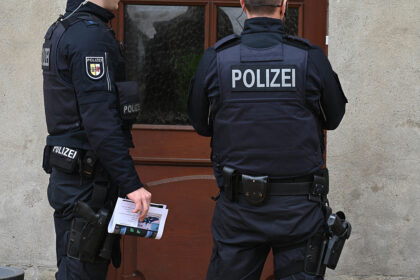
    Job vacancies in the police force, both federal and state, is an issue throughout Germany. In Brandenburg, to fill all of the vacant places due to retiring officers, 400 new officers must be recruited each year. Since Brandenburg borders with Poland, they also look for potential candidates beyond the Oder River.

    Reports state that 15 Poles have been accepted to the Brandenburg police academy in Oranienburg. The first three have completed their training and have started service in Frankfurt (Oder). Since 2015 when the vacancies were announced, 354 Polish men and 181 Polish women have answered the call.

    Germany informs the public about their recruitment through the web, as well as through pamphlets given out at border crossings.

    The Polish-German police agreement foresees cooperation in terms of patrols near the borders, crossing the border when chasing criminals and close cooperation in fighting crime.

  • Tusk calls for protests in Poland

    On Monday afternoon Donald Tusk tweeted a surprising message that shocked public opinion in Poland:

    “The lies organized by the government through public money is a perfidious and dangerous form of violence, whose victims we all are. And everyone should unite, under the law, against this lie and protest.”

    Most commentators have no doubts that this was an endorsement for protesters attacking TVP journalist Magdalena Ogórek on Saturday night.

    Donald Tusk’s statement is a cynical provocation to get tensions to rise

    It is unheard of that both the European Commission and the international community peacefully observe the ongoing and conflict provoking engagement of the President of the European Council with the political struggle in his own country. Donald Tusk’s statement is a cynical provocation to get tensions to rise, says Piotr Semka for wPolityce.pl

    As usual it happens through twitter and though it is sort of unbinding in today’s world, it is treated as any other political statement would be.

    Donald Tusk is playing a game in which he wants to strengthen the opposition and provoke the right-wing public opinion. This is a very dangerous intervention in which an external politician begins to define what is true and what is false in public media. 

    Creating a situation in which the discussion of whether someone is lying or telling the truth concerns only public media, and all other media are excluded, which benefits Donald Tusk. This is because the majority of private media support the opposition and indirectly Donald Tusk. 

  • Record number of Poles died in 2018

    An astonishing 414,000 Poles died in 2018, which is a 3 percent increase compared to 2017. This is a worrying sign, as Statistics Poland originally foresaw such a death-rate as late as 2032. 

    According to professor Piotr Szukalski of the University of Łódź, the ageing of society is responsible for 1 to 2 percent of the increase. This is due to the increase in seniors because more people from the post-war demographic high are turning 70. “A higher death rate may mean a stagnation in the average life expectancy of Poles,” he said. 

    Szukalski also drew attention to the fact that in 2017, the average life expectancy of women decreased by 1.5 months to 81.8 years, whereas the life expectancy for men increased by a week to 74 years.

    The main reasons for this increased death rate include smoking, bad diets and high blood pressure

    The main reasons for this increased death rate include smoking, bad diets and high blood pressure. In 2017, the factors for which humans had an effect on, were responsible for 37.3 percent of the losses in healthy life years. Diet was responsible for 14.2 percent and smoking 17.2 percent.

    Another reason for the increase is the unconsciousness of Poles towards the threats of bad diets. According to the authors of the report for the National Institute of Public Health the “results show an immediate need for more effective health education of the Polish society.” 

  • The worst attack on freedom of speech in 30 years

    When we start to label different opinions as disinformation, we are on the brink of totalitarianism. Once a proposed bill signed by dozens of MPs is labeled as a hybrid attack on the EU, all arguments are in vain.

    First of all, for tens of millions, the EU will set up dozens of censors’ jobs, or as we may rephrase in newspeak ‘strategic communications officers tackling disinformation’. Orwell called it the Ministry of truth. Even though he, fortunately, didn’t guess the year correctly, he accurately predicted this horrifying trend.

    Secondly, the EU has teamed up with technology giants (Facebook, Twitter, Google, and Mozilla) to censor the internet. The EU wants to ensure that ‘harmful’ content will be deleted. In France, Macron’s officers had a chance to directly control Facebook processes and its efforts to delete and block inappropriate content and users. According to German law, internet providers face draconian punishment if they leave any inappropriate content online.

    Finally, the EU intends to subsidize selected ‘trusted’ media. In the times of Goebbels, this was called ‘propaganda’. And again, the EU plans to spend tens of millions on ‘quality news services.’ The program is called ‘Creative Europe’ which aims for structural changes in the media industry.

    During the Communist era, the line between constructive criticism and outrage was thin. Nowadays, it will be up to European bureaucrats to decide what is disinformation and what is quality news. Moreover, the establishment of a European prosecutor is underway. The Czech Lower Chamber approved that bill just last week.

    Well, it looks like hybrid disinformants won’t stand a chance, so we can keep calm and ‘build the Union’ as we used to say.

  • ANO to spend 30 million CZK on European election campaign

    Still, ANO’s projected spend will be way below the legal ceiling on campaign expenditure which is set at 50 million CZK. For example, the Civic Democrats plan to spend around 10 million CZK and other Parliamentary parties even less.

    The Civic Democrats hope it will be enough to secure 5 MEP seats out of 21 dedicated for the Czech Republic. The Social Democrats plan to invest 8.1 million CZK, significantly less than in 2014 when their European campaign cost 25 million.

    The Pirate Party will spend 6 million, the Communists 6.5 million, which will be mainly used for promotional materials. The Christian Democrats will spend 5.5 million as they did during the last elections five years ago. Also, they will use additional funds from sponsors and candidates.

    An election coalition between TOP 09 and the Mayors is still being discussed. Thus, their spending has not yet been set. The far-right SPD party refused to comment on its planned campaign budget.

    The EP campaign is expected to start in the coming weeks. According to political marketing expert Karel Komínek, domestic issues will most likely dominate the campaign, only topics such as migration and Brexit (or Czexit) may be used by some parties. Voters are not usually interested in the European issues, and it’s too complicated to communicate them, he added.

    The European elections are second-tier elections with an extremely low turnout; voters are more willing to get experimental with their votes, said Komínek. He thinks that parties with a strong voters’ base can succeed – Civic Democrats, Christian Democrats, and Communists.

  • Eurosceptics to take over the European Parliament

    Eurosceptics will likely sweep away the grand coalition between the European People’s Party (EPP) and the Socialist and Democrats (S&D). The coalition is set to end after 40 years as it has been the leading force in Parliament ever since the first European elections back in 1979. This year’s EP elections might take on a historical dimension.

    According to the current predictions of Europe Elects, the ECR, the EFDD, and the ENF, under the leadership and influence of Salvini´s League, Kaczynski’s Law and Justice and Orbán´s Fidesz, it should be strengthened by 15 deputies.

    If Salvini succeeded to unify the right, the newly created Eurosceptic faction, according to the prediction of Tobias Gerhard Schminke of Europe Elects, would have 132 seats and would become the second strongest force in the European Parliament.

    The European Liberals of the ALDE, supported especially by Macron´s LaREM and the Spanish Ciudadanos, should gain 31 more seats. On the contrary, the Socialists of the S&D seem to await a steady fall, losing 62 seats. The EPP might lose another 44 seats. It would be the first time the grand coalition of the EPP and the S&D would not receive the majority in the European Parliament.

    Such development might bring along a major shift in the functioning of the European Parliament, and the question is what coalition will take it over. In principle, there are two possibilities. The first and more likely option is that cooperation between the EPP and the S&D will continue, although extended of the ALDE. From such a majority, we could expect further pressure to deepen European integration and actual support centrist economic policy.

    Or the EPP will try to meet the voters’ wishes, tossing the S&D or the ALDE over the deck and inviting Eurosceptics to work together. Such a scenario could lead at least to a relief of the pressure to deepen integration.

    Either way, this year, we can expect the most interesting elections to the European Parliament. And perhaps even more interesting changes after them.

  • Czechs increasingly more satisfied with current political situation

    President Zeman still has high trust among people at 53 percent, while 44 percent of respondents trust the Government. Local councils and mayors remain the most trustworthy constitutional institutions and at the same time the Lower Chamber the least trustworthy.

    The Chamber of Deputies improved by two percent compared to December, while the Senate increased by four percent. The most trusted are the municipal councils with 66 percent of satisfied respondents, and mayors who are trusted by 65 percent of people. Confidence in regional self-government has not changed much since December.

    With the current political situation, 24 percent of survey respondents are satisfied, 39 percent are dissatisfied, and one third say they are neither satisfied nor dissatisfied. Compared to the previous survey, this means a four percent increase in satisfaction and a six percent drop in dissatisfaction. The survey took place between January 5th to 17th and included 1,087 people over 15 years of age.

  • Olympic gold winner awarded Budapest cultural ambassador prize

    Kovács was a member of the Hungarian Olympic team in 1996, 2000 and 2004, winning the gold medal for the 200m breaststroke event at the 2000 Sydney Olympics. She is also the winner of two World Championships and seven European Championship golds. She was inducted into the International Swimming Hall of Fame in 2014.

    “We all need role models to inspire us in our everyday activities,” Teodóra Bán, director of the Budapest Festival and Tourism Center (BFTK) said at the awarding ceremony. The BFTK founded the cultural and tourism ambassador award in 2017, that year the winner was Roman Catholic priest Zoltán Osztie while last year the award went to Csaba Káel, director of the Budapest Palace of Arts.

    Kovács said she is proud to represent Budapest both as her native town and as the location of major sporting events she was part of.


  • MNB says central banks and governments must be united during a crisis

    In cyclic economies where periods of prosperity are inevitably followed by a crisis, governments and central banks must take swift and decisive actions in a strategic partnership, Matolcsy said at the conference.

    The Lamfalussy lectures is an annual financial conference launched in 2014 by the MNB in honor of Belgian economist of Hungarian extraction, Alexandre Lamfalussy (born Sándor Lámfalussy), one of the founding fathers of the euro.

    Matolcsy said that the reaction of the United States to the global financial and economic crisis that began in 2008 is a good example of such cooperation. He said the history of the euro so far has some important learnings: in the initial stage, from 2000 to 2008 it was to the benefit of the emerging members of the euro zone, particularly those in southern Europe.

    But the 2008 crisis also showed that the euro zone was not equiped to handle such an event, even though it began in the United States and Europe did have some time to prepare for it. The European Union mishandled the crisis by relying exclusively on restrictive measures, Matolcsy said.

    He also said that the Central European member states of the EU should speed up the convergence process through continued and widespread institutional reforms. Regarding the introduction of the euro in Hungary – which the country must eventually do in line with its EU accession treaty – Matolcsy said it will happen “sometime in the coming decades”.

     Title image: MNB Governor György Matolcsy speaks at the Lamfalussy financial conference in Budapest (MTI/Noémi Bruzák)

  • “Red mud disaster” accused receive jail sentences

    A dam failure of the Ajka aluminum plant in northwestern Hungary on October 4th, 2010 released some two million cubic meters (70 million cubic feet) of caustic sludge over a 40 square kilometers (15 square miles) area, killing ten people and injuring 227 and causing several billion forints in damages.

    While the first trial that began in 2012 concluded in 2016 that the disaster was a result of natural causes – causing a huge public uproar – and no one had been convicted, the second trial at the Győr court in northwestern Hungary handed out effective jail sentences to the first and second order defendants, the CEO and the technical director of the MAL Zrt. plant, and suspended jail sentences for five other defendants.

    The spillage was the most severe environmental disaster in Hungary in recent decades, only comparable to a cyanide spill from a gold mine in Certej, western Romania in 1971. In that accident – also resulting from the failure of a tailings dam that released 300,000 cubic meters of cyanide sludge – 89 people died and 76 were injured.

    An investigation by a commission of then Communist Romania concluded that the dam failure was a result of natural causes that could not be predicted and eventually dropped all charges against the leaders of the mine.

  • Facebook is a desperate attempt at stopping time

    Seize the day! – states the famous quote from the movie Dead Poets Society.

    In my teens, when I left home to hang out with my classmates a few streets over, my parents could track my whereabouts in one of two ways: they could either come with me or call me on a landline. Since then, technical evolution has developed in leaps and bounds.

    Ever faster computers, the hesitant birth of e-mails, compact disks, mobile phones, and the first local social platform, which we mainly used as an alternative to mails. I was in Krakow, Poland on an Erasmus scholarship when the news arrived about Facebook and what a great way it would be to keep in touch with my Erasmus mates.

    Since then, Facebook has devoured the internet and mobile telephony.

    But I’m not bent on delivering a dystopian diatribe on how the all-pervasive Facebook has dissolved personal space and put our lives on display for all to see and judge. Because this can – with a modicum of effort – be avoided.

    What I am really trying to say is that although nothing forces us to post every banal event, we somehow still do. What’s more, Facebook motivates us to lead a life consisting of postable events.

    One could say that this is a case of collective narcissism and our need for recognition and love. But there is more to it.

    The digital junk collection that is Facebook, storing and hibernating our moments on some remote servers is ultimately a desperate attempt to stop time

    The ever-flowing and more often than not muddy river of time carries with it all the memories we have shared, occasionally bringing random ones to the surface – mostly on anniversaries. But ultimately this river also dumps everything into a great abyss, thus paradoxically being both an attempt at recording events and a permanent reminder of the passage of time.

    I cannot know whether Facebook will be with us in a couple of hundred years as are railroads and telephones or be superseded by something else, never to come back again.

    What I do know is that man has always been desperate to seize the day, with whatever means at its disposal. And we will keep on fighting the passage of time.

    Title image: Niagara Falls (Gergely Szilvay)

  • What in fact is behind the lawsuit against Zeman

    Only the announcement of the lawsuit that doesn’t yet exist has been sufficient for the media and the campaign has already started. Láska also revealed that he is preparing a list of deeds that President Zeman should have committed, reportedly violating the Constitution. In the following phases, we are expecting a media presentation of that list, then a media presentation of the lawsuit, and finally the terse and frequently mediated efforts of senator Láska to persuade other senators about the lawsuit.

    In between, there will be the summer holidays so that the proposal might make it to the Senate plenary in the autumn. Formally, it would be a debate about the lawsuit, but in fact, it would be a debate Zeman versus anti-Zeman. In this play, Láska would lead the anti-Zeman camp wearing a shiny armor to protect the Constitution and laws. Anyone who would oppose him would immediately be presented as a repulsive person standing on the side of President Zeman.

    The mathematics of the Senate is relatively simple. Láska needs 49 votes in the case of full attendance. His club has six. The STAN club, which includes TOP 09 senators and others, could add up to 18 votes. Another 15 could come from the People´s Party whose sympathy Láska already has, according to his words. And from three of the non-partisans, Zeman’s unsuccessful rival from the presidential election, Pavel Fischer, might join Láska as well. That is 40 votes in total.

    The final decision is up to the ODS club (18 senators), ANO (7 senators) and ČSSD (13 senators). It is not hard to imagine that Láska would find the nine votes left between these.

    Thus, Láska´s lawsuit might go through the Senate, and then the whole show would continue in the Chamber of Deputies, where Láska has less chance of success, but that is not the point here. It would be a great media event, and the media would allow Láska to further benefit from the story. With some luck, he could extend the story up to the spring of 2020.

    And if he had somehow succeeded in the Chamber of Deputies, then the whole story would, of course, continue to live in the center of media attention. And it is not at all essential if he succeeded or not in the Constitutional Court. What is essential is that Láska would be seen as a leading figure of the anti-Zeman movement, and especially that he might be re-elected to the Senate in the autumn of 2020 in Prague.

  • No-deal Brexit means a problem for the Czech economy

    If Britain left the EU with a deal, the Czech economy would grow by 2.5 percent this year. In the case of a no-deal Brexit, it would increase its volume by only 1.7 to 1.9 percent, the ministry estimates.

    A withdrawal without any deal would mean that the United Kingdom would become a so-called third party country from the point of view of the EU. This would very likely introduce tariffs and other non-tariff barriers to mutual trade.

    “The Czech economy would be hit directly by a drop in foreign trade with the United Kingdom and indirectly due to a reduction in demand for Czech goods in the Eurozone – this indirect effect would be the most significant,” said Jakub Vintrlík from the press department of the Ministry of Finance. “The overall decrease in demand for the Czech export would be 1.1 percentage points due to both factors,” he added.

    The Confederation of Industry of the Czech Republic estimates that the economic damage on the domestic economy would amount to tens of billions of CZK. “If Brexit came in March, then this year, the total reduction in exports could amount to 30 billion crowns,” says the Confederation´s spokesperson Eva Veličková.

    Also, the Chamber of Commerce points out that some businessmen are unlikely to be aware of the overall threat of Brexit. “For example, firms supplying components to Germany, where they are further processed and subsequently re-exported as new goods to the UK, would be hit by a hard Brexit. The question is whether all these companies are prepared enough for possible new conditions,” Chamber of Commerce spokesman Miroslav Diro said.

    However, the Ministry of Finance assumes that the impact will be rather a one-off and, in the longer term, adjusting the exchange rate and increased demand for domestic production at the expense of import should help the economy.

  • French court toughens sentence for Czech truck driver Sagan

    Sagan was imprisoned for smuggling migrants and sentenced to one and a half year in jail. Now, the court of appeal in the French town Douai has toughened his sentence to two years of jail time and a four-year entry ban to the country. MEP Tomáš Zdechovský, who has been helping Sagan, reacted on Twitter that there is no evidence of Sagan’s wrongdoing, but all they can do now is try to get him to the Czech Republic.

    Sagan was defended by three lawyers, two French and one Czech. The defendant also presented his version of events. His attorneys opposed mainly procedural errors in investigations which the prosecutor, according to them, was not able to explain satisfactorily. The prosecutor, on the contrary, insists on Sagan´s guilt and even demanded to toughen the sentence.

    The Czech driver was arrested at the beginning of last summer when fifteen Iraqi refugees were found in his truck trying to get from France to Great Britain. Since the beginning, Sagan has been saying that he did not know about them. According to him, they had to get into the truck secretly without his knowledge. He claims to have complied with all recommended safety rules.

    The court of appeal in Douai announced its decision nearly a month after a court session took place on January 2nd. Sagan’s lawyers now consider whether there is any other procedure that could help him.

  • Czechia leaving Visegrad is not a good idea

    From time to time, some journalists and commentators recommend that the Czech Republic should leave Visegrad. According to them, the group has a “toxic label”, mainly due to the rejection of the European solution to the migration crisis. At the same time, they criticize the situation in Hungary or a stronger turn to Russia.

    However, according to commentator Jan Macháček, none of this is a reason for the Czech Republic to leave the V4. Referring to other partnerships such as the Benelux as well as a new treaty between Germany and France, Macháček argues that regional clusters can only refresh the EU.

    Moreover, cooperation in Visegrad works very well. For example, culture cooperation can be considered a great one. Also, there is a natural skepticism over the transgender revolution and neo-marxism as well as the removal of statues or growing political correctness. These attitudes are rooted in a common experience with communism and totality.

    Of course, in addition to common advantages, the countries have their common problems as well. For example, the foreign capital that controls their banking systems or the widely discussed dual quality of food. We have to admit that there are things which need improvement, but leaving the group is simply not a good idea.

  • Neo-marxists separate art from God

    “We live in a period of continuous and developing axiological revolution in which moral, esthetic, cognitive and religious values are being subject to brutal revisionism,” Podhorecka said in an interview for naszdziennik.pl. 

    She sees current left wing ideology as “neo-marxist” due to its “program, aims and goal which it is realizing, so all forces are concentrated on removing God from public space.” Christianity is the main obstacle for those environments to build their vision of the world, in which man is without God. “After all, Christianity teaches love and not hatred.”

    Christianity is the main obstacle for those environments to build their vision of the world, in which man is without God

    The critic argues that the names of left wing movements don’t matter – they’re all the same “leftist” and “neo-marxist”: “No one is being deceived, because we can see how today’s culture looks like, completely shaped by the left.”

    Podhorecka claims that culture in Europe is formed entirely by the left: “this affects all aspects of culture.” She gives the example of theater where the intellectual and artistic are no longer the main criteria. Instead, “the main criteria are the left-ideological basis, politically correct. It is about showing the world depicted in shows from a leftist-liberal point of view, doing away with Christian values.”

    Man as a character in art has been reduced to matter. He has become objectified and deprived of the spiritual sphere

    She underlined the consequences of the dehumanization of a human: “Man as a character in art has been reduced to matter. He has become objectified and deprived of the spiritual sphere. Man cannot be seen other than through the integral “sphere of spirit, intellect and body.” 

    Podhorecka explained the gravity of such actions in theater: “such a theater, one which takes away dignity and which degrades man to a purely biological, even physiological function, opens a gate to walking over man and not respecting life as an imperative value.”

  • Thieves ransack Andy Vajna’s grave

    It is unclear whether the thieves were from the cemetery staff or other perpetrators, but the fact is that several dozen expensive cigars have disappeared since Vajna’s funeral on January 31st. Bors estimates the value of the cigars at least HUF 500,000 (US$1,800). Vajna was a known cigar aficionado and many of his friends and acquaintances left cigars on his grave as a final goodbye.

    Andy_Vajna_grave

    Born András György Vajna in Budapest in 1944, Vajna fled Hungary after the 1956 anti-Soviet uprising and studied cinematography at UCLA to later become a well-known producer of action movies. These include the first three Rambo movies, Evita, Red Heat, Total Recall and Air America.

    He returned to his native Hungary and was appointed Government Commissioner for the Hungarian film industry in 2011 and essentially reformed movie production along market requirements, while also establishing the state-financed Hungarian National Film Fund that recently financed titles such as the Oscar-winning Son of Saul.

  • The visit of the tired lady – Merkel in Bratislava

    The visit of the perhaps not old, but certainly tired and highly-strung lady is unlikely to bring about any momentous change, Faggyas writes, paraphrasing the title of a play by Swiss author and dramatist Friedrich Dürrenmatt – “Der Besuch der alten Dame” (The visit of the old lady).

    The official agenda is the following: the regime changes in the region that happened 30 years ago, EU affairs, international relations with a focus on the Western Balkans, Russia and Ukraine and – last but not least – forging closer economic cooperation.

    Despite her current status, Merkel’s visit could still be an important one, especially considering the fact that since 2015 she has done more harm to her country and – incidentally – Europe – than the good she did between 2005 and 2015.

    Merkel’s popularity is waning and her successor at the helm of the Christian-Democratic Party (CDU), Annegret Kramp-Karrenbauer and the leader of the Bavarian sister party Markus Söder of the Christian Social Union (CSU) are intent on conducting a “critical review” of party policies since 2015, especially in the fields of migration and refugee policy. And they want to do all this without Merkel.

    It remains to be seen whether this will in effect lead to a change in German migration policy, given that Merkel intends to serve her term until 2021. But the fact remains that a tired politician with an eroded popularity is about to meet the heads of government of a group of energetic, politically and economically stable countries.

    Economic issues will – as a matter of course – be central to the meeting, because Germany has 60 percent more trade relations with the V4 than it does with France. But we should not forget that – referring to the recently signed French-German Aachen pact – Merkel spoke about German-French “cooperation against rising populism and nationalism”, a clear hint to Hungary and Poland, the two countries that are most opposed to mass migration and Europe’s Islamization.

    So the Bratislava visit of the tired lady is one to watch.

    The summit in the Slovak capital is scheduled for February 7th.

  • Polish sport minister enters a big game

    The election for the head of WADA will take place in November in Katowice. This function would be confirmation of Poland’s rising position globally, not only in the world of sport. It would also be an appreciation of Witold Bańka and his ministry’s accomplishments in his endeavors to uphold fairness in sport. 

    The possible choice of a Pole for the head of WADA by the sport world can also been seen as a sign of impatience towards Russia

    But the head of WADA is not just a cozy job. A few years ago it turned out that in Russia, illegal doping was systematically supported by the government and even special services. Since then, tens of Olympic medals have been taken away from Russia. They have also lost medals from all sorts of championships, including athletics but not everything has been accounted for yet.

    Russia continues to toy with WADA. The possible choice of a Pole for the head of WADA by the sport world (and it is well known how Russian authorities react towards Poles) can also been seen as a sign of impatience towards Russia.

  • Happiness map of Hungary

    Psychologist Attila Oláh, the country’s foremost expert in matters of happiness has been mapping the feeling for years with his team at the ELTE University and says that happiness is a notoriously difficult concept to define, let alone measure.

    “Consider how happy we are when we have someone visiting and how happy we are when that guest leaves,” Oláh said in a lecture on happiness. He said one of the greatest modern authorities on the subject, American psychologist Martin Seligman hates the expression and prefers “relative well-being”.

    Oláh said that by correlating the self-confessed happiness levels mapped out in Hungary a few factors are evident: happiness is more common among women, those with more than four children, those with a higher education and the 30 to 50 age group.

    He said that while the regional differences have remained largely unchanged in Hungary over the past two decades, the overall happiness level of the country – as indicated by the World Happiness Report – has shown a gradual increase: while the country was only ranked 112th among the 156 countries included in the report, last year it was placed 69th.

    Oláh also said that an individual’s happiness is at around 60 percent, defined by an inner “thermostat” that will keep it relatively steady regardless of conditions, 40 percent of the factors defining it are under our control.

    By the way, Hungary has a happiness institute operated by a group of enthusiastic volunteers.


  • “European coalition” of political dinosaurs

    “I believe that the European Coalition is a continuation of the same socio-technical trick, which was made up a few months ago under the guise of “Polexit”,” Waszczykowski told wPolityce.pl. He argued that the opposition is trying to convince Poles to “create barriers which are meant to stop it [an anti-European government].”

    Politicians who have signed the “European Coalition declaration” are, among others, chairman of the Democratic Left Alliance Leszek Miller, former PM Włodzimierz Cimoszewicz, Former PM Ewa Kopacz and former Foreign Minister Radosław Sikorski.

    Waszczykowski argued that the opposition is not looking for new solutions. Instead “there are only former politicians who have many embarrassments on their accounts. We all know about those tapes and other accidents, etc.”.

    There are only former politicians who have many embarrassments on their accounts

    What will Tusk do?

    Waszczykowski drew comparisons to a past liberal party, much like PO, the Freedom Union. “Once the Freedom Union tried to forge an alliance with the post-communist politicians. Here Schetyna [PO’s chairman] is walking into the same rut. (…) I understand that if Jaruzelski [Communist leader who installed martial law in Poland] were still alive he would also be a part of the European Coalition and presented as a European and anti-PiS politician?” 

    The former foreign minister also claimed that he is curious as to Donald Tusk’s reaction to this new creation. “Will he bless it? Or will he, as he often does, travel to the Dolomites and observe for a few weeks. Depending on what he observes, he will either join it or ignore it.”

  • Finance Minister: Hungary to devise economic protection program

    Economic growth in Hungary this year will likely exceed the Organisation for Economic Cooperation and Development’s (OECD) recent forecast but it would be prudent for Hungary to devise a program to offset an expected slowdown of the global economy, Varga told national radio station MR1.

    The OECD’s recent forecast shows a 3.9 percent GDP growth for this year and 3.3 percent for 2020 – Varga said that international agencies regularly underestimate Hungarian economic performance but preparations for a global downturn should still be made. He said that for 2018, even the highest international forecasts only indicated a 3.5 percent growth, it eventually came in at 4.6-4.7 percent (the final data for 2018 will be available in March).

    Varga said the main factors that led to a higher growth rate were domestic consumption and rising investments.

    He said the government plans to devise measures to protect jobs, the growth rate of salaries, investments, domestic consumption and the real value of pensions.

    Varga added that while the Hungarian labor market underwent a significant change over the past few years with unemployment falling to a historic low of 3.6 percent from about 12 percent (in 2011), the drawback was a workforce shortage in some sectors of the economy. He said Hungary does not plan to solve the issue through migration but by mobilizing the internal reserves of the country, such as involving those currently inactive.

  • Attack on TVP journalist

    TVP Info journalist and the host of its main current affairs show “Minęła 20”, Magdalena Ogórek referred to the incident on Twitter herself: “My car has been spat on, scratched, covered with stickers. I was slandered and people threw themselves under the wheels. Tussling and violence. That is how my departure from TVP looked like. And they’re happy and even posted a video.”

    The twitter account which posted the film from the attack was deleted. However, other users were able to repost the video.

    Let us imagine: a demonstration under TVN and “Gazeta Wyborcza” headquarters. A group of people with white and red flags spit on the cars of editors and insult them. What happens next? The whole world learns that the “free media” had been attacked by Polish fascists. Despite swift police intervention, Brussels decides to halt donations to the “PiS state regime” till power is taken over by a “democratic rule of law.”

    Although many internauts were outraged by what happened to Ogórek, there were some with less sympathetic opinions:

    Mrs Ogórek fully deserved what she got

    “Although she seems to have it under control, that it doesn’t bother her, she stops her car around the corner and cries. Cries for a while. High five for this demonstration. You proved that it matters to you.”

    Opposition politicians such as Sławomir Neuman and Barbara Nowacka denounced the attacks and the Minister of the Interior Joachim Brudziński apologized for the idleness of the police during the assault. 

    Some opposition politicians, however, do not see the incident as something wrong, such as former minister Waldemar Kuczyński: “Mrs Ogórek fully deserved what she got.” 

    This is the issue: many opposition politicians and journalists criticizing the government have become proficient in this art. They cut themselves off from the behaviors of people who damage their PR who “fight” hate speech by justifying hateful actions. They always have answers ready, such as “you reap what you sow,” or “they started hate speech, so now they have it,” etc. 

    Some PiS opponents do not even bother with an alibi in the guise of an apology, such as Janusz Palikot: “But what should one do with this b*tch?”

  • Hard Brexit: The termination of Britain’s EU membership


    Good evening. The House of Commons authorized the government to renegotiate the agreement on the termination of the UK’s EU membership with Brussels. Prime Minister Theresa May promised not to introduce border control on the Irish–Northern Irish border after Brexit. The President of the European Council has not ruled out the possibility of revising the Brexit agreement if it is justified. The European Union and its institutions are united in sticking to the agreement that has already been adopted to determine the conditions for Brexit, said Michel Barnier, EU Chief Negotiator for Brexit, on Wednesday in Brussels. March 29th is the date for Brexit. By that time, the conditions for exiting should be settled upon. But, will they be settled? We will talk about this with my guests after the clip.

    Last December the House of Commons postponed. Then, in January it rejected the proposal that would regulate the termination of Britain’s EU membership. In addition to the opposition parties, the Prime Minister’s own party members and other cabinet parties did not support the Brexit document. The biggest debate was triggered by the question of reintroduction of border control on the Northern Irish border.

    The other major topic was whether to extend the date of the exit instead of leaving it at the end of March. On Tuesday, the pact was negotiated by the lower chamber of London and several points were amended. MEPs argued throughout the night. The Prime Minister urged the renegotiation of the agreement with the EU. Theresa May was empowered to do so by a minimal majority. The motion was supported by 317, but 301 voted against it.

    It is clear that the amendment to the exit agreement and its related negotiations will not be easy. The government’s goal is to seek legally binding changes, bearing in mind that there is no need to reintroduce border controls at the border between the Republic of Ireland and Northern Ireland, the Prime Minister said. The suggestion of the opposition party that the Brexit deadline be postponed to the end of the year was rejected by the Members of the House. Given that the Honored House rejected the pact supported by the Prime Minister, we are ready to meet with the head of government and propose what kind of agreement the Labor Party wants to have with the European Union, said Jeremy Corbyn.

    The President of the European Council stated that the Brexit document cannot be renegotiated. At the same time, Donald Tusk welcomed the fact that the UK would want to avoid an unregulated exit. The politician said that Brussels would be prepared to review the agreement if it were justified. For this, Britain is expected to remain as part of the single market or the customs union. If, however, the UK leaves the community without an agreement, that is, if a hard Brexit would happen, London could cease to enforce the EU principle of free movement in Great Britain within a short period of time. In that case, EU citizens, such as citizens of the Visegrád countries, who arrive in the UK after Brexit to visit, work, or study would only receive a three-month residence permit. If one wants to stay longer than three months, he or she must submit a separate request. It would be valid for another three years, but it would require a fee. In these cases, applicants would need to prove their identities and that they have not committed a serious crime. For a foreigner to be allowed to settle in the UK for over three years, the applicant’s qualification would be crucial. Foreign EU citizens who have been living in Britain for more than five years would not be subject to the new strict immigration policy.

    In the studio I welcome Csaba Szajlai, Deputy Editor-in-Chief of Figyelő, and Dávid Németh, Chief Analyst of K & H. I wish the gentlemen a good evening.

    Good evening.

    What seems to be the most likely scenario now? March 29th is very close.

    Maybe the latter, that is, the March 29th exit and a hard Brexit. My bet is that the European Union will not go into further bargaining. The British had time, because it has been almost a three-year long process. It would also make the decision-making mechanism of the European Union look not serious if they would set a further interval for Brexit. I am pleased that we are talking about this topic, because it is the biggest issue of the European Union, in several respects. It is a big deal from the perspective of money and the capital market, as the British play a significant role in this, as well as from the perspective of Anglo-Saxon influence, indirectly through America. It is a very important topic for the EU budget, since the British are net contributors. It is important also from the point of view of the labor market, as UK statistics show that about 1.2 million people from the V4 countries work in Britain. So, we are facing a big issue and we can’t tell what will happen, but I think we will face a lot of negative prospects in the next period.

    Well, we’ll talk about that too. Do you agree that this scenario is the most likely?

    I’m not so pessimistic. Indeed, the Brexit negotiations have not been very successful recently. However, the deadline is getting tighter, and it seems that events are spinning. Both sides are interested in working together in the future. Europe is interested in not having economic growth cut back, and Britain is interested in not collapsing.Of course, there is also an interest in Europe to show that it is not easy to get out of the European Union and that is why we make it hard.

    This is an important part of it.

    This is an absolutely important part of it, yes. But, I think that when we will be there where there are only a few weeks left until the actual date, that is when the European Union will be a little more compromising than it is now. But, it is true that a significant part of the contract will not be renegotiated because it would make no sense. If the British Parliament only needs a little fine tuning to accept the agreement that Theresa May negotiated, then I think the EU will be willing to do that, even at the price that the actual exit date would be postponed by a few months, say, to early July.

    How much will the Visegrád countries be affected with whatever Brexit will be realized?

    I think there will be a major transformation in the relationship between the UK and the EU and the Visegrád 4 as well, since nothing will be the same as it used to be. I think that the laws are going to change, and the conditions of working in the UK will most likely be different. It is impossible to know what exceptions the British are going to allow for the V4 countries, but, of course, this cannot be defined as just the V4, but for EU workers. There will certainly be a need for EU workers, as they are needed now.

    A big question in the next period is how the British economy will survive, because money is already leaving the country. Most likely many financial centers will transfer their headquarters after Brexit, especially from the inner parts and London, say, to the developed western European cities, such as Frankfurt, Paris, and Milan. I’m certain that this will be part of it. I think that, after the exit, although it is in the common interest of the European Union and Britain to keep up the economic growth, I think we can prepare for a recession. Another question is how the British imagine the future. Apparently, the British top leadership, the British aristocracy, if I may put it that way, the British politicians are basically pro-EU. But, according to recent surveys, if a referendum were to be held again on whether or not the British should quit, British citizens would again vote for Brexit. So, I think the relationship with the EU is still complicated.

    How will a large net contributor’s exit affect the economic management of the European Union?

    In the European Union budget, the British have been indeed very big contributors, and since our region, the V4, has benefited from that in the recent period by receiving more money from the European Union in the form of subsidies than they had to pay to the common budget, Brexit will negatively affect the region.

    The question should be divided into two parts. On the one hand, there will be less money in the EU’s budget, at least according to current knowledge. But in the meantime, the Germans and the French are trying to put together another EU budget, but we don’t know how and who will be net contributors in it. But, under the current system, there will be fewer payments in the EU common budget, which will be allocated to the member states through various structural, cohesion, or agricultural funds. Because of this, they will be sharing less money and we will probably receive less money. But, there is another effect. Britain is a rich country, and with the loss of a rich country, the GDP of the European Union will decrease. So, the level of the gross domestic product begins to decline, making our region relatively rich. And, there are rules that prevent developed regions from accessing certain development resources. As a result, there would be more regions in Hungary that would not be eligible for development funds anymore. So, overall, it is very easy to imagine that a loss of up to 20–25% may occur in the budget cycle after 2021 compared to during the 2014–2020 period.

    I would add that there are not too many regions that would be so over-developed in the context of the European Union if it really came true what Adam said. Otherwise, the reasoning is really logical, because if we think about it, London and its surroundings are the richest, most developed EU regions. Returning to what is very important for us Hungarians: how things will be after the Brexit, when the EU’s regional structure changes, and when there will be less payment to the common budget. It is even more important what will happen to the Hungarian exports to Britain. Great Britain is an important trading partner, with 5–6% of our exports…

    Sorry for interrupting, but we have a chart and we can show the V4 countries’ export and import proportions with the UK. I’m asking my colleagues to show the chart, and we can see together that the Hungarians, for example, are not at the top of the list compared to the Poles. Poland is a much more important partner for the UK both in terms of exports and imports. Here is the table. So, the Czech Republic takes 5%, Hungary 3.9%, Poland 7%, and Slovakia 6% in the export. For this reason, Brexit will hit Poland the hardest from the region. If we look at import data, there are no big differences: 2–3% each. But, the UK is not among our most important partners. From the point of view of Hungary, the UK is only in 14th place, so it will probably not affect the Hungarian economy very negatively, hopefully. Is this what the charts translate to?

    This chart was created by the OECD. I saw something else. I saw a British statistic that showed 5–6% for Hungary too, but it’s not worth to argue over a few percentages. The point is that we need the British market. So, it is very important for the Hungarian government to have good relations with Britain in the next period. There is an option for this, as Péter Szijjártó has negotiated with the British Minister of Economy and with the British Foreign Minister several times, and there were joint press conferences. So, you have the opportunity to stay in touch. This is important to us, since the percentages in question, whether it is 3.9% or 5–6%, are important. Just to provide some context, this is the volume of our commercial relations with Switzerland or Austria as well. So, the export of Hungarian products to Great Britain is a topic that should be addressed with priority, especially because we are able to export products, for example, red wine, that succeed only on the British market. It is a fact that only few people realize that Great Britain is one of the largest importers of Hungarian red wine. Another important area is productivity. What kind of plants are there in Hungary, and how can we adapt to the British global chains? And, it is not just about the commercial chains, but about the transmission that Britain provides to the Hungarians through the Anglo-Saxon culture. This is similar to the example when we talk about how Germany is the biggest market for Hungarian products, but in fact we indirectly also export to China and to the United States. The value of this is much higher than what can be seen from the statistics at first glance.

    Now, a transition period is coming. The new EU financial period will begin in 2020. Does this new scenario include the British-free scenario?

    What the British are now negotiating with the EU is just about the conditions under which they leave. That is why there is another period until 2020, when they will agree on how they will probably work together in the future. And, therefore, provided that the Brexit agreement is finally accepted by the British Parliament, until the end of 2020 the British will meet their obligations to pay their contribution to the EU budget. And, until then, the member states may call the full amount originally issued for them, of course, if they meet the requirements for such applications. So, by 2020, it can be said that, if this agreement is in place, that is if the British Parliament accepts it, we will not experience anything different in the EU budget or its functioning. After 2020, a new era will start in every respect. If there will be an agreement on how the European Union will cooperate with Britain in the future, we will also see better what kind of trade relations we will have with the UK in the long term. How much Hungary gets from the EU budget, that we will probably see earlier, maybe even in 2020. Theoretically, new tenders could be launched beginning in 2021. But, now it seems that this will not be realistic, because the European political forces will not be able to reach an agreement. So, it could be postponed even until 2022–2023 when our region and other European countries will actually be able to access EU funds and can start investing with them.

    Let’s move onto some political questions. In what cases did the United Kingdom stand behind the V4 and in what cases did it stand against them?

    Basically, the United Kingdom has always been a supporter of the V4 countries when political issues have surfaced. Our relationship was basically good and our relationship is still good now, for Poles, Hungarians, Slovaks, and Czechs. I think this is the starting point, and it should be nurtured and strengthened during the next period as well. But, perhaps there is a more important part to the politics of the next period. After all, with the withdrawal of the British, a so-called separate policy leaves behind the decision-making of the European Union, which means that the hegemony of the German–French axis will be clearly dominant.

    Is that what we have to prepare for?

    Yes, most probably.

    Because what characterized decision-making up to 2019 was a bit more diverse. The influence on the decisions of the Italians, Spaniards, and other Member States was more significant. Now, the German–French axis seems to be developing. The British have always had a great influence on the decision-making of the European Union, given that we are talking about a country of 60–70 million, and British MEPs also had a significant voting power in the European Parliament. This kind of special policy is now lost. We Hungarians must be interested in working with the V4 countries. We are not enough just by ourselves neither in the European Union nor in the European Parliament. However, if we work together with the V4 countries, Poles, Czechs, and Slovaks, and I would add our Croatian brothers as well, I think that we have a greater chance of being able to stand up for issues together. In this respect also, the withdrawal of the British is regrettable. As I said earlier, the Hungarian–British, Czech–British, Slovak–British, or Polish–British connections worked very well. In fact, if we speak in terms of our professions, economics, then, for example, the British influence, or more specifically the British Anglo-Saxon intellectual influence on the Polish economy, is very strong, much stronger than in other Central European countries. In Poland, the kind of money and capital market culture that is typical of the British has evolved or is evolving. I am thinking here first of all about the operation of the stock market.

    We have about two minutes left. I think we still have time for one of the most important questions. What happens to the employees? There are different estimates, but the number of V4 citizens working in the UK is between 1 and 1.5 million. What will happen to them?

    According to current information, those who are already employees can remain in the country. The big question will be what kind of agreement will the European Union have with the UK in the long term and to what extent will a free labor flow be allowed between Britain and the countries of the European Union. We have seen different agreements, for example, with Switzerland or Norway, where movement within the EU is more tolerant, but there are also different conditions for staying there. So, there can be many scenarios here which could lead to temporary employee permission, no employee permission, or even a strict definition of the professionals that will be allowed people to enter the country. The British are clearly of the opinion that they want to choose who is valuable to them and what the economy needs, and on that basis they want to decide how many people can settle and work in the country. However, if they want to remain to a large extent in the European single market, then the European Union is expecting the UK to be more liberal about allowing EU citizens to work in the UK and to pay more into the EU budget. So, there are still a lot of conflicts of interest here, and they will be settled as the result of the 1.5-year negotiation series, if they can agree on what the exit conditions will be for the UK.

    We, together with many, are curiously looking forward to seeing the developments. Thank you for being here and sharing your valuable thoughts with us.

    Thank you.

    Dear viewers, you have been watching the V4 Future of Europe program. Next week we will back with fresh information. Thank you for your attention and goodbye.


  • Proponents of the euro in Czechia running out of arguments

    Signatures under a petition for adopting the euro are being collected in the Czech Republic. Even though it is almost certain that the petition would not bring the euro to the country, it is good to think about what the adoption of the European common currency could mean for Czechia. The starting point for the petition could not be worse, because currently, all the relevant institutions either reject the euro or at least do not recommend its adoption in the foreseeable future.

    Namely, Andrej Babiš´s government explicitly rejects the adoption of the euro. Among the main reasons why it does so, the government points out the loss of its monetary policy or the obligation to send tens of millions of CZK to the European stabilization mechanism.

    The date of euro adoption in the Czech Republic is not even foreseeable beyond the current coalition´s term. At the end of last year, the Ministry of Finance and the Czech National Bank recommended that the government should not set a target date for entry into the eurozone for the time being. Both institutions marked the unfinished process of real economic convergence of the Czech Republic at an EU level as the main obstacle to the adoption of the euro.

    Therefore, the petition for the adoption of the euro emerges in a situation where the topic of the common currency is “taboo” for the relevant institutions.

    Moreover, it is symptomatic that the authors of the petition, which is supported by some well-known political figures, argue not only with economic reasons but, to a great extent, with political ones. This is not surprising, as more and more people now understand that the euro is primarily a political project whose main goal is to bind the EU on its way to a higher level of integration.

    One of the arguments of the petitioners is in a nutshell, “We will be better”. But the idea of starting the economy is questionable. Today, the economy of the Czech Republic grows much faster than the eurozone economy and, moreover, grows more dynamically than, for example, Germany’s economy.

    Even the arguments that the euro would strengthen the voice of the Czech Republic in the EU and that the country would be safer are not relevant. Supporters of the euro thus suggest that the Czech Republic is now somehow a minor member of the EU. If it were the truth, accepting the euro would not change a thing. Also, according to international studies, the Czech Republic is one of the safest countries in the world, and it is not clear how canceling the Czech crown should contribute to state security.

    The above shows that the adherents of the euro adoption in the Czech Republic lack relevant arguments, and thus they must resort to poetic, political proclamations. Given that Babiš´s government has not included the euro in the program for its term in office, it is clear that the goal of the authors of the petition is mainly a political promotional event aimed at improving the image of the European Union before the elections. That is the elections in which anti-European or anti-Brussels forces are expected to succeed.

  • Cooperation between the Czech and Polish Book Festival

    The aim of the collaboration with the Warsaw Book Festival is to improve the promotion of Czech authors in Poland and to increase the saleability of their books. In Poland, dozens of Czech titles, including top-selling contemporary artists, are published every year. The Warsaw Book Festival is taking place from May 21st to 24th, 2020.

    “Czech literature has an exceptional position in Poland: 25 to 28 Czech titles are published annually in Poland, and Polish readers know us well,” said Tomáš Kubíček, Director of Moravian Regional Library. In cooperation with several libraries in Poland, the Moravian Regional Library plans to publish a database of Czech and Polish book titles.

    The honorary guest this year is Latin America, but preparations for next year in cooperation with Poland are already underway. The director of Book World Prague, Radovan Auer, stressed that so far, there has been no such cooperation in the field of literature between the Czech Republic and Poland.

    “Polish culture is close to us, and Czech culture is even closer to the Poles, so in a way, we go to an explored area, which is an advantage over Latin America this year,” Auer added.

    This year’s 25th festival is taking place from May  9th to 12th in Prague’s Holešovice. The main theme is Memory and Memories. Writers from Argentina, Brazil, Chile, Mexico, and Peru, including several holders of prestigious literary prizes, have promised to join the fair.

  • Czech Chamber of Commerce opposes higher wages for Ukrainians

    According to the proposal, Ukrainians should earn at least the median of their profession or a 1.2 multiple of the guaranteed wage. According to the Chamber, this intention goes against the principle of equal conditions and favors the Ukrainian workers.

    The proposal to extend the recruitment program from Ukraine, according to which the Czech Republic should gain 40.000 Ukrainian workers annually (compared to 19,600 workers it currently gets), also includes wage setting in two variants. According to the first one, Ukraine’s employees should earn at least the median of their profession. According to the second option, their wage should be at least between CZK 16,020 and 32,040 this year, i.e., 1.2 times the guaranteed wage. Thus, Ukrainian workers would earn more than Czechs, the Chamber said.

    “We have demanded the introduction of a government-regulated regime for the accelerated employment of workers from Ukraine to help employers address the acute shortage of workers. However, with the intention of wage-favoring these workers over Czech employees, we do not agree. There should be equal conditions at the workplaces for the workers, no matter where they come from,” said Vladimír Dlouhý, President of the Chamber.

    On the other hand, the trade unions agree with a wage criterion. They would prefer the median option. According to the chairman of The Czech and Moravian Confederation of Trade Unions, Josef Středula, the wage criterion is to prevent the abuse of Ukrainian workers.

    In 2017, according to expert estimates, 472,400 foreigners were employed in the Czech Republic, of which over 80,000 were Ukrainians. Men work mainly in industry and construction, women in commerce, healthcare, and services.

    The Czech Republic has record low unemployment. Companies complain that they cannot find workers and some have to limit production. According to the Chamber, 440,000 employees lack staff.

    The Chamber is negotiating with the government to increase the annual quota of Ukrainian workers to 40,000. The cost is estimated at CZK 100 million per year. According to the Chamber’s calculations, however, the state’s income from taxes and levies would increase at least a hundredfold, i.e., by 10 billion crowns per year.

  • Babiš cancels EP address as he has ‘nothing to say to current MEPs’

    Babiš was supposed to present his vision for the future of the EU as a part of a debate. The PM said he would rather wait for the new MEPs to arrive before presenting his vision, and went on a work trip to Asia instead.

    Speeches in the debate on the future of the EU are considered very prestigious. Previously, German Chancellor Angela Merkel, French President Emmanuel Macron, Prime Ministers of Poland, Croatia, Estonia, and other EU countries have taken the opportunity to speak to MEPs. On Thursday, the President of the Finnish Government, Juha Sipilä, presented his vision in Brussels. The Italian and Slovak Prime Ministers are going to do so in the coming weeks.

    Andrej Babiš was supposed to come to the EP on January 16th. Eventually, however, he announced through the embassy that he would not attend. Instead, Babiš left for a work trip to Asia, and Spanish PM Pedro Sánchez is going to use his term to speak at the plenary.

    Babiš commented on his decision, saying that he has nothing left to say to the current MEPs. “The Parliament de facto ends in late March, and I do not know what to discuss with them. I will wait for the new parliament, and I will gladly go there then,” he said.

    In the past, Viktor Orbán and Angela Merkel faced criticism during their speech in the EP. The Czech PM is now facing a similar situation because OLAF is concerned with his earlier business activities, and Transparency International is examining his potential conflict of interest. Babiš concluded that most critics in the EP are campaigning and behaving accordingly. He added that he hopes that after the European elections these voices will silence thus changing the atmosphere in the EP.

  • Sapkowski and CD Projekt Red “close to agreement”

    In October 2018, Sapkowski had demanded at least PLN 60 mln from CD Projekt. The money was meant to be compensation for using his “The Witcher” book series, on which the developer’s games are based on. The Warsaw company considered the author’s claims to be completely baseless but argued that they will search for an amicable solution. 

    The issue poorly reflected on CD Projekt’s international standing due to online commentary and media attention. The developer had boasted that the profits from “The Witcher” games amounted to over PLN 1 bln. Sapkowski had demanded six percent of the profits.

    Arrangements are underway between both sides. In no more than a month it should be known what the solution is

    “Puls Biznesu” reported that “arrangements are underway between both sides. In no more than a month it should be known what the solution is. There is likelihood of a settlement, but nothing is certain.”

    [block:views=related_articles_field-block]

    The settlement would most likely not be the demanded sum. “This could rather be a form of appreciation for Sapkowski’s work – his character, talent and potential, when it comes to helping the company create ideas.”

    CD Projekt Red has denied commentary on the negotiations. In October 2018, the company’s chairman Adam Kiciński underlined that the company wants to keep good relations with Sapkowski but also honor previous agreements and contracts.

  • Bad Polish meat delivered to 10 countries

    “The slaughterhouse which had conducted the illegal slaughter has been closed and its owner will take criminal responsibility,” Niemczuk explained. “The police and the prosecutor’s office are on the case.” The infected meat will be taken to utilization.  

    The issue concerns a slaughter of sick cows which was shown on a TVN news report. It had been conducted overnight without veterinary supervision in Ostrów Mazowiecka, North-East Poland.

    The meat amounted to 9.5 tons, 2.7 of which was sold abroad

    The meat amounted to 9.5 tons of beef, 2.7 of which was sold abroad. This includes: Finland, Hungary, Romania, Sweden, France, Spain, Lithuania, Portugal, Estonia and Slovakia. The rest was sold to “20 locations throughout Poland,” Niemczuk stated.

    The meat has also been reported to the European Food and Feed Safety Alerts (RASFF). The Inspector assured his counterparts in Brussels that it was an isolated incident and that Polish food is safe to consume.

    Both the Polish Veterinary and Sanitary Inspectorates guarantee the safety of meat on Polish shelves. The Chief Sanitary Inspector Jarosław Pinkas informed that “there is no threat to human health, since there are no biological hazards. We can safely consume beef and other meat preserves.”

  • Former Deputy Speaker involved in “contracts for sex” scandal

    Central Anti-Corruption Bureau (CBA) had detained three businessmen in Łódź who were under suspicion of delivering bribes to an MP. 

    According to several Polish media outlets, including TVP Info and “Super Express”, the MP in question is opposition MP Stefan Niesiołowski. The MP is also known for his harsh criticism of the PiS government.

    The CBA said that the businessmen received lucrative contracts among companies belonging to the national treasury in exchange for delivering financial benefit. Those were not the only profits they received, as CBA claims that decisions in their favor had been made at the Łodź local government and other institutions as well.

    Niesiołowski was to negotiate multi-million contracts for the businessmen, who in exchange organized and paid for sexual services for him

    “Super Express” claims that “Niesiołowski was to negotiate multi-million contracts for the businessmen, who in exchange organized and paid for sexual services for him.” 

    “CBA agents possess evidence, in which Niesiołowski is present,” said an investigator. “Niesiołowski was to have used 29 sexual services. The procedure occurred in a flat in Łódź, which belonged to the businessmen. Encounters with the women occurred between January 2013 till the end of 2015.”

    Randy Stefan

    According to “Super Express”, the businessmen spoke of him as “Randy Stefan.”

    Poland’s public prosecutor’s office in Łódz has announced that it intends to charge Stefan Niesiołowski MP with corruption and has filed a request to the Speaker of Parliament for the lifting of parliamentary immunity. Niesiołowski himself denied any wrongdoing and said that he was ready to give up his immunity.

    Niesiołowski is an anti-communist movement legend, former Civic Platform member and a former Deputy Speaker of Sejm. Recently he became one of the harshest critics of PiS rules.

  • Inca gold comes to Budapest

    More than 100 Inca gold items worth over HUF 3 billion (US$11 million) will be exhibited in downtown Budapest from March, news portal Origo reports.

    The exhibition consists of gold jewelry, masks, religious items and symbols of power from the collection of the Peruvian Gold Museum operated by the Mujica Gallo Foundation.

    For Andean civilisations gold was the symbol of both the Sun and the gods, warmth, light and life. Inca rulers considered themselves descendants of the gods so naturally surrounded themselves with gold artefacts.

    The exhibition will also present how gold became the source of so much suffering during the conquest of Central and South America. It opens in Budapest on March 13th. The exhibition will be brought to Budapest by the Czech event organizer JVS Group, which also brought to the region exhibitions such as Titanic, Body and World of the Mummies.


  • Gazeta Wyborcza’s game of poker

    “Mister attorney. On a scale from 1 to 10? Taking into account the tolerance of Poles for this government. How much of a bomb will it be?” Giertych was asked by a Twitter user. The question concerned the announcement of the so called Kaczyński’s tapes to be released by “GW”.

    “11,” Giertych responded.

    It quickly turned out, that the announcement of the tapes which were to end PiS and create a “political earthquake” were exaggerated. Wojciech Wybranowski believes that “GW” had unnecessarily listened to Roman Giertych. 

    “GW” wanted to play political poker, but it had, as it turned out, bad cards. Padre Rydzyk even 15 years ago had warned loudly (during one of the meetings of his Radio [Radio Maryja]) – “Do not trust those Giertychs!” Jarosław Kurski [GW deputy editor in chief] made a mistake in not listening to the redemptorist.”

    It is important to note that Roman Giertych is one of the plenipotentiaries of Austrian businessman Gerald Birgfellner, who in the recorded conversation revealed by “GW”, demands payment for construction work on a skyscraper project. 

    Law and Justice’s chairman refused to pay due to the lack of the necessary documents and offered a legal solution to the Austrian.

    The family member recorded Kaczyński

    “GW” wrote that Birgfellner’s lawyers had put forward a notice to the Warsaw prosecutor’s office about “a warranted suspicion of committing a crime by Jarosław Kaczyński.” Birgfellner accused the PiS leader of “fraud on a large scale.”

    It was most likely Bigfellner who recorded the conversation

    Bigfellner is also the husband of Karolina Maria Wiktoria Tomaszewska, the daughter of Kaczyński’s cousin. It was most likely the cousin who recorded the conversation. 

  • The cost of mass migration

    The migration targeting the European Union is a multilayered phenomenon with political, cultural and identity-related risks, the financial burden it imposes on the recipient countries shouldn’t be overlooked either.

    Right at the onset of the migration crisis in 2015, research suggested that the annual cost in Germany could be around EUR 25 billion. Recently more accurate data emerged when minister for development Gerd Müller (CSU) said the upkeep of one million migrants costs the German state EUR 30 million. A simple mathematical operation shows us that including the remaining 700,000 refugees the figure is around EUR 45 billion.

    During the 2005 French riots, economics professor Jacques Bichot estimated that the failed integration efforts of migrants cost France EUR 24 billion. Bishot’s data, however, were very conservative – manily due to political correctness – and the true amount was more like 30 billion. By 2018, this figure must have risen to around EUR 50 billion.

    The remaining major recipients – Austria, Sweden, the Benelux states and Italy – together spend an estimated EUR 25 to 35 billion a year on migration, bringing the total to around EUR 130 billion or 1 percent of the European Union’s GDP.

    But who should bear the costs of migration? Recent debates have mainly focused on national budgets, municipalities and the distribution of costs among EU member states. But there is another, seldom-mentioned factor: given that the main argument for migration is one of workforce supply – and particularly as applied to Germany – maybe the beneficiaries (i.e. the major corporations) should also bear the majority of the costs, as opposed to the taxpayers as a whole.

    There is another aspect to the import of workforce through migration: given the low skill level of the migrants, western European industry has no incentive to keep up modernization and innovation, ultimately leading to a loss of competitiveness.

    From this perspective it is understandable why recipient countries want the newcomer Central European nations to share this burden. But since they see none of the benefits, a lack of open discussion could further widen the divide between the two Europes.

  • Historian John Lukacs turns 95

    “I think a lot about my homeland. God bless the country and its people,” Lukacs told Mandiner in a short telephone interview from his Phoenixville, Pennsylvania home.

    Born János Albert Lukács in Budapest in 1924 to a Roman Catholic father and a Jewish mother, he studied history at the University of Budapest.

    During the war, he served in a Hungarian labor battalion for Jews but evaded deportation to the death camps and survived the siege of Budapest. After the war, he worked as the Secretary of the Hungarian-American Society and fled to the United States in 1946 when it became clear that Hungary was going to be a repressive Communist regime.

    He was a professor of history at Chestnut Hill College from 1947 to 1994 and held the chair of the history department from 1947 to 1974. He has served as a visiting professor at Johns Hopkins University, Columbia University, Princeton University, La Salle University, Regent College in British Columbia and the University of Budapest and Hanover College.

    Lukacs, who describes himself as a “reactionary”, wrote over 30 books, mainly dealing with WWII and American history, but also some works on the theory of history. He also considers himself a toquevillian and is a practicing Roman Catholic.

    His oeuvre is in English but 22 of his books have also be translated into Hungarian.

    “I have just turned 95 and I am not very fond that God is keeping me for so long,” Lukacs told Mandiner.

  • Strong growth in Hungary, overheating labor market

    “The economy is prospering. Growth is expected to rise even further, following a past strong performance. Domestic demand is fueled by strong private consumption, reflecting high real income gains, and dynamic business and housing investment,” the report said.

    In its short-term forecast the OECD expected a GDP growth of 3.9 percent this year and 3.3 percent in 2020 compared with a 4.6 percent growth last year. It also expects a relatively low inflation of 4 percent both for this year and 2020 compared with 3 percent in 2018. The Hungarian Central Bank’s (MNB) inflation target is 3 percent and the OECD’s recommendation to increase interest rates is in line with the MNB’s recent hint that a tighter policy is coming.

    The unemployment rate has fallen to a historically low level of 3.6 percent and as a consequence, labor shortages have emerged. This has been, accompanied by strong and broad-based wage increases, helping to preserve a high level of income equality, and restarting income convergence with the European Union.

    Risks are both external and domestic, the OECD said. It pointed out that Hungary is vulnerable to the escalation of international trade disputes, which could cause a shock to exports, and particularly to the important vehicle sector, and would undermine investors’ confidence.

    The OECD also said that despite a rising life expectancy pensioning age has remained unchanged. Its key recommendations in this area are to complete the ongoing increase of the statutory retirement age to 65 by 2022 and subsequently link it to gains in life expectancy as well to introduce a basic state pension to guarantee a minimum income for all pensioners.

    The organization also recommends to encourage greater labor mobility and increase the skilled workforce so as to bring workers closer to economic centers. Another key goal is the development of local networks to integrate domestic firms into regional and national supply chains.

  • Another lawsuit against the Czech President? Nothing but a PR stunt

    As chairman Václav Láska claims ‘they’ have already collected 20 violations, and would like to present a legal analysis within a month. As commentator Jan Palička pointed out in his post on Twitter, none of the announced lawsuits has yet been filed, so it’s nothing but a PR stunt.

    It is the umpteenth constitutional lawsuit against Miloš Zeman to be prepared by legislators, reminded Palička, adding that in fact there have been exactly zero lawsuits filed so far. Thus, as he believes it is nothing but another PR stunt. Such actions undermine the Institute of the constitutional lawsuit itself, warned Palička.

    Other Senate groups are divided on this matter. The Christian Democrats announced that they are going to support the lawsuit, while Civic Democrats don’t believe it can succeed. As their vice-chairman Oberfalzer reminded, constitutional lawyers have never found that Zeman’s actions meet the facts of the case.

    The President’s spokesperson responded that it is yet another hateful attempt to draw the attention of the media and that doesn’t come as a surprise that those who call themselves ‘liberal democrats’ are behind the lawsuit.

  • British Parliament sends a clear message to Brussels

    Theresa May’s government can celebrate. Two weeks after the draft agreement failed in Parliament, it seems that the prime minister managed to unite her party and strengthen her position for further negotiations with EU leaders.

    Parliament has dealt with seven draft amendments. The government supported one of them. It was a proposal by Sir Graham Brady, which asked the government to focus on talks to agree on an “alternative solution” to the Irish backstop which was the biggest problem for the rebels inside the Conservative party, led by Boris Johnson.

    The joint proposal of Conservative MP Caroline Spelman and her Labour colleague Jack Dromey has also succeeded, rejecting a withdrawal without a deal.

    Adoption of this amendment, however, weakens the position of the government because it makes it harder for the cabinet to push the MPs to approve the deal under the threat that the only alternative is leaving without any deal. However, if the new deal does not happen, it is not clear what practical impact this amendment would have. Under the current law, the UK is leaving the EU on March 29th.

    A delay of Brexit was not passed by Parliament. MPs voted on two Labour proposals – to extend the deadline by the end of the year or indefinitely – and none of them succeeded.

    The last category of proposals attempted to open more variants of the next process. One was unsuccessfully submitted by Conservative MP Dominic Grieve. 301 MPs voted yes, and 321 were against it. If it succeeded, a new referendum, but also a withdrawal without a deal, or a softer Brexit, which would have put Britain´s relation to the EU in a position similar to Norway.

    After Tuesday´s vote, it is clear. Britain wants to change the Irish backstop and does not want to withdraw without a deal. The ball is now in the EU’s court which has, however, been reluctant to reopen the deal so far. The final form of relations between the EU and Britain is thus still far away.

  • Babis: We must support Libya to solve migrant crisis

    Czech Prime Minister Andrej Babiš met with his Libyan counterpart Fayez Sarraj in Prague and showed support to his cabinet in Tripoli, which is officially recognized as the Libyan government by the UN. Babiš also expressed his hopes that the EU will be more active in helping Libya tackle illegal migration.

    “I assured Mr. Sarraj that the Czech Republic fully supports his internationally recognized Government of National Accord, just as it supports the UN reconciliation efforts in the country,” said Babiš. Libya fell into chaos after the ousting of its long-time leader Muammar Gaddafi in 2011. Two rival governments are now trying to seize power, not to mention many armed groups.

    Babiš said that the V4 countries pledged to provide Libya with 35 million EUR last year to strengthen capacities of its coast guard. Even though the Czech Republic has already paid its share, only now the selection procedure for coast guard ships organized by the European Commission is underway. I’ll suggest to my V4 colleagues to organize a tender without the EU next time, as it would be faster and more effective, we must be more active, Babiš said.

    According to Babiš, the EU needs to focus on supporting Libya more intensely, because most smugglers’ boats with migrants crossing the Mediterranean set off from Libya. Europe is occupied with Brexit and the upcoming elections, but solving the situation in Libya is very important for us regarding a systemic solution to illegal migration, Babiš added. He would like to discuss it at the next EU summit.

    Around 800,000 illegal migrants from other African countries are now in Libya, noted Sarraj and added that Libya would welcome any support that can help to solve the problem of illegal migration.

  • State representatives to commemorate Czech accession to NATO

    Celebrations and ceremonies for 2019 anniversaries were high on the agenda at the meeting, mainly the 20th anniversary of the Czech Republic joining NATO in March.

    In their joint statement, they agreed to commemorate the accession and emphasize the European and Euro-Atlantic anchorage of the Czech Republic.

    On March 12th, Presidents Janos Ader, Andrzej Duda, and Andrej Kiska will join the celebrations at Prague Castle and attend the conference.

    V4 partners Hungary and Poland joined NATO in the same year as the Czech Republic, while Slovakia joined later in 2004. Later, Ministers Jan Hamáček (Interior), Tomáš Petříček (Foreign Affairs) and Lubomír Metnar (Defense) joined the meeting. Among the topics were the European agenda, foreign labor forces, and the Czech presidency of the V4 that will start in July this year.

    The last foreign policy coordination meeting was held in September. The recent meeting was the first for Foreign Minister Petříček, who has been repeatedly criticized by Zeman and called a puppet and incompetent. The two had disputes over a conflict in the Azov sea, where Petříček took the EU’s position, unlike the President.

  • Mike Pence will take part in Warsaw Middle East conference

    The news was broken on Twitter by TVP US correspondent Zuzanna Falzmann: “Breaking News!: Vice President Mike Pence is to fly to Poland! American sources have told me that Mike Pence plans to be at the Middle East conference, which will take place in Warsaw between February 13th and 14th.”

    The White House has confirmed that Mike Pence will visit both Poland and Germany between February 13th and 16th, 2019.

    In Warsaw Pence will give a speech on the topic of peace and security of the Middle East. “The Vice President will speak about cooperation with our partners on building a strong, safe and economically stable Middle East,” reads the official statement.

    [block:views=related_articles_field-block]

    The White House has also confirmed that Pence will hold talks with the Polish government about bilateral relations, focusing on energy, military and economic cooperation. US Secretary of State Mike Pompeo will also be part of the American delegation.

  • Poland the first country to appeal Facebook bans

    To appeal to a ban, a Facebook user will be able to do so through the Ministry of Digital Affairs website. The idea came after many users felt that they had been unjustly banned and had no way in which they could appeal to Facebook’s administration. 

    Poland is the first country to allow a formal appeal over Facebook’s decisions

    Bans on conservative content

    Andruszkiewicz commented on whether this move by the Ministry is due to reports that Facebook is more likely to ban conservative content. “We have had many signals from those environments, but also from individuals, that such a situation has appeared. I believe this is not a purely political issue and would like to approach it in that manner,” he said.

    Andruszkiewicz underlined how unique the situation is, because “Poland is the first country to allow a formal appeal over Facebook’s decisions, therefore, this is a huge success for the Ministry of Digital Affairs.”

  • Hungarian actor returns to stage in silent role after stroke

    Kulka – with over 50 movies, countless stage performances, TV shows and prominent dubbing roles to his name – has received every possible national artistic award possible during his fifty-year career (he first appeared on our screens as a child). Perhaps most importantly, in 2006 he was induced as an eternal “Company of Immortals” member –  a distinction awarded to the best actors by a jury of their peers.

    In April 2016 – when it is safe to say he was at the peak of his career – he suffered a severe stroke necessitating life-saving cranial surgery. Physically, he made an unexpectedly quick recovery but his speech center was also affected and he had to learn to speak again – a work still in progress.

    “I am a prisoner in my own consciousness,” he said in a recent interview. “My intellect and spirit remain the same, but I struggle to put words to it”.

    To give you a measure of his loss, below is Kulka performing Leonard Cohen’s Hallelujah just months before his stroke:


  • Czarnecki: Brexit no earlier than 2020

    “I’ve just returned from Brussels and I say this for the first time publicly. I believe that the decision on the side of the European Union has been made and I think London also knows this,” Czarnecki told Polish Radio.

    Czarnecki gave an exact date for the postponed Brexit. “The negotiations will be extended for nine months. Great Britain will formally be part of the EU for three more quarters and will leave on January 1st, 2020.”

    I believe that the decision on the side of the European Union has been made and I think London also knows this

    “This doesn’t confirm British politicians running for the European Parliament,” Czarnecki added. “There will be no changes to divisions of the “cake”; Poland will have one more mandate.”

    On Tuesday evening the MPs of the House of Commons made two amendments to the Brexit legislation. These suggest a necessity to find an alternative solution to the negotiated controversial emergency mechanism for Northern Ireland (the backstop). It also objects to a no-deal Brexit. 

    In response, Theresa May announced an attempt to renegotiate the deal to leave the EU, but it was immediately rejected by President of the European Council Donald Tusk. 

  • Anti-semitism rises in Europe due to migration

    The study examined the number of anti-semitic incidents in seven northern and western European countries (in France, the UK, Germany, the Netherlands, Sweden, Norway and Denmark) in relation to the number of immigrants.

    While the roots of the phenomenon are still being debated in western media, most agree that the number of anti-semitic incidents has shown a continuous and alarming rise since 2015.

    In France – with a Jewish population of 460,000 – data from the Protection Service of the Jewish Community (SPCJ) showed that violent attacks with an anti-semitic motivation have increased by 28 percent to a total of 92 in 2017, from 2016.

    The National Vigilance Center Against Anti-Semitism (BNVCA) – a group established by former officers of the French police – warns, however, that in many cases official police reports fail to identify anti-semitic motivations, which is relevant because even the SPCJ takes its data from police statistics.

    In Germany, the number of anti-semitic atrocities recorded reached 1,596 in 2014, 1,366 in 2015, 1,468 in 2016 and 1,504 in 2017. Norway only has a small Jewish community and no organization to keep track of anti-semitic attacks, but local surveys – such as a 2011 study commissioned by the Oslo municipality – one third of the pupils of a local Jewish school said they have been subjected to “negative incidents” related to their religion.

    The situation is somewhat more complex in Sweden, where part of the anti-semitic incidents are ascribed to white supremacists.


  • Piatek off to a great start at AC Milan

    “It was a fantastic feeling, but I’m just getting started,” Piątek announced. “I want to score more goals.”

    The Polish footballer became the hero of San Siro when he scored two deciding goals in half an hour. When the coach swapped him out near the end of the match, Piątek was given a standing ovation by the fans.

    It was a fantastic feeling, but I’m just getting started

    The most expensive Polish footballer

    Piątek became the most expensive Polish footballer following his purchase by AC Milan for EUR 35 mln. Piątek’s transfer is record breaking in Polish football, as it made him Poland’s most valuable player. 

    At 23 years old, the player is now waiting for his team’s match against AS Roma on Sunday. “I hope to play even better in Rome. I want to help my team in its next victory. We have everything we need to win. I just want to score the next goals. I feel great!”

  • Hungarian practice is fully in line with EU requirements

    Hungary did not take part in the debate because it was divorced from reality and the only goal of MEP Sargentini and other pro-migration politicians calling themselves left-liberals was to gear up for the approaching European elections, Kovács siad.

    Hungary must not take part in a process in which pro-migration forces use the European institutions for their political campaign goals

    The role of the EP and the European Commission is not to provide an arena for condemning dissenting member states, but to foster meaningful dialogue, he said, adding that the European Union does not have a comprehensive set of criteria based upon which it could even properly asses the rule of law in any given member state. “It is simply impossible to set up objective criteria based upon which countries can be held accountable for the principles now quoted by Brussels,” he said.

    He also said that Hungary is not prepared to make concessions in any of the issues discussed in Brussels because “there are no measures (of the Hungarian government) which go against the practice of the European Union”.

    Kovács said the left-liberal European press parading as independent is running an opinion terror and disinformation campaign against certain countries.

  • Audi Hungaria strike ends with compromise

    The result is a compromise, in which the Audi Hungária Union (AHFSZ) received more in direct payments but the cafeteria amount was reduced, while the majority of the union’s other demands have also been met.

    Workers will receive an 18 percent wage increase guaranteed for 15 months (the original demand was for 18 percent for a one-year period), but the cafeteria amount was reduced to HUF 400,000 (US$1,456) per year from the current HUF 620,000 and the union’s HUF 787,000 demand.

    Workers will also be guaranteed at least one full weekend each month – the plant works 24/7 – and the union will be involved in formulating a loyalty bonus scheme for employees.

    The Hungarian plant is the main engine producer of the Volkswagen Group – which Audi is part of – and the strike caused stoppages at the firm’s main plant in Ingolstadt, Germany.

    “Production continues uninterrupted at most Volkswagen facilities,” the VW Group told Hungarian news agency MTI in a press release. “The effect of the strike was only felt at a few facilities.”

    Last year Audi Hungária made 1,954,301 engines for 31 plants of the Volkswagen Group and assembled 100,000 cars, down 0.5 and 5 percent respectively from the 2017 production figures.

  • The importance of the V4 cooperation

    Good evening. Welcome. You are watching the TV show of the Visegrád 4. The Hungarian presidency of the V4 concluded this summer. The one-year period brought many results that have laid the foundation for a closer and more active cooperation, for which the past week was a good example. Former Ministerial Commissioner for the Hungarian Presidency of the Visegrád Group Krisztina Varjú will evaluate the presidency with us in the studio tonight. I wish you a good evening. Thank you for accepting our invitation. How big of a force field does the V4 cooperation represent today and to what extent must Brussels take into account this power?

    We have a very successful presidency behind us. To address how intense of a cooperation the V4 represents, we should add the wider context. The cooperation has existed since 1991, and it was created with the idea of assisting the then three states to join the European Union and NATO. After this was accomplished, the intensity of the cooperation diminished a little. The cooperation has seen more and less dynamic periods, but in recent years it has been demonstrated that within the framework of the European Union it is important for our countries to represent their common values and interests.

    That is correct. But 2018, or we can go back to 2015, gave a new goal and a new job to the formation. Regarding the intensity of the cooperation, the question arises of how strong this cooperation can be after two and a half decades of varying levels of intensity. The other part of the matter is that the Western European elite clearly makes every effort to divide this cooperation. On the one hand, there is a Hungary­–Poland axis, and, on the other hand, there is Slovakia and the Czech Republic. How can the power of the four states work in unity?

    I believe that the newly acceded EU member states, namely the V4 countries and other Central European member states, ten years after accession have recognized that there are common strategic interests in which they should jointly represent their positions in the European Union. Obviously, this is not in the interest of all member states. Aspirations to divide the formation of the V4 community can be identified in various decision-making mechanisms. The V4 countries have a great advantage of having found a way to stand together in representing their goals.

    The most significant example within the V4 countries of representing other communities’ interests is Slovakia. Slovakia has a commitment towards the Visegrád 4 cooperation, but it is at the same time a member of the eurozone, and, therefore, it is not a secret that Slovakia aims to belong to the Core Europe as well. How strongly can Slovakia advocate its interest in this regard? The question is also important because Slovakia is currently serving as the president of the V4.

    One of the very basic driving forces of the Visegrád cooperation is that we do not have to agree on everything. It is our strength that we work together on themes that are in our common interest. Because Slovakia is a member of the eurozone, there are political decisions in which the country has to consider other aspects, but the leaders of the V4 countries respect and understand that.

    I started this conversation with you asking about the balance of our Visegrád presidency. What priorities were formulated ahead of the Hungarian presidency, what were the objectives, and what was achieved?

    I think that the Hungarian presidency, which ended this summer, was probably the most dynamic V4 presidency ever.

    People saw this from abroad as well.

    The most significant result is perhaps that it has provided a new dynamic for the Visegrád cooperation. We have been trying to raise awareness of what the Visegrád community is, what it means to be Central European, what it means when the prime ministers of the four countries jointly enter a meeting room in Brussels, and what kind of common values we represent here in the heart of Europe. This is an aspect that had been less emphasized during previous presidencies. We organized many programs that aimed at bringing the Visegrád concept closer to the people. We were able to reach hundreds of thousands of people with events focusing on sports, gastronomy, and culture. Concert series and literary evenings have been held, but also in the field of science, a major international conference was held in May. This is a new aspect of the cooperation that was less important before. Of course the Hungarian presidency also did its part in terms of the political content of the cooperation. We focused on topics that are the contemporary challenges of our century, where it is really important for the four Central European countries, or other like-minded countries, that they can act together.

    Let me briefly mention some facts. One of the aspects of our V4 presidency was related to the European Union. We explicitly sought to present as many joint proposals as possible in the EU decision making processes to show the Central European interest and to try to counterbalance those Western European aspirations that are disadvantageous to us. I believe that we managed to work well together in this regard. As an example, we can mention the coordination that we started concerning a common position for the next seven-year budget cycle. The Slovak presidency is continuing this political priority. A summit on this subject was held in Bratislava last week. But, we could also mention the migration crisis in which the V4 formed a united front back in 2015, focusing on how to stop illegal migration, contrary to the incentives of Brussels that encourage illegal migration. Today, the V4 position has become virtually part of the European mainstream.

    I am glad that you mentioned Brussels’ plan for the future reduction of cohesion resources. To make it clear to the viewers what happened in Bratislava, 15 countries including Hungary participated in the meeting entitled “Friends of Cohesion” with the aim of discussing the EU framework budget of 2021–2027. Prime Minister Viktor Orbán was interviewed at the meeting.

    “We are organizing ourselves. There are countries in the European Union, more than a dozen, whose interests are aligned regarding the next year’s most important issue. The most important issue in the coming year will be, after the EP elections, the creation of the seven-year budget. The interests are diverse, but we, approximately a dozen of us, share our interests. We call ourselves the Friends of Cohesion, and we will now coordinate our positions that we want to represent together against the groups with opposite interests. These will be complicated negotiations, but in the end we will agree.

    Is the V4 capable of showing enough power to achieve this agreement?

    Negotiating the budget cycle is always a very complex and lengthy process. There are common points that Central European countries can jointly stand up for. Serious conflicts of interest will certainly take place before the final decision is made. The Hungarian V4 presidency efficiently coordinated the budget negotiations for the year, so I hope that our Slovak counterparts will follow suit. For us, the most important thing is that the resources available from the cohesion funds and the common agricultural policy are not reduced.

    So, there is continuity between the priorities of the presidencies?

    Absolutely. The presidencies carry more or less similar priority areas, and it is true in our case as well. We coordinated the presidency’s transfer with the Slovak partners so that we could roughly determine what strategic directions were important to us, and I think they are taking some of them on. For example, I can mention our second priority area, which is developing regional connections. Negotiations are being held under the Slovak presidency on the topic of the fast train linking the V4 countries. The Hungarian presidency initiated this project. Our presidency closed with the declaration of prime ministers in which they confirmed that this project is necessary. The region is facing a spectacular lag in terms of infrastructure development, so this is a topic that interests all four countries. Negotiations were held under the Slovak presidency at the ministerial level on infrastructure developments. Péter Szijjártó, Minister of Foreign Affairs and Foreign Trade, took part on behalf of Hungary. I think that next year they will be able to begin the work that will predict how this long-term project can be realized.

    And what is the Digital V4 about? What does this name entail?

    In the Hungarian presidency, we chose a nickname for our priority areas to help create an easier understanding. As I mentioned, our first area of focus was the coordination in EU affairs, so this area was called “European Visegrád.” Secondly, our efforts to strengthen regional development and cohesion were called “Regional Visegrád.” And, the third area was called “Digital Visegrád.” Here, our primary goal was to increase the competitiveness of the region and to encourage our businesses and young talents to stay in the region. Our ambition was to help our entrepreneurs and talented, creative young professionals to get their first international experience here in the region, thereby increasing the value generated in our region and the regions’ economic strength. We targeted start-ups, that is, young creative entrepreneurs with innovative ideas, in all four countries with many programs. We launched projects and competitions for them.

    Are the Visegrád Funds related to this topic or are they completely different?

    They are related. I can mention an example that combines the Slovak presidency, the Visegrád Fund, and the aftercare of the Hungarian presidency. As the initiative of the Hungarian presidency, we launched a strategic cooperation with the V4 and Israel. The completion of the project happened in the last couple of days. In this framework, young start-ups from the V4 countries could participate in a three-week study program in Israel. I think that this is a significant achievement of both digital competitiveness and the V4+ cooperation. The Visegrád Funds are also connected since the project was funded from the Visegrád Fund’s framework.

    The grants of the Visegrád Fund are available for all member states.

    For this particular project, a so-called dedicated funding source was allocated from the framework of the Visegrád Fund. Originally, the Fund was created to complement the political cooperation by providing an opportunity for the nationals of the V4 countries to strengthen their connections with fellowships and talent programs.

    Krisztina Varjú, thank you for coming in.

    Thank you for the invitation.

    After his visit to Bratislava last weekend, Prime Minister Viktor Orbán also visited Prague and met with his Czech counterpart, Andrej Babis. We are now connecting to our Prague-based correspondent, Péter Balla. Hello, Péter! How was the Hungarian Prime Minister’s visit received in the Czech Republic?

    Hello! I have to say that, I, who was born and raised in Prague, have never seen such good relations between Hungary and the Czech Republic. Viktor Orbán had a very busy schedule. He met the prime minister, the president of the two chambers, the head of state, and he even visited the cardinal. As it is known that the Cardinal of the Czech Catholic Church has a very good opinion of Hungary. They founded a Hungarian parish in Prague a year ago. The Czech media constantly reported on the visit of Viktor Orbán, and I again have to say that I have never experienced such a great reception of a visit of a Hungarian prime minister.

    Czech Foreign Minister Tomas Petricek had earlier removed the Czech diplomatic representation in Budapest from the list of priority embassies. Did this fact shadow the meetings?

    I think that this case has more of a domestic policy relevance. It should be mentioned that Petricek was in Poland when the decision was made. In the meantime, the Polish foreign minister was also abroad. I think this is the play of the President Zeman. The former foreign minister said that this decision is relevant in the ministry’s internal operation because it determines the degree of diplomatic presence in some countries. It is obvious that countries such as Afghanistan are more problematic, and it is logical that they put Hungary in a lower category. I think this does not mean that Hungary would be less important to the Czech Republic.

    So, this is actually the cause of the conflict, I mean the conflict between Petricek and Babis. Péter, please let me ask you briefly about one more topic.  According to the news, the giant Volkswagen factory in the Czech Republic might be moving to Hungary. What is the reason for that, and where is the factory moving?

    This is a hot topic in the Czech Republic. The factory in Kvasiny has grown too large. There is a huge labor shortage in the region; they cannot even get workers from abroad. But, it is not about the factory leaving. They are just reorganizing the production. Volkswagen products will be manufactured there, but Skoda will be produced somewhere else. Bulgaria, Turkey, and Hungary could all come into the picture as possible new locations.

    Péter Balla, from Prague, thank you very much for the information. We are continuing with another case that points out how important the cooperation of the V4 is: the EU is launching a probe against Austria about family benefits.

    The EU will launch a probe on the Austrian family allowance following the joint action of the V4, said Katalin Novák, State Secretary of Family and Youth Affairs. The four Visegrád countries have opposed the Austrian decision, which, beginning in January, lowers family allowances to children of non-Austrian EU workers, among them, Hungarian workers. V4 countries, alongside with Bulgaria, Lithuania, and Slovenia think that the Austrian decision seriously violates EU law, the principle of equal treatment, and the principle of social security coordination, and unjustifiably discriminates foreign workers as they pay the same taxes and contributions as Austrian nationals. Katalin Novák emphasized that the indexation of Austrian family benefits to the greatest extent affect Hungarian families, including almost 40,000 children. Marianne Thyssen, EC Commissioner for Employment, Social Affairs, Skills, and Mobility, pointed out to Katalin Novák that the EC believes that all EU citizens are entitled to equal rights on the basis of the principle of free movement and should not be discriminated in terms of family allowances.

    With the news of the Visegrád 4, we are expecting you in a week’s time. On behalf of my colleagues, thank you for being with us, and goodbye.


  • Tesla to open its first Czech service center

    Tesla made its first step toward opening a new service center in the Czech Republic, when it registered its branch office last year.

    “The official Tesla Service Center will be open in Prague at the end of February or during March, replacing the services Czech owners have to use in Munich, Nuremberg and Vienna,” says Radovan Hasal, head of the Czech Association of Electromobility and Innovative Technologies.

    According to the experts, the importance of the Czech market in the eyes of American Tesla is growing. “The brand seems to have appreciated the Czech market as interesting enough that it wants to please the customers and prepare the ground for the new Model 3,” says PwC expert on automotive industry Radek Dráb. According to him, the next step might be setting up an official sales agency.

    The carmaker, according to its website, has announced five jobs for Prague, including technicians, managers, and consultants for service. Tesla is planning a service center shortly before the Model 3 comes into Europe.

    “Model 3 should be available for Czech customers around the end of March or April,” Hasal said, adding that Tesla could be more widely used in the Czech Republic thanks to the new model. However, the carmaker does not yet offer a direct sales agency, so the buyers will continue to use the nearest sales support center in Vienna.

  • More harmful effects of Brexit to come

    The still uncertain form of the upcoming Brexit leads to growing caution in the mutual Czech-British trade. Especially with an outlook of a so-called hard Brexit, Czech companies are thinking more carefully about concluding a contract with their British counterparts. They fear that Brexit may be followed by many years of negotiations over the form of a trade relationship between the EU and Britain, which would make cross-border trade across the English Channel more expensive.

    Although Britain may reduce the EU import tariffs, under the rules of the World Trade Organization which would have to follow in the case of hard Brexit, it would have to reduce tariffs to the same level for third party countries, so for countries outside the EU, too.

    The United Kingdom, together with Austria, is now the only key importer to the Czech Republic whose volume of imports has decreased year-on-year. Imports from Austria fell by 1.6 percent year-on-year from January to November, but imports from Britain decreased far more, by 14.9 percent.

    Caution in mutual trade is also evident in ​​Czech exports. The United Kingdom is the only one out of the key export destinations of the Czech Republic where we exported a lower volume of goods in the period from January to November last year, by about 2.7 percent.

    If the so-called hard Brexit occurs, it would further weaken imports from Britain to the Czech Republic as well as the export of Czech goods to the UK.

  • Klaus Jr: EU attacks freedom of speech

    The bill presented by Václav Klaus Jr. to ban censorship in the Czech Republic raised a great amount of reaction and aroused debate. Klaus justifies his proposal in particular by defending freedom of speech which is crucial to him.

    In the interview with DVTV, he recalled that the EU has recently launched a major censorship campaign. They hire hundreds of officials to evaluate what is fake news and have also an agreement with four giants including Google. Klaus protests against this and wants to present a reasonable alternative. “The EU has already forced these companies to delete more fake news or alleged misinformation. I say – let it be in the Czech Republic. Here, we rather want free space,” Klaus said.

    Talking about the details of the proposal, punishments would affect webmasters or administrators of discussions who are, according to Klaus, censors and informers. In the extreme cases, if, for example, a political party´s facebook page was turned off, it would be a crime and there would be a threat of jail.

    However, it would have to be about a major public interest, about things that can massively affect the election results. Klaus himself has 100,000 fans on Facebook and points out that if an official decides to turn off the site, it can affect the outcome of the election.

    Klaus does not like that some inconvenient views are being dispelled from the debate. “People have the right to express their opinions whether these are stupid or clever,” Klaus said, adding that according to his experience, people inclining to the right and conservatism are more often blocked than liberals.

    Klaus’ bill has been signed by MPs across the political spectrum which demonstrates that the topic resonates. The deputy and son of former President Vaclav Klaus has received a number of positive and negative reactions.

  • Corruption perception index: Czech Republic has improved

    In the CPI compiled every year since 1995, the countries are ranked according to the perception of corruption in both the public and business sectors, using a scale of 0-100. A score of 100 points indicates a country with almost zero corruption, and 0 points means a high level of corruption.

    According to Czech PM Andrej Babis, the result is good but the Czech Republic should have moved much higher. “We have no corrupt cases since our movement entered the government. I think we have made the Czech Republic more transparent than ever before,” Babis said.

    The Czech Republic has confirmed a slightly increasing trend: just like last year, it improved by two points and jumped from 42nd place to 38th place. Of the 100 possible points, the Czech Republic has 59, the same as Cyprus and Lithuania. The EU average is 65 points.

    The number of countries changes every year. This year’s total of 180 countries was rated, while the Nordic countries continue to take the leading positions. After a year’s break, Denmark returned to first place (88 points last year), overtaking New Zealand (87 points) which lost two points compared to last year.

    Compared to the member states of the European Union, the Czech Republic moved to 16th position. Visegrad countries are stagnating (Slovakia with 50 points, Poland with 60), Hungary (46 points) has improved by only one point compared to last year.

  • Joanna Jędrzejczyk: God, faith, family and Poland

    Joanna Jędrzejczyk is becoming increasingly popular. She is the first woman to have fought in the UFC gala – the most important and largest MMA organization in the world. She has also played an important role in the Polish movie “Women of the Mafia 2”.

    Although she is a warrior and trains in Florida for an American federation, she does not forget where she comes from. During ceremonies, fights and commercial parties, she can always be seen wearing Polish colors.

    God, faith and my family are the pillars in my life and career

    “I’m proud that I can represent Poland on the international arena. Even during fights for which I had to pay for myself,” Jędrzejczyk explained. “I’ve fought for less than PLN 8,000, but still represented the Polish eagle. That was and will be the most important thing for me. Although I represent an American club from Florida, I’m a Pole. I moved to the US to improve my skills in MMA and so I can better represent Poland.”

    Jędrzejczyk, an expert in boxing, thai boxing and kick-boxing as well as mixed martial arts does not hide that she is a religious person: “I’m a religious person and that helps me a lot. God, faith and my family are the pillars in my life and career. Each day I try to be not only a better sportswoman, but also a better person.”

  • PKN Orlen expanding in Slovakia

    The first station is to be constructed between March and April 2019 in Malacky, West Slovakia. The whole network of stations will be developed through franchised cooperation with smaller gas station operators or takeovers. 

    Orlen is also present in the Polish, Czech, German and Lithuanian markets. PKN Orlen possesses the largest network of gas stations in Central-Eastern Europe, with 2,787 facilities. More than 1.6 billion transactions occur daily.

    Orlen’s CEO Daniel Obajtek underlined that the company is entering Slovakia as an “experienced, international player.” He also highlighted that “20 percent of Slovakia’s wholesale are products from Orlen’s oil refineries.”

    20 percent of Slovakia’s wholesale are products from Orlen’s oil refineries

    Obajtek explained that they chose Benzina because it is a brand which is recognized by two thirds of Slovakia’s drivers. “As a long-term leader in the Czech market, having a strong and stable background, we can offer our Slovakian clients services and products of the highest quality, in accordance with their expectations,” Obajtek said.

    In Slovakia, Benzina will be utilizing mostly its own gas, whereas in its products outside of gas, customers will be able to purchase products from Poland and the Czech Republic, as well as local ones.

  • Kaczyński’s “bombshell” tape

    The tape unveiled by “GW” is from July 2018. Jarosław Kaczyński, an Austrian businessman with family connections to Kaczyński, Gerald Birgfellner and Kaczyński’s cousin Grzegorz Tomaczewski took part in the conversation at PiS’ headquarters in Warsaw. 

    “GW” reported that Kaczyński had halted the project to construct a 190-meter skyscraper, because Warsaw’s City Hall under Civic Platform rule blocked the development conditions. 

    “If we won’t win the elections, then we will not build the skyscraper in Warsaw,” Kaczyński said in the recording.

    Hearing the news, Birgfellner starts to demand payment from Kaczyński, for the work completed so far. The PiS’ chairman refuses due to the lack of necessary documents and encouraged the Austrian to take legal action.

    Polish publicists and internauts mocked the tape:

    “I read about Kaczyński’s tapes in Gazeta Wyborcza and I consulted the doubts about payments and the receipt with a property expert. This truly is a bomb: GW has decided to strengthen PiS. In a very circuitous way, because it’s due to evident self-ploughing.  There is nothing new or substantial in it. Nothing,” wrote journalist and political scientist Bartłomiej Radziejewski on Facebook. 

    The above tweet by commentator Łukasz Warzecha: “A quick evaluation after looking through GW’s text: there is nothing legally doubtful there. It’s a complicated issue, so I won’t ground myself in details. There may be, however, a general feeling that “PiS is making some odd business – they’re just like PO.”

    “Czuchnowski [the co-author GW story] on what is so sensational about this recording: that someone recorded Kaczyński. The scandal of scandals,” wrote the head of Warsaw Enterprise Institute, Tomasz Wróblewski. 

  • Schwarzenegger to attend Andy Vajna’s funeral

    The funeral of Andy Vajna, who died on January 20th will be held on Thursday, January 31st and Schwarzenegger – a close friend – will speak at the funeral.

    Born András György Vajna in Budapest in 1944, Vajna fled Hungary after the 1956 anti-Soviet uprising and studied cinematography at UCLA to later become a well-known producer of action movies. These include the first three Rambo movies, Evita, Red Heat, Total Recall and Air America.

    He returned to his native Hungary and was appointed Government Commissioner for the Hungarian film industry in 2011 and essentially reformed movie production along market requirements, while also establishing the state-financed Hungarian National Film Fund that recently financed such titles as the Oscar-winning Son of Saul.

    “Andy Vajna was a dear friend and a revolutionary force in Hollywood. He proved that you don’t need studios to make huge movies like Terminator 2 or Total Recall. He had a huge heart, and he was one of the most generous guys around. I’ll miss him. My thoughts are with his family,” Schwarzenegger tweeted upon news of his death.

    According to the wishes of his family, Vajna’s funeral will be a private event.


  • The fate of Eurozet will be decided in Prague not in Warsaw

    Křetínský, the main shareholder of Czech Invest Media, is known by the Vltava as “King Midas” due to his overtaking of falling entrepreneurships and transforming them into profitable endeavors. He is also engaged in several economic projects. His main areas of expertise are banking, energy, construction, tourism and media.

    The businessman is a global player who conducts his interests not only in Europe, but also in the Western hemisphere. He holds the majority of shares in the largest energy company in Central Europe and the largest tourism entrepreneurship in the region. He controls 40 percent of Germany’s coal market. He was the person most responsible for pushing out German capital from the Czech press market by purchasing titles belonging to the Axel Springer group.

    [block:views=related_articles_field-block]

    Investments in Poland

    Křetínský has also been investing in Poland for several years. In 2010 he purchased the decommissioned Silesia mine in Czechowice-Dziedzice. The mine started bringing in profits instead of losses. He also purchased the majority of shares in the Czyrna-Solisko ski resort in Szczyrek. 

    The decision to sell Eurozet will be made not by the Vistula, but by the Vltava and it will be made by one person – Daniel Kretinsky.

    Last Summer, the owner of Eurozet (Radio Zet, Antyradio, Chillzet), became Czech Media Invest, which purchased it from French Lagardere.

  • Szíjjártó denies US-Hungarian tensions

    Szíjjártó spoke about Hungarian-US relations in a live interview on Hír TV and was also asked about a recent Wall Street Journal article alleging tensions between the two countries.

    “This article fits into the line of lies about Hungary,” Szíjjártó said, denying the article’s allegation that there is no defense agreement between the two countries. “We have a defense agreement that was signed two years ago and at most we can discuss an update of the agreement”.

    He also said that the Foreign Ministry will begin discussions to include Hungary in the US Secretary of State’s upcoming European tour.

    “There hasn’t been a US state secretary in Hungary in the past eight years, and this was attributed to the bad relations of the two countries. Now when it seems that the secretary of state is indeed coming to Hungary, they keep talking about bad relations,” Szíjjártó said.

  • Could the Islamization of Europe benefit business interests?

    The Islamization of Europe is a very profitable venture for financial services based on the Islamic economic model, which is growing at a rate of 10-12 percent every year, the study found.

    These institutions have a combined capital of US$3.27 billion in Europe and need an increasing consumer base for sustained growth. Business circles in the United Kingdom, for example, have welcomed the appearance of Islamic financial and other services, in the hope of large investments, potential for services and international expansion.

    Britain has five banks which are entirely Sharia-compatible and another twenty that offer financial services tailored on the Islamic economic model.

    Halal food is another major business opportunity: a forecast by California-based Grand View Research indicates that by the year 2025 the global halal food market will reach US$739 billion. The main exporters of halal food are the United States, Brazil, the Netherlands, China and Germany.

    The European companies providing Sharia-compatible financial services, food and clothing are only interested in expanding their business, thus are not concerned about the breakup of previous social cohesion, nor with the fact that their services further encourage migration, the Századvég research concluded. 

  • Strike at Audi Hungária hits German plant

    The strike at the Győr plant of Audi Hungária – a unit of the Volkswagen Group – started last week when workers demanded an 18 percent immediate wage increase and additional bonuses. It is now also affecting the Ingolstadt plant as the Hungarian plant supplies a range of engines for the Volkswagen Group.

    Government spokesman Zoltán Kovács said the Hungarian legal environment allows everyone to fight for their position but ultimately a compromise will be required.

    While workers at the plant have an average net wage of around HUF 300,000 (US$1,073) compared with the national average of HUF 215,544 (US$771), their income is significantly lower than at the group’s other regional operations.

    A recent comparison showed that wages are 28 percent higher in Slovakia, 24 percent higher in the Czech Republic and 39 percent higher in Poland. Audi workers in Belgium have an average wage 3.6 times higher than in Hungary.

    The Audi plant in Győr began as a greenfield investment in 1992 and has since produced over 34 million engines for the Volkswagen group brands and it also began car assembly in 1998, with more than 1.2 million cars assembled since.


  • Soukup and Okamura possibly running together in EP elections

    The journal bases its statement on information from the European Parliament and business environment resources. In the upcoming months, the joint candidate for European elections could be supported by one of the most striking French politicians, Marine le Pen.

    Although Soukup himself refused to confirm it in any way, the cooperation would make sense. Based on the experience of Barrandov’s broadcasting, which Soukup owns and where he moderates eleven shows, he can be expected to align with similar voters like Okamura´s movement, the journal writes. In addition, the cooperation would also make sense in terms of finance.

    While this may not seem to be the case at first sight, the success of the new political formation is not unlikely. Five years ago, the Free People’s Party sufficed with less than 80,000 votes to win one mandate.

  • The last migration wave was just a demo version

    Over the past 35 years, the African population has grown from 550 million to 1.3 billion people. Kechlibar believes that most of the inhabitants of Africa want to head to Europe and it has severe implications. The number of young people, who are usually those willing to embark on a long journey, is increasing rapidly, he added.

    In the 1980s, the biggest boom was expected in Asia. But it seems that countries in Asia were able to adopt the idea that families should have two children. And even India was able to do so, apart from the poorest parts of the country. In China, it has fallen to one child per family, so the high birth rates are only seen in Afghanistan and Yemen, Kechlibar explains.

    “In Africa, this process seems to be slower, especially in the territory between Senegal to Somali, and today it seems that the estimates were not correct,” Kechlibar said, adding that by 2050, it is estimated that there will be 2.5 billion people in Africa, whereas in the 1980s the UN estimated that it would be well below 2 billion. The important question is what will happen in the second half of the century because the estimates say it could be over 4 billion.

    According to Kechlibar, the problem in the future will be small amounts of fertile soil. In sub-Saharan Africa, the number of deserts is increasing. For example, in Niger, where in over 50 years the population has increased from 3 million to 22 with an outlook of 70 million, the population shares about 15 percent of fertile land.

    “What Europe faces in the form of mass migration is just a fraction of how Africans migrate within Africa. For instance, there is a large percentage of people from Zimbabwe in South Africa because the Zimbabwean economy is at a critical level. It is, of course, closer for them to go to South Africa than travel to Europe,” Kechlibar says.

    According to him, it can therefore be expected that Brussels will quietly undertake the Italian route, thus closing the ports and preventing migrations. “And everyone will be relieved,” Kechlibar concludes.

  • Europe lacks political pressure to solve migrant crisis

    Compared to 2017, the number of arrivals from Turkey increased by 22 percent last year despite the agreement between the EU and Turkey, which was promoted by Chancellor Angela Merkel in 2016 as one of the most important steps contributing to the reduction of the then European migration crisis.

    According to expert on migration Tomáš Jungwirth from the Association for International Affairs, both Europe and Turkey are responsible for the problem. “However, the EU’s contribution to relocating people is also behind an expectation, and this may be one of the reasons why Turkey’s willingness to enforce the agreement may not have been so great,” Jungwirth said. According to Turkey, the EU does not fulfil the financial part of the agreement, but Ankara is also dissatisfied with the fact that it has not achieved the visa-free regime. Another reason why the number of people coming to Greece is rising is the poor economic situation of Turkey.

    Merkel herself has already admitted that the deal with Turkey does not work. “Unfortunately, it does not work as it should,” the German Chancellor said during a visit to Athens two weeks ago, adding that sending migrants back to the Turkish territory does not work. Expert Jungwirth points out that it is clear from the beginning that the agreement does not fulfil its function to discourage potential migrants.

    However, the EU-Turkey agreement is not the only measure that is not effective. Changes can also be expected with the Sophia naval operation intended for fighting smugglers. Italian Interior Minister and head of the counter-immigration party Matteo Salvini demands the rules either to be changed or the mission is over.

    Last but not least, the negotiations on measures presented by the European Commission in 2016 as part of the migration and asylum package also remained at a dead end. The greatest contradictions are caused by reform of the Dublin system that determines which EU countries are responsible for processing the asylum application.

    “At this point, everything indicates that nothing can be done and all these legislative measures concerning the EU’s internal asylum system are likely to be negotiated again after the new European Parliament is elected and the new European Commission is formed,” Jungwirth says, adding that there is insufficient political pressure or will to solve the hopeless situation.

  • EU to tackle dual quality food, thanks to V4

    According to Miroslav Toman (ČSSD), Minister of Agriculture, the matter of dual quality food has been included in the agenda of the Romanian EU presidency. In the first half of the year, the changes should be approved, despite the possible objections of countries such as Germany and Austria. “We want dual quality to be prohibited so that citizens of the Czech Republic are not citizens of the second category,” said Toman.

    Member States must agree on their stance on the proposal for new consumer rules so they can start negotiating their final version with the European Parliament. Last week, the Committee on the Internal Market and Consumer Protection of the European Parliament adopted its position on a proposal in which the dual quality of food for unfair commercial practices was clearly identified.

    The problem of dual quality food has been bothering countries of Central and Eastern Europe for a long time. That is why Brussels tried to solve this issue last year. Unfortunately, Austria has refused a draft of a ban, and so politicians have to discuss it again.

  • Adamowicz’s widow may enter politics

    In “Newsweek’s” newest issue, Magdalena Adamowicz is interviewed by the magazine’s editor, Tomasz Lis. The text is titled “Everything About Paweł”.

    “On the day of his death he called me really early. It was morning in Poland. He said: “I had a terrible night, nightmares.” He was very shaken,” one can read in the interview.

    Robert Biedroń, a leader of a new opposition party, has even urged Magdalena Adamowicz to take part in the European Parliament elections from his list, so she can “continue Paweł Adamowicz’s work in the European Parliament.”

    The announcement of the interview with Adamowicz has provoked controversy, as this is seen as a political move by many.

    “A coffin celebrity. This brings the question: when will we have a “Dance with the Stars?” Because the “Dance with the Coffins” has been going on for very long…”

    “The cover of Monday’s Newsweek. A widows is making a show. Pathetic.”

  • Russian tanks at the Polish border

    The 11th army corps and costal defense, belonging to the Baltic Fleet has been strengthened with a regiment of tanks located in the town of Gusev approximately 30km from the border with Poland, claims “Niezavisimaya Gazieta”.

    The Russian journal refers to unnamed media and underlines that the exact number of tanks and their type has not been stated. Usually, such a regiment consists of 90 tanks. According to data, the 79th independent mechanized brigade is also stationed in Gusev, which also includes a tank regiment, usually consisting of 40 machines. In total, the whole armored corps may count up to 130 tanks.

    In total, the whole armored corps may count up to 130 tanks

    This information has been given in context of the recent NATO-Russia Council meeting in Brussels. “NG” has confirmed, that “in the upcoming months, Russia will face new challenges in its sphere of security.” “NG” also refers to recent information from Poland about establishing a permanent American military base in its territory.

    According to the Russian newspaper, Moscow is “trying to counteract NATO plans to extend the grouping of the Alliance in the East.” In its title, “NG” highlights that “Russia has moved its tanks to its border with Poland.”

  • Former defense minister spokesman detained

    The others accused include a former clerk who worked at MON, Bartłomiej M’s friend, Radosław O., who was a former member of the board of the Polish Armaments Group (PGZ) as well as two other directors from that group. 

    Bartłomiej M. held office during former defense minister Antoni Macierewicz’s tenure. The investigation found out however, that Antoni Macierewicz was unaware of Bartłomiej M.’s influence peddling.

    Representative powers of the CBA in Wrocław and Warsaw have gathered much evidence. One of the main cases is the investigation into Bartłomiej M’s investments with the PGZ, described in an article by “Sieci” weekly.

    Events, displays and concerts

    The matter concerns events from 2016, when PGZ signed a few deals for non-existent training and events in Warsaw with the Association for the Good of the Republic of Poland (SDR). According to the CBA, there was money paid for ‘displays’ in Kielce which did not take place, and the costs of a different Pro Defense display, which earned money for people associated with M.

    The majority of the money went into the Ten Team company’s bank account. All of these subjects are associated with Bartłomiej M. or his colleagues. 

  • Szijjarto in Warsaw: V4 is the engine driving the EU

    According to Minister Szíjjártó, “Soros is in favor of bringing millions of immigrants to Europe and disagrees with the ideas presented by the governments of Poland and Hungary, which pay great attention to our heritage and sovereignty”. In his opinion the “Visegrad 4 is the engine driving the EU”.

    Earlier talks with Minister Brudziński involved cooperation concerning migration not only between Hungary and Poland, but also between other members of the Visegrad Four, and other countries which share their point of view.

    UN Migration Agreement

    “Poland is of the opinion that in terms of European policy, regaining full control over the migration influx is paramount. We remind, that Hungary like Poland did not support the UN migration agreement (GCM),” reads the official statement published after the meeting. 

    The two ministers also agreed that “the logic of supporting illegal migration, which stands behind this agreement, should not permeate into the position of the European Union and influence the direction of cooperation with the country of origins and transit of migrants.”

    The logic of supporting illegal migration, which stands behind the UN migration agreement (GCM), should not permeate into the position of the European Union

    The ministers agreed that Poland and Hungary should further coordinate their positions and cooperate in terms of “promoting a responsible approach to the migration issues in the European Union and in the broader international arena.”

    Frontex

    The topic of reforming the European Border and Coastal Guard Agency (Frontex) was also touched upon, as the ministers underlined that Frontex’s strengthening cannot hinder the competencies and powers of countries to protect their own borders. This is including the external borders of the EU. 

    The official statement also confirmed that efforts supported by the Visegrad Four, outside of the EU’s borders, “have contributed to a strong decrease in the number of migrants on the trail leading through Libya.” Joachim Bruziński is of the opinion that this cooperation should continue. 

  • Hungarian think-tank drafts EU transparency proposal

    Lomnici said EU funding for George Soros’ organizations can only be reined in if at the upcoming elections national powers succeed in gaining a majority.

    Századvég recently made a proposal for the increased control over EU leaders and institutions.

    “This proposal could end wasteful spending of the EU’S financial resources, but also its biased and anti-competition decisions,” Lomnici said.

    He said the main goal of the proposal is to ensure that the money of the Union’s citizens serves their long-term needs and creates the foundation of a sustainable and secure existence of the next generations.

    He said the European Parliament, the Council of Ministers and the Commission are the Union’s three most profligate bodies. Despite the fact that the seven-year budget of the group somewhat restricts excessive spending and annual budgets must also be approved by member states, neither the European Court of Auditors (ECA) nor the European Anti-Fraud Office (OLAF) can or are willing to uncover all irregular spending.

    Lomnici said one of the most critical areas is the funding of NGOs, pointing out that the European Parliament has recently increased the financing of Soros’ human rights NGO network to EUR 1.8 billion (US$2.06 billion), a move that is both difficult to understand from a legal perspective, ignores the legitimate demands of EU citizens and is instrumental in the forceful promotion of outside influences and interests.

  • Czech car industry going strong

    Last year, Czech factories produced a record 1.47 million passenger cars, a 1.17 percent increase over 2017, the AIA said. Also last year car exports rose by 2 percent while domestic sales declined by 1.7 percent. AIA president Bohdan Wojnar said the Czech car factories benefited from a sustained high demand, adding that all three of the country’s car plants are running at full capacity and further increase in output can only be achieved by expanding production facilities.

    The country’s largest car manufacturer, Škoda – a subsidiary of the German Volkswagen Group – increased its production last year by 3.3 percent to a total of 886,103 units. Toyota Peugeot Citroen Automobile (TPCA) also returned to a 6 percent growth in 2018 after a decline in 2017, producing 210,993 cars. The output of South Korean Hyundai fell by 4.6 percent last year to 340,300, but was still 3.1 percent above what it had planned for the year.

    Wojnar said that because the factories are already running at full capacity, a further increase is not expected this year, with all manufacturers focusing on modernizing and improving the efficiency of their existing facilities while all three also plan further investments during this year.

    He warned, however, that all of the country’s auto makers are facing a severe shortage of skilled labor, having to hire workers from Slovakia, Poland and Romania. 


  • Hungary continues to fight population decline

    A recent report of the Central Statistics Office shows that the number of births in the January-November period of 2018 has declined by 1,408 to 82,580 which also probably means that the full-year figure will trail behind the 2017 number of 91,500. But does this mean that the positive demographic trend of the 2010-2016 period is reversing?

    Not necessarily. After a low of 1.23 in 2011, the fertility rate rose to 1.49 by 2016-2017 and remained there in 2018 as well. This was the second fastest growth in fertility rates within the European Union and has lifted Hungary to the middle of the field.

    Most of the improvement is due to the government’s family policies and the improved performance of the Hungarian economy. But in order to keep the population number level, every woman should have at least two children. No European country can sustain its population without immigration or the higher birth rates of groups coming from other cultures.

    At a May 2017 demographic forum Prime Minister Viktor Orbán announced a strong and continued government effort to turn around the demographic decline, where the key figure is reaching a 2.1 birth rate by 2030. But – as Orbán said at the time – even a sustained and consisted family and demographic policy will only yield results over a longer period, just like an ocean liner which only responds slowly to a change in direction.

    In a recent radio interview Orbán said the government will further expand the family support and child protection system and even introduce new elements. The ship is turning, but slowly.

  • Israel to host V4 summit in February

    The four heads of government — Poland’s Mateusz Morawiecki, the Czech Republic’s Andrej Babiš , Slovakia’s Peter Pellegrini, and Hungary’s Viktor Orbán — will gather in Jerusalem on February 18-19th.

    The meeting was discussed by Israeli Prime Minister Benjamin Netanyahu and Orbán on January 1st in Brasil, during the inauguration of Brazilian President Jair Bolsonaro.

    Netanyahu first offered to host a meeting of the V4 during a visit to Budapest in July 2017 (pictured above), in the hopes that the group would help sway the European Union’s policies regarding the Israeli-Palestinian conflict.

    Next month’s meeting will also likely focus on how the Visegrád Group can help fight what Netanyahu considers the unions’ unfair policies towards Israel.

    Not everybody is happy about the meeting, though. The leader of Israel’s centrist Yesh Atid party Yair Lapid called on Netanyahu to cancel the summit saying Orbán “led an anti-Semitic campaign” while Poland’s Morawieczki “passed a law desecrating the memory of Holocaust victims”.

    Netanyahu called Orbán a “true friend of Israel” who has done much to fight anti-Semitism and support Jewish life.

    Title image: Israeli Prime Minister Benjamin Netanyahu and the leaders of the Visegrad Group in Budapest, July 19th, 2017 (Haim Tzach/GPO)

  • Prestigious gallery may open branch in Prague

    There is a chance that the Czech capital could exhibit arts from one of the biggest and most renowned collections of modern art, including the works of Pablo Picasso, Jackson Pollock, and Joan Miró.

    The Czech National Gallery management is discussing closer cooperation with Center Pompidou – one of the world’s largest collections of modern paintings and sculpture. For Czech negotiators, the ideal outcome would be if a branch of the famous Parisian gallery was to be established in the capital. There are not many of them in the world so far; one Center Pompidou is already located in Malaga, Spain.

    “The French ambassador informed us that Mr. Lasvignes accepts the invitation. We are waiting for confirmation of the date,” said Babiš, who had been lobbying for “Pompidou for Prague” during his November visit to Paris. Obtaining a license to open the branch of the famous center is one of the prime minister´s priorities. The director of the National Gallery, Jiří Fajt, has praised this dedication.

    An obstacle, however, might be the fame of one of the world’s most significant collections. Across the world, there is a tremendous interest in establishing one of Center Pompidou´s branches, and behind the scenes, it is said that the number of licenses is getting thinner. The question is whether Prague can compete with its rivals, but the prime minister is calm, and the negotiations continue.

    Establishing such a branch does not come cheap. According to available information, Spain pays millions of euros a year for the center in Malaga. The amount includes rental of borrowed works of art, but also the right to use the name and logo of Center Pompidou.

    The representatives of the Czech National Gallery have already been working with the French while preparing the recent exhibition of works by one of the most famous Czech painters, František Kupka. Many of his paintings were lent to Prague by Center Pompidou from its large collections. The exhibition portraying František Kupka’s great artistic career had become one of the most successful exhibitions in the Czech Republic in recent years when nearly 100,000 people came to see it.

  • Islamic organization suggests love for Jews to fight Islamophobia

    At a conference during the Islamic Human Rights Commission in London, one of the debates was on the issue of Islamophobia in Europe. As was said there, a way how to face Islamophobia in Europe is to fight against Philo-Semitism – a love for Jews and Judaism – among Europeans.

    One of the speakers at the conference titled ‘Islamophobia and Silencing Criticism of Israel’ was French-Algerian activist Houria Bouteldja. She condemned Philo-Semitism, saying that Muslims cannot understand Islamophobia and state racism unless they understand Philo-Semitism, which she believes is a form of racism and a kind of brother of Islamophobia and negro-phobia.

    Bouteldja also offered a solution. According to her speech, Muslims must criticize radical Islamophobia and Philo-Semitism, which she called the two faces of state racism. Her answer is to fight against Islamophobia and Philo-Semitism so that Muslims will become more resistant to racism and Zionism. 

    Bouteldja was born in Algeria but lives in France. She is a spokesperson of the political movement Indigènes de la République which represents non-European immigrants and their children against the white French. Additionally, she wrote a book in which she called for a fight against the white supremacy in Europe. She often takes anti-Semitic stances and supports the terrorist groups Hamas and Hezbollah.

    The IHRC has consultative status with the UN ECOSOC. It focuses on activities tackling Islamophobia and supporting anti-racism. Moreover, it is actively lobbying for a boycott of Israel. The organization has been criticized for its tolerant attitude towards Islamist regimes and ties with Islamist activist.

  • Czech deputies aim to fight censorship on social networks

    Klaus jr. announced the preparation of the bill last summer. “Freedom of speech is one of the most important principles of our civilization. People have the right to share their opinions, clever or stupid, inspiring or provocative. The border is very thin,” said Klaus jr. He added that free Internet is an important part of the freedom of speech when it clashes with the monopoly of so-called traditional media.

    Recently, according to Klaus, there has been pressure to get the internet under control. “A lot of people are blocked for absolutely innocent opinions or simply opinions which are based on their way of thinking,” he said. The deputy declined the arguments that social networks operate by private companies that can set the conditions they want.

    A newly designed crime should be called “violation of freedom of speech” and it would cover social networks with more than 100 000 users (Facebook, Instagram, and Twitter). A crime would, according to the proposal, be an unjustified removal or otherwise disallowing a contribution on issues of public interest that would not be contrary to criminal law, international treaties or good morals.

    Such behavior is subject to fines ranging from 500,000 to 50,000,000 CZK. Social network operators could not arbitrarily ban opinions according to their own rules and standards. Operators may face up to three years imprisonment or a ban of their activity.

  • Huawei should be discussed across the EU

    It was Huawei who asked the Czech PM for a meeting. “I warned them, however, that we insist on a security warning by the National Cyber and Security Information Agency. All operators of the country’s key infrastructure will have to analyze if they are not open to attack due to using Huawei products,” said Babiš, ensuring that he will always defend Czech interests.

    Saying there is a need to exchange information, the Czech PM expressed his wish to discuss the situation with all EU countries. We will see if there is a will for a common approach to dealing with Huawei.

    In Davos, Babiš took part in an informal meeting, held under the motto “The turning point in Europe”, that was also attended by Prime Ministers of the Balkan countries, Poland and Slovakia. There the Czech PM explained why we should not delay access of Croatia or Romania to the Schengen area. 

    “They should not wait six or seven years to join Schengen. It makes them non-full members and causes tension between the inhabitants of the old and new EU countries,” he said in an interview for iDNES.cz.

    According to Babiš, Brussels should pay more attention to its budget. The Czech Prime Minister is surprised that Brussels wants to raise the cost by 23 percent in a situation where the UK is leaving the EU, and its population will be reduced by 15 percent.

    “The EU wants another 25 billion euros for security and defense, while we are members of NATO,” Babiš said, explaining that he simply cannot understand why the EU wants to increase its military spending. He would rather prefer investments that he believes to be the engine of the economy and also one of the few meaningful measures against poverty.

  • Kaczyński declares “acceleration”

    “We are achieving this acceleration due to our economic successes in the civil and social sectors,” the PiS leader explained during the “Rules of conducting development polices in Poland” conference.

    “Let us go forward swiftly together, because Law and Justice can govern well. This acceleration must go down to the local governments,” Kaczyński urged.

    Kaczyński underlined PiS’ successes in the municipal elections, because prior to them, PiS had less power at the municipal level. “Today, after the victorious elections, the situation has changed. We have a significant part of the power in local governments. It is time for the acceleration to begin where it wasn’t always there,” he said.

    Let the march forward be a constant in our lives, so that Poland will advance, so that Poles will advance, so that Polish families will advance materially and spiritually

    Although Poland has “serious development potential”, Kaczyński argued that it is necessary to “remove, also at a municipal level, all those mechanisms and pathologies which weaken the strength of development.”

    Jarosław Kaczyński highlighted the serious divisions within Poland and argued that these divisions are being made on purpose. “That is why we should work above divisions in local governments. Let the march forward be a constant in our lives, so that Poland will advance, so that Poles will advance, so that Polish families will advance materially and spiritually,” Kaczyński said.

  • Poll: PiS win outright majority in parliament

    PiS would gain 42.4 percent of the votes, with the Civic Platform (PO) coming in second at 31.1 percent.

    Third would be taken by the Kukiz’15 movement (8.6 pc) and the Polish peasant party (PSL) at 6.8 percent. In total, four parties would be voted into the Sejm.

    Under the line

    Parties which did not reach the 5 percent threshold are the Democratic Left Alliance (SLD) with 4.8 percent, the Together party (1.6 pc), the Freedom party (1.4 pc), the currently present in the Sejm Modern party (1.4 pc) and the Now! group (0.4 pc).

    PiS would have 234 MPs (231 are needed to form a majority), PO 170, Kukiz’15 34 and PSL 21.

    The survey was carried out on 1,002 adults between January 23rd and 24th, 2019.

  • Soros to take over large radio station in Poland

    Eurozet was put up for auction a few months after its purchase by Czech Media Invest from the French Lagardere group. Radio Zet, as well as smaller Chillzet, Antyradio and Meloradio are all part of the Eurozet capital group. Since the summer, the owner of the media holding company is – through the Czech Radio Center – Czech Media Invest (CMI).

    According to “Wirtualne Media”, 40 percent of shares are to be taken over by Agora and 60 percent – by Czech company SFS Ventures. Its minor partner, the American company Salvatorska Ventures LCC is part of the Media Development Investment Fund (MDIF), financially supported by George Soros.

    PiS spokeswoman Beata Mazurek criticized the purchase on Twitter:

    “PiS along with Chairman Jarosław Kaczyński at its head, believe that the State should do everything in its power so that stock speculators would not increase their influence over the media market.” She urged for an increase in the shares of the Polish capital in media investments.

    Web portal wPolityce.pl reported on Saturday, that “Soros, a known stock speculator who has been able to reduce the value of the British Pound, is attempting to increase his influence over the Polish state – also through purchasing large media outlets.” 

    It was previously reported that the owner of wPolityce.pl – the Fratria company – is also one of the bidders in the Eurozet takeover.