
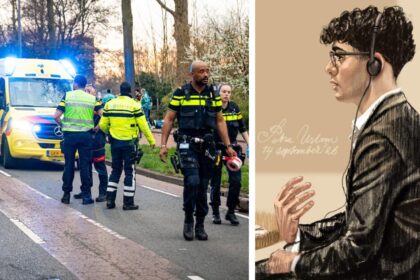
A mother of four discovered her 5-year-old daughter sitting on a 62-year-old naked Chechen man’s lap inside a car parked outside their temporary housing facility in the city of Limay, in the Yvelines department, at 10:20 p.m. on Sunday. The child was reportedly subjected to acts of penetration.
Now, police confirm an investigation into “rape of a minor under 15 by an adult with an age difference of at least five years” is now underway. The Versailles public prosecutor’s office has confirmed the man is in custody.
Remix News previously reported on this case three days ago, but reported the man was a 64-year-old Russian suspect. Although he is indeed a Russian national, his age is 62 and it has been clarified that he hails from the country of Chechnya. The mother has also delivered a statement.
The 62-year-old Chechen pensioner, Kureysh, was found with his penis still erect and sexually assaulting the child when the mother began hitting him. Afterward, she took her young daughter to the shower to wash away the traces of the sexual assault committed by the man, who is a former neighbor of hers and well known for his kindness around children.
“He was well-liked because he often spent time with the families and children. He had never shown any strange or inappropriate behavior, nor did he have a criminal record,” said a source who knew him for several years while speaking to Le Parisien.
“When we heard what happened on Sunday, we were horrified,” said the source.
The evening began with the families returning from a barbecue in Mantes-la-Jolie, near Limay. That day, the children had spent their day playing by a lake. Upon their return, Fatoumata, her children, and her sister Fanta, who are all originally from Ivory Coast, went to their rooms to make dinner. While her mother was in the kitchen, the 5-year-old girl, Léa, went downstairs to join the man, who was offering pieces of watermelon. The mother said she was not suspicious because she already knew the man.
The mother of four said both her and the child now suffer psychological damage from the incident.
“Since it happened, my daughter doesn’t smile anymore; she isn’t happy. She used to laugh all the time; she’s lost her zest for life. I’m not doing well either. My birthday is this Thursday, but I won’t be celebrating it. All this reminds me of the rape I suffered in Libya, when I was trying to reach France,” said the woman.
“It’s very hard to go through all this. And yet, we feel so much safer in France,” she said.
“The police believed us; the officers took us seriously. They hunted down the rapist just as they would have for anyone else,” she added.
A mother has described her anguish after her 5-year-old daughter was raped by a 62-year-old Chechen immigrant in the parking lot of a social housing hotel in Limay, west of Paris. The man was found naked with an erect penis when the mother approached. Reports indicate that the young girl was the victim of penetrative sex.
“I’m doing very badly; I’m suffering from what happened,” said Fatoumata, the 28-year-old mother of the young victim. “My heart aches so much, you have no idea. All I want is to leave here. I don’t want to talk about this anymore. I don’t want to walk past that parking lot; I don’t want to hear about any of this anymore.”
The child has barely left the family’s hotel room since the alleged attack on Monday, relatives said, with the room now serving as a refuge from the outside world.
According to the family’s account, Fatoumata found her daughter sitting on the suspect’s lap inside a parked car. She said she struck the man to make him release the child after discovering him with an erection.
The suspect was known to families living at the hotel and had not previously raised concerns among residents.
“He was well-liked because he often accompanied families and children. He had never behaved strangely or inappropriately, with no prior record,” one witness who had known him for years told Le Parisien. “When we learned what happened on Sunday, we were horrified.”
The family had returned from a barbecue in Mantes-la-Jolie when the girl went downstairs while her mother was preparing dinner.
“While her mother was in the kitchen, Léa went downstairs to join this man who was offering pieces of watermelon. She wasn’t suspicious at all because she knew him,” said Fanta, the child’s aunt.
Fatoumata said the alleged rape has transformed her daughter’s personality.
“Since what happened, my daughter no longer smiles; she’s no longer joyful. Before, she laughed all the time; she’s lost her zest for life,” she said.
She added that the ordeal had revived memories of her own trauma.
“I myself am not doing well. My birthday is this Thursday; I won’t celebrate it. All of this reminds me of the rape I suffered in Libya, when I was trying to reach France.”
Despite the family’s horror, Fanta said they felt the French authorities had treated them seriously.
“It’s very difficult to go through all this. But still, we feel so much safer in France,” she said. “The police believed us; the officers took us seriously. They chased the rapist like they would have for anyone else.”
Remix News reported on the attack on Tuesday, noting the suspect was a Russian national of Chechen origin, and had been arrested after fleeing the scene. His vehicle was intercepted on the A13 motorway in the early hours of Monday.
The child was able to identify the suspect from a photograph, helping authorities to track his vehicle and detain him as he fled back toward Paris.
An investigation into the alleged rape of a minor remains ongoing.
A 29-year-old Afghan man is now under arrest for murdering his mother-in-law, a 60-year-old Afghan woman in the German city of Elsenfeld.
On Sunday evening, a major emergency operation was triggered near the Elsenfeld train station in the Miltenberg district after bystanders discovered an unconscious woman who suffered multiple stab wounds between the station and Bahnhofstrasse around 6:00 p.m.
The witnesses immediately notified emergency services and law enforcement. Medical personnel transported the 60-year-old victim to a nearby hospital, but she succumbed to her injuries shortly after arrival.
On June 15, it was announced that a 27-year-old Afghan man walked into the Obernburg police station and surrendered to police. He was taken into custody without any resistance and spent the night in prison. Police determined he entered the country in 2016 and his mother-in-law arrived in 2015, according to German news outlet InFranken.de.
Following an inquiry, the Aschaffenburg public prosecutor’s office confirmed that the murder weapon, a knife, has been recovered. The suspect is scheduled to appear before a prison judge for a screening on Monday at 2 p.m.
The Aschaffenburg criminal police and the public prosecutor’s office have assumed control of the local investigation, which has so far involved gathering forensic evidence and questioning initial witnesses. So far, a motive behind the murder remains unclear.
In response to the tragedy, Tobias Bozem, the press spokesman for the Lower Franconia police, addressed local anxieties regarding public safety. He noted, “The recent events in Elsenfeld and the district of Miltenberg can of course affect the citizens’ sense of security. We take this very seriously.”
When questioned about an apparent rise in violent incidents across the Miltenberg district, such as a recent machete assault on a young man in Mömlingen and another knife attack near the Elsenfeld station, Bozem emphasized that current evidence shows no link between the crimes. He explained, “In most cases, there were also indications of existing identification or a relationship between the people involved. The background of the individual acts is the subject of the ongoing investigations and will be examined separately in each case.”
French activist Thaïs d’Escufon has vowed to appeal her latest conviction after a court fined her €1,000 over comments linking immigration to violence against women, while dropping the possibility of a prison sentence.
D’Escufon, who says she was sexually assaulted by a Tunisian migrant in 2022, revealed the outcome in a video message to supporters, describing the ruling as a significant reduction from the punishment she had been facing.
“I went from facing four months in prison to receiving a €1,000 fine,” she said.
The activist had been prosecuted over statements in which she argued that “the main threat to women in France comes from black and Arab immigrant men.” According to d’Escufon, prosecutors sought a four-month custodial sentence over those remarks.
D’Escufon posted a screenshot of the verdict on her Patreon, which confirmed she had been convicted of public insult on the basis of origin, ethnicity, nationality, race, or religion.
Speaking after the verdict, d’Escufon claimed the case was politically motivated and linked it to her own experience as a victim of sexual violence.
“I was sued for these words despite the fact that I was myself the victim of a sexual assault committed by a Tunisian migrant in 2022,” she said.
She also referenced an earlier conviction related to anti-migration activism, saying, “I had already been sentenced to a six-month suspended prison and a €3,000 fine for denouncing human trafficking across the Mediterranean Sea.”
Dear friends, the verdict has been handed down.
I have been found guilty, but thanks to you and your support, I have avoided a prison sentence, and I can’t thank you enough for that.
D’Escufon credited an international support campaign for helping her avoid imprisonment.
“What happened feels almost unreal. Your support exceeded anything I could have imagined,” she said. “The media pressure became international.”
The activist claimed coverage of her case spread across Europe, the United States, and Japan, creating scrutiny that influenced the outcome.
“Because of you, this absurd injustice was forced to back down,” she said. “The moment we shine a light on what they are doing, they can no longer hide.”
D’Escufon announced that she will challenge the conviction despite the risk of a harsher sentence on appeal.
“I have decided to appeal this conviction,” she said. “I could end up receiving a harsher sentence, but after everything you have done for me, I simply do not have the right to be cowardly.”
She argued that accepting the judgment would mean acknowledging wrongdoing where she believes she was raising legitimate public concerns.
“It would mean admitting that I was wrong to speak out about what I believe threatens the French people,” she said. “It would mean accepting a criminal record like an ordinary offender when my only crime was speaking out in what I believe was the public interest.”
🇫🇷French activist Thaïs d’Escufon faces prison for insulting migrants, even after she was sexually assaulted by one.
"They want to send me to prison. In France, it’s better to be a migrant who assaults women than an identitarian who loves her country."pic.twitter.com/NcThdsGNAu
D’Escufon also used the video to criticize French institutions and draw comparisons with Britain’s grooming gang scandals, arguing that authorities are more willing to prosecute controversial speech than confront politically sensitive crimes.
“That is the reality many would rather suppress,” she said. “And today I am being convicted for pointing to facts.”
The right-wing activist vowed to continue highlighting concerns over immigration. “Even if I’m too radical for the right-wing politicians in France, my determination and my radicality will not move an inch,” she said. “The world stood with me when I needed it most. Now I intend to make sure the world knows what is happening here.”
German arms giant Rheinmetall wants to build a new artillery shell factory in Poland.
Rheinmetall, through its company Rheinmetall Polska, submitted a letter to the Ministry of National Defence regarding plans to build a new MCS (modular propellant charge) plant for 155mm artillery ammunition.
As reported by Business Insider Poland, a memorandum of understanding on this matter between the German company and the Polish side may be signed in the coming weeks.
At the initial stage, the location being considered for the investment is northern Poland. The German factory, as described by BI, would be part of the Green Industrial District “Kashubia” project.
In 2025, a government initiative coordinated by the Ministry of National Defence aimed at creating a new area of concentration of industry, energy and infrastructure in Pomerania. It covers primarily the Pomeranian, West Pomeranian and Kuyavian-Pomeranian Voivodeships.
The website indicates that access to 155mm artillery shells is a top priority for the Polish army. Last year, the government decided to build domestic production in this area, and companies from the PGZ group received PLN 2.4 billion from the Capital Investment Fund for the construction of artillery ammunition factories.
Without money from SAFE
At the same time, the Polish Armaments Group recently signed an agreement with its French partner Eurenco to create a joint venture to produce MCS. In parallel, the German proposal involves the construction of a plant capable of producing at least 600,000 shells per year. The estimated value of the first stage of the project is PLN 250-500 million.
“The German side declares its readiness for a joint Polish-German launch of the plant, extensive involvement of Polish subcontractors, employment of Polish employees and transfer of the necessary know-how,” Maciej Samsonowicz, advisor to the Minister of Defence and coordinator of the working group for the “Kashubia” project, told Business Insider Poland.
According to the website’s sources, talks are also underway with the Industrial Development Agency and the Ministry of State Assets. Poland is expected to involve the domestic financial sector on a commercial basis, but without financing Rheinmetall’s investment from the SAFE program.
A 25-year-old autistic Swedish woman, who is reportedly severely disabled and requires a wheelchair, was allegedly raped by a 45-year-old Iraqi man who was transporting her via ambulance in the Swedish city of Kristianstad.
The incident happened on June 6, 2026, Sweden’s National Day, but is only being reported on now.
The woman was utilizing a “Färdtjänst,” a specialized transport service for disabled people, which she routinely uses since regular public transport is often difficult for individuals with severe disabilities.
The Iraqi was reportedly driving the woman home when at some point, he allegedly raped her, according to news outlet Kristianstadbladet.
Few details have been released about the incident but police have detained the man.
Swedish news outlet Samnytt was the only one to report that the man is Iraqi. The outlet indicates that the man cannot be deported due to his residency status.
The transport service often features drivers on contract, and there have been past cases of misconduct by Färdtjänst drivers in the region, though this is the latest reported incident.
The investigation is ongoing. His vehicle has been seized and he remains in detention.
A mother has gone to the German media with the story of her 12-year-old son, Eren, who was beaten, stripped, sexually abused, and whipped with a belt by migrant youths during a variety of different incidents that occurred over the course of weeks in the Swabia region of Germany.
The woman, 38-year-old Ilknur S. said the majority of the abuse occurred during a school trip at a ski camp in Kleinwalsertal, Austria, which involved two 13-year-old classmates. The trip was organized by the Bismarck School in Memmingen.
“The fear of this boy made him sick,” said the mother to Bild newspaper.
The perpetrators even published videos of their abuse and uploaded them to social media channels, including TikTok.
“There were five teachers present. Why didn’t anyone notice that my son was being tormented for a week?” the mother asked. “Here, the duty of supervision was massively violated.”
Eren was allegedly repeatedly beaten with a belt until he was black and blue inside his accommodation during the trip. The main perpetrator, an Afghan, has already been expelled from the school while the Syrian played the role of an accomplice, according to the police.
🇩🇪🔴"How it feels to become a minority in one’s own country."
In Hamburg, the "migrant share in some schools is so high that German children are increasingly being bullied because they do not participate in Ramadan or because girls wear short skirts."
During the torture sessions, he was also partially undressed and sexually coerced. More details about what this exactly entailed have not been disclosed. However, videos of the abuse were uploaded to TikTok.
Initially, when Eren came home, he told his mother that bruises were from falling while skiing, but eventually, the truth came out when the school principal informed the mother what happened on April 24.
🇩🇪🔴This German youth says that 5 Syrians raped him in 10th grade in a school toilet.
Afterwards, the judge just let them go.
When asked by @eingollan_real if they were punished in court, he said that DNA samples were taken which confirmed the attack, but that "nothing"… pic.twitter.com/XbqR00INX7
The principal informed her that the torture had been ongoing for weeks but the peak of the abuse occurred during the ski trip. The Afghan also confessed to the acts.
Due to the age of the suspects, they are below the age of criminal responsibility in Germany, which means they will face no legal repercussions. Nevertheless, police spokesperson Alexander Heubuch confirmed that an investigation is underway regarding coercion, assault, and the violation of privacy through the recording of intimate images.
However, the mother continues to be furious with the school administration.
“I expect the school administration to ensure that my child never has to encounter the two perpetrators again. My son suffered from sleep disturbances, stomach pain, and nausea for weeks. The fear of these boys made him ill,” she stated.
The school, however, is declining to comment, citing data protection standards for those involved. The name of the mother and child were changed by Bild to protect their identities.
The case all received some attention from Elon Musk, who replied to a post from Austrian political activist and the head of the Remigration Institute, Martin Sellner, who stated: “Germans are forced to pay everything for these people, and then their own children are raped and tortured by them in schools. Send them all back. They have no reason to be in Europe.”
Overall, school violence is soaring in Germany, in large part due to mass immigration. In addition, German students are increasingly becoming the victims of bullying in schools across the country as they head towards minority status.
Data shows that in Germany, 150 teachers and students are physically attacked, threatened, and insulted every single day. That amounts to a 37 percent increase since 2022. Data has also shown that 40 percent of all crime suspects in German schools are foreigners and that there are also two knife-related crimes in German schools every day.
An Italian prosecutor is considering an appeal after a court sentenced a 29-year-old Bangladeshi man to five years in prison for sexual acts with a minor rather than sexual assault, despite the fact that a 10-year-old girl became pregnant following sexual encounters at a refugee reception center.
The case stems from events that took place in September 2024 at a refugee reception facility in Collio, housed within the “Il Cacciatore” hotel. The girl, who was 10 years old at the time, became pregnant after two sexual encounters with the defendant.
In a ruling, Judge Valeria Rey concluded that while there was sufficient evidence to establish that sexual intercourse had taken place, the prosecution had failed to prove beyond doubt that the encounters involved physical violence, threats, or coercion. As a result, the court reclassified the offense from sexual assault to sexual acts with a minor.
As reported by Giornale di Brescia, the child told investigators that she had been taken by force, sexually abused, and threatened with death if she disclosed what had happened. She described two separate incidents occurring in different rooms within the reception center. Her mother testified that she noticed her daughter appeared distressed during the period in question and later learned that her unhappiness was linked to the defendant’s actions.
However, the judge wrote that the girl’s allegations of violence and threats were not supported by objective evidence. According to the ruling, material recovered from the defendant’s mobile phone did not corroborate either version of events, while surveillance footage from the center failed to capture any scenes of aggression or intimidation.
“The present proceedings feature two competing versions,” the judge wrote. “If one accepts the minor’s version, it will be a case of sexual assault; if one accepts the defendant’s version, the act must be classified as sexual acts with a minor.”
The ruling also addressed a defense argument concerning the girl’s mother. According to the judgment, the mother was presented as being open to the possibility of a future marriage between her daughter and the defendant, despite allegedly being unaware of any sexual relationship between them. The judge noted that child marriage had historically been common in the family’s country of origin and cited UNICEF data stating that around 30 percent of marriages involved minors, with 10 percent involving children under 15.
Judge Rey wrote that this cultural background made the defendant’s account “not implausible,” while stressing that it did not absolve him of criminal responsibility.
Explaining the sentence, the court said the seriousness of the offense justified a starting point of nine years in prison, citing the victim’s age and the fact that the abuse resulted in pregnancy with “evident and profound psychological consequences.”
Bresciaoggi noted that mitigating factors reduced the sentence to six years, before adjustments for multiple offenses increased it to seven years and six months. The summary trial procedure then reduced the final sentence to five years.
The Prosecutor’s Office is now reportedly preparing an appeal, seeking a review of the court’s decision to exclude the more serious charge of sexual assault.
Heavy Ukrainian drone strikes on Thursday morning slammed parts of Moscow, leaving flames and smoke rising over the southeastern Kapotnya district of the Russian capital.
Moscow Mayor Sergei Sobyanin confirmed that Ukrainian drones successfully targeted a major oil refinery in the area once again. Videos showed major strikes on the refinery, with smoke rising over Russia’s largest city.
According to Astra, an independent Russian internet portal, the refinery suffered at least five separate fires. The facility, which is operated by Gazpromneft, stands as one of the largest refineries in the nation and provides a substantial portion of the fuel supply for Moscow, underlining the serious nature of the strike.
🇷🇺🔥Moscow this morning.
Major wave of Ukrainian drone strikes leaves the Moscow Oil Refinery in flames. pic.twitter.com/1iZDzdAb3K
Mayor Sobyanin described the drone strikes as a large-scale attack, claiming that air defense systems managed to intercept roughly 180 drones as they moved toward the capital. However, this claim has not been independently verified.
Ukrainian President Volodymyr Zelensky wrote on X: “Last night our long-range drones reached the Moscow region again – for the second time this week the Moscow oil refinery was hit. Targets in the Rostov region and in temporarily occupied territories of Ukraine were also attacked.“
He added that the operation serves as a “fully justified response to Russian attacks on our cities and towns.”
Last night, our long-range sanctions once again reached the Moscow region – for the second time this week, the Moscow oil refinery was hit. Targets were also struck in the Rostov region and in temporarily occupied territories of Ukraine. This is a fully justified response to… pic.twitter.com/NhFl4FlT9L
— Volodymyr Zelenskyy / Володимир Зеленський (@ZelenskyyUa) June 18, 2026
Reports also indicate that the falling debris and strikes hit a residential building, a large garden center, and caused minor damage to a shopping center in an outlying district. So far, no injuries have been reported in Moscow or surrounding areas.
The attack also disrupted traffic in the area, according to Russian state media. Flights were also suspended and evacuations took place at Sheremetyevo Airport, the largest airport serving Moscow.
Just days ago, on Tuesday, a Ukrainian strike halted operations at the refinery. The fact that Ukraine struck the complex just days later underlines the ease with which Ukraine strikes major energy targets across Russia, with Russia seemingly powerless to stop these attacks.
These latest strikes further strain the energy supply of Russia, despite the country being a global oil producer. The situation has deteriorated to the point that Moscow has been forced to import extra fuel by sea due to continuous Ukrainian targeting of its refineries.
The Russian Defense Ministry reported that a total of 555 Ukrainian drones were intercepted and destroyed across multiple regions overnight, though this figure remains unverified.
At the same time, Ukraine reported facing fresh Russian strikes. Authorities in Kyiv directed residents to seek shelter due to ballistic missiles, and a drone strike in the northeastern city of Sumy resulted in one death.
Drone strikes were also recorded in Russian-border regions and Russian-occupied territories. Enerhodar, a city housing many workers from the occupied Zaporizhzhia nuclear power plant, reported one death. In the Belgorod region of Russia, local authorities indicated that one man was killed inside his vehicle during a Ukrainian drone attack.
Badalona’s mayor has branded a Moroccan suspect “human scum” after he allegedly snatched an 81-year-old woman’s purse, saying that if it were up to him, he would “swim him back to Morocco” but that Spain’s far-left government will let him off.
Xavier García Albiol said the incident happened in the Llefià neighborhood on Thursday morning, when the suspect allegedly grabbed the elderly woman’s purse before being chased down by one of the mayor’s municipal police bodyguards.
“This morning, this human scum who came from Morocco snatched a purse from an 81-year-old woman in the Llefià neighborhood,” Albiol wrote on X.
“Luckily, one of my bodyguards from the Badalona Municipal Police was there, and after a chase on foot of several minutes, he finally managed to catch up with him and arrest him,” he added.
Albiol said the suspect had picked on a vulnerable pensioner but had failed to get away.
“You have to be a real scoundrel to rob an elderly woman. It didn’t work out for him today,” the mayor said.
As reported by OKdiario, Albiol then linked the case directly to Spain’s national government, accusing it of allowing foreign criminals to avoid punishment.
“If it were up to me, I’d swim him back to Morocco. Unfortunately, thanks to the current government, he’ll be back on the streets tomorrow,” Albiol said.
The suspect was reportedly stopped after witnesses raised the alarm, with one member of the public helping the officer during the pursuit and arrest.
Albiol praised both men, saying, “Congratulations to the Guardia Urbana officer for his excellent performance and also to the citizen who assisted him in the pursuit and arrest.”
He also said Badalona would continue taking a firm line against crime, adding, “We in Badalona will continue working every day for the benefit of our residents and to ensure that anyone who comes here to commit crimes knows they will find a firm response.”
The row comes as immigration remains one of Spain’s most heated political issues following Prime Minister Pedro Sánchez’s move to regularize large numbers of undocumented migrants.
Spain has reportedly received around 900,000 applications under the scheme, far above earlier expectations, with the total expected to exceed one million.
A Senegalese football supporter forcibly kissed popular French streamer Minaravel in the middle of her stream right before the Senegal versus France World Cup match.
The victim was waiting for the France vs. Senegal kickoff when she decided to stream live from the Châtelet–Les Halles in Paris with her partner. He briefly left and she was joined by another female friend of hers, who is also a streamer.
The Senegalese supporter suddenly appears and begins to forcibly kiss Minaravel, who maintains a smile up until the moment the man left. On X and Reddit, numerous users note that many women react in this manner out of fear and in the hope that the man involved does not become more aggressive. In effect, women smile or even laugh during such encounters to avoid a more aggressive response.
She does, however, tell him: “Really, you’re way too comfortable! What’s wrong with you?”
She then tells her audience: “There’s no shame even when we’re livestreaming. The guy, we see his face!”
On X, the Remix News post went viral but has since been censored by X and cannot be embedded.
French identitarian activist Thaïs d’Escufon also commented on the incident, writing: “Live sexual assault in Chatelet (Paris): A man kisses a streamer without her consent during a live broadcast. Can you guess where he is from? Warning: French government might send you to jail if you say it.”
Live sexuel assault in Chatelet (Paris) : A man kisses a streamer without her consent during a live broadcast.
D’Escufon is currently on trial and facing a potential prison sentence for “incitement to racial hatred” for a comment she made on BFMTV in 2023, where she stated: “The main danger for women is immigrant men, Africans, blacks, and Arabs.” She was discussing the case of a woman raped by a migrant who already had a deportation order.
D’Escufon was nearly raped by a migrant herself in 2021, as Remix News covered at the time.
She could be sentenced today, June 18, and faces a one-year prison sentence and a €45,000 fine.
The latest incident involving Minaravel has not yet been covered by any major French news outlet, but various streamers in France have faced similar situations, and in some cases, far worse encounters.
Last year, famed Korean streamer “Jinnytty” was brutally attacked by a man reportedly of North African origin on the streets of Toulouse.
🇫🇷 "What do you want, you dirty whore?!"
Famed Korean streamer "Jinnytty" was brutally attacked by a man reportedly of North African origin on the streets of Toulouse.
The Korean streamer has 1.1 million Twitch followers, and is one of the biggest streamers in South Korea.… pic.twitter.com/QwJLThgjYS
A teenage suspect has confessed to the murder of an 86-year-old woman who was found dead with her throat slit amid other fatal blows near a campsite in the southern French resort of Grau-du-Roi, according to local media reports.
The victim, identified as Jacqueline, was discovered on June 11 near a pond close to a campsite where she had spent holidays for many years. Emergency services found the elderly woman with her throat cut and extensive injuries, prompting the opening of a murder investigation by authorities in the Gard department.
Five days later, investigators arrested a suspect, reported by Actu Nîmes to be a minor aged around 15. He was taken into custody in Nîmes on June 16, where he allegedly confessed to carrying out the killing.
Due to the suspect’s age, no further description was provided by the authorities.
According to La Dépêche, the suspect told investigators he attacked the victim using a drill. His account is said to be consistent with findings from an autopsy conducted at Nîmes University Hospital, where forensic specialists documented significant injuries that investigators described as evidence of an exceptionally violent assault.
Authorities believe surveillance camera footage may have played a key role in identifying the suspect. Investigators reportedly traced a young male riding a motorcycle near the crime scene around the time of the killing.
While reports indicate the suspect has admitted responsibility for the attack, prosecutors have not publicly disclosed any motive. The exact nature of any relationship between the suspect and the victim also remains unclear.
The European Parliament has approved a major overhaul of the European Union’s return policy for illegal migrants, backing legislation designed to accelerate deportations, increase detention periods, and improve cooperation between member states.
The measure passed on Wednesday by 418 votes to 218, with 30 abstentions, following support from lawmakers in the European People’s Party, the European Conservatives and Reformists, Patriots for Europe, and Europe of Sovereign Nations groups. Left-wing and Green lawmakers opposed the legislation, arguing it risked undermining migrant protections and fundamental rights.
Under the new framework, deportation orders issued by one EU member state will be recognized across the bloc through the creation of a European Return Order. Supporters say the change will prevent migrants who have been denied the right to remain from moving to another member state to avoid removal.
The legislation also introduces a legal obligation for migrants facing deportation to cooperate with authorities. Those deemed likely to abscond, refuse cooperation, or present security concerns may be detained while removal procedures are carried out. Administrative detention periods will be extended to a maximum of 24 months, with the possibility of a further six-month extension in certain circumstances.
National authorities will be granted wider powers to prepare deportations, including the ability to carry out searches of residences, personal belongings, and electronic devices subject to judicial or administrative authorization.
The new rules also allow member states to establish agreements with non-EU countries to host so-called “return hubs,” where migrants subject to removal orders could be transferred before being returned to their countries of origin. Countries like Italy had already agreed such an arrangement with Albania; the move now becomes officially sanctioned by the European Union, subject to compliance with international law.
Hungarian MEP András László welcomed the vote but said the real test would be whether governments follow through. “Adopting new rules isn’t enough. European citizens have had enough. The EU and national governments must now deliver on removing illegal immigrants from the EU!” he wrote.
Polish MEP Anna Bryłka said the reforms were necessary because the existing system had failed to enforce deportation decisions. “These changes are crucial because currently, only about 20 percent of illegal migrants who have been denied the right to stay in the EU actually leave its territory,” she said.
Jordan Bardella, the president of France’s National Rally and an MEP, said the vote marked a break with years of failed migration policy. “The return regulation has been adopted,” he wrote. “After years of denial, the European Union is finally equipping itself with instruments commensurate with the stakes to move beyond migratory laxity.”
Bardella credited the result to sustained pressure from his party’s MEPs. “This is a first step in the right direction, achieved thanks to the constant mobilization of the National Rally deputies,” he said. “We will continue the fight by organizing a referendum in 2027 to fully regain control of our migration policy.”
The Sweden Democrats also hailed the result in stark terms, writing: “The age of Willkommenskultur is over, the era of mass deportations has begun.”
🇪🇺 MEPs chant "Send them back" in celebration after the European Parliament approved the strictest migration law in EU history.
The legislation aims to speed up the deportation of migrants with no legal right to remain in Europe.
Dutch MEP Malik Azmani, who served as rapporteur for the legislation, said the EU had finally adopted effective return measures after nearly two decades of political deadlock.
The legislation must now receive formal approval from the Council of the European Union before entering into force. While some provisions, including those relating to return hubs, will take effect immediately, most of the new rules will become applicable 12 months after the law is formally introduced.
Another terrifying homejacking has hit France, but this time, a 12-year-old girl thwarted the armed men by calling the police in time to save her two parents.
The investigation has determined that the armed gang was targeting the father, who is a senior executive in a large financial company. He reportedly held a cryptocurrency wallet with at least €20,000 via the Waltio platform, which had been hacked a few months earlier. The father’s information had been released onto the dark web at the time.
The terrifying episode occurred on March 8 in the French city of Nancy but the French news outlet Valeurs Actuelles is only reporting on the details now.
Several individuals posed as police officers to gain access to the home. Among them, one was armed with a UZI type submachine gun. Around 8:30 a.m., the 41-year-old mother was returning from walking the dog when she was approached by three men who forcibly dragged her towards her apartment and began hitting her. Her husband then ran down the stairs to aid his wife but was also attacked.
The attackers may have thought they had the situation under control, but the 12-year-old daughter responded by dialing police. Police sources said that one of the gang members saw the daughter on the phone at the top of the stairs, at which point he decided to flee the house, followed by the other armed men.
In the rush to leave the scene, the suspects left a number of items behind, which investigators quickly recovered, including clamps which were meant to restrain their victims.
Now, police believe the head of the gang, Rayane B., has fled to Morocco.
One suspect, 32-year-old Fayssal K., was identified due to DNA and arrested on June 9. He lives in Seine-Saint-Denis. He tried to flee when the police arrived before being caught.
He confessed to the court that he drove the getaway vehicle in exchange for €1,000 and was indicted for attempted extortion with weapons by an organized gang, attempted kidnapping by an organized gang and criminal association. He remains in pre-trial detention.
Similar housejackings have ended on a much more horrifying note, including kidnappers cutting off the fingers of their victims to force a ransom. Wealthy individuals, celebrities, journalists, and business executives have been targeted in numerous cases over the years. As of late, suspected leaks and hacks have led to a wave of armed gangs targeting cryptocurrency holders, including executives at cryptocurrency firms.
🇫🇷 5 suspects arrested for brutal kidnapping of the father of a French cryptocurrency entrepreneur
They sliced off the father's finger, cut him allover his body, and tortured him repeatedly.
“Son of a b**ch, do you think we’re joking? We’re going to cut your fingers off… We… pic.twitter.com/6O4I2E512g
An Italian counterterrorism unit has arrested a 16-year-old from the province of Bologna after uncovering what authorities describe as a rare blend of white supremacist extremism and Islamist terrorist ideology, a phenomenon security officials have dubbed “white jihad.”
The teenager was taken into custody following a police operation coordinated by prosecutors at the Juvenile Court of Bologna. Investigators allege he possessed a large collection of terrorist material, including manuals on constructing homemade firearms and explosives, and instructions for carrying out vehicle attacks.
The investigation began in autumn 2025 when officers monitoring extremist activity on the internet identified an account distributing material linked to terrorist tactics. According to police, further inquiries traced the account to a minor living in the Bologna area.
During a search of the teenager’s home, officers reportedly discovered handwritten documents featuring white supremacist symbols and imagery, alongside instructions for making a homemade bulletproof vest. He allegedly possessed a wider cache of extremist material on his mobile phone.
In a statement, police said the device contained both white supremacist propaganda and Islamist extremist texts, as well as manuals covering the manufacture of homemade weapons, the construction of a pistol, the use of aggressive chemical substances, and the assembly of explosive devices.
Investigators also found a copy of the full video from the 2019 Christchurch terrorist attack. Authorities allege the teenager exchanged messages praising Brenton Tarrant, the gunman responsible for the massacre, and presenting him as a figure to emulate.
The most serious allegations concern conversations in which the suspect allegedly discussed rebuilding clandestine extremist organizations in Italy. According to investigators, the exchanges included references to homemade weapons and potential violent actions against specific groups, including magistrates and prominent journalists.
“The evidence emerging from the investigations suggests a fusion of white supremacist extremist content with jihadist propaganda, a phenomenon counterterrorism specialists call ‘white jihad,’ characterized by the convergence of seemingly distant ideologies united by the exaltation of violence as a tool for ideological affirmation,” police said.
The teenager was arrested and transferred to a juvenile reception center in Ancona. A judge subsequently validated the arrest and imposed restrictions prohibiting him from accessing the internet, using electronic devices, or obtaining material connected to terrorist or subversive ideologies for a period of two months.
Video of Poles being beaten in Berlin has gone viral, but a number of left-leaning Polish politicians appear to be happy with the outcome, including the Polish foreign minister.
The incident began when German police intervened against Poles who wanted to pay tribute to Polish victims of German crimes during the Second World War.
Several people were injured and had to be taken to hospital. Members of the Border Defense Movement, led by Robert Bąkiewicz, came to the German capital to erect a wooden cross and lay flowers at the site where the memorial boulder was placed.
🇵🇱🇩🇪German police were filmed beating Poles who carried a large cross to the Place of Remembrance for Poland 1939-1945, a monument to the Polish victims of WWII in Berlin.
The videos, which quickly appeared online, show how the intervention of German police officers took place. The video clearly showed that they tried to snatch a large cross from the Poles and several people were knocked to the ground and arrested. The footage also shows officers punching Border Patrol Movement (ROG) members, including the organization’s leader, Robert Bąkiewicz.
Robert Bąkiewicz’s daughter, Blanka, wrote on social media: “It’s bad. They were taken away by ambulance. Jacek, Paweł and Dad in serious condition. Dad is vomiting. He has broken ribs.”
However, Foreign Minister Radosław Sikorski wrote Wednesday morning that he wishes them a “successful holiday.”
“Due to the beginning of the holiday season, I encourage you to follow the Pole Abroad website. Local law must be followed and orders from law enforcement must be followed. Consuls of the Republic of Poland provide assistance, but they cannot always protect against the effects of imprudent behavior. I wish you a successful holiday and a safe return to the country!” wrote Sikorski.
W związku z rozpoczynającym się sezonem urlopowym zachęcam do śledzenia strony @PolakZaGranica Należy przestrzegać lokalnego prawa oraz wypełniać polecenia służb porządkowych. Konsulowie RP udzielają pomocy ale nie zawsze mogą ochronić przed skutkami zachowań nieroztropnych.…
— Radosław Sikorski 🇵🇱🇪🇺 (@sikorskiradek) June 17, 2026
The daughter of Bąkiewicz commented on his post. “Mr. Sikorski! In the light of article 36 of the Constitution of the Republic of Poland a Polish citizen residing abroad has the right to be cared for by the Republic of Poland. In addition, art. 20 para. 1 of the Consular Law explicitly states that the consul provides assistance to a Polish citizen in the event of a serious accident, serious illness, arrest, as well as in the event of an act of violence of which a Polish citizen has fallen victim,” she wrote.
Panie Sikorski! W świetle art. 36 Konstytucji RP obywatel polski przebywający za granicą ma prawo do opieki ze strony Rzeczypospolitej Polskiej. Ponadto art. 20 ust. 1 ustawy – Prawo konsularne wprost stanowi, że konsul udziela pomocy obywatelowi polskiemu w razie poważnego… https://t.co/0oiAYc5Gsf
“In this case, we are dealing with precisely this situation: Polish citizens were assaulted by German police, taken to hospital, required medical assistance – and the Polish state has an obligation to react! It is not a matter of your sympathy or your grace! This is your sacred duty! Please stop lecturing Poles and start defending Polish citizens or resign for incompetence,” she wrote.
Other ruling coalition politicians reacted with glee at the beating video. Krzysztof Śmiszek applauded the German police for their actions, and others reacted with amusement.
“Finally, someone at the level took care of Bąkiewicz and his deluded followers. Bravo!” – wrote MEP Krzysztof Śmiszek.
W końcu się ktoś zajął na poziomie Bąkiewiczem i jego odklejeńcami. Brawo! https://t.co/XCPAAxNQeo
When Robert Bąkiewicz reported that the police beat him and locked him “in a cage without oxygen”, Bartosz Arłukowicz, a PO politician and a doctor by profession, did not hide his amusement either.
“Mr. Bąkiewicz! Breathe through your nose! Nose! The cages have holes! Breathe sir! Damn, breathe through your nose!” mocked the MEP.
Panie Bąkiewicz! Oddychaj pan nosem! Nosem! Klatki mają dziurki! Oddychaj pan! Nosem kurde oddychaj! https://t.co/3oCFIBWoF1
After Restore Britain leader Rupert Lowe released the Rape Gang Inquiry Report, which documented the systemic rape and often torture of up to 250,000 young British girls at the hands of predominately Muslim rape gangs, SpaceX and Tesla founder Elon Musk agreed with calls for Nuremberg-style trials for the perpetrators and those who enabled the heinous attacks.
One post calling for Nuremberg Trials in connection to the rape gang inquiry and executions for those who were responsible, also received a one-word response from Musk, who stated: “Yes.”
An excerpt from the report reads: “The incidents of criminal activities listed in this report are drawn from court records, official and unofficial inquiries across the country, and witness testimony provided to the Inquiry. They confirm that this was never a series of isolated local failures. It was a coordinated, nationwide pattern of organised child sexual exploitation that repeated in town after town, city after city, from the far north to the south coast. The same ethnic and religious profile of the perpetrators was documented throughout almost all of the witnesses who contacted the Inquiry.”
The politicians who turned a blind eye to the Rape of Britain must go to prison pic.twitter.com/JFfHZSwiDc
The report further states that “the scale of the rape gang phenomenon is endemic across the entirety of Britain.”
The report cites the figure of 250,000 raped across Britain, which comes from a statement in the House of Lords by Lord Pearson of Rannoch on May 14, 2019: “Do the Government accept that if we extrapolate nationally the Jay report on Rotherham and other reports from Telford and Oxford, there appear to have been upwards of 250,000 young white girls raped in this century, very largely by Muslim men, usually several times a day for years?”
He added that this number “is probably an underestimate.”⁷
The report found that this number can now be supported through the data collected in the report, which scaled the data from the most thoroughly and well-documented inquiries.
The report cites:
“Rotherham (Jay Report, 2014): At least 1,400 girls abused between 1997 and 2013, with some updated estimates exceeding this. Perpetrators were overwhelmingly Pakistani Muslim men.”
“Telford Inquiry (2022): More than 1,000 children (predominantly girls) over decades, again with the same perpetrator profile.”
List of heinous crimes
The report makes for difficult reading. It found that the victims were typically between eight to 12 years old.
Children were forced to have sex with dogs and beaten with bats, which were then inserted into them anally and vaginally.
In one case, a little girl’s tongue was nailed to the wall so she could not move while she was being raped by multiple men.
It was also found that police were warning rapists that they were being reported in order to threaten the victims into stopping their reports. In other instances, police participated in the gang rapes themselves.
One girl was raped by between 30 to 80 men, most of whom were never charged by British authorities.
In another case, a little girl was told: “If you don’t come back, I’m going to rape your little sister instead.”
When one mother tried to call for help, a British police officer told her: “You should be happy your daughter is experiencing a different culture.” He then hung up on her.
Another girl was blinded by acid while trying to escape one of the rape gangs.
Widespread torture and rape across the country
The report also noted the widespread nature of the mass gang rapes, both geographically and temporally:
“Grooming gangs operate in 149 Local Authority Districts with victims numbering in the hundreds of thousands,” according to the report. “The grooming gang model has been confirmed in dozens of towns and cities. Our independent Inquiry, led by Rupert Lowe MP, has heard evidence demonstrating coordinated operations extending to all corners of the country, in at least 149 local authority districts.”
The report notes that, “When the Rotherham/’Telford scale is applied across the documented national distribution, and multiplied by the extreme under-reporting factor accepted by official reviews, the total reaches the 250,000 threshold as a bare minimum.”
However, much of the abuse remains in the shadows and more investigation is required, not only to document this historical injustice, but to potentially hold those accountable for what occurred.
“We are far from grasping the full extent of grooming gang criminality in modern Britain. It is reasonable to assume that, since sexual abuse of all kinds tends to be under-reported, this is also true of grooming gangs. The Independent has reported that almost 19,000 children were identified as sexual exploitation victims in England in one year alone, despite the reluctance of state actors to name or tackle the problem of the rape gangs. After decades of abuse, victims must number in the hundreds of thousands. The full scale is not yet known.”
The report acknowledges that it may be impossible to ever ascertain how many victims there truly were, as much of the information was not documented or remains suppressed.
Every major review has emphasised that recorded statistics severely understate reality:
• Baroness Casey National Audit on Group-Based Child Sexual Exploitation and Abuse (June 2025): The audit explicitly states that the scale, nature, and characteristics of group-based child sexual exploitation remain impossible to quantify precisely due to inconsistent data collection and historical suppression.
• Independent Inquiry into Child Sexual Abuse (IICSA) and multiple local inquiries (2022-2025): “It is simply not possible to know the scale” because ethnicity, group offending, and historical cases were routinely unrecorded or shelved to protect “community cohesion.”
Government actors presided over a cover-up
The report further notes that key players in the government were instrumental in keeping the mass rape from being investigated and revealed to the public.
The report notes:
“Roger Stone (Labour council leader, Rotherham 2003-2014): Presided over local government during the cover-up documented in the Jay Report. • Multiple Rotherham Labour councillors interfered in police investigations, tipped off perpetrators, or dismissed victims as “making lifestyle choices” to protect “community relations” and votes. • While Sir Keir Starmer was the Director of Public Prosecutions, it has been reported that 13,000 suspected rape gang members and paedophiles were let off with warning letters.
As stated earlier, the Mayor of London Sadiq Khan repeatedly insisted there were no grooming gangs operating in the city. He described evidence from whistleblowers as politically motivated. He told the London Assembly that child sexual exploitation in the capital is a “far more complex” matter and does not fit the grooming-style patterns on display across deprived northern towns. These statements he made despite the fact that the Metropolitan Police had in its possession reports of young girls being plied with alcohol and drugs then raped by groups of men in hotels and other locations across London. A Daily Express investigation revealed that Khan had direct access to HM Inspectorate of Constabulary documents detailing the very patterns of offending he had denied. Khan read these files yet continued to deny the existence of grooming gangs in public.
Overall, the Labour Party did not just fail to prosecute the gangs. In some cases, its own members were the abusers and in most cases its councillors, leaders, and ministers put loyalty to Pakistani Muslim blocs before child safety. No other political party has such a well-documented track record of direct involvement with and institutional protection of industrial-scale child rape. This was in large part due to Labour’s own electoral self-interest.”
Police dismiss victims as racists
In regards to the police, a huge portion of the UK police force was active in the cover-up.
Only the police took any formal action, issuing ‘harbouring notices’ to the men – official warnings stating they had no permission to associate with, contact, or house a vulnerable child. However, no further action followed. When Fiona’s mother called the police to report her daughter missing and mentioned a history of abuse by Asian men, the call handler told her: “You can’t describe them as Asian men because that’s racist. You should just be glad your child is being taught a different culture.” On one occasion, a police officer returned Fiona to the house where the abuse was occurring and told the men to “have fun with her.” On another occasion, police instructed the abusers that if they could persuade Fiona to sign herself out of care, the police would stop bothering them.
A migrant-fueled rape crisis
The report notes that these grooming gangs primarily consisted of Africans, Indians, Gypsies, Asians, and Muslims:
Researcher Peter McLoughlin in Easy Meat (2016) compiled a comprehensive list of grooming gang convictions from 1997 to 2018 (with updates in subsequent analyses), drawing from published court outcomes. His examination of names indicated that approximately 87% of those convicted bore distinctively Muslim names, which was a figure echoed in related analyses far exceeding the Muslim proportion (around 6%) of the general population of Britain.
The majority of these convicted groups consisted entirely of men from Muslim backgrounds. These groups are predominantly of Pakistani heritage, especially when the group exceeds ten or more members. The larger group size dynamic of Pakistani perpetrators is on display in major prosecutions and official reviews from locations such as Rochdale, Rotherham, Huddersfield, Oxford, Telford, and others.
Other convictions have involved groups primarily composed of Muslims from non-Pakistani origins, demonstrating that the issue is not necessarily confined to one ethnic group:
• Two Somali-origin gangs in Bristol • A mainly African-heritage gang in Banbury • Three Iranians in Chelmsford • Three Syrians and one Kuwaiti in Newcastle • Two Turkish men in Somerset • A Romanian rape gang in Rotherham
The large Newcastle “‘Operation Sanctuary” case, involving 17 men and one woman from diverse Muslim backgrounds: Albanian, Kurdish, Bangladeshi, Indian, Turkish, Iranian, Iraqi, Pakistani, and Eastern European heritage. Nearly all published names were Islamic.
An additional expert commentary included statement from Dr. Taj Hargey, an imam at the Oxford Islamic Congregation. He noted that virtually every individual in these grooming gangs appeared to be Muslim, estimating that 95 percent of those involved are of Muslim faith.
Beyond Europe?
The grooming gangs are also operating in other countries, including France on a massive scale, but also such cases are arising in Germany. Remarkably, Musk’s calls for a Nuremberg-style trial just so happen to coincide with reports that in the city of Nuremberg itself, there are grooming gangs operating targeting underage German girls.
For his part, Lowe says the issue is and continues to be mass immigration.
“Essentially what has happened is that the decaying political establishment has imported millions of migrants from alien cultures that are entirely incompatible with the British way of life,” stated Lowe on X.”
Essentially what has happened is that the decaying political establishment has imported millions of migrants from alien cultures that are entirely incompatible with the British way of life.
Those migrants have colonised large parts of our country, and live their lives how they…
“Those migrants have colonised large parts of our country, and live their lives how they choose to do so because our authorities are too frightened of being called racist to challenge them. That has meant attitudes have flourished and spread which, in short, treat women and non-Muslims like shit. And yes, I do mean that.”
He said that the entire political class was to blame, including “Conservative, Labour and Reform politicians [who] are all directly responsible for this vast importation. Personally, I will never forgive anyone responsible. Vulnerable working class white girls were treated like a piece of meat. Raped, abused, tortured, murdered. It was a racial attack, and it was a coordinated attack. All across Britain. They targeted these girls because they were vulnerable, they were young, they were white. Until the political class accepts that fact, nothing will EVER change.”
A dispute over a banner that read “Italy for Italians” unfurled by two students at a school in Cesena has escalated into a national political controversy after the students involved were reprimanded and ordered to complete a reflective essay ahead of their final exams.
The banner was hung from a window of Liceo Classico Vincenzo Monti on June 6 by a group of graduating students. Following a police investigation, those responsible were identified and subjected to disciplinary measures by the school’s governing body, Il Giornale reported.
One of the students involved, an 18-year-old graduating senior, defended the action as a patriotic gesture rather than a political protest. He said the banner was intended to express pride in Italy and concern for national identity, arguing that the reaction from some critics had unfairly portrayed the students as extremists. He also pointed to what he described as widespread public support following the incident.
“I’ve received thousands of messages of solidarity and support that people are sending wherever this episode is discussed,” he told Corriere della Sera. “I believe this reaction to be even more significant than the equally supportive one expressed by various political figures. If some have tried to make this seem like an isolated case, the truth is quite different. Those who are afraid are those who would like to silence this widespread sentiment,” he added.
The student rejected accusations that the slogan was motivated by hatred or racism, claiming instead that it reflected concerns about immigration, crime, demographic change, and national culture. He argued that many Italians share similar concerns but are reluctant to express them publicly.
“European prisons are overflowing with foreigners; they make up 26 percent of the prison population, despite only making up 10 percent of residents. In Italian juvenile prisons, this percentage reaches 50 percent,” he said.
“In less than 10 years, we’ve spent nearly €20 billion on sea rescue and the reception of illegal immigrants, while the average annual net contribution from legal immigrants is estimated to be just over €1 billion. Not to mention the social damage caused by mass immigration, such as widespread violence and rampant insecurity. Added to all this is Italy’s demographic winter, countered by the proliferation of newborns to foreign families. This isn’t a conventional war invasion, but we are on the verge of ethnic replacement,” he added.
The disciplinary response has become the focal point of the controversy. The student said school officials told those involved that the sanction was imposed because the banner had been displayed without authorization rather than because of its content. However, he questioned why they had also been required to prepare an essay touching on themes including racial laws, migration, and remembrance.
“The content of the thesis goes in a completely different direction. It’s titled ‘Who Made Italy?’ and the material we have to consult talks about ‘racial laws,’ ‘We Are Africans,’ and ‘Remembrance Day,’” he explained.
The case quickly attracted political attention. Deputy Prime Minister Matteo Salvini publicly backed the students, while Education Minister Giuseppe Valditara subsequently questioned the punishment handed to the students. He argued that expressions of opinion that do not directly offend individuals should not be sanctioned under Italy’s student regulations.
“Not only is this statement not racist in any way, but it expresses a sense of belonging to a nation that also involves second-generation Italians. Those who stigmatize it are unclear about either racism or what it means to love our country,” the minister told Il Giornale.
The ministry later announced that the Regional School Office of Emilia-Romagna had launched an inspection into the affair.
The findings of the inspection are expected to determine whether the school’s actions complied with national regulations governing student conduct and freedom of expression, and the outcome could have wider implications for how Italian schools handle politically sensitive speech by students in the future.
An Eritrean care worker in his 30s has been sentenced to four years in prison for raping an 82-year-old woman, though he has avoided deportation due to his integration record in Sweden. Among the evidence obtained was sperm samples the African man left in the elderly woman’s bed.
The vulnerable victim, who suffers from impaired near memory, received home care services from the convicted man. On the night of Nov. 3, 2025, her son contacted the police after she was raped by the Eritrean. In subsequent interrogations, the woman recalled the abuse, describing it as painful and unpleasant, according to Swedish outlet Samnytt.
The investigation revealed that the domestic worker had entered his employer’s office and opened a key cabinet during the night of the crime, despite being off duty at the time. Forensic teams discovered a sperm stain on the woman’s sheets, and a subsequent DNA analysis confirmed it matched the suspect.
🇫🇷🔴A French journalist says there is a shocking pattern of foreigners raping elderly women in France.
Just this week, a Moroccan migrant was arrested for raping and torturing a 74-year-old woman in Romainville with a telescopic baton.
The man denied any wrongdoing, but during police questioning, he initially claimed he left the sperm stain during a previous work visit while having phone sex with his girlfriend. He then later changed his story, admitting the girlfriend story was made up but maintaining that he had secretly masturbated during a previous service visit, and ejaculated on the woman’s bed.
He explained his presence at the office on his night off by stating he wanted to spend time with co-workers or prepare for an upcoming shift, adding that he did not remember opening the key cabinet.
The district court rejected his explanation and found it established that he raped the woman. The prosecution argued that the offense should be classified as serious due to the victim’s advanced age, reduced health, and her dependent relationship with the care provider.
However, the court considered a number of alleged mitigating factors, describing the rape as “short-lived and one that occurred without threats or blows.” Ultimately, he was sentenced for rape in the normal degree to four years in prison.
Samnytt revealed that the care company hired the Eritrean man despite multiple entries in his criminal record. He had previously been convicted of theft and petty theft, as well as serious offenses connected to Stockholm’s gang environment. In a 2022 ruling from Svea Court of Appeal, the man was sentenced to two years and two months in prison for aggravated drug offenses and aggravated drunk driving.
The prosecution also requested that the man, an Eritrean national, be deported for life. However, the court refused to deport him. It argued that he arrived in Sweden as a child, lived in Sweden for almost 20 years, spoke fluent Swedish, and had maintained employment in recent years, making the legal threshold for deportation high. The rape of an elderly woman was apparently not enough to cross this threshold.
The district court noted it was a serious crime and also noted his previous convictions, stating that ”there is a clear risk of continued crime.”
Remix News has covered numerous similar stories in recent years involving foreigners raping elderly European women, including 14 such cases in France.
Several high-profile cases of child sexual exploitation have triggered growing concern in Switzerland after investigators uncovered a grooming network operating from a Geneva barbershop where teenage girls were reportedly sexually abused for money over an extended period.
Swiss authorities arrested eight men during a police operation at the premises, including the business owners and suspected customers. Prosecutors allege that multiple underage girls were exploited at the shop over the course of more than a year, Junge Freiheit reported.
The youngest known victim was 14 years old, while investigators currently believe at least six minors were involved.
Authorities in Geneva and Vaud have identified about 90 young people believed to have been caught up in serious sexual exploitation. However, Marc Zingg of the Geneva cantonal police told Swiss public broadcaster SRF in December last year that the true figure could be far higher.
“This is just the tip of the iceberg. It’s difficult to say whether it’s 100, 200, or 300,” he said.
The most prominent case in recent times began with a barbershop near Geneva’s hospital. Police raided the premises in May and arrested eight adult men, including people connected to the business and alleged customers. The suspects are being investigated over alleged paid sexual acts with minors and encouraging minors into sexual exploitation. Geneva prosecutors have opened a criminal investigation and have declined to give further public details.
Zingg described the exploitation scene as “extremely secretive” and “discreet,” and said police were struggling to reach what was happening out of sight. “We don’t have it under control. It takes place underground,” he said.
In a separate video report published by SRF, a teenager identified as Sarah gave an account of her experience, who said she was 16 when she began going to the Geneva barbershop. She described a setting that began as social and then drew her into drug use and paid encounters with adult men.
“Little by little, we went there every day. The people were nice, it was a party,” she said.
Sarah said she began using cocaine and other drugs there. She also said the manager told the girls to ask for money if adult men wanted sex.
“It was the manager who told us: if they want to sleep with you, you say yes, but you ask for a banknote,” she said.
Asked whether the men could tell she was a minor, Sarah replied, “Yes. They could guess it, but they had to want to guess it.”
She said she did not regard herself as a victim at the time. “I was living my life. I said yes. Nobody forced me,” she said.
That attitude, according to specialists cited in the report, is one of the reasons these cases are difficult to uncover. Some exploited girls believe they are making their own choices or controlling the situation, while failing to recognize that adults are taking advantage of them.
Sarah said she had been sleeping rough and repeatedly running away from home during that period. She later ended up in a residential facility, but said she was still able to leave regularly. She now says she suffers nightmares and flashbacks.
“Even when I dream, scenes come back to my mind. I feel as if I am reliving them,” she said. “But I am doing my best to get through it.”
Police and social workers say social media and online advertisements are also being used to connect minors with adult men. RTS said it had seen exchanges between girls and potential customers, including a proposal for a minor to meet an adult man in a cellar in the Geneva area for 60 Swiss francs.
The recent revelations from Switzerland mirror separate investigations across Western European countries, including Germany, France, and the United Kingdom, where grooming gangs are operating far more prolifically.
Earlier this month, Restore Britain leader Rupert Lowe used a Westminster Hall debate to confront MPs with harrowing testimony from White girls and women who were raped, tortured, trafficked, and degraded by migrant grooming gangs, and abandoned by the very authorities that should have protected them.
He then read out a series of graphic testimonies that exposed the scale of the abuse suffered by almost exclusively White girls. One survivor said she was only “about 12, nearly 13” when a man raped her before forcing an empty Jack Daniel’s bottle inside her and breaking the glass. Another described being held down by groups of men as they took turns to rape her, before beating her and threatening to kill her and harm her loved ones if she ever spoke out.
🇦🇹🔴Arabs in Austria are creating UK-style grooming gangs targeting underage girls and turning them into sex slaves.
In many cases, the girls are ending up dead.
A psychiatrist who has worked with these underage prostitute victims says the girls give the same story: "They were… pic.twitter.com/KvzluuglmJ
In one of the most disturbing accounts read to MPs, a survivor recalled seeing the back of a van opened to reveal “15, 20 girls locked in dog cages.” Another said dogs were brought in during an attack while men stood around filming, laughing, and betting on what would happen. She said she had nowhere to move and was raped by a dog while a man held her face and stared into her eyes because “he wanted to see me break.”
Lowe also read testimony from a survivor who said she was raped by “probably about six or seven hundred different men” over three years after the abuse began when she was 13. Another said abuse escalated around Eid and holidays, when parties became “bigger, worse, and more violent,” with more men and more girls involved.
Similarly disturbing accounts have also appeared across France and Germany. In the former, a new book published last month called “Lost Hearts” revealed a new crisis of teen prostitution from the town of Angoulême in the Charente region, revealing the case of local children swept up in the horrifying world of sexual exploitation.
In it, the mother of one 15-year-old girl revealed how her daughter had been forced into 10 to 12 sexual encounters per day while being kept under the heavy influence of cocaine.
“My daughter had become ‘the white doll of the blacks of the Champ de Mars. She became their thing: they made her do anything and paid with drugs,” the mother said.
Last month in Germany, Bavarian state police revealed the dismantling of a migrant grooming gang accused of exploiting underage girls by luring them with gifts, getting them hooked on hard drugs, and then demanding sex in exchange for further supplies.
In a statement published on Thursday, Bavarian Police said investigators found growing evidence that members of the drug scene were deliberately approaching young girls from unstable family and living situations. The men identified so far are described by police as predominantly of Syrian, Pakistani, and North African origin.
The suspected exploitation centered on Nelson Mandela Platz near the city’s main railway station, as well as nearby areas including Südstadt and Celtispark, which have long been known to police for drug crime.
“I have been in Poland for almost 33 years, so I would say that after a few decades, my hometown, where I grew up, looks completely different. While there was an Arabic or Turkish quarter when I was a teenager in my hometown of Vienne, which has a population of 30,000, now the whole city is such that White French people are in the minority. Culturally, you can also see the difference,” he said.
“If we have hundreds of thousands of immigrants every year, and in the case of France, that number is growing fast, even during the time of President Sarkozy, i.e., the first decade of our century, we had a net immigration rate of under 200,000 a year. Now it’s closer to 400,000. With each subsequent presidency, it grows,” said Bault.
This perception is not just Bault’s either, but widely shared by the French public. According to polling, 60 percent of voters believe France is witnessing “a replacement of the French population by non-European populations.”
He said that more immigration begets more immigration in a process that is ever accelerating.
For France, he said that there are a number of factors that drive this process, with migrants choosing countries where they have family and friends. Then, there is family reunification, “which is also written into European law” and backed by the European Court of Human Rights, leaving countries with few options.
“Nation-states are no longer even fully in control of this process,” he stated.
The third issue is that once migrants from Africa and the Middle East arrive, they tend to have more children.
The end result is that “we are at a stage in France where about 30 percent of the population of France has an immigrant background, either in the first or second generation, and where this is an irreversible process.”
Bault says the same process is taking place in Poland: “I would say that in the case of Poland, where I see that Poland is also moving in this direction—what France, Germany, and Great Britain once were—the time to stop it is now. Later, it will be too late.”
Poland still has the opportunity to look to the West and see the large-scale integration failures at nearly every level, including schools, the workforce, and the culture.
“There is no integration if several hundred thousand new immigrants arrive every year. There is no such possibility. If 10 percent of the population of France is already Muslim, plus people from different countries, they live in their neighborhoods among themselves, and these are [ghettos].”
Bault then veers into discussing Islamism, which has plagued France in particular. He notes that there neighborhoods across France where police fear to go and where Muslims live by their own rules. Notably, many within this group follow the concept of “Ummah.”
“Every practicing Muslim belongs to the Ummah, to the Muslim community, before they belong to a given nation. So there is also the problem of this belonging, which becomes a problem when a large part of society belongs to this Ummah,” he said.
Again, research has generally confirmed Bault’s fears. A detailed study by the prestigious polling service Ifop shows that hardline views are growing amongst Muslims in France, including an emphasis on the laws of Islam being placed over those of the state, particularly among young Muslims.
Among Muslims in general, 44 percent polled say they “respect the rules of Islam” as being more important “than respect for French laws.” For those aged 15-24, 57 percent believe the rules of Islam are more important than “respect for French laws.”
To compound the problem, far-left organizations are actively working with these Muslims groups, even when the Muslim groups are actively opposed to many of the ideologies.
“It is also worth mentioning that the Muslim Brotherhood, an international organization that is considered terrorist in many states, including Arab states, operates quite legally in most European countries and in Brussels, supports and cooperates with the far left. Even though this European far left is LGBT and trans and so on, their clear strategy is to encourage us Europeans to lose our values, our civilization, to make a place for the Islamization of our continent,” stated Bault.
He concludes: “If we want to talk about integration, we must first regain control over immigration. We must limit, radically, immigration to Europe.”
Sweden has passed a new migration law that will allow residence permits to be refused or revoked if foreign nationals are deemed not to have lived in an orderly manner, marking another major tightening of the country’s immigration system.
The Swedish Parliament adopted the government’s amendments to existing immigration laws on Monday by 302 votes to 44, with the Left Party and the Green Party voting against the measure. The changes will mainly come into force next month.
Under the new rules, a foreign national’s conduct will carry greater weight when authorities decide whether to grant, extend, or revoke a residence permit. The law does not set out an exhaustive list of behaviors that will be treated as unacceptable, leaving the Migration Agency to assess cases individually. It means that an immigrant who may not hold a criminal record but has acted in a disorderly manner in other ways could be told to leave.
Decisions can be appealed to a migration court.
Government representatives and investigators have cited several examples of conduct that may count against an applicant, including failing to follow Swedish laws and regulations, ignoring decisions by public authorities, systematically avoiding debts or fines, working illegally, failing to pay taxes, criminality, and links to extremist organizations.
Migration Minister Johan Forssell defended the proposal when it was presented in March, saying Sweden should demand more from those seeking to remain in the country.
“Anyone who doesn’t make the effort to do the right thing shouldn’t be able to count on staying,” Forssell said.
The measure forms part of a broader shift in Swedish migration policy under the current government, which has moved to make residence, citizenship and asylum rules more restrictive.
Earlier this month, Parliament also approved the removal of permanent residence permits for several asylum-related categories, including people granted protection, long-term residents in Sweden, and their family members.
Sverigedemokraterna levererar på våra vallöften! I dag har riksdagen röstat ja till dubbla straff för gängkriminella, ett återinfört tjänstemannaansvar och vandelskrav för uppehållstillstånd. 🇸🇪 pic.twitter.com/MNxX5n4Tf9
Hailing the move, the right-wing Sweden Democrats wrote on X, “The Sweden Democrats are delivering on our election promises! Today, the Swedish parliament voted yes to double penalties for gang criminals, the reintroduction of official liability, and character requirements for residence permits.”
While the party is not in government, it props up the current administration on the proviso that restrictive immigration reforms continue to be implemented.
Earlier this year, Sweden also passed a strengthened return package giving police and migration authorities more tools to enforce deportation decisions. Several public authorities will be required to share information with police if they suspect a foreign national has no right to remain in the country. The package also expands the use of fingerprints, photographs, and checks of mobile phones in migration cases.
Other recent changes include stricter work-permit rules, including a salary threshold of at least 90 percent of the Swedish median salary for most applicants, and tougher citizenship rules.
The ordinary residence requirement for citizenship recently rose from five to eight years, alongside tougher requirements on self-sufficiency, conduct and knowledge of the Swedish language and society.
The government also increased voluntary repatriation grants at the start of the year, allowing eligible adults with protection-related residence permits to receive up to 350,000 Swedish kronor if they return permanently to their country of origin.
The Alternative for Germany (AfD) continues to run away from its main rival, the Christian Democratic Union (CDU) and its sister party, the Christian Socialist Union (CSU) in a new poll, which shows the AfD nine points ahead.
The AfD achieved a new record in the current YouGov poll, reaching 29 percent, while the CDU/CSU and SPD have hit all-time lows. The results are expected to pile on the pressure on a governing coalition the German public increasingly despises.
In the YouGov poll, CDU/CSU achieves 20 percent of the vote and SPD earns 12 percent. The Union parties have never been worse in a YouGov poll.
However, the Greens at 14 percent and the Left Party at 12 percent are making slight gains.
The FDP is also gaining ground, reaching 5 percent for the first time in a year and a half after a new chairman was elected, Wolfgang Kubicki.
The results for the CDU in particular are bound to spark further turmoil in the party, with some members perhaps even eyeing a future coalition with the AfD, a move that has been soundly rejected by CDU leadership. In particular, Chancellor Friedrich Merz has vowed to never work with the party.
The conundrum for the CDU remains that the party is forced to build coalitions with predominately left-wing parties like the Greens, the SPD, and even the Left Party, through its firewall against the AfD. The resulting politics have left CDU voters increasingly unhappy with the results, but remarkably, about half of CDU voters also reject a coalition with the AfD.
Majority of Germans reject politicizing the World Cup
YouGov also found that a majority of Germans do not want the World Cup politicized. The German national team has a history of taking a “woke” stance in the last two World Cups, but the German team was eventually humiliated in each tournament, failing to advance past the preliminary round in both World Cups.
However, Germans soundly reject politics in football, with 65 percent of respondents saying they want the World Cup and politics to be strictly separated. AfD voters (82 percent) and CDU/CSU voters (74 percent) are especially in favor of this position. More than half of SPD voters at 55 percent also share this view.
However, those on the more extreme left, back politics in football, like the Left Party (41 percent) and the Greens (34 percent).
A 64-year-old Russian national has been arrested in France for the alleged rape of a 5-year-old girl in a parking lot.
As reported by Le Parisien, the incident occurred in a hotel parking lot in Limay at around 11 p.m. on Sunday. The suspect was spotted by a woman sitting naked in his car with the young girl. He reportedly had an erection.
The victim was left in the parking lot as the suspect fled the scene. She was tended to by the witness, who noticed that the victim was bleeding from her genitals. Her description of how she had been treated intimated she had been raped.
Police sources told CNews that the victim’s mother contacted the authorities later that evening. It is unclear how the suspect managed to be alone with the girl, or where her parents had been at the time of the attack.
French media reported that the victim was able to identify the suspect from a photograph. He is understood to have been born in Russia in 1964 and had been living in Paris.
No further description of the suspect has been provided.
Following the alleged sexual assault on four girls in Halle, the public prosecutor’s office has decided not to file for detention, which means all the youths with a migration background were released. Despite two victims requiring hospitalization, Chief Prosecutor Dennis Cernota stated that the incident began as a “voluntary meeting.”
According to the public prosecutor’s office, there are no legal grounds for detention, such as a risk of flight or a risk of repetition. The accused individuals also maintain a fixed address.
More details have arisen since the case was first reported, which indicate that the individuals involved knew each other prior to the evening, and at least one girl and boy were related. In addition, the girls, all 16 or younger, supposedly prompted the meeting and even brought the alcohol.
Nevertheless, there are already signs that the evening may have started in one direction and quickly deteriorated. The four youths, aged 13 to 16 and who all have a migration background from Portugal and Mali, are still charged in the case. They are accused of abusing all four girls in an apartment building in the south of Halle.
Two of the girls had to be treated in the hospital and the two others had to receive outpatient care. Police are still investigating whether drugs and alcohol played a role in the incident.
The public prosecutor’s office indicates that the girls are having trouble remembering what happened in the night, potentially due to substance abuse, but witness statements may be able to fill in the details and lend credence to the girls’ claims. Reportedly, a local resident observed one of the girls running out of the house partially naked while on the phone with police, and then found another girl lying on the floor disoriented inside the apartment.
Another resident said they heard loud noises and screaming before the teen girls fled outside, reportedly followed by a young man who was partially undressed. One of the girls had visible injuries to her face, according to the witness.
The public prosecutor’s office has confirmed that sexual acts occurred during the evening, but what occurred during those acts and whether they were criminal is still the subject of investigation.
One 13-year-old suspect is under the age of culpability and had already been immediately released to his parents.
Tech trillionaire Elon Musk has said he will take legal action against German public broadcaster ZDF after it linked him to unrest in Belfast and accused him of helping instigate a “hunt” against migrants.
The dispute followed the attempted beheading of a man in Northern Ireland by a Sudanese migrant, which prompted British right-wing activist Tommy Robinson to call for nationwide protests. Musk shared Robinson’s post on X and added, “Only through repeated and loud protests will anything change.”
ZDF later used the incident in a segment on ZDFheute live, introducing it as part of a wider discussion about online agitation after violent crimes. Presenter Christina von Ungern-Sternberg said, A brutal attempted murder in broad daylight in Belfast. Someone films it. The video goes viral. A racist mob then hunts down migrants. This was called for by a British far-right extremist and tech billionaire Elon Musk.”
She then asked, “What’s behind it? Which actors have an interest in using a violent crime to incite civil war?”
The framing triggered criticism in Germany, including from journalists who said the broadcaster had gone beyond what Musk had actually written. Welt journalist Anna Schneider said, “ZDF is attributing a statement to Musk that he never made.”
NDR editor Sebastian Eberle also criticized the segment, writing on X, “Dear colleagues in Mainz, with all due respect, this is unacceptable. We cannot and must not work like this. This is completely unacceptable.”
ZDF later acknowledged that the wording in the segment had been flawed. Asked by Nius about the controversy, a ZDF spokesperson said, “The presenter was supposed to succinctly summarize the complex situation of the violently escalating protests and the previous calls for protests on X at the beginning of the very comprehensive and nuanced 30-minute program. However, the chosen wording was imprecise and therefore misleading.”
The broadcaster said Robinson had called for protests after the Belfast knife attack and that Musk had shared the post.
Musk responded on Monday by saying he would pursue legal action against the broadcaster. “Legal action is being taken against ZDF for their outrageous lies,” he wrote on X.
This isn’t the first time this year the broadcaster has been enveloped in controversy for its reporting. Back in February, the same program was forced to issue an on-air apology after it was found to have broadcast a segment containing AI-generated footage depicting U.S. Immigration and Customs Enforcement (ICE) officers arresting a migrant family.
“We invest a great deal of effort to provide you with verified information. This time, we failed to do so,” it said at the time.
German police in Göttingen are currently searching for a fugitive who shot and seriously injured an officer during an operation targeting a migrant gang. While the officer’s life is no longer in danger, the perpetrator remains at large despite a search effort that has included the use of a helicopter.
According to law enforcement officials, authorities were dispatched to an incident near the B27 federal highway on Saturday evening due to an apparent dispute between rival extended families. Investigators are currently examining the background of the conflict as well as the origins of the individuals involved.
The unidentified perpetrator is reported to have fired at least one shot, and potentially several, at a sidewalk at approximately 10:15 p.m., striking an officer before fleeing the scene, according to German news outlet NDR.
A police spokeswoman emphasized the urgency of the investigation, stating, “We want to get the shooter. That is now our focus.”
Nearby, thousands of residents were simultaneously celebrating the “Night of Culture“ in Göttingen’s city center, though police clarified that the public was never in danger. To reassure the community, officials plan to temporarily increase their presence in public spaces.
The incident has drawn sharp criticism from political leaders, though representatives from the SPD and CDU have faced scrutiny for remaining silent on the specific aspect of clan crime.
Lower Saxony’s Interior Minister Daniela Behrens, representing the SPD, stated: “This escalation of violence is appalling and absolutely unacceptable. Anyone who attacks a police officer in such a brutal way despises the rule of law and thereby attacks us all.”
However, she did not mention the crime was related to migrant clans.
Wiard Siebels, the parliamentary managing director of the SPD parliamentary group, also stated: “We will never accept such acts.”
Carina Hermann, the Parliamentary Managing Director of the Lower Saxony State Parliament from the CDU, expressed a similar sentiment. She stated: “The targeted use of a firearm against a police officer is a particularly serious attack on our rule of law,” but also made no mention of clan networks.
Alexander Saade, police policy spokesman for the SPD parliamentary group, did however address the clan aspect, stating: “The rule of law must be enforceable everywhere – on our streets, in our cities and against all forms of organized crime and also against criminal clans.”
Meanwhile, Stephan Bothe, the AfD parliamentary group’s spokesperson on domestic policy, called for better protection for the police, fire brigade and rescue service.
“Those who are primarily committed to our well-being and safety must be able to trust at all times that we will protect them from violence and hostility in the best possible way,” he said.
The Green Party’s domestic policy spokesman, Michael Lühmann, stated that nobody should jump to conclusions about the shooting.
“Anyone who already believes they know what conclusions need to be drawn on the ground should first take a step back and let the police and public prosecutor’s office do their job,” said Lühmann.
The Czech government has approved a proposal to abolish television and radio license fees and replace them with direct state funding for the country’s public broadcasters.
Culture Minister Oto Klempíř said the existing law on radio and television fees would be repealed and replaced with a new law on public broadcasting finance. Under the proposal, Czech Television would receive 5.74 billion crowns (€237.5 million) a year, while Czech Radio would receive 2.065 billion crowns (€85.4 million).
As reported by Echo24, the figures are based on the broadcasters’ 2024 annual reports. Compared with this year, Czech Television and Czech Radio would see their combined budgets fall by around 1.4 billion crowns (€57.9 million). Czech Television would lose about 1 billion crowns (€41.4 million) annually, while Czech Radio would lose roughly 350 million (€14.5 million).
The bill also includes an inflation clause, which would take effect once cumulative inflation exceeds 10 percent.
The abolition of license fees was included in the government’s program statement, with Prime Minister Andrej Babiš’s coalition arguing that the change would reduce the burden on households and businesses.
“We join the majority of European countries that have already withdrawn from this outdated instrument,” Klempíř said after the government meeting. “We are maintaining the current form of the Act on Czech Television and Czech Radio, with the exception of the passages on concession fees. We are repealing the Act on Radio and Television Fees and replacing it with the Act on Financing Public Service Media.”
Klempíř said talks with the heads of Czech Television and Czech Radio suggested their main concern was not funding itself, but preserving the current operation of both institutions. He said the government had been accommodating on that point.
The culture minister argued that the proposed funding level was sufficient, pointing to the broadcasters’ own 2024 reports and saying they had been strong market players at the time. He said Czech Radio’s Radio Journal station had led the market and claimed the reports did not present a lack of money as a central obstacle to development.
“I am convinced that both directors can prove that they are people in their place and, just as they were able to cope with the budget increase, they will also be able to work with a slightly lower budget compared to this year,” Klempíř said.
Babiš accused the previous government of breaking a promise not to increase the fees and said the public broadcasters had shown little interest in cutting costs.
“If we compare the money that these media received in 2024, it was 7.805 billion crowns (€322.9 million). If we compare it with 2026, the difference is 1.401 billion (€58.0 million). If the fees are abolished, the media will save at least 250 million (€10.3 million) in terms of collecting these fees, because people do not want to pay it, and then someone probably makes money from collecting them. None of the media has shown any interest in saving,” Babiš said.
The coalition wants the new system to take effect from Jan. 1, 2027, though Babiš acknowledged that the normal legislative process could take around nine months and that the opposition is expected to mount significant obstruction.
The plan has already triggered strong criticism from opposition parties, media experts, and employees of Czech Television and Czech Radio. Staff at both broadcasters are on strike alert and are planning a warning strike next Monday.
Critics say direct state funding could make the broadcasters more vulnerable to political pressure. Their demands for explicit legal guarantees against such pressure have not been met.
Klempíř rejected the need for additional safeguards, saying the government had not changed the other laws governing the operation and mission of Czech Television and Czech Radio.
The funding bill is now expected to face a heated debate in Parliament.
Hungary continues to formally reject the European Union’s migration pact in its current form, according to a new statement from the country’s interior minister, signaling Budapest and Brussels may still have a rocky road ahead.
Currently, Hungary has declined to draft a Member State implementation strategy and has no intentions of presenting such a framework moving forward, according to Hungarian news outlet Mandiner. This stance was confirmed by the Minister of the Interior, Gábor Pósfai, during a legislative hearing before the Parliament’s European Affairs Committee following a Justice and Home Affairs Council meeting in Luxembourg.
Interior Minister Gábor Pósfai says Hungary will only provide technical assistance for migration but Hungary refuses to accept migrant quotas.
The interior minister clarified the country’s position regarding the specific solidarity pillars outlined in the European Union agreement, which include mandatory distribution quotas, financial redemptions, and technical assistance. Out of these options, Hungary views technical assistance as the only acceptable measure.
However, the minister emphasized that this form of aid would still necessitate explicit approval from any nation experiencing mass migration that might require support. While preliminary and informal bilateral discussions took place during the council session, no definitive agreements were finalized on the matter.
Magyar leaves the door open for migrants in the future
Last week, Remix News covered a Euractiv interview in which EU Migration Commissioner Magnus Brunner said they are ready to use “sticks” to make countries like Hungary fall into line.
“There are sticks and carrots in the pact. So, you get funding, you get money, only if you apply the pact,” he said.
Furthermore, the Euractiv report noted a shift in tone regarding the Hungarian leadership’s future stance on the policy.
“Péter Magyar, Hungary’s prime minister, once firmly opposed to the EU migration pact, is now keeping his options open. Pressed by the opposition Fidesz to rule out implementation, he sidestepped the question, saying only that ‘there will be no illegal migrants in Hungary’ under a Tisza government,” wrote Euractiv.
Nevertheless, Magyar’s first political instinct is to do whatever he can to stop migrants from arriving in the country. Not only was he originally from the anti-immigration Fidesz party, but he also has a history of promising voters he would reject the EU Migration Pact. If he can somehow secure EU money and keep migrants out, that would be the ideal scenario for the Hungarian leader.
The question is now whether the EU is going to allow Hungary to take the easy path. Magyar himself has left the door open for accepting migrants by not outright rejecting the pact when pressed by the now-opposition Fidesz party to clarify his position.
Magyar’s carefully worded distinction to only accept “legal” migrants means migrants who are processed “legally” under the parameters of the new EU framework may still be arriving. Commissioner Brunner lauded the new Hungarian administration’s shift, calling the government “very constructive” and adding, “Our job is to explain the advantages for Hungary and make them visible on a political level.”
The verdict is still out, but it appears Hungary is playing hardball and for now, with the official government position claiming that it will only provide technical assistance for the fight against illegal immigration. If that is truly the case, then Hungary may soon face the “sticks” from Brussels that Brunner warned of.
Polish President Karol Nawrocki accused Donald Tusk’s government of weakening Poland’s position with Washington as he began a visit to the United States, saying his priority was to secure a permanent American military presence in Poland.
Nawrocki, who is in the United States at the invitation of President Donald Trump, is expected to attend the UFC Freedom 250 gala at the White House and hold meetings with Trump, American politicians, and members of the Polish community.
Before those meetings, the president attended Mass at the Polish Roman Catholic Church of Our Lady Queen of Poland and St. Maximilian Kolbe in Silver Spring, Maryland. Speaking to reporters afterward, he said Poland’s “strategic goal” remained the stationing of US troops in the country on a permanent basis.
Nawrocki said the relationship he had built with Trump had created an opening for Poland, but argued that the government in Warsaw was not moving quickly enough to turn it into concrete results.
“This is the main task for Polish journalists, for the Polish public opinion, to ensure that what is being established at the highest political level, thanks to the excellent relations between the two presidents, is implemented by the government, and we have big problems with this,” he said, as cited by wpolityce.
The president pointed to “problems” in the conduct of Prime Minister Donald Tusk and delays to the proposed Fort Trump military base in Poland, and said the issue had been raised during his talks with Trump last year.
“This was also the subject of my conversations with President Trump on Sept. 3. We agreed that President Trump is ready to invest in Fort Trump in Poland,” Nawrocki said.
He argued that the government’s financial position and policy priorities had made the project harder to advance, singling out Finance Minister Andrzej Domański and accusing the administration of failing to make use of a favorable diplomatic moment.
“And the feasibility of these tasks, due to the dramatic situation of public finances, caused by Minister Domański, and the implementation of even 100 of the current government’s demands, is simply poor. If there were a government able to take advantage of this favorable situation, which has emerged in the relationship between the two presidents, we would be much further ahead. I hope I can mobilize the Polish government to take advantage of the establishment of these relations at the highest level,” Nawrocki said.
The president was also asked whether he should travel to Washington with Tusk or Foreign Minister Radosław Sikorski, as Andrzej Duda once did with Tusk for a meeting with Joe Biden.
Nawrocki rejected the suggestion, saying Sikorski’s foreign policy approach was making his work harder rather than easier.
“Minister Sikorski really wants to come in, Mr. Editor, but Minister Sikorski must realize that the policy he is pursuing, which is mainly the result of Prime Minister Donald Tusk, is more of a hindrance than a help,” he said.
He added, “It is not the president’s role to improve the image of the prime minister after the statements of the prime minister, the marshal, and certain gestures.”
Nawrocki said questions about the state of Polish-American relations should be directed not at him, but at those he accused of damaging ties with Washington.
“That is, I think the editor should formulate these questions, out of concern for Polish-American relations, not at me, because I’m doing my job, but at those who behaved irresponsibly and destroyed the relationships that I managed to repair. I managed to repair them thanks to the wisdom of the Polish nation, which elected a president who saw a strong transatlantic course,” he said.
Polish Foreign Minister Radosław Sikorski emphasizes that Ukraine’s accession to the European Union may be a long-term process, and Kyiv will have a difficult time.
Ukraine declares its willingness to join the European Union, but the head of Polish diplomacy indicates that Kyiv’s path to the EU may take many more years.
“With each decade of the European Union’s existence, it becomes more difficult, not easier, to join it, because the achievements of European law and integration are greater and deeper,” said Sikorski in an interview with journalists.
“It took us about seven years of technical negotiations and we must be sure that Ukraine will be ready, that we will be ready and that enlargement will be a success for both sides. Therefore, all criteria must be fully implemented,” added the head of the Ministry of Foreign Affairs.
Ukraine becoming a negotiating EU candidate gives both Kyiv and the bloc a target point for their relations, Polish Foreign Minister Radosław Sikorski [@radeksikorski] said ahead of a meeting of EU foreign ministers in Luxembourg. pic.twitter.com/ttHxmx7dyH
Many believed that former Hungarian Prime Minister Viktor Orbán was the main stumbling block regarding Ukraine entering the European Union. However, even with the Hungarian leader gone, Zelensky may find that other European countries were using Orbán as a shield, and they may now have to become more open about their desire to keep Ukraine out as well.
Just last week, Ukraine requested an additional $20 billion from its allies to intensify attacks on Russian energy infrastructure. Each of Ukraine’s allies will be asked to provide between $2 billion and $6 billion in donations or loans.
Ukraine-EU negotiations have begun
European Union member states have agreed to open the first cluster of accession negotiations with Ukraine and Moldova.
“Today, the European Union took a major step forward. All member states have agreed to open the first cluster of accession negotiations with Ukraine and Moldova,” European Council President Antonio Costa said on Friday in a statement published on social media “
Today, the European Union took a major step forward.
All member states agreed to open the first accession negotiations cluster with Ukraine and Moldova.
At the first intergovernmental conference on Monday, we will open the cluster on fundamentals; the backbone of the accession… pic.twitter.com/mRgElIElSk
“At the first intergovernmental conference on Monday, we will open the cluster on fundamentals; the backbone of the accession process. It covers the core values and principles on which the EU is built, from the rule of law to strong democratic institutions”
“This is a recognition of the determination, courage and hard work shown by both countries in advancing reforms, even in the face of immense challenges. And a signal that the EU’s offer of peace, stability and opportunity is unmatchable. Enlargement is a strategic choice. By bringing our nations closer together, we strengthen peace, security and prosperity across our continent,” he continued.
A Syrian living in Austria says he never faced the kind of lawlessness in Damascus that he is now enduring in Vienna, where migrant youth gangs have repeatedly targeted his hair salon.
Khaled Fayad, 52, fled Syria with his family in 2015 and later opened a men’s barbershop in Döbling, one of the Austrian capital’s richest districts.
His business, however, has become another example of the migrant crime crisis enveloping parts of Vienna.
Speaking to Profil, Fayad says his salon has been targeted six times, including three attempted break-ins in recent months. Security footage reportedly shows youths arriving at night in groups. They are often armed with hammers and wrenches.
When they have managed to get inside, the burglars have helped themselves to cash, cutting tools, perfumes, and even an e-scooter. They also took money from a donation box earmarked for children in Palestine.
The Syrian business owner said that surveillance footage often captured their voices, revealing that the Arabic being spoken was a dialect he recognised as Syrian or Iraqi.
“I’m ashamed of them,” he said, adding that he had spent 25 years working in Damascus and had never experienced anything like the repeated attacks now hitting his shop in Vienna.
Fayad has now resorted to camping out at his salon on the weekends to keep watch, and revealed that the same suspects are now targeting his wife’s women’s salon, which recently opened next door. He said he also knows of a tailor, a cafe, and another hairdresser allegedly targeted in the same area.
Authorities have now launched targeted operations in the district and apprehended nearly 20 young suspects. Police believe they may be linked not only to the burglary wave, but also to robberies of young students.
The suspects are said to include youths from Afghanistan and Syria, along with a smaller number of Austrian citizens. Most live in Vienna’s 19th district, though others from outside the area are also believed to have joined the group.
Around one in three is below Austria’s age of criminal responsibility, meaning they cannot be prosecuted and remain free.
A homeless Gambian migrant is now under arrest after he allegedly tried to kidnap a 5-year-old girl from her mother’s hands in the Fontivegge train station in Perugia.
The incident occurred on the evening of Thursday, June 11, around 8 p.m. while a 40-year-old woman, originally from Arezzo, was waiting for a bus with her young daughter.
Suddenly, the suspect grabbed the child and began dragging her away, prompting the little girl to cry and the mother to scream for assistance. People in the vicinity were alerted to the emergency and rushed to the little girl’s aid.
Emergency services were also contacted and police officers rushed to the scene at Piazza Vittorio Veneto to arrest the suspect.
The mother managed to chase down the individual and successfully wrest her daughter away from the migrant.
The girl was uninjured but clearly shaken, according to Italian news outlet La Nazione.
“He was staring at us, then he yanked me,” the little girl reportedly told the police.
Despite the intervention, the man allegedly continued to harass the child until law enforcement officers arrived at the station perimeter to arrest him. The African has previous convictions for a variety of crimes.
🇮🇹Italy
In Bergamo, a Romanian migrant tried to kidnap a one-and-a-half-year-old girl at the entrance of a supermarket.
The mother and other witnesses managed to stop the man, but the little girl suffered a fractured femur.
A subsequent inspection of the suspect’s cell phone revealed that he had taken multiple photographs of the little girl prior to the incident. Investigators later verified the mother’s account of the events using the train station’s electronic video surveillance systems.
“My daughter is still terrified,” the mother stated.
So far, no video of the attempted kidnapping has been released.
The individual was taken into custody on charges of attempted kidnapping and was transferred to the Perugia prison facility under the authority of the local judiciary.
German police are investigating four migrant teenagers after several girls were allegedly subjected to serious sexual offenses in an apartment building in Halle.
The suspected incident took place on Saturday evening in the south of Halle, in the eastern German state of Saxony-Anhalt. Police said four suspects aged between 13 and 16 had been identified as part of the investigation. According to Bild, the suspected boys are from Mali and Portugal.
Police have described the case as a “serious sexual offense” involving several girls, but said they would not release further details because of victim protection and the continuing investigation.
Two of the girls were admitted to hospital in Halle for inpatient treatment, while two others were treated as outpatients. Police said the lives of the hospitalized girls were not believed to be in danger.
Bild reported that the victims are German girls under the age of 14. Police have not publicly confirmed further personal details about the girls.
Controversially, German public news network MDR reported the incident but did not name the country of origin of the suspects.
BREAKING: 🇩🇪4 underage German girls have been reportedly drugged and raped in the city of Halle.
Four foreign youths from the African country of Mali and from Portugal have been arrested.
Alexander Junghans, a police spokesman, said investigators were still working to establish the precise facts of the case. “Now it must be determined whether and how many of the victims were victims of a sexual offense,” he said.
Police said forensic examinations had already been carried out to secure evidence. “The medical examinations carried out on the girls included tests for alcohol and other substances that could potentially impair consciousness or will,” police said.
The toxicology tests mean investigators are examining whether alcohol, drugs, or so-called date rape drugs may have played a role. German media reported that forensic medicine specialists were brought into the investigation both to collect DNA evidence and to assess whether the girls had been given substances.
“The three suspects, aged 14 and 16, who are of legal age for criminal responsibility, were subsequently arrested and taken into police custody on the orders of the Halle public prosecutor’s office,” Junghans said.
A fourth suspect, aged 13, was released into the custody of his guardians because he is below the age of criminal responsibility, which in Germany is 14. Police said the youth welfare office had been informed.
Junghans said: “The criminal investigation was launched immediately and is being conducted with the highest priority.”
Stern reported that police may decide on Monday whether to seek detention orders against the three suspects who are criminally responsible.
In its statement, Saxony-Anhalt police said, “For reasons of victim protection and in consideration of the ongoing investigation, no further information can be released. We ask for your understanding.”
Just last week, Remix News reported on the rise of grooming gangs in German cities, including in Nuremberg, where foreign gangs are suspected of drugging, raping, and forcing German girls into positions as sex slaves.
🇩🇪Migrant gangs are being accused of turning underage German girls into sex slaves in Nuremberg.
When AfD co-leader Alice Weidel brought this topic up in parliament, Left Party MP Katrin Fey laughed, according to the official Bundestag minutes.
An asylum seeker who allegedly tried to rape two random women in Rotterdam was arrested after Central Shelter for Asylum Seekers employees recognized him in photos, with a boyfriend of one victim nearly dying during the first assault after being choked out. The 22-year-old suspect is also accused of attempted manslaughter following a violent night in the Rotterdam region.
The first attempt occurred around 3:00 a.m. at the Schoterboshof in Rotterdam’s Agniesebuurt. There, he supposedly first attacked a 22-year-old man who was accompanied by a 24-year-old woman.
According to the Public Prosecution Service, the suspect took the man in a rear-naked chokehold until he became unconscious, after which he kicked the victim in the face several more times. As the man lay on the ground badly injured, the aggressive individual ran after the woman and tried to pull down her pants.
When the attempt to rape her failed, he fled the scene.
Dutch activist and commentator @rblommestijn has been convicted for posting tweets where she criticized mass immigration to the Netherlands and violence committed by migrants.
"The message from the Dutch justice system is clear: if you, as a citizen, opinion maker, commentator,… pic.twitter.com/x7rplyrarg
A few hours later, around 5:00 a.m., the man made another attempt to assault a woman. In Schiebroek, a few kilometers away, his eye fell on a 19-year-old student walking down the street. He chased her and threatened her with a knife, telling the woman: “It’s okay if you listen to me.”
In the Secretariestraat, he clutched his arms around her neck, opened the woman’s fly, and tried to rape her. The attempt failed when a local resident, alarmed by screams, came to the rescue, allowing the man to escape once again.
Police began an investigation and determined the man had taken a train from Rotterdam Central Station after the various crimes he committed. However, in the following days he turned out to be untraceable, after which the police decided to distribute photos. After that, the man was quickly identified. Several employees of the Central Shelter for Asylum Seekers recognized a Moroccan asylum seeker and notified the police.
🇳🇱🇩🇪 Women in the Netherlands and Germany are now trying to defend themselves with "Smurf spray" after an asylum seeker raped and murdered 17-year-old Lisa.
"Since Lisa’s death, many of (self-defense) products have been sold out, including the Smurf spray."
That same day, the suspect was taken into custody, where police learned the suspect was born in Morocco and was only in the Netherlands for a few months when he was arrested. He is considered a so-called safe lander, meaning someone who has no chance of obtaining a residence permit because the Dutch government considers Morocco a safe country.
🇳🇱"We just want to fight for the safety of our girls… These girl cycle home, also in their shorts."
After Dutch police beat anti-immigration protesters in Loosdrecht, mothers have come on to the streets with their sons and daughters to protest.
The man was arrested inside his room on an asylum hotel boat in Hendrik-Ido-Ambacht, where the police found clothing and a backpack that had been seen on security footage during the attack.
During a first preliminary hearing of the criminal case, the Public Prosecution Service announced that the man “had been clearly identifiable” on cameras at the Rotterdam Central Station and that these sharp images had therefore led to recognition among Central Shelter for Asylum Seekers employees. The prosecutor also said that DNA from the man had been found on the cheek and clothing of the second female victim.
A psychiatric expert has now examined the suspect and says he has not diagnosed any mental disorders. However, the chance of recurrence is estimated at “moderate to high.”
In January this year, the victim of a Somali suspect stormed out of court when the attempted murder charge against the man was dropped by a Dutch court, despite the victim stating that she was strangled for several minutes by the man. The judge sentenced the man to three and a half years in prison for attempted sexual assault in the case.
Swiss voters have rejected a proposal to cap the country’s population at 10 million, dealing a defeat to the Swiss People’s Party after a referendum campaign focused on immigration, public services, and Switzerland’s relationship with the European Union.
The provisional official final result showed 54.79 percent voting against the initiative and 45.21 percent voting in favor. In absolute terms, 1,808,916 voters rejected the measure, while 1,492,603 backed it. Turnout stood at 58.86 percent.
The initiative, formally titled “No to a Switzerland with 10 million!” and also known as the Sustainability Initiative, would have required the federal government and parliament to act if the permanent resident population exceeded 9.5 million before 2050. Its stated aim was to keep the population below 10 million.
Those measures would have focused in particular on asylum and family reunification, while remaining compliant with international law. The proposal also called on the Federal Council to seek exemptions or safeguard clauses in international agreements contributing to population growth. If the 10 million threshold were exceeded, Switzerland could ultimately have been required to terminate such agreements, including its free movement arrangement with the European Union.
The proposal failed not only in the popular vote but also at cantonal level, meaning it did not satisfy Switzerland’s double-majority requirement. Official data showed support was strongest in several central and eastern German-speaking cantons. Appenzell Innerrhoden voted 65.92 percent in favor, Schwyz 63.19 percent, Uri 59.90 percent, Glarus 58.60 percent, Obwalden 58.48 percent, and Nidwalden 58.13 percent. St Gallen, Thurgau, Aargau, Solothurn, and Ticino also narrowly backed the measure.
The rejection was clearest in Switzerland’s French-speaking west and in major urban areas. Basel-Stadt recorded one of the strongest “No” votes at 73.48 percent, while Neuchâtel rejected the initiative by 67.26 percent, Geneva by 65.42 percent, and Vaud by 64.49 percent. Jura, Fribourg, and Valais also voted against it, meaning all French-speaking cantons rejected the proposal.
The language-region breakdown showed a marked divide. The German-speaking region rejected the initiative by 53.02 percent to 46.98 percent, while the French-speaking region opposed it by 62.09 percent to 37.91 percent. The Italian-speaking region narrowly voted in favor, with 50.85 percent backing the initiative and 49.15 percent opposing it.
Major cities rejected the proposal by 70.42 percent to 29.58 percent, while other urban areas also voted “No” by 54.79 percent to 45.21 percent. Suburban areas narrowly backed the initiative with 51.17 percent, while rural areas supported it more clearly, with 58.16 percent voting “Yes”.
The government had warned voters that the initiative could put major international arrangements at risk. In its referendum material, it said Switzerland had around 9.1 million residents at the end of 2025 and that the population had grown by around 1.7 million since the introduction of free movement of persons in 2002, mainly because of immigration. It said that migration levels were closely tied to the labor market, with companies, hospitals, and care homes often recruiting workers from the EU when they could not find enough staff domestically.
Justice Minister Beat Jans welcomed the result, calling it “a sign of stability, openness and reliability”.
European Commission President Ursula von der Leyen, who had not intervened in the campaign, also welcomed the outcome once the votes were counted. “The Swiss people have spoken. The EU and Switzerland share deep ties and a strong partnership,” she said.
The Swiss People’s Party said the result did not remove the pressures that had driven support for the initiative. Party president Marcel Dettling said the vote showed that “the population wants solutions. Not a single problem has been solved”.
Nils Fiechter, a Swiss People’s Party politician in the canton of Bern, also criticized the result. “We have lost control,” he said.
“Unchecked immigration is leading to Switzerland no longer being Switzerland,” he added.
A demonstration of several thousand people took place in Rome on Saturday to advocate for remigration and stricter controls on immigration.
Coming from various regions across Italy, a crowd of roughly 3,000 individuals paraded through the nation’s capital behind a prominent sign declaring “Remigration and Recapture,“ a slogan used to call for the mandatory deportation of migrants back to their countries of origin.
🇮🇹Thousands demonstrate for remigration in Rome.
Protesters are increasingly hitting the streets across Europe demanding mass deportations.pic.twitter.com/X9zFjOkXeH
The march drew participation from various right-wing organizations, including Casapound.
According to Luca Marsella, a spokesman for Casapound, their objective is clear. “We want to throw out the illegal immigrants because they shouldn’t be here.”
He further noted that their demands extend beyond those without legal status, adding, “And because we are not politically correct, we also say that we want to send home the legal immigrants who have obviously not adapted or integrated.”
🇮🇹Huge turnout for Remigration in Rome, Italy.
Thousands marched with Italian flags in support of secure borders and mass deportations.pic.twitter.com/YxsvERdZMw
Concurrently, Rome hosted the inaugural party congress for Futuro Nazionale (National Future), a newly established right-wing political group organized by Roberto Vannacci, a former general who now serves as an MEP.
Speaking to reporters at a press conference, Vannacci expressed an uncompromising stance on border control, asserting, “If it were up to me, no one should be allowed to enter Italy.”
Vannacci previously aligned with the anti-immigration League Party party led by Vice Prime Minister Matteo Salvini. His political emergence means that Prime Minister Giorgia Meloni, leader of the right-wing Brothers of Italy (Fratelli d’Italia), alongside her coalition allies, will contend with fresh rivals on the right.
Public opinion polls suggest that Futuro Nazionale could capture 4.5 percent of the electorate, drawing its strongest support from citizens who previously voted for League. Vannacci’s movement already possesses a foothold in the legislature, as eight sitting parliamentarians have already defected to join his ranks.
During a session in the Bundestag, Alternative for Germany (AfD) leader Alice Weidel described a case from Nuremberg in which migrants allegedly subjugated underage girls with drugs and forced them into prostitution. Her speech was met with loud interjections in the plenary session, including laughter. According to the official Bundestag minutes, a specific MP, the Left Party’s Katrin Fey, laughed at this specific point in the address.
🇩🇪 AfD co-leader @Alice_Weidel asks German MPs, "What have you done to our country?" after exposing the migrant grooming gangs taking underage German girls as sex slaves in Nuremberg.
Weidel had responded to the government statement by Chancellor Friedrich Merz and sharply attacked his policies, describing his words as the “chant of a failed individual“ while accusing the federal government of economic policy failure, continued immigration into social systems, and a catastrophic deportation record.
She then spoke about the consequences of migration policy for internal security. Weidel said that “violent, sexual and crude offenses are not ‘cold statistics,’ but daily companions of fear and ‘concern for our children.”
The AfD chairwoman then detailed the case at the Nuremberg Central Station, where young men from Syria, Iraq, Pakistan and North African countries are alleged to have driven girls between the ages of 13 and 18 from precarious circumstances into drug addiction in order to force them into prostitution.
At this point in the speech, the Bundestag chamber grew loud with several heckling incidents. While the initial livestream did not make it clear who was laughing, the official Bundestag minutes later attributed the laughter to Left Party MP Katrin Fey, who serves as the spokesperson for civil and human rights in her parliamentary group, chairwoman of the Committee on Human Rights and Humanitarian Aid, and a member of the Committee on Internal Affairs.
🇩🇪Migrant gangs are being accused of turning underage German girls into sex slaves in Nuremberg.
When AfD co-leader Alice Weidel brought this topic up in parliament, Left Party MP Katrin Fey laughed, according to the official Bundestag minutes.
The official minutes also recorded a shout from Green Party MP Mayra Vriesema at that moment. Weidel continued her speech and asked: “How many Nurembergs are there in Germany? And what have you all – yes, everyone here – done to our country through mass migration, brutalization, and moral decay?“
The broadcast camera then showed Chancellor Merz with a serious expression. While the AfD parliamentary group applauded Weidel, further heckling occurred, including from the Left Party and Green Party MPs.
It remains unclear what exactly was so funny about migrant gangs raping young girls in Nuremberg that it would prompt the laughter from Left and Green Party MPs. In the United Kingdom, tens of thousands of young White girls were raped in the most barbaric fashion, mostly enabled as a matter of government record by left-wing and anti-racist ideologies that led police and authorities to ignore the issue out of fear of being called racist. Girls were raped by dogs, whiskey bottles, and hundreds of Muslim men, according to official police and investigative reports.
Although nothing on this scale has yet been described in Germany, more and more reports are arising of similar foreign gangs plying young girls with drugs, getting them hooked, and then turning them into sex slaves.
The same trend is present in France as well, as documented by Remix News. There, the sex trafficking trade is almost entirely dominated by foreign gangs from North Africa, sub-Sahara Africa, and Eastern Europe.
In her speech, Weidel also attacked Federal Minister of Labour Bärbel Bas. The SPD politician recently caused outrage with her statement that “nobody is immigrating to our social systems.” She further claimed that in another speech that Germany before mass immigration was a “uniform brown” and “gray,” a statement that led some politicians to call for her resignation.
Weidel referred back to Bas’ statements in her latest Bundestag speech, stating: “Anyone who speaks like that hates their own and themselves and has no place in a government.”
The Left Party itself has had a long history of refusing to confront the problem of sexual violence and Germany’s migrant population.
Jan van Aken, who just retired as the co-head of the German Left Party weeks ago, claimed in March of this year that the most prominent cases of gang rape involved all White men during his appearance on a German podcast show hosted by Ben Berndt. Remix News fact-checked his claim.
“So let’s start with gang rape. So the most prominent cases we know of are all white men. Epstein, gang rape, Gisele Pelicot in France, gang rape, all by white men,” said van Aken.
Van Aken further stated: “Gang rape exists, it’s a huge problem. But to pretend that this is a migration problem, I would put a big question mark over that.”
Remix News delivered an in-depth fact-check on his claim, which found his statement was clearly false. In addition to refuting his first claim about only White people being involved in cases of high-profile gang rapes, German statistics also paint an entirely different picture from van Aken’s claim about migrant violence. Germany-wide, approximately 50 percent of all gang rape arrests involve foreign nationals, which predominantly come from North African, Middle Eastern, and sub-Saharan African countries.
A Moroccan national has gone on trial on the Spanish island of Mallorca, accused of attempting to murder a stranger by cutting his throat with a serrated knife in an early-morning attack in the Son Gotleu neighborhood of the capital, Palma.
Prosecutors are seeking a 14-year prison sentence and more than €20,000 in compensation over the November 2024 attack, which left the victim with a wound to his neck measuring nearly 15 centimeters.
The trial opened at the Palma Provincial Court on Monday but was delayed until June 22 after two key witnesses failed to appear, despite having been formally summoned. The defendant is expected to testify at the end of the hearing, at the request of his defense.
As reported by Ultima Hora, the alleged victim told the court he had been outside his home on Tomás Rullan Street at around 4 a.m. when he was attacked from behind.
“I was outside my home talking on the phone, leaning against my car, when someone suddenly came up behind me and cut my neck with a serrated knife, the kind used to cut meat,” he said.
He told the court there was nobody else in the street at the time. After being cut, he tried to run after the attacker but collapsed shortly afterward.
The man said he still does not know why he was targeted, telling the court he had money and his phone with him at the time, but had not been robbed.
“I had money on me, I had my phone… I do not know what he was looking for,” he said.
Police officers later told the court they came across the victim while patrolling the area. One officer said they initially believed he was drunk because he was staggering, but then saw he was bleeding badly.
“The cut he had was very large. I thought he would not make it,” the officer said.
Police said they were given a description of the suspected attacker, that he was an Arab, and soon found a man matching it as he tried to enter a building. According to one officer, the man said he lived there and had merely gone out for a walk.
Officers said the man matched the description they had received of a heavily built suspect with a shaved head and a white T-shirt.
A mother and son at the scene also told police they had seen the attacker and later identified the suspect “without any doubt,” officers told the court. However, both witnesses failed to attend Monday’s hearing.
Two forensic doctors said the victim’s wound measured between 10 and 15 centimeters, but had fortunately been more superficial than first thought.
Like other Western European countries, Belgium is dealing with an influx of foreigner prisoners, with nearly half of all inmates made up of foreigners. Of the total number, there are 13,400 Moroccans, which make up 10 percent of the prison population. Now, Minister of Justice Annelies Verlinden will make an official visit to Morocco this Thursday to transfer these convicts to Morocco.
However, if the past is any guide, Morocco will not take these prisoners willingly. Verlinden will meet her counterpart, Abdellatif Ouahbi, where her priority will be the transfer of convicted persons of Moroccan nationality to their homeland.
“It is therefore essential to increase the possibilities allowing these people to serve their sentence in Morocco in order to ease the pressure on our prison system while guaranteeing consistent execution of sentences,” she said in a press release.
If these transfers were not possible in the past, new agreements have been concluded with the Moroccan authorities, added Verlinden.
According to her, “The results are also starting to be felt, the Belgian justice system having already prepared 33 cases in recent months.”
“Thanks to more intense and open dialogue, cooperation is going better and better. A better mutual understanding of administrative and legal conditions has developed, which considerably speeds up the processing of files. At the same time, Belgian justice continue to actively prepare dozens of additional files,” she said.
🇩🇪 In many German states, half the prison population is now made up of foreigners.
🔺Germany spends €1.8 billion a year on its exploding foreign prison population, out of a total of €4.1 billion.
However, 33 cases may only be a token gesture offered by Morocco in order to give the Belgian government a positive headline. The justice minister may have a significantly harder time transferring the rest of the over 13,000 prisoners back home.
The continent’s foreign inmate surge has been linked to prison overcrowding in Western Europe, according to a report from the Council of Europe.
“Prison administrations like Switzerland (72 percent), Greece (54 percent), Austria (53 percent), Catalonia (50 percent), and Germany (49 percent) report extremely high proportions of foreign inmates,” the report noted.
A Venezuelan migrant accused of the brutal rape and murder of a Polish doctoral student has gone on trial behind closed doors in Toruń, one year after the attack that shocked the city.
Yomeykert Josue R.-S. is charged with murdering 24-year-old Klaudia K., a doctoral student at Nicolaus Copernicus University who also worked as a bartender at a student club.
The assault took place around 1:00 a.m. on the night of June 11-12, 2025, in Glazja Park, located in the Jakubskie Przedmieście district.
According to local police, a bystander heard the woman’s screams and quickly intervened, scaring off the attacker and calling the authorities. Police patrols were immediately dispatched, including units from outside the city.
Klaudia was found with multiple stab wounds to the head, neck, and back, and she had been sexually assaulted.
The suspect was tracked down and arrested shortly after attempting to flee the scene.
He was later charged with murder after Klaudia succumbed to her injuries, passing away in hospital on June 27.
The first hearing opened on Thursday at the District Court in Toruń. The defendant was brought into the court building on Piekary Street under heavy police escort and placed in a glass-enclosed dock, with a Spanish interpreter seated beside him. He was represented by a court-appointed lawyer.
The Polish Press Agency (PAP) reported that Judge Grzegorz Waloch, who is presiding over the six-member panel, ordered the trial to be held without the public or media present. He cited the welfare of the victim’s family, the need to ensure the proceedings ran properly, and the risk of “potential disruption of order and security.”
According to the indictment, the defendant intended to kill the young woman and inflicted multiple wounds to her head, neck, and hands. Prosecutors say she lost consciousness and was left helpless before being sexually assaulted.
One of the stab wounds caused irreversible brain damage, according to the prosecution. Klaudia K. was taken to Toruń City Hospital but never regained consciousness.
Yomeykert R.-S. has been charged with murder with particular cruelty, an offense that carries a possible life sentence. Prosecutors said the evidence gathered during the investigation justified the charge.
When questioned as a suspect, he refused to answer the charges and exercised his right to remain silent.
He was later placed under forensic psychiatric observation. Experts concluded unanimously that he was sane at the time of the alleged offenses and was capable of understanding the meaning of his actions and controlling his behavior.
The indictment also accuses him of threatening another Toruń resident in April 2025. Prosecutors say he brandished a knife at the man inside an apartment, then later stood outside and made a throat-slitting gesture after seeing him at a window.
🇵🇱 Residents of Poland's Toruń march through the city's streets to protest against mass immigration.
Last week, a Venezuelan migrant was arrested on suspicion of raping a young Polish woman and gouging her eyes out with a screwdriver. pic.twitter.com/GVFKAXOFzl
The killing of Klaudia K. caused widespread public outrage in Toruń. After her death, around 20,000 people took part in a silent march through the city streets in her memory.
The European Union’s Migration and Asylum pact has officially entered into force on Friday, June 12. The core of this regulation involves distributing illegal immigrants across the European Union, including to member states that have previously resisted opening their borders to mass migration. Under the framework, if a government refuses to participate, its taxpayers will be required to pay financial penalties to the European Union.
In response to the implementation of the EU regulation, the press spokesperson of the Ministry of Internal Affairs, Karolina Gałecka, released a statement reiterating the government’s stance that Poland will “neither allow immigrants into the country under the pact nor pay fines to the European Commission.” The Ministry of Interior and Administration assures that “Poland will not implement the provisions of the Pact that threaten the security of Polish women and men.”
🟢 KOMUNIKAT | Polska nie będzie przyjmować migrantów z innych państw, ani ponosić kosztów z tym związanych. Wchodzi w życie Pakt Migracyjny
Wejście w życie unijnego paktu migracyjnego ma za zadanie pomóc odzyskać kontrole nad migracjami w UE. Nie zmienia się sprzeciw wobec… pic.twitter.com/phLyL3WNRd
In November, the Polish government requested a specific exemption from the forced relocation of migrants, pointing to the ongoing migration pressure from Belarus and the country’s acceptance of a massive number of war refugees from Ukraine. While Warsaw successfully secured this consent until the end of this year, the government maintains that this temporary exemption is just the beginning and that Poland will not accept immigrants regardless.
The official statement from the Ministry of Interior and Administration reads: “The entry into force of the EU Migration Pact is intended to help regain control over migration in the European Union. Opposition to mechanisms that could reduce the security of Polish women and men even in the slightest remains unchanged. At the same time, over the last two years, many provisions of the Pact have been adapted to Polish specificities, including Poland’s exclusion from the relocation of migrants and the payment of fees for this purpose.”
“This was achieved thanks to negotiations between Minister Marcin Kierwiński, Minister Tomasz Siemoniak, Deputy Minister Maciej Duszczyk and other representatives of the Ministry of Interior and Administration, the Ministry of Foreign Affairs and the Permanent Representation of the Republic of Poland to the European Union. Poland will only apply regulations that strengthen border protection, strengthen migration policy and increase access to data to fight illegal migration.”
Regarding what changes will actually occur within the country, the government informs that “only those elements of EU regulations that actually increase the level of migration security will be introduced into the national legal order. These are primarily new regulations on return policy, a ban on instrumentalizing migration and instruments tightening procedures in situations of sudden threat or mass influx of migrants. Poland therefore does not intend to depart from the solutions suspending the right to asylum that work in practice, and the provincial administrative courts recognize them as consistent with the Polish Constitution and international conventions.”
Furthermore, the Ministry of Interior and Administration notes that Poland has been an active and effective advocate for EU institutions to address the issues of instrumentalization and weaponization of migration, while working to create a more efficient return policy for individuals residing in Europe illegally.
The Polish state fully backs new, accelerated procedures designed to ensure that foreigners whose presence is deemed undesirable leave the European Union. The government highlights its current standing by stating that they are one of the leaders of the European Union in terms of the effectiveness of ongoing deportations and voluntary returns since 2022, with the number of successful deportations increasing by 200 percent.
Concluding its release, the ministry indicated that Poland continues to support a comprehensive overhaul of the European Union’s broader approach to migration and is calling for immediate work to begin on implementing the core assumptions outlined in the “Chisinau Declaration.”
Six years ago, in 2020, French political leader Marine Le Pen described the Migrant Pact, which was then in the planning stages, as the “suicide of Europe.” She said it would bring 60 to 70 million new migrants to Europe, as Remix News reported at the time.
Europe is about to find out just how prophetic its critics have been. On June 12, the highly contested EU Migration Pact officially came into force, instantly triggering a sharp political divide across the continent.
Brussels is already signaling a hardline approach toward resistance; the bloc’s own EU Migration Commissioner recently admitted that the Union is preparing a “crackdown” on member states that refuse to comply with the new relocation directives.
At the heart of the controversy is the pact’s mandatory migrant quotas, framed by Brussels as “burden-sharing.” In practice, critics argue this distribution system allows nations like Germany and France a convenient mechanism to offload asylum seekers onto Central and Eastern European nations – such as Poland and Hungary – which have historically maintained strict anti-refugee stances.
Europe’s anti-immigration politicians are already responding to what they say is a law that will bring disaster to Europe. Le Pen, six years later, is calling for a “constitutional referendum on immigration.”
“Tomorrow, the Migration Pact will enter into force. It will require the States of the European Union to welcome migrants, under penalty of fines. When we come to power, we will propose to the French a constitutional referendum on immigration, the only means to regain control of our migration policy,” she wrote on X.
Demain, le Pacte des migrations entrera en vigueur. Il imposera aux États de l’Union européenne d’accueillir des migrants, sous peine d’amendes.
Lorsque nous arriverons au pouvoir, nous proposerons aux Français un référendum constitutionnel sur l’immigration, seul moyen pour…
The financial penalties for defiance are severe. Non-compliant governments face fines as high as €21,000 per migrant, potentially costing dissenting nations hundreds of millions of euros. Furthermore, the pact allows for these financial penalties to be adjusted upward in the coming years, which could quickly escalate the cost of non-compliance into billions of euros.
Meanwhile, other establishment European politicians are celebrating the move. German Chancellor Friedrich Merz tried to frame the migration pact as a positive for controlling immigration.
“The migration turnaround has been initiated—nationally and at the European level. As of today, the Common European Asylum System applies: better control and order, faster procedures, and a fair distribution of responsibility. The reform must be implemented effectively. This is how our country will benefit,” wrote Merz.
Die Migrationswende ist eingeleitet – national und europäisch. Ab heute gilt das Gemeinsame Europäische Asylsystem: bessere Steuerung und Ordnung, schnellere Verfahren, gerechte Verteilung von Verantwortung. Die Reform muss effektiv umgesetzt werden. So profitiert unser Land.
— Bundeskanzler Friedrich Merz (@bundeskanzler) June 12, 2026
Of course, the EU is also trying to sell the pact on social media as well.
Fairer rules, shared responsibility and stronger coordination. The EU pact on migration and asylum starts applying today.
Linguistically, the EU’s emphasis on sharing a migration “burden” represents a stark rhetorical departure from the peak of the 2016 refugee crisis. A decade ago, newcomers were widely championed by Brussels as Europe’s future workforce—the doctors, lawyers, and engineers destined to salvage the continent’s aging pension systems. Today, that idealistic language has been replaced by the utilitarian vocabulary of managing a “burden.”
Strategically, the pact acts as a political pressure valve. By reducing the immediate concentration of migrants in Western Europe, Brussels hopes to blunt the rapid electoral rise of populist right-wing parties. Simultaneously, the framework seeks to introduce demographic diversity into Eastern European nations, which EU leadership has long criticized as being overly homogenous and politically conservative. Over the long term, the naturalization and family reunification of these migrants could fundamentally alter the electoral dynamics in these traditionally conservative regions in favor or left-wing and pro-migration parties.
However, Central and Eastern European populations remain overwhelmingly opposed to forced relocation. Decades of polling show a deep societal preference for maintaining current demographic structures, setting the stage for protracted constitutional and political gridlock between national capitals and Brussels.
Hungary under new leadership
The EU’s political chess board has also shifted significantly with Hungary’s recent transition of power. Former Prime Minister Viktor Orbán, long the most fierce opponent of Brussels’ migration quotas, has been succeeded by Prime Minister Péter Magyar.
A report in Euractiv’s newsletter questions “whether some national governments are ready” for the EU Migration Pact, which has “raised questions over whether Brussels will need to crack down on non-compliant capitals.”
In an interview, Migration Commissioner Magnus Brunner said they are ready to use “sticks” to make countries like Hungary fall into line.
“There are sticks and carrots in the pact. So, you get funding, you get money, only if you apply the pact,” he said.
In fact, Euractiv is quite open that Magyar may be more than willing to sell out the public on the issue of migrant quotas.
“Péter Magyar, Hungary’s prime minister, once firmly opposed to the EU migration pact, is now keeping his options open. Pressed by the opposition Fidesz to rule out implementation, he sidestepped the question, saying only that ‘there will be no illegal migrants in Hungary’ under a Tisza government,” wrote Euractiv.
This carefully worded distinction leaves the door wide open for the arrival of migrants who are processed “legally” under the parameters of the new EU framework. Unsurprisingly, Commissioner Brunner has lauded the new Hungarian administration’s shift, calling the government “very constructive” and adding, “Our job is to explain the advantages for Hungary and make them visible on a political level.”
Certainly, Brunner was smart enough to not frame the new migration pact as the “suicide of Europe” while trying threaten the new Hungarian government. He can be given that much credit.
Czechia is preparing to build three small modular reactors as part of a wider strategy to expand nuclear power and position domestic industry inside a growing European supply chain.
The planned sites are Temelín, Dětmarovice and Tušimice, while officials are also examining other possible locations, Industry and Trade Minister Karel Havlíček said after visiting Škoda JS in Pilsen with Prime Minister Andrej Babiš.
As cited by Echo24, Havlíček said the program should not be viewed only as a domestic energy project, but as part of a broader European nuclear effort in which Czech companies could play a major manufacturing role.
“At the moment, we have three locations, and we are looking for other possible locations, but this is already a fairly decent number. Not to mention that our ambition is to be in the supply chain. This means that for us this is not just a Czech project, but at least a pan-European one,” Havlíček said.
The minister said the government wants Czech industry, including Škoda JS, to capture a significant share of future SMR production, adding that components made in the country could become part of around 10 percent of small modular reactor deliveries worldwide.
Škoda JS, which is part of the ČEZ group, was selected in May by Rolls-Royce SMR as one of two suppliers of key components, including reactor pressure vessels, internal reactor parts and primary circuit equipment. ČEZ has held a 20 percent stake in Rolls-Royce SMR since last year.
Rolls-Royce SMR is expected to build its first three small modular reactors in Wales. Havlíček said the first British unit is expected in the mid-2030s, with the first Czech reactor likely to follow within about a year.
Škoda JS chief executive Karel Bednář said the Pilsen-based company is working to establish itself firmly in the Rolls-Royce SMR supply chain.
“We have signed contracts for the preparation of the production of major components with a long-term deadline, such as the reactor vessel and the installation of internal parts. Today we showed the prime minister and the minister how the preparations are going and how far we are. And they showed that Škoda still has the capacity and people here to be able to produce those components,” Bednář said.
He said cooperation with Rolls-Royce began almost three years ago and has already moved into contracted preparatory work. Contracts for the actual supply of parts are expected to follow once construction begins.
A 23-year-old Lebanese care worker accused of killing a 91-year-old woman at a nursing home in Chemnitz is due to appear before a court later this month in proceedings aimed at determining whether he should be held in a psychiatric hospital.
The case concerns the violent death of an elderly resident at the Haus Steinbachhof nursing home on Jan. 18. According to prosecutors, the suspect, identified by Tag24 as Mouemen A., is alleged to have attacked the woman around midday and strangled her with her own clothing.
MDR reported that the Chemnitz public prosecutor’s office has confirmed the accused is considered not criminally responsible because of a mental illness at the time of the alleged offense. The finding means the case will not proceed as a standard criminal trial, but as preventive detention proceedings. He therefore will not spend time in prison.
Prosecutors said the aim is to place the accused in a psychiatric hospital. They argue this is necessary because, due to his condition, there is a risk he could commit further serious unlawful acts.
The suspect is reportedly being held at St. Georg Clinic in Leipzig rather than in prison. He is understood to have been diagnosed with a form of schizophrenia.
Senior Public Prosecutor Ingrid Burghart confirmed that the suspect has made no statement about the alleged crime. Some German media outlets are reporting that the victim was strangled with her own pajamas, while others say that her swimsuit was used as a ligature.
The Swedish Parliament has officially passed a government bill to end permanent residence permits, which will offer a vastly stricter approach to the country’s immigration policy. Under the new legislation, the government “eliminates the possibility of granting permanent residence permits to asylum seekers” and other immigrant groups specified in the reform.
Set to take effect on July 12, the updated rules dictate that affected individuals will now only be eligible to receive temporary residence permits. However, those who currently hold valid permanent residence will keep their existing status and remain unaffected by the change.
While temporary permits have become standard practice in Sweden over recent years, this reform goes significantly further by preventing specific groups from converting those temporary stays into permanent ones. Through this measure, the Swedish Executive aims to tighten its oversight regarding the long-term status of foreigners within its borders.
This legislative shift takes place amid deep public and political concern over escalating violence tied to criminal networks and the cost of mass immigration. Recent data emerging from Scandinavia, specifically from the Danish Ministry of Finance and analyzed by the White Papers Policy Institute, showed that Scandinavian nations like Denmark and Sweden are spending billions on their migrant populations.
“The financial consequences of mass immigration. The White Paper Policy Institute also refers to the costs for Somalis in this context and concludes that Sweden will spend approximately 117.3 billion euros on the 102,000 Somalis living in Sweden over the next 50 years,” the MEP wrote on X.
Security is also a top concern. For years, Sweden has grappled with rampant shootings, targeted gang retaliations, and turf wars driven by drug trafficking networks, many of them made up of individuals of immigrant origin. Of course, there is also the issue of gang rape, rape, and robberies, which are dominated by foreign offenders.
🇸🇪🔴"I still feel sick when I think about it."
A Swedish court is under fire after an African migrant raped 16-year-old Meya Åberg, with the court ruling the migrant could not be deported because the rape did not last long enough.
In some cases, lives have even been lost as gang violence spiraled out of control in many major cities. According to official police data published in May, “23 people outside these gangs have died and another 30 have been injured in shootings” linked to organized crime over the last three years. Law enforcement officials emphasize that these bystanders were not the intended targets but were rather caught in the crossfire by stray bullets, misidentified by attackers, or targeted simply due to their personal associations with gang members.
This newly approved immigration law aligns with a broader, multi-pronged crackdown targeting individuals connected to organized crime. Notably, the Swedish Migration Agency recently revoked the permanent residence permits of 11 individuals who maintained “strong connections with criminal networks and long stays outside the country.”
According to state authorities, these individuals were living abroad in nations such as “Iraq, Lebanon, Türkiye, United Arab Emirates, and Morocco.” Stripped of their permanent Swedish residency, they have lost access to the national welfare system and now face severe restrictions regarding international travel within the Schengen zone and their ability to conduct business.
Despite these measures, there are still many anti-immigration critics of the current conservative coalition government. They argue it has done little to truly stem the tide of mass immigration and reverse the radical open borders policies that dominated Swedish society for many years.
Spain wants the same immigration policy as the Vatican, says Vox party leader Santiago Abascal after Pope Leo XIV made a historic speech in the Spanish Congress where he called for, among other things, legalization of migrants and other open border policies.
Santiago was quick to respond, pointing the Vatican’s own impressive border fence, city walls, and strict immigration policy.
“In fact, I like the migration policy of the Vatican City State. If someone enters illegally with violence, they face a fine, prison, and an entry ban. I would like a similar migration policy for Spain,” said Abascal.
🇪🇸🔴Spain wants the same immigration policy as the Vatican, says VOX leader Santiago Abascal in response to the pope's latest call for open borders.
“In fact, I like the migration policy of the Vatican City State. If someone enters illegally with violence, they face a fine,… pic.twitter.com/en3YOBUYti
There has been a long line of popes, including the late Francis, who advocated for open borders. Pope Leo XIV is now continuing this tradition.
“The tragic drama of migration also challenges the conscience of nations and the ethical foundation of the international order today,” said the pope during an appearance in the Spanish Congress on June 8.
He then called for “social justice to offer safe and legal pathways, a respectful welcome and real opportunities for integration.”
Vatican City has some of the strictest immigration, residency, and border controls in the world. It is, of course, a tiny nation state, measuring only 0.44 km² and has a population of roughly 800 people. However, it has extremely strict rules about immigration and citizenship, including large fines and prison time for those who illegally enter the country.
Perhaps the most glaring contradiction is that the Vatican is also heavily guarded by professionals, affording residents of the Vatican a large degree of security that Europeans could only dream of, especially due to worsening crime through mass immigration, a topic the pope does not address. For instance, the pope has never met with the many thousands of families and victims of immigration crime that have shattered lives across the European continent.
Despite its tiny size, the Vatican has 265 to 285 security members working to protect only 800 people. Critics of the pope say this security staff is there to address security realities that the pope appears to not fully understand, and which are already far worse in the countries where people have to live, work and send their children to school.
Other areas of hypocrisy involve the Catholic Church’s massive financial holdings, which are often used in the Catholic mission, but critics have also pointed to financial mismanagement, embezzlement, and opulent displays of wealth. The Vatican itself owns close to €80 billion in liquid assets, although many believe this is an underestimate. Overall, the figure balloons to hundreds of billions when real estate and other assets are included. The Vatican City itself owns up to €5.7 billion in liquid assets.
There is also the question of land controlled by the Church. The Vatican directly owns 4,051 properties in Italy and 1,120 abroad.
A recent documentary on the cultural channel Arte, which is funded by French and German taxpayer license fees, has sparked controversy and raised questions about its reporting claims.
The documentary claims that following the 2006 World Cup in Germany, Germany’s victory cultivated a “toxic brand of patriotism,” which eventually gave rise to political movements like Pegida and the Alternative for Germany (AfD). However, the network cited a number of “pogroms’ against Italians that there is currently no evidence for and which the network has so far refused to verify.
In the debate about “fake news” and “misinformation,” the fact that a well-funded network with a large team of reporters and presumably fact checkers cannot defend its claims is raising serious questions, especially when the EU is seeking to throttle “problematic” but truthful content in the EU.
The documentary film, which as only garnered a meager 16,000 views despite its likely high production costs, is entitled “Flag on the chest – fashion or patriotism?” and it criticizes the display of national pride and the wearing of German football jerseys. To back up his argument that these public displays of national identity laid the groundwork for future right-wing movements, director Yuri Sternburg alleges that serious “pogrom-like” violence broke out following Germany’s semi-final loss to Italy.
He states: “Of course, football also connects, but there were also pogrom-like conditions in rural areas. After Germany flew out against Italy, pizzerias were attacked, and people were chased through the streets.“
Yet, government authorities have found no evidence to support these claims of widespread rioting, according to Nius news outlet.
When questioned, neither the Ministry of the Interior nor the Federal Criminal Police Office (BKA) could identify any incidents matching that description. A BKA representative stated: “The Federal Criminal Police Office has no information indicating that any ‘pogrom-like conditions’ occurred during the 2006 FIFA World Cup held in Germany in connection with Germany’s defeat against Italy.“
Remarkably, despite the questionable claims from Arte, it is not the network Arte that top politicians are discussing banning. In fact, Nius, the outlet questioning Arte’s reporting, has been the target of such discussions. Nius has been cited with no factual basis whatsoever that it is a “fake news” outlet that should potentially be banned.
Nius even reached out to Arte to confirm which “pogrom-like conditions” the network was actually referring to. Arte has so far refused to respond.
News archives from 2006 also show no record of organized assaults on Italian businesses or football fans, describing the atmosphere as overwhelmingly peaceful instead, according to Nius research.
Media coverage at the time highlighted that German fans handled the emotional elimination remarkably well after the team came in third. Photos showed disappointed locals and ecstatic Italians peacefully mingling in public fan zones. Police reported only minor, isolated incidents.
Certainly, there were no large-scale riots or “pogroms” targeted at Italian fans based on all available evidence.
The same cannot be said for European cities following football matches involving foreign teams like Morocco, which have sparked large-scale rioting for years. In cities like Paris, large contingents of almost entirely foreign youth or youths with a migration background have participated in large-scale arson attacks and property destruction, as the recent PSG victory showcased.
🇫🇷🔴A compilation of footage of what happened after the PSG match in Paris.
However, the basis for the documentary, which is that Germans showcasing their national flag and wearing their national uniform colors is a problematic development, is also questionable. This is especially the case when migrants from other countries unfurl their own flags and participate in mass destruction and rioting.
The rapper Pimf is also interviewed, warning against looking back at the tournament as a positive event.
“I really don’t want any pictures of fan miles to appear where they say: ‘Yes, just look how beautiful all this can be and how peacefully the Germans can celebrate here.’ This is unpleasant and it is dangerous because we generally, but also in Germany, have a very tense political situation, and many marginalized groups are being pushed very drastically to the margins,” he claimed.
However, he describes football, football jerseys, and national flags from “rather marginalized“ countries as generally a positive development, in contrast to Germany. He said among the “marginalized” it might feel that “a strengthening takes place somehow through this community, and accordingly, such cohesion is forged under one banner.”
However, this same logic “should not apply to Germany or other dominant Western nations,” writes Nius.
The rapper states: “Why is everyone else allowed to do this, and why are only we Germans not?“
In his view, the historical context behind a symbol changes its meaning entirely. He argues that “different jerseys of course always conveyed their own vibe,” noting that comparing German colonial history to the Kurdish independence movement is a false equivalency. He concludes: “If I wear a jersey with a Kurdish flag on it, it tells a completely different story.“
Notably, Turkey itself, where many Kurds live, was a historical colonial power and occupied parts of Europe for hundreds of years. So far, there has been no documentary about “problematic” Turkish flags or jerseys, either in Turkey or in Germany itself.
The Sudanese asylum seeker charged in connection with the attempted beheading in Belfast on Monday was granted refugee status in Britain through a fast-track Home Office process that avoided a full face-to-face interview.
The Daily Mail reported on Thursday that the 30-year-old suspect, identified as Hadi Alodid, was allowed to remain in the U.K. after completing a 10-page questionnaire under the Streamlined Asylum Process, a system introduced under the then-Conservative government to help clear tens of thousands of unresolved asylum cases.
Alodid’s case was reportedly handled under the scheme, which was set up as ministers sought to reduce a backlog of 92,000 claims. The process was overseen by then-home secretary Suella Braverman and then-immigration minister Robert Jenrick, both of whom have since joined Reform UK, the party topping national polling in Britain.
According to the tabloid newspaper, the fast-track programme was known inside parts of the Home Office as the “grant 0factory,” allowing applicants from countries with very high asylum grant rates to have their claims processed without the usual in-person interview.
It initially applied to selected nationalities and was later extended to Sudanese applicants in June 2023. Alodid had travelled from Dublin to Belfast by bus in February of that year and was granted a five-year refugee visa in September 2023.
The Streamlined Asylum Process also covered applicants from countries including Syria, Afghanistan, Eritrea, Libya, and Yemen, despite significant security concerns surrounding particular entrants from those countries.
Migration Watch UK, which campaigns for stricter border controls, warned at the time that the scheme was a “dangerous folly” and an “asylum amnesty in all but name.”
A Conservative source told the Daily Mail that the policy had been driven by then-Prime Minister Rishi Sunak despite internal resistance at the Home Office. “The Home Office at the time did not want to do the fast-track scheme, but Rishi forced it on them,” the source said.
The revelation that the suspect was offered an easy ride into Britain prompted an angry response from Restore Britain leader Rupert Lowe, who said Jenrick and Braverman had “serious questions to answer” over the system introduced while they were in government.
“This is traitorous,” he wrote on X, before calling for the asylum system to be abolished, mass deportations, and a referendum on the death penalty for offenders who carry out extreme knife attacks in Britain.
Alodid has now been charged with the attempted murder of Stephen Ogilvie, 44. The victim reportedly lost his left eye and suffered wounds to his neck and back.
Maitiu Mag Tighearnan, a 32-year-old father, has been praised after intervening in the attack with a hurling stick. Tighearnan said he had arrived at the scene by chance and acted to “protect a young lad.”
“This was late at night, and so we thought we better go and break it up,” he said. “He shouted to me that the man attacking the other had a knife and to get something to help. At this point, I thought someone was going to lose their life.”
“Instinct took over and I ran over and I smashed this guy over the head with a hurling stick,” he said. “Right on the flat side, about three times. As hard as I could.”
“I just hope the victim pulls through and manages to recover as best he can,” he added.
The Daily Mail also reported that Ogilvie had survived a horrific attack in Scotland 25 years earlier. In 2001, he was tortured and set on fire in a flat in Livingston by drug dealer David McLeave, who was later jailed for 14 years by the High Court in Edinburgh.
According to the report, Ogilvie had been given the drug GHB, burned with a cigarette, stripped, doused in aftershave, and set alight while unconscious. He fled back to Northern Ireland after the attack and later reported the ordeal to authorities.
Houses are being burned down in Belfast in response to yesterday's attempted beheading of a man by a Sudanese migrant.
Videos are surfacing of several HMOs (Houses in Multiple Occupation — properties frequently contracted by the UK Home Office to accommodate asylum seekers)… pic.twitter.com/X7kD94nWX9
Monday’s attack sparked major unrest in Belfast, where homes and cars were set alight after hundreds of people took to the streets on both Tuesday and Wednesday night. Houses in Multiple Occupation (HMOs) — properties whereby several unrelated individuals share facilities, a type of arrangement frequently used by the Home Office to accommodate asylum seekers — were targeted in attacks.
In Germany’s capital city of Berlin, Malik O. has been convicted for a hit-and-run negligent homicide while he was driving double the speed limit at 98 km/h (61 mph). However, his sentence of probation is raising eyebrows. If he does not commit another crime, he will serve no prison time.
The details around the hit-and-run are also significant. 27-year-old Malik also threatened witnesses at the scene, telling one of them, “Stop filming, you little bastard.”
On June 26, 2024, Malik O. was driving a borrowed, 585-horsepower Mercedes AMG SL 63 down Hermannstrasse at nearly twice the legal speed limit – allegedly due to stress involving his pregnant girlfriend, whom he was on his way to visit. At the intersection of Biebricher Strasse, he struck 67-year-old tile layer Said T., who was crossing the street just steps from his home.
The impact launched the victim more than 20 meters through the air. Said T., a Turkish national warmly known to locals as “Uncle Said,“ died at the scene. Instead of rendering aid, the driver fled, turning himself in to the police alongside his father an hour later.
During his trial at the Tiergarten District Court, the 28-year-old defendant, who was already known to police for other crimes, initially let his lawyer speak for him. Malik O. testified that he was driving to visit his pregnant girlfriend in Kreuzberg when traffic built up on Hermannstrasse due to a motorcade celebrating a Turkish victory in the European Championship. Attempting to bypass the congestion, he accelerated through a traffic light and overtook vehicles on the left.
“I slammed on the brakes, but caught him“, the defendant stated, adding: “I made mistakes and I regret them.”
While Malik O. maintained a remorseful demeanor during the trial, witnesses painted a vastly different picture of his behavior at the scene of the crash. Onlookers reported hearing a revving engine and the driver turning aggressive. When a bystander began recording the aftermath of the collision, the defendant shouted from the car: “Stop filming, you little bastard!“
An expert testified that the Mercedes reached a peak speed of 98 km/h and was still traveling at 91 km/h at the moment of impact, according to German news outlet BZ. The expert noted that had the defendant adhered to the 50 km/h speed limit, he would have been able to stop roughly 16 meters ahead of the pedestrian, meaning the fatal collision was entirely preventable.
The victim, Said T., is survived by three children living in Turkey.
Malik O. was convicted for negligent homicide, dangerous interference with road traffic, and a count of unauthorized fleeing from the scene. However, the court sentenced Malik O. to one year and ten months’ probation. He is only banned from driving for two years and six months.
British Prime Minister Keir Starmer has threatened Belfast’s nighttime rioters with the “full force of the law” after they conducted arson attacks on cars and homes on Tuesday night after a brutal video went viral featuring a Sudanese man trying to behead a disabled Scottish victim.
“The scenes in Belfast last night were shocking and completely unacceptable. There is no justification for the violence and disorder that we saw threatening our communities, nor for those who encouraged it, online or elsewhere. It is clear that people were targeted last night because of their background and I will not tolerate it. Those responsible will feel the full force of the law,” wrote Starmer on X.
The scenes in Belfast last night were shocking and completely unacceptable.
There is no justification for the violence and disorder that we saw threatening our communities, nor for those who encouraged it, online or elsewhere.
On the other end of the spectrum, Restore Britain leader Rupert Lowe says “millions must go” in response to the attack on disabled 44-year-old Scottish victim Stephen Ogilvie.
Lowe went even further, stating that “civil servants, judges, and politicians” must be “held to account for what has been done to this country.”
I want people finally held to account for what has been done to our country.
Civil servants, judges, politicians.
If they have knowingly placed unvetted dangerous third world savages in our communities, near our children, then a Restore Britain Government will aim to prosecute…
“If they have knowingly placed unvetted dangerous third world savages in our communities, near our children, then a Restore Britain Government will aim to prosecute them. If that includes Reform’s Robert Jenrick and Suella Braverman, then so be it. When they held the power – they welcomed that Sudanese monster into our country and handed him a visa. An attempted beheading followed their decision,” he continued.
Starmer’s Labour Party has accused tech billionaire Elon Musk of fueling the nighttime riots in Belfast. Protests turned violent on Tuesday evening after a shocking video showed a Sudanese man violently attacking Ogilvie with a knife before he was saved by locals who beat the perpetrator.
Houses are being burned down in Belfast in response to yesterday's attempted beheading of a man by a Sudanese migrant.
Videos are surfacing of several HMOs (Houses in Multiple Occupation — properties frequently contracted by the UK Home Office to accommodate asylum seekers)… pic.twitter.com/X7kD94nWX9
Yesterday evening, dozens of masked men gathered in residential areas and set fire to several houses, a shop, and numerous vehicles.
Labour Party leader Anna Turley partly blamed Musk and his news platform X for the riots after Musk shared several posts on Tuesday that had called for protests. Turley told Times Radio: “I think we need to acknowledge and see that social media plays a role in this. And I think there are actors with evil intentions who are often sitting many, many kilometers away.”
The knife attack follows a range of other heinous attacks and high-profile incidents involving foreign nationals in Great Britain. Numerous people shared calls for demonstrations, which were also picked up and further disseminated by Elon Musk.
While rallies in London, for example, were peaceful, groups of masked rioters gathered in Belfast before sunset and began setting fire to cars and buses. In the later hours, they directed their anger at houses where migrants also lived. A Middle Eastern supermarket was also set on fire.
Two Iraqis are on trial in the German city of Essen for allegedly raping a 7-year-old who lived next door to them. There is only one news report on this case in all of Germany, and it involves a short video clip from RTL West that was released yesterday.
Currently, the short video clip details that the suspects are two brothers, 18 and 21 years old, and are accused of raping a 7-year-old friend of their sister on two different occasions. The girl lived next door to the brothers.
The Essen District Court will deliver in August.
These are all the details known about the case and after a search, there are no other German news reports currently available. This could have to do with the fact that a minor was targeted, but also due to the nationalities of those involved in the case. If information on a verdict is released, Remix News provide an update on this case.
Less than two weeks ago, an 11-year-old girl attending a special needs school in Koblenz, Rhineland-Palatinate, became the victim of a horrific sexual assault from an Afghan migrant, who threatened her through the assault at knifepoint inside a school toilet. Shockingly, he allegedly did not conduct the assault alone, but he had an accomplice who has still not been apprehended.
Providing insight into the terrifying ordeal, Bilal Colak, the family’s lawyer, told Bild newspaper: “The girl told me that one of the two young men was at the scene of the abuse, pulled down his pants. A knife was also involved.“
“Samira,” a pseudonym used to protect the child’s identity, was inside her school on April 28 when a 20-year-old unemployed Afghan man named Nassar S. allegedly breached school security to sexually abuse her. The targeted facility was the Hans-Zulliger-School, which features a prominent warning sign at its entrance reading: “School grounds. Entry prohibited for unauthorized persons.“
A new poll from Sweden leaves no doubt about what Swedes think about adopting the euro currency for their own country, rejecting it by nearly a 24-point margin.
According to the results of a survey published on Wednesday by the Swedish Statistical Office (SCB), 52.1 percent of Swedes would be opposed to adopting the euro currency in a referendum. Only 28.7 percent would be in favor of changing the currency to the euro.
A significant amount of the population, 19 percent, said that they had no opinion on the matter.
In comparison with the same survey from May 2025, the percentage of opponents of the euro increased, while the percentage of supporters decreased.
Sweden joined the EU in 1995 and unlike Denmark, did not negotiate a derogation to retain its own currency. However, the Swedes rejected the idea of introducing the euro in a plebiscite in 2003, where 55.9 percent of voters voted against the EU currency, and 42 percent said yes.
In Sweden, the issue of introducing the euro resurfaced in March this year when the country’s co-ruling Liberal party reached an agreement with the Sweden Democrats on a 2030 deal to hold a referendum on this issue. The Liberals are the most pro-EU formation in the Swedish parliament, and the Sweden Democrats believe that the Swedish krona should remain the nation’s currency.
Finance Minister Elisabeth Svantesson of the liberal-conservative Moderate Coalition Party announced the publication of a report on the benefits of converting the krona into the euro. This document would be published during the next parliamentary term. The euro issue is not at the forefront of the campaign for the Swedish parliamentary elections scheduled for Sept. 13.
In the Austrian city of St. Pölten, a 28-year-old Afghan brutally attacked his Afghan partner during an argument and tried to cut off her nipple with a knife in mid-May. Prosecutors are also investigating the charge of rape as well. The details are just being released now.
The attack began in their multi-family house in St. Pölten. The woman managed to escape to a neighbor, while the aggressor is in pretrial detention, according to Austrian outlet Heute.
On Monday, Lower Austria’s vice-president and FPÖ state party leader Udo Landbauer reacted to the incident from a political perspective. “This is the result of imported violence from Afghanistan and other Muslim countries. There is no place in Austria for such people,” he said in a statement.
He continued by saying the “excess of violence” is “proof of the failed integration policy of the single party” and “the classic case for remigration.”
“What else has to happen before ÖVP Interior Minister Karner finally pulls the emergency asylum brake and ensures that not a single asylum seeker enters the country?” asked Landbauer. “That’s enough. Too many women and children have already fallen victim to the unbridled welcoming policy.”
When just examining two foreign groups, the data shows that 49 percent of all social assistance paid out in the small city of approximately 56,000 people is going to just two groups of origin: Syrians and Afghans, according to the Austria Press Agency (APA).
A man was shot dead outside a National Police station in Barcelona on Wednesday morning in what was the second execution-style killing in the city this week.
The Mossos d’Esquadra opened a murder investigation after the victim was gunned down at around 9:50 a.m. on Balmes Street, in the Sarriá-San Gervasio district, just meters from the police station. The area was quickly sealed off by Catalan police and National Police officers as emergency crews arrived at the scene.
According to witnesses cited by La Vanguardia, the gunman approached the victim from behind at close range and shot him in the back of the head. The victim collapsed on the sidewalk outside the station.
“We thought it was a firecracker or a car tire that had blown out,” one witness told the Spanish news outlet. “We turned around and saw a man lying on the ground.”
Security cameras at the police station reportedly captured the attack. La Vanguardia said witnesses heard only one shot, while another witness said the attacker appeared to move toward the victim as if to fire again, but left after realizing he was already dead.
The suspect fled on foot as people in the area ran into nearby shops for cover. Investigators later found a pistol on a bus stop bench beneath a bicycle helmet nearby.
Spanish media have released a still of the suspect.
As OKdiario reported, the murder comes amid growing concern over gun violence in Barcelona and the surrounding area. It was the second fatal shooting in the city in 48 hours, after a Serbian man was shot dead on Mineria Street in the Zona Franca district on June 8.
Another young Spanish national was killed on the same street on May 16 in a shooting with a similar method, although police later determined the two Zona Franca killings were unrelated.
On May 31, a man was wounded in a shootout during an alleged dispute between drug traffickers in Tordera, in the province of Barcelona. Days earlier, a 10-year-old girl was injured by a stray bullet during a shootout between two clans in Badalona.
In April, a 44-year-old Serbian man was shot in the back and head while having lunch with his wife and daughter on a bar terrace in Barcelona’s Poblenou neighborhood. He later died at Hospital del Mar after being admitted in critical condition.
That victim was identified as a member of the Skaljari clan, which has been locked in a long-running war with the rival Kavac organization for more than a decade.
A judicial delegation led by the judge of Barcelona’s Court of Instruction Number 31 attended the scene on Wednesday to oversee the removal of the body, while officers continued searching for the gunman.
A Paris criminal court has acquitted Éric Zemmour, members of his Reconquête party, and National Rally officials of defamation after they criticized a teacher who planned a school trip to a pro-migrant association near the Calais migrant camps.
The case centered on Sophie Djigo, a philosophy teacher in Valenciennes, who organized a study visit to Calais for preparatory school students as part of a project on exile, migration, and borders. The outing involved meeting volunteers from a refugee aid association operating close to one of France’s most politically sensitive migrant hotspots.
As reported by Charlie Hebdo, nationalist figures publicly criticized the trip back in November 2022, arguing that students were being exposed to one-sided pro-migration activism under the banner of education. Zemmour denounced what he called “grand indoctrination in service of the Great Replacement.”
The controversy spread after Parents Vigilants, a group linked to Reconquête, published details of the proposed trip. Local National Rally figures also criticized the project, and the Lille education authority eventually canceled the outing on security grounds.
Djigo said the backlash led to online abuse, threats, police protection, time away from work, and eventually a transfer to another school. Five people were separately given suspended prison sentences this year for cyberbullying.
The ongoing defamation case against nine public figures, however, ended in acquittal on Tuesday, with the court citing a lack of substantial evidence.
Djigo told Libération after the ruling, “I was hoping for their conviction, but I lost.” Her lawyer, however, confirmed her intention to appeal the ruling.
Parents Vigilants has committed itself to fighting what it describes as woke” ideology and indoctrination in schools. The group says its aim is to expose activist influence in education and defend parental oversight.
Djigo, who founded the Migrations 59 association in 2018, which aims to support and assist migrants and asylum seekers in northern France, denies acting as a party-political activist and says her work is linked to human rights and dignity. She has said the controversy did not make her give up teaching or her research interests.
Shortly before the Belfast anti-immigration riots yesterday evening, there was a German opinion piece in Welt newspaper about the deadly stabbing attack that proved remarkably prophetic. The piece outlined how the British are increasingly living in a state that appears unable to protect its citizens from the horrors of mass immigration, creating an existential crisis for the ruling class.
Just hours after the Welt piece was published, Belfast would break out into a full-blown riot, with the homes of migrants being targeted in arson attacks and cars. It is a part of Ireland that has dealt with riots and sectarian violence for decades.
Houses are being burned down in Belfast in response to yesterday's attempted beheading of a man by a Sudanese migrant.
Videos are surfacing of several HMOs (Houses in Multiple Occupation — properties frequently contracted by the UK Home Office to accommodate asylum seekers)… pic.twitter.com/X7kD94nWX9
The op-ed by Henry Donovan addresses the Sudanese migrant nearly cutting off a Scottish man’s head, who has been identified in other news reports as Stephen Ogilvie, a vulnerable 40-year-old man living in social housing. In the piece, entitled “How much longer? The question Britons are asking themselves is existential,” Donovan argues that a succession of horrific violent crimes has pushed the British public past a purely political debate, driving them into a crisis concerning the state’s very ability to protect its people.
Donovan outlines how the police are nowhere to be seen, and it is in fact locals who have to beat the Sudanese attacker.
“A Briton lies on the pavement, a Sudanese man hacks at him with a knife. The police are not there. Instead, it is neighbors who stop the attacker – one with a typical Irish hurling bat,” he writes.
According to Donovan, the sheer brutality of the incident left bystanders screaming, “He is trying to cut off his head.” The assailant is in his thirties, held a five-year visa, repeatedly struck a victim, causing severe injuries to his face, neck, and back. For Donovan, the fact that citizens had to defend themselves before authorities arrived serves as a stark indictment of the state: “The police arrived later. First came the neighbors.”
The op-ed emphasizes that the Belfast incident is not isolated, but rather part of a cumulative psychological breaking point for the country. Donovan contextualizes the public’s outrage by connecting it directly to previous tragedies: “What is happening right now is more than a cluster of violent acts. It is the gradual dismantling of a fundamental assumption: that the state protects its citizens, that rules are enforced, that failure has tangible consequences.”
He points to a rapid succession of high-profile cases that have seared themselves into the British collective consciousness: “Southport, where three little girls were stabbed to death. Then Nowak. Now Belfast.”
However, there have been many more events in Britain over the years, including the attempted beheading of Lee Rigby, the Manchester Arena bombing, and the mass rape of tens of thousands of British girls by Pakistani gangs. Together, these many events have shifted public sentiment from standard political frustration to something much deeper.
Donovan wrote that the question being asked across the country “is no longer political, but almost existential: How much longer?”
The Welt writer also pans Prime Minister Keir Starmer and the predictable rhetoric of the political establishment, the same type of rhetoric the West has seen after countless murders, rapes, and terror attacks. Donovan points to this repetitive cycle of government public relations:
“Public anger is not difficult to understand. It is not directed abstractly against immigration, but quite specifically against a political class that performs the same choreography in every such case: horror, reassurance, silence.”
Following the Belfast attack, Prime Minister Starmer released a statement on X expressing that he was horrified and maintained “absolutely no tolerance.” However, these remarks have become mere empty platitudes: “These are – almost literally – the same words as after the verdict in the Nowak case. Starmer convicted. Starmer reassures. Starmer has no answers.”
It is remarkable that this sentiment is being shared in arguably the most popular newspaper in Germany about a country across the Channel, but the reality is that this sentiment is remarkably uniform and growing across the entire West.
Donovan further argues that the government has failed to provide meaningful explanations regarding immigration policies or how a visa holder could commit such an act on a public street. When the police chief reflexively appealed to the public not to be weaponized by “far-right elements,” Donovan observes that it functioned primarily as “an admission that one has nothing to answer the actual questions.”
Ultimately, the op-ed concludes that the British population is tired of formulas of condemnation. Pointing back to the citizens who disarmed the Belfast attacker, Donovan warns: “Eventually, the public will stop asking what he has to say about it – and start asking what he can do about it. In Belfast, the residents have already taken matters into their own hands. With a hurling bat.”
Just hours later, these residents would go even further. Masked groups blockaded streets, clashed with police cordons, and engaged in widespread arson, which included vandalizing vehicles, torching a public transit bus, and setting fire to a Middle Eastern supermarket alongside local properties.
This is the sign of a U.K. government that is unable to contain the growing anger of the British public. Northern Ireland’s Justice Minister, Naomi Long, condemned the violence, stating that bad-faith actors were actively weaponizing the community’s genuine anger and hurt to stir dangerous civil unrest. While this statement is expected, it provides no fundamental solution to the problem these residents are rioting over. If there is “genuine anger,” then again, what is the solution the state is offering?
However, these riots in Belfast are counter-productive to the end goal of those participating in it. The goal may be remigration but does this type of violence further it? The reality is that while rioting may be celebrated and honored by the Western political class when it is for racially-charged cases involving Black individuals like George Floyd, when White males riot, they are met with the full force of the state and a crackdown on speech and political organizing. While Floyd’s death was met with national reforms, kneeling from FBI agents and British police alike, and hundreds of millions in DEI initiatives from Fortune 500 companies, any grievances by White people are ignored, vilified, and met with even further repression.
Donovan’s text in Welt is remarkably apt: “Keir Starmer knelt after the death of George Floyd. After Nowak, he remained silent for too long.”
White people are ultimately left in a situation where they must endure rising migrant crime and all the associated ills of mass immigration silently. If they protest, they are ignored. If they form political parties, they are demonized, lose their jobs, and hunted by activist journalists. If they are violent, they are met with the full force of the law. It is quite untenable, but it is very much the status quo.
While the rioting in Belfast is the inevitable outcome of the government’s ant-White, pro-immigration policies, one should not expect the state to change course even an iota. Whether it is the Tory conservatives or the Labour leftists, the rotating ruling class will instead continue to double down on mass immigration until White people are a minority in Britain, just as they are fast approaching a minority in the United States. In fact, it is the same policy of almost every single Western nation.
Ukraine has once again hit Russian oil facilities with a series of drone strikes, with Kyiv stating the actions were aimed at disrupting Russia’s energy sector.
The new Ukrainian drone attacks hit oil industry facilities in Russia and the occupied Crimea, resulting in fires in several places as the European Union prepares another package of sanctions against Moscow, according to Hungarian outlet Mandiner.
According to the Ukrainian General Staff, the Grusovaya oil transfer base in the Krasnodar border area of southern Russia was targeted near Novorossiysk during the night. The facility is one of the most important oil and petroleum product distribution centers in the area.
Russian authorities confirmed that a Ukrainian drone caused a fire at the facility. About 130 firefighters and rescuers worked to control the flames, but no injuries were reported.
Ukraine also targeted the Krasny Yar oil production and dispatch station in the Volgograd region. According to the Ukrainian information, a fire broke out there as well, although the Russian side did not provide information about the exact function of the facility.
Is Russia on the ropes?
In recent months, Ukraine has increasingly carried out long-range drone attacks on Russian territory. According to Kyiv, their primary targets are military and energy facilities that serve the Russian war effort.
The wave of drone strikes comes at a time when the war is increasingly coming to Russian territory and the Russians appear to be unable to react. Analysts say that up until now, most of Russian society did not feel the direct consequences of the war, and in many areas, the economy was even booming. Now, Russian President Vladimir Putin is facing attacks on Moscow and on key energy infrastructure on a weekly basis. Meanwhile, his so-called “red lines” are nowhere to be seen.
The constant strikes against Russian energy facilities have not only led to drastic cuts in Russian oil and gas exports but they have also fostered the image of a Russia unable to defend itself.
Russia may now be faced with a situation where it needs to truly mobilize all of its society and economic stakeholders in order to achieve military objectives, which could significantly dampen the public’s appetite for more war. Russia may even launch another round of forced mobilization into the Russian army.
Fuel supply is also a problem in Crimea
The Ukrainian military also attacked the Semikolodezkaya oil base in Crimea, an important storage site for the Russian military’s fuel reserves. According to the Ukrainian side, one of the oil warehouses near Feodosia was also hit.
Kremlin spokesman Dmitry Peskov admitted that there were problems with fuel supply on the peninsula.
“There are indeed certain difficulties at the moment, but the necessary measures are under way,” he stated.
However, as Ukraine attacks Russian infrastructure, the Russian military continues its strikes against Ukrainian cities. The attack on the city of Chuhuyiv in the Kharkiv region killed three people and wounded ten others. Residential buildings and vehicles were also damaged, according to local authorities.
More EU sanctions are being prepared
Meanwhile, Kaja Kallas, the High Representative of the European Union for Foreign Affairs and Security Policy, announced that the new sanctions package under preparation could affect around 80 new persons and organizations.
The planned measures include sanctions against actors in the Russian military industry, “propagandists,” and individuals responsible for human rights violations.
According to Kallas, Western sanctions so far have cost the Russian economy approximately $1.2–1.5 trillion.
An African man who already has 25 convictions on his record was convicted this Monday for exposing his penis to a child, the child’s mother, and the child’s sister before attacking and injuring French police officers at the Grau-du-Roi beach and the public square hosting a local carousel.
The criminal court in Nîmes handed out a sentence of one year in prison and one year probation for the 40-year-old man, who has a violent criminal history.
The incident took place during pleasant weather on the evening of June 3. The area was crowded with people when the intoxicated African migrant began making a scene in front of a small child. When the child’s mother and her sister stepped in to intervene, the man exposed his penis while making highly inappropriate remarks, which were not disclosed by French press outlet Objectif Gard.
Once officers arrived on the scene, he forcibly resisted when they tried to arrest him. During the struggle, he slammed a door directly into the head of a municipal police officer. The injured officer was subsequently granted a 10-day temporary incapacity for work (ITT) due his injuries.
Gendarmes were called in to assist, but the backup patrol also faced equally intense resistance, including gouging the eyes of a gendarme with his finger while subjecting another to a barrage of racist insults. The French press did not disclose what those racist insults were.
“But I too am African,” said the man during his court trial while trying to convince the court for leniency. “I have nothing to do with any of this, I am innocent. In any case, I have never committed violence against the police.”
Court President Mathilde Pagès responded by reading the suspect’s extensive criminal record out loud, which features 25 prior mentions, including five specifically linked to contempt and resisting arrest against police officers and gendarmes.
The African was sentenced to two years in prison, including one year of a probationary suspended sentence lasting three years, which legally mandates that he seek medical treatment and reimburse his victims. The remaining one-year prison term is firm but not final.
An Afghan man has been arrested in Austria after allegedly attempting to cut off his girlfriend’s nipple with a knife and is also facing a rape allegation, according to Austrian media.
The incident is reported to have taken place in mid-May in the city of St. Pölten, where the 28-year-old Afghan national allegedly attacked his partner, who is also Afghan, inside their apartment. He is now being held in pretrial detention and has reportedly made a partial confession.
According to Kronen Zeitung, the couple became involved in a domestic dispute that escalated into violence when the suspect allegedly armed himself with a knife and attempted to sever one of the woman’s nipples. The attack is said to have been partially successful, leaving the victim seriously injured.
The woman managed to escape from the apartment and flee to a neighbor’s home, where emergency services were contacted.
She was subsequently treated in hospital while police arrested the suspect.
In addition to assault charges, Der Status reported that prosecutors are also pursuing a rape allegation against the man.
The case has sparked political reaction in Austria, with FPÖ Deputy Governor Udo Landbauer describing it as “the result of imported violence from Afghanistan and other Muslim countries.”
Landbauer argued that the attack demonstrated what he called the failure of the country’s integration policy, adding, “In such a case, the question of integration is no longer relevant; such people have no place in Austria. This is a classic case for remigration.”
He also called on the federal government to tighten asylum policy, saying, “What more has to happen before Interior Minister Karner finally pulls the emergency brake on asylum seekers and ensures that not a single new asylum seeker enters the country? Enough is enough – too many women and children have already fallen victim to the unrestrained welcoming policy.”
The public hospital El Can Misses de Ibiza has strengthened its security protocols after a 35-year-old Moroccan migrant sexually assaulted a 69-year-old patient with terminal cancer. After the incident, the suspect managed to access the health complex at dawn on May 14.
According to the police investigation, the man managed to enter the hospital without authorization and went through numerous checkpoints undetected before he arrived at the woman’s room. During the sexual assault, the Moroccan reportedly threatened to kill the woman.
He reportedly told her he would “cut her neck” if she screamed for help while he squeezed her throat. However, the woman managed to hit her emergency button. This may have saved the woman’s life, as once the alarm was activated, the man bounded out of the hospital, breaking a door in the process, according to Spanish news outlet El Debate.
The death threats and sexual assault occurred despite the fragile woman undergoing palliative care, which has sent shockwaves through the hospital center’s workers.
While the man managed to escape the hospital grounds, national police were able to identify him and arrest him days later. Spanish media has since learned that the man had an open deportation order, which was issued by a court for his long line of criminal offenses, including altercations and violent episodes on the island of Ibiza.
Remarkably, instead of trying him in court, authorities admitted him into the same hospital for psychiatric treatment where the elderly woman was raped. Although he was in a different unit, it remains unclear if the woman herself knows her attacker is in the same hospital complex.
The management in the Can Misses hospital are now reviewing security protocols in the wake of the sexual assault. Due to the foreigner, who allegedly wanted to rape an elderly woman, the main entrance of the hospital is no longer freely open to the public and will now be blocked during certain hours. The entrance must always be supervised, maintain a guard, and be tightly controlled by hospital staff.
Now, the hospital features an “extraordinary number of security guards,” with the plan to extend this trial phase throughout the year.
The hospital has also launched a campaign for doctors, nurses, and other staff warning them to keep an eye on suspicious activity. The campaign is entitled: “You are the eyes of our patients.”
Remix News has frequently reported on foreigners raping elderly patients across Europe, with such stories frequently appearing in France and Sweden.
A Turkish citizen accused of raping a woman in a park, targeting women traveling alone on public transport, and molesting a 10-year-old boy has appeared in court in Poland.
The defendant, identified as Husajin A., faces five charges that could result in a life sentence if he is convicted. According to Gazeta Wyborcza, prosecutors allege he traveled from Berlin to Poland and carried out attacks in Poznań and Szczecin.
The newspaper reported that investigators believe he followed a pattern, seeking out lone female passengers on public transportation, cornering them, abusing them, and then fleeing back to Germany.
In Poznań, he is also accused of raping a woman in a park. After later appearing in Szczecin, he allegedly molested a 10-year-old boy.
Victims told investigators that the attacker spoke to them in German, a detail that became central to the case. When questioned by police, the suspect reportedly claimed he only delivered baklava to Turkish restaurants and denied the charges.
Police arrested him after victims provided a description and later identified him from a photograph. Officers then spotted him at a bus stop.
Investigators say around two and a half months passed between the alleged attacks in Poznań and Szczecin, but they have not established exactly where he was during that period.
“It cannot be ruled out that after the acts in Poznań, he left Poland and only returned on the day of the events in Szczecin,” Julia Szozda, spokeswoman for the Szczecin prosecutor’s office, told the newspaper.
The trial is being held behind closed doors after the court agreed to exclude the public, a move supported by both prosecutors and the defendant’s lawyer.
A forensic investigation is underway in north Belfast after a migrant male attempted to behead a White male victim, leaving the injured man in critical condition before bystanders beat the assailant. According to the Police Service of Northern Ireland (PSNI), emergency services were dispatched to the Kinnaird Avenue area at approximately 10:30 p.m., where the victim was located and subsequently transported to the hospital for treatment.
A video of the incident, which shows a male brutally stabbing his victim and trying to slice off his head, has gone viral on social media. Some social media reports indicate the man is from Africa. The suspect appears to yell something in Arabic before trying to slice the victim’s head off. The video has been censored on X.
Authorities confirmed that a second man was apprehended at the scene in connection with the knife attack and remains in police custody. Forensic officers and police personnel maintained a visible presence at the cordoned-off location into Tuesday morning.
Notably, the attack came to an end only after bystanders intervened and beat the attacker.
Councillor Paul McCusker described the scenes as “horrific” and said “the bravery of those residents was commendable.”
“I have spoken to the police and the male who carried out the attack has been arrested and the victim is critical in hospital. I really hope he survives this attack and his family are getting support,” he added.
Detectives are actively appealing to the public, urging anyone who may have witnessed the assault, or who possesses relevant closed-circuit television (CCTV) or vehicle dashcam footage, to come forward immediately.
The aftermath of the violent encounter has sparked widespread anxiety throughout the local community, but European authorities appear to have moved to censor the video on social media platforms.
Local DUP councillor Jordan Doran publicly said he was “left shocked and deeply concerned” by footage circulating online following the stabbing.
“Many residents have contacted me expressing concerns about community safety and seeking reassurance following this incident,” he said. “Those concerns are entirely understandable. People deserve to feel safe in their homes and communities, regardless of where they live.”
Nearly six years after the tragic death of 14-year-old Tamar, the primary suspect is finally being taken to criminal court after her parents fought for years for a prosecution The young teen girl, who is from the Dutch island of Marken, was hit and killed by a Iraqi driver on a road in July 2020.
The incident occurred during the night of July 25, 2020, when Tamar ran away from home in Marken following a disagreement regarding her phone and laptop use.
Her body was later discovered by authorities on the shoulder of the Zeedijk, a road connecting Marken and Monnickendam. She had been hit by a car. Medical evaluations concluded that the teenager was likely killed instantly upon impact.
In fact, the police initially told the mother the driver was a German, but later, it was discovered that all four men in the car had an Iraqi background and were driving to a campgorund. The driver, Jamal T.., was actually an Iraqi applying for asylum in Germany and was driving with German plates.Even until this day, media outlets in Germany and the Netherlands falsely report that the driver was German.
When the mother learned the man’s Iraqi background, she told Dutch media that the police responded that they had withheld the real background “because we didn’t want to create a (Geert) Wilders-effect.” Wilder is a Dutch right-wing political leader. She described this as a “second blow” after losing her child, emphasizing that they should have been honest rather than offering “political excuses.”
The driver did not just flee the scene in Zeedijk, but forensic evidence suggests that her body was moved at the scene of the accident. Furthermore, his vehicle was cleaned and sold just two months after he struck the girl. He claimed, however, that he never noticed hitting the girl, saying he thought he hit “something” but did not know what. The girl was hit so hard by the impact that the coroner said she died instantly.
Forensic analysis verified that the suspect’s vehicle had indeed struck the teenager, causing her fatal injuries. However, prosecutors initially declined to pursue criminal charges, stating it could not be proven that the driver, who was 28 at the time, “could be accused of serious traffic errors.”
Despite driving away from the scene of the girl’s death, he was given only a €1,500 fine for looking at his phone while driving. However, he was not even given the fine, as he disappeared and the fine was “undeliverable” for years.
The family finally took matters into their own hands. They filed an Article 12 procedure, a legal mechanism allowing citizens to challenge a prosecutor’s refusal to take a case to trial. Now, finally, after six years, 33-year-old Iraqi is being prosecuted for the fatal accident and fleeing the scene.
The legal representative for the family, Sébas Diekstra, expressed the profound emotional weight of this development on behalf of Tamar’s parents and brothers.
“For Tamar’s parents and brothers, this is a long-awaited and fraught moment. After years of uncertainty and waiting, the point has finally been reached at which the case will actually be substantively prosecuted,” Diekstra stated to Dutch outlet AD.
The attorney highlighted the toll the multi-year delay has taken on the relatives, noting, “The road here is tough and exhausting. For the parents and brothers, it feels for a long time as if their case has come to a standstill, while they are confronted every day with the loss of Tamar and the questions that remain unanswered.”
“One thing is central to them: truth and justice. The file and traces in this case show that there is no real scenario other than that Tamar was moved after the collision. This fact means that this case should never have been left behind and must now be assessed by the criminal court. Clients hope that action will now be taken without further delay,” added the lawyer.
The case has become extremely divisive due to the authorities attempting to hide the suspect’s nationality, according to the mother, all in order to make sure Geert Wilders did not benefit from a case involving Iraqi nationals driving away from the scene of a crime. It further creates the perception of two-tier policing. The fact that the prosecution did not even pursue a trial despite evidence the body was moved raises further questions about how the case was handled.
Spanish police have arrested a 36-year-old Moroccan immigrant for the particularly gruesome alleged sexual assault of a vulnerable, autistic minor in the town of Dénia.
The case concerns an incident that allegedly took place on the afternoon of May 1 inside a pizzeria and kebab restaurant in the Spanish port town. According to reporting from Informacíon, the minor was visiting the establishment with her parents when the suspect struck up a conversation with the family, claiming to be Belgian and saying he had lived in the town for a decade.
Investigators allege that the man gained the family’s trust during the encounter and even provided them with his telephone number. A short time later, the girl went to the restroom, where police say the alleged assault took place.
According to the complaint, the minor later told investigators that she was sexually assaulted inside the restroom after encountering the suspect. She said that as she was attempting to leave to return to the table, the suspect grabbed her and began forcibly kissing her. Despite initially attempting to reject his advances, the suspect froze from fear as the Moroccan national pulled down her trousers and anally raped her while he took photos of the attack.
She did not immediately tell her family what had happened, later stating that she had been frightened and emotionally shocked by the incident.
Her father reportedly became concerned when she remained away for an unusually long time and asked whether she was feeling unwell. She initially said she had been sick, but after the family returned home, she disclosed what she alleged had happened.
Her parents then reported the matter to the authorities, and the minor was taken to Dénia Hospital for examination by a forensic doctor.
Officers identified the suspect, and the victim, together with several relatives, recognized him from photographs shown during the inquiry. Investigators also allege that after the incident, the suspect continued contacting the minor, sending messages inviting her to meet him again at his home.
Police examining the suspect’s mobile phone reportedly discovered two photographs taken inside the establishment’s restroom that had been placed in the device’s deleted files.
The investigation remains ongoing.
The alleged attack occurred during the same month as several other reported offenses by Moroccan immigrants in Spain. In Bilbao last month, a Moroccan migrant was accused of breaking a 74-year-old woman’s collarbone and putting her husband in a rear naked chokehold after he was asked to turn down his music inside a public elevator.
Meanwhile, in Mallorca, a 52-year-old Moroccan man was arrested on suspicion of attempted sexual assault after he allegedly stalked a 9-year-old girl for several days, monitored her routines, and waited for her outside school and tutoring sessions.
The suspect had reportedly traveled by bus to the Balearic capital to follow the child in the Pere Garau area of Palma. The child spotted the man in her neighborhood and alerted a friend of her mother. Several witnesses chased the man and caught up with him, allowing police time to arrive and arrest him.
After appearing before a judge, the man was released with a restraining order banning him from contacting the girl.
The same month, in the Catalan city of Lleida, a Moroccan migrant accused of sexually assaulting an unconscious woman on a street in Spain was released and told to stay 200 meters away from the victim after police allegedly found him lying on top of the victim with her pants down, touching her genitals.
Upon his arrest, he insisted the sexual act with the unconscious victim had been consensual.
A shocking turn of events occurred on Sunday evening regarding the house explosion in Görlitz that claimed the lives of three people in mid-May, as the incident is no longer being reported as an accident. The police have identified two suspects, a 33-year-old Afghan Zolmai K. and 27-year-old Pole Bartosz K.
Police say they are responsible for the murder of two Romanian women, 25-year-old Georgiana Rusu and 26-year-old Simona Marcu, as well as 48-year-old German-Bulgarian Ahmed.
All of these victims lost their lives in the explosion, which was “caused by traumatic injuries related to the collapse of the house,” said Irene Schott, 59, spokeswoman for the Görlitz public prosecutor’s office, to German newspaper Tag24.
Rescue teams combed through the explosion debris for days to recover the bodies. However, surveillance footage revealed that the Zolmai K., the Afghan, cycled away from the building at the same time the house exploded, including in this still image that was released by the police. Police say the suspects may have fled across the Neisse River towards Poland after the explosion, as Görlitz was actually divided between Poland and Germany after the war.
All three victims died on May 18tas a result of the collapse of the Gründerzeit building on James-von-Moltke-Straße in Görlitz.
Forensic technicians were only able to closely examine the pile of rubble starting on June 3, which apparently led to quick success. Police spokesman Kai Siebenäuger, 45, confirmed that they have been able to identify two suspects. He further stated that “They are suspected of having damaged the pipelines. The theory is that they intended to steal copper and turn it into cash.”
The two suspects, Bartosz K. and Zolmai K., were not initially arrested due to the explosion. Instead, they were already known to the police through various thefts and burglaries, including near the targeted house, and subsequently arrested. They were known to target bicycles, steal scrap metal, and once arrested, they told police they had gained access to the building before it exploded.
A police spokesperaon said that “what happened after entering the property is the subject of further investigation.”
HelloFresh has come under fire after publishing a Pride Month promotion telling customers that while “eating isn’t always a top priority this month,” it had “an extensive lineup of high-fiber recipes available” for those who are “prepping.”
The company then wished followers a “Happy Pride.”
The campaign drew even more attention after HelloFresh responded to a social media user who suggested a Pride Month discount code of “BOTTOMSUP.”
According to a screenshot shared online, the company replied, “Use code BOTTOMSUP for a Pride Month discount. You ask, we deliver. Literally.”
The promotion quickly spread across social media, where it attracted criticism from commentators and campaigners.
I thought there was no way this was real… it had to be parody… so I looked it up myself.
It’s real. @HelloFresh are advertising their product as being good for clearing out your rectum in preparation for anal s*x during Pride Month.
Education campaigner Katharine Birbalsingh wrote, “We have lost our moral compass. We can no longer tell right from wrong. Where this leaves our children, God only knows.”
Conservative commentator Robby Starbuck described the campaign as “one of the most disturbing marketing campaigns you’ve ever seen.”
“HelloFresh wants you to know that they have food for you to prepare your colon for receiving anal sex during Pride Month. Yes, this is real. No sane person should use this insane company,” he wrote.
Commentator Mario Nawfal wrote, “HelloFresh is apparently marketing their meal kits as prep for anal sex during Pride Month. This is what happens when a brand’s marketing team has zero adults in the room.”
Wade Miller, executive director at Center for Renewing America, also criticized the campaign, writing: “Interesting choice by HelloFresh. It wasn’t enough for them to merely celebrate Pride Month, they went the extra mile in associating their food with human assholes. Unsubscribed.”
The X account Libs of TikTok, which has 4.7 million followers, urged supporters to cancel their HelloFresh subscriptions, with dozens of social media users confirming they had already done so.
Criticism also came from within the LGBT community. New Zealand political commentator Ani O’Brien wrote on Facebook, “As a lesbian, I am so tired of this nonsense. I am tired of corporate Pride and activist Pride.”
HelloFresh is a German multinational meal-kit company headquartered in Berlin. Founded in 2011, it operates across the United States, Canada, parts of Europe, Australia, and New Zealand, with North America accounting for the majority of its revenue.
HelloFresh has not yet responded to the criticism.
A trans Pakistani national has reportedly confessed to the fatal stabbing of a 35-year-old man found dead inside his Marseille apartment on Friday evening.
The victim was discovered by his mother at an apartment on Boulevard Bonnes Grâces in the city’s Belle-de-Mai. She found her son lying wounded and called emergency services.
Firefighters arrived at the property and found the man in cardiac arrest, according to La Provence and Info.fr. Despite efforts to revive him, he was pronounced dead at the scene.
An examination of the body found at least two stab wounds, prompting police to open a homicide investigation.
Hours later, a 22-year-old suspect presented himself at the Noailles police station and admitted stabbing the victim the previous day. He was taken into custody.
The suspect was born in Germany in 2004 and holds a Pakistani passport listing him as female. The suspect is reported to be in the process of transitioning to male.
Investigators established that the suspect and the victim had met only days earlier, and the suspect had reportedly been staying with the victim at the time of the killing.
The alleged murder weapon was later recovered in a public place after information provided by the suspect.
A psychiatric assessment carried out during custody found that the suspect’s judgment was impaired at the time of the attack, but not completely absent. That finding could become significant in court, as it may affect sentencing without necessarily removing criminal responsibility.
An incredibly disturbing targeted assault has shaken the Porta Romana district of Milan involving 30-year-old Polish model Anna Aksamit. She had moved to the Lombardy capital just a few months ago, but just days ago she was stalked, cornered, and physically attacked by a gang of youths in broad daylight. A devastating gang rape was only prevented because a passing young man bravely intervened to rescue her.
The incident took place last Friday at approximately 2:00 p.m. while Aksamit was walking down Via Livenza. She recalled the exact moment the group noticed her:
🇵🇱🇺🇸Poland is much safer than the US, says Polish-American supermodel Joanna Krupa.
She directly refers to the murder of Ukrainian refugee Iryna Zarutska, who was killed by a career criminal with 14 convictions.
“I was going grocery shopping at the supermarket right next to my house. I had just left. At one point I noticed this group of boys, there must have been six, seven or maybe eight. They were drinking beer. I immediately had a bad feeling, so I changed my path to avoid crossing paths with them. But there was no point in moving. By now they had pointed at me,” she told Il Corriere newspaper.
In an effort to escape, Aksamit quickly changed direction, but the group pursued her. They quickly closed the distance and initiated a physical assault. According to the victim, their ultimate objective was clear: they intended to gang rape her.
“They chased me, caught up with me and started touching me,” she said.
As she fought back, her screams alerted a nearby young man, believed to be an Italian national, who ran to help her. Following a brief physical struggle with the rescuer, the pack finally backed off and fled the area.
“Without his intervention I don’t know what would have happened to me. I’d like to meet him or at least know his name. I owe him a lot and I would like to thank him for what he has done. It was an extraordinary gesture, like a true hero,” said the woman in a subsequent interview.
Aksamit is currently working with lawyer Domenico Musicco and plans to file an official police report. Because the attack happened so quickly, her memory of the perpetrators’ faces is blurred, though she remembers them all being thin and carrying beer bottles.
The severe physical toll of the beating is still highly visible. “I still have the marks on my face. The right eye is very swollen and bruised,” she said.
As she tries to cope with the profound psychological trauma of the event, Aksamit expressed a deep desire to find and thank the stranger who saved her life, though she currently has no information about his identity, and does not even have his name.
“I spent the whole night crying,” she said, describing her ongoing distress. “I can’t stop. I was so scared and, if I look in the mirror, I see my eye continue to swell from the beatings. Those were terrible moments. An episode I will hardly be able to forget.”
Her lawyer, Domenico Musicco, said he and his client would go to the hospital and file a complaint with the police.
Polish MEP Grzegorz Braun is angling to extend his current trial regarding, among other things, the extinguishing of Hanukkah candles, as a future run in national elections is at stake.
The trial of MEP Grzegorz Braun began in December 2025 with the politician facing seven counts. The first charge concerns an incident at the National Institute of Cardiology in Warsaw, where Braun allegedly violated the inviolability of Professor Łukasz Szumowski, who was then the director of the institute and the former Minister of Health.
Another charge involves destroying property and throwing a Christmas tree into the trash at a Krakow court because it featured baubles supporting sexual minorities, the EU, and Ukraine.
Braun is also accused of destroying property at the German Historical Institute, where he disrupted a Holocaust lecture by Professor Jan Grabowski by destroying a wireless microphone and a lectern. For this incident, Braun was additionally charged with disturbing the peace of the home.
The final two allegations involve extinguishing Hanukkah candles in the Sejm in December 2023. The prosecutor’s office states that the MEP insulted a group of people because of their religious affiliation and “violated the inviolability of Magdalena Gudzińska-Adamczyk, who tried to prevent the MP’s actions.”
Braun regularly attends hearings before the District Court for Warsaw Praga-Południe alongside supporters and politicians from the Confederation of the Polish Crown. The party leader’s speeches are broadcast online, where they achieve considerable popularity.
According to Rzeczpospolita, “Our conversations with people close to Braun indicate that the leader of the Confederation of the Polish Crown fears that a conviction will simply thwart his political plans. The point is that, according to the Constitution, a person sentenced by a final judgment to imprisonment for an intentional crime prosecuted at the public prosecutor’s office cannot run for the Sejm. And the ban applies even if sentenced to a suspended prison sentence – and Braun will most likely see such a sentence.”
Political analyst Łukasz Pawłowski, president of the National Research Group, notes that the result of the Confederation of the Polish Crown would certainly have been better if Braun had been on the list than if he had not been. He adds that the 100,000 to 150,000 votes potentially collected by Braun could have influenced the outcome of the entire list, concluding that “Braun is happy with trials, but not with convictions.”
Regarding how Braun’s defense is fighting the court, Rzeczpospolita reports that Braun wants to prolong the trial. A recent example involves the prosecutor’s office refusing to question 11 of approximately 70 witnesses.
The prosecutor argued in court that these individuals were standing in the back rows at Professor Grabowski’s lecture or were sitting in Professor Szumowski’s office with their backs to the entrance when Braun burst in, meaning their accounts are not extensive and are mostly secondary.
In court, Grzegorz Braun argued against this and opted for the witnesses to be questioned, stating, “This is fraud! And I will treat the further reduction in the number of witnesses as a clear, outrageous violation of my right to defense.”
According to the newspaper, the defense strategy of the leader of the Confederation of the Polish Crown was also made evident when he began complaining that the accumulation of hearings forced him to spend a significant part of the year in the courtroom.
When the judge proposed to refrain from directly questioning some of the witnesses and to instead disclose their testimonies without reading them, Braun’s defense called the move unfair. In response, the defense filed a motion to exclude the prosecutor accusing Braun, charging him with bias and the persecution of members of the Confederation of the Polish Crown.
In many polls, Braun scores between 8 and 10 percent of the vote. If he scores this actual figure on election day, he could potentially play kingmaker for a future Polish government.
After a shooting rocked the German resort island of Sylt, a 15-year-old from Azerbaijan has now been taken into custody on Friday afternoon, with photographers capturing him grinning while being placed under arrest. Another individual, a Turkish suspect, has also been arrested in connection with the crime. Police believe the shooting may have been a contract killing.
The Flensburg public prosecutor’s office strongly suspects the teenager of opening fire on a local hair salon. Following the incident, a judge issued an arrest warrant for attempted manslaughter and firearm violations, and law enforcement officials transferred the minor to a correctional facility in Lower Saxony, according to Bild newspaper.
Due to his age, he is unlikely to face any serious punishment in Germany.
The shooting occurred on Wednesday in broad daylight at the “Ocean’s Cut“ hairdresser’s shop, located on the island. Surveillance footage of the incident was captured and widely distributed on social media.
Ein Angriff auf einen Friseurladen erschüttert Westerland auf Sylt: Ein bewaffneter Täter soll laut Zeugenaussage mehrere Schüsse abgegeben haben – in Richtung eines Mitarbeiters, dann auf einen weiteren Mann. Auf dem Wochenmarkt kommt es zu einem Großeinsatz der Polizei. Nach… pic.twitter.com/NparFsZGHO
Investigators reveal that the 15-year-old was supposed to be under care at a youth facility in Lower Saxony but he had been reported missing for some time.
Police say that it is probable the teen had orders to travel to the North Sea island after being hired to kill a target. However, the individuals behind the hit have not been identified as of yet.
In an illustration of another failure of German authorities and law enforcement, it remains unclear how the minor entered Germany or obtained the firearm.
A second arrest warrant was also issued by Judge Andrea Soltau for a 23-year-old Turkish national, who currently holds only a temporary residence permit. He faces charges of aiding and abetting attempted manslaughter. While investigators are still looking into the exact motive, information indicates the shooting may stem from ongoing disputes among several local barber shop operators.
German social media users were quick to comment on yet another shooting, this time on an island many associate with a peaceful vacation getaway.
One user wrote: “Isn’t that just ‘delightful?’ Muslim clan warfare has now arrived in Sylt too. Perpetrator: 23-year-old Turk, later also a 15-year-old from Azerbaijan. And the old parties just keep watching the colorful spectacle.”
Multiple bullets were fired into the salon, but despite many of them landing in the interior, somehow nobody was injured.
DHL courier Marcel T. was working just meters away from the shooting, saying: “I was standing two or three meters away from the shooter. He ran past me, suddenly drew his weapon and fired twice. I ran straight into a doorway and the doorbell rang everywhere, I just wanted to get in somewhere.”
As he attempted to find cover, the danger multiplied: “I thought the situation was over. Then another perpetrator came from the other side. I was lucky that a woman opened the door.“
He also told Bild newspaper that he had not expected such an incident on the island, saying: “You don’t expect that here on Sylt. If the perpetrator had fired indiscriminately, I probably would have been one of the first to be hit.“
The father of a German teenager murdered by a migrant on a regional train has questioned whether he and other bereaved parents could be treated as right-wing extremists after Saxony-Anhalt’s domestic intelligence agency cited an Alternative for Germany (AfD) politician’s remarks about “murdered children” in its classification of the party’s state branch as an extremist organization.
According to Apollo News, the Office for the Protection of the Constitution in Saxony-Anhalt justified its classification of the AfD state association as a confirmed right-wing extremist organization in part by pointing to the party’s migration rhetoric.
The agency’s report accuses the AfD of being “essentially permeated by the racist ideology of ethnopluralism” and says the party promotes the vision of ethnically homogeneous states. It claims that such a vision amounts to “the expulsion of all ‘aliens’.”
Among the examples cited as “xenophobic agitation” were a carnival speech by AfD deputy state chairman Hans-Thomas Tillschneider in which he claimed that illegal migrants “stream in here in masses and want to squander our money,” and a Facebook post from Oliver Kirchner, co-chairman of the AfD parliamentary group in Saxony-Anhalt in which he wrote, “”Let us never forget the murdered children for whom this illegal and uncontrolled immigration by the established parties is responsible. It can happen to anyone in Germany, anytime, anywhere!”
He also called for the removal of those “on whose hands the blood of the victims is stained and who are responsible for these conditions.”
The reference to murdered children has now become the center of a wider dispute after Michael Kyrath, whose 17-year-old daughter Ann-Marie was stabbed to death on a train near Brokstedt on Jan. 25, 2023, publicly challenged the state government.
Ann-Marie was killed alongside her 19-year-old boyfriend, Danny, by a stateless Palestinian man who had reportedly been released from custody just days earlier despite a history of violent crime.
Since his daughter’s murder, Kyrath has become a prominent voice among bereaved families demanding answers over violent crime, immigration, deportation failures and political accountability.
His daughter was murdered by an illegal Palestinian migrant, stabbed 38 times, along with her boyfriend.
17-year-old Ann-Marie is gone, but her father won't let her memory die. He delivered a message to Olaf Scholz's face:
In an interview with FAZ in January, Kyrath said families like his were repeatedly told that such attacks were isolated incidents.
“People always talk about these as regrettable isolated incidents. But we’re in contact with more than 1,000 families who have lost loved ones to violent crimes in recent years. It’s always the same perpetrator profile. It’s almost always the same weapon. It’s nearly always the same sequence of events. It’s always the same motives. And it’s always the same platitudes from the same politicians, who, after such an act, tearfully cry into the cameras. Then nothing happens,” he said.
Following the Saxony-Anhalt report, Kyrath asked on X whether he too would now be considered a right-wing extremist for publicly commemorating victims of illegal immigration.
The Saxony-Anhalt Interior Ministry replied to his post, saying, “Unfortunately, we are unable to comprehend why you assume that the Constitutional Protection Agency of Saxony-Anhalt would classify you as hostile to the constitution. We would be happy to discuss this in person. A phone number will follow via direct message.”
Kyrath responded by directly linking his own campaigning to the AfD passage cited by the intelligence agency.
“Is it not correct that someone from the Constitutional Protection Agency of Saxony-Anhalt was classified as a confirmed right-wing extremist because he thought of the murdered children by an illegal and uncontrolled immigration, and warned that it can strike anyone and anywhere?
“According to hearsay, the Constitutional Protection Agency of Saxony-Anhalt must also classify me and countless other bereaved parents as right-wing extremist — for after all, we too commemorate our children who were killed by murderers who immigrated illegally, had multiple prior convictions, and were subject to deportation! After all, we citizens are all equal before the law, aren’t we?” Kyrath wrote.
The ministry replied, “We can assure you that the Office for the Protection of the Constitution does not classify anyone as extremist for mourning the victims of the most horrific crimes.”
Kyrath later clarified that he did not believe he personally would be classified as a confirmed right-wing extremist, but said the logic of the report still raised a troubling question.
So, an diesem Punkt muss eines mal klar, deutlich und unmissverständlich klar gestellt werden: NEIN, ich persönlich werde wohl nicht vom Verfassungsschutz als gesichert rechtsEXTREM eingestuft!
Allerdings hat der Verfassungsschutz einen Politiker als gesichert rechtsextrem…
“The Constitutional Protection Agency has classified a politician as a right-wing extremist because he reminded people of the murdered children of illegal and uncontrolled migration and warned that it could strike anyone at any time!” he wrote.
“That’s exactly what I’m doing, and many other bereaved parents are doing too… we publicly remember our children murdered by illegal and uncontrolled migration and try to change something, because it can indeed strike anyone anywhere!”
“Of course, my post was deliberately provocative — and posed more as a question than as a fact,” he added.
“Nevertheless, the question remains hanging in the air: What is extreme right about it if one mourns murdered children of uncontrolled and thus illegal migration?”
The Saxony-Anhalt report also accuses the AfD of comparing modern Germany to the former East Germany and National Socialism, which officials say denigrates the democratic system and its institutions. It claims the state branch aims to break with the existing order across several areas of society.
The report additionally names a restaurant used for AfD events, describing it as a hub for “supra-regional gatherings of the far-right spectrum.”
A 41-year-old Eritrean migrant sexually harassed and coerced a 25-year-old man at Erlangen main train station in Germany on the night of Monday, June 1.
At around 2:00 a.m., the Eritrean sat down on a bench next to the 25-year-old German and spoke to the man several times. Then, he grabbed the victim’s buttocks. The 25-year-old pushed his hand away and changed places, but he was followed by the suspect.
“When he sat down next to the man again, he exposed his penis, grabbed the 25-year-old’s left wrist and tried to guide his hand to his penis,” the police wrote in a police report.
The Middle Franconia police headquarters reported the incident to the federal police and they arrested the Eritrean at the train station and took him to the police station.
However, instead of detaining the man, they completed the paperwork and released him. Remarkably, the African man has a police record for manslaughter and threats.
The Nuremberg Federal Police Inspectorate is now investigating him for sexual harassment and exhibitionist acts.
It is unclear if a judge ordered his release or police released him at their own volition.
New police data released days ago showed that foreigners committed 44 percent of the 27,800 violent crimes on trains last year, according to the Federal Police.
🇩🇪🔴 A migrant was awarded with German citizenship after stabbing this German comedian 5 times inside the Bremen central train station.
Nikita Miller expressed disbelief that the migrant who nearly killed him received German citizenship. Not only that, but he was released on the… pic.twitter.com/NcxMabWeIO
The data shows there were 27,800 violent crimes in German train stations and on trains in 2025.
Violent crime has nearly doubled since 2020, when there were only 16,327 violent crimes. At the time, the proportion of foreign suspects was at 42 percent.
In 2025, there were around 2,200 sexual offenses at train stations in Germany as well. Foreign suspects were eight times more likely to be represented than Germans for this crime category.
In addition, there were 980 knife crimes; with non-German suspects six times more common than German suspects in this category.
A move that French news outlet Valeurs Actuelles has described as “unheard of,” French police in the 8th arrondissement police station have gone on strike, from the top of the police command to the bottom. This is no ordinary police precinct either, but in the heart of Paris, right next to the Élysée.
The strike began yesterday on June 3 and it involves all branches of the precinct, including the Rescue Police Brigade (BPS), the Territorial Contact Brigade (BTC), via the Anti-Crime Brigade (BAC). That means in this arrondissement, the entire workforce has ceased police operations, apart from acute emergency rescue operations, such as car accidents, a source told Valeurs Actuelles.
The decision comes after two separate issues. One was the conviction of a number of officers, who two weeks ago, were sent to prison. The other has to do with the riots that broke out during the Champions League final on Saturday, which saw 890 people arrested, close to 200 officers injured, and two deaths.
Both French police unions, Alliance and Un1té, are standing behind the officers “in the face of this political and judicial abandonment,” wrote Valeurs Actuelles.
BREAKING: Scenes of absolute chaos in Paris on the Champs-Élysées.
French police appear to have lost control of the situation, with widespread rioting after the PSG’s Champions League victory. pic.twitter.com/HSW7Y2LAte
Regarding the PSG riots in Paris, the officers are outraged over fabrications and what the officers are calling outright lies from Interior Minister Laurent Nunez.
Despite the chaotic riots, Interior Minister Laurent Nunez said the term “chaos” should not even be used to describe them. He described these as simply “lively celebrations accompanied by unacceptable excesses.” He further argued that “no major damage occurred.”
He also claimed it was “a situation we anticipated and were prepared for,” he stated, adding: “We had the situation under control.
JUST IN: Rioters are firing mortar shells and projectiles at French police at the Parc des Princes.
Paris is seeing widespread unrest, mostly from youths with a migration background, after PSG won the Champions League.pic.twitter.com/KQtZHtBljs
The second reason for the strike involves four BAC (plainclothes) police officers, accused of having mistreated passers-by and supporters on the sidelines of the quarter-finals of the Football World Cup in 2022. Nearly four years later, they were sentenced to prison sentences ranging from three to 12 months, all suspended, by Paris Criminal Court on May 18.
Four police agents were also placed in police custody following an intervention during a shoplifting incident which devolved into an intense physical confrontation, with three to be tried in 2027.
“For us, all this is political, the approach of the presidential election is not unrelated to all these decisions,” a policeman source said. “Enough is enough…today, the thug is protected while the police officer is convicted,” He added that “the values are totally reversed” where “colleagues are disgusted, exhausted, abandoned.”
“The justice system is attacking us like never before,” the officer said.
“While the rioters of the Champions League final and repeat offenders emerge free or benefit from dismissals, the police are treated as delinquents of the worst kind,” summarized another outraged police officer. “The only one who goes to prison are our colleagues.”
An officer was recently sentenced to 14 months in prison for a confrontation with a motorist after the PSG victory. On the other hand, all the rioters also tried in immediate appearance in Paris in recent days have regained their freedom.
“The unease is deep, anger is brewing and morale is at its lowest,” confides a police officer.
The serious problems in the 8th arrondissement
The officers in the 8th arrondissement face specific challenges. Major football matches routinely draw tens of thousands of fans to the 8th arrondissement, and the local police station and nearby units like the BAC, CRS, and BRAV-M bear the brunt of managing crowd control when celebrations sour into vandalism, commercial looting, or clashes with law enforcement.
There is growing exhaustion and anger among rank-and-file officers. Common grievances include feeling under-equipped to deal with recurrent guerrilla-style urban violence, a perceived lack of firm judicial follow-through on arrested rioters, and operational fatigue from being mobilized heavily for foreseeable sports events.
Following severe outbursts of violence in the area, local officials (such as the mayor of the 8th arrondissement) and police unions, are now pushing for a shift in doctrine — arguing for total bans on public gatherings on the avenue post-match, stating that it is impossible to “channel chaos” and that stricter preventative measures are required.
This strike, however, appears to be a radical departure from previous grievances. If the public no longer has a functioning police force in an entire section of Paris, politicians may finally start to take notice.
Ukrainian President Volodymyr Zelensky has issued a direct open letter to Vladimir Putin, accusing the Russian leader of personally choosing a war that has exhausted Russia, hardened Ukraine’s independence, and left Moscow increasingly dependent on foreign backers.
In the letter, addressed to the president of the Russian Federation, Zelensky said relations between Ukraine and Russia had been transformed during Putin’s 26 years in power from civilian issues such as trade into a relationship dominated by “strikes and losses.” He said Putin had spent nearly half of that time waging war against Ukraine and rejected Moscow’s stated justifications for the conflict.
“Whatever you may say about NATO, geopolitics, or the Russian language, this war is your personal choice — a war without a real cause,” Zelensky wrote. “That is how history will remember it.”
The Ukrainian president said his country did not want a permanent war and proposed ending the conflict through direct engagement between the two leaders. He called for a meeting in a neutral country, naming Switzerland, Turkey, and Arab states as possible hosts, while dismissing Moscow and Kyiv as unsuitable venues.
“After these 26 years, there is nothing for a Ukrainian leader to do in your capital — just as there is nothing for a Russian leader to do in Kyiv,” he wrote.
Zelensky said the front line should be the starting point for diplomacy and offered a full ceasefire for the duration of negotiations. He also proposed an all-for-all prisoner exchange and said serious steps were needed to return civilians and children taken during the war.
He argued that Russia’s position was weakening, saying Russians were becoming less comfortable with the impact of the war, including drone and missile strikes, fuel shortages, rising prices, restrictions, and the possibility of further mobilization. He further claimed Moscow would not have enough money or political capital to continue buying domestic loyalty as it had done for more than two decades.
The letter also said Russian forces had suffered more than 30,000 killed or seriously wounded in May, with Ukraine claiming video confirmation of the losses. Zelensky said Ukraine was also losing people, adding that “every loss is painful,” even if Russian casualties were far higher.
He warned Putin that Ukraine had endured the invasion, maintained international backing, and brought the war onto Russian territory, adding that Moscow had turned to North Korea for help and had become dependent on China, while sanctions and international fatigue with Russia would continue.
The Russian president was accused of preparing to extend the war into 2027 and 2028, seeking to draw Belarus deeper into the conflict, and creating pressure around Transnistria. He said Ukraine would continue fighting if Putin did not decide to end the war.
“The choice is yours now,” Zelensky wrote. “Enough of war. Ukraine proposes to end this war.”
The letter ended with a warning that Russia’s own history showed what could happen when the country became exhausted by its rulers.
In recent days, the government in Kyiv has been floating the notion that an end to the conflict by November could be realistic, adding that battlefield conditions over the winter could be the catalyst for an end to the fighting.
Following significant Russian strikes last week on major cities, including Kyiv, Kyrylo Budanov, who replaced the disgraced Andriy Yermak as head of the presidential office in Ukraine at the beginning of the year, said Zelensky was seeking to end the war “as soon as possible… preferably before winter.”
“In my opinion, this is absolutely correct, timely, and realistic,” he added.
The Ukrainian president has recently met with opposition figures such as Petro Poroshenko in an attempt to open a dialogue with Ukrainian politicians that could serve as a way to offer a unified approach to peace negotiations that would eventually lead to elections.
With French national elections approaching in 2027, the mass riots seen in Paris following the PSG victory in the Champions League are leading to an even sharper electoral shift towards the right-leaning National Rally’s Jordan Bardella.
Verian’s June barometer, published by Le Figaro Magazine, places Jordan Bardella at the top of political figures, with 47 percent of those questioned wanting to see him occupy an important place in public life.
This rating, up six points in one month, reveals a record result for the National Rally.
Marine Le Pen comes in second position and is also progressing. Several other personalities located on the right are also rising in the ranking, including Marion Maréchal, Éric Ciotti and Robert Ménard.
The riots in Paris left stores and cars burned out and resulted in 890 arrests, 180 officers injured, and two deaths. The apocalyptic videos from the riots also sent shockwaves through the French public.
While these polls cannot predict the election, they underline data showing that Bardella or Le Pen are well positioned to win the presidency in 2027 elections.
🇫🇷🔴"He’s scared, he’s scared… Why are you trembling like a trembling d**k? You’re scared? You son of a wh*re?"
"I’ll f**k your mother, you wh*re…. Go die, old man, go die."
Syrian "asylum seekers" are filming themselves harassing random French people near the Eiffel Tower,… pic.twitter.com/6edBbETccc
Other recent polls also show that Bardella would win a runoff against a range of candidates. A poll from a week ago from Odoxa showed Bardella beating former Prime Minister Édouard Philippe 52 to 48 percent. Other potential candidates, such as the far-left Jean-Luc Mélenchon, were also beaten by wide margins, with polling showing Bardella nearly 50 points ahead of him, at 74 percent to 26 percent, illustrating the France’s distate for Mélenchon’s politics.
Brussels’ nightmare scenario
Politico ran a piece three days ago entitled “Brussels’ nightmare scenario,” which predicted that a Bardella-Mélenchon matchup is a real possibility and would be viewed as catastrophic by the EU elite, as both candidates have a highly skeptical view of the European Union.
“That prospect of stopping Bardella has hit a major potential hurdle, however, as momentum builds behind the campaign of the firebrand Jean-Luc Mélenchon, leader of the far-left France Unbowed party. The latest polls suggest he now has a strong chance of qualifying for the second-round showdown — depriving the race of a centrist who could rally voters against the far right in the EU’s No. 2 economy.”
🇫🇷"As White as you are, as ugly as you are."
French far-left leader Jean-Luc Mélenchon has once again resorted to anti-White racism, calling Whites "ugy" while claiming the Goth Europeans only destroyed.
This comes after his promotion of a "creolized France."
The paper also quoted, Gérald Darmanin, the justice minister under President Emmanuel Macron. He said he now believes Mélenchon will be the main challenger to the “far right.”
“You have … to be wearing blinkers not to see it,” he said.
After years of German authorities prosecuting and terrorizing citizens who “insult” politicians on social media, one Alternative for Germany (AfD) politician is testing how far authorities will go in prosecuting such speech.
MP Beatrix von Storch took to X to call Chancellor Friedrich Merz as “lying Fritz,” with Fritz routinely used as a nickname for Friedrich, the chancellor’s first name. She made this move after it was revealed that German authorities have fined an individual a month’s salary, €5,000, after he called Merz “lying Fritz” on Facebook.
“Chancellor Merz is a lying Fritz. To the competent public prosecutor’s office: Please investigate me now. Or do you only secretly investigate and target citizens who can’t defend themselves? I’ll drag this into the glaring light of the public eye—where it belongs. And I’ll defend myself, that’s a promise,” she wrote.
Bundeskanzler Merz ist ein Lügenfritz.
An die zuständige Staatsanwaltschaft: Bitte ermitteln Sie jetzt gegen mich. Oder ermitteln Sie nur klammheimlich und gegen Bürger, die sich nicht wehren können?
Ich zerre das ins grelle Licht der Öffentlichkeit- wo es hingehört. Und ich…
— Beatrix von Storch (@Beatrix_vStorch) June 3, 2026
Von Storch was then joined by other, including prominent attorney Markus Haintz, who runs a well-trafficked legal commentary site and has represented a number of clients involved in high-profile freedom of speech cases in recent years.
“Hello @bundeskanzler Lying Fritz, I fully endorse the statement by @Beatrix_vStorch. I may therefore ask you not to object to a criminal prosecution pursuant to § 194 para. 1 sentence 4 of the German Criminal Code, which you otherwise would not do, so that citizens can be prosecuted,” he wrote.
The involvement of an AfD politician and a high-profile attorney who are now both calling Merz “lying Fritz” may not actually result in criminal charges, as it is unlikely authorities will pursue cases against these two individuals out of fear of media coverage. However, it does create the perception of a two-tier legal system where only powerless citizens are persecuted for exercising freedom of speech.
The Heilbronn public prosecutor’s office in Germany has been pursuing criminal cases against citizens who posted insults about Chancellor Friedrich Merz (CDU) on Facebook — including the individual who was fined 30 daily rates for calling him “Lügenfritz” (Lying Fritz). However, another also paid at least €100 after an investigation into the term “Lackaffe” (fop/dandy). This comes after years of similar cases involving “insults” against other German politicians, including “idiot,” and “Pinocchio.“
The cases stem from a wave of critical comments posted beneath a Heilbronn police Facebook announcement about a drone flight ban ahead of a Merz visit last October. Among the comments flagged by investigators were “Pinocchio,” “Lügen-Kasper” (Lying Clown), and various other insults — some of which resulted in penalty orders, while others were dropped or remain open.
However, the prosecutor’s office clarified that the words themselves are not necessarily criminal. Instead, it is the “potential consequences of the insults” that make them prosecutable, according to Welt newspaper.
“Regarding the statements you mentioned, the personal comments under a Facebook post have continued to escalate,” a spokeswoman for the prosecutor’s office told Welt. “In any case, according to the public prosecutor’s office, the statements ‘Lügenfritz’ and ‘Lackaffe’ were therefore likely to shake confidence in the integrity of the victim, because they were likely to incite further negative reservations or aggression among like-minded people.”
In other words, the prosecution is not treating the insults as harmful in isolation, but argues they could encourage others to pile on, escalating criticism of the chancellor within the group or within broader society.
“This fulfills the element of suitability to make public activity considerably more difficult,” the spokeswoman added, citing Section 188, Paragraph 1 of the German Criminal Code, which offers enhanced protections for public officials against defamation,” the office added. “Therefore, in the cases brought to court, the particular public interest in prosecution was assumed.”
It is unclear how calling him a liar, when he is on record lying, is a punishable speech offense.
Welt newspaper even pressed the prosecutor’s office on whether investigators also examined whether the accusations of lying had any factual basis, pointing to Merz’s pre-election promise not to touch the constitutional debt brake, which he effectively circumvented after the election by approving a “special fund.”
Welt also cited a Tagesschau fact-check of a 2024 Merz claim about refugee numbers from Afghanistan and Syria. The ARD editorial team had concluded: “At a press conference, CDU leader Merz claimed that Germany had taken in the most refugees from Syria and Afghanistan in the world in relation to its size. But that’s not true.”
The prosecutor’s response was unambiguous: the office examines “any potential criminal liability solely on the basis of the legal text and the comments thereon.” Whether the accusations of dishonesty against Merz have any merit is, according to investigators, entirely irrelevant to the prosecution.
Notably, a prominent politician from Merz’s party, Jens Spahn, had called for abolishing the “insult paragraph” in the legal code for politicians before his party came to power. The “insult” law, which was introduced under Angela Merkel, allows politicians to hire out legal firms who scan the web looking for social media commentators who criticize them or call them insulting names. The legal firm takes a cut of the money if they win and so does the target of the insult.
Many of the original comments remain visible on the police Facebook post. Most are relatively harmless, including remarks like “security precautions for our best politician ever,” and “Fritz is coming.”
Even when European countries manage to take some minuscule action against asylum seekers and the various pull factors that keep illegal immigrants coming to Europe, the continent’s highest court is often there to overturn the will of governments and voters.
In this case, the European Court of Justice (ECJ) in Luxembourg has ruled that the reduction of social benefits in Germany for rejected asylum seekers violates European Union law.
The court determined that basic benefits covering clothing, a phone, and household products must not be cut, even in cases where another EU member state holds responsibility for the asylum seeker. Under the current EU Reception Directive, member states are legally obligated to guarantee an “adequate standard of living“ that the ECJ argues additionally ensures the protection of the physical and mental health of applicants.
The legal battle originated from a lawsuit filed against the Bavarian district of Schweinfurt by a young Afghan man. In 2022, following a deportation order to Romania, his benefits were reduced. While he continued to receive food, heated accommodation, hygiene products, and healthcare, he was denied any financial allowance for clothing and household products.
In their final ruling, the judges in Luxembourg clarified that clothing constitutes one of the “most elementary needs.” Furthermore, the court emphasized that cash benefits intended for daily requirements, such as transportation tickets, communication devices such as phones, or personal care items, are absolutely necessary to ensure a “minimum level of participation in social and cultural life.”
As Remix News reported in May of this year, there were more than 70,000 people who were legally required to leave Germany were still receiving state benefits at the end of 2024, according to federal figures, exposing the scale of a benefits system that is no longer fit for purpose.
The data, cited by the Merkur news outlet after inquiries to federal authorities, show that 12,005 recipients of benefits under the Asylum Seekers’ Benefits Act were subject to enforceable departure orders. A further 58,705 recipients had “tolerated status” while also being legally obligated to leave the country.
The German policy to cut certain benefits reviewed by the court was actually made even stricter in 2024. Current national regulations allow for benefits to be completely withheld once it is legally established that another EU country is responsible for an asylum seeker and they are required to depart.
Following this ECJ ruling, Germany’s tightened stance appears even more structurally incompatible with European legal standards. Highlighting this contradiction, social lawyer Constantin Hruschka noted: “If I am not allowed to cut, I am of course certainly not allowed to withdraw.”
Despite this legal victory for asylum seekers, the legal landscape is on the verge of shifting. The current EU Reception Directive will be overwritten by a new framework on June 12 with the implementation of the Common European Asylum System (CEAS) reform, according to Welt newspaper.
These upcoming rules will explicitly grant member states the authority to restrict benefits if an asylum seeker relocates to an EU nation other than the one officially responsible for their application. However, these incoming restrictions will still face clear legal boundaries.
Highlighting the limitations of the upcoming reform, asylum expert Hruschka emphasizes: “The new regulation also states that a minimum standard must be guaranteed in accordance with Union law.” This baseline requirement means that any future benefit reductions must still comply with the overarching protections outlined in the EU Charter of Fundamental Rights.
That means that the EU’s top court may have the final say on any laws that are passed even at the European level, making it yet another hurdle for European patriotic parties who are seeking to reduce immigration and the pull factors that keep bringing more migrants into Europe.
Germany’s long-running “firewall” that sees the country’s legacy parties exclude cooperation with the right-wing Alternative for Germany (AfD) is moving further out of step with a large section of the electorate, with new polling showing voters now evenly divided over the governing CDU’s refusal to work with the nationalist party.
According to the latest Deutschlandtrend survey by Infratest Dimap for ARD and Welt, 47 percent of Germans now say the CDU’s exclusion of cooperation with the AfD is not right, while the same proportion say it is right. That marks a significant shift since September 2024, with opposition to the stance rising by 12 points and support falling by 13 points.
The figures come as the AfD remains Germany’s strongest party in the national polling. Infratest Dimap puts the AfD unchanged on 27 percent, ahead of the CDU/CSU on 23 percent, with the Greens on 14 percent, the SPD on 13 percent, and the Left Party on 10 percent. The FDP and BSW would both remain below the five-percent threshold for entering parliament.
The CDU’s position still has clearer backing among its own voters, with 62 percent of CDU/CSU supporters saying the exclusion of cooperation with the AfD is right. However, the wider national picture suggests the policy is no longer backed by a clear public majority.
The east-west divide is particularly stark on the AfD question. In western Germany, a narrow majority still supports excluding cooperation with the AfD (50 percent in favor to 45 percent against). In the east, where the AfD has built some of its strongest support, a clear majority opposes the CDU’s stance (58 percent against to 38 percent in favor).
The poll also points to a deeper crisis of confidence in Germany’s established parties. Only half of respondents said they support their preferred party out of conviction, while 46 percent said their choice was driven by disappointment with the alternatives. When the same question was asked in 2018, 61 percent said conviction was the main reason for their party preference.
That disappointment is especially pronounced among AfD voters. The poll found that 57 percent of AfD supporters are motivated primarily by frustration with other parties, although the party also scores strongly on its political program among its own base.
The findings come after a series of strong results and polling boosts for the AfD, particularly in eastern Germany. Last month, AfD politician René Stadtkewitz won a snap mayoral election in Zehdenick, Brandenburg, with 58.4 percent of the vote, becoming the party’s first directly elected full-time mayor in the state. Separate regional polling has also shown the party on the cusp of absolute majorities in Saxony and Saxony-Anhalt.
AfD co-leader Alice Weidel has presented the trend as part of a broader political realignment, writing after earlier polling gains: “The political shift is inevitable — we will put the interests of our country and our citizens back at the forefront!”
The pressure on the CDU is being intensified by deep dissatisfaction with Chancellor Friedrich Merz and the federal government. According to the Deutschlandtrend figures cited by Welt, only 16 percent of Germans are satisfied with Merz’s performance, while 82 percent are dissatisfied. Overall, just 12 percent are satisfied or very satisfied with the federal government, compared with 87 percent who are less satisfied or not satisfied at all.
Economic pessimism is also weighing heavily on the political landscape. The economy is now the top issue for voters, ahead of refugees and migration. Only 13 percent describe Germany’s economic situation as good, while 85 percent rate it as less good or bad. Just six percent expect to be better off in a year’s time, while 38 percent expect things to worsen.
A tragic incident has deeply shaken the community at a special needs school in Koblenz, Rhineland-Palatinate. An 11-year-old disabled girl, who eagerly attended classes despite suffering from a serious illness, became the victim of a horrific sexual assault from an Afghan migrant, who threatened her through the assault at knifepoint inside a school toilet. Shockingly, he allegedly did not conduct the assault alone, but he had an accomplice who has still not been apprehended.
Providing insight into the terrifying ordeal, Bilal Colak, the family’s lawyer, told Bild newspaper: “The girl told me that one of the two young men was at the scene of the abuse, pulled down his pants. A knife was also involved.“
“Samira,” a pseudonym used to protect the child’s identity, was inside her school on April 28 when a 20-year-old unemployed Afghan man named Nassar S. allegedly breached school security to sexually abuse her. The targeted facility was the Hans-Zulliger-School, which features a prominent warning sign at its entrance reading: “School grounds. Entry prohibited for unauthorized persons.“
Despite this security measure, Nassar S. and an accomplice allegedly entered the building illegally and hid, waiting for a vulnerable target. When Samira briefly left her classroom to use the restroom, the men allegedly trapped her.
The victim was reportedly threatened with the weapon throughout the encounter.
Traumatized by the event, the young girl remained silent for days before finally confiding in her sister, which prompted the family to immediately file a police report.
This led to the arrest of the primary suspect, who has been held in custody since May 5. A classmate also recalled that Samira had been missing from class for about 20 minutes while in the restroom.
The school administration has declined to comment on specific details of the case, citing the “ongoing police investigations.” The scope of the investigation has since widened as authorities look into whether Nassar S. targeted other children.
Koblenz Chief Public Prosecutor Kirsten Mietasch shed light on the expanding case, confirming: “It is true that there is another criminal complaint against the accused for an alleged sexual offense.”
Furthermore, a spokeswoman for the Public Prosecutor’s Office confirmed “investigations are being conducted regarding a possible accomplice” regarding the sexual assault against Samira.
While the suspected accomplice has gone into hiding, local parents have voiced their concern, noting that both men are notorious in the area as troublemakers who are known for “specifically targeting young girls.”
In response to the incident, police spokesman Jürgen Fachinger noted that law enforcement has increased its visibility around the campus using both marked patrols and plainclothes officers.
The Supervisory and Service Directorate (ADD) in Trier, which acts as the responsible school authority, has also deployed emergency resources. Explaining the institutional response, spokesperson Eveline Dziendziol stated: “The school has set up a crisis team. In addition to the school administration, this includes school social workers, guidance counselors, school supervisors, school authorities, school psychology services and police representatives.”
According to Dziendziol, extensive counseling and support networks have been established for the student body. The school has also upgraded its physical security, utilizing an intercom system equipped with an image function on the entrance doors and strictly reinforcing staff supervision during recess periods.
Local families are still terrified, with many parents now escorting their disabled children to school.
One mother asked Bild: “If our children are no longer even safe at school – where then?“
There have been numerous cases of migrants targeting children inside schools and kindergartens in Germany in recent years. One of the most horrifying cases involves Afghan man Enamullah O., who went into a “bloody frenzy” and started stabbing kindergarten-aged children in the Bavarian city of Aschaffenburg in 2025. A 2-year-old boy was stabbed to death and a man lost his life during the attack. A caregiver also broke her arm trying to fight the man off. Another victim was also stabbed. It later emerged that the Afghan man should have already been deported.
The Freedom and Direct Democracy (SPD) movement has vowed to appeal after a Prague court fined the party 3 million crowns (€124,000) over election posters that judges ruled amounted to incitement to hatred.
The District Court for Prague 1 imposed the fine over two posters used by SPD during its 2024 regional and Senate election campaign. The verdict is not final, and SPD leader Tomio Okamura said the movement was prepared to take the case as far as the Constitutional Court.
“The aim of our posters was not to incite hatred, but to name the problems that really exist,” Okamura said, as cited by Echo24.
The case concerns one poster showing a Black man holding a bloody knife, with blood on his shirt, alongside the text: “Deficiencies in healthcare will not be solved by imported ‘surgeons’” and “Stop Migration, then the EU.”
A second poster showed two Romani boys smoking a cigarette. Its accompanying text read: “They say let us go to school, but ours are stuck…” and “Support only for families where children complete their schooling!”
SPD, which now forms part of the governing coalition in Czechia, denies that the campaign was criminal, arguing that it was communicating political positions on the European Union migration pact and the abuse of social benefits. Okamura said the party was being unlawfully punished for expressing its opposition to illegal migration and to welfare payments for families who do not send their children to school.
“In no way were we targeting racial motives,” he said.
At a press conference on Wednesday, Okamura held up the posters and said, “A fine of 3 million crowns for a truthful poster “Stop the EU Migration Pact”? We disagree and will file an appeal!
Judge Ivana Tichá said the issue was not whether SPD was entitled to hold political views, but how those views were communicated to the electorate.
“Having an opinion and the way in which I express that opinion are two different things,” she said.
According to the judge, the campaign placed groups into a hostile “them and us” relationship with the rest of Czech society.
Okamura rejected the reasoning and accused the judge of trying to dictate the boundaries of political campaigning. He claimed she had sought to influence Czech politics by lecturing the party on how an election campaign should be conducted.
“In our opinion, the single judge clearly had a verdict prepared in advance, regardless of the main trial and evidence,” he said.
The SPD leader described the proceedings as an important precedent for freedom of speech and democracy. He has consistently argued that the prosecution of both him and the movement is political and was intended to influence last year’s parliamentary elections.
French leaders know how to manipulate their voters, but the voters are also apparently easily manipulated. Every leader from French President Emmanuel Macron to François Mitterrand in the 1980s has decried immigration numbers and promised a crackdown, all while allowing immigration numbers to continuously climb year after year.
Here are just some relevant quotes:
Emmanuel Macron said in 2023: “There is an immigration problem in France.”
In 2016, then French President François Hollande said, “There are too many arrivals, immigration that shouldn’t be there.”
In 2023, then leader Nicolas Sarkozy said: “There are too many immigrants in France.”
In 1991, former leader Jacques Chirac said, “We must stop family reunification. We must completely revise the right of asylum. We must open the debate on the right of all foreigners to social benefits.”
In 1989, the famous leader François Mitterrand said, “On immigration matters, we have crossed the tolerance threshold.”
The age-old adage is that “nobody voted for this.”
It is true that the specific question of mass immigration never came to a referendum, but it is also fair to say that some very pro-migrant candidates, such as Macron, have continuously made it into office.
Still, one would assume that in a democratic system, with leader after leader calling for a halt to immigration, that immigration levels would tend to trend lower. However, this is not how Western democracy has worked over the last decades. The same developments have been seen in the United Kingdom, Germany, and the United States. Leaders know the masses are unhappy about immigration, so they make proclamations against immigration to placate the masses, all while actual policy serves an entirely different purpose.
Macron is arguably the worst offender the French have ever seen when it comes to migration. In 2023, he said France must reduce immigration, beginning with legal entrants in a wide-ranging interview with weekly political magazine Le Point. Macron’s remark comes after he said in 2022 that migration “is part of France’s DNA” and oversaw a record increase in immigrants in 2022.
What has his record been since then?
Well, Macron was lying, as this chart clearly shows:
The foreign population has soared year after year, reaching record after record. In 2025, a record number of first-time legal residence permits were issued, totaling 384,000. In short, France is being buried in a wave of mass immigration that only a minority of French actually wanted. The estimates of how many foreigners are now living in France varies wildly, with some figures going as high as 9 million. However, there are also millions of legal French citizens who also have a migration background, which has led to a massive demographic shift.
Poll after poll has shown the French are remarkably opposed to mass immigration.
In a CSA poll for CNews in 2023, 64 percent of French said “we should stop non-European immigration to France.”
In a CSA poll for Europe 1 in 2024, 48 percent of French people said they wanted zero immigrants coming to the country, including 53 percent of women respondents.
In an Ifop poll in 2026, 60 percent of French people said they believe France is witnessing “a replacement of the French population by non-European populations, mainly from the African continent.”
In a poll from Odoxa-Backbone Consulting for Le Figaro in 2023, 74 percent of French said they believe there are too many migrants in France and 72 percent said they want a referendum on immigration.
In a CSA poll for CNews in 2023, 80 percent of French said they support a total ban on more immigration.
Meanwhile, in communist China, where there is not even an illusion of a democratic vote, foreigners only make up 0.06 percent of the population of 1.4 billion people. It may be hard to believe for many, but there are now fewer foreigners in all of China, at 845,000, than there are in just one European city, Berlin.
The political leaders that have governed the West have lied every step of the way on immigration, and in the process, they have gravely imperiled democracy. Many looking to authoritarian China see a country on the rise, where high-speed trains and critical infrastructure are quickly and efficiently erected, where crime is low, and social cohesion generally high.
Meanwhile, Europe is throwing up protectionist barriers against China at a time when China is pulling ahead in green energy, automobile manufacturing,machine tools, and AI.
Mass immigration has been an unmitigated economic, educational, security, and budget disaster for the West.
Democracy itself should not necessarily be condemned, however. Japan, Taiwan, and South Korea, all thriving democracies, have managed to keep their borders almost entirely closed to mass immigration while growing their economies, all based on the will of the people.
In the end, it may have something to do with Europeans themselves and their culture of guilt, self-righteousness, and virtue signaling, which are attitudes that tend to dominate amongst European populations. The trend has been remarkably uniform across the Western world. It is not only France, but also the Netherlands, Germany, Spain, and the United Kingdom, all marching in lockstep. While we can point our fingers at the mass media and academia, we also have to look at ourselves in the mirror and ask how we collectively allowed this to happen.
Two Dutch beach areas have been placed under emergency-style security measures after days of disorder, violence and public nuisance involving groups of young people, many of whom are of a migration background.
The boulevard, station area, and adjoining beach in Zandvoort were designated as a security risk area after disturbances last weekend, when beach bar owners said they no longer felt safe and some closed early.
Police have now been given additional powers in the coastal town, west of Haarlem and Amsterdam, including the authority to carry out preventive searches. The measure was introduced after consultation between the municipality, police, and the Public Prosecution Service.
Mayor David Moolenburgh said the group responsible for the disorder showed open contempt for authority.
“The group in question has no respect for authority,” he said. “I wish we could detain people longer.”
Security expert Sander Schaepman, as cited by Nieuws van de Dag, said the same problem was being seen repeatedly. “They get caught, but not prosecuted,” he said.
The same outlet reported that “especially Moroccans” were behind the nuisance in Zandvoort.
The municipality said the security risk designation was imposed after groups of young people caused disturbances and committed violence on the beach and boulevard. The measure will be reviewed daily to determine whether it should remain in place.
Zandvoort was extremely busy over the bank holiday weekend because of the warm weather. According to local officials, the crowds led to problems in several areas. Seven people were arrested for offenses including disturbing public order, assault, theft, and public drunkenness. The suspects were aged between 19 and 34.
🇳🇱🔴Absolute chaos in Scheveningen Beach today in the Netherlands.
The beach is supposed to be a premier tourist and leisure destination for the Dutch.
Now, masses of diverse youths frequently riot at this location, including last year at the start of May. pic.twitter.com/Ciq4beCuWD
Municipal spokesperson Walter Sans said the decision followed warnings from local businesses and authorities.
The restrictions are intended to restore order on the boulevard, the beach, and the terraces of beach pavilions, where owners had warned that the atmosphere had become threatening.
Similar powers have also been imposed at Rotterdam-Nesselande, where the beach and surrounding area have been designated a security risk zone with immediate effect by Mayor Carola Schouten, as reported by Open Rotterdam.
Remix News also reported last week on similar scenes in neighboring Belgium.
🇧🇪A Belgium beach descended into chaos over the weekend.
"A cozy day at the beach this weekend is being ruined here too by foreigners. Is this even Ostend anymore?" wrote Belgian political leader @tomvangrieken.
The Rotterdam measure follows several incidents during a spell of hot weather, when large groups of young people gathered at the beach and caused unrest. On Wednesday evening, two people were injured in a stabbing.
Residents had demanded tougher action after the latest violence. “Preventive searches of everyone and tough action,” one concerned local resident told the outlet.
The security risk area in Nesselande came into force on Thursday. Police can carry out preventive searches, stop vehicles for inspection, and open packaging if necessary.
The municipality said it hoped the powers would ensure an “orderly and safe course of the beach days.” The measures will remain in place for two weeks and are due to expire on June 12.
Nesselande has faced repeated problems on warm days for years. The beach was also designated as a security risk area twice last year after illegal parties were announced and authorities feared disorder.
Jan Lemmers, chairman of the Nesselande neighborhood council, said he hoped the area would not have to remain under permanent security restrictions, but accepted the need for action if it prevents further confrontations.
“But if it keeps the young people and the confrontations away from here, then perhaps it is a good alternative as far as we are concerned,” he said.
Four migrant farmworkers were burned alive in southern Italy after allegedly demanding better pay and working conditions, in a murder that Prime Minister Giorgia Meloni said had “shocked us all.”
Two Pakistani nationals, Safeer Ahmed and Ali Raza, both 31, have been arrested on suspicion of premeditated murder after the victims were trapped inside a minivan in Amendolara, near Cosenza, in northern Calabria.
The dead have been named as Waseem Khan, a 29-year-old Pakistani, and three Afghan Pashtuns: Amin Fazal Khogjani, 28, Ullah Ismat Qiemi, 19, and Safi Iayjad, 27.
A fifth worker, 35-year-old Afghan Mohammad Taj Alamyar, survived the massacre after breaking the rear window of the vehicle and escaping the flames. His testimony has now placed the killings at the center of a wider debate about slave-like conditions in Italy’s agricultural sector.
According to investigators, the workers were locked inside the minivan before flammable liquid was poured into the vehicle and it was set alight. The suspects allegedly carried out the attack because the men had been demanding better pay and conditions, as reported by Ansa.
The survivor reportedly told investigators that the victims had worked in strawberry fields between Calabria and Basilicata but had not been paid properly. “They gave us food and shelter, but no money,” he said.
He also claimed that a “large Pakistani mafia” operates in the agricultural sector and said the two arrested suspects had threatened him and the other workers with knives and pistols to force them to work.
The killings took place near a gas station on the SS106 state highway in Amendolara. Firefighters were initially called to what appeared to be a vehicle fire, only to discover the charred remains of four people inside the minivan after the flames had been extinguished.
Security camera footage from the area reportedly helped investigators piece together the attack. Police say the images show two people blocking the vehicle doors from the outside while flammable liquid appears to be poured in through the tailgate. A flash of flame is then seen before the attackers flee.
TG2 broadcast footage of the vehicle and the smoke from the blaze.
In #Calabria, nel cosentino, 4 migranti sono stati trovati carbonizzati in un'auto ferma a un distributore. Gli investigatori ipotizzano l'omicidio pic.twitter.com/SBoR1prScR
Meloni said the first arrests were “an important step towards establishing the truth and determining responsibility.”
“The horrific murder of the four farm workers in Calabria has shocked us all. My thoughts are with the victims and their families.
“Italy does not back down in the face of violence and barbarity: it is essential to shed full light on this terrible crime and bring all those responsible to justice,” she added.
The victims were identified through documents found at an apartment in Villapiana, where they had been living with other migrants, including the sole survivor. Their bodies were so badly burned that investigators had to rely on those papers to confirm their identities.
Italy’s largest trade union federation, CGIL, estimates that up to 230,000 seasonal agricultural workers in the country have no employment contract, more than a quarter of the sector’s workforce.
The union described the killings as an “unspeakable horror” and called on politicians to act against what it called the “inhumane daily life that many workers, often migrants, experience in our fields.”
Francesco Savino, the Bishop of Cassano allo Ionio in Calabria, also condemned the exploitation of foreign workers.
“Enough of the disastrous habit of considering it normal for people who have come from afar to harvest, work, live, and die here like bodies without a history,” he said.
Investigators are also examining whether the killings may be linked to wider tensions within migrant labor networks in the area. Several vehicles belonging to Pakistani migrants have reportedly been targeted in arson attacks in recent months.
A 45-year-old Afghan man accused of murdering a female relative in Germany may not be swiftly returned from the Czech Republic unless he consents to extradition, according to the Chemnitz public prosecutor’s office.
Chief Public Prosecutor Ingrid Burghart said the suspect, who was arrested on a Czech highway after allegedly fleeing the scene of a deadly attack in Chemnitz, remains in Czech custody while German authorities seek his return.
“The prisoner must consent,” Burghart said, as cited by Tag24, explaining that if he refuses, a court will have to decide whether he can be extradited. Only after that process can German investigators question him.
The case has intensified local anger after the suspect allegedly killed a 38-year-old Afghan woman and seriously injured another female relative, aged 20, in an apartment in the Heckert district early on Sunday morning.
Police were called to a prefabricated apartment block on Wilhelm-Firl-Straße at around 4:30 a.m. after reports of a violent attack inside the building. Investigators say the 45-year-old attacked the 38-year-old close relative in the apartment, leaving her with life-threatening injuries. Paramedics were unable to save her and pronounced her dead at the scene.
The suspect is also accused of seriously injuring the 20-year-old relative before fleeing the apartment and driving away by car. She was treated at the scene before being taken to hospital.
Around 90 minutes after the attack, Czech police located the Afghan man on a highway between Prague and Brno. He was stopped and arrested, but his return to Germany could now depend on whether he agrees to be handed over voluntarily or forces the matter before a Czech court.
Authorities have not confirmed the murder weapon. A knife was found near the apartment building on the day of the attack, but investigators have not said whether it was used in the killing.
Authorities are continuing to investigate the circumstances of the attack, including the woman’s cause of death, the suspect’s relationship to the victims, and the motive.
Once returned to Germany, the suspect is expected to be brought before an investigating judge at the Chemnitz District Court.
A memorial service for the murdered woman is due to take place on Wednesday afternoon at 4 p.m.
An investigating judge’s decision to hold a 29-year-old Moroccan man in prison for allegedly sexually assaulting a 14-year-old girl has been reversed by the Venice Court of Review. The suspect faces charges of aggravated sexual assault after allegedly targeting a 14-year-old girl and groping her inner thighs on May 7 in the Castellana municipality near Venice.
Though a Treviso investigating judge initially upheld the suspect’s placement in prison as a precautionary step, the Court of Review ultimately invalidated that directive.
The Venetian magistrates have authorized the release of the 29-year-old Moroccan national, who is accused of assaulting a young girl under the age of 14 earlier this month. In place of jail time, the court determined that a the man only required to sign in with authorities.
The ongoing inquiry, spearheaded by Public Prosecutor Gabriella Cama, indicates that the offense transpired during the afternoon of May 7 in a community park. The young victim said she was seated by herself on a bench when the 29-year-old approached her, according to Italian outlet Treviso Today.
Appearing to be under the influence of alcohol, the man sat beside her, confiscated her mobile device, and coerced her into giving him her phone number. He then dialed the number from his own phone to confirm she had given him the correct digits. Following this, the suspect allegedly used physical force to restrain her, pinning her by the shoulders to block her exit before fondling her inner thigh.
Authorities were first notified at 6:26 p.m. and Italian police responded. By 7:30 p.m., the victim’s father arrived at the Castelfranco Veneto Carabinieri Station to submit a formal report.
Roughly 30 minutes later, officers from the Castelfranco Veneto Company located the suspect near a train underpass. When he spotted the police vehicle, the man reportedly tried to conceal himself by crouching behind a low wall, and he subsequently refused to identify himself once cornered.
Police searched the suspect and confiscated his smartphone to inspect his recent communications and investigate the potential existence of child pornography.
The release of the man has sparked anger, including from Italian journalist Francesca Totolo.
“The Venice Court of Review has revoked the prison custody previously ordered by the investigating judge against a 29-year-old undocumented Moroccan man, accused of having assaulted, grabbed, and groped a 14-year-old girl in a park For the Moroccan man. Only the obligation to report for signature has been ordered,” she wrote on X.
“What could happen if the girl were to cross paths with him again?” she asked.
Il tribunale del riesame di Venezia ha revocato la custodia in carcere precedentemente disposta dal gip nei confronti di un 29enne marocchino clandestino, accusato di aver aggredito, afferrato e palpeggiato una ragazzina di 14 anni in un parco.
The courts viewed the evidence against the 29-year-old Moroccan as highly compelling. Investigating judge Marco Biagetti underscored the complete credibility of the young victim, pointing out that her account was highly accurate regarding the suspect’s attire, which was a green military-style shirt paired with gray pants. Furthermore, her account was corroborated by the phone number left in the call history of her device.
The investigating judge originally granted the Prosecutor’s request for strict pretrial detention due to a distinct flight risk, citing the suspect’s irregular status as a non-citizen who has lived in Italy without legal documentation or a fixed address for more than two years. Nevertheless, this arrangement was ultimately canceled by the formal ruling of the higher court.
On Monday evening, a 31-year-old Indian national stabbed an employee of the REWE supermarket to death in the Altona district of Hamburg.
The confrontation began outside the grocery store around 9:30 p.m. before spilling into the building itself. Once inside, the suspect assaulted the worker with a knife in front of horrified shoppers and staff members. The 29-year-old victim died from numerous stab wounds to his upper body.
Police gather blood-stained crime scene evidence from Rewe supermarket where a 29-year-old victim was stabbed to death.
Bystanders contacted the police right away, and the assailant gave himself up peacefully to responding officers, according to the German outlet Nius. Notably, other public media outlets like MDR, which are financed through compulsion by German citizens, made no mention of the man’s nationality.
🇩🇪🔴A migrant man goes on a rampage in a German supermarket, smashing bottles and goods across the store.
One female worker says: "It's ok, it's really all good. Please, stop… Why are you doing this?!"
Though paramedics rushed to the scene and attempted to revive the victim, he succumbed to his injuries after being transported to a hospital emergency room. Specialists were also deployed to assist shocked onlookers who witnessed the event.
Store security managed to recover the weapon, described as a combat knife, and the suspect was booked into a detention center. The local homicide unit has launched an investigation to determine exactly what provoked the deadly encounter.
MDR added that both the attacker and the victim knew each other, but no motive has yet been established.
German supermarkets have been the scene of some brutal cases in recent years, including one in 2024 where a Syrian national stabbed a 4-year-old girl at random in the city of Wangen im Allgäu.
Recently, Lutz Richrath, the boss of over a dozen Rewe supermarkets in the Cologne region stated he was looking into shutting down the supermarkets in the inner-city due to the real problems related to assaults, thefts, and homelessness.
He said the “problems are really very clear —and they have only gotten worse.”
Amnesty International’s reaction to the murder of Henry Nowak has prompted outrage, with the organization having nothing to say about the atrocious and inhumane actions of the police during the incident, but sharply condemning the “political commentary” in the wake of Nowak’s death.
“At a time when hate crimes are rising, and violence and fear are becoming a daily reality for people of colour and migrants, calls for ‘cold, hard rage’ are completely reckless. Henry Nowak’s murder is an awful tragedy and his family have said “we do not want his death to be used to create further division, hatred or tension”. The very least politicians can do is respect that,” wrote Amnesty International.
Not everyone is happy about Amnesty International’s remarks on the case, which has up until now, said nothing about the manner in which the police handcuffed a dying Nowak as he bled out from eight stab wounds.
Swedish MEP Charlie Weimers wrote on X, “Amnesty has been morally bankrupt for a long time. A pure left-wing organization.
Amnesty är moraliskt bankrutt sedan länge. En ren vänsterorganisation. https://t.co/6W2UaEgNdW
He was responding to a comment from Lauren Chen, who wrote: “Incredible statement from Amnesty International UK on Henry Nowak: Not a single word of conveying outrage or horror over the brutal murder, or of how police left him to die without dignity. Instead, their statement is about policing the political commentary around the case. I kid you not. What a grotesque betrayal of any moral purpose.These NGOs aren’t just useless – they actively despise you. They are hostile to everything you value and everything you hold dear.”
Amnesty International, however, is known for its pro-migration and left-wing stances and has a long history of funding from the Open Society Foundation of George Soros. Nevertheless, the organization is often critical of police conduct, which makes it all the more remarkable that the organization has nothing to say about the police’s actions in this case.
🇬🇧 The distressing bodycam footage of Henry Nowak's final minutes has been released by the Crown Prosecution Service.
Henry was stabbed by Vickrum Digwa, with an 8-inch blade he said he carried as part of his Sikh faith, while walking home alone in December last year in… pic.twitter.com/mIM1BgGdkj
The Southampton officers in the case disregarded Nowak’s pleas for help while immediately taking the claims of Vickrum Digwa, who said Nowak made racist comments to him, at face value. Notably, Nowak told the police multiple times that he had been stabbed and warned them: “I can’t breathe.” When he told the officer he had been stabbed, the officer replied, “I don’t think you have, mate.”
At the same time, the murder weapon was given to his mother, and police later found it at the family home along with more than 20 other weapons. His mother is due to be sentenced for removing the murder weapon from the crime scene.
The Nowak case has many parallels with the George Floyd case, where Police Officer Derek Chauvin was controversially convicted for murdering Floyd after placing him in handcuffs and kneeling on his back while Floyd said, “I can’t breathe.” Although the left weaponized the case, sparking mass riots the resulted in billions of damage across the United States, Amnesty International never condemned the left’s political rhetoric in the Floyd case. The Soros-funded organization also never condemned the mass riots, which left stores and homes burned out across major American cities.
If anything, Amnesty International’s “political commentary” around the case only served to inflame tensions and put vulnerable communities under further threat.
This double standard has not been lost on English protesters, who gathered in the streets and chanted “I can’t breathe,” at police officers in Southhampton yesterday, before unrest broke out. Notably, no shops were burned and no businesses harmed during the small-scale unrest — a far cry from the mass riots following Floyd’s death.
JUST IN: 🇬🇧
Thousands of English protesters chant, "i can't breathe," in front of the Southampton police station.
They are protesting the treatment of Henry Nowak by British police, who handcuffed the youth as he lay dying from multiple stab wounds.pic.twitter.com/kXg35Rnw1R
The murder of Nowak had sparked anger across Britain, but parties on the right, in particular, have been the most critical. Amnesty International appears unhappy that political commentators are pointing out the racial double-standard at work, including the police immediately taking the side of the murderer because he cried, “racist.”
Meanwhile, the leader of Restore Britain, Rupert Lowe, is making headlines for his call to return the death penalty for killers like Digwa.
A Restore Britain Government would give the British people a referendum on removing men like Digwa from society for good.
All of this explains Amnesty’s position and why that organization will never try to hold the police accountable for their actions in the Nowak murder case.
Former Hungarian Prime Minister Viktor Orbán has endorsed the Save Europe Act after the petition surpassed 150,000 signatures, throwing his support behind a new European anti-mass migration campaign launched by Dutch conservative activist Eva Vlaardingerbroek, Austrian nationalist Martin Sellner and other European figures.
Orbán, who lost office after Hungary’s April parliamentary election, promoted the campaign on X and accused Brussels of trying to silence opposition to mass migration.
“For years, Brussels told Europeans not to worry about migration. Then they told us not to believe our own eyes. Now they’re telling us that opposing mass migration is racist and un-European,” Orbán wrote.
“Thanks to Eva Vlaardingerbroek, Europeans have a chance to say NO! The Save Europe Act aims to remind Brussels that Europe is not a waiting room for the world. It is our home. Courage is contagious. Make sure you sign it today!” he added.
For years, Brussels told Europeans not to worry about migration. Then they told us not to believe our own eyes. Now they’re telling us that opposing mass migration is racist and un-European.
The initiative was unveiled at a remigration summit in Porto over the weekend and is being presented as a formal demand for the European Commission to advance new legislation aimed at halting mass migration, accelerating returns, and reducing incentives for migrants to remain in Europe.
The Save Europe Act Charter opens by declaring that the “Peoples of Europe” are acting out of “a deep love and sense of responsibility” for their nations, descendants, and shared civilization. It states that Europe’s native peoples have an “inalienable right to preserve their collective identity, heritage and way of life,” arguing that this right is rooted in national sovereignty and self-determination.
The charter claims that replacement migration, both legal and illegal, has damaged social cohesion, public services, security, and the ethnic and cultural continuity of European nations. It warns that native Europeans risk becoming minorities in their own homelands unless radical changes are made to asylum and migration policy.
Its demands include a formal moratorium on new non-Western and non-European immigration channels, the suspension of asylum processing for economic migrants and applicants from safe countries, the halting of new study and family reunification visas for non-Europeans, and strict limits on legal migration until social cohesion and cultural continuity are restored.
The document also calls for fundamental reform of the EU migration and asylum system, with a focus on external border protection, physical and technological barriers, rapid screening, and immediate return mechanisms.
Another section demands the systematic return, or remigration, of illegal migrants, rejected asylum seekers, criminals, and people deemed a threat to public order. It also calls for an EU-wide framework for voluntary and incentivized remigration for non-European migrants described as unintegrated or a serious cultural or financial burden to member states.
Patriots, we reached our milestone of 100,000 signatures in a mere two days. The time for Remigration is now, and the process of filing the @SaveEuropeAct starts today.
Vlaardingerbroek said on Tuesday that the initiative would be formally submitted to the European Commission with Sellner and five other European initiators.
“Now we need your help more than ever,” she wrote. “Help us reach one million signatures on our campaign page and give this initiative real political weight before it even reaches Brussels. With your support, we will make it impossible for them to ignore us.”
The campaign’s declaration says the proposed measures are necessary to uphold “the rule of law, democratic legitimacy, and the long-term survival of European civilization as a community of distinct peoples with shared yet sovereign identities.”
Polish President Karol Nawrocki is trusted by 46.4 percent of people, making the conservative politician the most trusted in all of Poland, according to a new trust survey conducted by IBRiS for the Onet.pl portal.
Among those who trust Nawrocki, 28.9 percent “definitely trust” him and 17.5 percent “rather trust” him. This is 2.7 percentage points less than a month ago and almost as much as in the trust survey from March.
In addition, 42.8 percent of respondents have a negative opinion of the president – “I definitely don’t trust” at 33.8 percent and “I rather don’t trust” at 9 percent.
However, in a sign of the polarization in Poland, politicians from the left are the second and third most trusted.
Deputy Prime Minister and Minister of Foreign Affairs Radosław Sikorski returns to second place in the poll, with 42.7 percent of respondents declaring trust in him. This is an increase of 5.3 percentage points compared to April. Meanwhile, 40.9 percent of respondents have a negative opinion of the head of the Ministry of Foreign Affairs.
Rounding out the podium is Prime Minister Donald Tusk, in whom 36.6 percent of people declare their trust, which is 2.6 percentage points less than in April.
More than half, 51.4%, of Poles do not trust the head of government.
Polling of trust in politicians
The leader of trust among politicians not in the ruling government is former Prime Minister and PiS vice-president Mateusz Morawiecki, who is trusted by 35.7 percent of people, which is 1.1 percentage points less than in April.
Fifth place is occupied by the Speaker of the Sejm, leader of the New Left, Włodzimierz Czarzasty, with a trust level of 35.2 percent, a drop of 0.1 percentage points.
The next place belongs to Krzysztof Bosak. The Confederation leader is trusted by 35 percent. This is an increase of 4.9 percentage points, and shows major growth in Bosak’s national profile.
“This means that Krzysztof Bosak is significantly improving his ratings compared to April and March and may be among the top in the future,” the website writes.
Next in line is Deputy Prime Minister and Minister of National Defense Władysław Kosiniak-Kamysz, who is supported by 34.2 percent of Poles, an increase of 0.9 percentage points.
Jarosław Kaczyński, the leader of PiS, is trusted by 29.7 percent of people, a drop of 0.1 percentage points.
The next places are occupied by: Piotr Zgorzelski from PSL with 28.8 percent, an increase of 0.6 percentage points, and Krzysztof Gawkowski, who is trusted by 27.2 percent of Poles, an increase of 4.4 percentage points.
However, the second leader of the Confederation, Sławomir Mentzen, is losing out, as indicated by 25.5 percent of respondents, a drop of 2.1 percentage points. Razem leader Adrian Zandberg is trusted by 23.6 percent of people, an increase of 0.8 percentage points.
The survey by the Institute for Market and Social Research (IBRiS) for Onet was conducted on May 22-23, 2026, using standardized computer-assisted telephone interviews (CATI) on a research sample of 1,100 adult Poles.
In Brussels, they expect that Ukraine and Moldova will be able to start official negotiations on joining the European Union as early as mid-June, according to information in Hungarian news outlet Magyar Nemzet, citing Politico. Several diplomats reported that Hungary has indicated that it is ready to resolve its previous opposition to Kyiv’s EU integration.
According to the paper, the opening of the first negotiation cluster could take place on June 15 in Luxembourg at an intergovernmental conference. This would be the first official step on the road to membership.
Ukraine and Moldova submitted their application for accession to the European Union at the same time, which is why the progress of the two countries was linked. Chisinau can only move forward in the process if Kyiv also receives the necessary support.
According to the diplomats cited ty Politico, progress has been made in the Hungarian-Ukrainian negotiations in recent days.
On Monday, an expert meeting was held on the issue of the rights of the Hungarian minority living in Ukraine, which Budapest has long referred to as a key condition for the start of EU accession negotiations.
According to the newspaper’s sources, the Ukrainian side gave guarantees that it wanted to deal with the objections previously formulated by the Hungarian side. At the same time, a Hungarian official emphasized that a final decision has not yet been made, and negotiations are still ongoing.
The importance of the matter is enhanced by the fact that all stages of the accession process require the unanimous support of all member states. This means that any country can raise a veto during the negotiations.
According to the paper, EU ambassadors will be able to finalize their position on the opening of the first negotiation cluster in the coming days. If a political agreement is reached, Ukraine and Moldova can officially start EU accession negotiations on June 15.
The leader of the Free Voters party, Hubert Aiwanger, is now calling Federal Labor Minister Bärbel Bas, a far-left Social Democrat (SPD) politician, to resign from her post after she delivered pro-diversity comments while using derogatory language towards tens of millions of ethnic Germans.
The controversy stems from remarks made by Bas during an appearance at a cultural diversity event, “Day of Action: Cohesion in Diversity,” where she argued that immigration is necessary “for the diversity in our society.”
🇩🇪🔴Germany needs even more diversity, says Labor Minister Bärbel Bas, who then refers to Germany before mass immigration as "uniform gray," and even "brown," in a nod to the Nazi era.
"And we want to fight for color and also stand against this so-called 'uniform grey,' or I… pic.twitter.com/l4mrJfDngO
The remarks sparked widespread debate across Germany, including criticisms that they were deeply historically inaccurate and an insult to Germany’s culture and society dating back thousands of years.
In a blunt statement published on X, Aiwanger, who also serves as the Bavarian Minister of Economic Affairs, wrote: “Ms. Bas, please resign.”
Aiwanger contends that anyone attempting to intentionally alter the country’s cultural landscape is acting in a way that is “fundamentally violating the law.”
Frau Bas, treten Sie zurück. Sie verstoßen fundamental gegen Gesetze wenn Sie die Kultur gezielt verändern wollen. Der Staat hat die Kultur zu schützen, unter anderem geschieht das über die Kulturhoheit der Länder. Wer das gezielt aushebelt und die bestehende Kultur als…
Bas’ specific remarks were: “And we want to fight for color and also stand against this so-called ‘uniform grey,’ or I even call it ‘brown’ (Nazi). Even if some people may even long for it. That’s why it’s especially important to me as Minister of Labour to address this here. We need the people who come to us, even as high-skilled labor, yes. But we also need them to ensure diversity in our society.”
Aiwanger strongly rebuked the labor minister for what he described as defaming the nation’s existing culture by labeling it as “uniform brown.” According to the Free Voters party head, individuals who harbor such viewpoints are ultimately “out of place in the federal government.” To reinforce his position, Aiwanger pointed to the government’s duty to protect its cultural heritage, referencing the Bavarian Constitution as a legal precedent.
This represents just the latest in a wave of pushback against Bas following her address on the nationwide “Day of Action: Cohesion in Diversit,” where she said the societal benefits of immigration are clear: “We need the people who come to us, even as professionals, yes. But we also need them for diversity in our society. This is just as important.“
Her perspective drew additional criticism from CDU politician Wolfgang Bosbach, who told WELT TV that the minister’s phrasing had effectively “placed large segments of the population under a latent suspicion of fascism,” leading him to suggest the chancellor remove her.
Bas says she has been targeted with extreme hate online for her various remarks.
“I have become such a personified enemy image,” she told Rheinische Post.
Recently, she received pushback for her remarks that “nobody immigrates to enter the social welfare system.”
She claimed the vitriol directed at her is not rooted in constructive feedback, but is instead designed for “putting people down“ and “killing them.” Despite the pressure she says she is facing, Bas said she is not leaving her position and said she did not want to make way for populists to gain power.
The family of Vickrum Digwa has been accused of adding insult to injury after issuing a statement asking that Henry Nowak’s murder not be used to cause “further pain,” despite fierce public anger over the way the 18-year-old was stabbed, falsely accused, handcuffed and left dying in the street.
Vickrum Digwa was sentenced to life in prison with a minimum term of 21 years on Monday after stabbing 18-year-old Henry Nowak multiple times in Southampton. According to the account provided, Henry was stabbed five times, including twice in the back of the legs, once in the face and once fatally in the chest.
The case has caused national outrage not only because of the killing itself, but the wider context. After the stabbing, Digwa’s brother phoned police and claimed that “some White guy” had racially insulted his brother. Henry had not done so, a court ruled. Instead, Digwa had used a ceremonial knife to stab him repeatedly.
Police then arrested Henry purely on the basis of the report of racial assault against him. Bodycam footage released by the Crown Prosecution Service after the sentencing showed Henry lying motionless on the ground while being arrested on suspicion of assault. He told officers he had been stabbed and could not breathe.
🇬🇧 The distressing bodycam footage of Henry Nowak's final minutes has been released by the Crown Prosecution Service.
Henry was stabbed by Vickrum Digwa, with an 8-inch blade he said he carried as part of his Sikh faith, while walking home alone in December last year in… pic.twitter.com/mIM1BgGdkj
“I don’t think you have, mate,” one officer replied.
Henry died minutes later.
Against that background, the Digwa family’s statement has been met with disbelief. The statement said, “The loss of a young life is a grief that no family should ever have to carry. We are deeply sorry for the pain and suffering the Nowak family has had to endure.”
“We love Vickrum. We will continue to love him. That love does not stand in opposition to the sorrow we feel for the Nowak family. Both are real, and both will remain with us for the rest of our lives.”
But the line that has drawn particular anger came later, when the family said: “We would give anything to turn back time so the path of both Henry and Vickrum never crossed that night. We cannot change what has happened; we just hope that no further pain is caused in its name.”
Rather than calling an ambulance, Digwa filmed Henry. The murder weapon was given to his mother, and police later found it at the family home along with more than 20 other weapons. His mother is due to be sentenced for removing the murder weapon from the crime scene.
“We ask that this tragedy is not used by anyone to inflame division or hostility towards any community. We now ask for privacy as we come to terms with what lies ahead,” the family added.
The Digwa family ask for privacy so they can ‘come to terms with what lies ahead’. F*** off. They didn’t call an ambulance, they lied to police, they played the race card, they also raised a monster. They get to visit their son in prison, the Nowaks will never see their son again pic.twitter.com/2QG7sHsEs6
— Patrick Christys (@PatrickChristys) June 2, 2026
GB News anchor Patrick Christys wrote in response, “F*** off. They didn’t call an ambulance, they lied to police, they played the race card, they also raised a monster. They get to visit their son in prison, the Nowaks will never see their son again.”
Political commentator Connor Tomlinson wrote, “The Digwa family aren’t sorry. They just wish they hadn’t been caught.”
“Note that they laundered this face-saving statement through a ‘Sikh Press Association’ account,” he added. “I can’t name a white advocacy organisation that would publish a statement from a family who conspired to cover up a murder.”
GB News presenter Michelle Dewberry said she had heard what members of the Digwa contingent had said and done in court towards the Nowak family.
“It didn’t sound like the behavior of people who are ‘deeply sorry’ to me,” she wrote. Dewberry was referencing the conduct of the Digwa family at the court during Monday’s sentencing hearing, in which they continued to claim they were being racially discriminated against.
Presenter Dan Wootton also condemned the statement, writing. “This is a revolting and reprehensible statement from Henry Nowak murderer Digwa’s family.”
The conduct of Digwa’s relatives is now under wider scrutiny. Reform UK MP Robert Jenrick, a former Conservative Home Office minister, asked why Digwa’s brother and father had not yet been charged.
I hope Hampshire Police and the CPS have a good explanation as to why Digwa’s brother and father have not yet been charged.
His mother is being sentenced soon for removing the murder weapon from the crime scene.
If his brother and father knew Henry had been stabbed, are they…
“I hope Hampshire Police and the CPS have a good explanation as to why Digwa’s brother and father have not yet been charged,” he wrote. “His mother is being sentenced soon for removing the murder weapon from the crime scene. If his brother and father knew Henry had been stabbed, are they not accessories too?
“The brother called 999 to falsely report Henry for racially attacking the murderer. The father physically detained a dying Henry until the police arrived. None of them informed the police that Henry had been stabbed. All watched him die, handcuffed, on the ground,” he added.
Henry’s family issued statements outside court after the sentencing. They described his treatment by police as “inhumane and degrading.” His father said Henry “did not die with dignity.” His sister, Olivia Nowak, said, “The day we got the knock on the door to say my brother had passed, I don’t think there are any words to describe that type of pain. A lot of myself died when he died.
“Henry was the most wonderful, funny, handsome, kind, precious, smart boy. He lit every room he walked in,” she added.
The fear of being called racist was greater than dealing with Henry Nowak’s murder.
On Tuesday, Reform UK leader Nigel Farage said people should respond to Henry Nowak’s death with “pure cold rage,” calling it evidence of a “two-tier culture.”
Restore Britain leader Rupert Lowe said Digwa should face the death penalty. “A Restore Britain Government, with the British people’s approval, would put Vickrum Digwa to death,” he wrote. “Henry Nowak was stabbed by Digwa five times, including twice in the back of his legs, once in the face, and a fatal wound to the chest.”
Enough is enough – a deep line needs to be drawn in the sand. Talk is weak. Britain needs to say no more, and mean it.
A Restore Britain Government, with the British people's approval, would put Vickrum Digwa to death.
“Rather than calling an ambulance, Digwa filmed Henry. Digwa gave the knife to his mother and it was found by police at their home along with more than 20 other weapons. Keeping this savage alive serves nobody,” he added.
Lowe also said the police officers at the scene “who allowed Henry to die” would face criminal charges for gross negligence manslaughter under a Restore Britain government, and that “Digwa’s foreign family will be deported.”
Junior Pashi Kabunda, the individual nicknamed “the monster of Brussels,” has been released from prison under conditional terms, a decision that has sparked significant controversy. Now, the 36-years-old Pashi Kabunda was recently permitted to leave Huy prison, where he was serving a life sentence for multiple homicides.
The list of his crimes is truly shocking. Born in the Congo on May 6, 1990, he had moved to Belgium and by the age of 16, he had murdered Benjamin Rawitz-Castel, a Jewish pianist of Polish descent who was returning from a recital. He committed the assault on Aug. 29, 2006, with 22-year-old Laurent Oniema, who beat the victim unconscious, dragged him to a basement, and then beat him again when he woke up. Rawitz-Castel asked the men before he died, “What did I do?” Instead of helping the man, they stole his Honda Civic. That was just his first murder, but many more would follow.
Pashi Kabunda’s first victim was Benjamin Rawitz-Castel, who he beat to death.
Instead of being imprisoned, he was institutionalized in a children’s care home after being tried in March 2008.
In September 2009, Kabunda received a pass to leave the children’s home to visit the family of his girlfriend, Céline Mamadou-Hendrickx, in Woluwe-Saint-Lambert. That turned out to be a fatal mistake on the part of Belgian authorities.
On Sept. 20, 2009, while on leave from the center, he raped and murdered 79-year-old Marcelle Deconinck, the grandmother of his girlfriend, Céline.
Pashi Kabunda then beat and suffocated his own 18-month-old daughter Anaïs to death over the suspicion that she was not his child. However, a DNA test would later determine it was indeed his child. During the incident, he also tried to strangle Céline and left her for dead.
Pashi Kabunda seen with his daughter and the grandmother before he murdered them both and raped the grandmother
In December 2010, the justice system sentenced Pashi Kabunda to life in prison, which legally equated to 30 years and one month. During the trial, he showed no remorse and was found guilty of double murder and attempted murder. However, under Belgian law, prisoners who have served over half of their time are eligible for parole.
In 2024, he became eligible for release. This year, 2026, the courts have agreed to release him despite protest from the victims and the prosecution. The prosecution has already alleged that he has violated his conditional release and is fighting to ensure he is imprisoned once again. His current conditions include an electronic ankle monitor, supervision from a probationary officer, and therapy.
The victims are in complete shock that “The Monster of Brussels” is freely roaming the streets once again at only the age of 36, which means he has a long life of freedom ahead of him. According to Brussels Today, the relatives of the victims say the conditional release has brought back immense pain and anxiety.
During an earlier parole evaluation in 2022, David Mamadou-Hendrickx—who lost his mother and his granddaughter in the attacks, while his daughter Céline survived—voiced his profound distress. He heavily criticized the terminology used in the judicial system, explicitly targeting the use of the word “life imprisonment,” which he argued becomes meaningless if a convict is allowed to walk free before their natural death.
To add to the shock, family and friends of Céline, who is still alive, only learned by chance that he was granted unsupervised day outings from prison as early as 2021. That means he was out on the streets and could have targeted Céline or anyone else if he chose to do so — all with no supervision from the authorities during the time he was outside the prison.
Pashi Kabunda had already been granted unsupervised day outings starting as early as 2021.
A review hearing about the man’s release is slated to take place shortly, leaving the final determination with the judge. Defense attorneys who represented Pashi Kabunda throughout his legal proceedings have declined to comment on the matter.
Pashi Kabunda is far from the only “monster” in Europe either. Known as the “Monster of Cherbourg,” one of the most horrifying accused criminals in France, Oumar Ndiaye, became infamous for his brutality.
He then repeatedly raped her, both through sexual intercourse and then with a 29-inch-long broom handle.
Mégane arrived at the hospital with life-threatening internal injuries, including perforations of her colon, small intestine, peritoneum, and diaphragm. She also suffered a collapsed lung and fractured ribs.
Emergency responders who attended the scene were offered psychological care and support, with many emergency responders also breaking down in tears at the condition of the victim, France Bleu reported at the time.
“Investigators are shocked, they have never seen so much barbarity,” one source familiar with the case told France Bleu.
After spending a month in a coma on the brink of death, she finally regained consciousness on Sept. 6, 2023.
Shortly after emerging from her coma, her father said: “(The government) not communicating about this attack gives credit to all these sexual predators and other parasites of society who plague the streets. A wake-up call to the government about the fact that we leave this kind of individual, with a heavy criminal past, in complete freedom, would be welcome. ‘Trust in justice,’ we were told… We only want that.”
Though she survived, her life has been shattered. She has undergone numerous surgeries and has been forced to move back in with her mother. Today, she suffers from recurrent nightmares and severe depression, requiring ongoing medication. She no longer leaves her house alone and has had to give up both her career and her passion for sports.
Restore Britain leader Rupert Lowe used a Westminster Hall debate on Monday to confront MPs with harrowing testimony from White girls and women who were raped, tortured, trafficked, and degraded by migrant grooming gangs, and abandoned by the very authorities that should have protected them.
The debate was secured after 260,974 Brits signed a petition calling for Parliament to address the rape gang scandal. Lowe opened by thanking the signatories and welcoming survivors who were sitting in the hall, saying the debate was not about politics, but about them.
“I want the world to hear what we heard during the two weeks of our independent rape gang inquiry hearings, an inquiry that should never have needed to happen,” Lowe said.
He then read out a series of graphic testimonies that exposed the scale of the abuse suffered by almost exclusively White girls. One survivor said she was only “about 12, nearly 13” when a man raped her before forcing an empty Jack Daniel’s bottle inside her and breaking the glass. Another described being held down by groups of men as they took turns to rape her, before beating her and threatening to kill her and harm her loved ones if she ever spoke out.
Lowe told MPs that the evidence heard by his inquiry included repeated allegations that White British girls were deliberately targeted. One survivor said abusers made constant references to “White girls” and “Christian girls,” claiming they had “fewer morals or lower values,” while Muslim girls were described as having “dignity and higher moral standing.”
Another alleged victim said race “did play a part” in the selection of victims, adding that the girls she encountered during her exploitation were “almost exclusively White.”
The testimony also included claims that children in care were effectively handed over to abusers. One survivor said men would sound a car horn outside a children’s home before a staff member brought a child to the front door. Another said, “It was all of the White girls in every home that I went to.”
In one of the most disturbing accounts read to MPs, a survivor recalled seeing the back of a van opened to reveal “15, 20 girls locked in dog cages.” Another said dogs were brought in during an attack while men stood around filming, laughing, and betting on what would happen. She said she had nowhere to move and was raped by a dog while a man held her face and stared into her eyes because “he wanted to see me break.”
Lowe also read testimony from a survivor who said she was raped by “probably about six or seven hundred different men” over three years after the abuse began when she was 13. Another said abuse escalated around Eid and holidays, when parties became “bigger, worse, and “more violent,” with more men and more girls involved.
The Restore Britain leader claimed that institutions had repeatedly failed victims. One girl said she went to hospital at 15, bleeding, swollen, and unable to sit down after an assault, but was given tablets and discharged after telling staff her drink had been spiked because she was too frightened to say what had really happened. “They did not ask any questions,” she said.
Another survivor alleged that she was raped by multiple police officers in different parts of the country. A further testimony claimed a man put a cigarette out on a baby’s face.
Lowe said the abuse was also used to attack the faith and identity of victims. One Christian survivor said her cross was used as a way to break her down, with abusers asking, “Where is your God now? Has your God forsaken you?”
The politician said he could have continued reading testimony “for hours and hours,” warning that Parliament no longer had any excuse for inaction.
“All of us in this building have a responsibility to finally act. Not to talk, but to act,” he said. “Our Rape Gang Inquiry report will be released in the coming days. It will change Britain for good.”
Lowe launched his own independent inquiry before the U.K. government announced a statutory national investigation into grooming gangs, a probe that identified evidence of child sexual exploitation across dozens of local authority areas.
The European Parliament and EU Member States have reached an agreement on a new regulation on the deportation of migrants staying in the EU without the right of residence.
The regulations provide, among other things, for the possibility of establishing deportation centers outside the EU, extending detention periods and tightening the rules for the return of persons subject to an order to leave the EU.
The new regulations are considered one of the most restrictive reforms to European migration policy in decades. According to the European Commission, their aim is to increase the effectiveness of deportations and reduce the scale of irregular migration.
EU data shows that currently only about 29 percent of people who have been ordered to leave the EU actually return to their country of origin.
Deportation centers outside the EU
The provision stirring up the most anger from the left is the provision allowing member states to set up so-called return centers in third countries. It is intended to house persons who have been denied the right of residence or international protection in the territory of the Union.
The solution will not be mandatory, but countries interested in implementing it will be able to conclude appropriate agreements with non-EU countries with the support of the European Commission.
Similar solutions are already being tested by some member states. Italy is implementing a project related to the handling of migrants in Albania, while Germany, Denmark, Austria, the Netherlands and Greece have launched joint activities aimed at finding countries ready to establish future deportation centers.
Search of a migrant’s home without documents
The new regulations also provide for the expansion of the powers of the services responsible for enforcing deportation decisions. Proposed solutions include the possibility of conducting searches to find migrants without regulated residence status, extending the maximum detention period and tightening bans on re-entry to the EU.
According to the agreed text, persons subject to a deportation decision will be obliged to cooperate with the authorities. In the event of refusal or risk of flight, they may be detained for up to 30 months.
Additional measures are provided for foreigners deemed to be a threat to security, including the possibility of imposing long-term and, in some cases, indefinite bans on entry to the EU.
The new law is stirring emotions
The agreement was met with sharp criticism from non-governmental organizations and some political groups. Human rights activists say the new regulations could lead to violations of migrants’ rights and an increase in long-term detention. The possibility of sending families with children to deportation centers outside the EU has also sparked particular controversy.
Supporters of the reform argue that the current return system is inefficient and undermines the credibility of EU migration policy. Representatives of conservative and right-wing groups emphasize that member states need more effective tools to enforce decisions on the deportation of people without residence rights.
The new regulations may come into force as early as July. Some of the regulations will come into force in 12 months.
Italian anti-terrorism police have arrested a 21-year-old man of Moroccan origin after investigators said his online posts praising martyrdom raised fears he could be “immediately and unexpectedly activated.”
Zakaria Ben Haddi, who lives in Vimercate in Brianza, was detained by DIGOS officers at the request of the Milan Prosecutor’s Office. He is accused of international terrorism over alleged social media activity linked to Islamic State propaganda and incitement to martyrdom, according to Il Giornale.
Investigators said the alarm intensified after Ben Haddi allegedly published a series of posts on May 30 praising martyrdom. Prosecutors said the material led them to believe it was “likely” that he could take “immediate and impromptu” action.
La Presse reported how the 21-year-old had also posted messages referring to the May 15 attack in Modena, where Salim El Koudri allegedly drove a car into passersby and injured seven people.
The outlet said Ben Haddi wrote on TikTok the day before his arrest, “Don’t blame me for what I’ll do tomorrow, because I’m doing the right thing.” In a second post, he allegedly added, “Tomorrow, I will make Italy a better place.”
Investigators said Ben Haddi used public Instagram and TikTok profiles to share propaganda videos connected to the jihadist sphere, including material referring to Islamic State and its former leader Abu Bakr al-Baghdadi.
The Milan Prosecutor’s Office said the content praised Islamic State attacks “against Christians” and the West more broadly, while also glorifying and encouraging martyrdom.
Prosecutor Alessandro Gobbis has charged Ben Haddi with conspiracy to commit terrorism, including international terrorism, or subversion of the democratic order.
The case is centered on the allegation that his online activity went beyond extremist propaganda and suggested a possible imminent threat.
A retired Austrian prison officer has claimed that Muslim gangs now control the prison black market and that female officers are facing a worsening climate of intimidation behind bars.
Sabine K., who worked in prisons in Vienna and Lower Austria before taking early retirement due to illness last year, told Exxpress that Austria’s prison system had changed dramatically during her career, particularly for women working on the wings.
“All trade and bartering is firmly in Muslim hands; you might still get toilet roll from an Austrian,” she said. “Muslim gangs have divided up everything that’s profitable and criminal.”
The long-serving officer said the shift was accompanied by a sharp deterioration in security and respect for female staff. She said that when she first entered the prison service in Vienna after previously working in childcare, conditions were largely manageable.
“It was only with the increase in Chechen inmates that serious problems with disrespect and attacks against us female officers began,” she said. “I’m not talking about sexual assault, but insults, people throwing things on the floor in front of us, and contemptuous remarks and gestures directed at us women.”
She said the atmosphere in Vienna became progressively worse, prompting a move to Lower Austria, where the prison environment was far calmer than in the capital. She said conditions there were “worlds better” at first, with relatively few problems from inmates.
But she claimed that changed around 2017 when the number of inmates from Muslim backgrounds began rising rapidly following the migrant crisis two years prior.
“About two years after the borders opened, we were literally overrun, and that continued until the end of my time there,” she said.
Sabine acknowledged that Austrian inmates could also behave badly, but said the level of hostility toward officers had reached a different intensity. “Plenty of Austrian inmates have bad manners too, but we were never spat on, insulted, or threatened to this extent,” she said.
She said the security situation had become so severe that female officers could no longer carry out duties that had once been routine, including taking groups of inmates to the prison supermarket. That practice, she said, is now forbidden for security reasons.
“Nothing more can be done; the train has left the station, and it will only get worse,” she said.
“Our officers are under immense pressure, massively outnumbered, and facing a horde of men just waiting for the slightest mistake to harm them,” she said.
A major political standoff is developing in Hungary after Péter Magyar proposed a constitutional amendment to remove President of the Republic Tamás Sulyok from his office.
“This process will take about a month, we are trying to adopt the necessary legislation as quickly as possible, and yes, there will be talk of removing all puppets,” Magyar told reporters while describing the extraordinary efforts to oust Sulyok, who was appointed during Viktor Orbán’s term as prime minister.
President Sulyok confirmed on his Facebook page that he has no intention of stepping down.
Commenting on the situation, the president stated, “On the basis of the Prime Minister’s statement in the presence of the Minister of Justice, the Government plans to amend the Basic Law with personalized legislation in order to remove me from my legally held position. Constitutional law calls this process political bootlegging. The resulting constitutional crisis deepens social divisions and damages the international perception of Hungarian democracy, which can affect, for example, also the mobilization of EU funds subject to rule of law conditions.”
The growing severity of the conflict has drawn immediate attention from Brussels, with even the Brussels mouthpiece Politico reporting on the events unfolding at the Sándor Palace.
Politico highlighted that the European Commission has previously promised billions of euros in EU funds to Hungary, provided that the country successfully implements comprehensive reforms across its judicial system, anti-corruption frameworks, and public procurement sectors.
However, in its analysis of the situation, the paper mirrored the conclusions drawn by the president of Hungary.
“Magyar’s move to alter the country’s constitution to oust Sulyok could spark a constitutional crisis, and potentially complicate a final settlement,” wrote the paper.
On Friday, Magyar announced that Hungary would now have access to over €16 billion in frozen funds but the EU commission has offered a more cautious assessment, noting that Hungary would have to prove reforms were being made. So far, the deal has been very short on details.
While Magyar may come under fire from some for ousting Sulyok, there are many among the Brussels power bloc who want to see all traces of the Fidesz party wiped from power in Hungary. With Fidesz ruling for nearly 16 years and serving as a major thorn in the side of Brussels, they want to empower Magyar to implement EU-led reforms.
If Sulyok were to manage to hang on to power, his term would end in March 2029.
A Black woman assaulted a young Austrian woman on Vienna’s subway system on the U6 line in Meidling. The suspect also screamed xenophobic insults.
The 25-year-old victim said she was randomly attacked by the woman, who was wearing a pink dress in the video.
“Something like this has never happened to me in my life,” the victim told the Heute outlet, while also stating that she has been traumatized by the incident and has called in sick to her workplace.
🇦🇹🔴"Shitty Austrian!"
A Black woman assaulted a young Austrian woman on Vienna's subway system on the U6 line in Meidling. The suspect also screamed xenophobic insults.
The 25-year-old victim said she was randomly attacked by the woman.
According to the victim, she said the incident began on the subway. While speaking to her boyfriend, she was suddenly tapped on the shoulder by an unknown person as she got out of the train.
“I have never seen the person before in my life,” she said. However, the stranger claimed to have been laughed at by the 25-year-old. The Austrian woman denied it and simply went up the escalators.
Despite up to 40 witnesses, nobody did anything except for one man, according to the victim. That man had a skateboard and threatened the Black woman to back away.
“A whopping 40 people noticed this,” said the Viennese woman. However, she is grateful the one man helped her before the situation could escalate.
Police have opened an investigation, but so far there is no indication about who the perpetrator could be.