
On Thursday and Friday, French MEP and National Rally chairman Jordan Bardella conducted a high-profile visit to Poland, focusing heavily on European security, national sovereignty, and the ongoing migration challenges facing the continent.
Bardella will most likely become the National Rally candidate in next year’s French presidential election if Marine Le Pen is unable to run for the position. Her fate will be decided following a court ruling to be announced in early July. Bardella engaged with top Polish state officials and right-wing political leaders during his trip.
Earlier on Thursday, Bardella visited the Polish Sejm to coordinate with the right-wing Confederation party. He met directly with prominent Confederation MPs, including Deputy Speaker of the Sejm Krzysztof Bosak. As a joint gesture of historical respect, the politicians also laid flowers together at the Tomb of the Unknown Soldier.
Wizyta Jordana Bardelli, przewodniczącego francuskiego Zjednoczenia Narodowego jest kolejnym elementem budowania współpracy pomiędzy naszymi ugrupowaniami 🤝
W programie znalazły się https://t.co/fl5xQkqc2a. złożenie kwiatów przed Grobem Nieznanego Żołnierza, spotkania… pic.twitter.com/YaFLDOLpEt
— Karol Michalik (@krmichalik) June 18, 2026During a subsequent press conference, Bosak detailed the shared geopolitical stance of both political factions, particularly concerning the expansion of the European Union.
“We jointly express our position to Ukraine’s accession to the EU. We believe that Ukraine does not meet the standards in force in the EU, it creates very serious and completely unfair economic competition for sectors that are very important in our countries,” said Bosak during the conference.
Witold Tumanowicz, vice-chairman of the Confederation club, when asked by DoRzeczy.pl about the purpose of Jordan Bardella’s visit to Poland and his meetings with National Movement politicians, noted that “Jordan Bardella is with us, with the National Movement, in the joint Patriots for Europe faction in the European Parliament.”
According to the Confederation politician, “In this respect, the Polish-French alliance, for example in the context of stopping the disastrous climate policy that is devastating the European economy, or stopping the entire process of the migration pact and migration policy, is something that could be a great opportunity. If Krzysztof Bosak actually held a key position here in Poland and Jordan Bardella in France, then a lot could be fixed.”
Diplomatic talks at the presidential palace
A central pillar of the visit was a working meeting between the French politician and Polish President Karol Nawrocki. The discussion highlighted the growing importance of bilateral ties between Warsaw and Paris regarding the geopolitical layout of the continent.
Reflecting on the encounter, the head of the president’s office, Paweł Szefernaker, wrote: “Poland and France have many common challenges, as well as many opportunities for cooperation. Today in Warsaw, President Karol Nawrocki met with Jordan Bardella – French MEP and chairman of the National Rally. It was a very good conversation about the future of Europe, security and the role of sovereign states in the European community.”
Dziś w Warszawie prezydent Karol Nawrocki spotkał się z @J_Bardella – francuskim europosłem i przewodniczącym Zjednoczenia Narodowego 🇵🇱🤝🇫🇷 pic.twitter.com/CwqyuOoJOM
— Paweł Szefernaker 🇵🇱 (@szefernaker) June 18, 2026The French leader echoed these positive sentiments, emphasizing the strategic role Poland holds within modern Europe.
“It is an honor to meet the President of Poland, Karol Nawrocki. A long friendship unites France and Poland, which share numerous common struggles on the European stage. To build the new European architecture that our people desires, based on power, border protection and economic growth, Poland is today a country that cannot be missed.”
The two politicians also discussed economic growth and cooperation between Poland and France.
Fact-finding mission at Frontex and the Belarusian border
Beyond political offices in Warsaw, Bardella’s itinerary focused heavily on the physical boundaries of the European Union. He began by visiting the headquarters of Frontex, the European Border and Coast Guard Agency, located in the Polish capital. From there, he issued a stark warning regarding geopolitical blackmail and the weaponization of migration.
“Since 2021, the Polish border, the gateway to Europe, has been subjected to unacceptable migration pressure exerted by Belarus, with the consent of the Russian Federation. These destabilization operations are aimed solely at tearing Europe apart from within. We will never accept this blackmail: Frontex must stand alongside Poland to protect our continent,” he said.
🇵🇱🇫🇷Wspólnie z @J_Bardella @MichalWawer rozpoczęliśmy wizytację na polsko-białoruskim przejściu granicznym👇 pic.twitter.com/beFvVLkrJ8
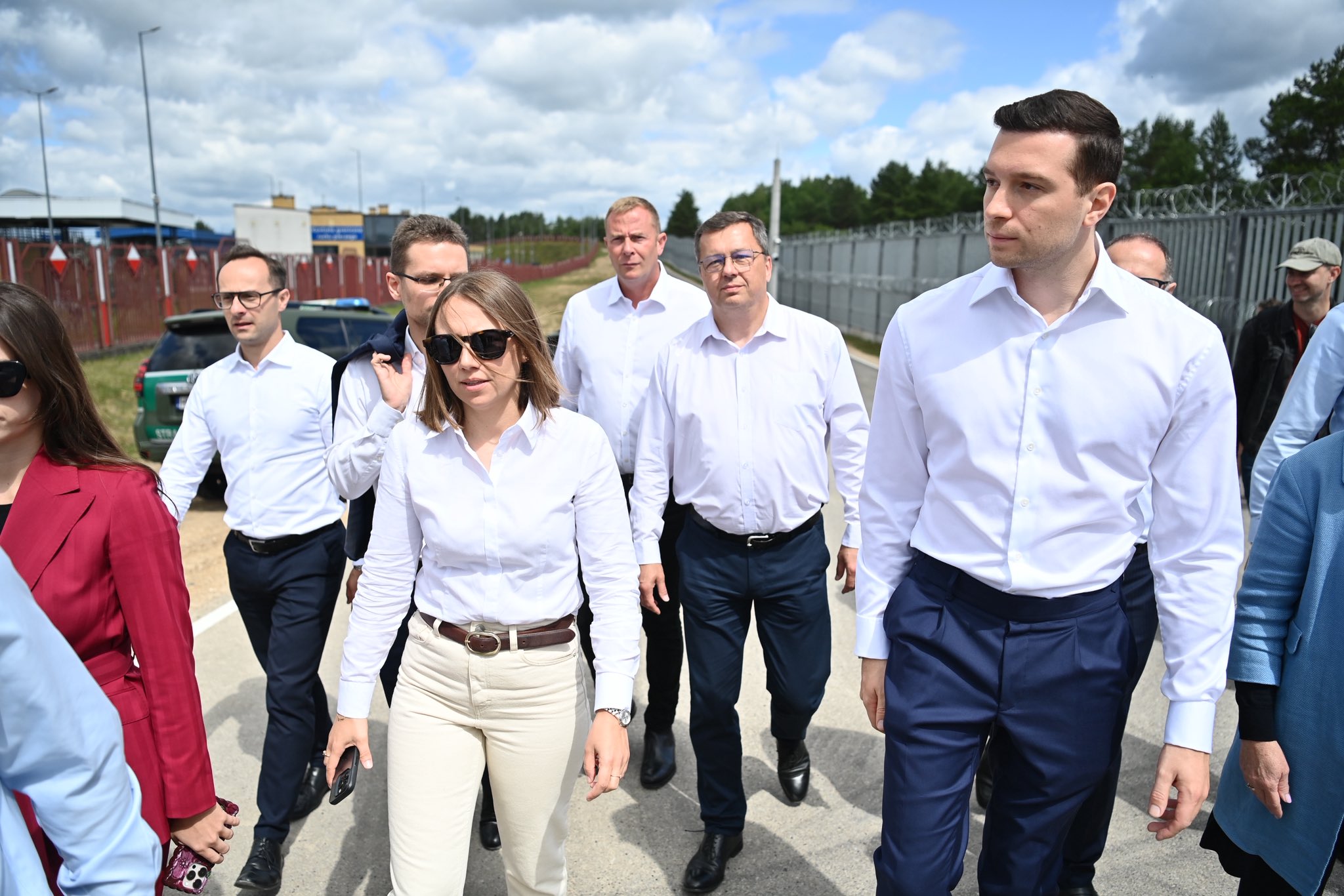
— Anna Bryłka (@annabrylka) June 19, 2026On Friday, the focus shifted directly to the frontlines of the migration crisis. Jordan Bardella, alongside Confederation MEP Anna Bryłka and Confederation MP Michał Wawer, traveled directly to the Polish-Belarusian border crossing to observe the security situation firsthand.
The delegation stressed that despite the construction of physical barriers, the pressure from illegal crossings remains a persistent threat, albeit through shifted geographical channels.
“Poland is still a target of illegal migration. The barrier on the border with Belarus limited the possibility of crossing to the Polish side, so the trail was moved through Lithuania and Latvia. From the beginning of 202, the Border Guard handed over over 550 migrants to Lithuania and detained nearly 60 couriers and organizers of the people transfer. Migrants come from Belarus to Lithuania, and from there they try to get to Poland and further to the West. The problem has not disappeared – only the route has changed,” Bryłka pointed out.
Polska nadal jest celem nielegalnej migracji. Zapora na granicy z Białorusią ograniczyła możliwość przejścia na polską stronę, dlatego szlak został przeniesiony przez Litwę i Łotwę.
Od początku 2026 r. Straż Graniczna przekazała Litwie ponad 550 migrantów i zatrzymała blisko 60… pic.twitter.com/1L39JCyInK
— Anna Bryłka (@annabrylka) June 19, 2026Bryłka also leveled sharp criticism at NGO actors operating in the border woodlands, arguing that certain groups are actively compounding the border security dilemma.
“Poland is still under migratory pressure, and alongside smugglers, there are increasingly emerging groups and organizations that, under the banner of ‘humanitarian aid,’ de facto facilitate the functioning of the illegal migration route. The border must be secure. No exceptions,” she added.