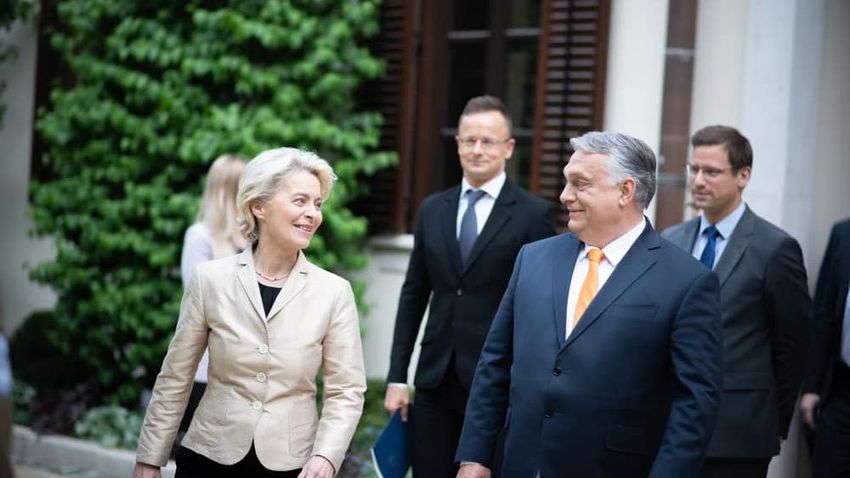
European Commission President Ursula von der Leyen made a short visit to Budapest on Monday in an attempt to convince Prime Minister Viktor Orbán to support the EU’s sixth sanctions package against Russia, but made little to no headway, according to reports.
While the photos released after the working dinner in the Hungarian prime minister’s office in Budapest show the two leaders smiling, all signs point to a not quite so friendly meeting. For one, the two did not hold a joint press conference or even offer joint statements to the press.
On the hosts’ part, Minister of Foreign Affairs and Trade Péter Szijjártó gave a short debrief of the meeting in a video posted on his Facebook page, while von der Leyen summed up the meeting in a “Hungary’s energy supply is secure, but the adoption of this sanctions package would destroy our energy security, as it would be impossible to obtain the amount of oil needed to operate Hungary and the Hungarian economy if it enters into force,” the head of the ministry emphasized.
“We cannot allow the Hungarian people to pay the price of this war,” he added.
Szijjártó also reported that von der Leyen had been informed in detail about the effects and problems facing Hungary during the evening meeting.
[pp id=31209]
“We asked that these problems be considered. As long as the European Commission does not offer a solution to these problems, Hungary will not be able to support the sanctions package, as in this form, without proposals for solutions, this package will amount to an atomic bomb dropped on the Hungarian economy,” Szijjártó said.
On her part, von der Leyen’s laconic tweet only said the discussion with Orbán had been “helpful to clarify issues related to sanctions and energy security.
“We made progress, but further work is needed. I will convene a VC with regional players to strengthen regional cooperation on oil infrastructure,” she added.
In a recent interview, Zsolt Hernádi, the president-CEO of Hungary’s oil and gas group MOL, said that converting the group’s two refineries (one in Hungary and one in Slovakia) to process Western crude would “take two to four years to implement and many hundreds of millions of dollars to spend.”