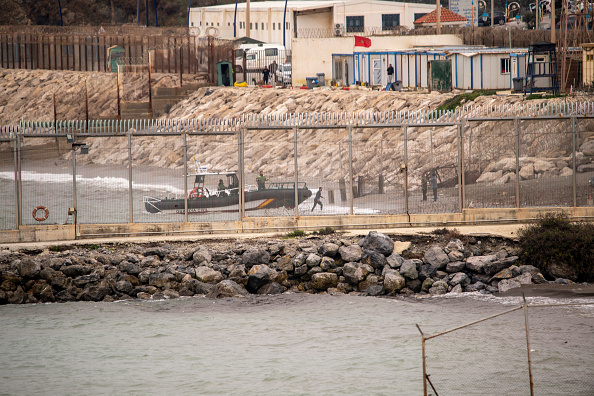
Spain’s Civil Guard officers’ association has warned that the border fence surrounding the Spanish autonomous city of Ceuta is in a state of serious deterioration, with several sections in disrepair, allowing migrants to cross the barrier in less than 30 seconds.
In a statement cited by Europa Sur, the Unified Association of the Civil Guard (AUGC) said recent storms in the Strait of Gibraltar, including Storm Kristin, caused parts of the double fence separating Ceuta from Morocco to collapse or loosen, leaving what it described as a border in a state of “collapse.”
Repair of the infrastructure has not been made a priority, and the damage has coincided with the mass amnesty offered by Spain’s socialist prime minister, Pedro Sánchez, to illegal immigrants, which experts warned has created a mass pull factor that is placing even more pressure on authorities protecting Spanish territory.
Mientras la gran mayoría de los medios mira hacia otro lado, la situación en los alrededores de #Ceuta sigue escalando a pasos agigantados. Cientos de inmigrantes ilegales se agolpan en #Belyounech y zonas adyacentes, organizando asaltos diarios a las vallas fronterizas. Medios… https://t.co/p3OfXGeh2u pic.twitter.com/dp46IaAe3p
— Rubén Pulido (@rubnpulido) February 3, 2026The association renewed calls for a comprehensive overhaul of the entire border perimeter, arguing that authorities have relied too heavily on temporary repairs and improvised fixes instead of implementing a long-term solution.
From an operational perspective, the AUGC warned that the current configuration of the double fence is “clearly vulnerable,” noting that migrants can scale both fences in under 30 seconds, leaving security forces little time to react effectively.
Security features installed to slow crossings are also proving ineffective, according to officers. Anti-climb netting can be bypassed with improvised tools, while hooks and other devices are reportedly used at the top of the 10-meter-high barrier to speed up ascents.
Officers further warned that the metal support beams on the inner side of the structure now function as “real ladders,” making descent easier once migrants cross.
Another concern raised is the condition of the fence’s detection systems. According to the AUGC, the accumulation of temporary repairs and structural patches prevents the fencing from vibrating properly, reducing the effectiveness of sensors designed to detect climbing attempts and sometimes causing delayed or failed alerts.
Attention has also turned to Ceuta’s maritime border. The association is calling for urgent expansion and renovation of the Benzú and El Tarajal breakwaters to prevent migrants from attempting to swim around land barriers. Officers described the Benzú breakwater in particular as “falling apart,” warning that its condition poses risks both to migrants and to security personnel.
The warning follows an incident on February 1, when dozens of illegal migrants from sub-Saharan Africa, including nationals from Guinea and Sudan, entered Ceuta irregularly after scaling the damaged fencing. Authorities said the group took advantage of bad weather and structural weaknesses to evade detection systems.
Spanish migration analyst Rubén Pulido warned on the La Noche de Cuesta radio program that further attempts to breach the fence could be imminent.
🔴 #ÚLTIMAHORA || Decenas de inmigrantes han ocasionado daños en las vallas fronterizas de #Ceuta. Se prevé un asalto masivo en las próximas 48-72 horas. En estos momentos la situación en nuestras fronteras es de máxima tensión. Los agentes están sin medios y se teme lo peor en… pic.twitter.com/CvLcy2qZIp
— Rubén Pulido (@rubnpulido) February 3, 2026“Dozens of migrants have damaged the border fences in Ceuta. A mass assault is expected within the next 48-72 hours. The situation at our borders is currently extremely tense. Officers are under-resourced, and the worst is feared in the area,” he said.
Prime Minister Pedro Sánchez’s government recently agreed with far-left allies to implement a large-scale regularization of migrants already in the country through a royal decree.
Under the measure, migrants able to prove their presence in Spain before Dec. 31, 2025, and at least five months’ continuous stay may qualify for provisional residence and work permits if they have no serious criminal record. Deportation proceedings are suspended once an application is filed, and successful applicants receive a one-year renewable residence permit. Podemos estimates that more than half a million people could benefit.
Critics argue the move risks encouraging further irregular migration by signaling leniency toward illegal entry.
Vox party leader Santiago Abascal sharply criticized the policy, saying, “The tyrant Sánchez hates the Spanish people. He wants to replace them. That’s why he intends to create a pull factor by decree, to accelerate the invasion. It must be stopped. Repatriations, deportations, and immigration.”