
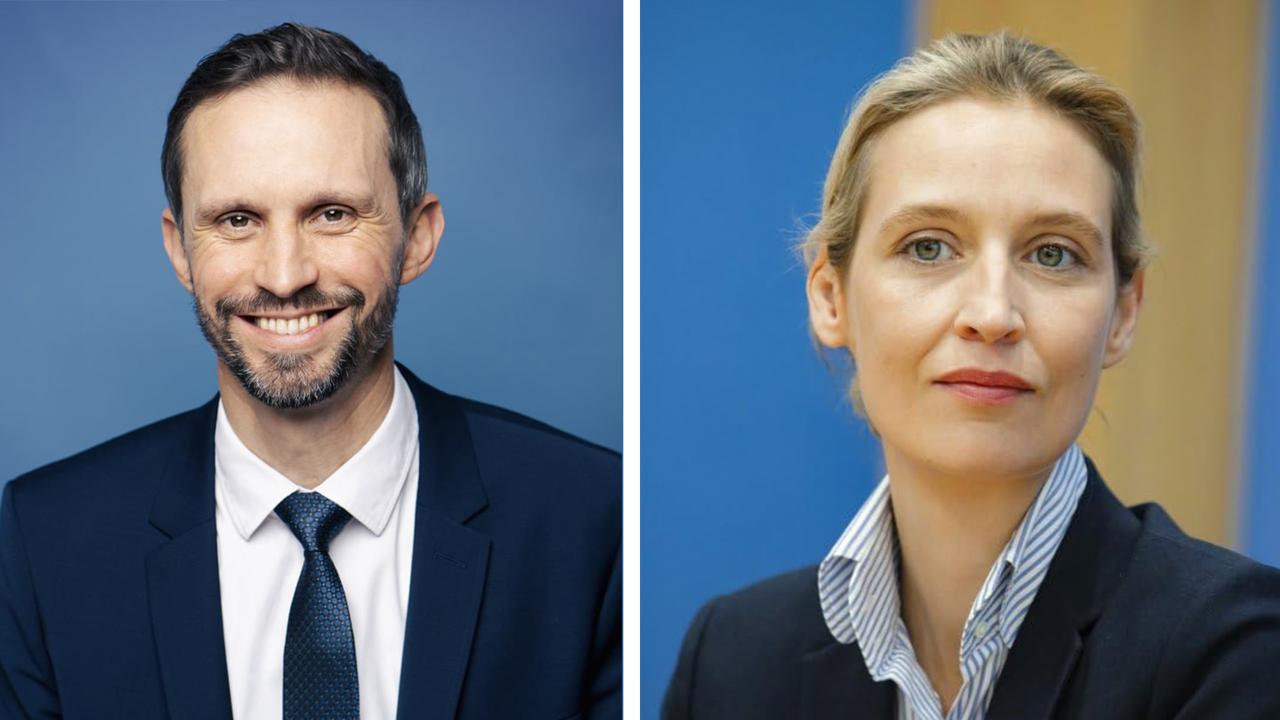
In a podcast with Paul Ronzheimer, ARD chairman Florian Hager conceded that public broadcasters have often lectured AfD voters, that migration coverage was “probably not critical enough” in places, and that journalists from academic backgrounds can lose touch with everyday realities.
During the podcast, Hager distinguished AfD politicians from their voters and said concerns about representation and trust in public media are a problem that public media must acknowledge as a problem.
“I am trying to create a separation between AfD politicians and the people who vote for the AfD,” he said, noting that the concerns of voters should not be ignored. “And if there’s a feeling that we don’t represent them, that they aren’t seen, or that they can no longer trust us, then it’s a huge issue for us. And then you can’t say it is their problem… but it’s our problem.”
These are rare admissions from an ARD chief. However, in a country where approximately a third of voters support the AfD, the party and its voters can no longer be swept aside by public media as anger over mass immigration soars.
In general, public trust has eroded in public broadcasting while the AfD consolidates its position at nearly 30 percent in national polls.
Public media’s trust problem is measurable and persistent. A Media Tenor “Zukunftsindex Deutschland” survey of more than 3,000 people found only 31 percent trust ARD, ZDF and related programs; among 16- to 29-year-olds the figure was 25 percent, and among AfD supporters it dropped to 15 percent.
WDR/Infratest Dimap data from spring 2025 put institutional trust in public broadcasting at 55 percent overall, with a clear East-West gap (higher in the West, lower in the East).
Compulsory fees continue to fund a system whose audience is shrinking relative to the political landscape, and the people who have to pay those fees are even willing to hold public demonstrations over the issue. t has strong echoes of the protests against the BBC.in Britain, where taxpaying Brits who vote for conservative parties have launched campaign after campaign for the abolition of compulsory fees to support the network.
The ideological skew inside the German journalism industry helps explain much of the uncritical migration coverage. Hager is now being forced to confront this issue, but the problem is that the vast majority of journalists working in public media are extremely supportive of left-green parties, and many of these same journalists could even be considered open-border extremists.
The 2024 TU Dortmund “Journalism and Democracy” survey of 525 journalists — with 40 percent of respondents working for public broadcasters — found 41 percent leaning toward the Greens, 16 percent toward the SPD, 6 percent toward the Left, and only 8 percent toward the CDU.
As for the AfD, it either was not listed or received support so low, at below 1 percent, that it was considered “negligible.”
In total, among those expressing a preference, left-green parties accounted for roughly 82 percent of journalists. Green Party support among journalists was several times the party’s national polling level at the time.
Meanwhile, the party that is supported about a third of the population, the AfD, does not even have 1 percent representation in the public media networks, even though those same networks are obligated by law to represent a full spectrum of the public’s political opinions.
What does this mean in practice? When the people producing the news overwhelmingly favor parties that have defended high immigration levels, expansive asylum rules, and framing that treats immigration restriction as morally unjustified, then the type of “uncritical” reporting described by Hager is the predictable outcome — not an accidental oversight.
Hager’s attitude has been repeated not only throughout German politics, but across the entire Western world. The elite, the political establishment, and the organs of the press offer a constant platitude, claiming to have not “paid enough attention” to voters and that we “need to do better” on the topic of immigration. This has been repeated ad nauseam for decades, and is only amplified when right-wing parties opposed to immigration get closer to power.
They are ultimately empty words at the end of the day meant to paper over a real crisis. Is Hager going to hire more journalists who support the AfD? The thought would never cross his mind. Is he going to start reporting on the nationality of suspects in crime reports? Highly unlikely. Is he going to start running more pieces critical of immigration? This is also unlikely, although there may be some subtle steering toward acknowledging there is a problem but that the public should never vote for the AfD to potentially fix the problem.
Notably, he also expresses worry that an AfD-led government may place curbs on the cash cow that feeds the ARD with tens of millions of euros in mandatory fees on German citizens, who have to pay to keep the ZDF and ARD running whether they like it or not.
Hager says he wants to separate AfD voters from the party and address feelings of being unseen. That is tactically sensible for an institution facing state-treaty threats and potential cuts to its funding. Yet the parties that dominate journalistic preferences – the Greens, SPD, and large parts of the center-left spectrum – continue to support higher immigration and more open policies that sharply contrast with the AfD’s core demand for sharp reductions and stricter controls.
That problem is not going away.
Even if Hager truly wanted to turn the ship around and gain back the trust of AfD voters, would there even be any institutional support for such a change of pace within the ARD itself?
The reality is that a majority of Germans want an immigration moratorium and mass deportations. They strongly reject immigration for Muslim countries. The ARD and its sprawling staff remain categorically opposed to these concepts.
For an example of this, it is important to review the case of Julia Ruhs. Her case shows, along with the cancellation of her show, that reporting critically on immigration can lead to a witch hunt within the German public broadcasters. Remix News covered the moment she learned public broadcasters had dropped her show.
🇩🇪🔴A female German journalist wanted to research the topic of gang rapes by migrants in Bavaria but was labeled "racist" and "right-wing" by her colleagues.
Julia Ruhs, a high-profile television presenter, said it is still a "taboo" to research topics regarding why "certain population groups are more susceptible to committing sexual offenses."
"That’s when I realized the whole editorial imbalance that when you dedicate yourself to such a topic."
She added that it became an environment where she was told: "You’re not allowed to say that and you’re totally racist."
Ruhs is currently at the center of a significant "Cancel Culture" and media sovereignty debate in Germany.
She is often described as a rare conservative voice within the German public broadcasting landscape, which is frequently criticized for having a "left-green" bias.
In 2025, Ruhs was chosen to host a new experimental debate format called "Klar," co-produced by the northern public broadcaster NDR and the southern BR. The show’s mission was to reach viewers who felt alienated by mainstream media by tackling sensitive topics like migration, Covid-19, and the farmers’ protests.
After the first episode on migration, a massive internal wave of criticism hit. Approximately 250 NDR employees signed an open letter distancing themselves from the show, accusing Ruhs of one-sided and populist reporting.
In September 2025, the NDR officially decided to drop Ruhs as a presenter for their portion of the show, citing a desire to move toward a "multi-moderator concept."
Ruhs responded on social media, calling the decision a "disgrace" and claiming she was "too right-wing for the NDR."
High-profile politicians like CSU’s Markus Söder (Bavaria) and Daniel Günther (Schleswig-Holstein) criticized the NDR for stifling diversity of opinion.
While the NDR canceled her, the Bavarian broadcaster BR stood by her. New episodes of "Klar" are planned from the BR broadcaster for 2026.
— Remix News & Views (@RMXnews) February 18, 2026Hager is aware of this problem to a large degree. He also cites police and local officials repeatedly describing persistent problems over migration. However, he is offering nothing more than a weak mea culpa on behalf of years of ARD reporting, which has gone to great lengths to whitewash the growing problems with mass immigration.
Most importantly, Hager does not address how the ARD actually plans to change its reporting and win back the trust of these voters. Additionally, he completely fails to confront the structural imbalance in who is hired, trained, and promoted, or the compulsory funding that insulates the system from market feedback.
Damage control without altering the underlying editorial incentives or the immigration positions of the favored parties is unlikely to restore broad trust from AfD voters. If he was serious about truly diverse representation in the public media, he would require measurable diversification of political backgrounds inside the newsrooms and reporting that treats migration outcomes – crime correlations, integration failures, fiscal costs, and local pressures – with the same rigor applied to other policy areas.