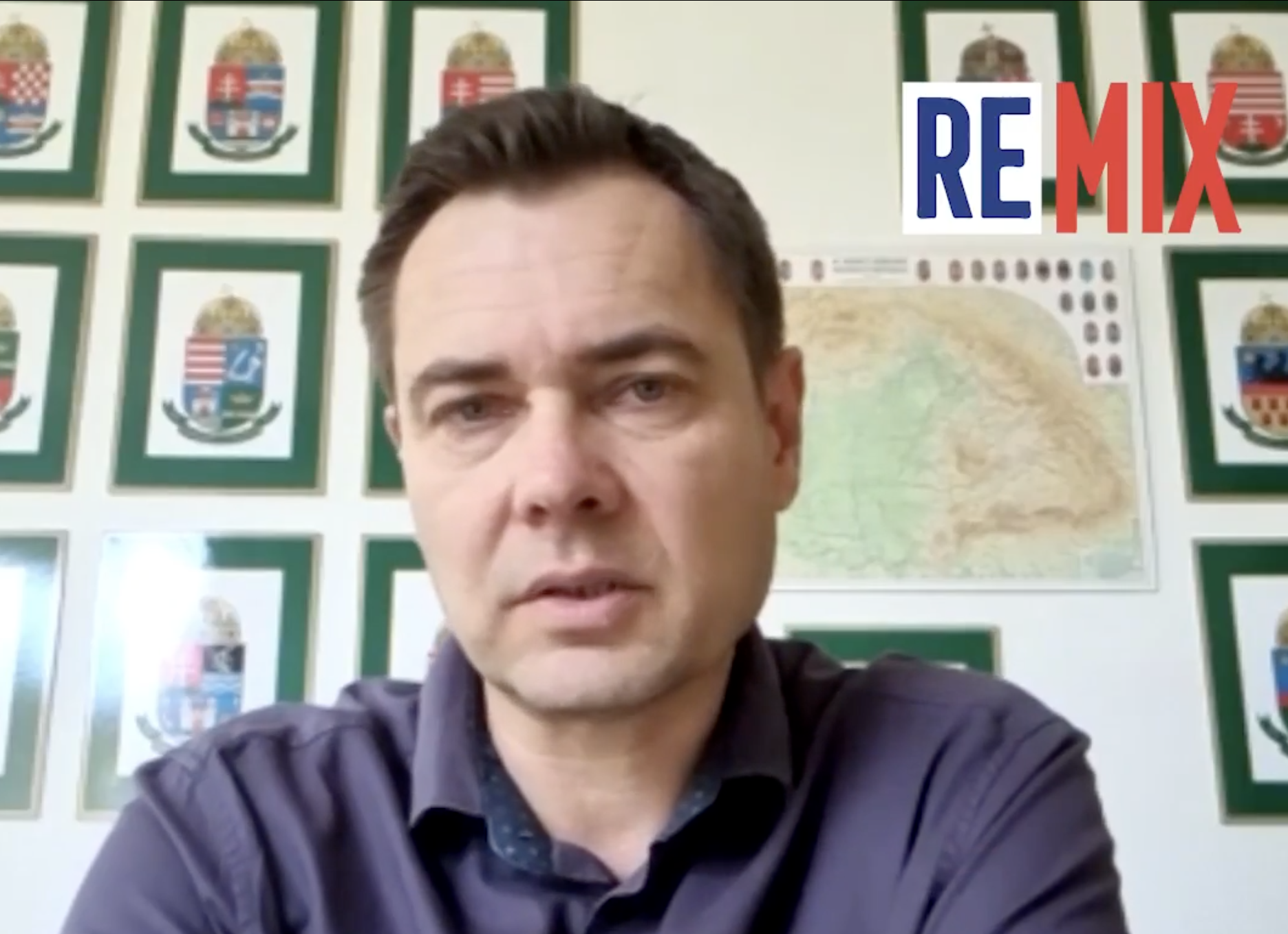
The Hungarian conservative media landscape is in the process of being bankrupted, gutted, or co-opted by the new Hungarian government under Péter Magyar. However, there remain a few holdouts, including Daniel Deme, who serves as the editor-in-chief of the English-language Hungarian news outlet Hungary Today as well as the German-language Ungarn Heute. Deme describes a “dire situation” brought on by a climate of fear, radical purges, mass layoffs, and little to no aid from key allies, including the Trump administration.
What is the current state of the Hungarian media landscape? How does it compare to the situation under the Orbán government?
Under the Orbán government, there were claims from the left that there were no media freedoms here, that journalists were persecuted. None of that was true. I’d say there was already a 60-to-40 split in the media landscape toward the left’s benefit at that time. But a difficult situation arose from the fact that Hungarian conservative right-wing media wasn’t independent enough, and that was really the case. It was very much talking to its own bubble.
I don’t think it was controlled by the government or presenting a government-controlled narrative. I think it was voluntary. But I think the culture of Hungarian conservative journalists was such that they wanted to stick to the central narrative, which was very close to the government.
On the other hand, you had foreign-funded left-wing media outlets. There were a few exceptions that survived commercially, but in very many cases they were funded by the Open Society Foundations and by the Norwegian Oil Fund. There’s a Norwegian radical-leftist sort of fund that is feeding the Hungarian liberal and woke environment, NGOs, and media outlets.
🇭🇺🇺🇸 EXCLUSIVE: The Trump administration has largely abandoned Hungarian conservatives after Viktor Orbán’s loss, warns @daniel_deme_HU in an interview with @RMXnews.
“So, I think the State Department of the Trump administration is shooting itself in the foot by leaving this… pic.twitter.com/vOAE8iajro
— Remix News & Views (@RMXnews) September 21, 2026And of course they were funded by European funds as well—awards, grants. So after the elections, the money that came from government advertising—by the way, they advertised in the left-wing media very heavily as well—just stopped immediately. And from week one, there was a purge of Hungarian right-wing media outlets. It wasn’t just the money that was taken away; the institutional standing was as well.
For example, the largest media conglomerate, Mediaworks, immediately started firing hundreds and hundreds of staff. What we haven’t even seen during communism: it wasn’t just that they removed the former Orbán government’s media managers from these public media outlets—they actually destroyed them. They shut them down.
And it was just outright scary, as if a foreign occupying force had arrived and shot our TV towers to pieces. One day we turned on our TVs and there was a blank screen. There was a black screen with an inscription that the “public media shouldn’t lie, and we are sorry that we lied for years, and this is going to change.” And that was it. That was it for weeks and weeks on end.
At the same time, it also happened with Radio Kossuth, a national institution. That’s a radio station that we used to listen to even during communism. And suddenly they switched it off. They just put some classical music on 24/7, and old people have complained to me that they used to turn it on in the morning and switch it off in the evening when they went to bed. It used to be part of their lives, and then there’s nothing. And now the only public television is completely turned into a Tisza Party mouthpiece.
There are a handful of surviving right-wing publications that, frankly, have not learned their lesson, in my opinion, about how to analyze Hungarian public and political life, and are very much continuing in the same line as before.
There are new shoots, I would say. It’s very hard to tell which ones are going to survive and which ones are not. And this is the situation when you realize one staggering fact: if you find yourself a media manager or an editor-in-chief, you start looking for funds and trying to survive, and you realize that there are no foundations, no grants for national, conservative, patriotic media in the world—anywhere.
Meanwhile there are dozens and dozens of rich funds for liberal, woke media that is spewing propaganda from Brussels or from the Democrats’ set of opinion-makers. So it’s amazing. There were two Hungarian foundations that sponsored some of the patriotic and conservative media in the country. They have both been shut down now and are now controlled by the Péter Magyar government.
So the situation is dire.
On the one hand, the conservative media has completely disappeared. We do not have a single conservative political daily on the newsstands now. Not a single one. Magyar Nemzet, which used to be everywhere, is now nowhere to be found. It has gone into weekly print production. And on the other hand, when you go onto social media and LinkedIn, you see ubiquitous adverts for left-wing journalists at left-wing outlets everywhere. They’re expanding. It’s like a golden age for them.
That’s a pretty dramatic transition. How many people would you estimate have now been laid off in the Hungarian media landscape since Tisza, since Magyar, won?
I would definitely estimate it near 1,000 people. And you have to understand that the Hungarian media landscape is fairly small, and these are almost exclusively members of either the public broadcasters or conservative media—almost exclusively. People have been fired in a completely absurd manner, without any justification, without any wrongdoing on their side. Not even only people who had been biased toward the Fidesz government. Even when they fired the managers of the public media, MTI, they found replacements, a couple of media managers well known in the business, and they were appointed.
One of them was supposed to be the manager of the news department at the Hungarian News Agency, and someone pointed out on social media—I think on Facebook—that yes, he had worked for the left, and he had also worked for right-wing media like Hír TV. Péter Magyar left a single comment on Facebook under one of these comments saying, “I don’t think so.”
The next day, the guy was called into the office of his boss and fired on the spot. When they found out that he had worked briefly at one of the conservative news TV stations, he was fired on the spot and removed. That’s all it takes today: just a short comment on Facebook from our new neo-Stalinist leader, Péter Magyar.
You said there’s not a single foundation in the entire world that supports conservative media in Europe. Liberal institutions outside Hungary were pretty active supporting numerous liberal and left-wing institutions, media outlets, and so on with money—taxpayer money from Europe and corporate money from various corporations, foundations, and so on. Now, where are the Americans? Where is the State Department? Where are the foundations? What is your opinion on this particular issue?
Well, on the one hand, the State Department launched in July a grant for free, sort of conservative institutions in Europe—$5 million, I think, for the entirety of Europe. And I think they have received more than 1,000 applications. Whoever I spoke to, from Italy to Poland, everyone was applying. We applied as well. But it’s a ridiculous amount. $5 million is basically the price of a single bomb in Iraq. So this was just a drop in the ocean.
And I have managed to speak to members of the American State Department—I do not want to describe any more closely who they were—and I basically just asked what they thought about this. And they said, “You’re on your own. You have to fight this fight from your own resources. We have to respect the will of the people.”
And this is very gentlemanly, you know. This is a very noble position from the State Department. They do not want to interfere in other people’s countries. But I have to add very quickly that this is not the way the Democrats see it, or money groups and oligarchs connected to the Democrats. The left does not have these sorts of scruples toward Europe and is continuing to fund the Hungarian far-left media and NGO networks. There’s a glut of funds for them. So I think the State Department of the Trump administration is shooting itself in the foot by leaving this space empty, leaving the Hungarian conservative network to wither. In four years, when they come back, where they used to have allies—honest allies and friends—where they used to have an infrastructure of pro-American political and economic circles, they will have nothing. They will only find NGO networks and political networks that are 100% allied either with the Democrats or with networks funded from the other side of the world, from the East.
I’ve tried to explain this to American diplomats and opinion-makers: there’s been a huge void created after the elections. This void is going to be filled very, very quickly. And if you do not move fast enough, you will find that others will recognize the potential in this network—and so they did. And I do not want to mention the names of the countries, but they are not the United States’ geopolitical allies, let’s say that.
What do you think the motive is from the State Department there? Is it that there are still a lot of left-wing holdouts in the State Department who are directing policy, or do you think this is the conservative mindset of letting the free market work? If the conservative outlets can generate ad revenue and play in this kind of private market, then those are the outlets that deserve to survive. And if they can’t, then they deserve to die.
I think there could be some of this, but the State Department is very well known to be the bastion of the Democrats in the international field. It is still completely dominated by left-wing activist foreign policy. You just have to look at U.S. embassies and their appointments from local talent, or the communications of some of their ambassadors.
We don’t even have an ambassador in Hungary, which kind of shows that our status is not as important for Washington as it probably used to be, or as it should be. You have to remember that Viktor Orbán stood up for Donald Trump in the darkest years and months of the lawfare, when he was being photographed in police stations, when he was getting his mugshot taken by police. Viktor Orbán was the only foreign leader who stood up and paid enormous political capital, invested a lot of political capital, into defending Donald Trump personally and stood by the Republicans in these dark periods.
🇭🇺🔴 With Hungarian conservatives face growing persecution, where is Donald Trump?
"You have to remember that Viktor Orbán stood up for Donald Trump in the darkest years of and months of the lawfare when he was being photographed in police stations, when he was getting his… https://t.co/Wtlujt32u2 pic.twitter.com/HmHbkdVx9H
— Remix News & Views (@RMXnews) September 23, 2026And yes, there was a lot of support from the United States before the elections, from JD Vance and Marco Rubio, even from Donald Trump himself. Not the support that we needed. What we needed, first of all, was a good look into the far-left financial networks that are tilting the Hungarian political sphere toward the left, toward Brussels, and toward the Democrats. And the other thing was action on the giant tech firms like Facebook, Google, etc., who are openly censoring Hungarian and European media content, influencers, etc. And they’re doing it so blatantly that we expected the new White House to crack down on this undemocratic, biased behavior. And this didn’t happen.
Do you feel that now that Orbán is out of power, the US is actually betraying the Hungarian conservatives?
I don’t think they’re betraying us explicitly. I think there is a recognition of the seriousness of the situation, but I haven’t heard a single word from Republican circles expressing dismay or concern about what is happening in Hungary, and there’s plenty to be concerned about regarding what has happened in the last four months.
What we’ve seen in Hungary being done by the Tisza government is unprecedented in Europe, even in left-wing countries, even in partial democracies like Germany. There’s persecution of right-wing influencers, etc. I’m not going to go into details, but the U.S. State Department is completely silent about this, and I would say now is about time to open their mouths and take a hard look at what’s going on in Hungary.
Orbán invited JD Vance at a sort of inopportune time for his own election campaign. This had already been after the bombing of Iran, and there was a pretty big energy price increase right before Orbán went to the polls. Some people even said that this may have contributed to a larger loss for Orbán in the end. What is your opinion?
Whether the visits by JD Vance or Marco Rubio helped or not, I think they didn’t sway Hungary either way. They were very much welcomed by the Hungarian conservative networks, and I don’t think any of the Tisza Party’s potential voters changed their minds about voting for Fidesz because they understood how important the support of the American administration is. It is very, very important, but they had their minds made up already, and I don’t think these high-level visits changed anything in any way.
You have to separate Fidesz’s campaign performance from what really happened, the result of the elections. There was such an incredibly violent, intensive, and aggressive communication campaign from Tisza’s international and domestic supporters that throughout my 25 years in communications I have not seen anything like this.
We had the Ukrainians close our oil pipeline, Brussels withheld the European funds from the Orbán government, the Polish secret services were spreading fake news about Viktor Orbán, the British intelligence services were fairly active in Hungary, and on Facebook and Google the salvos of thousands of comments in our comments sections and everywhere else were coming from bot farms and paid influencers. And it was just amazing. I don’t think any society could have resisted this intensity of disinformation and demagoguery that we saw in the elections.
Of course, the other side of the coin is that Fidesz had a terrible election campaign, and it’s kind of universally understood even among conservatives that they really messed up their election campaign, and everyone is paying a very high price for this.
Since the election, I’ve seen polling that shows Fidesz tanking even much further than their election results, and Tisza seems to be more popular than ever. This is about four months in now. What realistic chances do you see of the conservatives coming back to power, and how will the Hungarian media landscape—without a real conservative voice, or not much of one going forward—even present the conservative or right-wing viewpoint?
I think some of those polls are right, and maybe not to the extent that they are showing, but Tisza’s popularity has actually grown since the elections and Fidesz has fallen back. That’s partly because Viktor Orbán was such an incredibly dominant personality in Fidesz, and his removal from the political scene is a huge hit for Hungarian conservatives.
And his replacement, János Bóka, is a young and very well-informed and competent person, but I don’t think he’s a full replacement for Viktor Orbán, and some are skeptical about his charisma, etc.
Fidesz’s performance since the elections can only be described as sketchy, and we are expecting Fidesz to do much more than they are doing. And there’s, of course, the other right-wing party, Mi Hazánk, Our Homeland. They are to the right of Fidesz, and very brave and vocal, and they are organizing demonstrations and are very active in parliament as well. They are getting into debates with Péter Magyar, but when it comes to voting, they almost always vote with Tisza.
They even voted for the so-called Asset Recovery Office, which is an absolute betrayal not just of their voters, but of conservative Hungary as well. That’s just a huge misstep. So they are not to be relied on. I think the only solution we can hope for is the emergence of a new conservative party, but we do not even see the sign of anything happening yet, and it seems Hungarian conservative circles are still in shell shock post-election.