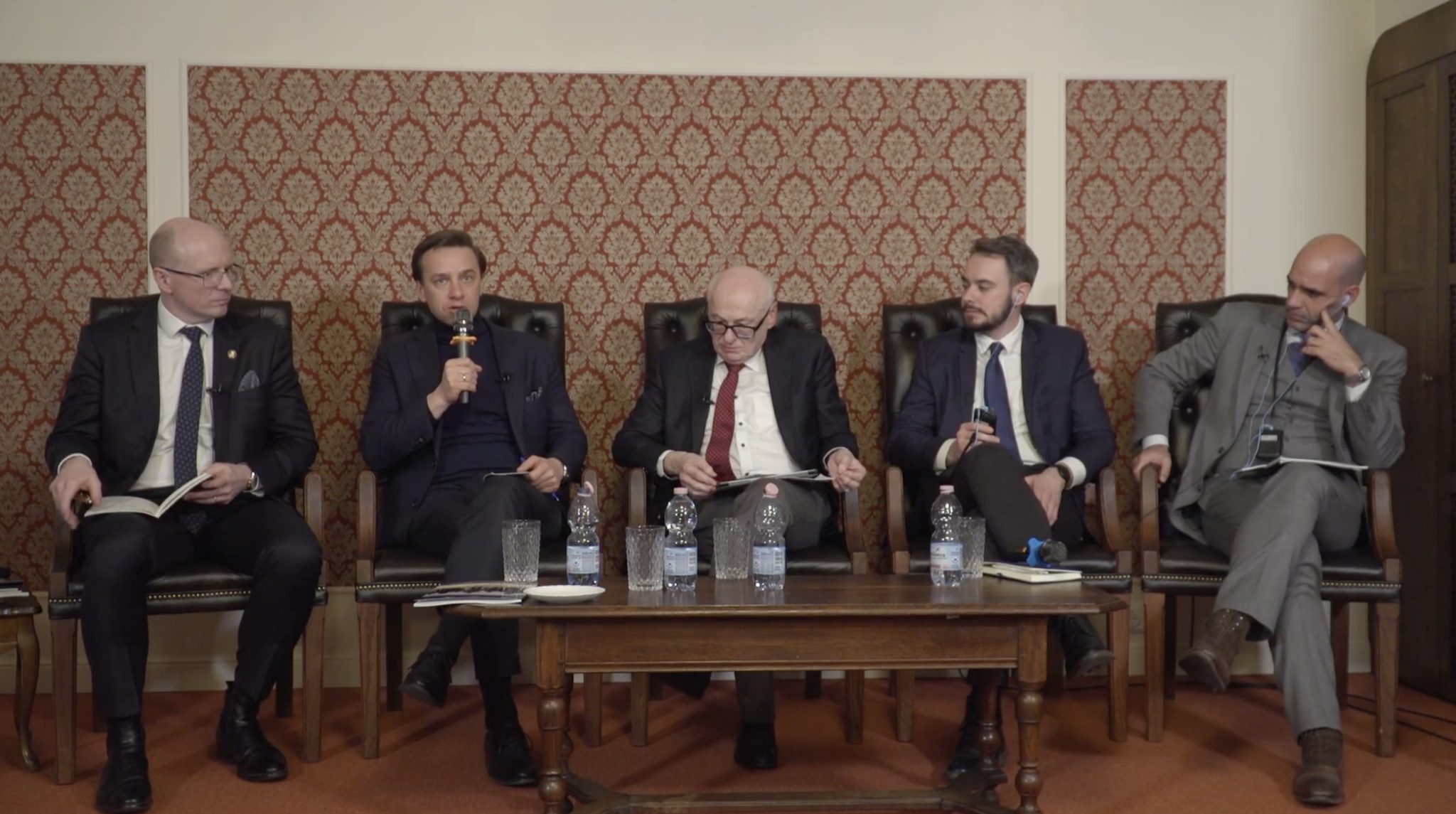
Europeans are committing demographic suicide and the tools used to managed migration are failing at every level, said Rodrigo Ballester, the head of the Center for European Studies at the Mathias Corvinus Collegium. He made his remark at a recent Ordo Iuris Institute event in Warsaw, Poland, which saw European politicians, policymakers, and other important players gather to discuss a groundbreaking paper: “Taking Back Control from Brussels. The Renationalization of the EU Migration and Asylum Policies.”
“As Europeans, we are committing demographic suicide. We are a continent of old rich people, facing a continent of young, hungry, and determined people — ambitious people. We’re still trying to manage migration with hopelessly outdated tools, using conventions from a century ago. They have completely lost their meaning today. In practice, I’m talking about the Geneva Convention. This is the ‘sacred cow’ we should get rid of,” Ballester emphasized.
The “Taking Back Control” paper, which was recently covered by Remix News, outlines 18 ways Europe can regain control of immigration policy. Ballester emphasized that these policies need to be implemented and quickly.
Many of the speakers discussed various aspects of Europe’s ongoing immigration crisis, including the sharply differing trajectories of pro-immigration countries such as Poland versus Germany.
Polish Prof. Zdzisław Krasnodębski, a former MEP, spoke to the large audience who had gathered, where he compared the impact of immigration on the Polish city of Warsaw to the German city of Bremen where he lived and worked for a long time.
“How did it happen that such a process, which is suicidal, was supported by societies for years? I can tell you that I know two such cities well. One was poor and large, and people were moving away from it. It was Warsaw. Warsaw was also White, if I may use that term. The other city (Bremen) was well-off, middle-class, also White. In 2025, one is almost a ruin. It used to be a prosperous, medium-sized town. Meanwhile, this big, great city we’re in right now has become one of the wealthiest cities in Europe,” he pointed out.
Krasnodębski underlined the trajectory of Warsaw, which is economically booming while still maintaining a strong White majority and rejecting the diversity seen in many other Western cities. Meanwhile, Bremen has been labeled the “most dangerous city in Germany,” where an incredible 73 percent of crime suspects are non-German. The situation has deteriorated so greatly in Bremen that even left-wing politicians in the city have admitted that “massive immigration” has sparked a housing and crime crisis.
However, other speakers warned that not all is well in Poland, either.
Jacek Saryusz-Wolski—a former Polish Minister for European Affairs and Member of the European Parliament, currently President Nawrocki’s main advisor for European affairs — took the floor.
“Looking at the statistics, you can see that in most of Western Europe, immigrant communities make up a percentage in the teens, or even over 20 percent, of the population. It’s not like that here (in Poland) yet, but we too face the risk of an open-borders policy starting here. We will then, after a certain delay, share the same fate,” noted Saryusz-Wolski.
Saryusz-Wolski further warned that the EU is taking more and more power away from nation-states in order to dictate an open borders policy.
“Migration policy is not among the European Union’s exclusive or shared competencies. This is only an area, the third category of cooperation, within which the Union institutions may assist, encourage, and advise the member states, but they cannot legislate. And that is the origin of this great usurpation,” the politician emphasized.
Another speaker, Róbert Gönczi, an analyst at the Hungarian Institute for Migration Research and at Mathias Corvinus Collegium, warned that policies in other countries, such as Spain, which is working to legalize hundreds of thousands of illegal migrants.
“Today we are witnessing a huge surge in migration that Europe is grappling with, and let’s not forget that we are all part of the European Union; it affects us all, and we all bear the consequences,” the analyst emphasized.
He also drew attention to the problem of numerous migrants not being registered in European countries’ systems.
“There are millions of people we can’t track down. We don’t know where they are, we don’t know what they’re doing, we don’t know where they came from, and we don’t know what to do about it. This places a very significant burden on the European system, on the European Union, and it is one of the reasons why we find ourselves in a serious economic crisis,” he noted.
Deputy Speaker of the Sejm, Krzysztof Bosak, emphasized that in addition to illegal immigration, mass legal immigration is also a problem.
“The discussion about legal immigration — its scale, rules, and criteria — is no less important, if not more important, because the transformation of Western Europe was largely the result of large-scale legal immigration, and only as a result — or in parallel — did illegal immigration begin to arrive,” he said.
The politician also noted that the European Union treats different countries unequally when it comes to assessing their migration policies. He pointed out that this area has already been partially “renationalized,” but he warned against a possible hardening of the stance toward countries that continue to firmly protect their borders.
“Please note that very few of our Border Guard’s decisions — whether during the Law and Justice government or now under the Civic Platform-led government — have been seriously challenged by any EU bodies. However, I’m not saying that this won’t happen at any moment now. It can happen. It depends solely on where the ‘Eye of Sauron’ from Brussels, from Luxembourg, turns its gaze, and which regulations, which practices it chooses to scrutinize. Such arbitrariness, it seems to me, has been taking place in the European Union for years with regard to the practice of so-called pushbacks — that is, what I call sending illegal migrants back to the proper side of the border,” said Bosak.
“Taking Back Control from Brussels. The Renationalization of the EU Migration and Asylum Policies” report discusses the possibility for European Union member states to regain greater control over migration and asylum policy without the need to adopt new EU treaties. The authors show that the key competencies concerning border protection, security, and deciding on the admission of foreigners still belong to nation-states, and that any limits on them result more from legal interpretation than from actual legal provisions.
The publication critically assesses the EU migration pact, indicating that it may facilitate mass migration and the forced relocation of migrants. The report also proposes specific legal measures that would enable EU countries to strengthen their own migration policy under existing European and international law.