Poland’s nationalist and right-wing parties could be within reach of a parliamentary majority after the next election, according to a new OGB poll that shows Prime Minister Donald Tusk’s Civic Coalition leading the race but increasingly isolated from viable coalition partners.
The survey, conducted between April 28 and May 11, 2026, places Civic Coalition (KO) first on 36.9 percent, down 0.7 percentage points. Law and Justice (PiS) remains in second place on 26.6 percent, despite falling 2.8 points.
However, the more striking finding is the strength of the parties to PiS’s right. Confederation is polling third on 13.1 percent, down only 0.1 points, while Confederation of the Polish Crown has surged to 11.2 percent, up 2.9 points.
Taken together, Law and Justice, Confederation Freedom and Independence, and Confederation of the Polish Crown account for 50.9 percent of support in the poll, suggesting that Poland’s nationalist and conservative forces could have a plausible route to a parliamentary majority if the result were repeated at an election. This percentage would translate to a larger majority of seats when parties that fail to make the threshold to enter parliament are removed from the picture.
Such an outcome would mark a serious threat to Tusk, whose party remains the strongest individual force but whose governing camp appears badly weakened. The only clear left-wing or liberal ally shown entering parliament is the New Left, which stands at 6 percent after gaining 1.4 points.
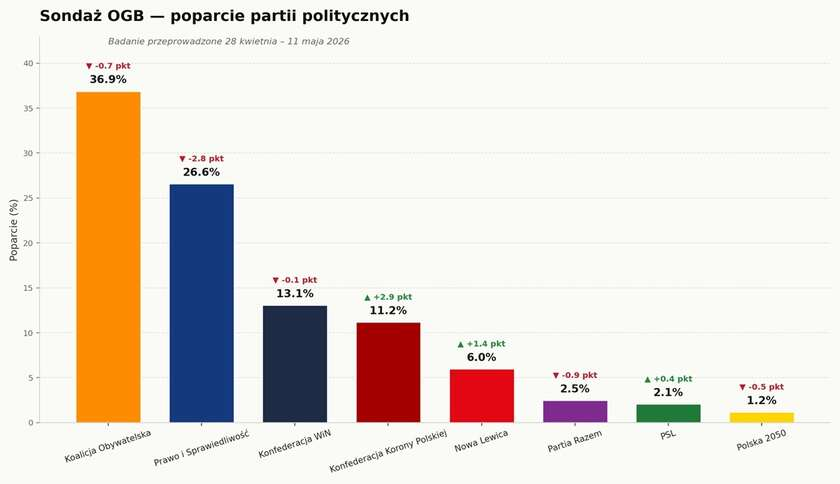
Beyond that, the picture for Tusk’s allies is bleak. The centrist Polish People’s Party and Poland 2050 are polling at just 2.1 percent and 1.2 percent, respectively, and the left-wing Together Party stands at 2.5 percent. On those numbers, all three would fail to enter the Sejm.
That raises the prospect of Civic Coalition winning the popular vote among individual parties but still failing to secure the numbers needed to govern. The poll suggests that Tusk’s party could be left as a large but isolated force, while the right benefits from a broader and more electorally viable spread of parties. Whether an alliance could be formed between the three right-wing parties, however, remains to be seen.
The result would be particularly damaging for the political model that brought Tusk back to power. His current majority depends not only on Civic Coalition’s strength, but on the survival of smaller centrist and left-wing partners. If those parties collapse below the electoral threshold, their votes could be wasted, potentially handing a decisive seat advantage to larger parties and blocs.
The growing support for Confederation of the Polish Crown, led by hard-right Polish lawmaker Grzegorz Braun, is also notable. Its 11.2 percent result puts it just behind the main Confederation grouping and makes it one of the biggest movers in the poll. Together, the two Confederation-linked forces are polling at 24.3 percent, almost level with PiS.
A future right-wing majority would still depend on whether Law and Justice and the nationalist parties could cooperate in government, but the OGB survey suggests that the parliamentary arithmetic may be moving in their favor, while Tusk’s room for maneuver is shrinking.
Poland’s next parliamentary election must be held by Nov. 11, 2027, unless an early election is called. On the current numbers, a snap election is highly unlikely, and while Tusk’s Civic Coalition would begin that contest as the leading party, the wider nationalist right could be better placed to form the next government.