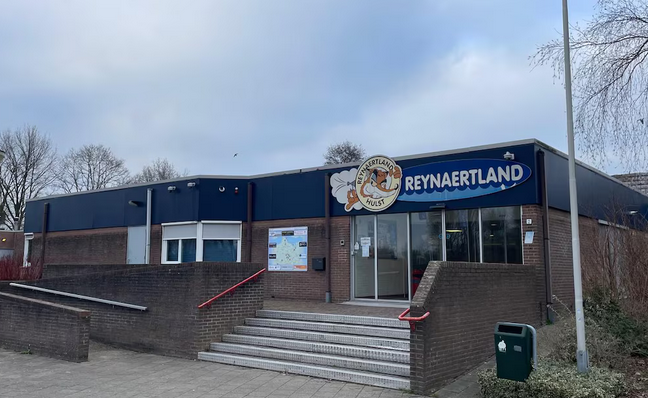
Residents in the Dutch municipality of Hulst have reacted with anger after local officials confirmed that the Reynaertland swimming pool will once again be used as emergency accommodation for asylum seekers.
The municipality said the decision was taken after an urgent request from the Dutch minister for asylum and migration, with the site due to reopen on May 15. The emergency center is expected to operate for one year and will house a maximum of 50 asylum seekers in the pool complex’s hall.
Despite the new accommodation arrangement, the municipality says the swimming pool will remain open to the public as normal.
That point has prompted particular concern from local residents, including parents whose children use the facility for swimming lessons.
As reported by De Dagelijkse Standaard, one local, Jordi Van de Wiele, responded sarcastically on Facebook, “Nice place in combination with our daughter’s swimming lessons. I’m glad other people are more important than ‘our’ people.”
The site has been used for asylum accommodation before, between October 2022 and July 2025, and several residents claimed the previous arrangement caused problems in the area.
Vanity Faas-esseling wrote, “Security… they were wandering around everywhere last time… and whistling at you by the roundabout.”
Another commenter, Beestenboel van Kaat, demanded written guarantees from the municipality. “Can you guarantee that the residents of the municipality of Hulst will remain 100 percent safe, and that if this is not the case, you will be held 100 percent responsible?” the resident wrote. “Please put this agreement in black and white on paper.”
The municipality has attempted to reassure residents by pointing to security measures, including 24-hour supervision and house rules for those staying at the site.
However, the comments under the announcement suggest many locals remain unconvinced.
Another resident, John S. van Ulst, wrote, “Hopefully no single young and ungrateful fortune seekers (come) to Hulst.”
The decision comes amid continuing pressure on Dutch municipalities to provide temporary accommodation for asylum seekers, a policy that has repeatedly triggered local opposition when public buildings, hotels, or sports facilities are converted into emergency shelters.
Residents of other Dutch towns now accommodating a center for asylum seekers have warned other municipalities from following suit. In February, residents in Harderwijk described what they said was a sharp deterioration in safety and quality of life.
One elderly resident said, “I won’t walk my dog here at night after nine o’clock. So, that says it all.” A mother added, “Fights, shots were fired here on the premises.”
Some described several incidents involving knives. “One stabbing to another stabbing. And then again that fuss, fights with people in the street,” one local said. Another added, “They stab each other. Just in the middle of the street with the children walking by.” A resident living opposite the center, who uses a mobility scooter, said, “If you see how often the police stand there. Surely that says it all.”
Last month, locals in the Dutch city of Loosdrecht protested against a proposed asylum seekers’ center, resulting in serious police violence targeting the protesters with baton charges, which left at least one protester unconscious on the pavement, which was caught on film.
Commentator and activist Eva Vlaardingerbroek praised the protests at the time, writing, “Hundreds of migrants are to be moved to a location in Loosdrecht – a small town close to where I grew up. The locals were not given any say, of course, and took to the streets in protest. Glad to see the true Dutch fighting spirit isn’t gone completely. Go, my fellow countrymen! Enough is enough.”
Following the protests, the local authorities scaled back plans, confirming that 70 asylum seekers will be housed at the facility instead of the proposed 110.