

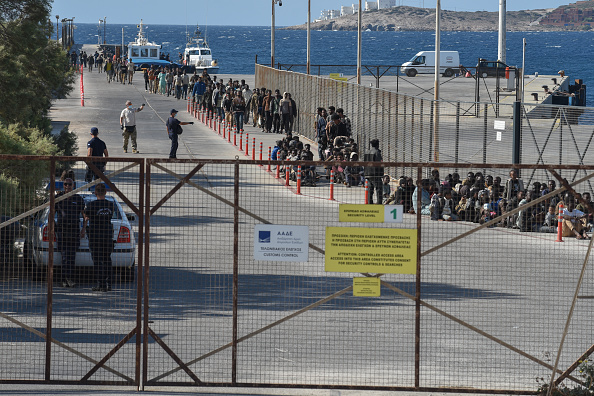
Greece’s Migration Minister Thanos Plevris has warned that around 550,000 migrants and refugees in Libya are seeking to reach Europe, as Athens braces for the possibility of more boats attempting the crossing toward Crete.
Speaking to ERT News on Sunday, Plevris said the central migration pressure facing Greece has shifted from the eastern Aegean to Libya, where smuggling networks are increasingly using routes toward the south of Crete and nearby islands.
He said Greece is working continuously with Frontex and the Libyan authorities to identify boats early, disrupt departures from the Libyan coast, and stop smuggling networks from turning Crete into a new frontline of Europe’s migration crisis.
Migration flows in the eastern Aegean have fallen by around 70 percent compared with 2025, according to the Greek government, which credited the decline to cooperation with the Turkish coast guard and increased surveillance. All eyes are now on Libya which is seen as the most urgent challenge.
The minister defended the government’s tougher approach to immigration. “There is no logic that Greece opens its borders and accepts people,” Plevris said, arguing that the country would “operate within the law, but will also reach its limits in order to protect the borders.”
He rejected allegations that the Greek coast guard is carrying out illegal pushbacks, saying: “We do not do pushbacks, but we do protect the borders,” adding that attempts to stop the boats were “absolutely within the limits of the law.”
“Anyone who is not entitled to asylum knows that they will be returned and we guard our borders,” he said.
Last summer, Greek Prime Minister Kyriakos Mitsotakis announced that “the path to Greece is closing” as his administration introduced a raft of legislative reforms to crack down on illegal immigration and asylum requests.
Athens announced the suspension of all asylum applications for three months for those arriving in the country from North Africa by sea, and established a closed detention center on the island of Crete, to which all arrivals would be taken to be processed and earmarked for repatriation.
“This sends a message to all traffickers and all their potential customers that the money they spend may well be entirely wasted,” Mitsotakis said at the time.
He also expressed the willingness of the Greek navy to assist the Libyan authorities in preventing the departures of small boats from the African mainland.
In November, Plevris revealed that tougher age verification checks introduced by the Greek government had found that over half of those still arriving after August, who claimed to be minors, were in fact over the age of 18 — 59 cases out of 104 — showing that some were still intent on trying to game the system.
At the weekend, Plevris insisted, however, that the new system of detention as a form of deterrence was working.
“Now, when it is likely that someone will not be granted asylum, they are not placed in a state of freedom but in a state of detention, so that if asylum is rejected, they can be returned,” Plevris said.
He said the number of unaccompanied minors had dropped from around 3,000 to roughly 1,500, adding that the government had reduced a series of benefits that had acted as an incentive for people to move to Europe.