

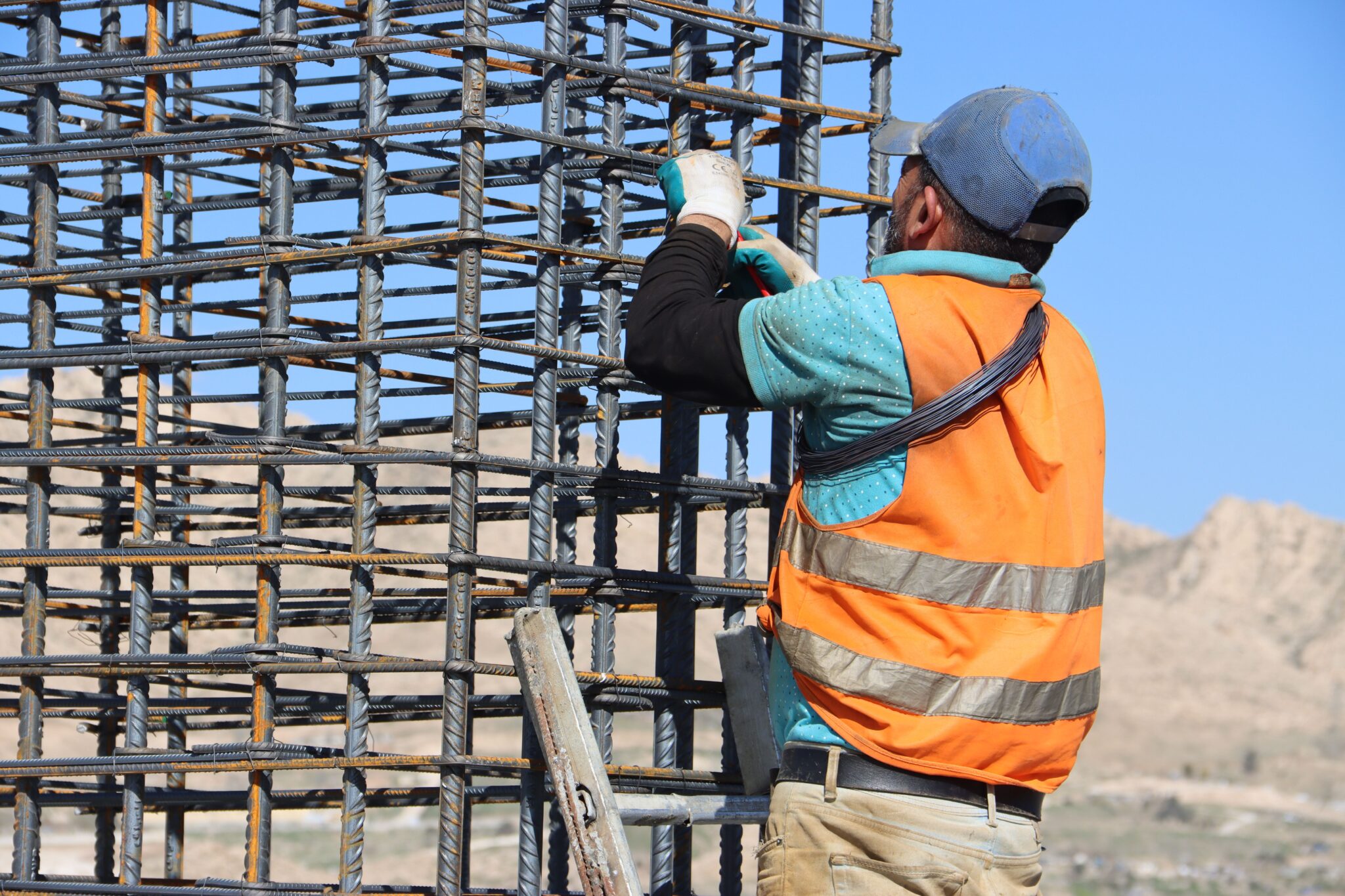
Spain’s construction industry is undergoing rapid demographic changes. Foreign-born workers in unskilled construction roles now make up 52.6 percent of all workers, according to data from Randstad from the first quarter
The data shows that foreign workers now exceed Spanish nationals for these unskilled roles by nearly 11,000 workers. The contrast is stark compared to pre-pandemic figures, when domestic laborers outnumbered foreign counterparts by more than 33,500.
Overall, the construction industry has lost 22,711 Spanish workers since 2019 while gaining 238,451 foreign employees, a figure that includes individuals with dual nationality. As a result, almost 36 percent of all construction workers, both skilled and unskilled, are now of foreign origin in the country.
The shift is equally evident among bricklayers. In 2019, Spanish bricklayers outnumbered foreigners by 111,000. Seven years later, that gap has narrowed to just 18,000 workers. Foreign labor has gained more than 16 percentage points in this category and currently accounts for roughly 48 percent of bricklayers working in Spain. While Spaniards remain the majority in most skilled roles for now, the statistical gap continues to shrink rapidly. Experts also predict that foreigners will increasingly dominate skilled and managerial positions in the future.
This transformation extends into specialized technical trades. The count of Spanish plumbers fell from 70,932 in 2019 to 57,781 today, while foreign representation doubled after adding over 10,000 workers. One in four plumbers in Spain is now foreign-born. Electricians show a similar dynamic, with about 32,000 foreign workers joining the profession since 2019, driving foreign representation up from under 11 percent pre-pandemic to nearly three out of ten today.
Industry analysts expect these patterns to hold due to impending retirements and low replacement rates among younger Spaniards.
Spain, like many other nations, is attempting to automate the construction industry as much as possible. However, instead of relying on advanced robots, Spain has so far shifted toward a modular construction approach in which concrete panels, bathrooms, and complete structural modules are built indoors in automated, factory-controlled settings that use machinery and assembly lines similar to those in the automotive sector. Cranes then assemble these modular components on site, requiring significantly fewer workers and dramatically cutting project delivery times.
Countries such as South Korea, by contrast, are racing ahead in automated construction, precisely because nations like Spain continue to rely on mass immigration, which is often cheaper in the short term but more costly over the long run.
South Korea does not only use automated construction in planning, but also in deploying commercialized robotics, automated modular manufacturing, and government-mandated smart construction.
Automated facilities, such as Space Factory, use advanced robotic arms to cut materials, assemble structural panels, seal joints, and fit window frames without direct manual intervention.
Unlike standard build sites in Spain, South Korean contractors actively deploy field robotics directly to job sites.
Automated rebar-tying robots and robotic concrete sprayers and finishers are routinely used by major developers, such as Samsung C&T and Hyundai E&C, to reduce heavy physical labor on high-rise residential projects. In addition, unmanned excavators and bulldozers guided by real-time GPS and drone mapping handle heavy site preparation.
Robots are even acting as supervisors to some extent, with autonomous quadruped robots, such as Boston Dynamics’ “Spot,” owned by South Korea’s Hyundai Motor Group, continuously patrolling construction sites, performing 3D laser scans to verify that progress matches digital blueprints.
As Remix News has previously reported, automation, robotics, and AI are all leading elements of Asian economies, which have chosen efficiency and technology over mass immigration and cheap foreign labor.