
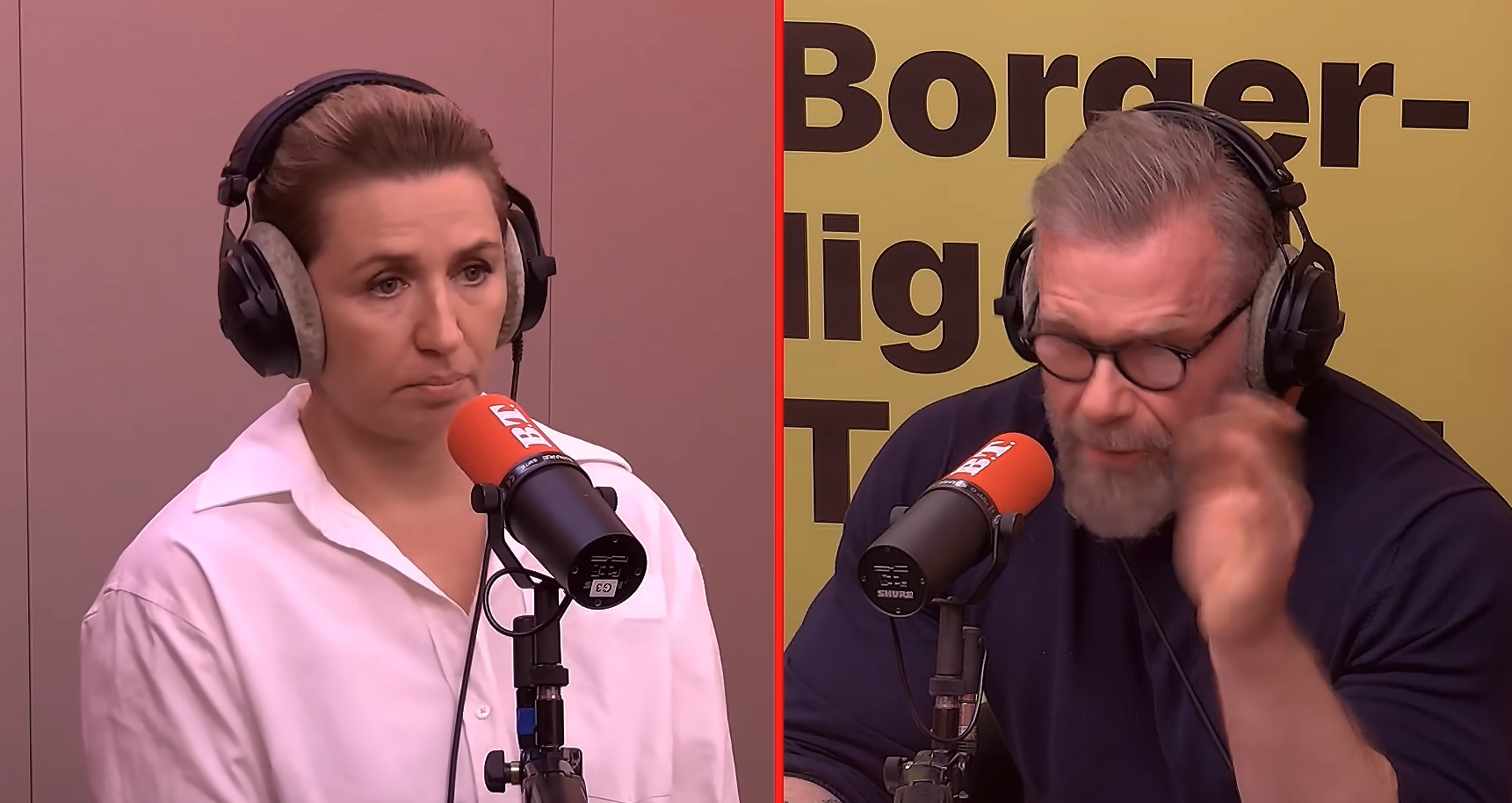
Danish Prime Minister Mette Frederiksen has used an appearance on a conservative-leaning podcast to reject multiculturalism and large-scale demographic change, while her left-wing government’s long-standing restrictive policies continue to produce some of the lowest asylum inflows in Europe. Frederiksen continues to use rhetoric that many on the right are afraid to use, all while avoiding the criticism and pressure from Brussels that others on the right, like former Hungarian Prime Minister Viktor Orbán, faced.
Speaking on the Borgerlig Tabloid podcast hosted by Joachim B. Olsen for the newspaper BT, Frederiksen stated: “I am not in favor of a multicultural society where one equates cultures.”
She added: “I am European, Danish and from Aalborg. And I am also not in favor of a large population replacement. I believe there needs to be a strong majority culture.” When pressed on what “Danish” meant, she pointed to the existence of a clear majority culture and described Danes as “an original tribe that is ethnically Danish.”
🇩🇰🔴 The left-wing PM of Denmark rejects “population replacement.”
“I am opposed to population replacement. I am not a moral relativist. I want a Denmark that is Danish.”
“We are the original stock of ethnic Danes. There must continue to be a Denmark in the future.”
“I do not support a multicultural society in which all cultures are treated as equal.”
“We do not have religious equality. We are a Christian country. We shall continue to be so.”
Many on the Danish right complain about PM Mette Frederiksen. While she has managed to drastically reduce asylum cases under her tenure, immigration overall has slightly increased in the last two years, with about half of those immigrants coming from European countries.
At the very least, even acknowledging that there is an ethnic Danish people who deserve to remain the majority is a far cry from the weakness seen from many conservative politicians across the West on this topic.
Follow: @RMXnews https://t.co/XS29eh3eHB
— Remix News & Views (@RMXnews) November 18, 2026She acknowledged that recent immigrant groups change the country’s composition but insisted that a strong majority culture must endure into the future.
Frederiksen singled out immigration from the Middle East, North Africa, Pakistan and Turkey (MENAPT countries), arguing that a “dominance culture” among some arrivals rejects homosexuality, opposes equal rights for women, and seeks to place Islam above national law. She called this culture “dangerous” and incompatible with the society Denmark has built, speaking both as a Social Democrat and as prime minister.
She also added: “We do not have religious equality. We are a Christian country. We shall continue to be so.”
The interview followed Frederiksen’s announcement, along with leaders from Germany, Austria, the Netherlands and Greece, of plans to establish a non-EU return center for illegal migrants, expected to be located in Rwanda. The facility would house rejected asylum seekers who refuse voluntary return. Frederiksen has described such external measures as a potential “game changer” for European migration policy.
How does Frederiksen get away with her rhetoric?
Frederiksen has always been a remarkable figure in the European political scene. Although her party has been firmly grounded on the left, she is known for pursuing far harsher immigration policies, often far harsher than the immigration policies of the so-called “conservatives.” The Tories in Britain, for example, were notorious for sending non-European immigration levels to record levels and completely transforming the country demographically.
Frederiksen also appears to be remarkably immune to any real criticism, even if left-wing NGOs and human rights organizations have routinely sniped at her over the years. Although Orbán and other right-wing Eastern European leaders became veritable bogeymen to the left due to their immigration policies, Frederiksen has often deployed the same rhetoric, and at times she has taken an even harsher line.
Danish PM Frederiksen: "The problem is that a great enemy has begun to grow from within."
"There are foreigners who have come to Europe, there are Hamas supporters, there are people who commit terror against European societies, there are people who do not recognize our fundamental European values, there are people who sympathize with some of the darkest forces in this world."
"So Europe is threatened. The problem is that we are threatened both from outside and now from within."
PM Mette Frederiksen explained why she is against Spain’s decision to legalize hundreds of thousands of migrants, who can now enter Danish territory,
Follow: @RMXnews
— Remix News & Views (@RMXnews) August 17, 2026Certainly, it is hard to imagine a left-wing party in Germany, France or Britain talking about maintaining a majority culture, stopping population replacement, and asserting that Christianity is the dominant religion and should remain so. Her discussion of the native ethnic population as not only a positive but as a group of people who should maintain the majority position in the country is unheard of from the left. In fact, any left-wing leader from another Western European country would likely be hounded out of their position for such statements. Yet Frederiksen makes these comments and nobody appears to blink an eye. No condemnation from Brussels and no calls for her resignation.
Of course, the Danes are known for their anti-immigration stance. Why them and not the Swedes, for example? Honestly, this is a hard question to answer, one which has historical, cultural, social, and perhaps even genetic explanations. Any attempt to explain it, though, is very likely open to interpretation and debate.
Perhaps at least a partial explanation is that Frederiksen has staked her immigration stance around liberal values, such as maintaining the welfare state, protecting the rights of homosexuals and women, and maintaining a progressive and liberal society for Danes. Orbán, on the other hand, knew how to antagonize the EU and the left, and appeared to relish his role as a fighter against expanding EU powers, even if Hungary itself was generally a very safe place for homosexuals and women.
The fact that Orbán is a man and Frederiksen is a photogenic woman also undoubtedly played a role and should not be underestimated.
In terms of targeted attacks from the power elite in Brussels, Frederiksen has also played ball in a number of pivotal areas, such as her support for Ukraine in its war against Russia, a point of contention with Orbán that sent the Brussels elite into a frenzy.
Frederiksen also has fewer weak points to attack. She governs an EU country that provides a budget surplus, whereas Hungary was highly reliant on EU taxpayer transfers. Denmark is known as one of the least corrupt countries in the world, whereas many Eastern European countries, which are poorer, still face significant corruption issues. There is very little scandal in Denmark. It is a renewable energy powerhouse with world-class companies. It is routinely ranked one of the best countries to live in globally.
Still, even in neighboring Germany there are many politicians from the right-wing Alternative for Germany (AfD) who are afraid to even reference ethnic Germans as a distinct and indigenous people, let alone any idea that they deserve to be in the majority in their native country. This has much to do with Germany’s historical guilt over the Second World War but also appears to be the attitude in all Western countries, including Britain and France. In the minds of the left, indigenous Europeans do not even exist, and sometimes they do but then only to be portrayed negatively or even genocidal, whether it is in ads, movies, or political debates.
Frederiksen’s rhetoric appears to defy political gravity and that is a positive development, since it shows there is a potential path forward for political figures who want to discuss the issue of demographic replacement openly, even if they belong the left. It certainly represents a welcome break from the typical left-wing self-flagellation and even outright racism towards native Europeans.
How effective is Frederiksen at actually controlling immigration?
There are not many topics that annoy the Danish right more than the international right’s praise of Frederiksen and her immigration policy. For those who are true immigration restrictionists, this is of course the right perspective, as it is always important to be as maximalist as possible. Frederiksen’s record is, of course, still mixed on this issue, but it is undeniable she has dramatically reduced asylum numbers during her tenure.
Denmark’s results on asylum numbers have seen a sharp reduction from the 2015–16 peak. That year, the country registered roughly 21,000 asylum applications and granted around 10,849 permits. By 2024, applications were reduced to 2,300 and roughly 860 were granted asylum. Preliminary 2025 figures show around 1,961 applications and approximately 875 asylum seekers received residence permits. These are among the lowest annual totals since the early 1980s, outside the anomalous pandemic year of 2020.
Relative to population, Denmark ranks near the bottom of the EU for asylum applicants. Official statistics and independent compilations confirm that first-time asylum applications have remained a small fraction of the mid-2010s levels for nearly a decade.
Since taking office in 2019, Frederiksen’s Social Democratic-led governments have enacted dozens of restrictive measures, many of which Remix News covered in an in-depth article. These include temporary rather than permanent residence permits, tighter family-reunification rules, asset confiscation to offset costs, “ghetto” legislation aimed at reducing the concentration of non-Western residents in certain neighborhoods, and enhanced powers to return people to countries of origin once deemed safe. Labor migration has been steered toward higher-skilled or “like-minded” sources, with recent limits on certain foreign students and healthcare professionals. Repatriation incentives have also been expanded.
Despite these policies and a sharp drop in asylum arrivals, overall net immigration has continued to increase, which is where the Danish right’s criticism comes in. Much of this immigration, a little over 50 percent, has been from European countries, often driven by free movement in the EU. Immigrants and their descendants now constitute roughly 16 to 17 percent of Denmark’s population.
The reality is that even though migration numbers remain low in Denmark compared to other Western countries, they are still extremely high and will eventually result in the demographic changes she says she is opposed to. Demographic projections published in 2025 suggested that, if current fertility and net-migration patterns persisted, people of foreign origin could become a majority in Denmark by the late 21st century.
In other words, if Frederiksen truly wanted the Danes to remain in a strong majority position, she and her government would have to take far greater action than they already have, including large-scale remigration efforts.
There are also more nuanced and perhaps more relevant questions Frederiksen has not answered, such as how much of a majority should ethnic Danes be? Should they be 70, 80, or 90 percent of the population? How can Danish governments control these numbers? How can her policies work in the long run when Denmark belongs to the EU, which allows freedom of movement between member states? These are all valid questions, and she may be hesitant to give concrete answers backed by real policy.
🇩🇰🚨 Denmark’s Prime Minister Mette Frederiksen used her New Year’s address to promise ramped-up deportations for foreign criminals.
"We do not want your culture of dominance. You are destroying the most beautiful country in the world." https://t.co/XKdbTmNXRn
— Remix News & Views (@RMXnews) January 5, 2026Nevertheless, Frederiksen’s willingness to use language such as “population replacement” and “majority culture,” coupled with her administration’s policies, has not only shifted the Overton window in Denmark but has also served as a template for other European nations. The reality is that the right’s economic message has failed to resonate with the young and many middle-class voters, many of whom are increasingly facing incredible economic and career struggles tied to AI, soaring housing prices, and stagnant wages. There is a broad perception that the current politics of the right-wing parties closest to power is mostly a vehicle for inflating the assets of Europe’s powerful Baby Boomer voting bloc.This perception may not be far from the truth.
Some combination of populist left-wing economics and an appeal to liberal sentiment coupled with an immigration policy that favors native Europeans could be a winning formula in the future. The Western European right would be wise to look to Frederiksen and try to emulate at least some of her positions. Otherwise, they will increasingly lose out to a left that promises relief from an increasingly rigged and uninspiring crony capitalist system.