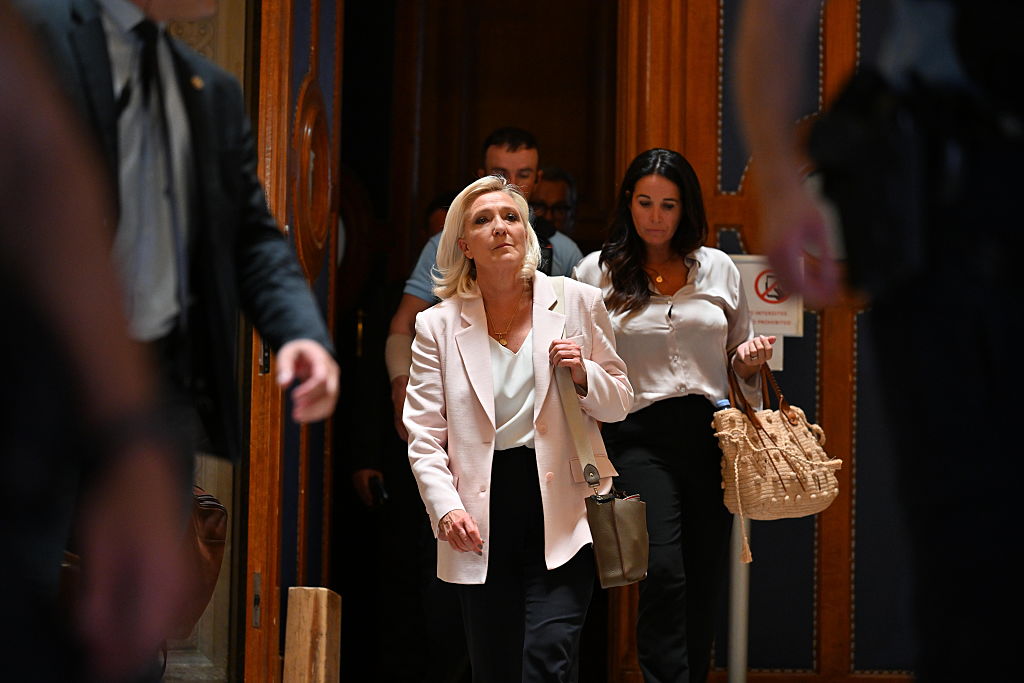
In a verdict that has sent shockwaves through French politics, the Paris Court of Appeal on Tuesday upheld Marine Le Pen’s conviction for misusing European Parliament funds but eased key penalties in a way that technically keeps her eligible to run for president in 2027.
The ruling, however, imposes significant personal and practical constraints, including an electronic ankle bracelet, that could still keep the National Rally (RN) leader from the campaign trail.
The court sentenced Le Pen to three years in prison — two years suspended and one year to be served under house arrest with an electronic ankle bracelet. She was also fined €100,000.
Her ban on holding public office was reduced from five years to approximately 45 months, with 30 months suspended. Since she has already served part of the original ban following the March 2025 first-instance ruling, the remaining active period does not bar her from the April 2027 presidential election on paper.
The conviction stems from a long-running investigation into the alleged creation of fictitious parliamentary assistant posts between 2004 and 2016. Prosecutors argued that EU funds intended for European Parliament staff were diverted to pay individuals working for the National Front, which has since been relabeled as the National Rally, in France, amounting to millions of euros in misused public money. Le Pen, who has consistently denied wrongdoing and described the proceedings as politically motivated, was convicted for playing a central role.
The appeal court largely confirmed the lower court’s findings on guilt while moderating the punishment, a move that has fueled debate over whether the judiciary is unduly influencing electoral outcomes.
Notably, Le Pen has been convicted at a time when both she and Jordan Bardella, also of the National Rally, are predicted to win national elections in 2027 regardless of which one runs. Now, Bardella is also facing threats of a criminal trial.
Despite the formal green light for 2027, Le Pen faces a major obstacle: the one-year electronic monitoring period. She has previously stated unequivocally that she would not mount a presidential campaign while wearing an ankle bracelet, arguing that the restrictions would make effective campaigning impossible.
“You can’t campaign under these conditions,” she previously said about an ankle bracelet. “Can you campaign without going out in the evening to meet your voters at rallies? That would be another way of preventing me from standing as a candidate.”
This creates a dilemma for the National Rally. as Le Pen remains a towering figure in the party she transformed from a fringe movement into France’s leading political force. Yet, the bracelet requirement could force her to step aside, opening the door for her protégé, Bardella, who has already emerged as a strong contender in internal and polling dynamics.
Le Pen has indicated she intends to pursue further appeals, potentially to the Court of Cassation. However, she will likely have to make a decision long before a verdict from that court arrives.
If she runs, she most certainly would rely on the “lawfare” argument to voters, arguing that she is the target of widespread efforts to keep her out of power. With many voters fed up with the French establishment, and there are many, this could prove a compelling argument.
However, the practical implications of campaigning are severely limited due to her electronic bracelet, as she has already noted.
In the end, Tuesday’s ruling did not deliver a knockout blow to Le Pen’s political ambitions, but there will be serious decisions to be made for both her and her party in the future, as the most pivotal election, perhaps in decades, arrives in 2027.
Regardless of her decision, a poignant pre-verdict message posted on X the day before the ruling from Le Pen’s niece, Marion Maréchal, may highlight the fact that Le Pen is unlikely to go gently into the night. Maréchal expressed unwavering support and noted that Le Pen told her that “fear is a feeling that is foreign to me.”
“A few hours before the verdict, in this vigil of arms, I wanted to write you these few words.
‘Fear is a feeling that is foreign to me,’ you said a few days ago, when you were questioned about the upcoming verdict. In doing so, you bore witness to the tenacity that earns you the respect of your supporters, the dogged pursuit of our adversaries, but also the confidence of millions of French people.
Those who hope to eliminate you from the political arena, those who imagine that a conviction would prevent you from continuing to fight for the French, are making a poor calculation. I have been one of the privileged witnesses to your resilience in the face of trials, whether political or personal. I know that, whatever the judges’ decision, nothing will stop for you tomorrow, quite simply because we will need you in the difficult years ahead.
They have undoubtedly forgotten that our family and our fight were forged in decades of fierce struggles. No, the Le Pens have never needed a parliamentary mandate to defend our country and our people.”
Chère Marine,
À quelques heures du jugement, dans cette veillée d’armes, je tenais à t’écrire ces quelques mots.
« La peur est un sentiment qui m’est étranger », disais-tu il y a quelques jours, alors qu’on t’interrogeait sur le jugement à venir. Tu témoignais ainsi de la… pic.twitter.com/woJ6iSn1kD
— Marion Maréchal (@MarionMarechal) July 6, 2026Based on Maréchal’s statements, Le Pen is likely to remain a thorn in the establishment’s side for years to come.