Some startling new figures are coming out of France on the level of education of its students. Long considered a bastion of learning and strict educational standards, the new data paints a disheartening picture.
A new thread compiled by statistician Marc Vanguard offers up telling details, starting with dictation errors for CM2 students (final year of primary school, typically ages 10-11). Government data shows that the average number of errors shot up 70 percent between 1987 and 2021, with 1 in 2 students unable to spell “aussitôt,” compared to only 1 in 5 in 1987.
Furthermore, in 1987, making 25 errors made you the worst student in a class of 20. Fast forward to 2021, and between 5 and 6 students out of 20 are making that many mistakes. Shockingly, some 75 percent of students in 2021 did not attain the average score from 1987.
For mathematics, the average score dropped by 30 percent, with data compiled between 1987 and 2017. However, 93 percent of students in 2017 could no longer reach the median score of 1987, and a whopping 56 percent did not even attain the bottom decile of 1987.
As Vanguard highlights, zero students in 2017 were achieving the best scores from 1987, while no students in 1987 scored as low as the worst students in 2017.
… sur ces 2 extrémités du graphique.
Pour le dire très simplement :
👉 À droite du graphique, les très bons de 1987 n'existent plus en 2017
👉 À gauche, les très nuls de 2017 n'existaient pas en 1987 (hors retard mental)
⬇️ pic.twitter.com/RGhYvF2BS9
— Marc Vanguard (@marc_vanguard) May 3, 2026All in all, France is now the worst country in the EU in CM1-level math, as shown in the 2019 TIMSS ranking, as well as the 2023 edition.
👉 Ainsi, la France est maintenant le pire pays de l'UE en maths niveau CM1.
C'est vrai dans le classement TIMSS 2019 (ci-dessous), et ça reste vrai dans l'édition de 2023. pic.twitter.com/42TRxLNkIU
— Marc Vanguard (@marc_vanguard) May 3, 2026“We’re doing worse in math than countries like Albania or Azerbaijan,” the statistician further remarks.
With official PISA data echoing the drop in educational levels, particularly in math, there is a common trend also highlighted: the increase in the number of students with an immigration background. As a matter of fact, in 75 percent of the countries in PISA’s study, children with an immigration background have a lower level of math skills than native kids.
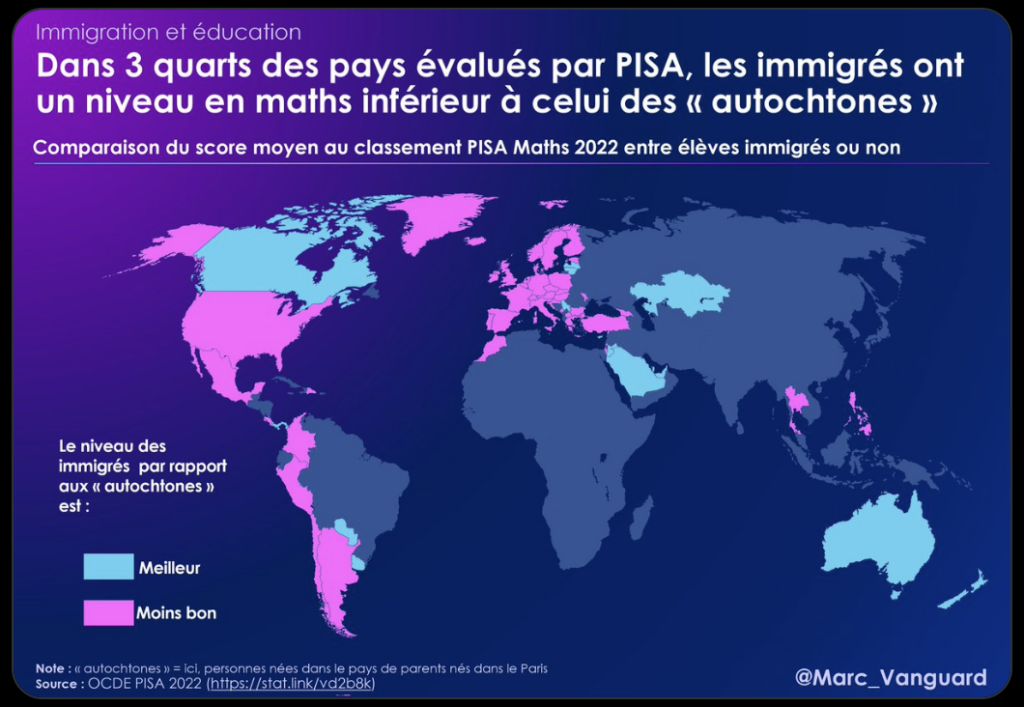
And descendants of immigrants are a full school year behind in their math skills compared to students whose parents were born in France. One exception to this trend are students with Asian backgrounds.
Vanguard also points to other factors that have led to a decline in French education, including the documented levels of noise and distractions allowed in classrooms, the continuation of ineffective teaching methods, and the use of, i.e., reliance on technology such as calculators and perhaps, more and more, AI.
While France may have its own internal issues to sort out, on top of the rising number of students with a foreign background, other countries in Europe have faced stark consequences of the massive influx of foreign kids. In Vienna, teachers are fleeing a system they no longer can work within, while Muslim students also now outnumber Christians.
In Germany, the situation has been dire for a while, with test scores plummeting and data also pointing to the impact of migration. A 2024 study from Humboldt University clearly noted that the children of foreign nationals and refugees continue to perform worse in all subjects, including math, chemistry and physics, than classmates without a migration background.