
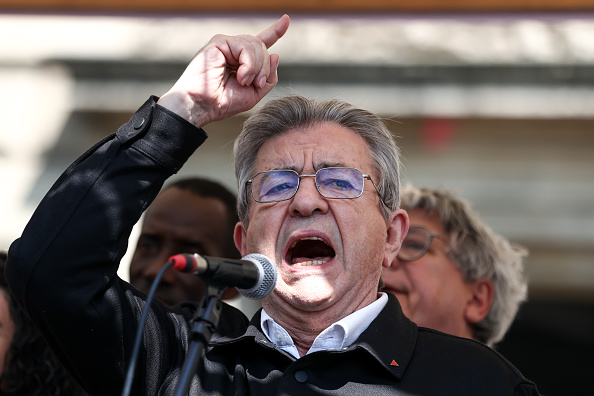
Jean-Luc Mélenchon has officially launched his campaign for the 2027 French presidential election, declaring himself the “best prepared” candidate on the far left and vowing to defeat the National Rally “soundly.”
The 74-year-old leader of La France Insoumise confirmed his candidacy on Sunday evening during an appearance on TF1, hours after elected officials from his party approved his run.
It will be Mélenchon’s fourth attempt to win the presidency, and his announcement comes a year before French voters are due to choose a successor to Emmanuel Macron.
“We are very clear. There is a team, a program, a single candidate,” Mélenchon said, insisting that the scale of the crisis facing France and the wider world justified entering the race early.
“Without wanting to cause alarm, but to be clear-sighted, we are entering a very turbulent season in world history. We are threatened by a widespread war. We are threatened by a dramatic change in the climate. And then we have an economic and social crisis coming towards us,” he added.
Mélenchon also took aim at rival parties on the left, warning that political fragmentation risked weakening their chances of defeating the right-wing National Rally, which is widely expected to be one of the dominant forces in the election.
🇫🇷 Far-left French politician Jean-Luc Mélenchon says "so much the better" about the Great Replacement.
"It is just one generation following after another. Everything is fine."
Yesterday, Mélenchon announced his candidacy for next year's French presidential election to succeed… pic.twitter.com/hcFVJ5H4VY
— Remix News & Views (@RMXnews) May 4, 2026He said “the internal divisions within the parties” were producing “a multitude of candidacies and confusion,” describing the situation as “irresponsible.”
The controversial far-left politician used an interview on TF1 to also address the ongoing tensions in the Middle East, arguing that France should have formed a “common front” with Spain in opposing American and Israeli strikes on Iran.
Speaking about the National Rally, Mélenchon dismissed expectations of a right-wing victory in the election.
“They are the main opponent since it seems they are going to win,” he said. “Honestly, I don’t believe it. I don’t even know if they’ll make it to the second round… I think we’re going to beat them soundly,” he added.
The National Rally has not yet confirmed whether Marine Le Pen or Jordan Bardella will carry its banner in 2027.
Le Pen, who has repeatedly sought the presidency, is currently blocked from running by a conviction and a five-year ineligibility ruling unless she succeeds on appeal.
“I know very well that the decision regarding this candidacy isn’t mine to make,” Le Pen said in February after the appeal hearing ended.
“It’s in the hands of three judges who will decide whether or not the millions of French people who want to vote for me will be able to do so,” she said.
“You can imagine that if the appeals court follows the lower court’s ruling that sentenced me to wear an electronic tag, I won’t be able to campaign,” Le Pen added.
Le Pen denies allegations that she was involved in a fraudulent scheme to misuse European Union funds. The appeal court’s president has said a ruling will be delivered on July 7.
If Le Pen is allowed to run, she is widely expected to be among the leading contenders to succeed Macron. If she remains barred, she has said Bardella, her 30-year-old protégé, would stand in her place.
Other declared candidates include former Prime Minister Édouard Philippe, who leads Horizons, and Bruno Retailleau, the former interior minister and president of the center-right Les Républicains.
Philippe’s party was created to broaden support around Macron’s political project, particularly among center-right voters, while Retailleau is seeking to position Les Républicains as a serious alternative after years of decline.