Blog

  • Gambia refuses to take back illegal migrants with EU deportation orders

    Gambia refuses to take back illegal migrants with EU deportation orders

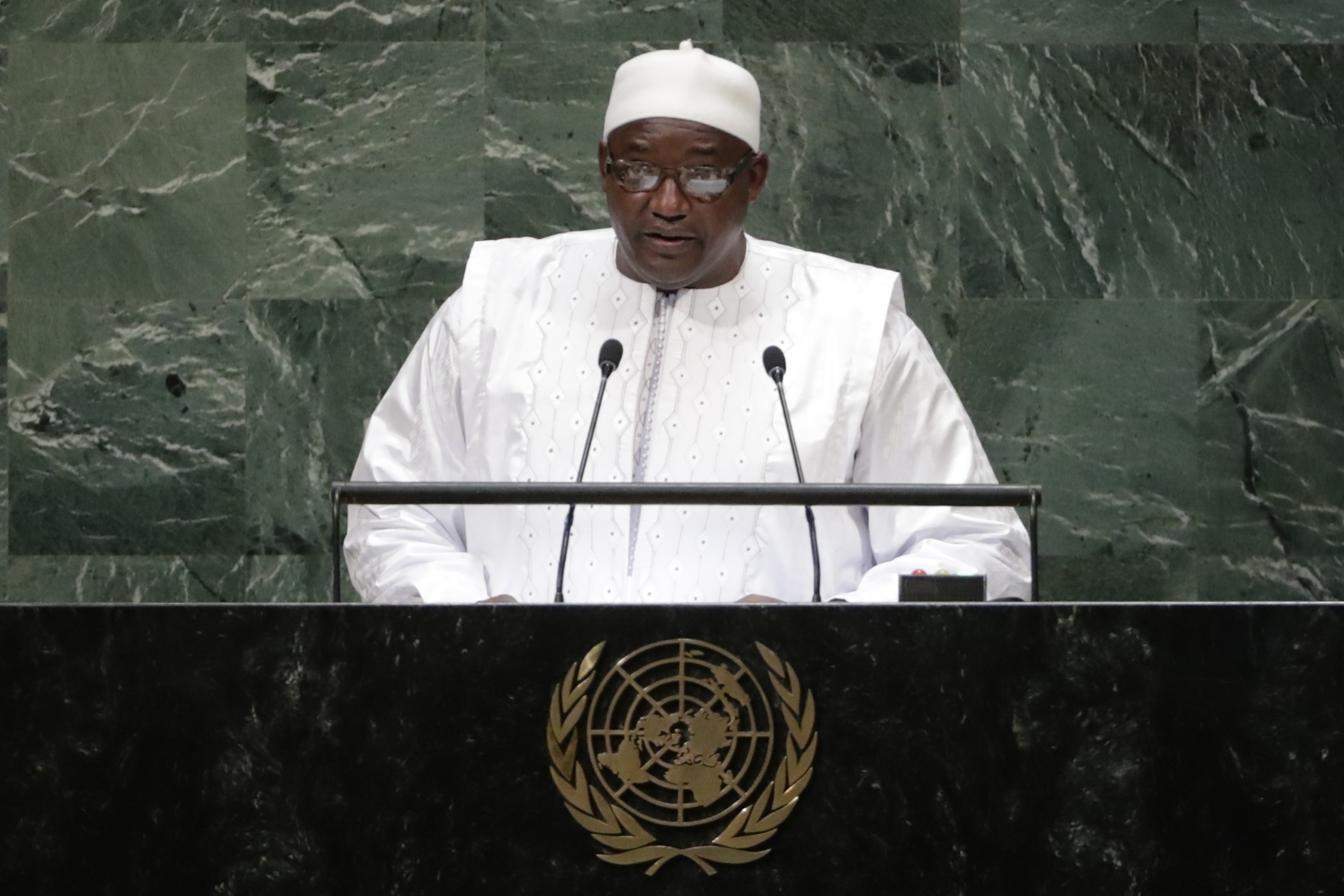
    The African country of The Gambia, headed by President Adama Barrow, is refusing to take back thousands of its citizens currently living in Germany and elsewhere in the European Union who have been issued deportation orders, blocking their repatriations back to West Africa.

    As a result of Barrow refusing to issue landing permits for deportation pilots from European Union countries since 2019, the bloc’s authorities have and continue to be powerless to deport 6,000 of the 16,000 Gambians currently residing in Germany who have been ordered to leave the country, Die Welt reports.

    The Gambia — where 95 percent of the population is Muslim — claims that it cannot take back its citizens who are residing illegally in Europe because they are “unable to be reintegrated back into society” — and if repatriated — would bring social unrest to the country. Thus, the government is refusing to comply with international law, which obliges country’s to take back their deported nationals.

    “Social unrest” can be expected when thousands of Gambian’s return, a spokesman for the Gambian government claimed. “We are trying to consolidate peace, stability, and democracy in our country.” 

    There are several reasons why President Barrow, who’s up for reelection this coming December, doesn’t want to see Gambian deportees who are living across Europe repatriated. One of the main reasons repeatedly given by Barrow is that the majority of the country’s population – composed of a little over 2 million people – believes that the departure of these young men now living across Europe has helped to eliminate crime and violence in the Gambia. If these young men were returned, they believe the crime and violence would inevitably come back as well, he claims.

    Furthermore, given Gambia’s dependence on remittances from Germany and the European Union, which comprise more than a fifth — exactly 21 percent — of its total gross domestic product (GDP), the country’s economy would likely see a sharp downturn if many of its citizens were repatriated. As a result, it would be ill-advised from a economic point of view for Barrow to allow deportation flights from Europe to land during the election campaign. 

    Per data from the International Monetary Fund (IMF), Gambians in the diaspora — composed of some 118,00 people living outside of the country — sent back €495 million ($588 million) in the year 2020.

    “Many livelihoods depend on money transfers from Europe,” said Julian Straiger, a representative of the Baden Württemberg Refugee Council.

    People like Emmanuel Bensah, a policy analyst on the Economic Community of West African States (ECOWAS) and the African Union, contend there are other factors like the COVID-19 pandemic which have played a significant role in influencing Gambia’s position on receiving deportees. 

    “Gambia’s president cannot be sure of the COVID-19 status of those who are being deported. In addition, the Gambia is a small country, and the health system has not been coping so well with COVID-19,” Bensah said, arguing that the arrival of deportees would, without a doubt, be an added burden for the country.

    In light of Gambia’s foreign policy behavior, authorities in Germany and Austria have become anxious that landing bans like the one enacted by President Barrow could become commonplace throughout Africa. According to international law expert Gawaya Tegulle, European governments are right to be nervous since Gambia’s decision is not isolated, noting that similar incidents involving the governments of Guinea, Eritrea, and Sierra Leone have already taken place.

  • ‘The most expensive group deportation flight in German history’ – Deporting just 33 people cost EU taxpayers €518,000

    ‘The most expensive group deportation flight in German history’ – Deporting just 33 people cost EU taxpayers €518,000

    Germany’s efforts to deport more illegal immigrants is hitting an operational and fiscal roadblock, as official figures show that voluntary departures are now outstripping state-executed deportations. Despite significant financial expenditure, almost 9,000 removal attempts failed in the first six months of the year alone.

    The financial burden of these operations is highlighted by a number of incredibly expensive or aborted deportation operations. In May, a chartered flight from Leipzig to Pakistan carrying 33 individuals subject to departure — escorted by 75 federal police personnel — cost approximately €518,000.

    The operation is now being referred to as “the most expensive group deportation flight in German history,” with funding provided by the European Border and Coast Guard Agency, Frontex.

    By contrast, German taxpayers directly absorbed the costs for two unassisted charter flights to Afghanistan in April and June, which each exceeded €300,000. Operations to various African nations, including Nigeria, regularly reached €400,000 per flight with Frontex support, while an additional €5.93 million went toward security personnel for repatriations.

    In other words, even small-scale deportation efforts are leading to exploding costs. Deportation numbers are also now falling, according to government data released following a parliamentary inquiry by the Left Party. The report reveals that federal authorities executed 9,663 deportations between January and June, a decline of 18.2 percent compared to the same period in the previous year. During this same timeframe, nearly 9,000 planned deportations failed to occur.

    While state-enforced deportations may be falling, more and more people appear to be willing to leave the country of their own volition. Border officials confirmed that 17,892 individuals required to leave the country departed on their own, with roughly 9,300 taking advantage of federal financial assistance to do so.

    Despite these exits, Germany’s overall backlog remains huge, according to Welt newspaper. By mid-year, roughly 259,000 foreign nationals obliged to exit the country remained in Germany. Of this group, 77 percent were granted temporary suspension of deportation and slightly more than 60 percent represented individuals whose asylum applications had been formally rejected.

    Even after cases were handed over to the German Federal Police, deportations were interrupted by administrative issues and even physical resistance. Out of 734 cancellations that occurred during this final phase, “130 were due to acts of resistance, and in 56 cases there were medical concerns.”

    At the same time, many pilots appear to be refusing to transport migrants slated for deportation. Pilots refused passage to scheduled deportees in 280 instances during the first half of the year, a notable rise given that 514 total refusals were logged throughout the entirety of 2025. Official records do not track the specific reasons pilots refuse to conduct these repatriations.

    To enforce compliance during transit, police utilized physical restraints in 786 cases, with such measures used “particularly frequently during repatriations to Algeria, Morocco and Nigeria.”

  • Spain’s Great Replacement: Half of unskilled construction workers are now foreign laborers

    Spain’s Great Replacement: Half of unskilled construction workers are now foreign laborers

    Spain’s construction industry is undergoing rapid demographic changes. Foreign-born workers in unskilled construction roles now make up 52.6 percent of all workers, according to data from Randstad from the first quarter

    The data shows that foreign workers now exceed Spanish nationals for these unskilled roles by nearly 11,000 workers. The contrast is stark compared to pre-pandemic figures, when domestic laborers outnumbered foreign counterparts by more than 33,500.

    Overall, the construction industry has lost 22,711 Spanish workers since 2019 while gaining 238,451 foreign employees, a figure that includes individuals with dual nationality. As a result, almost 36 percent of all construction workers, both skilled and unskilled, are now of foreign origin in the country.

    The shift is equally evident among bricklayers. In 2019, Spanish bricklayers outnumbered foreigners by 111,000. Seven years later, that gap has narrowed to just 18,000 workers. Foreign labor has gained more than 16 percentage points in this category and currently accounts for roughly 48 percent of bricklayers working in Spain. While Spaniards remain the majority in most skilled roles for now, the statistical gap continues to shrink rapidly. Experts also predict that foreigners will increasingly dominate skilled and managerial positions in the future.

    This transformation extends into specialized technical trades. The count of Spanish plumbers fell from 70,932 in 2019 to 57,781 today, while foreign representation doubled after adding over 10,000 workers. One in four plumbers in Spain is now foreign-born. Electricians show a similar dynamic, with about 32,000 foreign workers joining the profession since 2019, driving foreign representation up from under 11 percent pre-pandemic to nearly three out of ten today.

    Industry analysts expect these patterns to hold due to impending retirements and low replacement rates among younger Spaniards.

    Spain, like many other nations, is attempting to automate the construction industry as much as possible. However, instead of relying on advanced robots, Spain has so far shifted toward a modular construction approach in which concrete panels, bathrooms, and complete structural modules are built indoors in automated, factory-controlled settings that use machinery and assembly lines similar to those in the automotive sector. Cranes then assemble these modular components on site, requiring significantly fewer workers and dramatically cutting project delivery times.

    Countries such as South Korea, by contrast, are racing ahead in automated construction, precisely because nations like Spain continue to rely on mass immigration, which is often cheaper in the short term but more costly over the long run.

    South Korea does not only use automated construction in planning, but also in deploying commercialized robotics, automated modular manufacturing, and government-mandated smart construction.

    Automated facilities, such as Space Factory, use advanced robotic arms to cut materials, assemble structural panels, seal joints, and fit window frames without direct manual intervention.

    Unlike standard build sites in Spain, South Korean contractors actively deploy field robotics directly to job sites.

    Automated rebar-tying robots and robotic concrete sprayers and finishers are routinely used by major developers, such as Samsung C&T and Hyundai E&C, to reduce heavy physical labor on high-rise residential projects. In addition, unmanned excavators and bulldozers guided by real-time GPS and drone mapping handle heavy site preparation.

    Robots are even acting as supervisors to some extent, with autonomous quadruped robots, such as Boston Dynamics’ “Spot,” owned by South Korea’s Hyundai Motor Group, continuously patrolling construction sites, performing 3D laser scans to verify that progress matches digital blueprints.

    As Remix News has previously reported, automation, robotics, and AI are all leading elements of Asian economies, which have chosen efficiency and technology over mass immigration and cheap foreign labor.

  • Germany: African migrant tries to rape 3 women in a matter of minutes, then grab’s policewoman’s crotch during arrest

    Germany: African migrant tries to rape 3 women in a matter of minutes, then grab’s policewoman’s crotch during arrest

    A 24-year-old man from Gambia remains in custody after police arrested him in connection with a rapid series of alleged sexual attacks on three women in Heidelberg. During the incidents, he allegedly attempted to rape the three women in short succession by dragging them into a cornfield.

    Authorities say the incidents unfolded within roughly half an hour on Tuesday morning, Aug. 18, 2026, in an open field area beside the Pfaffengrund cemetery.

    According to statements from the Mannheim police headquarters and the Heidelberg public prosecutor’s office, the suspect was walking in the fields around 10:00 a.m. when he approached a woman who was out with her dog. He is accused of grabbing her by the chest and attempting to pull her into a nearby cornfield. The woman shouted and fought back, managing to break free and run away, according to German newspaper Wochenblatt.

    Minutes later, between approximately 10:25 and 10:30 a.m., the same man allegedly targeted two other female walkers separately. In each case he seized their hands or wrists and tried to force them toward the cornfield. Both women resisted vigorously, and he eventually released them without succeeding.

    Witnesses who saw the confrontations contacted emergency services. Officers launched an immediate search and detained the suspect a short time later. During the arrest, he is further accused of grabbing a female police officer’s crotch.

    The following day, the 24-year-old appeared before an investigating judge at the Heidelberg District Court. At the prosecutor’s request the judge issued an arrest warrant on suspicion of multiple counts of attempted sexual assault, sexual harassment, and additional related offenses. He was then transferred to a correctional facility.

    Investigators have indicated they are examining possible other incidents linked to the same individual. The joint probe by the Heidelberg public prosecutor’s office and the criminal police continues.

    The case has parallels with many other cases covered by Remix News over the years, including a case where a woman successfully fought off a migrant with a horse whip when he tried to drag her off her horse and rape her.

  • Romania’s years-long crisis of democratic legitimacy deepens

    Romania’s years-long crisis of democratic legitimacy deepens

    Romania’s ongoing political crisis is entering a more critical phase, with a collapsed government, an unresolved battle over the presidency and a growing conservative-nationalist challenge to the political order that has dominated the country for years.

    At stake is not just who governs Bucharest, but whether Romania’s institutions can recover public legitimacy after the extraordinary cancellation of the 2024 presidential election.

    The crisis dates back to November 2024, when independent nationalist candidate Călin Georgescu—to the surprise of many—finished first in the opening round of the presidential vote.

    Citing alleged electoral irregularities and intelligence—evidence that still hasn’t been disclosed to the public—claiming Russian interference in favor of Călin Georgescu, Romania’s Constitutional Court subsequently annulled the election.

    The court’s decision, therefore, erased an election result already delivered by Romanian voters and triggered one of the most serious democratic controversies in the European Union.

    Romania’s democratic clampdown deepened even further in March 2025 when Georgescu was barred from taking part in the rerun presidential election. The Constitutional Court upheld his exclusion, leaving the person who had won the original first round unable to compete when Romanians were sent back to the polls for a second time.

    The sequence of events became, for a broad cross-section of Romania’s population, undeniable proof of what many observers have begun to describe as “managed democracy”—meaning elections across the EU are “legitimate” only until voters choose someone “unacceptable” to the ruling establishment.
    It didn’t take long for news of the crisis to reach across the Atlantic. Vice President JD Vance used his 2025 Munich Security Conference speech to accuse Romania of having “straight up canceled the results of a presidential election based on the flimsy suspicions of an intelligence agency and enormous pressure from its continental neighbors.”

    The U.S. State Department’s subsequent Report on Human Rights Practices also leveled criticism that the annulment represented political interference and an unusually severe restriction on disfavored political speech. Elon Musk, for his part, in several posts to social media attacked the Romanian state’s treatment of Georgescu and described one official connected with the process as a “tyrant.”

    The episode resonated well beyond Romania because it touched a wider fault line running through European politics. Nationalist movements challenging Brussels on sovereignty, mass migration, security, green policy, cultural questions, and foreign affairs increasingly argue that institutional mechanisms are being weaponized to contain alternative political forces that can no longer be easily defeated—and may even be winning outright—at the ballot box.

    Romania’s own long-established, ruling elite class has since begun to fracture. Prime Minister Ilie Bolojan’s Brussels-aligned government was brought down on May 5 after the Social Democratic Party (PSD) abandoned the coalition and joined nationalist AUR and other opposition forces in backing a no-confidence motion.

    The result was overwhelming—281 lawmakers voted to remove the government, compared with only four against, well above the 233 votes required. The scale of the defeat exposed the government’s lack of legitimacy and revealed how quickly the firewall around Romania’s nationalist opposition had begun to crack.

    Especially noteworthy was the decision by the PSD, long one of the pillars of Romania’s establishment, to cooperate with the Alliance for the Union of Romanians (AUR). Whatever the parties’ differences, that cooperation showed that excluding AUR indefinitely from parliamentary influence was becoming increasingly difficult.

    President Nicușor Dan, so far, has failed to find a legitimate replacement. His nominee Adrian Veștea went before Parliament in June but secured only 189 votes—44 short of the 233 needed to install a government.

    The failure prolonged a political vacuum that has continued into August. Bolojan remains interim prime minister, while Dan has held repeated consultations with former coalition parties in an effort to maintain fiscal measures and secure Romania’s remaining EU recovery funds.

    The government’s paralysis has placed greater scrutiny on Dan himself. The right-wing S.O.S. Romania party formally initiated a constitutional procedure seeking his suspension under Article 95, alleging serious violations involving the separation of powers, government formation, the judiciary and democratic oversight of the intelligence services.

    S.O.S. leader Diana Șoșoacă said more than 400,000 Romanian living in the country and abroad had expressed support for Dan’s removal. She also claimed that 155 parliamentarians had indicated agreement with the suspension initiative, although the names of lawmakers outside her party were not publicly disclosed.

    The accusations against Dan include claims that he has blurred the constitutional boundaries of the presidency by involving himself too directly in judicial affairs. Critics have also objected to his public comments concerning the Constitutional Court and his consultations with magistrates.

    Another point of contention is Dan’s insistence on constructing what he has repeatedly called a pro-Western governing majority. His opponents argue that the Constitution requires the president to facilitate government formation rather than impose ideological tests on parties capable of assembling parliamentary support.

    Dan, for his part, has defended his approach as an effort to maintain Romania’s strategic orientation and produce a workable government. His supporters say the country’s position on NATO’s eastern flank, next to Ukraine, makes political and foreign-policy continuity especially important.

    The intelligence services have become another sensitive issue. Critics point to the absence of permanent civilian leadership at the Romanian Intelligence Service while proposals have circulated to expand the security apparatus into areas including corruption and tax enforcement.

    Such controversies carry particular historical weight in Romania, where memories of communist-era surveillance and the political power of the security services remain deeply embedded. Measures that might be treated elsewhere as routine institutional disputes can therefore trigger much deeper fears of political control.

    A separate 2026 rule-of-law report cited by critics has further intensified the argument over Romania’s Constitutional Court. The Civil Liberties Union for Europe report was cited as arguing that the court had effectively changed the law in its handling of electoral candidacies, raising questions about legal certainty and the scope of judicial power.

    The same report raised concerns over procedural protections for excluded candidates and discussed structural reform of the Constitutional Court itself. It also highlighted problems involving media independence, opaque political financing, and poorly defined anti-disinformation measures that can potentially restrict legitimate speech.

    Those findings have strengthened the case made by Georgescu’s and his supporters that the 2024 election annulment, described by many analysts as a constitutional coup, was never merely about one TikTok campaign. They see it as a confrontation over who ultimately sets the boundaries of acceptable politics—Romanian voters or institutions increasingly tied to a globalist, Brussels-centered political consensus.

    Romania’s crisis has moved beyond constitutional theory, as its political breakdown now collides with an economy facing some of the heaviest fiscal pressures in the European Union.

    Earlier predictions that Fitch could push Romanian sovereign debt into junk territory did not materialize this August. Fitch instead maintained Romania at BBB-, the lowest investment-grade level, while keeping a negative outlook and warning that prolonged political instability could undermine deficit reduction and jeopardize access to European recovery money.

    The reprieve should not be confused with economic security. Fitch expects Romania’s economy to contract by roughly 0.6 percent in 2026 and projects a budget deficit of about 5.9 percent of GDP—an improvement from previous years, but still exceptionally high for a BBB-rated state.

    S&P has likewise kept Romania at BBB- with a negative outlook. Both agencies have pointed to the ongoing political fragmentation, financing pressures, and the difficulty of sustaining fiscal consolidation while governments rise and fall in Bucharest.

    For ordinary Romanians, warnings like these translate into something much more tangible than ratings-agency terminology. They mean higher borrowing costs, increased pressure on household incomes, weaker growth, and further uncertainty over the country’s economic future. That helps explain why anger at political elites has persisted even as officials insist Romania remains firmly anchored inside the EU and NATO.

    The nationalist political revolt in Romania also forms part of a wider European trend. From the AfD in Germany and Marine Le Pen’s movement in France to populist forces in Italy, Austria and elsewhere, parties demanding national sovereignty, stricter immigration controls and, increasingly, remigration have forced issues once excluded from respectable debate into the political mainstream.

    Romania’s version of that revolt has developed around Georgescu and AUR, whose supporters increasingly compare their struggle with the movement that formed around Donald Trump in the United States. They view sovereignty, national identity, demographic security, economic accountability, and a nationally oriented foreign policy not as threats to democracy, but as core issues that any genuine democracy must be free to decide for itself.

    The Romanian establishment—and by extension its backers in Brussels—now faces an uncomfortable problem: attempts to isolate Romania’s traditional, nationalist, and patriotic electorate have not only failed to make it disappear, but have made it much stronger. The collapse of the governing coalition and the cooperation between PSD and AUR have shown that the old cordon sanitaire is becoming harder—if not impossible—to maintain.

  • Switzerland: 80.5% of North African asylum seekers have been accused of one or more crimes

    Switzerland: 80.5% of North African asylum seekers have been accused of one or more crimes

    Around 80.5 percent of asylum seekers from North African countries were accused of one or more offenses in Switzerland, underlining the massive amount of criminality present in this foreign population. The data comes from the State Secretariat for Migration (SEM).

    For asylum seekers as a whole, the rate of criminality is much lower, with only 12.5 percent having been accused of one or more offenses. Nationals from Algeria, Morocco and Tunisia are therefore extremely overrepresented compared to other asylum seeker groups.

    North Africans also have little chance of having their asylum applications accepted by Swiss authorities, with 99 percent of all applications rejected, according to Swiss newspaper Blick.

    In 2024, a “24-hour” rule was introduced for accelerated asylum procedures for North African countries, which enables Swiss authorities to process asylum claims with a low chance of success more quickly. Applicants can still appeal the decisions, which can significantly increase delay in reaching a final decision.

    “Criminals must leave Switzerland quickly. This is a priority of the asylum strategy,” said SEM spokesperson Daniel Bach.

    However, the process is often delayed by the actions of asylum seekers, including refusing to provide fingerprints and failing to show up for deportation appointments.

    Many applicants also obstruct the accelerated procedure: they refuse to provide their fingerprints, do not show up for appointments or quickly leave Switzerland. In these cases, their request can be filed without formalities.

    Authorities are now working to implement new measures to quickly deport asylum seekers, including the “systematic use of coercive measures against the perpetrators of repeated offenses.” Authorities are also planning to introduce stricter rules for administrative detention.

    The SEM also wants to increase cooperation with North African countries and recently signed an agreement with Morocco to accelerate the of asylum seekers ordered to be deported and help facilitate their return.

  • Full-face veils banned in Portugal after president signs ‘burqa law’

    Full-face veils banned in Portugal after president signs ‘burqa law’

    Portuguese President António José Seguro has officially signed into law a bill banning face-concealing attire in public spaces, with the move seen targeting the full-face Islamic veils like the burqa and niqab.

    Addressing the national debate, President Seguro framed the decision around human interaction, stating: “The face should be considered a central element of human identity and communication.” 

    However, the former Socialist Party leader acknowledged the controversial nature of the ban, recognizing it as a matter of significant cultural and social sensitivity.

    The law was largely backed by the country’s right-wing politicians and labeled the “burqa law” by Portuguese media. It passed parliament in July with the votes of right-wing parties, with the left firmly in opposition.

    The new legal framework strictly limits garments designed to hide one’s identity in public spaces. It also penalizes forcing individuals to cover their faces based on gender, religion, or age.

    Violators face financial penalties ranging from €150 to €3,000. There are, however, some exceptions. Wearing items that cover the face, such as medical masks, professional/artistic gear, and extreme weather wear, are all examples of exceptions under the law.

  • ‘Poles are drinking less and less alcohol’ – Non-alcoholic beer sales fail to save market

    ‘Poles are drinking less and less alcohol’ – Non-alcoholic beer sales fail to save market

    In the first half of 2026 alcoholic beer sales fell by as much as 11.9 percent, and despite the sharp increase in non-alcoholic beer sales, this trend is unable to arrest the dramatically deepening economic downturn in the brewery industry, which supports 85,000 jobs, including in agriculture, logistics, bars, and catering.

    The beer market has been falling continuously for eight years. Between 2018 and 2025, the market lost over 7.5 million hectoliters in beer sales, which corresponds to the annual production of three medium-sized breweries. In the first half of 2026, there is no sign of a rebound. According to data from the Polish Central Statistical Office, production of alcoholic beer fell by 11.9 percent compared to the same period last year.

    “The first half of this year is not encouraging. An alcoholic beer sales decline of almost 12 percent shows how troubled the brewing industry is in Poland. There are several sources, primarily the global NoLo trend (no or low-alcohol) or the ‘Better for You’ trend, which are increasingly effectively translating into the consumption behavior of Poles. Economic issues are also important: beer is a very price-sensitive product, and its retail price has increased by over 40% in recent years,” says Bartłomiej Morzycki, general director of the Association of Brewing Industry Employers Browary Polskie.

    Non-alcoholic beer gaining traction

    In the first half of 2026 production sold of 0.0 percent alcohol beers increased by as much as 16.2 percent, and in June by as much as 30.1 percent year over year.

    “Non-alcoholic beers are a daily choice for professionally active people, drivers and consumers who care about their health and consciously limit their alcohol consumption. They are increasingly choosing 0.0 percent products so as not to give up social rituals or the taste of beer itself. This is a pan-European trend that meets public health objectives,” said Bartłomiej Morzycki.

    Breweries unprecedented regulatory and financial pressure

    For almost a decade, breweries have consistently developed the 0.0 percent segment, investing in new technologies and innovative products. Variants without sugar and calories, enriched with vitamins and electrolytes, are appearing on the market. At the same time, research shows that non-alcoholic beer has a strong substitution effect, helping reduce alcohol consumption.

    “Recent CBOS research has shown that almost one in four Poles has given up alcohol, and among those who consume alcohol, more than half also reach for non-alcoholic beer. The substitution effect makes this segment of social, health and economic importance. Therefore, in many European countries it is supported by the state as an effective element of alcohol consumption reduction policies,” said Bartłomiej Morzycki.

    Meanwhile, several projects concerning the alcoholic beverages market are currently moving forward in Poland, which may hinder the further development of the non-alcoholic beer segment, including changes to the “Act on Upbringing in Sobriety and Counteracting Alcoholism,” as well as a proposal to abandon the current excise map. At the same time, the sugar tax in Poland might be expanded and the VAT for zero-income earners may also be increased.

    “Never before has the brewing industry faced such a large number of simultaneous changes. Each of them individually affects the operating conditions and competitiveness of beer in the alcoholic beverage market, and their combined impact may threaten the stability of many sectors in the brewing industry value chain. Moreover, the proposed changes go against the grain of socially acceptable alcohol reduction policies,” said the general director of the Polish Breweries Association.

    Risk to the entire economy

    The brewing industry represents 85,000. jobs, including thousands of farms and Polish enterprises in related sectors. Beer production accounts for approximately 0.56 percent of Polish GDP and contributes billions of zlotys to public finances each year in taxes and contributions.

    According to data from the Association of Brewing Industry Employers Browary Polskie, the industry uses approximately 400,000 tons of barley malt, 75,000 tons of other cereals, over 130 tons of alpha hop acids and approximately 30,000 tons of apples used to produce flavored beers. The reduction in production means lower orders for packaging manufacturers, logistics and transport companies, as well as lower turnover for retail and catering.

    “Poles are drinking less and less alcohol. If we add sharp tax increases and further administrative restrictions to natural consumer changes, we risk halting positive health trends and deepening the crisis of the entire value chain. Today, we need a well-thought-out, common-sense and emotion-free economic policy towards our industry,” said Bartłomiej Morzycki while speaking on behalf of the brewing industry.

  • ‘It’s terrible for us’ – Mohamed L. stabbed Alban Gervaise to death in front of his young children, and now just 4 years later, he’s being released

    ‘It’s terrible for us’ – Mohamed L. stabbed Alban Gervaise to death in front of his young children, and now just 4 years later, he’s being released

    Mohamed L. is being released in France after just 4 years in detention, the same man who brutally murdered 40-year-old military doctor and father Alban Gervaise in front of his young children in 2022.

    “It’s news that we’re trying to prepare for this early release after the murder, barely four years later. It’s news that is really hard to hear, that makes us really go back to our work of mourning for the children and me,” said Christelle Gervaise, the wife of Alban, in an interview with Legend TV.

    “It’s true that it’s hard to imagine being able to be in the same city as him. It’s true that it’s quite unbearable for us.”

    Alban was stabbed to death while waiting outside his children’s Catholic school to pick up his two sons, aged 3 and 7, while his 20-month-old daughter was inside his car, in Marseille in May 2022.

    Now, the killer will enjoy partial release during evenings and weekends “at liberty.”

    The mother, Christelle, is terrified, and the courts so far have refused to listen to her pleas to block Mohamed L. from being in the same city as her and her children.

    “I find that it is an additional concern in our lives that we didn’t really need. And I had to announce to my children this early release. There is necessarily a feeling of injustice. How can he leave prison so early after the murder of their father? And then, yes, there is a great concern on the part of my children. That’s for sure.”

    This clip is a condensed version of her full interview, but it showcases the horror a French family is facing, both from the murderer and from the French judicial system.

    In the interview, Christelle describes the moment of disbelief and grief when she first learned her husband had been stabbed.

    “This is not possible, this is not possible, what is happening,” she told herself.

    But it did happen, just as it has happened to countless Europeans year after year. Upon arriving on scene, she is greeted with an empty car and no sign of her children.

    “And in fact, I’m going to see a first policeman who is going to accompany me to see the principal this time, who reassures me, my children are safe inside the school, all three of them, but I learn from a policeman who comes that my husband is between life and death and has been transferred to the hospital for resuscitation,” she said.

    Alban spent 17 days in a coma, where she tried to tell him over and over again that the children were not harmed and that they needed their father.

    “And during those 17 days, I talked to him a lot and he … I hope he heard me. I will never know…. I kept repeating several times to Alban that our daughter is fine, that she is okay, that nothing happened at all. Because I imagine that as a father, for him, it was terrible to be attacked like that with a knife. And then to see that he was going to lose his consciousness. He must have felt it and imagined his daughter in danger.”

    “I also tell him that he can’t leave, he can’t leave us. Our children are very small, and I need him, the children need him.”

    Then, she describes the moment when she had to tell her young children that their father is gone.

    “The death announcement to the children is something that I will never forget and I think it’s the hardest moment of my life, really.”

    She was forced to sit her children down and let them know what happened to their father.

    “So I told them that I had terrible news to tell them, but that unfortunately, their father had died the night before,” said Christelle.

    Now, after the terrible ordeal of losing a father and a husband, the French court system is releasing their father’s killer with zero restrictions on him entering the same city as the family. While there is a direct contact ban, there is no guarantee they do not run into Mohamed L. on the street.

    Mohamed L. never even faced a trial. Why? He smoked too much cannabis and had a “psychotic break.” The court experts confirmed this, and just like that, authorities deemed he could not be held criminally responsible. No trial and freedom after just four years.

    “The fact that he is not imprisoned like a murderer for 15, 20 years in prison. It’s terrible for us. It’s terrible to know the violence Alban has suffered. And in addition, we must accept that after four years, his murderer is outside on evenings and weekends.”

    “I am very worried, first of all, about the risk of recidivism. And then I find that for us, it is also a concern, since this person has the right to come to Marseille.”

    She said that the authorities involved in the decision say Mohamed L. “must be able to benefit from it, he must have the necessary care.”

    The murder already led the children to be forced from their own school. Now, they may have to leave their own city.

    “My children have already had to change schools since it happened. They had to change friends. If, in addition, I tell them that we are leaving the city completely because the murderer and their father have the right to go where they want, I think that it is difficult to understand for them. I can’t help but say to myself, I don’t know where he is, I don’t know what he’s doing,” Christelle said.

    She is fighting desperately with her lawyer to ensure this killer is no longer allowed in her city.

    “The goal is that, is to have a measure that makes it forbidden for him to go to Marseille.”

    “It is something that we carry on our shoulders with the children and that we will carry for a very long time.”

    After his arrest, while held at Baumettes prison, he attempted to assault a guard, which contributed to his transfer to a psychiatric unit for difficult patients (UMD). This occurred after the murder and presumably, cannabis was not a factor in this assault.

    Shockingly, during the trial, one of the psychiatrists openly said that they cannot predict whether the murderer will “relapse.”

    “The question of the risk of a relapse. One of the psychiatrists had answered that it was a bit like predicting a plane crash, that it was impossible to predict. Psychiatrists who take care of this type of patient do not have a crystal ball to be sure that there will be no relapse. And this risk is still to be taken into account in the decisions to allow this person to be in the street today,” she said.

    In other words, psychiatric experts admit Mohamed L. may murder again, yet, he is being allowed out on evenings and weekends anyway.

    Christelle still has questions about how the man was deemed psychologically unfit to stand trial.

    She said that after passersby tackled Mohamed L., he screamed: “In the name of Allah, I gave him 30 stab wounds!”

    In response, Christelle said: “I always ask myself the question of something that was more premeditated than what you want to make me believe… We are talking about someone who can kill someone in the street. My husband only lasted a few moments. It’s not a fight, it’s a murder.”

    “You think he’s going to go to prison. It doesn’t happen as planned. In relation to the trajectory of the murder of my husband,” she added.

    “What is complicated, in fact, with this decision, is that we have no idea of the deadline. We don’t know how long he’s going to stay at the hospital in a closed unit. We don’t know how to answer this question. And despite everything, we can still hear that it is difficult to announce to his children that the murder of their father is not condemned to prison, but will have care for an undetermined duration. I also felt deprived of answers to certain questions,” she said.

    Regardless, three children are now missing a loving father, with Alban’s wife describing a happy home life before his murder: “We had a life with Alban who was quite classic and very happy. We met in 2009. I was a medical student and he was an intern. We got engaged and then we got married. We had three children. We moved several times because Alban was a military doctor. So we met in Lorraine. Then we went to Paris for his work. Then to Marseille in July 2021. And we really had a very happy family life because Alban was a very loving husband, very loved and a father really present for his children and very invested in his role as a father.”

  • ‘This is the first femicide our city has seen’ – Tunisian migrant arrested for stabbing his Polish wife 4 times in the throat near Rome

    ‘This is the first femicide our city has seen’ – Tunisian migrant arrested for stabbing his Polish wife 4 times in the throat near Rome

    During a marital argument, a 69-year-old Tunisian, Mohamed Habib Rouissi, allegedly murdered his 50-year-old Polish wife, Joanna Rouissi, by stabbing her four times in the throat in the town of Colleferro near Rome.

    During the argument and murder on Aug. 18, their nine-year-old son witnessed the brutal murder of his mother, and the couple’s eldest son, 20, was also in the apartment and was unable to stop his father.

    After killing Joanna, her husband reportedly dropped the knife and fled the scene. The daughter, who returned home moments later, found her younger brother terrified and her mother dying. Despite the intervention of the paramedics and attempts at resuscitation, the victim died at the scene, according to Italian newspaper il Fatto Quotidiano.

    As part of the immediate operational activities undertaken, police officers from the Colleferro police station detained Mohamed Habib several hundred meters from the murder scene. The man did not resist and confessed to the crime during questioning.

    The Tunisian is now under pre-trial detention.

    The Velletri prosecutor’s office is conducting an investigation into the murder, determining the exact course of events and the perpetrator’s motives.

    The mayor of the town has also spoken out.

    “From what we can understand, the lady was quite well known in the area and by some families of Colleferro. From what emerges, there were some signs of this situation which, however, evidently escaped authorities’ attention or were not considered so dangerous,” said the mayor of Colleferro, Giulio Calamita, while speaking to LaPresse. “This is the first femicide our city has seen in its modern history. A man, reportedly with mental problems, killed his partner. This is yet another tragedy after a difficult week, terrible news that has shaken a family of five children, one of whom is a minor. In these hours, we have given them as much support as we could and will continue to do so in the coming days. I’m sure the city will also find a way to react to this bad story.”

    Investigators are also checking whether the family has previously reported cases of domestic violence. According to preliminary findings, tensions had been brewing between the spouses for some time. The couple’s five children were placed in a care facility.

  • German police arrest large dark-skinned man for sexually assaulting 11-year-old girls

    German police arrest large dark-skinned man for sexually assaulting 11-year-old girls

    Two different sexual assault targeting young female minors occurred nearly at the same time on Saturday in swimming pools in close proximity to one another, with one of the suspects still on the run.

    At around 3:45 p.m., a dark-skinned male was arrested for sexually assaulting two 11-year-old girls at an outdoor swimming pool in the German city of Untersteinbach. The man allegedly touched their thighs and legs in the water, with pool staff moving in to detain the man until police arrived.

    Police have not released the man’s nationality, but he was described in the police report as 100 kilograms, or 220 pounds. Furthermore, they said the man was a 37-year-old with dark skin and was 1.83 meters tall, or 6 feet tall. He has black, curly hair and a “high forehead,” according to the Tag24 news outlet, according to Tag24 news outlet.

    Authorities are still searching for witnesses and do not rule out that other victims could come forward.

    Second sexual assault suspect remains on the run

    Almost at the exact same time, a similar sexual assault at yet another German swimming pool occurred at the outdoor swimming pool at Rendelstraße in Öhringen. There, a “tan-skinned” perpetrator sexually assaulted a 14-year-old girl, groping her buttocks and grabbing her stomach three separate times in the water.

    She told police the suspect had “tan” skin, short black hair, dark eyes, tall, is between 40 and 50 years old, and had a face with distinct wrinkles. He was dressed in black with a black bathing suit.

    The man was with a group of five to six other men at the time.

  • France: Indian accused of raping two coworkers wins supervised release due to legal technicality

    France: Indian accused of raping two coworkers wins supervised release due to legal technicality

    An Indian employee of a catering firm in the Val-d’Oise department of France, located near Paris, has been indicted on charges of raping two vulnerable migrant colleagues but will continue to remain free on the street under judicial supervision. The decision stands after the prosecution’s appeal was dismissed for having been filed beyond the statutory deadline, a legal technicality.

    According to details reported by French newspaper Le Parisien, the case began on April 17 when an undocumented worker of Sri Lankan origin employed by the same caterer in Saint-Ouen-l’Aumône went to the police to accuse a 34-year-old Indian colleague of rape. She alleged that he had exploited her precarious migration status to rape her, counting on her silence out of fear that she would lose both her job and any chance of being legalized to stay in France.

    A short time later, a second female employee of the company lodged a complaint of rape against the same man, describing circumstances that were essentially identical. Both women said the man raped them and then blackmailed them due to their illegal status to win their silence.

    In early July, the man was arrested at his home in Pontoise. He had worked for the catering firm since 2015, is the father of three children and had no prior criminal record.

    Placed in custody, he firmly denied the allegations during questioning and claimed he was the victim of a plot hatched by the women.

    Despite his claims, he was subsequently indicted for the rape of vulnerable persons. However, the judge ordered his release under judicial supervision, requiring him to live in Normandy and forbidding any contact with the two migrant women he allegedly raped.

    The public prosecutor’s office, persuaded that pre-trial detention was necessary, lodged an appeal against the release order. A procedural failure inside the services of the Versailles Court of Appeal, however, meant the file could not be examined within the legal fifteen-day period. Consequently the investigating chamber had no option but to record the missed deadline and uphold the judicial supervision already imposed on the indicted man.

    The suspect’s employer, which operates sites in both Paris and the Val-d’Oise, quickly terminated the man’s employment.

  • Another Ukrainian suspect arrested in Croatia in connection with Nord Stream pipeline explosion

    Another Ukrainian suspect arrested in Croatia in connection with Nord Stream pipeline explosion

    A Ukrainian national suspected of involvement in the 2022 sabotage of the Nord Stream gas pipelines has been detained in Croatia and faces extradition to Germany, according to an announcement from the German Federal Public Prosecutor’s Office in Karlsruhe.

    On the morning of Aug. 19, 2026, local police executing a European arrest warrant in the coastal city of Pula arrested the man, identified under German privacy rules as Vladimir Z., also referred to in some reports as Volodymyr Z.

    The warrant had been issued by an investigating judge at Germany’s Federal Court of Justice on June 3, 2024. Prosecutors describe Vladimir Z. as a trained scuba diver who is strongly suspected of jointly causing explosions, anti-constitutional sabotage, and the destruction of buildings and structures.

    According to the prosecutor’s statement, Vladimir Z. belonged to a group centered around separately prosecuted Ukrainian national Serhii K.

    In September 2022, the group is alleged to have planted explosives on the Nord Stream 1 and Nord Stream 2 pipelines near the Danish island of Bornholm. Vladimir Z. is said to have taken part in the necessary dives.

    The team departed from Rostock, Germany, aboard a sailing yacht that intermediaries had rented from a German company using falsified identification documents. The explosives detonated on Sept. 26, 2022, causing extensive damage to both pipelines.

    Upon extradition from Croatia, Vladimir Z. is expected to appear before the investigating judge at the Federal Court of Justice. German authorities are actively pursuing the transfer.

    This marks the second major arrest in the long-running German investigation. In June and July 2026, prosecutors filed an indictment against Serhii K., a former Ukrainian army officer, before the Hanseatic Higher Regional Court in Hamburg. He faces charges including co-perpetration of a war crime through an attack on civilian objects, causing an explosion, destroying infrastructure, and disrupting public services.

    Prosecutors allege that Serhii K. acted on behalf of Ukrainian state entities, helping to plan and lead an operation aimed at permanently disrupting Russian gas deliveries and denying Moscow revenue that could fund its military campaign. Both K. and Ukrainian officials, including former army commander Valery Zaluzhny, have denied the claims.

    Z. had previously been the subject of an extradition request in Poland. In October 2025, the District Court in Warsaw refused to hand him over to German authorities, lifted his pre-trial detention, and ordered his immediate release.

    The Nord Stream explosions remain one of the most consequential acts of infrastructure sabotage in recent European history. Two of the three operational strands of Nord Stream 1 and one of the two strands of Nord Stream 2 were ruptured. The second Nord Stream 2 line, with an annual capacity of 27.5 billion cubic meters, had never entered service. At the time, Russia had already curtailed deliveries through Nord Stream 1 amid sanctions and technical disputes, while European governments accused Moscow of weaponizing energy supplies. Russia has repeatedly pressed Germany to activate the remaining capacity.

    German investigators continue to treat the case as a matter of domestic jurisdiction because the pipelines terminate in Germany and their destruction affected the country’s energy security. Media reports, including those from Der Spiegel, have long described the operation as originating with Ukrainian actors.

    Some accounts have suggested that U.S. intelligence, including the CIA, was aware of early planning discussions and did not initially object, even examining technical aspects. However, there has been no official confirmation of any American role in preparing or executing the sabotage, and such claims remain unproven.

  • Ukraine corruption scandal deepens: ‘Operation Forrest Gump’ shocks Zelensky government with more searches

    Ukraine corruption scandal deepens: ‘Operation Forrest Gump’ shocks Zelensky government with more searches

    Ukrainian anti-corruption services launched searches under codename “Operation Forrest Gump,” targeting, among others, the deputy head of the Office of the President of Ukraine Volodymyr Zelensky. The move expands the ongoing anti-corruption investigation which has seen a number of top officials in Zelensky’s cabinet flee to Israel shortly before police could raid their homes.

    The National Anti-Corruption Bureau of Ukraine (NABU) and the Special Anti-Corruption Prosecutor’s Office (SAPO) announced they were conducting a special operation involving a criminal organization led by a current and former member of parliament, with the participation of high-ranking officials from the Office of the President of Ukraine.

    “NABU and SAPO are conducting a special operation aimed at exposing a criminal organization that operated under the leadership of a current and former member of the Ukrainian Parliament, with the participation of high-ranking officials of the Office of the President of Ukraine and other individuals. Details – coming soon,” announced the anti-corruption services on Telegram.

    The operation is codenamed “Forrest Gump,” also referred to as Forest Gump. Ukrayinska Pravda sources and other media reported that NABU and SAPO are conducting searches as part of this special operation at premises belonging to MP Vadym Stolar, who was elected to parliament on behalf of the currently banned Opposition Platform – For Life party.

    In addition, Iryna Mudra, deputy head of the Ukrainian Presidential Office, is also targeted in the raids.

    Stolar has confirmed the investigative actions at his home and stated he is fully cooperating without obstruction.

    Additional figures linked by media and law-enforcement sources include former MP Maksym Mykytas, officials from the Ministry of Justice, and senior management of the state-owned Sense Bank including the chair of the board and supervisory board. Searches were also reported at the bank premises.

    NABU has released excerpts of intercepted conversations.

    Fragments reference “bags of money,” discussions of registering assets or proceeds in the names of children, including high tuition costs, the “Forrest Gump” name itself in a context of concealing theft, and mentions of the Office of the President.

    As EuroMaidan writes, “The operation carries a mocking name, Forest Gump, drawn from the suspects’ own words. In a 47-second recording of intercepted conversations, one man ties the label to how the group allegedly hid money.”

    The suspect mocks that one of the co-conspirators used his children’s own name to register the stolen money.

    “We’ve got Saving Private Ryan, right? But only an idiot would register the theft of money—and their tuition on top of it—on their own children. That’s why, Forest Gump,” he said.

    Ukrainian anti-corruption investigators reportedly chose the name “Forrest Gump” to mock these statements from their own criminal targets.

    Other parts of the conversation reference cash and the presidential administration directly. “Well, there are four bags of money there,” one voice says on the tape.

    Another chimed in, saying: “If we do this, you can drive to the Office of the President yourselves. Believe me. I can see it.”

    Investigators allege the group gained effective control over Sense Bank around early June 2026.According to NABU/SAPO details released as part of the operation, the group organized money laundering of $3.5 million in cash (UAH 150 million).

    The funds were introduced into legal circulation through accounts of shell companies and Sense Bank to post bail for one of the defendants in the earlier “Midas” case, which was linked to former Energy and Justice Minister Herman Halushchenko.

    Cash was reportedly delivered in tranches, processed via controlled entities, and partially directed toward the High Anti-Corruption Court bail account. Allegations include that Mudra was expected to help arrange the raising of these funds and that unidentified individuals from the President’s Office tasked her with efforts related to bringing Sense Bank under greater control.

    Investigators also seized a document described as an anti-crisis communications playbook outlining steps and messaging to shape public opinion around a Verkhovna Rada temporary investigative commission, framing it as an “audit, not attack” while shielding President Zelensky and his cabinet.

    The probe has also documented alleged attempts to place controlled individuals in NABU and other law-enforcement bodies.

    Incredibly, NABU has already posted these documents directly to Telegram.

    Who is involved in the broader corruption scandal in Ukraine?

    One of the main suspects in the related investigation is businessman Tymur Mindich. He is the co-owner of the Kwartal 95 production studio, which was founded and headed in the past by Ukrainian President Volodymyr Zelensky.

    Fearing arrest in the Energoatom affair (Operation Midas), Mindich fled to Israel. The Midas case centers on alleged large-scale kickbacks, approximately 10–15 percent of contract values, at the state nuclear company Energoatom, involving roughly $100 million in illicit funds, with the group using code names and cash deliveries.

    During searches of Mindich’s premises in November 2025, investigators found large quantities of cash and a golden toilet, along with a golden bidet, in one of the bathrooms of his opulent Kyiv apartment —details that became a public symbol of excess and were widely referred to as the “golden toilet scandal,” which Remix News reported extensively on.


    Mindich was not the only key figure to flee to Israel. His close associate, Oleksandr Tsukerman, also fled. The country does not extradite its citizens but Ukraine later imposed sanctions and issued international arrest warrants.

    Among the suspects in the Midas scandal was the former head of Volodymyr Zelensky’s office, Andriy Yermak. The former head of the Ukrainian Presidential Office has been charged under the Criminal Code of Ukraine with laundering property obtained as a result of a crime. The alleged laundering of UAH 460 million, about $10.5 million, allegedly occurred during the construction of the Dynastia luxury housing complex in Kozyn near Kyiv.

    According to investigators, some of the funds used for the construction may have come from corruption activities at Energoatom. The court then issued an arrest warrant for Yermak.

    It stipulated that he would be able to be released if he paid bail of 140 million hryvnias. In mid-May, Andriy Yermak was released from custody after posting bail.

    The Forrest Gump operation is now being presented as connected to the wider Midas network of allegations involving high-level influence over strategic state enterprises, money laundering, and related luxury projects. Developments remain ongoing, with NABU indicating further details would be released.

    Polish state media outlet TVP reported: “The latest operation could further intensify scrutiny of the political establishment as President Volodymyr Zelensky’s government faces pressure to demonstrate progress in tackling corruption while Ukraine continues its war with Russia. It also poses a fresh headache for Zelenskyy after ousted defense chief Mykhailo Fedorov called for wartime elections in a bombshell statement late on Tuesday.”

    The question now remains: Is the noose tightening around Zelensky himself, or will he emerge from this massive corruption scandal of close associates squeaky clean?

  • ‘If two Arab boys need to be taken care of, I’m not sending in two girls’ – Hospital staff under threat in Germany due to mass immigration

    ‘If two Arab boys need to be taken care of, I’m not sending in two girls’ – Hospital staff under threat in Germany due to mass immigration

    When victims of organized migrant clan violence arrive at emergency rooms in Berlin, the impact extends far beyond the trauma bays. According to Felix Wolf (a pseudonym), a veteran emergency nurse with a decade of experience in a Berlin hospital, treating wounded clan members subjects medical staff to high-pressure security lockdowns, escalating street-level intimidation, and systemic stress.

    According to Wolf, who spoke with Welt newspaper, violent incidents involving knives and firearms are becoming routine occurrences that frequently bypass official crime statistics.

    “We are increasingly dealing with injuries from shootings and stabbings in the clinics,” Wolf said. “Not all cases become public or end up in the crime statistics, because especially in cases of simple stab wounds, the police are not always called in. We have such cases several times a week.”

    The official data already shows a sharp rise in violence not only in Berlin but across all of Germany. Berlin, in particular, has been hard hit by a wave of violent gang warfare, which has seen a record high number of shootings in 2025. Reports indicate that the number of shootings has only intensified in 2026.

    Wolf noted a trend toward younger offenders who demonstrate intentional lethality in their attacks: “Not only is the quantity increasing, but also the quality: especially among knife attackers, the perpetrators are getting younger and younger. I often treat 15- or 16-year-olds who know exactly where to aim in order to cause the greatest possible damage.”

    The violence does not end on the streets either but often extends into the hospitals. When gunshot or stabbing victims arrive – often unannounced or brought in directly by associates – hospital protocol demands rapid security measures to secure the facility. To reduce the risk of retaliation or targeted harassment if a clan member patient dies, hospital staff adjust their daily routines and assignment distributions:

    “This leaves us in nursing with great uncertainty: To what extent can we rely on support when we have to defend ourselves? Up until now, we’ve always been lucky that nothing worse has happened. But perhaps you remember the camera footage from New Year’s Eve when a nurse was knocked unconscious in another hospital? That happens too,” Wolf warned. “I haven’t worn a name tag in the emergency room for years because I don’t want to be identifiable. We take precautions: If two Arab boys need to be cared for, I don’t send in two girls, but at least one man. I also try to keep colleagues with Jewish surnames out of such a case.”

    When a gunshot victim from a clan arrives at the hospital, police are immediately informed, according to Wolf, “In most cases, the injured come on foot or are dragged literally by a relative. As soon as certain surnames are mentioned, we’ll call the police.”

    The police response often involves large-scale deployments to prevent secondary conflicts on hospital grounds.

    “Thankfully, the officers have always arrived faster than the relatives in our country so far. Then 15 to 20 team cars with hundreds of them roll up, and all you hear for five to ten minutes are sirens,” Wolf said. “Everything will be sealed off, not just the hospital grounds, but entire streets up to the nearest subway station. That’s quite impressive. They screen in advance exactly who could drive in where, stop cars and conduct identity checks.”

    During these incidents, emergency room operations are regularly halted.

    “The injured person is usually already lying with us, accompanied by the two or three guys who brought him here. Then the police arrive and determine the personal details, photograph and confiscate evidence. The procedure often takes several hours – during that time the emergency room is temporarily closed. New emergency patients cannot be admitted during this time.”

    In other words, not only have these criminal migrant gangs turned the streets of Berlin into the Wild West, but due to security precautions involved in such cases, entire emergency rooms are shut down, leaving patients unable to enter and receive treatment in their own city.

    When family members start arriving, it often means the trouble is only beginning. Wolf described up to 40 family members arriving in some cases, often organized through Telegram channels, where they “want to show a presence in an often aggressive way.”

    “In these circles, it is common for mothers and women to shout loudly and dramatically. This high noise level is a stress factor for staff and also for patients. In the clinic, this can still be managed to some extent; at the deployment site, it is significantly more difficult,” said Wolf.

    The medical outcome of a patient can dictate the level of immediate danger faced by hospital workers and first responders.

    “Thank God no clan member has ever died here. This might sound harsh, but we are always happy when the injured person dies on site and not here,” Wolf stated. “The stress that officers have to put themselves through in such a case is enormous: Because normally no one from the rival clan is there anymore, the police officers and emergency services are then attacked.”

    Due to security budget limitations across clinics, staff must rely primarily on municipal police protection while implementing their own personal safety protocols.

    “We must rely on the police. Money for one’s own security services isn’t very easy. I know clinics where you’re happy if even one security guard is on site at night,” Wolf observed. “Fortunately, the Berlin police are well-positioned and not hesitant. It is appalling under what conditions the police officers have to cope with such situations – and how, in the following days, individual images are repeatedly taken out of context and used against them.”

    Wolf also addresses a German society rapidly trying to adapt to expanding violence, in which the victims are being taught to deal with being a victim, instead of perpetrators, often violent, being held accountable for their actions.

    Wolf expressed skepticism toward institutional de-escalation courses, arguing they misplace responsibility onto healthcare workers: “Many clinics offer self-defense or de-escalation training. But I’m not a big fan of that. Many courses attempt to professionalize dangerous situations in such a way that a kind of perpetrator-victim reversal takes place. Why should I adapt to a situation that stems from the fact that the other person hasn’t learned how to behave decently?”

    The crisis goes even deeper, threatening the entire health system by contributing to medical staff burnout, which is likely costing lives. The combination of workplace stress and safety concerns has led to high turnover rates among emergency care personnel, with many leaving the field within five to six years.

    “Brutalization is a societal issue,” Wolf stated, saying that the amount of time staff are sticking around is dropping to five or six years at the most, with most moving on to other fields

    “To a certain extent, this is due to a political failure: the authorities and the health system are being let down. But this brutalization is also a societal question.”

    Wolf highlighted the difficulty of discussing specific patient demographics without facing public criticism or accusations of bias:

    “Anyone who addresses such topics and clearly identifies the clientele that causes them will immediately get a dressing-down. ‘That’s not how you should say it; that’s too generalizing’, it then says. That may be true – but we simply do not have these difficulties with other groups of people. The fact that we cannot address this is a problem. I constantly get accusations of racism. Colleagues in the medical field and also in the police force understand what I mean. However, in certain Berlin circles, this issue is considered socially unacceptable.”

    He claimed that voting for the AfD is not the answer, since he claims the AfD was especially opposed to the medical field during the Covid-19 pandemic.

    Responding to political narratives, Wolf rejected the idea that voting for far-right parties like the AfD provides a solution, citing past hostility toward healthcare workers during the Covid-19 pandemic.

    “During the pandemic, these very people declared us fair game,” he said.

    An exhaustive search was conducted and there is no evidence any AfD member ever called for attacks on medical staff. There was criticism of the way the medical establishment handled the Covid-19 crisis, but there is no evidence there were any efforts to unleash violence on medical staff.

    Wolf also stated that not all migrants can be blamed for attacks on medical staff, claiming that AfD members “are welcome to ask themselves if they would want to come and clean in our hospital for that kind of pay. Therefore, I do not want to turn our problems with clan members into a general migration debate.”

    Certainly, across the country, there are AfD voters and members in cleaning jobs. In fact, AfD has the largest share of low-income and working-class voters of any party in Germany.

  • ‘I have trouble behaving around girls’ – Palestinian migrant convicted for sexually assaulting 15-year-old French girl on a bus

    ‘I have trouble behaving around girls’ – Palestinian migrant convicted for sexually assaulting 15-year-old French girl on a bus

    Following a trial, a 29-year-old Palestinian has been convicted of sexually assaulting a 15-year-old girl on a bus in the French city of Toulouse. The girl, named Clara to protect her identity, openly sobbed in court while sitting next to her mother.

    On June 18, the young girl was riding the L11 bus in the city when the Palestinian migrant, Ahmed, sat next to her. Ahmed spoke in court through a translator, claiming he thought he saw the teenager give “a sign” to him that she wanted to get to know him. Ahmed said he was attracted to Clara “at first sight.”

    After Ahmed got on the bus, he went to sit next to the victim, at which point he began to rub her shoulders before he grabbed her transport card, which she had been holding between her legs, according to French news outlet La Depeche. He then grabbed her thighs before moving his hands to her chest. The Palestinian was then arrested after a criminal complaint.

    In court, after recounting that he was attracted to Clara, he apologized for his sexual assault in criminal court, saying: “I thought carefully. I would like to apologize. I have trouble behaving around girls. That day, I was elsewhere, I behaved badly.”

    “Do you realize that she is traumatized?” the judge responded.

    Ahmed fled Gaza and arrived in France in March 2025. He said he has had a difficult existence in France living on the street and in squats. He also says he has been actively consuming cocaine and alcohol “to suffer less psychologically.”

    He was then given taxpayer-funded social support and offered accommodations in Cugnaux.

    Ahmed told the court that he experienced war and violence during his childhood and adolescence.

    The court found Ahmed guilty and sentenced him to six months in prison with continued detention. He is also being banned from French territory for two years and is no longer allowed to participate in any activity involving minors. He will also be a registered sex offender.

    A civil case may also rule on further damages related to the 15-year-old girl he targeted.

    This is far from the only incident in Toulouse. Last year, Remix News reported on a 54-year-old Senegalese migrant who committed serial sexual assaults on the city’s bus lines over the course of three years, with the man targeting multiple women at different times.

    In 2025, Remix News reported that sexual assaults on French public transport had risen 86 percent over the preceding ten years.

  • France: Body of young TikTok influencer found burned and naked in a vineyard near Nimes

    France: Body of young TikTok influencer found burned and naked in a vineyard near Nimes

    French authorities have launched a murder investigation after an agricultural worker discovered the partially charred, naked body of a woman in a vineyard last week near Nîmes. While official identification remains pending, the victim is believed to be 29-year-old Sonia Bellina, a popular social media influencer who went missing on Aug. 10.

    Bellina, who lived between Paris and Nîmes, built a following of nearly 380,000 users across two TikTok accounts and 13,000 followers on Instagram.

    The Nîmes public prosecutor’s office opened the homicide inquiry following the Aug. 12 discovery in Saint-Gilles, located roughly 12 miles outside Nîmes. The investigation has been assigned to the Gard gendarmerie group and the Nîmes gendarmerie research section.

    Speaking to reporters, a woman identifying herself as the victim’s older sister, Mia, said Bellina vanished after leaving for a date the night before the body was found, according to French news outlet Le Dauphine.

    “She told us she was going out one evening, she never came back,” Mia said, adding that her sister was scheduled to meet someone she had been seeing. “She ran into the wrong guy at the wrong time.”

    Family members have pushed back against online speculation regarding Bellina’s personal life and background, pleading for privacy as the investigation unfolds.

    No arrests have been announced, and French authorities have not officially named a suspect in the ongoing investigation. The family is pleading for witnesses or people with information about the murder to come forward.

    The Nîmes prosecutor’s office assigned a dedicated criminal task force of up to 40 gendarmes to comb the vineyards for microscopic forensic evidence and map out her final movements.

  • What ‘red lines?’ Ukraine launches massive drone attack against Moscow as drone strike intensity reaches record high

    What ‘red lines?’ Ukraine launches massive drone attack against Moscow as drone strike intensity reaches record high

    A total of 620 drones were launched at the Moscow region last night, with Russian air defense forces claiming to have shot down 180 of them during an intense overnight attack. The massive attack underlines a growing reality: Russian President Vladimir Putin had said at the beginning of the war that any attacks on Russian soil would be a “red line.” Now, there are daily attacks ravaging the country, with Ukraine striking critical energy structures, residential buildings, and major logistics warehouses.

    Moscow Mayor Sergei Sobyanin reported on the attacks on Tuesday, Aug. 18, noting that due to the scale of drone launches, it was one of the largest Ukrainian airstrikes aimed at the region since the war began. The TASS news outlet claimed it was the largest.

    The mayor noted that emergency services were actively deployed to sites where debris fell, though he did not provide immediate specifics regarding overall damage or fatalities.

    Wildberries up in smoke

    In the Moscow region, falling debris damaged a logistics facility belonging to Wildberries, Russia’s largest online retailer, causing a localized fire. This follows Ukraine’s efforts to successfully strike Wildberries logistics hubs across the nation.

    To put the Wildberries attacks in context, some figures put the company at 8.5 percent of Russia’s GDP. The company is often called the “Amazon of Russia,” employing 270,000 people and accounting for half of the country’s e-commerce sales. Ukraine has been systematically destroying Wildberries warehouses across the country with near impunity. It would be the equivalent of an enemy state destroying the largest Amazon warehouses in the United States, which would likely spark a consumer panic and send product inflation soaring.

    In addition, Russia’s oil refineries and critical energy infrastructure are now being dismantled by Ukrainian drone strikes, threatening a major financial resource for Moscow and leading to fuel rationing across the country.

    In late 2024, Russia updated its formal nuclear doctrine to state that a massive conventional attack backed by a nuclear power could trigger a nuclear response. As evidenced by massive missile and drone strikes against Russian territory using NATO weapons like British Storm Shadow missiles, it appears those threats were entirely empty. This stance has dramatically reduced Putin’s leverage and could lead Ukraine to further step up its attacks on Russian targets.

    Drone strike intensity is increasing

    Casualties were also reported in connection with Ukraine’s latest attack. Regional authorities reported that at least three people were injured across the surrounding district, including a 10-year-old girl. The aerial operation also extended to Russian-occupied Crimea, where local officials reported power outages affecting southern, northwestern, and eastern sectors of the peninsula.

    Pro-Ukraine X account Nexta published some of the footage of the attacks

    Overnight, Russian strikes hit Ukraine’s Kharkiv region, killing at least 10 people and injuring others, illustrating the intensifying cycle of long-range aerial exchanges.

    This latest assault follows an earlier surge on Sunday, Aug. 16, when Moscow claimed to have intercepted more than 800 drones nationwide in what was previously cited as the war’s largest aerial assault to date. News agency Reuters pointed out that details regarding total drone counts and intercepted targets originate from Russian state sources and have not been independently verified.

    The surge in long-range drone deployments reflects a growing wave of Ukrainian retaliatory strikes targeting economic hubs, energy networks, and logistics nodes deeper inside Russian territory.

    Now in its fifth year, Russia’s invasion has developed into the largest armed conflict on the European continent since 1945. The duration of active hostilities has officially surpassed the timeframe of the Red Army’s engagement in World War II, known historically in Russia as the Great Patriotic War of 1941–1945.

  • Germany: AfD’s Weidel alleges campaign law violations over left-wing NGO spending in critical election

    Germany: AfD’s Weidel alleges campaign law violations over left-wing NGO spending in critical election

    Alternative for Germany (AfD) co-leader Alice Weidel has launched a fiery attack against government-aligned NGOs, accusing them of illegitimately funneling public and private funds into state election campaigns to support the far-left Social Democrats (SPD) and the Green Party.

    Speaking out against the massive capital deployment in Saxony-Anhalt, Weidel called for a full legal investigation into campaign spending practices.

    “What is becoming apparent here is a democratic scandal that must be fully investigated legally,” Weidel stated.

    At the center of the dispute is the left-leaning advocacy group Campact, which recently disclosed plans to spend hundreds of thousands of euros on targeted voter mobilization ahead of regional balloting. Weidel argued that such political intervention crosses the threshold into unregistered campaign financing.

    “When organizations with substantial financial resources deliberately campaign in favor of left-wing parties, the question arises whether they are still operating within the limits of permissible party funding,” she said, emphasizing that a mere “relabeling as ‘campaign’” should not exempt third-party groups from statutory donation oversight.

    The NGO industry in Germany is well-funded and overwhelmingly against the AfD, and as newspaper Junge Freiheit describes in a new article, “is descending like locusts” on the state to stop the AfD in September. The news about Campact comes after it was revealed that left-wing parties are pouring record sums into the race in Saxony-Anhalt.

    The AfD is extremely close to securing an absolute majority in Saxony-Anhalt, which would enable the party to rule without a coalition. That may be necessary, since even with 42 percent of the vote, the AfD may be kept entirely from power through a coalition consisting of all other victorious parties. Much depends on whether certain parties, like the Greens, receive 5 percent of the vote, which is the threshold required for them to enter parliament.

    Weidel pointed to the current ruling coalition of the SPD and Christian Democrats (CDU), targeting political hypocrisy surrounding state funding for civil society networks.

    “It is an absolute scandal when left-wing NGOs claim political neutrality on the one hand, but on the other hand engage in massive fear-mongering against opposition parties critical of the government and advocate for the election campaign interests of the SPD and the Greens,” she said.

    Chancellor Friedrich Merz had initially announced he would “clean up such negative developments” surrounding the explosion in the number of NGOs and their activities in Germany. However, Weidel says that the current black-red federal alliance has done the exact opposite by expanding federal allocations toward politically active advocacy organizations.

    The AfD wants to completely revamp and likely strip much of the NGO sector in Germany of its massive power and financing, at least if that funding comes from the state. The party is pressing for strict statutory reforms regarding campaign operations and nonprofit privileges. The AfD leader demanded “complete transparency about all state funding to NGOs, but also – as in the case of Campact – about clients, major sponsors and their political activities.”

    She argued that tax exemptions or state subsidies ought to be “bound to clear neutrality, transparency and control requirements.”

    She is also calling for a level electoral playing field: “Anyone who intervenes in political decision-making must face democratic transparency and fair competitive conditions –regardless of whether it is a party, a foundation or an NGO.”

    While Weidel may be focusing her ire on Campact, the NGO itself does not receive any taxpayer euros.

    The controversy is centered around documents showing major third-party expenditures were formally submitted to parliamentary auditors. Disclosures show that Campact earmarked twin campaign budgets of 310,000 euros ($340,000) each aimed at boosting turnout for both the SPD and the Greens.

    For its part, Campact maintains that its activities strictly adhere to electoral laws because the organization executes independent strategy rather than transferring funds directly to party treasuries. On its official website, the group asserted that the funds would be spent “without any mandate or control by these parties.”

    Describing its initiative as a parallel campaign focused on “voting strategically,” Campact rejected assertions that its spending constitutes a party contribution, even though parliamentary transparency registries log third-party expenditures in similar disclosure frameworks.

    “We do not transfer money to the SPD or the Greens,” the far-left organization stated, maintaining that they are urging citizens to vote for specific parties “on their own initiative.”

    The move from Campact may be open to a legal challenge, but by then such a challenge moves through the court system, the election in Saxony-Anhalt will likely have long been decided.

  • Spain: Women flee Ceuta after 15 rapes recorded since end of July, 10-year-old sexually assaulted by 3 Moroccans

    Spain: Women flee Ceuta after 15 rapes recorded since end of July, 10-year-old sexually assaulted by 3 Moroccans

    The Spanish Civil Guard has now confirmed there have been 15 rapes in Ceuta since the mass migrant invasion at the end of July, which has continued to shake Europe. In response, women are now reportedly fleeing the city in greater numbers as sexual violence spreads and scenes from the city portray a government unable to contain the growing chaos on the beaches and streets.

    The latest rape reportedly occurred on Friday night on Lisboa Street, where three migrant brothers reportedly sexually assaulted a 10-year-old girl. An investigation is ongoing regarding the incident. Remix News reported last week that five underage Moroccan girls had reportedly been raped in Ceuta since July 30, along with one underage boy. Since then, the number has risen to 15, according to the Spanish newspaper El Mundo.

    Women in Ceuta are now reportedly looking for an exit. Two sisters, Yoli and María José, say they have left the city until the crisis ends due to fear for themselves and their daughters.

    “What we are going through is very hard and it is very hard to hear journalists justify this Government, justify everything. We can’t take it anymore, we feel humiliated, trampled. I have had to take my daughters out of their house because the Government does nothing, because Mr. Pedro Sánchez is on vacation in La Mareta. Nobody cares about us,” said Yoli to Spanish television network Cuatro.

    There have now been dozens of videos of women, both young and old, expressing their fears over the crisis. One asked, “Why do I have to leave my city, the city where my mother gave birth to me, where I was raised, and where I want to raise my children? What we are living through is very extreme.”

    “I need someone to walk me to my front door at 29 years old. I never thought I would have to live through this situation we’re facing – never.”

    Another woman said she woke up to find a Moroccan migrant in his underwear in her bed after he climbed up multiple stories to slip into her room through the balcony window early in the morning.

    The sexual assault of the 10-year-old girl has also shocked residents, with one local woman saying she was now afraid to let her children go outside.

    The Civil Guard has already identified approximately 1,800 minors, who have all been issued an identification bracelet. Sources cited by El Mundo indicated that these minors are simply released back to the streets since they cannot be returned to Morocco.

    Beyond the threat of rape and sexual assault, daily life has also come to a halt in many respects. Many areas of the beach remain occupied by thousands of migrants, while health services speak of a catastrophe due to the influx of patients, many carrying and transmitting diseases like tuberculosis.

    The government has tried to present a picture of calm but an announcement that tents would start being erected for the migrants has fueled fears that many of the migrants could be in the area for some time to come. Meanwhile, 1,500 agents of the Civil Guard and the National Police, along with military personnel, continue to operate in the area.

    Police sources have also pointed out deficiencies in border controls, among them problems with air conditioning and identification systems.

    During controls, Spanish police have also detained an immigrant with history of terrorism and other crimes, who also had an arrest warrant from Interpol. The detainee remains in Ceuta while the procedures for his extradition are completed. The case raises fears that during the chaos, migrants with terrorist motives may have made their way to European territory.

  • Meta platforms flag migration searches, direct users to UN resources and offers to ‘help with moving to a new country’

    Meta platforms flag migration searches, direct users to UN resources and offers to ‘help with moving to a new country’

    Meta’s Facebook and Instagram platforms have begun displaying targeted warning messages to users searching for news or information related to mass immigration, including terms such as “Ceuta.”

    The prompts caution users to “be careful when searching for migration info” and include a prominent link or button offering “help with moving to a new country.”

    Clicking through takes users to a Meta Help Center page titled “Help is available if you want to move to a new country.” That page, created in consultation with experts from the International Organization for Migration (IOM) and the Organization for Security and Co-operation in Europe (OSCE), provides tips and guidance to help migrants enter Europe and other states.

    The site encourages regular migration, compliant with the laws of origin, transit, and destination countries, compared to illegal migration, which it describes as dangerous and likely to expose people to violence, exploitation, and abuse.

    The resource further directs users to the UNHCR website for information on asylum procedures, resettlement options for recognized refugees, and family reunification. These programs are fueling mass immigration into Europe and North America, often through legal channels, which offer a significantly larger demographic threat than illegal channels.

    It also references IOM services and, in related materials and app descriptions circulating with the prompts, points toward the IOM’s MigApp. That mobile application is officially branded by the UN migration agency as a tool for “empowering migrants,” offering information on visas, health regulations, risks, money transfers, document storage, and access to IOM programs.

    The feature appears to have rolled out recently and has drawn attention amid a surge of irregular migrant crossings into the Spanish enclave of Ceuta. In late July 2026, tens of thousands of people attempted to enter Ceuta by swimming or scaling border fences, with reports of dozens of deaths.

    Investigations showed that many of the attempts were coordinated through large public Facebook groups that shared maps, distances, equipment recommendations, and calls for additional crossings. Meta removed multiple groups after media reports, stating it monitors the situation in real time and removes content that facilitates human smuggling.

    Critics argue that Meta’s messaging goes beyond safety warnings and actively steers users, potentially including those researching or considering irregular routes, toward UN institutions that support asylum claims and migrant empowerment. Fox News correspondent Bill Melugin highlighted screenshots of the Instagram interstitial, noting that the “get migration info” pathway leads directly to UN resources for asylum seekers and the empowering-migrants app.

    Dan Lyman wrote on X that “journalists in Europe have noticed this ‘guide’ when conducting searches on Instagram for ‘Ceuta.’”

    Lyman further notes that a reporter told him, “It’s a guidebook to migration when people are searching for illegal immigration.”

    The EU knows that images like Ceuta are a boon to right-wing parties. For those seeking to come to Europe, there are many doors open. This new prompt from Meta may serve as a guidebook for mass immigration through the legal channels the EU desires.

  • ‘Most dangerous man in Germany’ – Local mayor threatens to fire firefighters for posing with AfD politician

    ‘Most dangerous man in Germany’ – Local mayor threatens to fire firefighters for posing with AfD politician

    A casual snapshot with a prominent Alternative for Germany (AfD) politician has ignited a massive political firestorm in a small German town, leaving four volunteer firefighters facing potential expulsion from service.

    The controversy centers on the market square of Egeln – a town of 3,000 residents in Saxony-Anhalt – where local volunteers chose to pose for a photograph with AfD lead candidate, Ulrich Siegmund.

    For those readers unfamiliar with Siegmund, he is arguably public enemy number one in the country at the moment. With upcoming state elections in Saxony-Anhalt, much is at stake, with Siegmund’s AfD party is close to capturing an absolute majority of the vote. Due to the popularity of Siegmund in the state, Spiegel Magazine has now famously released a cover featuring the AfD politician while labeling him the “most dangerous man in Germany.” In the article, which describes Siegmund as good looking, polished, and excellent at connecting with voters, his photo is presented as if it were a police mugshot.

    The magazine article comes almost at the same time as the incident with the firefighters, which was captured on video last week by “Weichreite TV.” According to the video footage, an active fire truck pulled up near an AfD information booth. The crew, still wearing portions of their official fire department uniforms, approached the politician.

    The interaction began cordially, with Siegmund greeting the emergency responders warmly. Shaking their hands, the politician remarked, “Boys, call it a day, you deserve it. Thank you for your efforts.” Seeking to connect further, Siegmund later asked, “Is there anything else I can do for you?”

    One of the volunteers responded, “We just wanted to take a look, we wanted to meet in person.”

    The group then gathered in front of their department vehicle to take a commemorative photo with the AfD candidate.

    Egeln’s long-standing mayor, Michael Stöhr, reacted with fury. The fact that Siegmund’s party is polling at 43 percent, which means nearly half of all voters support him, did not stop the enraged mayor from threatened to fire volunteer firefighters – a move that could leave his community vulnerable during peak wildfire season.

    In a detailed, sharply worded Facebook statement, the independent politician expressed that he was “stunned” by the crew’s actions, arguing that their conduct inflicted “enormous damage” on the reputation of the volunteer fire service.

    “As mayor of the municipality and head of the volunteer fire department, I expressly clarify that such behavior by members of our volunteer fire department in the line of duty cannot be tolerated,” Stöhr wrote. He further announced his intention to “evaluate the action internally and of course draw appropriate consequences.”

    He even implied that taking a photograph with one politician could mean their political alignment could compromise their impartiality during emergency operations. Thus, he is implying these firefighters may refuse to put out a fire simply because they posed with an AfD politician.

    “Our population must be able to rely on our fire department to provide assistance in an emergency, regardless of political opinion, religion, or origin. Should this be even remotely questioned by members of the volunteer fire department, then they have no business being in the fire department anymore.” Stöhr claimed.

    Concluding his public statement, Stöhr stated that he could only “therefore, explicitly apologize to all volunteer helpers in the fire departments,” while stating “that something like this will not happen again in our local fire brigades of the Egelner Mulde municipality.”

    Mayor’s reaction is slammed on social media

    The mayor’s strict disciplinary stance has triggered an intense wave of public criticism. Rather than garnering widespread community support, the Facebook post quickly became a lightning rod for controversy, accumulating nearly 8,500 comments.

    The vast majority of online users expressed deep shock over how the volunteer first responders were being publicly treated by local leadership. In the wake of the uproar, several commentators have begun demanding the resignation of Mayor Stöhr, who has held his office for 16 years.

  • Italy: Young girl in critical condition after boat carrying illegal migrants strikes her with propeller

    Italy: Young girl in critical condition after boat carrying illegal migrants strikes her with propeller

    A teenage girl is in critical condition after a boat carrying ten illegal migrants struck her off Su Giudeu beach in Chia, Italy, yesterday afternoon. The boat was transporting migrants from North Africa.

    The victim sustained severe injuries, including fractures and lacerations, after being caught by the boat’s propeller. The injuries led her to lose consciousness, but she was rescued by lifeguards before she could drown. Once they could drag her to shore, they began to administer first aid.

    The horrifying incident happened at approximately 4:30 p.m. in the bathing area in front of Su Giudeu beach where the 118 air ambulance landed, according to TGR.

    Due to the severity of her injuries, emergency medical personnel intubated the young woman on-site. She was then airlifted via air ambulance to Brotzu Hospital in Cagliari, where she was admitted in critical condition.

    While it remains unclear exactly how the young woman became trapped by the engine propeller, boats carrying undocumented migrants have increasingly appeared directly on popular swimming beaches across Europe over recent years. Often, these vessels offload their passengers right in front of shocked beachgoers.

    The risk of a serious accident during these landings is high. Smugglers are often desperate to quickly unload their cargo and escape, creating high-tension situations where they fail to notice swimmers. Additionally, after grueling journeys at sea, the arriving passengers are frequently eager to scramble ashore as fast as possible.

  • France: 108-year-old woman sexually assaulted and robbed in Lyon

    France: 108-year-old woman sexually assaulted and robbed in Lyon

    A 108-year-old woman was sexually assaulted and robbed in the French city of Lyon on Aug. 7, 2026, in the Villeurbanne suburb of the city.

    Around 10:30 a.m., a home caregiver arrived at the 108-year-old woman’s apartment to provide care. The caregiver found the elderly woman partially naked, in a state of shock, and sitting on her sofa. The victim was unable to explain what had happened. Reports note that, given her age and condition, she was a priori not able to undress herself alone.

    Emergency services were alerted about the woman’s condition. She was taken to the hospital for examination and medical analyses, according to French news outlet CNews.

    Investigators determined that a burglary had taken place. Several individuals allegedly forced open a kitchen window to enter the apartment. Several rooms were searched and ransacked, and bottles of perfume were stolen.

    The Lyon prosecutor’s office opened an investigation for burglary by breaking and entering and sexual assault. The sexual assault qualification was retained specifically “given her state of nudity at the time of discovery.” No other details were provided about the woman’s condition.

    There have been no announced arrests or identifications of suspects, who remain on the run.

    No specific descriptions of the perpetrators, additional stolen items, forensic results, or precise circumstances of the undressing beyond the initial findings have been made public. The investigation is ongoing.

    A police union spokesperson, Benjamin Camboulives of Alternative Police (CFDT), commented publicly that “the delinquents no longer have any limits,” but this added no new factual information about the case itself.

  • Poland: Two largest parties are losing, right-wing ‘Braun decides everything’

    Poland: Two largest parties are losing, right-wing ‘Braun decides everything’

    The latest poll shows that the current ruling coalition would lose power. The shape of the parliamentary majority would be decided by Grzegorz Braun, according to the latest poll from National Research Group.

    “This is what it looks like here in August in the OGB study. So much has changed that almost nothing has changed. October 15 coalition without a majority, everything is decided by Braun. Support for Morawiecki’s party as in April, i.e. 5-6 percent. and all this is PiS voters,” pointed out the head of the polling firm, Łukasz Pawłowski.

    The leader in the OGB ranking remains the Civic Coalition, which can count on 33.5 percent support, a decrease of as much as 5.4 percentage points. PiS is second in the poll with 22.3 percent, a decrease of 4.7 percentage points.

    The right-wing Confederation can count on 15.8 percent. support, an increase of 4.1 percentage points. The party of Grzegorz Braun, Confederation of the Polish Crown, records 10.5 percent, an increase of 1.2 percentage points.

    The New Left would also be included in the Sejm with support of 5.99 percent. (an increase of 0.8 percentage points) and Rozwój Plus. If former Prime Minister Mateusz Morawiecki had founded the party and run independently in the elections, he would have had a chance of winning 5.49 percent. support.

    The Razem party (3.6 percent), PSL (1.7 percent) and Polska 2050 (0.9 percent) would fall below the electoral threshold.

    Braun will decide the majority?

    If the poll support were translated into seats in the Sejm, the Civic Coalition would obtain 185 seats, Law and Justice 126, Confederation 79, Confederation of the Polish Crown 49, New Left 13, and Rozwój Plus eight.

    This means that the current ruling coalition would not maintain power. Donald Tusk’s KO party and New Left would have a total of only 198 seats. For the right wing to take power, an alliance between Law and Justice would be needed not only with the Confederation of Sławomir Mentzen and Krzysztof Bosak, but also with Grzegorz Braun’s group. Such a majority would have 254 votes, and together with Mateusz Morawiecki’s formation, it would jump to 262.

    There have been some calls to ban Braun’s party, but such a move would face high legal hurdles. Given its polling numbers, such an outcome seems unlikely. However, PiS has indicated they would refuse an alliance with the party, raising questions about how sincere that promise would be should Braun’s party remain the only path to political power.

    The OGB survey was conducted between Aug. 5 and 12 based on 1,000 respondents.

  • Germay: Racist plan for ‘Black-only’ swimming pool day canceled in Berlin over alleged safety concerns

    Germay: Racist plan for ‘Black-only’ swimming pool day canceled in Berlin over alleged safety concerns

    A planned event at the temporary publicly funded “Volksbad” pool in front of Berlin’s Volksbühne theater has been canceled following an alleged surge of online hostility and threats. The initiative, organized in collaboration with the association Each One Teach One (Eoto), was set to reserve the public bath exclusively for Black children and young people for a six-hour window on Friday before opening to the general public.

    The organizers are claiming that they could no longer protect participants. According to a statement from the Volksbühne, the event was canceled because the initiative “has become the target of right-wing and racist incitement.”

    If we may allow for some editorializing here, this claim is pure propaganda. As much as the fever dreams of the left would like to believe it, KKK members and rabid neo-Nazi extremists are not going to show up to an art project in Berlin and target Black kids.

    In short, the organizers got called out for their racist and exclusionary plan, some people complained about it online, and now they need a dramatic pretext to cancel a project that made them look racist.

    While the event has been canceled, the theater stands behind the initiative. Lilienthal defended the policy, arguing that the approach aligns with local policy by “implementing Berlin’s anti-discrimination law,” which allows for protected spaces for individuals affected by discrimination.

    The question is who gets to define “marginalized groups” and “discrimination.”

    For example, there is no doubt that across Germany, young White people are increasingly the target of structural and organized attacks based on their race, especially in the German school system, where they are often a minority. Cases have been exhaustively documented time and time again, yet, it is important to remember that this group would never be permitted to have their own exclusionary swimming day. After all, the dominant ideology governing Germany is that White Germans could never face systematic discrimination. Even commissioning a study to document these incidents would be highly controversial for the left.

    Eoto, which receives taxpayer money to empower Black people and runs Berlin-Wedding’s Black Communities Center, is also claiming the event was under threat, according to German newspaper Tagesschau. The organization reported receiving “racist threatening emails as well as threats of violence and discriminatory comments on social media” once public outrage began around the event. Consequently, Eoto stated that physical and mental safety for the children “cannot be guaranteed on Friday at the public bath, not even by security forces and police.”

    Volksbühne director Matthias Lilienthal confirmed to RBB hat bathing operations will be suspended between 12:00 p.m. and 6:00 p.m. entirely on Friday. Instead, Lilienthal said he plans to be on-site at noon to engage in open discussions with the public.

    Claiming that all Black people face blanket discrimination while implementing an openly discriminatory practice that actually favors them is something the theater should perhaps reflect on. However, Lilienthal’s claim that Berlin’s anti-discrimination policy actually allows for openly discriminatory practices such as this one is open to legal challenges.

    Berlin does legally permit and provides taxpayer money to support dedicated spaces for certain racial groups already, such as the Black Communities Center in Wedding. Again, no White “safe space” would ever be permitted.

    So, even if this pool initiative is no doubt racist and exclusionary, it could very well be legal under Berlin law but still very open to legal challenges. For example, for typical public events like concerts, club nights, or festivals, the General Equal Treatment Act (AGG) applies strictly. In theory, you cannot reject people from a swimming pool based on skin color and suddenly say that “no White people allowed.”

    However, under German constitutional law, the freedom of association and assembly allows groups to host focused political workshops, empowerment meetups, or educational panel discussions intended specifically for marginalized groups. These events are legally classified as “targeted empowerment” or educational platforms that compensate for structural disadvantages or create temporary psychological safety.

    Again, the definition of a “marginalized group” raises further legal gray areas that can be challenged. In fact, the entire law creates a problematic form of discrimination.

    It is also true that certain community groups and organizations have already secured an exclusive time slot, such as the Gangway Crew, which works with homeless people. However, there is so far no record of any other racial group, such as Hispanics or Asians, securing a time slot at the swimming pool exclusively for themselves. The question is also why do only Blacks of all “discriminated” groups receive a time slot?

    The leadership of the taxpayer-funded group is doubling down and is likely looking to pursue similar events in the future, despite the threat that evil neo-Nazis may be lurking in the bushes waiting to attack innocent Black children at the first chance.

    “We will continue working with Eoto, we will continue our events, and we will also consider an initiative for these children and young people,” Lilienthal noted, confirming that a replacement event is being planned.

    In terms of discrimination, Alternative for Germany (AfD) supporters are likely at the top of the charts in Berlin, where even the whiff of supporting the party can lead to job loss, social ostracism, and violent attacks from Antifa. In the major cities of Germany, being associated with the AfD in any manner is an open invitation to violent attacks.

    Sure, an AfD-only swimming event supported by taxpayer money is pretty laughable, but in terms of events that might actually be attacked in Berlin, it might be a top candidate. Yes, Antifa might literally be waiting in the bushes.

    Meanwhile, taxpayer money will continue to flow to organizations that continue to idolize minorities, with most of them run by very privileged White people. The Volksbühne venue operates on a substantial budget, benefiting from over €20 million in annual public taxpayer subsidies. The pool itself, measuring 25 meters in length and 1.30 meters in depth, can host a maximum capacity of 46 swimmers simultaneously, with the total budget designed to accommodate an estimated 20,000 visitors over the course of the swimming season. Admission may be free but obtaining an online reservation for a spot is highly competitive.

    Maybe in the future Germany can have a swimming day for “battered White kids” in Germany’s multicultural school system, but you shouldn’t hold your breath.

  • Genital mutilation crisis hits multicultural Paris neighborhood, nearly 140,000 women affected across France

    Genital mutilation crisis hits multicultural Paris neighborhood, nearly 140,000 women affected across France

    France is facing a female genital mutilation (FGM) crisis brought on by mass immigration, warns Mathilda Silva of Collectif Némésis, and in those neighborhoods with the most diversity, the most women are facing the consequences of this brutal practice.

    “This morning, I saw a graphic from an association that is absolutely revolting, in which it was written that 1 in 10 women in Seine-Saint-Denis is a victim of female genital mutilation. I don’t know if we realize this madness,” said Silva.

    Official data from the MSF-PREVAL pilot study, conducted in 2021 across health facilities and reported by Santé publique France, places the figure at approximately 7.2 percent among women aged 18 to 45 in the Seine-Saint-Denis department—roughly one in 14. This equates to an estimated 22,500 adult women. However, the study indicates that the upper bounds of this number could reach as high as 10 percent, which far exceeding rates in other French departments – around 1 percent in the Rhône and under 1 percent in the Alpes-Maritimes.

    Nationally, estimates range from 125,000 to about 139,000 women living with the consequences of FGM.

    Silva details that the practice is illegal in France but residents have a way of circumventing this restriction by traveling back to their home countries.

    “The process for this is always about the same: parents take their young girl on vacation to their country of origin. So the countries that practice this the most are Sub-Saharan African countries. How strange. And in fact, when the little girls come back, well, they have undergone mutilation,” she warned.

    This trend is not unique to France either. In 2023, a girl living in Sweden revealed how she was subjected to female genital mutilation when her parents brought her on a family holiday to Egypt.

    Research confirms that high-risk country origins in Seine-Saint-Denis center on African countries such as Mali, Côte d’Ivoire, Senegal, and Guinea. About 24 percent of women surveyed in the department came from such countries, and among them the prevalence reached around 30 percent. Risk drops sharply for those born in France after the mid-1990s, yet cases persist of girls raised in France being taken abroad during holidays for the procedure.

    French law is unambiguous. Female genital mutilation is illegal, classified as a serious crime. Silva underscores the human cost.

    “I obviously remind you that female genital mutilation is completely illegal in France, that it is an abominable torture, that it is often performed under absolutely deplorable hygienic conditions, that there are women who lose their lives, and above all, these women are traumatized for the rest of their lives by what they experienced.”

    Medical literature and survivor accounts detail immediate dangers—severe bleeding, infection, shock—and lifelong effects including chronic pain, complications in childbirth, sexual dysfunction, and profound psychological trauma. Specialized units, such as the one established in 2017 at the André-Grégoire hospital in Montreuil, now provide reconstructive surgery, psychological support, and sexological care to hundreds of women each year. Local maternity data from the same hospital has recorded FGM in about 13 percent of births.

    Silva reserves particular criticism for local leadership. “And it’s funny because the mayor of Saint-Denis –so, the largest city in Seine-Saint-Denis – Bally Bagayoko, who has been omnipresent in the media since his election, hasn’t had a single word for these mutilated girls. Yet, this is something that particularly affects his city. I haven’t seen him working with local grassroots organizations, I haven’t seen him run any prevention campaigns.”

    Bagayoko, elected mayor of the newly enlarged Saint-Denis in March 2026 under the far-left La France Insoumise-led list, has indeed drawn attention for his controversial stances.

    Public records show no prominent statements or dedicated campaigns from the new municipal team specifically targeting FGM prevention in the months following the election. Seine-Saint-Denis, with its significant population originating from high-prevalence regions, remains the clear epicenter within France.

    “We are talking about torture inflicted on tens of thousands of women and children, so maybe it’s time to take action,” Silva stated.

  • Spain: Vox party demands Morocco pay for migration crisis as Ceuta faces public health disaster

    Spain: Vox party demands Morocco pay for migration crisis as Ceuta faces public health disaster

    A massive influx of migrants into Spain’s Ceuta has pushed the autonomous city’s healthcare infrastructure to the brink of collapse, prompting urgent warnings from medical professionals and triggering a fierce political battle in Madrid over who should foot the bill.

    With an estimated 8,000 to 10,000 migrants still remaining in an enclave of just 80,000 residents and 19 square kilometers, local resources are severely overstretched, leaving health services struggling to contain potential infectious disease outbreaks.

    These health services are also dealing with cases of rape, physical assaults, and other injuries associated with the massive influx of migrants. Meanwhile, locals say the beaches are occupied by migrants, leading to sprawling tent camps, feces, urine, and the spread of infectious diseases during a critical holiday beach season.

    Medical staff on the front lines describe a system operating under extreme uncertainty. At Ceuta University Hospital, officials have opened a specialized 30-bed emergency wing intended for disaster scenarios. Many of these beds are occupied not out of acute medical necessity, but because doctors cannot safely release vulnerable patients onto the streets. As sources at the facility explained, “admission responds to the impossibility of discharging patients and sending them back to the streets.”

    The pressure extends far beyond hospital walls into improvised encampments, such as the one at Trampolín beach. Julián Domínguez, president of the Association for the Defense of Public Health of Ceuta, highlighted the immense logistical challenge of providing street-level care to thousands of unsheltered people.

    “The lack of hygienic spaces and isolation areas makes monitoring and controlling communicable conditions particularly difficult,” he said.

    Medical personnel are already identifying cases of concern, including scabies, tuberculosis, and unexplained fevers. Speaking on the news program En boca de todos, a Ceuta emergency physician warned that conditions are rapidly shifting:

    “Scabies is not a disease that has been eradicated, but there were very few cases, which are currently increasing,” said the doctor.

    Addressing the risk of other contagious illnesses, the doctor added: “There are still patients with tuberculosis from time to time, but we really don’t know if there will be many more with the massive entry of immigrants to Ceuta… We are having fever infections without focus, many immigrant patients who do not know exactly what the cause of the infection.”

    Vox party demands Morocco foot the bill

    The escalating medical emergency has sparked a fierce response from the anti-immigration Vox party. The party, led by Santiago Abascal, registered initiatives in congress demanding that the Spanish government guarantee the operational capacity of the National Institute of Health Management (INGESA) and take decisive legal steps against Morocco.

    Vox argues that Spanish citizens should not carry the financial burden of what it terms a “migratory invasion,” insisting that Morocco must pay for the consequences that “its act of aggression has caused Spain.”

    In its congressional filings, Vox demanded that the central government “conduct a rigorous audit of all expenses arising from the crisis and subsequently demand your refund from Morocco.”

    The proposed audit would cover all extraordinary expenditures, including security deployments by the Armed Forces, National Police, and Civil Guard; emergency rescue operations; direct healthcare and pharmaceutical costs; temporary housing; and infrastructure damage.

    Echoing warnings from the Official College of Physicians of Ceuta, which characterized the situation as a “healthcare catastrophe,” Vox pointed to documented cases of tuberculosis as evidence that recent events “put the public health of Ceuta residents at risk.”

    To resolve the staffing shortages hindering the medical response, Vox called for the immediate application of incentives for health personnel positions in Ceuta and Melilla that are notoriously difficult to cover. Above all, the party insists on diplomatic and economic pressure to ensure Rabat reimburses all accrued costs, “preventing the economic consequences of a massive and illegal entry from falling on Spanish taxpayers.”

    Meanwhile, local residents of Ceuta have taken measures into their own hands, hosting a massive rally on Aug. 9. Under the slogan “Enough is enough. Ceuta will not give in,” protesters organized by religious communities and neighborhood associations brought together thousands of people to demand action against the mass arrival of migrants on July 30. The organizers put the turnout at over 10,000 people.

  • Germany: State-TV debate program targets AfD before critical elections in the East, allegations claim audience was packed with left-wing activists

    Germany: State-TV debate program targets AfD before critical elections in the East, allegations claim audience was packed with left-wing activists

    Right before pivotal elections in the eastern state of Saxony-Anhalt, a debate program hosted by state broadcaster MDR showcased the massive propaganda being unleashed against the Alternative for Germany (AfD). The lead candidate for the AfD in the state, Ulrich Siegmund, not only faced seven other candidates all setting their sights on him, but also an audience and question panel hostile at every level to the AfD. In fact, at least one audience member has been identified as a politician running for the far-left Social Democrats (SPD) and another tied to the Left Party.

    With the AfD potentially scoring an absolute majority in the state, all stops are being pulled out to keep the party out of power. The AfD must win an absolute majority or it will almost certainly be kept from power, with only the BSW signaling they may allow Siegmund to be elected president of the state if push comes to shove. Currently, the party is polling at 42 percent, which means just a few points will make all the difference.

    As Welt notes in a piece entitled “Everyone against the AfD,” the entire MDR debate became a farce, noting that the audience members chosen to direct questions to the candidates appeared carefully selected by the state broadcaster.

    “Nineteen people then had the opportunity to do so on the program, including several pensioners, students, teachers, local politicians, a queer activist, and a refugee from Syria. People who had little or no opportunity to speak: people who stand on the assembly line, on the construction site or in the shop every day, skilled workers, craftsmen, entrepreneurs, creatives,” wrote Welt.

    Now, it is being reported that the audience member who said he fears attacks from right-wing extremists is tied to the Left Party.

    On top of that, the teacher who delivered a question also turned out to be a candidate for the Social Democrats (SPD).

    In addition, the hosts’ questions themselves were also carefully selected to avoid the topics most damaging to the ruling parties and the status quo. While the MDR claimed that the questions represented “the diversity of topics and perspectives in Saxony-Anhalt,” the reality was quite different.

    “The discussion then turned to the CDU’s firewall against the AfD and the Left Party, to cutting funds for promoting democracy and inclusion in the labor market. Regarding the Convention on the Rights of Persons with Disabilities, equal opportunities in education regardless of home, and the protection of young, foreign, left-wing, and queer people. Or about the danger that Germany will become a dictatorship (from the right), the lack of will (of the West) to end Russia’s war of aggression against Ukraine through diplomacy, or the guardianship key in daycare centers.”

    Welt notes that key questions were completely omitted, arguably the questions that matter most to Germans.

    “The following were not addressed, or hardly addressed: the rising cost of living, affordable energy, the use of countless billions to maintain and expand infrastructure, massive job losses, and countless company bankruptcies. It wasn’t about the wave of tax increases, the botched or stalled reforms to pensions, income tax, or long-term care,” wrote Welt.

    Christian Democrat (CDU) Prime Minister Sven Schulze was also among the candidates fielding questions, and even for him, the main focus of questioning appeared to relate to the AfD.

    He was repeatedly asked whether he would cooperate with the AfD, until he finally stated, “I do not intend to cooperate with the AfD.“

    Given that the party will almost certainly be the most powerful political force in the state, a CDU firewall will prove costly, as it will force the party to form alliances with a number of left-wing parties to remain in power.

    As for the AfD’s candidate, Welt writes: “In contrast, AfD member Siegmund is a permanent presence (during the debate). However, he must also defend himself against all sides, both against the politicians on the podium and against most of the questioners. He does this with increasing irritation as the program progresses. His concept against the financial weakness of municipalities: ‘Every euro we give away in the world is missing from the federal government, states and municipalities.’ Without aid for Ukraine, there would be enough money for the municipalities.”

  • Polish model Joanna Krupa addresses relationship rumors with right-wing politician

    Polish model Joanna Krupa addresses relationship rumors with right-wing politician

    Polish model Joanna Krupa, who currently resides in the United States, said she has no romantic relationship or ongoing contact with Polish lawmaker Dominik Tarczyński after paparazzi photos of the pair sparked speculation.

    “I’ve seen this guy maybe three times in my life,” Krupa said in an interview with the Polish outlet Pudelek, later aired on the program Portret.

    “I have no contact with him at all. The fact that I was at dinner with a group of friends, what does that mean? Nothing.”

    Paparazzi previously photographed Krupa embracing Tarczyński, a member of the European Parliament from Poland’s Law and Justice party. The images quickly fueled online rumors of an affair. Krupa had already addressed the speculation earlier, stressing there was no romantic involvement.

    In the latest comments, she described Tarczyński as one of many acquaintances across the political spectrum.

    “I have various colleagues who are on this or that side. I look at a person who is a good person,” she said. “Is Dominik a good man? I don’t know him closely enough to say if he’s a good person. The media made who knows what out of it.”

    The conversation also touched on U.S. politics. Posts on Krupa’s Instagram had led some observers to believe she was closely aligned with President Donald Trump. However, she declined to take a firm position on the U.S. leader.

    “Empathy? I don’t know if he has any empathy,” Krupa said. “Here, I won’t say I’m on his side or not. There were moments where, for example, he supported animals. When it comes to things like that, I agree.”

    She described herself as an empath and said she does not see the same quality reflected in Trump’s broader approach, while noting agreement on animal-protection issues.

    In the past, Krupa has touched on growing crime in the West, saying that in many ways, she views Poland as far safer for her and her children.

    She referred directly to the murder of Ukrainian refugee Iryna Zarutska, who was killed by a Black career criminal with 14 convictions in the United States.

    “I certainly feel more secure in Poland than in the States,” she said, while calling on Trump to take action against repeat criminal offenders.

  • Germany: 3 Syrians gang raped and urinated on a 10-year-old girl, case only revealed during televized debate program

    Germany: 3 Syrians gang raped and urinated on a 10-year-old girl, case only revealed during televized debate program

    A shocking new case has come to light, which involves three Syrians gang raping a 10-year-old girl, with the men also urinating on her and smearing her with feces. Incredibly, there are no public news reports about this incident. The case was only revealed due to prominent national victim advocate Michael Kyrath, who disclosed he is actively working with the victim as part of his victim outreach efforts.

    Kyrath described the details of the case during an appearance on ServusTV during a debate with a number of speakers on immigration, crime, and politics. which was published yesterday,

    “We are currently caring for over 1,000 victim families. We are currently supporting 36 young women who have become victims of sexual violence, including so-called gang rapes, which didn’t exist here at all 10 or 15 years ago. The youngest victim I am supporting was raped over several hours by three Syrians. They urinated on her, smeared her with feces, beat her, and kicked her. This girl is 10 years old. 10 years old!” said Michael Kyrath during his appearance.

    He continues by saying: “These perpetrators cannot be rehabilitated through therapy, if only because the training of our therapists is tailored to Central European socialization… That means we aren’t even capable of rehabilitating these people.”

    There is no public record of this case, which may have to do with the age of the victim. However, similar cases have also come to light in recent years, including the recent trial involving two Iraqis who raped a 7-year-old child in Essen. In that case as well, there was extremely limited coverage, with the case only coming to light once the trial started, with only one news outlet reporting on the details with an incredibly short news clip.

    It raises the question of how many cases are not being publicized by the news media regarding young victims being raped in Germany by immigrants. While the issue of foreigners raping Europeans has proven politically explosive, children being raped is a step even further. With each such case coming to light, it could shift public sentiment even further towards the Alternative for Germany (AfD), which may also be a political factor regarding why these cases are being suppressed.

    Kyrath’s own daughter, 17-year-old Ann-Marie, was stabbed to death dozens of times by a Palestinian migrant, along with her 19-year-old boyfriend Danny. Kyrath now works as a tireless advocate for families and victims of migrant violence, making frequent appearances on debate panels on major television networks.

    During the interview, he also discussed the role of immigration and crime in the country.

    “It’s always the same perpetrator profile, it’s almost always the same weapon, it’s virtually the same sequence of events, it’s the same motives, and for 11 years, it’s been the same empty phrases from responsible politicians that we’ve been hearing ever since—that it’s not that bad, you have to differentiate, you have to be careful, we must not play into the hands of the right, and all the other things we hear. People are dying every day, children are dying every day. And here we are, debating right versus left,” he said.

    He further addressed the state of Germany and the so-called “fight against the right,” a theme that dominates the public media networks.

    “We can go on, we can completely open up this topic. If you come to Germany: our schools are crumbling, the healthcare system is broken, internal security is eroded, trains don’t run on time, planes don’t run on time. But the main thing is: the fight against the right. Do you think any citizen whose children are beaten up at school because they eat pork cares about the fight against the right, or the right and the left? That doesn’t interest any citizen anymore. I am terribly sorry, but they are far removed from reality and what citizens see out there.”

    Kyrath notes that in his work as a master craftsman, every step is documented and regulated, and yet, migration involving hundreds of thousands of foreigners remains a black hole for German authorities, who often do not know which country these individuals are from, or even the real name or birth date of tens of thousands of migrants.

    “We don’t know how many illegal people are in this country, where they are, what their goals are, what their views are, or if they are willing to respect our way of life. Instead, we put them in container villages, give them a few euros every month, and call that successful integration. That is a completely false example from certain people living in a prosperity-decayed bubble, applauding themselves for how great they are. In reality, that has nothing to do with humanity or Christianity,” he said.

    Claims that migrants are a boon to the job market are also sharply squashed by Kyrath.

    “And here we come to the topic of skilled workers, as you mentioned earlier. As a master craftsman, I can tell you what requirements we have to meet today just to hire or employ someone, with all the documentation duties. I am terribly sorry, but 90 percent of the people coming here cannot be employed by us because we are simply not allowed to, because they don’t meet the requirements.
    They don’t have the schooling, the training, or the security checks,” he stated.

    He even touched on a growing theme that Remix News has published on extensively, which is the fact that artificial intelligence and automation are in the process of rendering mass immigration pointless. As Asia increasingly shows, migration is not necessary for successful economies. In fact, it may even be an impediment, as cheap labor hinders capital investment in automation. Countries like South Korea, Japan, and China — all nearly zero immigration countries — are pulling ahead of Europe in countless areas, including renewable energy, AI, robotics, and the automotive sector, all while embracing science over ideology.

    While addressing a point made about Spain and its inability to integrate migrants into the workforce and education system, Kyrath stated: “That also touches on a philosophical question: what will things look like in 10 to 15 years? With AI-supported technology, do we even need humans for these jobs in the future? Today, you don’t need a doctor when you have an Apple Watch, you don’t need taxi drivers, garbage collectors, or even teachers. Where are all these people supposed to go in 10 to 15 years? How will they be employed?”

    Regarding the murder of his daughter Ann-Marie, the host said: “The perpetrator had multiple previous convictions, had stabbed another man in the neck the year before, had no right of residence, and moved from state to state. Have you received any answers from politicians regarding how such a person was still in the country?”

    To which Kyrath answered, “On a state level, politicians listened to us and took our concerns seriously. But at the federal level, very few engage with the topic. We invited the Federal President, the Chancellor, and all 16 state premiers to an event in Frankfurt, and we received unanimous rejections, claiming they couldn’t attend every small association event.”

  • Green Party politician pushes for more Afghans in his city despite massive integration issues

    Green Party politician pushes for more Afghans in his city despite massive integration issues

    A prominent Green Party lawmaker from the German state of Baden-Württemberg is pressing the federal government to fly in more Afghan migrants who are currently awaiting entry to Germany from Pakistan. In an official correspondence addressed directly to Federal Interior Minister Alexander Dobrindt (CSU), MP Marcel Emmerich called for an expedited admission process so these individuals, who claim they worked with German armed forces and fear Taliban retribution, can resettle in his home constituency of Ulm along with their families.

    Emmerich targeted the long delays facing former local personnel who assisted international forces prior to the Taliban takeover. He emphasized that “people who fought alongside the German Armed Forces in Afghanistan for democracy, freedom and the rule of law are still waiting to be admitted in Pakistan.”

    He characterized the current administrative standstill as “unbearable.”

    His demand comes at a time when data shows that Afghans are one of the most poorly integrated of all migrant groups in Germany, along with a number of high-profile terrorist and criminal attacks conducted by Afghan nationals in recent years.

    The initiative follows a formal decision passed by the Ulm municipal council this past July, in which local authorities officially signaled to regional and federal officials their readiness to house and integrate incoming arrivals.

    Emmerich’s appeal also draws legal backing from a recent landmark ruling by the Federal Constitutional Court. Karlsruhe judges determined that arbitrarily shutting down admission pipelines violates constitutional protections against arbitrary governance, forcing the government to fulfill existing entry promises made to vetted individuals.

    Germans, however, have an entirely different views on refugees. Polling from last year showed that 68 percent of Germans wanted fewer refugees. Another poll from YouGov last year showed that a majority of Germans wanted a complete moratorium on immigration, which would mean a stop to all migration, whether legal or illegal.

    Between August 2021 and January 2025, Berlin issued formal entry commitments to over 10,000 Afghans designated as particularly vulnerable. Though operations slowed significantly, state-backed support continued. As of March 16, 54 Afghans in Pakistan were actively receiving assistance through an admission program, aided significantly by legal actions spearheaded by the non-governmental organization “Kabul Airlift.”

    Following successful litigation by civil society groups, the government resumed transport operations, gradually bringing individuals holding valid entry promises into Germany.

    The total volume of admissions has sparked persistent political opposition and concerns about who actually worked with Western coalition forces in Afghanistan. The number of Afghans arriving in Germany through the program has been significant. By May 2025, total arrivals through local staff channels had grown to approximately 19,300 people, which is substantially more than the figure first presented, which was in the range of 300.

    In April 2021, official military publications painted a relatively contained picture. According to an archived article from the German Armed Forces.

    “Currently, around 300 local Afghan personnel are working for the German contingent of the NATO mission Resolute Support. Any local authority recognized as being at risk can apply for admission to Germany for itself and its nuclear family through the so-called local authority procedure,” read the article.

    Addressing this divergence, CDU Parliamentarian Simone Borchardt noted that following the collapse of the Afghan government in August 2021, “the circle of those entitled to protection had expanded considerably.”

    The criteria were widened beyond recent military aides to include long-inactive workers, media personnel, human rights advocates, and staff from civilian NGOs. Family sizes were also estimated upward. While planners originally estimated three to five dependents per worker, field reports indicated “that many affected local workers lived with significantly larger households.” As a result, the number of Afghans eligible for the program exploded.

    Afghan family structures are also substantially larger and murkier than in the West, with far less documentation to provide evidence of their claims to Western authorities.

    Afghans have been shown to submit false documentation to support a record with Western military authorities that never existed, including fraudulent letters of recommendation or employment verification logs falsely claiming association with allied military or contractor forces.

    There is an absence of functional civil registries inside Afghanistan, which prevents standard cross-checking of births, marriages, and deaths. Authorities in the West have extreme difficulty vetting such claims, and incidences of fraud within Afghan family reunification and relocation structures involve fabricated biological relationships along with forged employment or civil documents.

    As Remix News previously reported, only one in eight Afghans admitted through the program in Germany has been properly screened, according to news reports.

    As European Conservative reported last year, the German program itself has faced widespread fraud accusations.

    “German embassy officials in Islamabad warned of ‘highly concerning’ practices. Visa applicants often presented forged identity documents and unverifiable claims of persecution. Some were openly coached to lie during interviews. One man, whose story had been written for him by NGO handlers, messaged an activist asking, ‘What am I now—trans or gay?’”

    The report continues, noting: “The abuse appears systemic. In one instance, a group of ten individuals submitted 21 fake Afghan ID cards claiming family ties to a man who had taught literacy classes. In truth, many had been living in Pakistan for years and may not have been Afghan nationals at all.”

    It would hardly be the first case involving such scams. As the U.S.-based Center for Immigration Studies noted in 2001, “U.S. authorities are investigating some 4,000 Iraqis suspected of filing fraudulent applications for refugee resettlement in the United States and are re-assessing cases involving more than 104,000 others. Over 500 Iraqis already admitted as refugees could be deported or stripped of their U.S. citizenship.”

    Reuters described it as “one of the biggest into refugee program fraud in recent history.”

  • Blacks only: New taxpayer-funded Berlin pool will only accept Black people on Aug. 14

    Blacks only: New taxpayer-funded Berlin pool will only accept Black people on Aug. 14

    A temporary open-air pool erected outside Berlin’s iconic theater was supposed to represent the ultimate low-barrier urban oasis. Instead, a plan to allow only Black people to attend on Fridays has sparked outrage and accusations of racism.

    Conceived as a free, non-commercial refuge requiring no identity checks — though reliant on a competitive online reservation system — the €300,000 project was introduced to the public as a shared summer meeting point. However, the organizers have implemented a protocol that excludes anyone non-Black one day this week, a clearly discriminatory practice.

    Tensions arose over a specific event slated for Friday, Aug. 14. According to the official program, “During this period, the public bath is exclusively open to Black communities.”

    Between 12:00 p.m. and 6:00 p.m., general admission is suspended. According to Berliner Zeitung, the venue’s operators added a note asking that “this collective self-designation and the associated spaces be respected.”

    The event is organized in partnership with “EOTO” (Each One Teach One), a publicly funded non-governmental organization dedicated to social and cultural programming for Black individuals. Because the NGO receives financial backing from both the German federal government and the state of Berlin, the decision to restrict access during those six hours — effectively excluding white visitors —has drawn criticism from those who feel it contradicts the venue’s core mission.

    When the venue was launched, organizers praised it as a communal stand against urban commercialization, describing the initiative as a open “summer invitation.” Critics now argue that reserving public infrastructure for specific demographic groups breaks that initial promise.

    Notably, advocates for the Black-only policy claim racism against White people must be implemented to provide a “safe space” for communities facing systemic racism.

    The pop-up installation serves as the inaugural project for incoming artistic director Matthias Lilienthal. The pool has been pushed as a practical solution to the city’s seasonal pool shortages. Nothing is said of the fact that Berlin’s population has exploded, mostly due to mass immigration, leaving many outdoor pool areas overcrowded and sometimes even violent.

    Lilienthal noted to news outlet ZDF: “Half of the indoor and outdoor swimming pools are closed, so we thought we were helping the Governing Mayor Kai Wegner.”

    The venue operates on a substantial budget, benefiting from over €20 million in annual public taxpayer subsidies. The pool itself, measuring 25 meters in length and 1.30 meters in depth, can host a maximum capacity of 46 swimmers simultaneously, with the total budget designed to accommodate an estimated 20,000 visitors over the course of the swimming season.

    Racism against Whites is funded by the taxpayer in Germany

    This is the hardly the only controversy involving race in Germany, with a number of government programs excluding White people or funding organizations that exclude White people.

    Just this year, the right-wing Alternative for Germany (AfD) vowed to cut off taxpayer money for left-wing activist groups after a Berlin organization that runs a coworking café that reportedly excludes White people received more than €662,000 in public funding.

    The pattern has been seen across Germany. In August 2023, a German museum of industrial heritage in Dortmund was scolded for only allowing “Black, Indigenous, and People of Color” to enter the museum on Saturdays between 10:00 a.m. and 2:00 p.m. for the “That’s Colonial” exhibition. The Zollern Colliery museum argued it was creating a “safer space” intended to protect people of color from “further discrimination.”

    The exclusive access was “an offer for BIPoC and black people to be able to withdraw and exchange ideas openly,” according to the museum. “For BIPoC, such safe spaces are rarely found in everyday life or in museum rooms.”

    In May 2025, the German Evangelical Church (EKD) was accused of racism after banning White children from attending a workshop on being “courageous and strong” during its Church Congress in Hanover.

    The “Become Courage and Strong” workshop was, again, only open to Black, indigenous, and children of color. However, while ethnic Germans and ethnic Europeans are indigenous to Germany and Europe, the designation did not apply to them, only indigenous people from other continents.

    “This offer is aimed exclusively at Black, Indigenous, and children of color,” read the program website.

    In January of this year, the German taxpayer-funded NGO “Black Sheep,” Schwarze Schafe in German, was offering a six-month intensive seminar designed specifically for White individuals to examine their “alleged privileges,” which is modeled after the concept of “Critical Whiteness.”

    The organization, which identifies as a “post-migrant education initiative,” has received significant taxpayer funding from Germans and operates a reporting center for anti-Muslim racism.

    White participants were expected to pay up to €2,290 for the course that runs from March to September.

    What is clear is that anti-White racism is a massive and lucrative industry in Europe, with funding amounting to tens of millions of euros, and possibly more, for tax-payer projects and NGOs targeting Whites for exclusion, ridicule, and discrimination.

  • AfD-linked influencer Naomi Seibt prepares new media network with US government funding

    AfD-linked influencer Naomi Seibt prepares new media network with US government funding

    German influencer Naomi Seibt, who is affiliated with the Alternative for Germany (AfD) party, is preparing to launch a media network called the “Freedom Alliance of the West (FAW)” using money from the U.S. government, according to a report in the Düsseldorf newspaper Handelsblatt.

    The 25-year-old, who applied for asylum in the United States last year and lives there most of the time, aims to finance the project through a $4.9 million fund. The Trump administration created the fund to support European organizations that campaign “against censorship” and address the “consequences of mass migration.”

    Seibt’s plans include creating a social media channel and broadcaster called “Freedom TV.” She has said she wants to collaborate on the project “with alternative media and polling institutes” as well as “with European lawyers representing freedom of expression cases.”

    Seibt has garnered a large audience on X and has remained critical of mass immigration. As she rose to prominence, she said she became a target of surveillance by German authorities, including the powerful domestic spy agency the Federal Office for the Protection of the Constitution (BfV).

    In a post on X where she discussed being a surveillance target, she said she also feared “state media defamation, and Antifa threats.”

    X and Tesla owner Elon Musk has openly supported Seibt on his platform, including retweeting her videos and commenting on her posts.

    Remarkably, Handelsblatt is outraged that Seibt is receiving any money at all, despite left-wing causes receiving hundreds of millions through German and European Union government sources, not to mention wealthy donors like George Soros.

    The German government also appears to be taking issue.

    “As Handelsblatt learned, the Foreign Office in Berlin is dealing with the design and motivation of the fund. In July, Chancellor Friedrich Merz (CDU) criticized the fact that financial interventions from abroad constituted an impermissible interference in the democratic process,” wrote the financial newspaper.

  • Spain: Algerian migrant beats victim into coma after raping homeless woman just days before

    Spain: Algerian migrant beats victim into coma after raping homeless woman just days before

    A 26-year-old Algerian migrant arrested for a violent street assault in Valencia has now been formally accused of two sexual assaults against a homeless woman, according to Spain’s National Police. The suspect, identified as Said Leksili, faces the additional charges after investigators linked him to attacks that took place on July 22 and 23 – just one day before he beat his neighbor into a coma, which landed him behind bars.

    Upon his arrest for the assault, Spanish police discovered that Leksili, who entered Spain illegally six years ago and has an open deportation file that has never been executed, had already accumulated 18 previous police arrests, half for violent acts, before the July 24 incident.

    When arrested by police, the suspect told them: “I drank a lot and I don’t remember anything.”

    His 47-year-old victim reportedly remains close to death in a Valencia hospital.

    The Algerian has been charged with raping a homeless woman.

    Officers from the Family and Women Care Unit (UFAM) of the Provincial Judicial Police Brigade of Valencia have now opened another investigation after learning of the alleged attacks on the homeless woman.

    The rape, according to the National Police, occurred on July 22-23 in an open field in the city of Valencia. Investigators say Leksili entered the tent where the victim spent the night while she was sleeping and forced himself on her, groping the woman and trying to rape her.

    On the first night, the woman successfully resisted penetration, but the following night, police say, he returned and carried out the assault more aggressively, this time successfully raping the woman with penetration.

    According to the police, the aggressor had threatened to kill the victim so that she would not report the events, which is why the woman did not initially inform the security forces. She later sought medical help at a hospital, which allowed the case to come to the attention of investigators.

    Once the UFAM team identified the perpetrator, they discovered he was already in custody for the July 24 assault.

    The National Police traveled to the jail where he is serving provisional detention to arrest him and charge him with two new crimes of sexual assault.

  • New president of Hungary elected, sharply criticizes Orbán in first speech

    New president of Hungary elected, sharply criticizes Orbán in first speech

    András Baka has been elected President of the Republic of Hungary, and in his first speech, he already criticized former Prime Minister Viktor Orbán.

    On Tuesday, Aug. 11, 2026, the parliamentary majority of the Tisza Party, led by Prime Minister Péter Magyar, elected the 73-year-old former president of the Supreme Court as the next head of state by secret ballot, with 140 votes in favor, six against, and no abstentions.

    Fidesz, Viktor Orbán’s former ruling nationalist party, and its long-time ally the Christian Democratic People’s Party (KDNP) did not participate in the vote. In their view, the vote was possible only through the illegal removal of Tamás Sulyok, the previous president appointed under Orbán. His term was ended last month, July 2026, by a constitutional amendment passed by the Tisza majority after he refused to resign.

    Shortly after the result was announced, Baka took the presidential oath in parliament. In his first address immediately after the election, he strongly criticized the Orbán governments for “wasting a generation’s time.” He claimed that Orbán had produced deep crises across the rule of law, society, the economy, public finances, energy, the environment, healthcare, education, and child protection.

    He said he would reject revenge politics, stating: “We cannot build the new Hungary on revenge.”

    However, he emphasized that accountability is necessary, while noting that the degree of responsibility differs among those who held power.

    Baka defined the presidential role as expressing national unity through party-political neutrality, but not value neutrality. He would not sign laws as a mere formality, would not act as an “extended arm” of the parliamentary majority or the government, and would speak out when fundamental constitutional questions are at stake.

    Baka will formally assume office on Aug. 19, 2026, with his term expected to last five years.

    The election of András Baka already seemed very likely a few weeks earlier, when Péter Magyar posted a joint photo with him and Bálint Ruff on his Facebook profile. The Tisza parliamentary group finally nominated Baka by secret ballot from a shortlist of three.

    The former chief justice’s candidacy was attacked from both the left and the right.

    Pro-Tisza commentators again pointed out the complete lack of wider social consultation before his election. From the right-wing perspective, Baka’s previous judicial roles were criticized. First, the fact that he had served as a judge at the European Court of Human Rights in Strasbourg for 17 years is deemed highly suspicious. While he was Supreme Court president, he also opposed the 2011 Nullity Act that annulled certain convictions of protesters arising from the 2006 protests and police actions, during which protesters were violently beaten by police while the left was in power.

    András Baka was removed from office in 2011–2012 by the Fidesz government through the abolition and reorganization of the Supreme Court, which was replaced by the Kúria. The European Court of Human Rights later ruled that this premature removal violated his rights. The aggrieved former chief justice – who briefly served as an MP for the Hungarian Democratic Forum in 1990–1991 – now assumes the largely ceremonial office of President of the Republic following the similar early removal of Tamás Sulyok.

  • France: 32-year-old Algerian arrested for forcibly kissing 1-year-old child in city park

    France: 32-year-old Algerian arrested for forcibly kissing 1-year-old child in city park

    A 32-year-old man of Algerian nationality was arrested Friday evening in the French city of Villeurbanne after allegedly forcibly kissing a one-year-old baby on the mouth in a public park.

    He is suspected of sexual assault and is reported to have admitted the facts while in police custody.

    On Sunday he was brought before a magistrate from the Lyon public prosecutor’s office and placed in pre-trial detention pending a trial scheduled for early October, according to French news outlet Le Progres.

    The incident occurred at Édouard-Glissant Park, at the corner of rue Colin and avenue Roger-Salengro in the southern part of the Croix-Luizet district. Police detained the suspect at the scene after a witness reported him.

    Similar reports involving sexual assault and rape of small children and minors involving foreign suspects have been reported in Europe in recent years.

    In April, a 12-year-old French girl collapsed in shock after a judge released the two men who were arrested for allegedly gang raping her in an Airbnb

    In Spain’s Ceuta, just in the last few weeks, at least five girls under the age of 14 have been raped following the mass migrant invasion of over 100,000 Moroccans in July.

    In June 2023, a 5-year-old girl was reportedly raped by a naked Chechen man inside a parked car, with the mother discovering her daughter on top of his erect penis.

    In Germany, two Iraqis are currently on trial for allegedly raping a 7-year-old girl in Essen.

    Following a sexual assault of a small child on a playground in Switzerland’s Basel, police are still searching for a Black-skinned suspect.

  • Germany: Weidel slams government after mass brawl between migrants with axes leaves several seriously injured in Düren city center

    Germany: Weidel slams government after mass brawl between migrants with axes leaves several seriously injured in Düren city center

    Residents of the German city of Düren watched in alarm on Sunday evening as up to 20 people fought uncontrollably in the street near Bonner Platz, a central location in the North Rhine-Westphalia city. Alternative for Germany (AfD) co-leader Alice Weidel has also responded to the video of the incident, which shows women shoved to the ground and victims mercilessly beaten while they lie defenseless.

    The clash erupted around 6:50 p.m. on Aug. 9, 2026. Bystanders managed to separate the groups before police arrived.

    According to police, participants used “striking tools.” The video clearly shows the attacks, with men casually walking around with axes after the attack concluded.

    A second video from street level is even more shocking, with victims covered in blood while witnesses scream in fear.

    Alternative for Germany (AfD) co-leader Alice Weidel has also commented on the incident on X, writing: “A ‘men’s group’ in Düren engaged in a violent altercation—armed with a hammer and an axe, six people were seriously injured. The danger to our own citizens grows daily, while the CDU-led federal government does nothing. Anyone who commits crimes in Germany must leave the country immediately. Only a strong AfD will ensure that!”

    Her post has been censored and cannot be embedded.

    Police confirmed six people sustained serious injuries and were taken by ambulance to nearby hospitals. Two others who were also seriously hurt refused medical treatment. No one was reported to be in life-threatening condition.

    Officers arrested a 22-year-old man from Düren and a 23-year-old from Cologne. It remains unclear why the street battle broke out, according to German news outlet t-online.

    A police spokesman told reporters that the circulating videos are valuable for the investigation. Detectives are working to identify additional suspects and are appealing for witnesses.

    Düren is close to the city of Cologne and has a population of about 94,000.

  • There are almost no Patriot missiles left for Ukraine in Europe

    There are almost no Patriot missiles left for Ukraine in Europe

    Ukraine’s European allies have dwindling stocks of interceptor missiles for Patriot systems, with the scale of the problem becoming a serious issue.

    Ukrainian President Volodymyr Zelensky previously announced in 2026 that Ukraine received only one-third of the number of air defense missiles transferred to it from partners in 2025.

    Particularly acute is the shortage of American Patriots, which are among the most effective systems available to Ukraine to combat Russian ballistic missiles.

    The scale of the problem was evident during the Russian attack on Kyiv on Aug. 4. According to Ukrainian authorities, Russian forces fired 24 ballistic missiles and four cruise missiles. None of the missiles were intercepted.

    Missile shortages are not only related to Ukraine’s growing demand. The availability of ammunition is also affected by the situation in the Middle East. The U.S. consumed significant amounts of missiles during the conflict with Iran, further straining the world’s stockpiles of such weapons.

    Washington is in talks with Kyiv to allow Ukraine to produce Patriots on its own territory. In July, Zelensky announced that the possibility of granting Ukraine appropriate licenses had been agreed at the political level.

    At the same time, European countries are trying to develop their own missile defense capabilities. Last month, European arms companies announced a plan to create a European interceptor system that would reduce the continent’s future dependence on American technologies.

    According to Reuters news agency, the chronic anti-missile shortage could persist for some time, forcing Ukraine to make difficult choices about priority defense targets.

    Controversial government decision

    In July, there was a lot of talk about the transfer to Ukraine of PAC-3 missiles for Patriot air defense systems, which Poland purchased from the United States to defend against Russian Iskander missiles. The information that initially circulated on the Internet was later confirmed by the Minister of National Defense, Władysław Kosiniak-Kamysz.

    Following the U.S. and Israeli attack on Iran, Patriot anti-missiles became one of the most sought-after weapons in the world. According to U.S. press reports, Tehran’s retaliatory strikes against U.S. allies in the Persian Gulf have significantly depleted U.S. stocks of PAC-3 missiles.

  • Germany: Left-wing parties pour record sums of money into stopping the AfD in the East

    Germany: Left-wing parties pour record sums of money into stopping the AfD in the East

    Germany’s Green Party is campaigning with record sums of money in the eastern German states of Saxony-Anhalt and Mecklenburg-Vorpommern to keep the Alternative for Germany (AfD) out of power.

    Remarkably, the Greens are campaigning with an intensity usually reserved for a national election, despite the party’s own election chances appearing rather dismal. In fact, in both states, the Greens are under threat of not even making it into parliament.

    Saxony-Anhalt is by far the most important election, as there is a realistic chance that the AfD alone will obtain an absolute majority, thereby capturing the first real position of power in its history. In such a scenario, the parties of the German mainstream will be forced to cooperate with it.

    Voters will choose their state legislatures, known as the Landtags, in close succession on Sept. 6 and Sept. 20, with the Greens campaigning on the slogan: “5% for the Greens in the Landtag – 0% AfD government.”

    The math of the campaign is simple. If the Greens achieve 5 percent of the vote, it drastically reduces the chances of the AfD obtaining an absolute majority. Parties that score 5 percent are able to enter parliament, and the more parties that enter, the higher the AfD must score to obtain an absolute majority. Currently, the AfD has approximately 42 percent of the vote.

    Right now, the Greens are under threat of being kicked out of parliament, as polling shows them consistently below the 5 percent threshold. In the last East German elections in 2024, in Thuringia and Brandenburg, the Greens were kicked out of the local Landtags; in Saxony, they just barely squeaked in. In Mecklenburg-Vorpommern, the 5 percent entry threshold was not even exceeded in the previous elections.

    How much money is at stake?

    In Saxony-Anhalt, the state campaign budget of the Greens now equals €1.5 million, which is the highest budget in the history of the provincial party organization, more than double the previous record, according to German newspaper Welt. Only 40 percent of this sum comes from donations.

    In Mecklenburg-Vorpommern, the budget is a more modest €800,000 — more than double what was originally planned for in December 2025. In addition to subsidies, the surplus was provided by subsidies from other provincial party organizations.

    By comparison, the far larger leading ruling party, the Christian Democrats (CDU), is campaigning in Mecklenburg-Vorpommern with about a million euros.

    In Mecklenburg-Vorpommern, the German Social Democratic Party (SPD), which is preparing to defend its title under the leadership of Prime Minister Manuela Schwesig, will campaign with €1.1 million, which is the same as the 2021 budget, but more donations will flow there than before.

    As a result, the ruling SPD in Mecklenburg-Vorpommern will be campaigning with less money than the Greens fighting for parliamentary entry in Saxony-Anhalt.

    The budget of the Left Party has also jumped significantly. In Mecklenburg-Vorpommern, the party is also running for election with a record amount of €600,000, and in Saxony-Anhalt they are also running with a record high of €562,000. In both states, the party reports increased willingness among individuals to vote.

  • ‘I feel violated’ – Spanish woman describes moment of terror after Moroccan nearly naked migrant snuck into her bed in Ceuta

    ‘I feel violated’ – Spanish woman describes moment of terror after Moroccan nearly naked migrant snuck into her bed in Ceuta

    A young Moroccan man with an extensive criminal past was arrested and swiftly convicted on Spanish territory on Saturday after being caught climbing into the bed of a 62-year-old sleeping woman in her Ceuta home. The victim, Beatriz Ferron, has appeared on national media to describe the shocking experience of having a man wearing only his underwear crawl into her bed.

    “Well, because he jumped onto the balcony—I live in the center on the fifth floor, mind you. Yes. He jumped onto my bedroom balcony. He came into my bedroom and got into my bed. I thought he was my husband, and when I turned around, I found a stranger in his underwear in my bed,” said Ferron.

    “Thank God I wasn’t alone. It’s bad enough… If I had been alone and had given him time, I don’t know what he would have done. Really, I don’t know,” she continued.

    The 20-year-old repeat sexual offender, who had entered Ceuta during the large-scale crossing on July 30 which saw over 100,000 migrants invade Spanish territory, forced his way into a fifth-floor apartment near Paseo de las Palmeras early Friday morning.

    Around 7:45 a.m. he reached the main bedroom balcony, entered, and lay down beside the woman while she slept.

    She said that the family quickly called the police and that he did not have time to get violent with her.

    National Police units quickly sealed off the area and detained him nearby, close to Paseo de las Palmeras and the Puerta de África Hotel, only a short time after he escaped.

    Brought before a court the next day under the fast-track procedure, he admitted the break-in. Prosecutors had sought a two-year prison term, however, the court applied the one-third reduction and imposed 16 months for unlawful entry. In addition, the judge ordered the Moroccan’s immediate expulsion from Spain for five years, warning that any return within that period could bring a further two-year sentence. A restraining order protecting the victim for three years and four months was also issued.

    Police records presented to the court showed the man already carried a ten-year entry ban and had previously been the subject of an administrative expulsion ordered by a Valencia court. His file included three sexual assaults plus convictions or charges for rape, violent robbery, intimidation and injuries.

    The victim’s family pointed to these previous offenses, noting there were insufficient guarantees he would not reoffend.

    From the moment of arrest to the final expulsion order, the entire judicial process was completed in under 24 hours.

  • Italy: Egyptian migrant who beat and robbed 86-year-old victim committed nearly 20 robberies targeting the elderly since just 2023

    Italy: Egyptian migrant who beat and robbed 86-year-old victim committed nearly 20 robberies targeting the elderly since just 2023

    A 27-year-old Egyptian citizen with a long history of targeting the elderly was arrested by Milan State Police on Saturday after he violently robbed an 86-year-old Italian man of his yellow-gold necklace in broad daylight. The incident was captured on surveillance video and published on social media.

    The attack took place on Thursday, August 6, shortly after noon in Via Pezzotti. The elderly victim was walking with his wife when the suspect approached him from behind, grabbed him by the neck, and threw him to the ground. Once on the ground, the Egyptian tore the necklace from his neck and fled toward Via Antonini.

    Motorcycle officers from the “Nibbio” unit of the General Prevention Office arrived quickly. The victim received first aid on the spot, refused hospital transport and gave a clear description of his attacker.

    Police from the 6th Section of the Milan Flying Squad immediately examined nearby security cameras and obtained a usable image of the perpetrator’s face.

    Two days later, on Saturday afternoon just after 4:00 p.m., officers spotted the same man on Via Pezzotti at the corner of Via Carcano. He was standing near the parish church, closely watching elderly people as they entered and left the building.

    According to the Italian newspaper Il Giorno Milan, this behavior suggested he may have been preparing another robbery. When stopped for a check, the suspect scrolled through photos on his mobile phone while looking for an identity document. Officers recognized him in one of the pictures, as he was wearing the identical clothes and accessories he had on at the time of the robbery.

    He was arrested on the spot, taken to San Vittore prison and placed at the disposal of the judicial authorities.

    Investigators say the 27-year-old has more than 20 police arrests, including convictions for thefts and robberies targeting the elderly.

    He has been an asylum seeker since 2024 and is therefore legally present in Italy despite his long police record. He arrived in the country in 2023, first landing in Siderno, with his criminal history beginning with a theft in April 2024. From that point, there were 17 further reports for thefts and robberies, most of them targeting elderly victims.

    He also has previous records involving illegal weapons In November 2025, he was arrested for robbery.

    The Milan Flying Squad is continuing its investigation.

  • Spain: After mass migrant invasion, 5 girls under 14 reportedly raped in Ceuta

    Spain: After mass migrant invasion, 5 girls under 14 reportedly raped in Ceuta

    Health sources have confirmed that Ceuta University Hospital has treated at least five girls over the past week for alleged rapes following the mass migrant invasion of Ceuta last month.

    All the girls are Moroccan and were reportedly under the age of 14 when they were raped, with an emergency doctor verifying the cases and noting that many of these minors are sleeping on the street because of a shortage of places in shelters.

    Susana Ascaso, an emergency-room doctor at Ceuta University Hospital, confirmed in an interview published by the Spanish outlet El pueblo de Ceuta that her service is dealing with cases of rape involving migrant girls.

    She described the victims as 14-year-old minors who remain on the street because reception centers for minors have no available places.

    “It’s not that we refuse to receive them, it’s that there is no room for them,” the doctor said.

    In addition to the Moroccan girls, at least one boy was also reportedly raped, bringing the total number of underage victims to six. There may also be more cases that have not been reported yet, as there are more than ten cases involving sexual assault that have been handled by the hospital.

    The Spanish National Police have opened an investigation into the alleged rape of a minor who entered Ceuta during the recent mass arrival of migrants. The child was taken to hospital, where injuries consistent with sexual assault were recorded. No arrests have been announced and the precise details of the case remain undisclosed as the investigation continues.

    Judicial sources also added that several attempted sexual attacks were prevented by the intervention of local residents.

    Ascaso described the entire situation as a “health disaster,” with her department receiving an average of “300 to 400 migrants a day” while operating with the same staff and resources that existed before the massive migrant crisis in July.

    After being discharged from the hospital, most patients have nowhere to go. She also warned of the risk of epidemic diseases.

    “We do not know if people arrive with tuberculosis, hepatitis or other types of diseases that, today, we will not be able to detect either,” she said.

    Meanwhile, the people of Ceuta are also competing for medical care with the migrants.

    Ascaso said the “population of Ceuta continues to get sick and go” to hospital as well, where medical authorities have established two different areas, one for migrants and another for Ceuta residents, who “also have the right to receive assistance,” according to the doctor.

    Organizations such as Save the Children have highlighted the heightened risk of human trafficking and sexual exploitation facing migrant girls and adolescents in Ceuta, largely because of gaps in identification, accommodation, and support.

    Jennifer Zuppiroli, a migration specialist with the organization, stressed that an adolescent girl left alone and outside the protection system can find herself in a situation of great vulnerability.

    The National Police have given priority to girls and children under 13 in their identification operations. Meanwhile, the Minister of Youth and Children, Sira Rego, has acknowledged a change in the profile of minors arriving in the city, marked by an increased presence of girls and very young children.

  • German teacher says school with 75% migrant-background students is plagued by violence, drugs, and even prostitution in toilets

    German teacher says school with 75% migrant-background students is plagued by violence, drugs, and even prostitution in toilets

    A German teacher has described a secondary school in the Rhineland where violence, drug dealing, and severe behavioral problems have become part of everyday life, including one case in which a 15-year-old girl allegedly prostituted herself in the school toilets for drugs and money.

    Speaking anonymously to Bild, special education teacher “Carola S.” said around 75 percent of students at her school have a migrant background, with many having arrived from Syria, Iraq, Afghanistan or Ukraine.

    “It’s all blowing up in our faces,” she said.

    “Every day is a challenge. Fights, shouting — this happens in the classroom and on the schoolyard,” she told the German tabloid. “We are happy if we can teach for a few minutes at a time. Sometimes the police have to come several times a week.”

    She said drugs are also dealt on school grounds and recalled an extreme case involving a 15-year-old pupil.

    “A particularly egregious case involved a 15-year-old student who prostituted herself in the school toilets for drugs and money. She became pregnant and left the school.”

    Carola said many newly arrived pupils initially speak little German and do not receive grades for their first two years. “After that, the students are graded regularly, but for many, their performance is still unsatisfactory. Some don’t return at all,” she said. “This year, almost 40 percent failed to obtain their secondary school leaving certificate.”

    She also described clashes over cultural attitudes, including a Syrian father who objected to his son being taught by a woman. “It is very difficult for us to reach these parents,” she said.

    Carola said she was punched in the face just three weeks ago while attempting to intervene in a fight between pupils.

    “I got caught in a fight between students and ended up with a split lip because a student punched me in the face during the scuffle,” she said.

    She reported the incident to police, but said the case was subsequently closed.

    “This is not an isolated incident. Some colleagues are openly insulted, threatened, or ambushed after school, and this isn’t even reported,” she added. “Many talk about not being able to do the job until retirement. We have a high rate of sick leave.”

    The German Teachers’ Association has long accused politicians of failing to respond quickly enough. Its chairman, Stefan Düll, said back in 2024 that preventive measures, social work, school psychology and other support systems had failed to expand in line with demand.

    “For too long, politicians have primarily acted reactively,” Düll said. He warned that Germany’s education system is being overwhelmed by immigration, arguing that large numbers of children entering schools with little or no German were placing an unsustainable burden on teachers.

    “Due to immigration in 2015, the war in Ukraine and other immigration, new people are constantly coming into the system, but the system is slow to keep up because it is moving too fast,” he said at the time.

    “The higher the percentage of immigrants, the more difficult it is to motivate the class.”

    Recent incidents have added to concerns over conditions in German schools. In May, a 20-year-old Afghan was remanded in custody after allegedly sexually assaulting an 11-year-old girl inside a school restroom in Koblenz while a 19-year-old suspected accomplice allegedly held the child down.

    That same month, authorities announced a regular police presence at the Karolina-Burger high school in Ludwigshafen following 118 criminal complaints, around 100 fire department call-outs and a succession of knife attacks, assaults and threats.

    Teachers there had reported death threats including “I’ll shoot you all,” pupils attacking one another, and extensive vandalism. In one of the most serious cases, prosecutors said a 16-year-old girl attacked a teacher with a knife “with the intention of killing her.”

    Concerns have also been raised over religious intimidation. In April, Berlin youth worker Wolfgang Büscher warned that some schools were producing what he described as “mini-Islamists,” with pupils allegedly pressuring Muslim and non-Muslim classmates to conform to strict religious practices.

    Back in the Rhineland, Carola said teachers increasingly feel abandoned by authorities.

    “No one from the school board ever shows up. They’ve left us to fend for ourselves,” she said. “And then the politicians want to close the secondary schools. Where are the children supposed to go then?”

  • Algerian father regularized in Spain’s mass amnesty and 16-year-old son arrested over violent robberies targeting elderly women

    Algerian father regularized in Spain’s mass amnesty and 16-year-old son arrested over violent robberies targeting elderly women

    Spanish police have arrested a 50-year-old Algerian man and his 16-year-old son over two violent robberies targeting three women in Alicante, including two elderly victims who were hospitalized after being thrown to the ground.

    The father, who has a prior criminal record, was ordered into pretrial detention on Tuesday, while his son was placed in a juvenile detention center.

    According to Información, the father is legally resident in Spain after obtaining regular status through Prime Minister Pedro Sánchez’s mass amnesty for illegal immigrants.

    Both suspects are being investigated for possible involvement in other unresolved violent robberies in Alicante.

    The father allegedly approached the elderly victims under the pretense of asking for help. The first reported attack took place at around 11 p.m. on Saturday in Tomás Valcárcel Square in Alicante’s San Blas neighborhood.

    A neighbor called the authorities after hearing screams and seeing an Arab male run toward a waiting car. Officers arriving at the scene found two women, aged 87 and 72, lying injured.

    After pretending to ask for directions, the man allegedly lunged at them, knocking both to the ground before ripping a chain from the 87-year-old woman and fleeing.

    Both victims were taken by ambulance to the hospital, with one suffering a broken hip.

    Officers subsequently learned that a 46-year-old woman had been robbed approximately two hours earlier by a man matching the same description, who took off in a car.

    The license plate details provided by the victim and another witness matched the vehicle reportedly used following the attack on the two elderly women. This led to the duo being arrested.

    Police said the 16-year-old admitted that he and his father had been stealing for two days but complained that “it doesn’t go well for us.”

    Officers instead seized three mobile phones, a speaker, a watch and a credit card registered to another person.

    The father has been charged with robbery and causing injuries to the two elderly women.

  • Poland’s Conservatives propose deporting unemployed Ukrainian men of military age

    Poland’s Conservatives propose deporting unemployed Ukrainian men of military age

    Poland’s opposition Law and Justice party (PiS) has proposed deporting Ukrainian men of military age who are living in the country without legal employment.

    The measure was presented by PiS MEP Tobiasz Bocheński during the party’s “Towards a New Government” policy conference and would be pursued if PiS returned to power.

    “It is not about deporting everyone, only those who are here, do not work legally and are of military age,” party chairman Jarosław Kaczyński told journalists, as cited by Do Rzcezy.

    PiS has defended the policy by arguing that men who are not working legally in Poland should return to Ukraine, where they could contribute to the country’s defense and ease pressure on its armed forces.

    “This is helping Ukraine in terms of mobilization,” Kaczyński said, claiming Kyiv faces a serious shortage of military personnel, and should Russia seek to mobilize further after legislative elections in September, Ukraine must be prepared.

    PiS spokesman Rafał Bochenek said similar proposals were being discussed elsewhere in Western Europe.

    “Men who don’t work in our country should work and be active on the front lines, because that’s where their homeland is,” Bochenek said. “It’s not Poles or other nationalities who should be sent to the front lines, but Ukrainians who should defend their homeland.”

    Relations between Poland and Ukraine have deteriorated over Kyiv’s commemoration of the Ukrainian Insurgent Army (UPA) and nationalist figures linked to the massacres of Poles in Volhynia during World War II.

    In June, Polish President Karol Nawrocki stripped his Ukrainian counterpart, Volodymyr Zelensky, of the Order of the White Eagle after Ukraine named a military unit in honor of the “heroes of the UPA.”

    Zelensky later announced plans for a National Pantheon that could include Ukrainian nationalist figures connected to the Volhynia massacres. Ukraine’s parliament subsequently backed draft legislation supporting the project.

  • Sweden: Teen convicted of attempted murder after throwing grenade into couple’s home and killing family dog avoids prison despite offense carrying 10-year term

    Sweden: Teen convicted of attempted murder after throwing grenade into couple’s home and killing family dog avoids prison despite offense carrying 10-year term

    A 17-year-old who threw a hand grenade into a Swedish couple’s home, killing one of their dogs and putting both residents at risk, has avoided prison because of his age.

    Södertörn District Court convicted Ayub Jafar Sharif Alnaseree of attempted murder, aggravated destruction endangering the public, and attempted arson, according to Mitti Stockholm.

    The court assessed the crimes as equivalent to around 10-and-a-half years in prison. However, because Alnaseree was 17 at the time, he was instead sentenced to two years and four months in secure youth care.

    The court found that, on March 15, he threw a hand grenade through the window of a villa on Lugnetvägen in Västerhaninge, Samnytt reported.

    The grenade exploded in the living room, seriously injuring the family’s two dogs. One later died while being held by its owner.

    “I was completely busy taking care of my injured dog. She died when I was holding her,” the woman told police as cited by the Swedish news outlet, adding that there was “blood everywhere.”

    The two adult residents were inside but escaped injury. According to Mitti Stockholm, they did not initially realize a grenade had been used and contacted police after finding its handle outside later that day.

    The couple said they were unaware of any threat against them, and the attack appeared to be completely random or a case of mistaken identity.

    Two days earlier, Alnaseree had broken into a cellphone store in Kallhäll, Järfälla, poured flammable liquid inside, and set it alight. The fire was extinguished before spreading to apartments in the building, leading to an attempted arson conviction.

    Alnaseree denied both attacks, but the court relied on cellphone data, taxi journeys, and surveillance footage to place him at both crime scenes.

    Samnytt reported that he was ordered to pay more than 480,000 Swedish kronor (€43,900) in damages.

    His parents were exempted from liability after the court accepted that they could not supervise him as he was in state care.

    Alnaseree cannot be deported because he was born in Sweden.

  • Murdered student’s parents call for firewall against AfD to be lifted

    Murdered student’s parents call for firewall against AfD to be lifted

    The parents of a 22-year-old student murdered in Trier have called for Germany’s political “firewall” against the Alternative for Germany (AfD) to be dismantled, arguing that politicians must be prepared to work with the party to secure majorities for tougher immigration policies.

    Marius Dick was stabbed to death at around 10 a.m. on July 15 while returning from shopping on Robert-Schumann-Allee. According to the reported account, Afghan asylum seeker Sajad M., also 22, emerged from behind a hedge and stabbed him in the chest with a kitchen knife, piercing his heart.

    The two men did not know each other. The suspect had reportedly been declared mentally ill by a public health officer, despite previously being regarded as well-integrated and described as a pleasant neighbor and colleague.

    Three weeks after their son’s death, Thomas and Elke Dick told Welt that Germany’s established parties must abandon their refusal to cooperate with the AfD.

    “You have to seek majorities to find majorities. That also means sitting down with the AfD and talking about common ground,” they said.

    The couple warned that dangerous migrants and refugees were moving around Germany without authorities knowing where they were and demanded that politicians “finally” act to stop the continuing series of violent attacks.

    They said the violence had continued even after Marius’s killing, pointing to the subsequent attack on Christopher Street Day in Berlin.

    The intervention is particularly significant because both parents are CDU members. The party leadership continues to reject parliamentary cooperation with the AfD under the longstanding political firewall. After the last federal election, the AfD became the second-largest party in the Bundestag, but because of the firewall, was unable to agree a coalition government with the center-right CDU, paving the way for yet another Grand Coalition between the CDU and the Social Democrats (SPD).

    The Dicks said they had lost confidence in the governing parties’ willingness and ability to halt illegal immigration and migrant violence. They also questioned whether their own party genuinely intended to act, saying cooperation with the AfD was now necessary rather than a matter of political sympathy.

    Chancellor Friedrich Merz contacted the family five days after the murder, but the parents said no meaningful political consequences followed.

    Their appeal comes as establishment pressure for proceedings against the AfD continues to grow. Earlier this week, the Republican Lawyers’ Association said 1,051 lawyers, judges, and prosecutors had signed a petition urging Germany’s federal institutions to seek a constitutional ban on the party, up from about 500 signatories in mid-July.

    Meanwhile, the AfD has continued to gain support, becoming the most popular party in Berlin in an Insa poll published last month. It received 19 percent, ahead of the CDU and Left party on 18 percent each. The Greens recorded 16 percent and the Social Democrats 13 percent.

    AfD co-leader Alice Weidel has continuously demanded stricter naturalization rules, faster deportations, and tougher asylum laws, in line with what she says law enforcement agencies have been crying out for.

    “Restrictive naturalization laws, stricter deportation rules, tightening of asylum law: What the German Police Union vainly demands from Merz has long been policy in the AfD,” she wrote on X. “With an AfD government, the migration turnaround is coming!”

  • French Green leader calls for X to be shut down over ‘supremacist’ Musk’s support for Marine Le Pen

    French Green leader calls for X to be shut down over ‘supremacist’ Musk’s support for Marine Le Pen

    French Green leader Marine Tondelier has reiterated her calls for social media platform X to be temporarily shut down, claiming its owner Elon Musk is using it to interfere in French politics and promote Marine Le Pen ahead of the 2027 presidential election.

    Tondelier, general secretary of the Ecologists and a declared presidential candidate, suggested that suspending X for one month would improve political debate in France.

    “If X were to stop for a month, it would do a world of good for the French public debate,” she said, as cited by Libération.

    She claimed the platform could not be treated merely as a question of freedom of expression or freedom of enterprise because it was controlled from the United States by an owner seeking to influence European politics.

    “This tool is owned by someone based in the United States, with a supremacist ideology, who clearly wants to push Europe into total submission to the United States,” Tondelier said.

    She also accused Musk of wanting Le Pen elected and argued that his intervention exposed what she described as the “hypocrisy” of the National Rally’s patriotism.

    “The algorithm of this social network is rigged,” she claimed. “The ‘ratings’ meant to indicate the veracity of posts are now a source of further fake news.”

    Tondelier also complained that environmental claims she posts on the platform are routinely challenged and said female politicians face persistent cyberbullying.

    In January last year, she said, “This network must be banned in Europe. Whether I leave it or not, it will still have an impact on the real world. It will contribute to destabilizing the next elections,” adding that X was a “source of suffering, as a politician and as a woman.”

    Her comments followed Musk’s public endorsement of Le Pen last month. Responding to an American account discussing her polling strength and the possibility of mass deportations under a National Rally government, Musk wrote, “She is France’s last hope.”

    Despite the outburst, Tondelier remains a marginal contender in the presidential race. Recent IFOP polling places her support at about 4 percent, with other surveys putting her between 3 and 5 percent.

    Le Pen, by contrast, is polling at approximately 35 percent and is strongly positioned to reach the second round of the election.

  • ‘I had accepted I was going to die’ — Teen victim recounts being stabbed eight times by Black attackers at Ghent Festivities

    ‘I had accepted I was going to die’ — Teen victim recounts being stabbed eight times by Black attackers at Ghent Festivities

    A 19-year-old has recalled how he was left fighting for his life after two Black men allegedly attacked him with a gun and knife in a case of mistaken revenge following the Ghent Festivities last month in Belgium.

    The victim, who has remained anonymous, told HLN that he had never seen the attackers before and had simply been waiting for a bus when they targeted him.

    “Honestly, right there on the ground, I had actually already accepted that I was going to die,” he said.

    The teenager suffered eight stab wounds, including four to his upper body and four to his legs. One blade narrowly missed his heart, while another struck his liver. “One [attacker] punched a hole in my head with his weapon, while the other kept hacking at me with a knife I never saw,” he told the Belgian news site.

    “One wound was barely two centimeters from his heart,” his mother added. “Those perpetrators had only one intention: to murder my son.”

    The attack took place after the teenager had spent an evening with friends at the Ghent Festivities. He later walked with an acquaintance to a bus stop near Sint-Jorisbrug.

    “Suddenly, in a flash, I saw two Black men walk past,” he said. “It looked like they were putting on some kind of balaclavas. One of them lifted his shirt, and I saw a gun glinting.”

    The two friends attempted to flee but separated. The teenager slipped on some steps, while his companion escaped.

    “Those two men eventually turned against me,” he said, before realizing he had been stabbed.

    “It felt like boiling water running down my head. I touched my face with one hand and saw that it was completely red. Blood,” he recalled.

    He then noticed that his shirt and pants were also covered in blood. “When I saw those stab wounds, I started to panic,” he said. “After a few steps, I collapsed.”

    The teen required emergency treatment but managed to survive the attack.

    The family later learned that the attackers had apparently been seeking revenge against the victim’s friend over a fight the previous day. The teenager had no involvement in that dispute.

    “Those two men had wanted to take revenge on that other boy,” his mother said. “But because they hadn’t been able to catch him, my innocent son had to pay the price.”

    The two suspects were identified through surveillance footage and arrested. They remain under investigation for attempted murder.

  • ‘She froze in fear!’ — German prosecutors criticized after dropping alleged gang rape case involving 14-year-old girl because her refusal wasn’t obvious enough

    ‘She froze in fear!’ — German prosecutors criticized after dropping alleged gang rape case involving 14-year-old girl because her refusal wasn’t obvious enough

    A mother and her 14-year-old daughter are challenging prosecutors’ decision to close an investigation into an alleged gang rape at a youth center in Lower Saxony.

    The girl, identified under the changed name Frida, says three boys sexually assaulted her last summer in an upstairs room at the center in Gnarrenburg. The boys were reportedly aged 15, 16 and 18 at the time.

    As reported by Bild, one of them allegedly filmed the incident without her knowledge, and the footage was later widely circulated. Frida’s family says she has since withdrawn socially and voluntarily repeated the ninth grade.

    Prosecutors closed the investigation after concluding that it could not prove a criminal offense with the certainty required to bring charges, suggesting that her refusal to the sexual intercourse was not obvious enough.

    However, the family’s lawyer has appealed the decision, arguing that prosecutors failed to properly account for the vulnerability of a young victim and the possibility that Frida froze in fear rather than actively resisting.

    Frida said she did not scream or cry during the incident because she had mentally shut down.

    “I was just scared, scared, scared,” she later told her mother.

    Prosecutors reportedly argued that the girl’s rejection of the sexual activity would have needed to be recognizable to an objective observer, such as through crying, verbal refusal, or physical resistance.

    The family’s lawyer disputes that assessment, pointing to research showing that some sexual assault victims experience an involuntary freezing or shock response.

    Welt reported how the case became public in March of this year after the victim’s mother saw a video on her daughter’s mobile phone showing her being held down by the gang. When the mother questioned the youth center leaders, they told her that the boys had locked the door to the room where the incident occurred, blocked the entrance with a pool table, and played loud music.

    Prosecutors said it could not be ruled out that the barricade had been intended to keep other people from entering rather than to prevent Frida from escaping. They also noted that the girl still had access to her phone.

    The authorities must now decide whether the investigation should be reopened and whether charges should be brought.

    One of the boys later reportedly apologized for his involvement and claimed in a private message that the other two had pressured him into participating.

    “I swear on the Quran: I was threatened to do this,” he allegedly wrote, adding that he intended to report the other boys himself.

    The case has taken on further significance after police confirmed a separate rape investigation involving another 14-year-old girl and a 17-year-old suspect.

    The suspect is reportedly the same boy described as the leader of the group in Frida’s case. The second alleged offense reportedly occurred on July 10, around four weeks after the earlier investigation was closed.

    Remix News reported last month how the share of foreigners involved in gang rapes across Germany hit a record high last year, reaching 53 percent. A total of 751 victims were gang-raped in the country, according to government data released in response to a parliamentary request by the Alternative for Germany (AfD).

  • ‘At least a dozen’ suspected jihadists previously deported from Spain re-entered during Ceuta migrant surge, counterterrorism police say

    ‘At least a dozen’ suspected jihadists previously deported from Spain re-entered during Ceuta migrant surge, counterterrorism police say

    At least a dozen illegal migrants who entered Ceuta last week had previously been investigated for jihadist terrorism in Spain before being deported to Morocco, according to EL ESPAÑOL.

    Specialists from the National Police’s General Information Commissariat and the Civil Guard’s Information Headquarters identified the suspects while examining surveillance footage, media images, and videos posted on social media over the past week.

    Some had previously been arrested or convicted in terrorism cases before being expelled from Spain. They have now allegedly re-entered the country and may be among the thousands of migrants who have not yet been returned to Morocco.

    The Spanish newspaper reports that the investigation remains at an early stage, and counterterrorism officers expect the number of identified suspects with jihadist links to rise as more footage is examined.

    Spanish authorities have previously warned that jihadists have used illegal migration routes to enter the country. Three members of a cell accused of planning a rifle attack entered Spain by boat across the Strait of Gibraltar before the plot was disrupted in 2021.

    Interior Ministry data published in 2022 showed that at least 15 Islamist terror suspects had used human-smuggling networks to enter Spain. Eight percent of the 191 radical Islamists arrested between 2018 and 2022 were undocumented migrants.

    Spain’s national security strategies have repeatedly identified illegal migration routes as a potential vulnerability. Official reports warn that terrorist-linked individuals may exploit migration flows to reach Europe and that hostile actors can weaponize mass irregular migration to place pressure on Spain.

    Authorities are now investigating whether last week’s influx into Ceuta was exploited in precisely that way.

    Spanish migration expert Rubén Pulido said, “Since the Moroccan attack on Ceuta began, I’ve been warning about this issue. The scenario that has unfolded in the autonomous city is a vector for jihadist and military infiltration.”

    Several politicians from the right-wing Vox party commented on the report, claiming it to be the latest example of negligence on the part of Socialist Prime Minister Pedro Sánchez.

    “Jihadists among the Ceuta invaders, the mafia transporting them to the Andalusian coast, and Pedro Sánchez on vacation,” wrote Vox Andalusia President Manuel Gavira. “His concessions to Morocco and his suicidal immigration policies have turned our borders into a sieve.”

    “Intolerable,” added Vox MP Ignacio Hoces Íñiguez. “It is a direct blow to National Defense. Their treason attacks our security, territorial integrity, sovereignty, and peace.”

    The report made waves across Europe, with the leader of France’s right-wing Rassemblement National, Jordan Bardella, also commenting on the story, claiming it justified calls to suspend the Schengen free movement agreement.

    “Leaving our borders open means letting enemies of our civilization into our home: the breach opened in Ceuta by the left’s naivety is a breach in the security of all Europeans,” he wrote. “If we do nothing, the perpetrators of future attacks that will strike innocents in Europe will have entered our home through Ceuta.”

  • Ukrainian teen charged with attempted murder for frenzied knife attack on Polish woman in Wrocław apartment stairwell

    Ukrainian teen charged with attempted murder for frenzied knife attack on Polish woman in Wrocław apartment stairwell

    An 18-year-old Ukrainian citizen has been placed in pretrial detention in Poland after allegedly attacking a Polish woman with a knife in the stairwell of an apartment in Wrocław.

    The suspect is accused of stabbing the 30-year-old victim several times in the neck and chest at around 9 p.m. on Saturday, Rzeczpospolita reported, citing the Polish Press Agency (PAP).

    A witness told Radio Wrocław, “My wife looked through the peephole and it turned out there was some kind of struggle. We opened the door, because we thought they were just struggling. But after opening the door, I started running. It was a stabbing. We gave the girl first aid. I saw wounds to her chest and neck.

    According to the witness, the victim said that the boy had spoken to her out on the street shortly before the attack, before following her into the apartment block. “I already talked to her about whether she knew him. She said he asked her for directions on the bus. We saw on the cameras that she entered first, and he followed her. The door hadn’t even closed yet, and he was already pulling out a knife,” he said.

    Police arrested him shortly after witnesses reported the attack. Prosecutors have charged him with attempted murder, an offense carrying a potential sentence of up to 25 years in prison.

    The teenager pleaded not guilty and refused to answer questions about the alleged attack, including his possible motive.

    A court on Tuesday ordered him to remain in custody for three months. Prosecutors said detention was necessary because the suspect has no permanent residence and could attempt to flee.

    The woman was taken to hospital in Wrocław following the stabbing. She was later discharged in good general condition and no longer required hospitalization.

    Interior Minister Marcin Kierwiński praised the police response and said there would be “zero tolerance for criminals and hatred.”

    The Ukrainian Consulate General in Wrocław also condemned the violence and said anyone who commits a crime must be held accountable under Polish law.

    The attack also triggered a political dispute over the government’s handling of foreign criminals.

    Przemysław Czarnek, deputy leader of the conservative Law and Justice (PiS) party, said the case demonstrated the need for stronger measures to remove foreigners who break Polish laws.

    “In Poland, every guest must follow our rules and respect our laws,” Czarnek said, accusing the government of delaying legislation he claimed would make deportations more effective.

    Karolina Gałecka, a spokeswoman for the Interior Ministry, rejected the criticism and said the suspect had been detained immediately, and further claimed that Poland is deporting far more foreigners now than under the previous PiS government.

  • Germany: Kazakh jailed after stabbing two men a combined 50 times before slitting their throats

    Germany: Kazakh jailed after stabbing two men a combined 50 times before slitting their throats

    A 38-year-old man has been sentenced to life in prison after murdering two men in separate knife attacks in Kassel within hours of each other.

    The Kassel Regional Court found that the defendant, who holds both German and Kazakh citizenship, stabbed the two victims a combined 50 times before cutting their throats.

    His 44-year-old best friend suffered 20 stab wounds, while a 51-year-old acquaintance was stabbed 30 times. Both men were attacked during the same night in March.

    The court also established the particular gravity of the crimes, which substantially reduces the prospect of release after 15 years, and ordered preventive detention after the prison sentence because of the risk that he could commit further serious acts of violence.

    Prosecutors said the killer had accused both men of attempting to murder him by giving him crack cocaine contaminated with fentanyl. He confronted each victim separately, claiming he wanted to discover why he had repeatedly experienced symptoms of poisoning after taking drugs.

    In both cases, an argument escalated into violence.

    “He first injured the victims with the knife and then killed them,” the presiding judge said, as cited by Tag24.

    Although the man suffers from severe multiple addictions and a pronounced antisocial personality disorder, the court ruled that he remained fully capable of understanding the illegality of his actions and controlling his behavior.

    His 30-year-old former girlfriend, a Russian national who had also been charged, was acquitted and released from pretrial detention.

    She admitted being present during the murders but said she had not participated and had accompanied the defendant only because she feared he would kill or seriously injure her if she refused.

    The court accepted that account, finding that their relationship had been marked by violence and abuse and that she had been at his mercy. Judges concluded that she was present under duress and had neither assisted nor encouraged the killings.

    The judgment can still be appealed.

  • ‘Paula was coming back to life after leaving Nabil’: Victim’s parents describe Moroccan suspect’s controlling behavior before she was found stabbed to death

    ‘Paula was coming back to life after leaving Nabil’: Victim’s parents describe Moroccan suspect’s controlling behavior before she was found stabbed to death

    A 39-year-old Moroccan man accused of murdering his 27-year-old former partner in Santander has refused to answer police questions ahead of his first court appearance.

    Paula Solanas was found dead inside her home on Friday after suffering severe bleeding injuries believed to have been caused by a bladed weapon.

    The suspect reportedly alerted the authorities himself and confessed that he was responsible. However, when formally questioned on Sunday in the presence of his lawyer, he exercised his right to remain silent.

    He was expected in court on Monday, when a judge would determine whether he should remain in custody.

    Investigators believe the killing followed Paula’s recent decision to end their four-year relationship. The former couple had a child under the age of one.

    Paula’s father said the separation had taken place only recently, while police continue to examine whether the breakup directly preceded the attack.

    Officers arriving at the apartment found Paula suffering from severe injuries. Emergency medical workers were unable to save her and confirmed her death at the scene.

    One neighbor told El Diario Montañés that even experienced officers appeared deeply affected by what they discovered inside the home, with one reportedly describing the scene as “shocking.”

    Paula was well known through her work with the Red Cross and had been involved in teaching children about equality and the prevention of violence against women.

    Her parents told Spanish media on Monday how their daughter had expressed concerns over the suspect’s behavior during their relationship. “He was very controlling and possessive,” her father said.

    “Paula seemed to be coming back to life after breaking up with Nabil,” they added.

  • From child refugee to suspected killer: Afghan boxer accused of murdering Christian volunteer and wheeling her body through Athens in a suitcase

    From child refugee to suspected killer: Afghan boxer accused of murdering Christian volunteer and wheeling her body through Athens in a suitcase

    The Afghan man accused of killing a Scottish refugee volunteer and dumping her body inside a suitcase first arrived in Europe as an unaccompanied minor before building a new life in Greece.

    The 26-year-old reportedly reached the Greek island of Lesbos in 2016 after traveling from Afghanistan through Pakistan, Iran, and Turkey, according to reporting by iefimerida.gr. He later settled in Athens, became a professional boxer, and participated in projects supporting refugees and other vulnerable people.

    It was through those circles that he is believed to have met 38-year-old Elizabeth-Jane Ross, known as Lisa, a devout Christian from Edinburgh who had traveled regularly to Greece to help asylum seekers.

    Ross’s decomposing body was found inside a suitcase in an abandoned building in the Kypseli district of Athens on July 18. The Afghan man has since been charged with murder, robbery, and weapons offenses.

    CCTV footage shows him moving through Athens with a large suitcase before entering the building where Ross was discovered. He is then seen leaving without it.

    The suspect denies killing her and claims he found Ross already dead before placing her body in the suitcase because he feared becoming implicated.

    However, investigators allege that he withdrew approximately €10,000 using Ross’s bank cards after her death and attempted to conceal her disappearance by sending messages from her phone.

    Friends and relatives received texts claiming Ross wanted to be alone and was traveling to a Greek island. Messages were also reportedly posted through her Facebook account before the communications stopped following reports that a woman’s body had been found.

    The suspect’s wife is said to have provided important evidence to police, including data from a shared location application placing her husband at the apartment where Ross had been staying.

    She also allegedly told investigators that he admitted killing Ross because she would not stop discussing Christianity and was attempting to convert her.

    The Afghan man and his wife had reportedly been involved with a Christian refugee organization in Athens. Ross had spent much of the previous seven years helping asylum seekers, particularly those from Afghanistan and Iran.

    Police searching the suspect’s home seized a replica handgun and a knife.

    Authorities have not yet established Ross’s precise cause of death because of the advanced decomposition of her body.

  • Slovak court finds no evidence linking Robert Fico’s would-be assassin to political opposition

    Slovak court finds no evidence linking Robert Fico’s would-be assassin to political opposition

    Slovakia’s Supreme Court found no evidence that the gunman who shot Prime Minister Robert Fico was directly connected to opposition parties, according to the written justification for its final judgment.

    The 31-page ruling, obtained by the newspaper SME through a freedom of information request, brings the criminal case against Juraj Cintula to a definitive close. The court upheld his conviction for a terrorist attack and sentenced him to 21 years in prison on April 29. No further appeal is possible.

    Cintula, a 73-year-old retiree from Levice, traveled to Handlová on May 15, 2024, intending to shoot and kill Fico after a government meeting, the court concluded.

    He fired five shots from approximately 1.2 meters away. The first projectile entered the right side of Fico’s abdomen and traveled more than 30 centimeters, damaging sections of the small intestine and colon, tissue surrounding the bladder, the left hip socket and the head of the femur.

    The court said Fico survived largely because the bullet narrowly missed major arteries that could have caused fatal internal bleeding.

    Other shots caused injuries to his abdomen, left forearm and right foot.

    Cintula denied intending to kill the prime minister, claiming that he merely wanted to injure him and remove him from office. The Supreme Court rejected that defense, ruling that death was prevented only by circumstances outside the attacker’s control.

    The judges also upheld the classification of the attack as terrorism because Cintula intended to disrupt Slovakia’s constitutional order by forcibly removing the head of government.

    Although a terrorist conviction would ordinarily carry a life sentence, the court reduced the punishment to 21 years after considering Cintula’s age, health and lack of previous convictions.

    The ruling does not substantiate Fico’s repeated claims that the assassin had a direct connection to opposition parties.

    Investigators confirmed only that Cintula sympathized with opposition movements and attended anti-government demonstrations. No evidence was presented showing that an opposition party directed, assisted, or coordinated the attack.

    Fico had claimed in October 2024 that evidence pointed to Cintula’s direct connection with the opposition and suggested that the Slovak Information Service was investigating even more serious links.

    However, no such evidence appeared during the criminal trial. Fico did not attend the hearings, and his legal representative did not request the introduction of evidence establishing an opposition connection. His testimony was provided through recordings with the authorities prior to the trial.

  • Algerian repeat offender finally deported from Austria at seventh attempt

    Algerian repeat offender finally deported from Austria at seventh attempt

    An Algerian repeat offender was finally deported from Austria on Sunday after six previous attempts to remove him failed, prompting renewed criticism of the country’s immigration enforcement system.

    As reported by Heute, the man allegedly entered Austria illegally from Hungary in early 2024. He was subsequently arrested in connection with burglary, damage to a vehicle, and attempted burglary.

    After serving another prison sentence, he was detained again in 2025 over a drug offense. Authorities later placed him in deportation custody following another break-in, but repeated efforts to remove him from the country were unsuccessful.

    It ultimately took seven attempts before the deportation was completed.

    Freedom Party of Austria (FPÖ) Secretary General Michael Schnedlitz said the case exposed a government system that was incapable of promptly enforcing its own decisions.

    “That this man was finally deported is thanks to the efforts of the law enforcement officers involved,” Schnedlitz said. “Politically, however, this case is no cause for celebration.”

    He argued that requiring seven attempts and around two and a half years to deport an illegal migrant with multiple convictions showed that the Interior Ministry had lost control of the process.

    Schnedlitz said Austrian citizens had been left to bear the consequences while police officers were forced to operate within a dysfunctional and bureaucratic deportation system.

    “People rightly expect legally binding decisions to be enforced and that criminals are not repeatedly released, allowed to disappear, and strike again,” he said.

    The FPÖ called for foreign criminals to remain in deportation detention until their removal, stronger identity verification, more effective repatriation agreements, and deportations to be completed on the first attempt.

    “Austria doesn’t need a deportation lottery where the rule of law has to hope that it might work on the next attempt,” Schnedlitz added.

  • Half of foreign welfare recipients in Spain are Moroccan

    Half of foreign welfare recipients in Spain are Moroccan

    Nearly half of all foreign nationals receiving Spain’s Minimum Living Income (IMV) are Moroccan, according to previously unpublished figures obtained by The Objective through a transparency request.

    The National Social Security Institute recorded 139,446 foreign recipients of the benefit, including 69,517 Moroccan nationals. Foreigners therefore account for approximately half of the nearly 280,000 registered recipients, while Moroccans represent almost 50 percent of the foreign total.

    The figures provide the first official nationality-by-nationality breakdown of foreign IMV recipients. Public statistics had previously distinguished only between Spanish and foreign claimants without identifying their countries of origin.

    Romanians formed the second-largest foreign group, with 15,262 recipients, followed by Ukrainians with 4,612. Colombians accounted for 3,549 recipients, Algerians for 3,362, Italians for 3,043, and Bulgarians for 2,826.

    Other recipients included Portuguese, Pakistani, Venezuelan, Brazilian, and Nigerian nationals. More than 100 nationalities were represented overall, alongside 215 people categorized under “other nationalities” and 175 stateless recipients.

    The data counts only the registered recipient in each household, rather than every family member supported by the payment. The actual number of people benefiting from the program is therefore higher.

    The totals also exclude the Basque Country and Navarre, which administer the Minimum Living Income independently under their special fiscal arrangements.

    Social Security data also indicates that around 70 percent of Moroccan women of working age do not formally contribute to Spain’s employment system, reflecting particularly low labor-force participation among that group.

    The publication of the figures comes at a politically sensitive time, given the much-reported migrant influx from the Arab country into the Spanish enclave of Ceuta.

    Over 50,000 Moroccans are estimated to have entered the autonomous city illegally within the past week, and the number to have since been returned is heavily disputed.

  • Italy: Pakistani woman held captive by family to stop her from integrating escapes by jumping from moving car

    Italy: Pakistani woman held captive by family to stop her from integrating escapes by jumping from moving car

    A young Pakistani woman was allegedly imprisoned inside her husband’s family home in Italy for nearly a year to prevent her from learning Italian, meeting other people, and integrating into Italian society.

    As reported by Il Giornale, investigators say the woman was kept in near-total isolation after arriving in Novellara in August 2025 to join her husband. She was allegedly denied independence, deprived of money, and subjected to repeated physical and psychological abuse.

    Her 27-year-old husband has been arrested. Her 55-year-old father-in-law and two 21-year-old brothers-in-law have been banned from approaching or contacting her and ordered to wear electronic monitoring bracelets.

    All four are suspected of domestic abuse, aggravated bodily harm, and attempted sexual assault.

    According to the authorities, the family prevented the woman from learning Italian or building a life outside the home. Prosecutors say the restrictions formed part of a system of domestic segregation intended to keep her completely dependent and submissive.

    She told investigators that she had been slapped, punched, kicked with reinforced safety shoes, and whipped with a belt. The alleged abuse was accompanied by humiliation, death threats, financial control, and attempted sexual assaults.

    The case emerged after another alleged attack on June 4. Investigators say the woman was beaten by her husband, father-in-law, and brothers-in-law, leaving her with multiple injuries and bruises.

    She was taken to hospital, where doctors assessed her injuries as requiring seven days to heal. Her relatives allegedly then placed her back in a car.

    During the journey, she opened the door and jumped out. Two passersby found her in a state of shock with visible injuries and contacted police and emergency services.

    After being returned to hospital, the woman gave a statement through an interpreter detailing months of alleged violence and confinement.

    The evidence gathered during the subsequent investigation led a judge at Reggio Emilia Court to impose precautionary measures against the four men.

    The case has again focused attention on Novellara, where 18-year-old Saman Abbas was murdered by members of her Pakistani family in 2021 after refusing a forced marriage and seeking greater independence.

    Italy’s Court of Cassation last month upheld the convictions of five relatives involved in Saman’s honor killing. Her parents and two cousins received life sentences, while her uncle was jailed for 22 years.

    Saman was strangled after rejecting a marriage to an older man in Pakistan and resisting her family’s attempts to control her relationships, clothing, and personal life.

  • Ceuta: Abascal accuses PM Sánchez of lying about mass returns to Morocco and calls for him to be put ‘in the dock’

    Ceuta: Abascal accuses PM Sánchez of lying about mass returns to Morocco and calls for him to be put ‘in the dock’

    Vox leader Santiago Abascal has called for Prime Minister Pedro Sánchez to be put “in the dock,” accusing his government of lying about the number of illegal migrants returned to Morocco following the latest mass influx into Ceuta.

    Abascal traveled to the Spanish enclave at the weekend after canceling a planned visit to Colombia, saying the situation demanded his presence in Spain. Upon arriving, he posted footage of significant numbers of what appear to be illegal immigrants occupying beaches in the city. He claimed that “thousands and thousands” of illegal migrants remained in Ceuta and that frightened residents were still unable to leave their homes.

    “What happened in Ceuta has been an invasion and an act of war promoted by Morocco and allowed by Sánchez, who is incapable of responding because he is subservient to Morocco,” Abascal told reporters on Sunday.

    He demanded the immediate return of all illegal Moroccan migrants, permanent militarization of the border, closure of the border crossing, suspension of the European Union’s agreement with Morocco, and legal proceedings against Sánchez.

    According to OKdiario, the Spanish government says more than 48,000 of the approximately 50,000 migrants who reached Ceuta have already returned to Morocco. Abascal disputed those figures, arguing that footage from the city showed large numbers of migrants still present.

    The center-right People’s Party also stepped up its criticism of Sánchez. Party leader Alberto Núñez Feijóo remained in Ceuta over the weekend, meeting representatives of the Civil Guard and police unions.

    PP Secretary General Miguel Tellado accused Sánchez of being on vacation while attempting to make the public forget that he had failed to prevent what Tellado called the greatest attack on Spanish sovereignty.

    “The worst prime minister at the worst possible time,” he said.

    La Gaceta reported that undocumented migrants had carried out widespread looting of shops and supermarkets across Ceuta, placing severe pressure on local businesses struggling to maintain supplies of food and other essentials.

    Government delegate Miguel Ángel Pérez Triano nevertheless insisted that the number of migrants in Ceuta had fallen substantially and said authorities would accelerate return procedures.

    “There are far fewer people than when they arrived. There have been many departures,” he said, promising that removals would be processed “without fail.”

    Some migrants have already attempted to travel onward to mainland Spain. El País reported that National Police intercepted two boats carrying 17 people of North African origin near Algeciras and La Línea de la Concepción.

    Police are investigating where the vessels departed from and the circumstances surrounding their arrival on the Cádiz coast.

  • BMW to cut 8,000 jobs in latest blow to German manufacturing

    BMW to cut 8,000 jobs in latest blow to German manufacturing

    BMW is the latest German manufacturer to announce cost-cutting measures by eliminating around 8,000 jobs worldwide by the end of 2027.

    The reductions are expected to begin in October following six weeks of negotiations between management and employee representatives. The agreement was finalized on Tuesday, as reported by Handelsblatt.

    BMW chief executive Milan Nedeljković warned staff that the restructuring would be difficult but said the company had to restore profitability and competitiveness. The measures are estimated to save approximately €1 billion a year from 2028.

    “I am aware that the coming period will demand a great deal from all of us,” he said. “BMW is important to me — and therefore I will do everything necessary to ensure that we become successful again.”

    The program will focus primarily on administrative, research, planning and management roles, with further reductions expected through natural attrition and unfilled vacancies. Voluntary redundancy is also set to be offered to tens of thousands of employees in Germany.

    BMW employs approximately 154,000 people worldwide, including around 84,000 in Germany.

    The company has come under growing pressure from weak demand in China, competition from Chinese electric-vehicle manufacturers, U.S. tariffs and the high cost of developing new technology.

    The announcement follows major reductions elsewhere in Germany’s auto industry.

    Porsche announced this week that it is preparing to cut approximately 8,900 jobs, including a further 5,000 positions at its Zuffenhausen plant and Weissach development center. The measures will be carried out mainly through voluntary severance, partial retirement, and natural attrition.

    Employees will also face reduced bonuses, delayed pay increases and tighter remote-working arrangements.

    The wider VW Group is pursuing an even broader restructuring program that could eliminate tens of thousands of jobs by 2030 and result in some German factories being reduced in size or closed.

    German Association of the Automotive Industry president Hildegard Müller recently warned that some plants may need to be transferred to foreign manufacturers to avoid closure.

  • Italy and French conservatives demand Schengen suspension after nearly 50,000 illegal migrants descend on Ceuta in 24 hours

    Italy and French conservatives demand Schengen suspension after nearly 50,000 illegal migrants descend on Ceuta in 24 hours

    Italy’s government and prominent French conservatives have demanded the suspension of Schengen arrangements with Spain after an estimated 49,000 illegal migrants entered the Spanish enclave of Ceuta from Morocco within 24 hours.

    The figure, attributed to estimates used by Spain’s Department of Defense Security and confirmed by two ministerial sources, would amount to roughly 59 percent of Ceuta’s population of approximately 83,000.

    The influx began with migrants swimming around the coastal border fence, enticed by a Spanish Supreme Court ruling earlier this month that prevented immediate pushbacks of people entering Spanish territory by sea. As the flow intensified, footage showed thousands gathering at the frontier before overwhelming the border infrastructure and entering the autonomous city.

    The Spanish government later announced the deployment of the armed forces to support the Civil Guard, despite initially refusing to rule out the declaration of a national emergency.

    “The armed forces will reinforce the Civil Guard in the exercise of its powers and any others that may be necessary to maintain security in the city of Ceuta,” the Interior Ministry said.

    Italian Prime Minister Giorgia Meloni said the scenes highlighted the security threat posed by uncontrolled illegal immigration and confirmed that Rome was considering suspending Schengen arrangements with Spain.

    “The images coming from Ceuta are striking and demonstrate, once again, that uncontrolled illegal immigration poses a concrete threat to the security of Europe’s borders,” Meloni said.

    She added that Italy was convening the relevant authorities and was prepared to adopt “extraordinary measures” to protect its borders and citizens, “including the suspension of the Schengen Area with Spain.”

    “On illegal immigration, we will not yield an inch,” she said. “Defending the borders, stopping human traffickers and ensuring effective repatriations will continue to be the line of this government.”

    Deputy Prime Minister Matteo Salvini also called for Schengen to be suspended.

    “I faced years of trial, risking six years in prison, for having protected the borders of my country. Sánchez no,” Salvini wrote. “Suspend Schengen. Defend the borders.”

    French nationalist Marine Le Pen called on France to strengthen border controls immediately.

    “Faced with the massive and coordinated influx of migrants into Spain, encouraged by the Spanish government, France must without delay strengthen controls at its borders,” she said.

    Le Pen added that, if elected in 2027, her movement would reserve Schengen free movement for European Union nationals.

    French MEP Marion Maréchal described the situation as a “genuine migrant invasion” and blamed a combination of judicial decisions, the Spanish government’s proposed mass regularization and the use of migration as diplomatic pressure.

    “This situation demands that France put an end to the Schengen Area as it exists today on the table of the European Council,” she said.

    French Interior Minister Laurent Nuñez said on Friday that border controls with Spain would be strengthened. “Given the situation observed in the Ceuta enclave, I have given instructions since last night to reinforce controls at the Spanish border without delay. Furthermore, I have activated the Rapid Intervention Border Force to carry out thorough checks,” he wrote on X.

    Ceuta was initially defended by approximately 42 National Police riot officers, despite previous warnings that a major influx could follow the Supreme Court ruling.

    Those officers were overwhelmed as thousands crossed through the El Tarajal area and spread into the city. Reinforcements from Seville, Málaga, and the Central Riot Control Unit were later ordered, alongside officers from the Prevention and Reaction Units.

    The reinforcements were expected to increase the number of officers specializing in public order to approximately 200 — still a fraction of the number of migrants who had entered.

    Police sources warned that the situation could deteriorate further as tens of thousands of undocumented migrants remained without adequate accommodation or support.

    Security forces were also concerned that large groups could gather in El Príncipe, a neighborhood close to the Moroccan border that has previously seen serious attacks on police during enforcement operations.

    Amateur footage showed clashes and unrest between local residents and migrants occupying streets across the city, while arrivals continued through the night.

    One resident in Loma Colmenar alleged that two Moroccan migrants, accompanied by a baby, broke a window and entered a residential property using a ladder, as reported by La Gaceta.

    Residents have reported other incidents involving migrants entering courtyards, buildings and residential neighborhoods as police resources were stretched across the city.

    El País reported that 19 bodies were recovered from the waters off Ceuta following the mass crossing.

    Spain and Morocco later announced an agreement for the urgent return of those who had crossed from Moroccan territory, although the Spanish government was still examining how the returns could be carried out.

  • German legacy parties’ failure to represent voters is greatest threat to democracy, former top judge warns

    German legacy parties’ failure to represent voters is greatest threat to democracy, former top judge warns

    Germany’s established political parties have themselves helped drive voters toward more radical alternatives by failing to represent public concerns, according to former Federal Constitutional Court president Hans-Jürgen Papier.

    The country’s former top judge and one of its top legal scholars rejected the argument that growing support for parties on the political right and left is the principal danger to German democracy.

    “I would argue almost the opposite,” he told Tagesspiegel.

    “The shortcomings of our parliamentary democracy and the established parties, which have led to a stagnation of reforms and gaps in representation, have fostered radicalization. This is precisely what ultimately endangers democracy,” he said.

    Papier, who led Germany’s highest constitutional court from 2002 to 2010, said large sections of the population believe the mainstream parties no longer address their interests, fears, or priorities.

    “The established parties are no longer close enough to the people in many areas,” he said. “Many people no longer feel represented.”

    Papier argued that representative democracy cannot function merely through formal institutions, but requires voters to believe their views are genuinely reflected in political decision-making.

    According to him, this widening gap between voters and the CDU/CSU, SPD, Greens, and FDP has strengthened political movements outside the traditional center.

    He said there was “cause for concern about Germany,” claiming that roughly half of the population no longer trusted the democratic system to solve the country’s problems, and claimed that this loss of confidence was the result of “years of short-sighted policies and poor political management.”

    However, Papier rejected comparisons between Germany’s current political climate and the final years of the Weimar Republic.

    “We are not facing a takeover by an authoritarian regime,” he said. “Such fear-mongering scenarios have nothing to do with reality. They are, however, dangerous.”

    Papier has also opposed attempts to ban the Alternative for Germany, arguing that the constitutional requirements have not been established.

    “Is the AfD waging a war against the free and democratic basic order? I consider that [that suggestion] unjustifiable,” he said, adding that proceedings to outlaw an entire party could not be based solely on statements made by individual officials.

    Papier also defended the concept of populism, saying it should not automatically be treated as a derogatory term. “For me, populism is not necessarily a dirty word,” he said. “Populism is also about being close to the people.”

    It is not the first time that Papier has been outspoken about the state of governance across Europe. In an interview with The Times last year, he criticized the expansion of European asylum case law, warning that decisions by national courts and the European Court of Human Rights were restricting governments’ ability to control immigration.

    He described the growing body of rulings as a “de facto right to immigration through the back door” that was settling “like mildew” over the political authority of European states, and argued that expansive interpretations of human rights provisions had allowed courts to prevent deportations in circumstances far beyond the original scope of the Geneva Convention.

  • Tunisian jailed and banned from France after starting bushfire when Lidl refused him entry for being drunk

    Tunisian jailed and banned from France after starting bushfire when Lidl refused him entry for being drunk

    A Tunisian man has been jailed for 12 months and banned from France for five years after deliberately starting a fire near a Lidl supermarket that had refused him entry because he was drunk.

    The 39-year-old, who was legally resident in the country, was convicted by the Toulon criminal court on Wednesday over the fire in Ollioules, in the Var region.

    According to the Toulon prosecutor’s office cited by CNews, the man started the blaze beside a road shortly after being refused entry to the supermarket by a security guard because he was drunk.

    He was arrested by police officers on July 25 and held at Toulon police station before being placed in pretrial detention.

    The defendant claimed the fire was accidental, telling investigators that his lighter had “jammed” while he was attempting to light a cigarette, an explanation the court rejected.

    Police officers and two fire engines quickly brought the blaze under control. Around 40 square meters of vegetation were destroyed, while an EDF electricity line was also damaged.

    The man had three previous convictions for unrelated offenses. A psychiatrist who examined him found no impairment of judgment and he was therefore deemed criminally responsible.

    The case comes as French authorities adopt a tougher approach to suspected arson during periods of extreme heat and elevated wildfire risk.

    Two other people were arrested on Tuesday over separate fires in Nanterre and Grenoble.

    In Nanterre, a suspect allegedly used a lighter to ignite a bush in André Malraux Park, burning approximately 2,000 square meters before firefighters extinguished the flames. The perpetrator’s identity has not been made public.

    In Grenoble, a 28-year-old Romanian man riding a scooter allegedly fired fireworks, one of which landed in a bush and started a fire. Passersby prevented the flames from spreading, and the man, who was already known to police, was taken into custody.

  • Vox slams ‘traitor’ Pedro Sánchez as more than 1,500 migrants swim to Ceuta from Morocco in one week

    Vox slams ‘traitor’ Pedro Sánchez as more than 1,500 migrants swim to Ceuta from Morocco in one week

    More than 1,500 migrants have reached Ceuta by sea in recent days, overwhelming the Spanish enclave’s reception system as hundreds more continue attempting to swim across from Morocco.

    Ceuta President Juan Vivas described the situation as “serious” on Wednesday, saying both the Temporary Immigrant Detention Center, known as the CETI, and shelters for unaccompanied minors were full.

    “There’s no room for anyone else, and more than 200 people are arriving every day,” Vivas said, as cited by El Mundo.

    The CETI has an official capacity of 512 people but was already housing around 700 by Tuesday. Hundreds more were waiting outside, with migrants sleeping on roads, Red Cross blankets or beneath makeshift shelters made from sheets and cardboard.

    La Gaceta reported that more than 400 people were camped outside the facility, while El Mundo put the number waiting beyond the center’s gates at between 800 and 1,000.

    Between Tuesday night and Wednesday morning alone, Maritime Rescue and the Red Cross rescued 119 migrants. The Salvamar Atria rescue vessel has reportedly been operating almost continuously since the latest wave intensified early Tuesday.

    Many of the arrivals are young Moroccan men who entered the water near Castillejos, on the opposite side of the border. One group of 16 told El Mundo that it had taken them approximately five hours to make the crossing before they were picked up by Maritime Rescue.

    “We were freezing, but it was worth it,” one said after asking for directions to the CETI. Several were still wearing wetsuits or swim trunks.

    The change in tactic from climbing border fences has arisen following a Spanish Supreme Court ruling earlier this month that migrants intercepted at sea cannot be pushed back, unlike those who cross on land. Entry through the land border also requires a visa and the perimeter fence remains heavily secured.

    A Civil Guard officer suggested the ruling could be encouraging further crossings.

    “It’s impossible not to think there’s a pull factor because of this,” the officer told El Mundo. “The CETI is a pressure cooker. Hundreds continue to arrive every day.”

    Authorities and residents now fear a repeat of the May 2021 crisis, when more than 10,000 people entered Ceuta from Morocco in four days.

    Vox described the current crossings as an “invasion” and blamed Prime Minister Pedro Sánchez’s government.

    “Sánchez is a traitor, a corrupt man, and an indecent person,” Vox leader Santiago Abascal wrote. “He acts as the enemy of the Spanish people.”

    Abascal claimed the migrants were “men of military age” encouraged to cross by the government and accused Sánchez of creating conditions that would allow them to remain in Spain. His party further posted footage of several newcomers praising Sánchez.

    Spanish Vox MEP Jorge Buxadé similarly described the arrivals as a “massive assault” on Ceuta.

    “A single responsible party: Sánchez,” he wrote. “Victims: the people of Ceuta and, by extension, all Spaniards.”

  • Berlin mayor calls for Islamic lessons in state schools following latest attack

    Berlin mayor calls for Islamic lessons in state schools following latest attack

    Berlin Mayor Kai Wegner has called for Islamic religious education to be introduced in state schools following the deadly Islamist attack near the capital’s Christopher Street Day celebrations.

    The CDU politician argued that young Muslims are being radicalized through religious networks operating beyond meaningful state oversight, including what he described as “backyard mosques.”

    As reported by Tagesspiegel, Wegner said Islamic instruction inside public schools could help protect young people from extremist influences because the curriculum and teachers would be subject to state supervision.

    “Religious education in state schools could make a significant contribution to protecting young people from such influences,” he said.

    He added that Islamic religious education should be offered in Berlin schools precisely because it would bring instruction under public control rather than leaving it solely to independent mosques and associations.

    “We must increase the pressure and control on radical mosques with the aim of banning them,” he also added, as cited by Bild.

    The intervention follows an attack by Abdul Ballout, a known Islamist whom German authorities had previously prosecuted for attempting to join Islamic State.

    Ballout had been detained in Lebanon while trying to reach Syria, returned to Germany and arrested at Berlin Brandenburg Airport in November 2025.

    In May 2026, a Berlin youth court convicted him of preparing a serious act of violence endangering the state, distributing Islamic State propaganda and other offenses.

    Prosecutors sought a sentence of two years and ten months, but the court imposed a youth sentence of one year and ten months and provisionally suspended it.

    He was released while prosecutors appealed.

    Ballout was later accused of killing a woman and injuring 29 people after driving a rented van into a crowd in Berlin’s Tiergarten before attacking people with a machete.

    Police subsequently located him at an allotment complex in Spandau. He was shot dead after approaching officers with a bladed weapon.

  • Entire Ethiopian football team vanishes in Sweden after youth tournament

    Entire Ethiopian football team vanishes in Sweden after youth tournament

    Twenty Ethiopians connected to a youth football team disappeared in Sweden on the final day of the Gothia Cup youth tournament, prompting an international missing persons search.

    The group consists mainly of boys aged between 14 and 17, together with one or more adult leaders. Police believe they left voluntarily, amid suspicions that they may be attempting to remain in Sweden or another European country, although officers say that has not been confirmed.

    The Gothia Cup, also known as the World Youth Cup, brought teams from 77 countries to Gothenburg this year, including four teams from Ethiopia.

    The disappearance was discovered when an administrator at the school accommodating one of the Ethiopian teams found that its players and accompanying adults had left without notifying anyone.

    Gothia Cup organizers contacted police as a precaution, and a formal missing persons report was filed. Ten days after the tournament ended on July 19, the group remained unaccounted for and had not returned to Ethiopia.

    “From our perspective, it’s strange because this is a team that we have a good relationship with,” Gothia Cup press officer Fredrik Beckman told Göteborgs-Posten.

    The final communication received from the team reportedly came from its contact person, who thanked organizers for their “consideration” and claimed the situation appeared to have resulted from a communication problem.

    However, the message provided no explanation of where the players and leaders had gone or whether they intended to return home.

    Police said the group is now being sought internationally. Officers are working with the Swedish Migration Agency, border police and authorities in other countries, and expect to be alerted if any member of the group attempts to cross a border or comes into contact with officials.

    Police say there is no evidence that the group was trafficked or smuggled.

    “There is no indication that anything illegal lies behind this, such as people smuggling or something similar,” Halldin told Swedish media.

    She added that in previous cases, missing participants had often been located gradually over time.

  • Three-time rejected asylum seeker entered British school grounds armed with hatchet, knife, and petrol

    Three-time rejected asylum seeker entered British school grounds armed with hatchet, knife, and petrol

    A failed asylum seeker, who had already been rejected three times, remained in the U.K. and was able to walk onto school grounds carrying a hammer, a hatchet, a seven-inch kitchen knife, and a container of petrol.

    Both Douk Deng, 21, entered the premises of Edgar Wood Academy in Heywood, Greater Manchester, on Aug. 6 last year after becoming “increasingly frustrated” that immigration officials were not helping him remain and work in Britain.

    Manchester Minshull Street Crown Court heard that the South Sudanese national wanted to “create a scene for attention” in the hope that it would advance his immigration case.

    Deng was seen behaving strangely near the secondary school while carrying a petrol can and wearing a hammer tied to his belt. A member of the public raised the alarm.

    He then walked a full circuit of the school, mumbling and scanning the building before entering the grounds. The school was closed to pupils for the summer, but builders were working on the site.

    CCTV captured Deng entering the premises with the weapons. Concerned workmen confronted him and called police.

    Officers detained him as he walked away and discovered the hammer, hatchet, kitchen knife, and a jerry can containing around half a liter of petrol. Bodycam footage caught the moment he was arrested.

    The court also heard that Deng had behaved suspiciously at another school just one day earlier. He was seen at Holy Family RC and CE College in Rochdale, where he kicked and damaged the intercom while the premises were also closed to pupils.

    Deng had applied for asylum in Britain on three occasions and had been refused every time. Despite those decisions, he remained in the country and was housed in shared accommodation.

    His defense lawyer said Deng had not intended to hurt anyone and claimed the incident was an immature and compulsive act committed while he was in distress.

    She said he felt ignored by immigration authorities, was unable to work because of his status, and had become frustrated after seeing other asylum seekers receive assistance.

    Psychiatric reports found no major mental health condition.

    Deng pleaded guilty to offenses including criminal damage and possessing weapons and a knife in public and on school premises.

    He was jailed for two years and will serve up to half the sentence in custody before being released on license.

  • Babiš warns Czechia could become net EU payer by 2029 as contributions surge

    Babiš warns Czechia could become net EU payer by 2029 as contributions surge

    Czech Prime Minister Andrej Babiš has expressed alarm over the country’s rapidly increasing payments to the European Union, warning that the Czech Republic could become a net contributor to the bloc as early as 2029.

    Following talks with Finance Minister Alena Schillerová, Babiš said Czech payments into the EU budget had risen by 22 billion crowns (€911 million) this year alone.

    “I was shocked by how much we are paying into the European Union,” he said, as cited by Echo24. “If in one year we are told that we will pay 22 billion more, that is a lot.”

    Officials currently expect the Czech Republic to become a net contributor to the EU budget for the first time in its history in either 2029 or 2030.

    Babiš was also asked about next year’s state budget deficit. When asked whether it would exceed this year’s planned shortfall of 310 billion crowns (€12.8 billion), he replied, “Don’t test me. I don’t know what the deficit will be.”

    Schillerová said a reliable estimate would only be possible after the Finance Ministry publishes its updated economic forecast next month.

    The government has informed the European Commission that it expects next year’s structural deficit to reach as much as 2.9 percent of GDP, compared with 2.4 percent this year. According to Schillerová, Brussels has provisionally accepted the higher ceiling.

    “We have to invest in hospitals, highways and bypasses,” he said, justifying the overspend but maintaining that the deficit should remain significantly below 400 billion crowns (€16.6 billion).

    Planned spending includes psychiatric hospitals, surgical facilities, oncology centers, highways and city bypasses. The government also intends to maintain defense expenditure at 2 percent of GDP.

  • Porsche to cut more than one in three German jobs as auto crisis deepens

    Porsche to cut more than one in three German jobs as auto crisis deepens

    Porsche is preparing to cut more than one in three jobs in Germany under a cost-cutting measure intended to protect its remaining workforce and existing production sites until 2035.

    The Stuttgart-based sports car manufacturer will eliminate a further 5,000 positions at its main Zuffenhausen plant and Weissach development center. Combined with reductions already announced, around 8,900 employees are expected to leave the company.

    The cuts are due to be carried out without compulsory redundancies, primarily through natural attrition, partial retirement schemes, and voluntary severance agreements, Die Zeit reported.

    “This package creates the opportunity to strategically realign our company,” Porsche chief executive Michael Leiters said. “Only if we achieve our goals and are economically successful can we also provide our employees with the necessary security.”

    The restructuring will also require significant concessions from staff.

    Porsche plans to defer 3.5 percent of current and future collectively agreed pay increases for employees covered by company-specific salary arrangements. Senior managers will forgo part of their planned base-salary increases in 2027 and 2028.

    The company-funded portion of employees’ Christmas bonuses will gradually be reduced, cutting the maximum payment from the equivalent of a full month’s salary to 60 percent. Future bonuses will also be tied more closely to Porsche’s profitability and overall performance.

    Remote working will be restricted to eight days a month, down from 12, while break arrangements and production cycle times will also be revised.

    The package was negotiated with the IG Metall union and the Südwestmetall employers’ association. According to Junge Freiheit, IG Metall members will receive an additional annual day off and a €200 voucher. Regular employees will receive a one-off €1,500 transformation payment in August, rising to €1,911 for union members.

    Porsche’s latest measures follow a previous agreement to remove around 1,900 jobs in the Stuttgart region by 2029, as well as the expiry of approximately 2,000 temporary contracts. The manufacturer has also cut positions in Leipzig and announced the closure of three subsidiaries employing more than 500 people.

    The company has been hit by collapsing sales in China, U.S. tariffs and costly investments in electric vehicles that have yet to produce the expected returns. The saturation of the European auto market by cheaper Chinese imports has further exacerbated problems within the wider German industry.

    Audi recently lowered its revenue and profitability forecasts after second-quarter net profit fell by around 21 percent to €563 million.

    Volkswagen is also pursuing a much broader restructuring programme that could reportedly eliminate as many as 100,000 jobs by 2030 and result in factories being reduced in size or closed altogether.

    Earlier this month, German Association of the Automotive Industry president Hildegard Müller warned that the crisis had become so severe that some German plants may need to be transferred to foreign manufacturers to prevent their complete closure.

    “We will not be able to keep all the factories and suppliers open this way,” Müller said, arguing that Germany and Europe now faced “significant changes” and the end of costly habits and entitlements that the country could no longer afford.

  • Two Syrians acquitted of raping and blackmailing 16-year-old girl in Vienna due to insufficient evidence

    Two Syrians acquitted of raping and blackmailing 16-year-old girl in Vienna due to insufficient evidence

    Two Syrian men accused of raping and blackmailing a 16-year-old girl in Vienna have been acquitted after a court ruled that the case did not meet the standard required for conviction.

    The defendants, aged 19 and 21, walked free following Monday’s decision after the prosecutor accepted the outcome and waived the right to appeal.

    According to broadcaster ORF, the case centered on an alleged encounter in the spring of 2025, when the teenager traveled from Graz to Vienna and contacted the older defendant through Snapchat.

    Prosecutors claimed the 21-year-old persuaded her to visit an apartment, prevented her from leaving, and forced her into sexual acts. They further alleged that he later called his cousin to the property and left the younger man alone with her, where a second assault took place.

    The men were also accused of recording the encounters and using the alleged footage to threaten the girl into silence.

    Both men denied wrongdoing, and the case went to trial. However, the court found that key elements of the prosecution’s case could not be established with sufficient certainty. The presiding judge said the complainant’s evidence contained major gaps, including an inability to clearly identify when the alleged offenses happened or where they took place.

    No incriminating recordings were found on the older defendant’s seized phone, Exxpress noted, a point emphasized by his attorney during the proceedings.

    The 21-year-old said he had briefly been in a relationship with the teenager and insisted that any sexual contact had been consensual. He told the court that he later ended the relationship.

    His 19-year-old cousin said he had only gone to the apartment to collect a dry pair of shoes after his own footwear became soaked while swimming in the Danube. He denied having any sexual contact with the girl.

    The teenager did not appear in person at the trial. She had previously been questioned during the investigation, and a recording of her evidence was shown to the court behind closed doors.

  • Syrian teen given 10 months in closed youth care in Sweden for repeated rape of 14-year-old girl he called his ‘whore’ and a ‘dog’

    Syrian teen given 10 months in closed youth care in Sweden for repeated rape of 14-year-old girl he called his ‘whore’ and a ‘dog’

    A 15-year-old Syrian boy who repeatedly raped, threatened, and humiliated his 14-year-old girlfriend in Gothenburg, Sweden, has been sentenced to ten months in a closed youth care facility after an appeals court increased his punishment.

    The Gothenburg District Court had previously concluded that the offenses carried an adult-equivalent sentence of approximately seven years in prison. Because of the defendant’s age, however, it imposed only one year of youth supervision, effectively allowing him to walk free.

    As reported by Göteborgs-Posten, that decision was challenged, and the Court of Appeal has now replaced the non-custodial punishment with ten months in a secure juvenile institution.

    The case concerned a campaign of controlling behavior and sexual abuse. The boy reportedly regarded violence and degradation as punishment when he was dissatisfied with the relationship.

    Messages presented in the case showed him insulting the girl and arranging meetings with her. In one exchange, he directed her to an old public toilet and told her to walk there.

    Prosecutors said he forced the girl to submit to sexual acts at several public locations, including a library and at transport hubs. During one incident, she was ordered to get on all fours and describe herself as his “whore” or his dog.

    He also used threats that intimate recordings would be distributed to compel her to perform oral sex. Days later, he forced her to cut off part of her hair before attacking her again at the public transport station in the city.

    During that assault, he strangled the girl until she lost consciousness, spat on her, and recorded what happened.

    Samnytt reported how the teenage victim had told investigators that the relationship initially appeared normal but gradually became highly controlling. She said the boy told her what clothes she could wear, demanded that she keep her coat closed, and became angry when she spoke to others, smiled, or disobeyed him.

    She described being subjected to “various punishments” and said he frequently insulted or blocked her on social media when she upset him, but always returned with demands.

    During questioning, cited by Dagens Nyheter, the defendant had accepted that he dictated to her what she could and couldn’t do, saying he would comment on her “style of dress and who you go out with and what time.”

    “She should wear full-coverage clothes. I don’t want her to go out and show her body,” he added.

    When asked whether he had forced her to keep her coat on and closed during school hours, he replied, “I told her to keep her coat closed. Not forced. I also said I would kill her, which I didn’t do, which shows that nothing was serious.”

    The defendant was prosecuted for a series of offenses, including aggravated rape of a child, unlawful coercion, assault, child pornography offenses, exploitation of a child, and violations of a restraining order.

    The District Court also ordered him to pay the victim 520,000 Swedish kronor (€47,000) in damages.

    On appeal, prosecutors sought a more serious classification for one of the rape convictions and demanded a harsher punishment. The victim also requested that her compensation be increased to 780,000 kronor (€70,500).

    The Syrian migrant denied the offenses and asked for the charges and damages claim to be dismissed. The Court of Appeal rejected his account, and set the final punishment at ten months in closed youth care.

  • Knife attacker stabs three women in Paris before saying ‘Allah commanded me’

    Knife attacker stabs three women in Paris before saying ‘Allah commanded me’

    A knife-wielding man stabbed three women in northwest Paris on Monday before being subdued by police, with video footage appearing to show him saying, “Allah commanded me” while pinned to the ground.

    As reported by Le Figaro, the attack unfolded at around 11:30 a.m. between the Les Deux Coupoles brasserie and the Porte de Clichy tram stop in the 17th arrondissement.

    The victims, aged 19, 24, and 36, were taken to hospital. Two suffered serious wounds to the lower back and abdomen and were listed in critical condition, although none of the three women were believed to be in life-threatening condition. One of the victims was pregnant, according to district mayor Geoffroy Boulard.

    Witnesses described scenes of confusion as the attacker moved through the area carrying two knives. One woman told Le Figaro that she saw a young victim lying bloodied inside a bar.

    A 31-year-old off-duty police officer, who was jogging nearby, spotted the armed man near the tram station. He called for backup, followed the suspect, and helped an arriving patrol bring him under control.

    Footage posted online showed several people restraining the attacker. He appeared disoriented and could be heard quietly saying, “Allah commanded me.”

    Authorities said the suspect was speaking incoherently and appeared to have serious mental health problems.

    According to Le Parisien, the man also reportedly provided police with a false identity, and his true identity had not yet been established. He remained in custody on suspicion of attempted aggravated homicide.

    The Paris judicial police are investigating what motivated the attack. France’s national anti-terrorism prosecutor’s office said it was monitoring the case being handled by the Paris prosecutor.

    Boulard condemned the “ignoble knife attack” and praised the off-duty officer and passersby whose intervention prevented further bloodshed.

    The attack came 48 hours after an alleged Islamist vehicle attack at Berlin’s Christopher Street Day Pride event, in which a 21-year-old German citizen of Lebanese origin drove a rental van into a crowd, killing one person and injuring dozens. He was later shot and killed by police.

  • Afghan migrant charged with murder after elderly Chinese woman stabbed around 20 times in France

    Afghan migrant charged with murder after elderly Chinese woman stabbed around 20 times in France

    A 29-year-old Afghan migrant has been charged with murder and placed in pretrial detention after allegedly stabbing a 65-year-old Chinese woman to death in an apartment used for prostitution in Béthune, northern France.

    The victim’s body was discovered on July 13 in a short-term rental apartment in the city center. An autopsy found that she had suffered multiple stab wounds — around 20, according to La Voix du Nord. Investigators believe she was killed on July 11, two days before her body was found.

    The suspect was arrested on July 22.

    He confessed during police questioning but has not clearly explained why he carried out the attack, prosecutors said, according to Le Figaro. Initial findings indicate that he had been a client of the victim, who authorities believe may have been engaged in prostitution at the apartment.

    The Afghan national was legally residing in France and had been granted subsidiary protection by the French Office for the Protection of Refugees and Stateless Persons.

    Local authorities reportedly asked the agency to withdraw that protection, arguing that the suspect’s conduct represented a serious threat to public order.

    A separate investigation has been opened into alleged aggravated pimping connected to the apartment, which had reportedly been used for prostitution for several years and had previously been linked to violent incidents.

    A Chinese man in his forties, suspected of renting the property and profiting from prostitution, has been charged and placed under judicial supervision. Prosecutors had sought his detention and have appealed the judge’s decision to release him under supervision.

  • Mass bomb threat targets around 400 buildings across Czechia

    Mass bomb threat targets around 400 buildings across Czechia

    Police are investigating a mass bomb threat sent to around 400 offices, shopping centers, and other buildings across the Czech Republic.

    Authorities said they were gradually contacting the affected operators and carrying out checks while most buildings continued normal operations. Based on the information available so far, police assessed the seriousness of the threat as low.

    “This morning, we received notification of a mass threat to place an explosive device in buildings across the Czech Republic,” police said, as cited by Echo24, adding that approximately 400 recipients had been targeted.

    Operators who received the warning but had not yet contacted authorities were urged to call the 158 emergency line.

    According to iDNES, the headquarters of the Ministry of the Environment in Prague’s Vršovice district was evacuated after receiving a warning that an explosive device had been placed inside the building.

    Employees were ordered to work from home for the remainder of the day while police searched the premises.

    “According to the decision of the security director, the building was immediately evacuated, and employees were ordered to work from home all day for security reasons,” ministry deputy spokesperson Kateřina Pacíková said.

    Several other government buildings, including the Chamber of Deputies, Senate, Ministry of Labor and Social Affairs, Labor Office, Labor Inspectorate, and Czech Social Security Administration, said they had not received threats.

    Authorities declined to disclose further details about how the threats were delivered or their exact contents, but said additional information would be released when available.

  • Germany brought Syria-bound Islamist back from Lebanon — then let him loose before Berlin CSD massacre

    Germany brought Syria-bound Islamist back from Lebanon — then let him loose before Berlin CSD massacre

    Germany brought an ISIS-bound Islamist back from Lebanon, arrested him at the airport and prosecuted him for preparing terrorist violence — only for a Berlin court to release him shortly before he allegedly carried out the deadly attack near the capital’s Christopher Street Day Pride celebrations.

    Abdul Ballout, 21, is accused of killing a woman and injuring 29 other people after driving a rented van into a crowd in Berlin’s Tiergarten before attacking bystanders with a machete.

    Ballout was born in Germany and held German citizenship. His family is of Lebanese origin, and his mother had been naturalized before his birth.

    Authorities had known about his Islamist activities since he was a teenager. He was later classified by police as an Islamist Gefährder, a designation used for individuals considered capable of committing a serious politically motivated offense.

    In 2025, Ballout left Germany intending to travel through Lebanon to Syria and join Islamic State. Lebanese authorities arrested him before he reached Syria.

    A Lebanese military court sentenced him to three months in prison for offenses including incitement to religious and sectarian conflict.

    After completing the sentence, Ballout was returned to Germany in November 2025. German police arrested him when he arrived at Berlin Brandenburg Airport.

    It has not been established publicly whether German authorities actively organized his transfer or whether Lebanon deported him and Germany accepted his return as a citizen.

    In May 2026, a Berlin youth court convicted Ballout of preparing a serious act of violence endangering the state, publishing Islamic State propaganda and other offenses.

    Prosecutors requested a sentence of two years and ten months. The court imposed a youth sentence of one year and ten months and suspended it under a preliminary probation arrangement.

    The judgment, as cited by Focus, noted that Ballout was “deeply religious, prays five times a day and regularly attends Friday prayers.”

    It added, “The defendant is of the Muslim faith and has belonged to the Shiite branch of Islam for several years. This has repeatedly led to conflicts with his relatives, who are predominantly Sunni. From mid-2023 to summer 2024, he was briefly married to a woman from Salzburg according to Islamic law. He sees his faith as a reliable support in his life and stated during the main hearing that he distances himself from extremist ideology and violence.”

    Ballout was released while prosecutors appealed the decision.

    On Monday, Bavaria’s Interior Minister Joachim Herrmann said the sentence handed down was “a catastrophe… and the judges who have to assess such a case must, of course, be aware of the responsibility they bear for people’s safety.”

    The court reportedly considered his time in detention in Lebanon and Germany, his confession, and his claim that he had distanced himself from Islamic State.

    After his release, Ballout remained under intermittent police surveillance. His mobile phone was reportedly monitored, and his case was discussed by Germany’s Joint Counter-Terrorism Center.

    He was also referred to a deradicalization program and attended two voluntary appointments. A third meeting was scheduled for after the date of the attack.

    Shortly before the attack, police investigated Ballout after he posted an image of what appeared to be a weapon. Officers determined that the object was a toy gun, and he was not arrested over the incident.

    Following the CSD attack, police launched a manhunt. Ballout was later located at an allotment complex in Berlin’s Spandau district.

    Police said he approached officers carrying a bladed weapon. Officers shot him, and he died at the scene.

    In an interview with German media, the attacker’s father explained how his son had been “brainwashed” by Islamist ideology, and how his son had called him before the attack, but he was unaware of what was about to happen.

    “He said that he missed me and wished he were with us in Lebanon right now,” the father said, as cited by Bild. “We are Shiites. We do not support the Islamic State.”

    He also recalled a previous argument with his son after he didn’t allow him to grow a long beard, synonymous with the jihadist ideology.

    Despite the Islamist attack, some German media continued to broadcast a narrative that the LGBT community’s primary threat came from “right-wing forces.”

  • Rotterdam imposes unprecedented nighttime exclusion zone after years of disorder by anti-social migrant youth gangs

    Rotterdam imposes unprecedented nighttime exclusion zone after years of disorder by anti-social migrant youth gangs

    Rotterdam has introduced an unprecedented nighttime exclusion zone across large parts of the De Esch neighborhood following nearly three years of street racing, drug use, intimidation, prostitution, and persistent noise from migrant youth gangs.

    The order, which took effect on Thursday evening, makes it a criminal offense to enter the designated area between 11 p.m. and 5 a.m. without a valid reason. Police can fine anyone unable to explain why they are there.

    Residents, workers, visitors to local homes, and people attending events, restaurants, or bars are exempt. The measure will remain in force for three months before being evaluated.

    “Calm must return to De Esch, and residents must feel comfortable and safe. That is why I am using this power,” said Rotterdam Mayor Carola Schouten.

    Locals told NOS that large groups of outsiders have gathered in the neighborhood after dark since shortly after the Covid pandemic. At weekends, dozens and sometimes hundreds reportedly arrive to race cars, sound horns, consume drugs, party in the streets, and leave rubbish behind.

    “Once it gets dark, they go completely wild,” one resident told the broadcaster.

    Previous measures, including concrete barriers, increased police patrols, and talks with those responsible, failed to bring the disruption under control.

    The first night of the ban was noticeably quieter.

    “I slept wonderfully,” one resident told Rijnmond. She said she had previously endured screaming, honking cars, and noise almost every night, even while wearing earplugs. “Now, the street is completely clean,” she said.

    Another woman said she had stopped walking her dog alone at night because of dangerous driving and aggressive behavior. Her parents were nearly struck by cars being driven side by side on the sidewalk, while attempts to confront those responsible sometimes resulted in insults, threats, and filming for social media.

    “Until now, there was little that could be done about the nuisance,” another said. “Thanks to the restraining order, it is now legally possible.”

  • Poland proposes joint Patriot missile production with US and Ukraine

    Poland proposes joint Patriot missile production with US and Ukraine

    Poland has proposed hosting a joint production facility for Patriot air defense missiles involving the United States, Ukraine, and Poland, arguing that Polish territory would offer a safer location for the project.

    According to the Polish Press Agency, as cited by Polsat News, Deputy Defense Minister Magdalena Sobkowiak-Czarnecka presented the proposal during talks in Washington this week with officials from the Pentagon and U.S. State Department.

    The plan follows discussions over potentially manufacturing Patriot missiles inside Ukraine. Warsaw’s alternative would move production to Poland while retaining Ukrainian participation and American technology.

    “The proposal I put forward today on behalf of Poland is aimed at taking into account certain concerns of the American side,” Sobkowiak-Czarnecka said.

    She said trilateral cooperation would help ensure that production takes place in a secure location, while increasing supplies of a missile system that is in growing demand across Europe and elsewhere.

    “This is a product that is actually needed all over the world,” she added. “That is why we propose to engage in such joint production.”

    Sobkowiak-Czarnecka argued that Poland’s rapidly expanding defense industry, strategic position on NATO’s eastern flank, and growing purchases of American military equipment made it a natural location for both production and servicing.

    Raytheon, a major U.S. defense contractor, has previously confirmed that talks are underway over licenses to manufacture Patriot missiles in Ukraine, according to Ukrainian news outlet UNIAN. The company said cooperation could involve several stages of the production chain, including individual components, final assembly, and maintenance.

    Lockheed Martin has also acknowledged discussions with the U.S. government over how such a project could be implemented.

    Tim Cahill, president of Lockheed Martin Missiles and Fire Control, said the proposal remained at an early stage and that the company would support whichever option was selected by the U.S. military and administration.

    The Washington meetings also covered the future presence of American troops in Poland. The Polish government has adopted a resolution on funding a future base, while teams have reportedly been established at both the Pentagon and the Polish Defense Ministry to advance the project.

    Sobkowiak-Czarnecka said the final decision on any increase in US troop numbers would rest with U.S. President Donald Trump.

  • Foreign nationals now make up nearly half of Germany’s prison population

    Foreign nationals now make up nearly half of Germany’s prison population

    Foreign nationals now account for almost 45 percent of Germany’s prison population, with the proportion approaching 60 percent in Berlin and Hamburg, according to figures obtained from all 16 state justice ministries.

    An analysis by the Neue Osnabrücker Zeitung found that 27,000 of the 60,408 people held in German prisons or pretrial detention as of March 2026 did not possess German citizenship. That puts the nationwide foreign-prisoner rate at a record 44.8 percent, up from roughly 30 percent in 2015.

    The figures count dual nationals and foreign-born individuals with German citizenship as Germans, meaning the true number of foreign-born prisoners is likely to be far higher.

    The highest rates were recorded in the city-states. Foreign nationals made up 59 percent of Berlin’s inmates and 58 percent of Hamburg’s. More than half of prisoners in Bavaria, Baden-Württemberg, and Hesse were also non-German citizens.

    Rates were considerably lower in eastern Germany, where approximately one in four prisoners in Mecklenburg-Western Pomerania, Saxony-Anhalt, and Thuringia lacked German citizenship.

    The German newspaper reported that foreign prisoners most commonly came from Eastern Europe and Arab nations. Their share of the prison population is disproportionately above the number of foreign nationals in Germany’s general population, which stands at just under 17 percent.

    The German Association of Prison Officers warned that the changing prison population is placing growing pressure on an already strained correctional system.

    “Language barriers are a major problem,” association chairman René Müller told the newspaper, explaining that interpreters are not always available and translation technology cannot replace the direct communication needed to address prisoners’ problems and prepare them for release.

    “Our officers are finding it increasingly difficult to rehabilitate inmates and are struggling to connect with them,” Müller said.

    He warned that communication failures can increase aggression, encourage prisoners to retreat into isolated subcultures, and raise the risk of Muslim inmates being radicalized behind bars.

    Bavaria’s Justice Ministry similarly cited language difficulties and “culturally determined behaviors” that can produce serious conflicts between prisoners and staff.

    Remix News reported on this back in 2024, when it was estimated that German prisons cost taxpayers approximately €4.14 billion annually, with around €1.82 billion spent incarcerating foreign nationals. At the time, foreign prisoners already made up more than half of the inmate population in several states.

    Alternative for Germany lawmaker Martin Hess said those figures demonstrated the consequences of the country’s migration policies.

    “Around 15 percent of people living in Germany are foreigners. However, their share of suspects, convicted persons, and prisoners is disproportionately high,” Hess said at the time.

    The former police officer called for stricter deportations and a complete reversal of Germany’s migration policy, arguing that foreign criminality imposes both a security risk and a major financial burden on taxpayers.

  • Woman stabbed and set on fire inside Stuttgart shopping center

    Woman stabbed and set on fire inside Stuttgart shopping center

    A 47-year-old woman was left fighting for her life on Thursday after she was repeatedly stabbed and then set on fire inside Stuttgart’s Milaneo shopping center.

    Emergency calls began reaching police shortly after the mall opened at around 10:15 a.m. The victim, reportedly an employee at one of the stores, was rushed to the hospital with life-threatening injuries and underwent emergency surgery.

    According to Bild, the suspected attacker fled the scene, prompting police to evacuate and seal off the shopping center while armed officers searched the complex. A helicopter was also deployed.

    Officers arrested a 54-year-old man at approximately 12:10 p.m. in Stuttgart-Heumaden, several miles from the mall. Prosecutors said the suspect and victim were, or had previously been, in a relationship.

    Investigators are reviewing surveillance footage and securing evidence as they attempt to establish the motive. Authorities said there was no continuing danger to the public, and the Milaneo later reopened.

    The Stuttgarter Nachrichten identified the suspect as a German national. However, his background remains unclear.

    When asked on X why the suspect’s nationality had not been included in the initial police statement, Stuttgart Police said recently announced state guidelines requiring greater disclosure had not yet taken effect and that officers were still following the previous regulations.

    German authorities also routinely describe naturalized foreign-born suspects solely as German nationals. It is therefore not yet known whether the arrested man was born in Germany or later acquired German citizenship.

    The suspect is expected to appear before a magistrate on Friday.

  • ‘Anti-White racism is finally recognized!’ Judges add aggravating racism factor to fatal stabbing of Thomas in Crépol

    ‘Anti-White racism is finally recognized!’ Judges add aggravating racism factor to fatal stabbing of Thomas in Crépol

    French investigating magistrates have formally added racism as an aggravating circumstance to the charges arising from the high-profile killing of 16-year-old Thomas Perotto in Crépol, marking the first official recognition that the deadly attack may have been motivated by anti-White hatred.

    Le Figaro reported that the magistrates in Valence informed the parties that all 14 people implicated in the case now face charges of murder or attempted murder aggravated by racism. The decision follows further questioning of the accused earlier this summer and comes as the judicial investigation reaches its conclusion ahead of a possible trial next year.

    The addition of the aggravating factor could result in any sentence imposed on the defendants being significantly higher.

    The racial character of the attack had been disputed since the investigation began, despite witnesses reporting that members of the knife-wielding group shouted about wanting to “kill White people.”

    Thomas, a promising rugby player, was stabbed in the heart during violence outside a community dance in the rural Drôme village on the night of Nov. 18-19, 2023. He died while being transported to the hospital. Two other men were critically injured, while several additional victims suffered stab wounds.

    The suspects were part of a group that had traveled from the La Monnaie neighborhood of Romans-sur-Isère to gatecrash the village celebration. Although much of the French media initially portrayed the violence as a spontaneous brawl between young people, witnesses described a coordinated attack involving a larger group of Black youths armed with knives.

    “They took out the knives, they were there to kill,” one witness said at the time, as cited by Paris Match. Another local resident reported that members of the group shouted: “We are going to kill White people.”

    The General Alliance Against Racism and for Respect for French and Christian Identity, or AGRIF, an advocacy group that led the fight to have the aggravating factor of racism recognized on the charge sheet, said its lawyer Jérôme Triomphe reviewed the extensive case file and submitted 30 pages of observations intended to establish what it described as the anti-White and anti-French racist motive behind the violence.

    According to AGRIF, those submissions prompted the judges to reopen consideration of the issue and add the racism aggravator, which prosecutors had previously declined to invoke.

    “The judges have reopened the investigation and added to the file the aggravating circumstance of racism, which the Prosecutor had refused to invoke and which had not, until then, been discussed,” the organization said, welcoming what it called an important decision for the continuation of the case.

    “Anti-white racism has finally been recognized,” it added.

    Le Parisien reported that 11 of those charged, including one who was a minor at the time, have been referred to the juvenile court in the Drôme region.

  • ‘Save Europe Act’ founders threaten legal action after European Commission rejects remigration initiative as ‘discriminatory’ and ‘contrary to European values’

    ‘Save Europe Act’ founders threaten legal action after European Commission rejects remigration initiative as ‘discriminatory’ and ‘contrary to European values’

    The European Commission has refused to register the Save Europe Act as a European Citizens’ Initiative, ruling that its proposed moratorium on non-Western immigration would constitute discrimination based on race and ethnic origin.

    The campaign, which had gathered 593,739 signatures at the time of writing, called for a temporary halt to new non-European immigration channels while the EU migration and asylum system was fundamentally reformed.

    Its organizers accused Brussels of excluding opposition to mass immigration from legitimate democratic debate and announced plans to challenge the decision in court.

    The Save Europe Act proposed suspending study and family reunification visas for non-Europeans, restricting asylum applications from economic migrants and applicants from safe countries, strengthening external borders and accelerating deportations.

    It also called for an EU-wide remigration framework, including voluntary financial incentives for migrants considered unintegrated or a serious cultural or financial burden, alongside restrictions on welfare benefits viewed as migration pull factors.

    In its decision on Wednesday, the Commission said the initiative failed to meet the legal conditions required for registration.

    It argued that the proposed moratorium was not based simply on migration-management criteria, but on the “ethnic, cultural, or civilizational origin” of the people concerned.

    “The criteria on which the proposed moratorium would be based would constitute discrimination grounded on race and ethnic origin,” the Commission said.

    Brussels said the proposal would exclude broadly defined groups without the individual, case-by-case assessment required under existing EU law. It concluded that the initiative was “manifestly contrary” to Article 2 of the Treaty on European Union and Article 21 of the Charter of Fundamental Rights.

    The Commission also rejected the organizers’ reliance on Article 4(2) of the treaty, which requires the EU to respect the national identities of member states.

    According to the decision, national identity cannot be used to justify immigration restrictions that conflict with the bloc’s interpretation of fundamental rights.

    The Save Europe Act argues that Europe’s native peoples have a right to preserve their national, cultural and demographic continuity. It claims that decades of legal and illegal migration have weakened social cohesion, strained public services and welfare systems, contributed to parallel societies and increased the risk of native populations becoming minorities in their own countries. On that basis, it calls for Europe to prioritize the security, sovereignty and long-term survival of its historic nations.

    Dutch commentator and campaign co-founder Eva Vlaardingerbroek said the Commission was attempting to disregard almost 600,000 supporters.

    “They are trying to set aside the almost 600,000 European patriots who have already signed our Act and who want one thing and one thing only, and that is to save Europe and protect our national identities, protect our ethnocultural continuity,” she said.

    Vlaardingerbroek accused the Commission of declaring that opposition to non-Western immigration was racist while reserving for itself the power to define European values.

    “Who gets to decide what those European values are? Well, apparently the Commission does,” she said.

    She argued that Brussels had effectively ruled that wanting to “keep Europe European” and prevent native populations from becoming minorities was incompatible with EU principles.

    “That is unacceptable to us,” she said. “We will not allow the Commission to hide behind such vague principles that they seem to think they have the right to define.”

    Vlaardingerbroek confirmed that the organizers would take the dispute to court and urged supporters to continue signing until the campaign reached one million names.

    “This is no longer just an initiative,” she said. “This is a movement.”

    Fellow founder Martin Sellner said the refusal was “a beginning, not an end,” claiming EU officials feared the campaign would easily reach the formal one-million-signature threshold.

    “They know exactly that we would easily achieve the one million signatures because within just one and a half months we have achieved more than 500,000,” he said.

    Sellner argued that the decision showed Brussels considered efforts to preserve Europe’s ethnocultural character inherently discriminatory.

    “If you want to save our people, our cultural continuity, what makes France French and Germany German, then you are racist, and you’re not allowed to take part in democratic discourse and competition of ideas,” he said.

    He said the campaign would pursue its legal challenge while building a broader Europe-wide activist network.

  • Germany: Convicted offender remains free after kicking guard from moving train during ticket-check attack

    Germany: Convicted offender remains free after kicking guard from moving train during ticket-check attack

    A convicted violent offender remains at large after a Deutsche Bahn security guard was kicked from a moving train during an attack in Baden-Württemberg.

    The 26-year-old victim suffered severe head injuries after falling from regional train RB44 as it traveled from Offenburg to Karlsruhe on Friday evening. Bild reported on Wednesday that the victim, a young father, remains in a medically induced coma.

    The confrontation began during a ticket inspection when a 36-year-old passenger claimed he could not display his digital ticket because his phone battery was dead. Witnesses said the apparently intoxicated man repeatedly questioned whether the security personnel were qualified to check him.

    The situation briefly calmed after federal police were contacted, but the dispute soon erupted again. The passenger allegedly stood up and attacked the guard, causing both men to fall to the floor during the struggle.

    Witnesses said the passenger kicked the employee near one of the train doors. The door opened during the altercation, and the guard fell through the resulting gap while the train was moving at approximately 120 kilometers per hour.

    “Then the security guard suddenly disappeared and was sucked downward by his upper body,” one witness told Bild. “I only saw his legs, and then he was completely gone.”

    The train continued for around two kilometers before stopping at Ettlingen-Bruchhausen station.

    According to the witness account, the suspect sat on the platform, smoked several cigarettes and then returned to his seat, where he continued drinking beer.

    Authorities identified the 36-year-old, who has previous convictions primarily involving violence and is currently serving a suspended sentence on probation.

    No further description of the attacker has been published.

    Prosecutors requested an arrest warrant, but Karlsruhe District Court rejected the application. The court said silent surveillance footage created uncertainty about the precise sequence of events and concluded that there was not yet sufficient suspicion or an established risk that the suspect would flee.

    The judges also reportedly found that the man could not necessarily have anticipated that the train door would open during the struggle.

    Prosecutors are considering appealing the ruling. The train has been impounded as investigators work to establish exactly how the door opened and how the guard was thrown from the carriage.

  • Tunisian migrant jailed for 10 years after raping two Italian teens lured by fake tattoo offer

    Tunisian migrant jailed for 10 years after raping two Italian teens lured by fake tattoo offer

    A Tunisian man has been sentenced to 10 years in prison for raping two young women after posing as a tattoo artist and luring them to an isolated farmhouse near Milan.

    As reported by Il Giorno, the victims had met at a residential center for troubled girls and formed a close friendship. The younger girl, who was 17, wanted the name of her 18-year-old friend tattooed on her arm as a symbol of their bond.

    The pair met the 33-year-old man in Milan last spring after he claimed he could carry out the tattoo. Instead, he took them to a farmhouse, where he assaulted them and held a knife to the throat of one of the victims during the attack.

    The prosecution had sought a 14-year prison term, but an Italian court handed down a 10-year sentence at a preliminary hearing in Milan following an expedited trial. The court also ordered the defendant to pay an interim award of €25,000 to each victim.

    The man had been arrested in Spain and is now being held in Milan’s San Vittore prison.

    After the verdict was delivered, he began protesting loudly inside and outside the courtroom. Speaking in Arabic, he complained about the severity of the sentence and shouted that it amounted to “death” for him.

  • Zelensky names new armed forces chief in sweeping Ukraine military shake-up, following days of street protests

    Zelensky names new armed forces chief in sweeping Ukraine military shake-up, following days of street protests

    Ukrainian President Volodymyr Zelensky has appointed Major General Ihor Skybyuk as chief of the General Staff of the Armed Forces as part of a major overhaul of the country’s military leadership.

    The decision follows the appointment of Mykhailo Drapatyi, 43, as commander-in-chief of the Armed Forces of Ukraine, replacing Oleksandr Syrskyi.

    “We determined the order of further steps,” Zelensky said after the announcement. “Today, decisions regarding the replacement of the leadership of the Armed Forces of Ukraine will be formalized — the relevant decrees are being prepared.”

    “Together with Mykhailo Drapatyi and Yevhenii Khmara, we determined that the new chief of the General Staff of the Armed Forces of Ukraine will be Major General Ihor Skybyuk — a very experienced military officer, with whom the new commander-in-chief defended Ukraine side by side.”

    Zelensky said the new command structure must ensure that every part of the military continues to operate as a unified force. “It is important that all components of our army continue to function absolutely cohesively,” he said.

    The president added that decisions had also been made on how Syrskyi would continue serving Ukraine’s defense, although he did not disclose his future position.

    Zelensky said discussions with the new leadership covered the development of Ukraine’s cyber forces, troop training, military mobilization, strengthening frontline units, and expanding the corps system.

    “The priority for the real ability of the Armed Forces of Ukraine to carry out defense tasks is a practical, effective mobilization process,” he said.

    The military changes follow a wider cabinet reshuffle that prompted protests across Ukraine, particularly over the dismissal of Defense Minister Mykhailo Fedorov.

    Fedorov had been praised for revitalizing the ministry, modernizing the armed forces and leading efforts against corruption. Rumors that his removal was linked to a dispute with Syrskyi were later confirmed. Syrskyi was widely regarded as a traditional Soviet-school commander who was reluctant to implement more radical military reforms.

    In a farewell address, Syrskyi defended his record and said the army he was leaving behind was in a stronger position than when he took command.

    “An army that was fighting a difficult defensive campaign two years ago is now on the offensive,” he wrote on Telegram. “I am handing over to my successor an army that is not only holding the line but is advancing. I sincerely hope this offensive will continue.”

    Drapatyi, a battle-hardened general who is popular within the armed forces, pledged to lead with discipline and respect for Ukrainian troops.

    “I will work responsibly, with full focus, and with respect for the people who are defending our country today,” he said. He also thanked Syrskyi “for his consistent work to strengthen the Ukrainian army,” adding: “I grew up in it.”

    After days of street protests over Federov’s dismissal, the president also said he had met Fedorov and offered him a “worthy position in power,” but did not reveal whether the former defense minister had accepted.

    Fedorov was replaced by Yevhenii Khmara, a former senior official in Ukraine’s Security Service.

  • Moroccan teenager arrested after 75-year-old woman beaten to death during dog walk in Spain

    Moroccan teenager arrested after 75-year-old woman beaten to death during dog walk in Spain

    An 18-year-old Moroccan national has been arrested over the killing of a 75-year-old woman who was allegedly beaten and slashed to death while walking her dog near a small town in Catalonia.

    The suspect was detained on Monday in Soses, in the province of Lleida, the Mossos d’Esquadra confirmed. Police have publicly disclosed only his age, but Spanish crime outlet El Caso reported that he is a foreign national originally from Morocco.

    The victim, identified as Dolors Agustí, left her home at around 7:45 p.m. Saturday to walk her dog on the outskirts of the town.

    When the animal returned alone several hours later, her relatives and neighbors became alarmed and launched a search.

    Her body was discovered late that night in a cornfield approximately 200 meters from the center of Soses, according to La Vanguardia. She had suffered extensive bruising and cuts apparently caused by a blunt or sharp object.

    El País reported that investigators believe the attacker used a glass bottle, inflicting severe cuts and other injuries.

    A broken bottle was recovered from the scene, and Agustí suffered several wounds, including a fatal cut to the neck. Her body appeared to have been moved and concealed in the cornfield.

    A homicide investigation was launched, and the Moroccan teenager was arrested two days later.

    The suspect had reportedly previously worked for a prominent fruit company in Soses but had been dismissed several days before the killing. Police have not confirmed that detail or disclosed whether he has a criminal record.

    The town council declared three days of official mourning and held a minute of silence attended by residents from Soses and surrounding communities.

  • Woman held captive, raped, and tortured for a week before being run over near Dutch highway

    Woman held captive, raped, and tortured for a week before being run over near Dutch highway

    A Dutch woman found barely alive beside a highway in March had allegedly been held captive, repeatedly raped, and subjected to days of brutal torture before her suspected attacker tried to kill her with his car, prosecutors have told a court.

    The 38-year-old victim was discovered covered in blood near an exit from the A12 motorway at Maarsbergen on the morning of March 30. Her injuries were so extensive that officers reportedly said they had never seen a living person in such a grave condition.

    Speaking to RTV Utrecht, a witness compared the scene to a horror film.

    During an initial court hearing, the Public Prosecution Service alleged that the suspect imprisoned the woman at his home on De Clomp from March 24 until March 30. He is described in the Dutch media as a 52-year-old Zeist resident, named only E. el B.

    Prosecutors said the victim was repeatedly punched, kicked, and beaten with objects during her captivity. She was allegedly forced beneath a cold shower, had a plastic bag placed over her head, and a rope tightened around her neck.

    Her arms and legs were also reportedly cut with a knife, while prosecutors allege she was raped multiple times using violence.

    The woman suffered two collapsed lungs, a fractured shoulder blade, a broken nose and the loss of a front tooth. One eye was swollen shut, and her body was covered with cuts, stab wounds, and other injuries. Deep marks were visible around her neck, and she was unable to walk.

    Prosecutors allege El B. later drove the victim toward Maarsbergen, threw her from his vehicle and then ran her over in an attempt to kill her.

    Her mother and sister had reported her missing while she was allegedly being held inside the Zeist property.

    Investigators initially did not know how the woman had come to be beside the highway. Police later traced a vehicle linked to the suspect after its license plate was recorded by cameras along the A12 highway.

    Blood belonging to the victim and other DNA evidence were subsequently discovered inside the suspect’s home, according to prosecutors.

    Police also found graphic photographs of the injured woman on El B.’s phone. His internet history allegedly contained searches relating to violent sex and a sedative that could be used to incapacitate someone for transportation.

    El B. faces charges including attempted manslaughter, unlawful detention and rape involving violence. Prosecutors also said he is being pursued in a separate case involving the alleged assault of his former wife two years earlier.

    The suspect is also due to undergo a psychiatric evaluation at the Pieter Baan Center to establish his mental capacity. It could be held that he is not criminally responsible for the crimes.

  • Iraqi repeat offender who slept with two prison employees wins fight to keep refugee status in Germany

    Iraqi repeat offender who slept with two prison employees wins fight to keep refugee status in Germany

    An Iraqi-born repeat offender accused of having sexual relationships with two female prison employees has won a court battle to retain his refugee status in Germany.

    The Schleswig-Holstein Administrative Court overturned a July 2024 decision by the Federal Office for Migration and Refugees (BAMF) which had stripped 19-year-old Ahmad J. of his protected status.

    In its May 20, 2026 ruling, cited by Bild, the court declared the agency’s decision unlawful and ordered the German government to cover the legal costs.

    Ahmad arrived in Germany with his mother as a minor during the migrant crisis a decade ago, and received refugee status in 2017. He was later convicted of crimes including theft, aggravated assault, attempted robbery, extortionate kidnapping, aggravated extortion, and resisting arrest.

    In July 2023, the Lübeck District Court sentenced him to three years in juvenile detention.

    BAMF argued that his record showed he posed a danger to the public and revoked his refugee status, removing an important obstacle to his possible deportation to Iraq. However, Ahmad appealed this decision and won.

    The administrative court acknowledged that his offenses were serious and could not be dismissed as a single lapse in judgment. A January 2025 risk assessment estimated that he had a 78 percent chance of committing further offenses.

    However, the judge ruled that a serious criminal conviction alone was insufficient to justify withdrawing refugee protection. The court said authorities must establish that the individual still presents a concrete danger at the time of the hearing.

    A second assessment completed in August 2025 reportedly found that Ahmad had matured, developed greater insight into his behavior, and improved his impulse control. The judge therefore concluded that the required current risk had not been proven.

    BAMF said it was reviewing the ruling and could still appeal.

    Ahmad is separately accused of receiving cellphones, jewelry, money and food deliveries while detained in Schleswig’s juvenile prison.

    Prosecutors allege that he had sex with the facility’s former department head, then 28, and its psychologist, then 32. Some of the encounters allegedly took place inside prison offices while Ahmad was 17.

    Both women lost their jobs and were later convicted.

  • Swedish police veteran warns Islamization is replacing gang violence as country’s defining threat

    Swedish police veteran warns Islamization is replacing gang violence as country’s defining threat

    A veteran Swedish police officer says tougher criminal laws have sharply improved security in Uppsala, but warns that Islamization and parallel social structures now pose a deeper long-term threat.

    Maria Rosander, a police officer of 17 years and Sweden Democrat group leader in Uppsala, told Samnytt that conditions for officers had changed dramatically since shootings and explosions reached crisis levels.

    “From a police point of view, it’s like night and day,” she said.

    Rosander credited tougher sentences, expanded surveillance, better cooperation between police regions, and greater use of covert measures. Suspected young gang recruits can now be intercepted before carrying out attacks, she said.

    The improvement showed that political decisions could reverse criminal decline, but it still has a long way to go. “We have come to the conclusion that it is not profitable to be a criminal,” Rosander said.

    However, the police chief suggested that while legislation to tackle gang violence was starting to produce the desired effect, religious segregation and increased Islamization across Swedish society remain a huge problem.

    “Islamization is a contributing factor to what we have seen in society. I am absolutely convinced of that,” she said.

    Rosander described the mosque in Uppsala as a symbol of segregation, honor-based oppression and unequal treatment of men and women. She said female officers were often ignored in favor of male colleagues and claimed girls in heavily segregated areas were kept away from public life.

    “We are letting Islamization creep in to the point where we will not be able to say no,” she said. “Society is being eaten from within.”

    Rosander called for a halt to new mosque construction, restrictions on the niqab and burqa in public, and a ban on children wearing Islamic veils.

    She also rejected the language of integration. “I think we should talk about assimilation,” she said.

    Swedish society, Rosander argued, should not continually adapt to newcomers who maintain separate cultural and social systems. She criticized multilingual municipal information, saying it removed incentives to learn Swedish.

    Rosander further claimed that parallel structures were facilitating welfare abuse, false address registration, and informal financial transfers through religious networks.

    She described couples registering at separate addresses while remaining married under Islamic law, allowing them to claim additional housing and benefits.

    “The woman receives housing allowance, extra allowance and an apartment for her children,” she said. “The man also receives an apartment that he rents out illegally.”

    Rosander also warned that foreign criminal gang networks were deeply established in Uppsala’s vulnerable districts. “We absolutely have gang structures in our society,” she said.

    She said extended families repeatedly appeared in criminal investigations and described reports of business owners being forced to pay protection money.

    “It’s classic mafia,” she said. “I see clan and mafia as basically the same thing.”

    “It’s not the Swedes. These are foreign groups that have connections to organized crime and networks,” Rosander added. “It is not Swedish youth who commit these crimes.”

    Rosander called for stricter background checks for sensitive public-sector positions, arguing that clan loyalty could override loyalty to Swedish institutions.

    She also criticized Uppsala Municipality for allegedly failing to scrutinize the foreign funding of Muslim associations and mosque projects.

    “If you can’t account for 100 percent where the money comes from, it should never be opened,” she said.

    Rosander supports an active remigration policy and wants Uppsala to establish a municipal unit focused on illegal residence, improper settlement, and misuse of public housing.

    “For me, remigration is necessary,” she said.

    She said Sweden’s success in reducing crime proved that its cultural decline could be reversed, but only if politicians were willing to confront uncomfortable realities.

    “As a Swede, I should not have to change my life and start deviating from things that we in Sweden have always done just to suit someone else,” she said.

    Read the full interview here.

  • Moroccan migrant arrested in Italy for entering police station and threatening police with ‘Allahu Akbar’-inscribed knife

    Moroccan migrant arrested in Italy for entering police station and threatening police with ‘Allahu Akbar’-inscribed knife

    A Moroccan migrant was arrested near Milan on Monday after allegedly entering a police station with a large kitchen knife marked with the words “Allahu Akbar” and threatening officers.

    The 31-year-old walked into the local police command in Baranzate at about 12:30 p.m. and began waving the roughly eight-inch blade while shouting threats, according to Imola Oggi.

    Police officers rushed to disarm the man without further resistance.

    He was arrested on suspicion of committing terrorist acts and threatening a public authority or its employees. Authorities said he has a criminal record and reportedly suffers from bipolar disorder.

    At the time of the incident, the suspect was allegedly subject to court-imposed restrictions connected to an aggravated theft case, including an obligation to remain at home and report to judicial police.

    A search of the illegally occupied warehouse where he had been living uncovered around 30 shotgun shells, numerous knives, blunt instruments bearing propaganda-style inscriptions and construction equipment believed to have been stolen, police said.

    Additional accusations include unlawful weapons possession, carrying offensive objects, and handling stolen goods.

    The suspect was placed in pre-trial detention while investigators examine whether the incident was ideologically motivated or linked to his mental condition.

    On the same day, police clashed with demonstrators in Bologna during protests over the death of another Moroccan-born man following an attempted arrest.

    Police had been called after reports that a man, now named as Abderrahim Fakir, was behaving aggressively and damaging a vehicle. Video recorded by a resident showed Fakir lying face down while being restrained by two officers. Reuters reported how he could be heard telling officers he couldn’t breathe shortly before he stopped moving.

    Hundreds later gathered in Bologna, where some demonstrators reportedly threw fireworks near police buildings, resulting in officers responding with tear gas and water cannons.

    Prosecutors have opened an investigation, while police said body-camera footage from the officers involved would be handed over.

    Interior Minister Matteo Piantedosi said he had full confidence that the inquiry would establish what happened.

    Deputy Prime Minister Matteo Salvini condemned the unrest and accused the political left of fueling hostility toward police, while European Affairs Minister Tommaso Foti described chants branding officers “murderers” as disgraceful.

    “Irresponsible and anti-Italian is a left that fuels hatred toward those who wear a uniform and defend us. In the coming days, I will be in Bologna to bring my support and solidarity to the women and men of the State Police,” Salvini wrote on X.

  • Sudanese migrant arrested over serial sexual assaults against minors spanning years on Toulouse bus route

    Sudanese migrant arrested over serial sexual assaults against minors spanning years on Toulouse bus route

    A Sudanese migrant has been arrested in Toulouse after allegedly carrying out a series of sexual assaults against young women and minors on one of the city’s major bus lines over nearly three years.

    The 54-year-old, who was already known to police, was detained on Thursday following an investigation into attacks reported between December 2023 and June 2026. He admitted the alleged offenses while in custody, according to La Dépêche.

    Investigators say the suspect repeatedly targeted young women traveling alone between the Arènes metro station and Colomiers International High School.

    French media reported how his method had stayed consistent as he sought to isolate the women before the assaults. He would sit beside a victim, press his body against her to restrict her movement, and then touch her thighs while concealing his actions from other passengers.

    At least three women filed formal complaints, although warnings about the man had reportedly circulated among female students on social media for some time. Actu reported that one alleged victim was just 14 when she was assaulted, while the others were also young women.

    Police identified the suspect by comparing the victims’ descriptions, reviewing public transportation surveillance footage, and conducting interviews. His repeated use of the same bus route and method ultimately helped investigators locate him.

    During questioning, the man reportedly confessed to the assaults attributed to him.

    Prosecutors have ordered a psychiatric examination to assess his mental condition. Should he be found to be suffering from mental illness, a court could rule that he is not criminally responsible for his actions. This regularly results in suspects avoiding prison in exchange for psychiatric confinement.

    Depending on the expert’s findings, the suspect could face an expedited court hearing or be released from custody.

  • Syrian axe attacker avoids prison after being ruled not criminally responsible for ICE train rampage

    Syrian axe attacker avoids prison after being ruled not criminally responsible for ICE train rampage

    A Syrian migrant who attacked passengers with an axe and hammer aboard a German high-speed train has avoided prison after a court ruled that he was not criminally responsible because of schizophrenia.

    The Regensburg Regional Court instead ordered the 21-year-old to remain in a psychiatric hospital, concluding that he was suffering from severe delusions when he launched the attack on an ICE train in Lower Bavaria on July 3, 2025.

    Two passengers suffered serious head injuries, and the presiding judge said it was only by chance that nobody was killed. The ruling is not yet final and subject to appeal.

    According to the court’s reconstruction reported on by Die Zeit, the attacker first approached a 25-year-old Syrian passenger who was traveling to Passau with his mother and younger siblings. He stared at the man before walking through the carriage carrying an axe and hammer.

    The family became alarmed by the suspect’s behavior, and the mother asked another passenger to call police. While the 29-year-old was making the emergency call, the attacker struck him in the head with the axe, leaving him unconscious with a fractured skull.

    The assailant then moved toward the family and struck the 52-year-old mother twice in the head, also fracturing her skull. Her son managed to seize the axe and hit the attacker in self-defense, seriously injuring him.

    A recording of the emergency call was played during the trial. The caller can be heard warning police about a man with an axe before saying that the attacker was standing beside him. A blow and screams then follow before the caller stops responding.

    The defendant apologized to the injured passenger after hearing the recording but otherwise remained silent throughout the court hearing.

    According to Welt, the court considered charges including attempted manslaughter and aggravated assault, but found that the man could not be held criminally responsible because of his mental illness.

    The judge said he had developed schizophrenia after arriving in Austria as an unaccompanied minor following a three-year journey through Turkey and Greece. He reportedly heard commanding voices and believed that criminal groups were pursuing him.

    At the time of the attack, he believed he was under threat and acting in self-defense. The court also linked his purchase of the weapons shortly before the train journey to those delusions.

    Investigators found no evidence that the attack was politically motivated, including during an examination of his phone.

    Prosecutors, defense lawyers, and representatives of the victims all supported continued psychiatric confinement. The court said the Syrian national still poses a serious risk of further violence and must remain in secure treatment.

  • German motorists flood Czech border as fuel price cap ends

    German motorists flood Czech border as fuel price cap ends

    German motorists formed kilometer-long lines at Czech gas stations on Sunday as they rushed to take advantage of lower prices before the government’s fuel cap expired.

    Stations near the German border were overwhelmed by drivers seeking cheaper gasoline and diesel, with footage showing long queues at some locations. According to Echo24, fuel in the Czech Republic was as much as €0.80 per liter cheaper than in Germany.

    The surge came shortly before regulated pricing ended and the Czech fuel market returned to market-based rates. Prices began rising at several stations on Monday morning, with diesel generally recording the sharpest increases.

    At a PRIM station in Prague’s Dolní Počernice district, diesel rose by 2.40 crowns (€0.10) to 39.90 crowns (€1.65) per liter. Natural 95 gasoline increased by 1.40 crowns (€0.06) to 40.90 crowns (€1.69).

    At a Shell station in Prague’s Chodov district, diesel increased by one crown (€0.04) to 41.90 crowns (€1.73) per liter. Natural 95 gasoline rose by 0.60 crowns (€0.02) to 43.10 crowns (€1.78).

    Analysts had expected diesel prices to climb by as much as three crowns (€0.12) per liter because a temporary reduction in the diesel excise tax expired alongside the price controls. Smaller increases were forecast for gasoline.

    The government introduced the measures in April after oil prices rose amid the conflict in the Middle East. The Finance Ministry imposed daily maximum prices based on wholesale costs and capped retailer margins, initially at 2.50 crowns (€0.10) per liter and later at three crowns (€0.12).

    The cabinet also temporarily reduced the diesel excise tax from 9.95 crowns (€0.41) to 8.011 crowns (€0.33) per liter. The gasoline tax remained unchanged at 12.84 crowns (€0.53).

    Finance Minister Alena Schillerová previously said the diesel tax reduction cost the state budget around one billion crowns, approximately €41.3 million, per month.

    Schillerová said the government would continue monitoring the market and could reintroduce regulation if fuel prices rise sharply or conditions on global oil markets deteriorate.

    The cabinet also temporarily reduced the diesel excise tax from 9.95 crowns to 8.011 crowns per liter. The gasoline tax remained unchanged at 12.84 crowns.

    Finance Minister Alena Schillerová previously said the diesel tax reduction cost the state budget around one billion crowns per month.

    Schillerová said the government would continue monitoring the market and could reintroduce regulation if fuel prices rise sharply or conditions on global oil markets deteriorate.

  • Three-quarters of refugee-linked households in Vienna rely on taxpayer handouts

    Three-quarters of refugee-linked households in Vienna rely on taxpayer handouts

    Three-quarters of households in Vienna connected to migrants from popular asylum-origin countries are unable to support themselves without government benefits, according to figures analyzed by Statistics Austria.

    The analysis, cited by Kronen Zeitung, covered approximately 103,000 households across Austria containing at least one recognized refugee, asylum-seeker, or person granted subsidiary protection from Syria, Afghanistan, Iraq, Iran, Somalia, or Chechnya in the Russian Federation.

    Vienna recorded by far the highest rate of welfare dependence. About 75 percent of the households examined in the capital relied on minimum-income payments or comparable state support, meaning only one in four was considered economically self-sufficient.

    Nationwide, 47 percent of the households included in the study could not support themselves independently, according to Exxpress.

    For the purposes of the analysis, a household was considered self-sufficient when its income came from employment, pensions, unemployment insurance, or sickness benefits rather than minimum-income assistance and related welfare programs.

    The findings stand in sharp contrast to the figures for Austrian households without an immigrant background. Depending on the state, between 90 percent and 93 percent of those households were classified as self-sufficient. Vienna again performed worse than the rest of the country, although its rate among non-immigrant households remained approximately 86 percent.

    Integration Minister Claudia Bauer said the figures demonstrated the need to move welfare recipients into employment more rapidly.

    “The welfare state should support people in becoming self-sufficient as quickly as possible,” Bauer told the Austrian newspaper. “It should never be attractive to live permanently on social benefits instead of providing for oneself and one’s family through work.”

    The minister indicated that future policy would place greater emphasis on enforcing integration obligations. Recipients who refuse to participate in required integration measures could face reductions in taxpayer-funded benefits.

    Officials have also pointed to Vienna’s removal of minimum-income support for people granted subsidiary protection. According to data from Austria’s Public Employment Service, unemployment among the affected group subsequently declined by more than one-third.

    The government argues that the decline indicates many welfare recipients were capable of finding employment even under difficult economic conditions once benefit rules were tightened.

    “Anyone coming to Austria must be able to provide for themselves and their families as quickly as possible,” Bauer said. “Work is the key to integration.”

    While Vienna remains a hub for foreigners relying on taxpayer handouts, there are other areas across Austria where the percentages of foreign households raking in welfare benefits are disproportionate.

    In January, separate figures showed that foreign nationals accounted for 72 percent of social-assistance recipients in St. Pölten, the capital of Lower Austria.

    Of the city’s 1,278 benefit recipients, 528 (41 percent) were Syrian nationals. Another 99 recipients, representing approximately 8 percent, were Afghan nationals. Together, Syrians and Afghans accounted for nearly half of all recipients in a city with a population of approximately 56,000.

    Austrian citizens accounted for 359 recipients, or 28 percent of the total, despite representing the large majority of the city’s population.

  • Trio arrested for allegedly beating and dragging woman onto Mallorca beach in attempted rape are Moroccan brothers

    Trio arrested for allegedly beating and dragging woman onto Mallorca beach in attempted rape are Moroccan brothers

    Three Moroccan brothers have been arrested in Mallorca after allegedly attacking and attempting to rape a young woman who rejected them in a nightlife district near Playa de Palma.

    According to Diario de Mallorca, the suspects, aged 18, 23 and 26, approached the woman at around 5 a.m. on June 30 and attempted to flirt with her.

    When she told them to “fuck off,” police say the three men became violent, grabbed her by the neck, and dragged her from the street onto the sand.

    The brothers allegedly groped her and tried to pull down her pants, intending to rape her.

    The woman screamed and fought back as the suspects kicked her and punched her in the face. Her resistance prevented her from being raped, and the three men eventually fled.

    The victim, who is in her twenties, later reported the attack to the National Police but initially said only that she had been assaulted and that her mobile phone had been stolen.

    She did not initially disclose the sexual assault because she felt “ashamed,” according to her later statement.

    Around two weeks after the attack, the woman recognized the three suspects on the street, close to where the alleged assault occurred.

    She was accompanied by a relative, who managed to detain two of the men while police were called. Officers searched the surrounding area and located the third brother shortly afterward.

    Following the arrests, the woman submitted an additional statement detailing the alleged sexual touching and the attempt to remove her pants.

    Police confirmed that all three suspects are Moroccan nationals with legal residency in Spain.

    Mallorca al Día reported that, with an attempted rape and an assault charge, the suspects could face custodial sentences of between 4 and 10 years, with the group attack and brutality used being significant aggravating factors should they be charged.

  • Ukrainian media defy court injunction to reveal exposé into State Bureau of Investigation chief’s brother and his 143 cut-price apartments

    Ukrainian media defy court injunction to reveal exposé into State Bureau of Investigation chief’s brother and his 143 cut-price apartments

    Ukrainian media outlets have jointly published an investigation into 143 apartments and offices linked to the brother of State Bureau of Investigation (SBI) Director Oleksii Sukhachov after a Kyiv court barred two of the original organizations from releasing it.

    As reported by ZN.UA, the article was published under “Initiative 143,” a coordinated response by journalists who described the injunction imposed by the Pechersk District Court as an act of censorship.

    The reporting focuses on Oleksandr Sukhachov, the older brother of the SBI director, whose property record reportedly runs to 155 pages.

    According to the investigation, Oleksandr Sukhachov acquired 143 apartments and commercial units between 2018 and 2020 in two Kharkiv developments for a fraction of the going rate. Ukrainian media claim the apartments were acquired “for the price of a smartphone.”

    On July 9, 2018, Sukhachov reportedly bought 30 apartments in the IT-Park Manufactura complex for between 24,600 and 48,900 hryvnias each, equivalent at the time to roughly $932 to $1,856.

    The total price for the 30 units was said to be just over one million hryvnias, or around $39,300, accounting for the exchange rate at the time.

    Two days later, he allegedly acquired another 28 apartments for less than $33,000 in total.

    The investigation noted that apartments in the same complex were later advertised at an average of nearly $800 per square meter, raising questions over how Sukhachov obtained the properties at such heavily discounted prices.

    The seller, Parkovyi-2 LLC, went to court after receiving questions from the press, but outlets were subsequently barred from publishing information concerning Sukhachov’s property purchases or investments.

    Parkovyi-2 argued that the information concerned an individual’s private life and contained commercial secrets.

    The journalists said the issue extended beyond private property ownership because the developer of the apartment buildings, Stroy City, later became connected to a criminal investigation handled for a period by the SBI, the agency led by Sukhachov’s brother.

    Parkovyi-2 was owned at the time of the apartment purchases by Ivan Kozikov, who has been linked to Stroy City.

    The reporting also connected the developer to businessman Yehor Maslennikov, from whom Oleksandr Sukhachov allegedly bought another 11 apartments for nominal sums.

    During searches of Stroy City offices in 2021, police reportedly discovered company seals and financial records connected to firms owned or previously owned by Oleksandr Sukhachov.

    That year, police and prosecutors opened proceedings over suspected unauthorized construction by Stroy City in Kharkiv, including at locations where Sukhachov had acquired property.

    The case was transferred in December 2022 to the SBI’s main investigative directorate.

    No potential conflict of interest was reportedly disclosed while the case was under the bureau’s control. The proceedings were later reassigned to the National Police in August 2025 and were eventually closed, although the journalists said they were reopened after those named in the investigation received media inquiries.

    Oleksandr Sukhachov no longer owns nearly all of the 143 properties, according to the report.

    The State Bureau of Investigation said it had no information concerning Oleksandr Sukhachov’s business relationship with Stroy City or his acquisition of real estate.

    The bureau also rejected suggestions that family ties had influenced the handling of the criminal proceedings.

    Some Ukrainian MPs are now calling for the resignation of Oleksii Sukhachov.

    “The Council must urgently adopt a bill to reboot the State Bureau of Investigation and elect a new director there through a transparent competition,” said People’s Deputy Yaroslav Zheleznyak after the report’s publication.

    Tetyana Sapian, communications adviser to the SBI director, told Ukrinform that the bureau had not itself made the decision to close the case.

    She said responsibility for assigning investigations rests with prosecutors and confirmed that a deputy prosecutor general transferred the proceedings to the National Police on Aug. 16, 2025.

    “Family ties of any persons are not grounds for conclusions about the influence on the course of the pretrial investigation or the adoption of procedural decisions,” Sapian said.

    She added that the SBI does not comment on the private business activities of people who are not employees of the bureau.

  • Half of women report harassment or assault at beaches as Marseille expands safety app scheme

    Half of women report harassment or assault at beaches as Marseille expands safety app scheme

    Marseille has extended its safety scheme across the city’s supervised beaches, allowing victims and witnesses of sexual harassment or assault to send immediate geolocated alerts to teams working on the sand.

    According to the City of Marseille, the free and anonymous “Safer Plages” app will operate at Corbière, Catalans, Prado Nord and Prado Sud, Borély, Bonneveine, Vieille Chapelle, Pointe Rouge and Frioul until Aug. 30.

    According to the municipality website, users can activate an emergency button that transmits their location to nearby mediators, who can intervene, protect the victim and contact police or emergency services where necessary.

    The scheme combines the app with a visible presence on the beaches, where “mediators” also speak to visitors about sexual harassment, violence, and consent.

    Le Parisien reported that the initiative is intended to address concerns over women’s safety on French beaches, citing a 2023 IFOP survey that found one in two women said they had experienced harassment or assault at the beach.

    Reported behavior included indecent exposure, unwanted photography and sexual touching in the water.

    The Safer Plage program was first piloted back in August 2022 before being expanded to other parts of Marseille’s coastline.

    Mediators handled around 200 incidents involving sexual or gender-based violence during the 2025 season, while more than 200,000 people have been approached through the program’s awareness work since its launch.

    The app has been downloaded around 4,000 times.

    The city also uses a 22-question self-assessment checklist known as the “Beach Respect Meter” to identify abusive behavior. It asks beachgoers about conduct they have experienced or witnessed and is intended to indicate whether a situation may be inappropriate or potentially dangerous.

    The safety teams are present every day throughout July and August, while local feminist organizations and groups working against sexual violence will also run occasional information stands.

  • Illegal Moroccan migrant shoots lawyer after failed lawsuit in Spain

    Illegal Moroccan migrant shoots lawyer after failed lawsuit in Spain

    An illegal Moroccan migrant allegedly shot his lawyer at point-blank range after losing a lawsuit in southern Spain, leaving the attorney hospitalized in serious condition.

    According to Antena 3, the shooting took place at around 9:30 a.m. on Wednesday on Granada Street in El Ejido, Almería, after a dispute between the suspect and the lawyer over compensation connected to an unsuccessful lawsuit.

    Police initially believed the weapon was a pellet gun and that the injuries were minor. Investigators have since established that the attacker used live ammunition, firing an old .32-caliber automatic pistol into the lawyer’s side at point-blank range.

    The victim remains hospitalized after undergoing treatment to remove the bullet. His condition was later described as serious.

    OKdiario reported that the suspect is a Moroccan national who entered Spain by boat through the Canary Islands around four years ago and is living in the country illegally. He had reportedly applied to have his immigration status regularized.

    Sources close to the investigation said the man had been seeking compensation following an accident at an internet café where he was allegedly working without legal documentation.

    The lawyer, who is also of Moroccan origin, had represented the suspect in the claim. Investigators believe the shooting may have been motivated by anger over the failed lawsuit and a subsequent dispute concerning compensation.

    Forensic specialists are examining the recovered projectile to determine whether the firearm may have been used in other crimes.

    The National Police have launched a major operation to locate the suspect, deploying available officers and resources across the area.

    Authorities said the man has no known address and no established links to El Ejido, complicating the search. He had not been detained at the time of writing.

    The Almería Bar Association and the Andalusian Council of Bar Associations condemned the shooting as an incident of “extraordinary gravity.”

    The regional council said any violence or intimidation directed at a lawyer constituted “a direct attack on the rule of law itself.”

  • Father puts migrant in emergency room after alleged sexual assault on five-year-old boy in Toulouse park

    Father puts migrant in emergency room after alleged sexual assault on five-year-old boy in Toulouse park

    A father has admitted to beating a 70-year-old man after allegedly witnessing him sexually assault his five-year-old son in a park in Toulouse.

    According to La Dépêche du Midi, emergency services were called to Parc de la Violette in the north of the city on Wednesday evening after the elderly man was found lying semi-conscious with severe swelling to his face.

    When police arrived, another man approached officers and admitted that he had assaulted him.

    According to witnesses, the violence erupted after the 70-year-old allegedly grabbed a boy aged around five and placed his hands on the child’s genitals over his shorts.

    The incident was witnessed by the boy’s father and several other people in the park. The father then allegedly repeatedly punched the man in the face.

    Firefighters treated the injured man at the scene before taking him by ambulance to the emergency department at Purpan Hospital. The suspect, who reportedly does not speak French, has remained in hospital following the attack.

    The boy’s father subsequently told police that he wanted to file a complaint over the alleged sexual assault.

    Witnesses interviewed at the scene claimed that the elderly man had previously behaved inappropriately towards other children visiting the park.

    The Toulouse public prosecutor’s office has opened an investigation.

    Police are expected to question the man over the alleged sexual assault once he has received treatment and been discharged from hospital.

  • Finnish MEP warns Britain is ‘worst example’ of death to free speech in Europe after entry ban ahead of CPAC speech

    Finnish MEP warns Britain is ‘worst example’ of death to free speech in Europe after entry ban ahead of CPAC speech

    Finnish MEP Sebastian Tynkkynen has warned that Britain is fast becoming the worst example in Europe when it comes to defending free speech after he became the latest elected European politician to be banned from entering the country ahead of his appearance at the inaugural Conservative Political Action Conference (CPAC) Great Britain.

    In a video posted on social media, the conservative politician said, “I was just banned from entering the U.K. I am an elected member of the European Parliament and was invited to speak at the very first conservative CPAC conference in the U.K.

    “We had the adverts out, flights and hotel booked, and I was supposed to head to the airport in just two hours.

    “Then, only moments ago, I was informed that my presence wouldn’t be conducive to the public good.

    “Throughout my political career, I have defended our girls and women from the threats posed by mass migration. For some, like U.K. Prime Minister Keir Starmer, this is hate speech.

    “For me, it is simply what all politicians should be doing: addressing the problem, changing the legislation and sending them home.”

    Tynkkynen then warned the British people that something is “deeply wrong” with their country, and that it was “becoming the worst example in Europe of the death of freedom of speech.”

    He urged them to change their leadership if they wanted to change their lives “for the better.”

    Tynkkynen is a member of the co-governing Finns Party, a right-wing populist party that is currently the second-largest in the Finnish parliament. The party holds seven of the 19 ministerial positions in Prime Minister Petteri Orpo’s coalition government.

    He is also a member of the European Conservatives and Reformists Group (ECR), the European parliamentary faction originally founded by the U.K. Conservative Party when Britain was still a member of the European Union.

    Tynkkynen is the latest in a growing list of European and US politicians and political commentators to be banned from Britain after the Home Office deemed their conservative views not to be “conducive to the public good.”

    This is the phrase used by the U.K. government in notices handed to individuals when they are informed that their Electronic Travel Authorisation (ETA) has been revoked.

    In May, Polish MEP Dominik Tarczyński vowed to sue U.K. Prime Minister Keir Starmer personally after the Home Office cancelled his permission to travel to Britain ahead of a major patriotic rally in London.

    “This is what communism looks like in the 21st century,” Tarczyński said.

    “Starmer will be sued by me. Not the government, not the Home Office, but Starmer personally. Once you lose the next election, communist, we’ll meet in court!” the conservative politician added.

    Other figures banned ahead of speaking at the London rally back in May included Dutch conservative activist Eva Vlaardingerbroek, US commentator Joey Mannarino, MAGA influencer Valentina Gomez and Spanish political commentator Ada Lluch.