
Blog

  • Inquiry into EuroWeek pictures scandal involving foreigners and underage girls

    EuroWeek became a controversial topic last week, when several photos of foreign men kissing and hugging young girls were posted over the internet. The pictures were taken during EuroWeek’s integration and language camps. The main participants were teenagers and adult “non-European” men. According to some media, sexual molestation of some of the underage girls had occurred during those courses.

    In response to these allegations, Poland’s minister of the interior Joachim Brudziński had requested that Poland’s Police General Commandant “take appropriate action.” He had also consulted the matter with the Polish minister of education. 

    The state Lower Silesia’s has explained that the investigation into EuroWeek has been completed and that all motions have been sent to the Ministry of Education. Although the police are still conducting their own investigations, he was unable to comment on their progress. The police have secured material evidence from EuroWeek headquarters on Saturday, including photographs.

    So far, the prosecutor’s office under whose jurisdiction fall EuroWeek’s headquarters stated that no crime has been reported to them from the foundation. 

  • Warsaw: Civic Platform (PO) election cheaters

    So, we’ve been throwing people out of tenement houses. It went through, right? And in such a beautiful way: our Rafał [Trzaskowski] even won in the first round of elections. This means everything will go through! PO councilmen in Warsaw voted in favor of a 98 percent rebate on transforming leasehold of properties into freehold just before the elections. Now they’ve voted in favor of abolishing it. 

    Instead of paying PLN 400, Warsaw’s citizens will have to pay PLN 8,000. Disgusting? True. Will it go through? Of course! Especially since a 128-year-old regaining property rights went through. The next municipal elections are in four years, so everyone will forget by then. Pay up lemmings.

    The sheep voting for the wolf and the sheep who bleated that they don’t care about him, will now gladly be consumed

    After all, this is better than the dictatorship of Kaczyński, who is violating the constitution. You can go and see “Kler” to make yourselves feel better or go and ask the “free courts” for help, since you love them so much. 

    And you, bumpkin, who decided not to vote for Jaki [PiS candidate] in the end. Because some actress from a TV show disheartened you, or a friend from work told you that every politician is a thief. 

    You weren’t supportive of Warsaw Uprising heroes being thrown out of their tenement houses, because you didn’t live in such homes yourselves? Well now no one will support you. The sheep voting for the wolf and the sheep who bleated that they don’t care about him, will now gladly be consumed. 

  • First CD vending machine in Hungary

    The machine – installed at Lumen Café in the heart of Budapest’s “party district” – is operated by Hungarian independent copyright management agency MZK Publishing. The agency is also active in music publishing, online sales, artist management and bookings.

    “CDs are more practical than cassette tapes, smaller than vinyl, are easy to produce and can be accompanied by very nice and colorful booklets,” MZK Publishing’s director Krisztián Muhari told Origo, adding that his company has a large domestic and international music portfolio.

    Incidentally, Muhari is also a member of the Hungarian “Bohemian Betyars” speed folk fiddler band and all of their albums are also available from the vending machine.

    Bohemian_Betyars_CD_vending_machine

    Bohemian Betyars

    Title image: Réka Vatai

  • Broken balance of liberal order

    In 2011 at the peak of the Eurozone financial crisis, it turned out the European Central Bank (ECB) was buying out Italian stocks to hinder Berlusconi’s government and replace it. This was a shameful discovery which affected the conviction that transnational European institutions, with the ECB as the crown jewel, were neutral. 

    Meanwhile, we can see the European Court of Justice involving itself similarly, by publicly interpreting Brexit the day prior to the vote in the British parliament or by taking a stance about the rule of law in Poland during the “election silence” at the time of the municipal elections.

    This can be explained simply by a mechanism in which a few European capitals are pulling the strings to further their own interests using European institutions.

    But the issue is much more complicated. Even a decade ago, American political scientist Anne-Marie Slaughter put forward the thesis that there is a new political order in which transnational networks play key roles and not states. These networks are most clear in finance and economy but are just as powerful in the areas of regulation, legislation and the judiciary. 

    There is a new political order in which transnational networks play key roles and not states

    The Polish government has already clashed with this network reality, when it wanted to, in a traditional way, basing its actions on its parliamentary majority, introducing judiciary reforms. The government still hasn’t diagnosed this phenomenon, which may determine its final victory or defeat.

    It is observable how many societies are rising up against the involvement of transnational connections and how popular the wish to regain control over one’s country has become. It is believed that the success of the recent liberal order was based on the balance between the need for sovereignty and international dependence. This balance has been, unfortunately, broken. 

    Are the transnational networks promoting inequality and migration to blame? Or nationalist populists who are taking over countries? Both sides will slander each other, but the important question is whether they will be rational enough to reach a compromise.

  • Hungarian minimum wages to rise significantly

    Hungarian minimum wages will rise next year to a gross HUF 150,00 per month (US$525) for unskilled workers and HUF 200,000 (US$700) for skilled labor, Magyar Idők reports. The daily said the figures were based on a recent agreement between the government, employers and employees.

    Magyar Idők said that with this increase the Hungarian minimum wage will have been doubled from the level it stood at during the last Socialist government in 2009. It also said that the minimum wage for unskilled labor – which now stands at HUF 138,000 is probably of little relevance, since the overwhelming majority of employees who are registered by their employers at this level receive in fact significantly more.

    The increase in skilled labor minimum wage to HUF 200,000 is more significant both in it being closer to actual wage levels and due to the fact that it is 230 percent higher than during the last Socialist government.

    As usual, these minimum wage increases will also have a ripple effect on higher wages, as employers will have to increase those proportionally in order to avoid tensions in the wage structure.

  • Third day of opposition protests at national media headquarters

    Opposition MPs led a third day of protests against the increase of allowed overtime (termed by them “slave law”) and the establishment of administrative courts. There were no major clashes between protestors and the police, but some opposition politicians were removed by the security guards of national media holding MTVA.

    Government spokesman Zoltán Kovács told CNN that the selection of the footage on American media distorted the events, giving the impression of police violence, when the authorities in fact only reacted to the violence of the crowd.

    He said the increase of allowed annual overtime (from 250 hours to 400 hours) was fully in line with European Union guidelines and contrary to opposition claims it was not mandatory but subject to individual agreements between employers and employees.

    Kovács also said that the establishment of administrative courts was also fully compliant with the EU framework and the criticism leveled against them was largely fueled by groups linked to billionaire George Soros.

    Title image: Protestors in front of the MTVA headquarters (MTI, Balázs Mohai)


  • Elite still wants a federal Europe

    Next year’s European elections will be a confrontation between those supporting a federal Europe, migration and globalism against those who want a Union of strong nation states. But let us go back to the roots.

    One of the founding fathers of the European Union, the French Jean Monnet left school at sixteen and soon became a well-known political figure, by 1939 becoming the advisor of President Roosevelt. But above all, he was a money man with good connections on Wall Street and the founder of the Swiss Bank of International Settlements (BIS).

    Although supposedly an international organization, it was a private venture – just like the Federal Reserve – backed by the major banking dynasties. This immediately raises the question whether Monnet was really not under the influence of the global financial elite.

    More importantly, in 1943 Monnet said that there will only be peace in Europe if it will be rebuilt as a federation, as the nation states are too fragmented to be able to safeguard peace. But when it came to actually forging the European Economic Community, his federalism was tempered by the cautious approach of Robert Schuman and Konrad Adenauer.

    And there was Charles de Gaulle in France, who resisted federalism during his entire presidency (1959-1969) to the point that in 1966 France did not attend the meeting of European ministers, thus establishing the “empty seats policy”.

    While Monnet retired from active politics in 1955, but returned to establish the Action Committee for the United States of Europe. After him – up to the present – there was a long line of his “children” who continued his work.

    But European voters can no longer be fooled and we have every hope that they will vote accordingly next May.

  • A sharp exchange of views at the EU summit

    Michel believes that countries which show no solidarity regarding migrants’ redistribution may be expelled from the Schengen area if their attitude is not going to change. He specifically addressed his words to the Czech Republic and the rest of the Visegrad group.

    According to Czech PM Babiš, it is absurd to threat V4 countries like that. It probably is a result of a current governmental crisis in Belgium, he glossed. There is no legal base for expulsion from Schengen, he added.

    Michel claimed that the PM of Luxembourg Xavier Bettel and French President Emmanuel Macron share his views. Both Michel and Bettel are members of the same European group as Babiš. And Macron is expected to join ALDE after the European elections as well.

    Moreover, Babiš has called Bettel a friend several times and repeated it again during a press conference after the summit in Brussels. In reaction to Michel’s words, Babiš only said that their views on this matter diverge.

  • The Czech Republic has the most attractive labor market

    A study prepared by the British Legatum Institute with the support of Erste Group examined work-related migration trends between 2000 and 2015. During the analyzed period, 400,000 people came to the Czech Republic, which is 3.5 percent more than how many have left the country. The net migration rate has begun to reverse after the Czech accession to the EU in 2004. Over the last year, nearly 30,000 people came to the country.

    Such net migration rates leave the Czech labor market the second most attractive in Central Europe right after Austria with a positive rate of 7.4 percent. For example, Hungary has a positive 1.1 and Slovakia 0.1 percent. On the other hand, typical emigrant countries include Albania, Latvia, Lithuania, and Romania.

    While Ukraine is not mentioned, it is a number one source of migrants coming to the Czech Republic. There is a special governmental program for workers from Ukraine, Serbia, and Mongolia that matches existing demand with foreign applicants.

    Additionally, the report shows workers’ satisfaction. The Czech Republic is again second right after Austria regarding an overall standard of living. When it comes to their satisfaction with salary, the Czech market is fourth after Lithuania, Slovenia, and Austria. 

    Work-related migration is going to dominate in Europe for another decade at least. So far, the Czech Republic doesn’t have a problem with closed communities of Gastarbeiters and large groups of unintegrated migrants, which could potentially be a security threat for the country.

  • A twelve-year-old transgender? Mental illness, not a right

    According to Joch, the topics currently under discussion – the Istanbul Convention along with the question of same-sex marriages and the already solved issue of the UN Migration Pact – are the three fundamental matters of politics, but mostly of civilization. By their solution, the entire Western society will determine what kind of civilization it wants to be.

    Discussion of these key issues takes place in the Czech Republic with due seriousness. Because of experience with communism, Central European countries – the Czech Republic, the Visegrad Four, Austria, or parts of Germany – maintain a common sense in the debate, and are less subject to an ideological bias that is noticeable in Western Europe.

    The institutions of marriage and traditional family correspond to human nature, and their ideal is shared by the vast majority of the population. Although the divorce rate in the Czech Republic is almost 50 percent, Joch is optimistic in the long run. In the population, there will always be people who prefer a family and who are willing to have more children over those who do not want the family or children. According to Joch, the future does not belong to secular liberal individualism, but conservative traditionalism.

    Regarding the issue of increasing birth rates, which Andrej Babiš discussed with Viktor Orbán, the problem in the Czech Republic is that the Social Democrats control the Ministry of Labor and Social Affairs. In the Social Democratic Party, the stream of the new left, which seeks a cultural reconstruction of society and is not interested in increasing birth rates but in equality of men and women, prevailed. However, if a woman chooses to stay at home with children or to have more children, it is obvious that she cannot have the same salary as a man. So we have to choose whether we want more children or more childless young women with high incomes?

    Joch considers the trend of some Western countries, where there is a belief that a twelve-year-old child has the right to change its gender, to be an expression of decadence and the end of civilization. As a graduate of the Medical Faculty, Joch recognizes that there are rare cases when one is born into a wrong body. These should be treated hormonally and surgically. One has to acknowledge reality and not to think that anyone can claim to be a member of another sex. It would be rather a manifestation of a psychological problem, not a right.

    In general, the trend of transformation of real rights and freedoms into group privileges is considered by Joch to be dangerous, because it limits the actual rights and freedoms of all, not only minorities.

  • Szijjártó: We refuse a shift towards a post-Christian era

    Minsiter Szijjártó visited Prague as one of the panelists at a conference on the persecution of Christians, who are now the most persecuted group in the world, as they were some 2,000 years ago. According to Szijjártó, there is a widespread false belief that the world’s largest group cannot be persecuted and looking for help. He reminded that 80 percent of people worldwide who are persecuted and killed for their religion are Christians.

    Somehow, when we talk about the freedom of religion in international organizations, Christians are never included. In Europe, hypocritical politics has spread, that force us to shift towards a post-Christianity and to forget our Christian roots. While some demand Europe to abandon its values and traditions, we believe that European nations detached from their heritage create a weak Europe, said Szijjártó.

    He mentioned that Hungary and Poland had been Christian countries for more than a thousand years. Thus they take their heritage seriously. The Hungarian government established a secretariat for the aid of persecuted Christians and spent already more than 17 million EUR on direct aid to help Christian communities. Moreover, Hungary supports the construction of schools in Iraq, Syria and Jordan, funds young Christian students and provides direct financial support to hospitals and churches in Lebanon. According to Szijjártó, Middle East bishops are in close contact with them, asking for help to protect their communities against destruction and migration.

    Regarding the UN migration pact, Szijjártó noted it is based on a false claim that migration is a fundamental human right. In recent years, we see that for many countries, migration is dangerous and poses a security threat. The pact aims to legalize illegal migration, which is unacceptable, he added. It also includes several requirements that Hungary is not going to fulfill – training for migrants and bank discounts to name just a few. The UN repeats the EU’s mistake with migrant quotas and tries to force something on its members, said Szijjártó and added that as a global initiative it’s even more dangerous.

    The Hungarian Foreign Minister also condemns accusations that Central European countries hold a begging-bowl while they’re criticizing the EU. European subsidies cannot be presented as humanitarian aid, expressed Szijjártó, adding there are objective criteria to be followed. He reminded that Central European countries entered the EU and opened their markets to the West and subsidies are basically funds that belong to those countries in return. 

    According to Szijjártó, the Czech Republic is a friend and a strategic partner of Hungary. Therefore we appreciate that Czech PM Babiš has repeatedly spoken up for Hungary. When it comes to comments of the Czech Foreign Minister, Szijjártó reacted he would rather discuss his concerns directly than deal with some messages within the Visegrad.

    Regarding NATO, Minister Szijjártó believes that by 2024 Hungary will meet the 2 percent pledge, also thanks to a cooperation with the Czech weapons industry. He agrees that Europe must spend more on NATO and its security. On the other hand, Hungary is capable of protecting its borders, and thus it is strongly against any requirement that could make its borders permeable for illegal migrants.

  • Polish hero from Strasbourg attack has died

    Niedzielski’s death was reported by Magda Rutkowska on Twitter:

    “Bartek has passed away, a great man who loved people, who loved life… Goodbye Little Brother.”

    Niedzielski along with his friends had prevented the terrorist from entering one of Strasbourg’s clubs, reported “Gazeta Wyborcza”. Owing to their bravery, a massacre on the scale of the 2015 Paris attacks had been avoided.  

    Witnesses explained that Bartosz and his friends had gone out for a smoke in front of one of the clubs. They saw the armed terrorist and threw themselves at him in an attempt to foil his plans. Niedzielski and his Italian friend 29-year-old journalist Antonio Megalizzi had paid for the lives for the people in that club.

    The Pole had been an active part of Strasbourg’s community. He was a guide in the European Parliament as well as around the city. He was also a journalist for local media, organized a comic book festival and participated in Strasbourg’s choir. 

    President Andrzej Duda paid tribute to Bartosz Niedzielski on twitter.

    “Yesterday Bartosz Niedzielski died in hospital in Strasbourg. The fifth Fatality of the attack of 11/12. He worked at the EP and I knew him by sight. I’m shocked. I did not realize that it was him who was mortally wounded while protecting people. Hail to His Memory! RiP”

    Andrzej Dera, the aide of the president informed that Bartosz Niedzielski is to be decorated posthumously by the president.

    On the 11thof December 2018 a terrorist attack struck Strasbourg. The assailant, Cherif Chekatt a French citizen with Moroccan roots opened fire on a crowd near Strasbourg’s Christmas market. Witnesses claim he had screamed “Allah Akbar” while shooting. Five people were killed and twelve were left wounded. Chekatt was killed by French police two days later.

  • Polish hero from Strasbourg attack has died

    Niedzielski’s death was reported by Magda Rutkowska on Twitter:

    “Bartek has passed away, a great man who loved people, who loved life… Goodbye Little Brother.”

    Niedzielski along with his friends had prevented the terrorist from entering one of Strasbourg’s clubs, reported “Gazeta Wyborcza”. Owing to their bravery, a massacre on the scale of the 2015 Paris attacks had been avoided.  

    Witnesses explained that Bartosz and his friends had gone out for a smoke in front of one of the clubs. They saw the armed terrorist and threw themselves at him in an attempt to foil his plans. Niedzielski and his Italian friend 29-year-old journalist Antonio Megalizzi had paid for the lives for the people in that club.

    The Pole had been an active part of Strasbourg’s community. He was a guide in the European Parliament as well as around the city. He was also a journalist for local media, organized a comic book festival and participated in Strasbourg’s choir. 

    President Andrzej Duda paid tribute to Bartosz Niedzielski on twitter.

    “Yesterday Bartosz Niedzielski died in hospital in Strasbourg. The fifth Fatality of the attack of 11/12. He worked at the EP and I knew him by sight. I’m shocked. I did not realize that it was him who was mortally wounded while protecting people. Hail to His Memory! RiP”

    Andrzej Dera, the aide of the president informed that Bartosz Niedzielski is to be decorated posthumously by the president.

    On the 11thof December 2018 a terrorist attack struck Strasbourg. The assailant, Cherif Chekatt a French citizen with Moroccan roots opened fire on a crowd near Strasbourg’s Christmas market. Witnesses claim he had screamed “Allah Akbar” while shooting. Five people were killed and twelve were left wounded. Chekatt was killed by French police two days later.

  • Musician’s dilemma on medal from the president

    The Polish Independence Centenary Medals were given out to 28 Poles who had distinguished themselves in Poland’s name by president Andrzej Duda. Some internauts were outraged by Skrzek’s acceptance of the award and slandered him as a conformist, sellout and spineless person. 

    Skrzek responded to the criticisms on Twitter: “Thank you everyone for your understanding. I apologize for the disappointment. I will return the medal…” 

    The entry did not stop the wave of hate, however. The musician’s response provoked a different group of internauts who accused him of being childish and spineless once more. “I will return your albums, then. Will there be a refund?” some asked.

    Other users were disappointed with how Skrzek gave into internet hate. “Mister Józef, have you allowed yourself to be intimidated by boorishness? Thankfully, you are one of my followers and that is why I ask you not to do so. You are famous and popular enough not to give into the demands of barbarians.”

    Some people saw Skrzek’s response as political: “Your music is what makes people happy. Music, not politics.”

    Józef Skrzek cooperated with groups such as Breakout and the Amethysts. He the SBB rock band in 1971 who co-created Polish rock. He has recorded more than 40 albums and holds concerts all across the world. 

  • “Cold War” takes five wins at “European Oscars”

    The Polish movie was declared the Best European Film of 2018. Pawlikowski himself received the award for European Director and European Screenwriter whereas lead actress Joanna Kulig was deemed the best European Actress. Film editor Jarosław Kamiński also won an award.

    The web is buzzing with the Polish film’s success:

    Pawlikowski himself was overburden by the number of statues he had to hold:

    The Best European Animated Feature was awarded to Pole Damian Nenowa and Spaniard Raul de la Fuente for their “Another Day of Life”.

  • “Katowice rulebook” to bring climate pact to life

    The document, the so called “Katowice rulebook” is meant to be a road map in realizing the Paris Climate Agreement of 2015. 

    Negotiators in Poland have finally secured agreement on a range of measures that will make the climate pact operational in 2020. Last-minute rows over carbon markets threatened to derail the two-week summit – and delayed it by a day.

    The “Katowice rulebook” was introduced at the COP plenary session on Saturday night. None of the COP24 participants voted against the document and Michał Kurtyka, the president of the conference, declared the document approved.  

    “The COP 24 Katowice climate conference ends in great SUCCESS! We reached an agreement and the “Katowice rule book” has been APPROVED. Congratulations to minister Michał Kurtyka, the COP24 President and minister Rafał Bochenek responsible for organizing the event. Well done!” wrote President Andrzej Duda on Twitter.

    Polish PM Mateusz Morawiecki also commented on the success, voicing his approval: “We have managed to reach an agreement during the COP24 Katowice Climate Summit. The “Katowice rule book” has therefore been approved of by the members of the UN. Many thanks and congratulations to minister Michał Kurtyka who was president over the conference.”

    The 2015 Paris Climate Agreement was the first global climate agreement in history. The countries who signed it have vowed to take action to stop global warming at 2 or even 1.5 degrees Celsius above temperatures from prior to the Industrial Revolution.

  • IMF: Global debt US$184 trillion

    Global public and private debt at the end of 2017 stood at a record US$184 trillion or 225% of the GDP of the 190 countries included in the report, the International Monetary Fund said.

    “The top three borrowers in the world (United States, China, and Japan) account for more than half of global debt, exceeding their share of global output,” the IMF said in a statement released together with the data.

    This means that the average debt per person is US$86,000 or more than two and half times the average annual wage.

    In a recent speech at the G20 summit in Argentina, IMF Managing Director Christine Lagarde said rising global debt was one of the main challenges that world leaders had to address.

    She said the fact that the total value of global debt has rocketed by 60 percent in the decade since the peak of the financial crisis was a worrying development. The rapid increase of debt has left both the governments and businesses of the developing world more vulnerable to higher U.S. interest rates, which in turn could trigger a flight of funds and destabilize their economies.

  • Tőkés: Romanian revolution was also one of faith

    Tőkés – whose congregation stood watch outside his parish in Timișoara to protect him from being arrested by the secret service of Communist Romania, the Securitate – was the spark that ignited the revolution on December 16th, 1989. The protests quickly escalated into the Romanian Revolution of 1989 that overthrew Ceauşescu and the Communist government.

    At the commemoration Tőkés said the first ones to join the small Hungarian Protestant community were the Baptist Romanians of the nearby congregation and in Timișoara the ecumenical spirit remained alive even after the revolution. He said this spirit must be kept alive today, when “the Christian roots of Europe are being questioned”.

    Florian Mihalcea, another iconic figure of the revolution and head of the Timișoara Soceity said that during the revolution the local Romanians did not side with Hungarian László Tőkés, but with a fellow citizen who said what everyone felt but was too afraid to say it out loud.

    Title image: László Tőkés outside his parish in December 1989.


  • Commentary: Europe without leaders

    Christmas is coming and this is the time to have a look at the family album. And I’m not talking about the pictures where granny was still with us, but about those of the larger European family. In a picture that is just a few years old, we can see then Austrian Chancellor Werner Feymann and former Croatian Prime-Minister  Zoran Milanović. Not only have they disappeared since, but even their successors are nowhere to be seen.

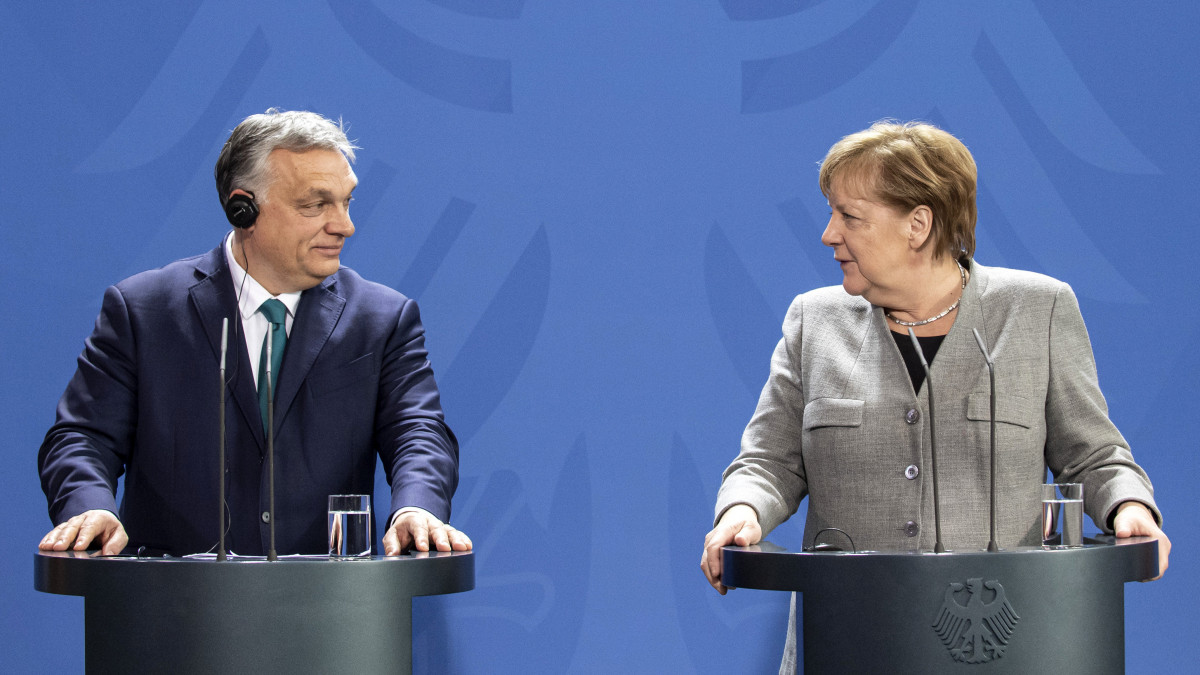
    Digging up some yet older pictures, only three of those featured are still in position: Angela Merkel, Viktor Orbán and Jean-Claude Juncker, albeit in a different position. Juncker only has a few months left in his position and it is hard to judge who is more eagerly awaiting his retirement: himself, the whole of Europe or perhaps the alcohol retailers of Luxembourg.

    Merkel would like to stay chancellor until the 2021 elections but her earlier departure is increasingly likely.

    Looking at the family photo taken at the most recent EU summit, by 2022 there will only be three leaders standing: Orbán, Emmanuel Macron and possibly Austrian chancellor Sebastian Kurz (though given the latest developments in France, Macron’s position isn’t that solid).

    But let us have a look at the crises Europe has maneouvred itself into in the past few years.

    While Germany does have institutional and economic stability, it lacks political and personnel stability. Formally it is still in the Merkel-era, put in practice that era is over and a future three-party broad coalition is unlikely to happen again.

    In France, recent protests have eroded Macron’s position and he was forced to make concessions that will cost about ten billion euros, which may or may not soothe protesters but will put a sizeable hole in the budget.

    The Brits are effectively out of the picture. Theresa May only managed to hold onto her position by promising not to run for office again.

    In Italy the government may be popular and Deputy Prime Minister Matteo Salvini may be heading Western Europe’s probably most popular party, but it is sitting on a huge mountain of public debt: 2,300 billion euros equivalent to 133% of the country’s GDP.

    These are the EU’s four key countries, but the smaller ones also have their share of problems. Hungary, Poland, the Netherlands and Portugal – and to some extent the Czechs – looks stable, but there is trouble in most other states.

    So it is about time for those European elections and the fresh air they may bring.


  • Belgian PM questions V4 states’ Schengen membership

    The Visegrád Four countries’ lack of solidarity in migration management raises the question whether these countries should be members of the Schengen area, Belgian Prime Minister Charles Michel told journalists at a European Union summit on Friday.

    “By stubbornly, repeatedly, systematically refusing to show a minimum of solidarity, these countries automatically open the political debate about the Schengen area, they in fact open the question of their own place in the Schengen area,” Michel said. “The point I am making is being supported by more and more people around the table,” he said.

    Charles Michel

    Belgian Prime Minister Charles Michel at the December 14 EU summit

    The Schengen area – named after the Luxembourg town the agreement was signed in 1985 – comprises 22 member states of the European Union that have effectively abolished passport and border controls between their inner borders. Four more member states – Bulgaria, Croatia, Cyprus and Romania – are also obliged to join the area as soon as they fulfill criteria, pertaining to the control of external borders.

    At the same summit Hungarian Prime Minister Viktor Orbán said that in a stormy debate on the issue of migration a last attempt to force rules on how migration should be managed has been averted.

  • Tomský: The EU will not survive

    According to Tomský, Brexit divides friends and whole families more and more in the UK. He, as a British citizen, voted to leave because the EU is a utopian project that forces liberalism as a mandatory ideology.

    The EU is blackmailing the UK using pretentious protectionism, access to the European market is the only thing that has value for Britain. The same applies for other member states, including the Czech Republic. We would be better off without the EU. Brussels wants to humiliate Britain, and even though May bent the knee, she negotiated nothing at all, said Tomský. He thinks that for most of the British MPs a hard Brexit is not an option. Thus there will be a deal.

    Tomský also believes that the UK joined the EU by accident; therefore any potential damage that Brexit can cause to Britain is irrelevant. The British people voted to leave to liberate themselves and avoid further integration and bureaucracy.

    The main problem with the EU is a widespread ideology, something that Tomský calls a liberal political corrective. Brussels is forcing homosexuality as a superior ideology on us all; it is nothing but oppression of the majority. According to Tomský, an adoption of same-sex couples is unnatural.

    Tomský stresses there is another important Brexit reasoning, that the UK is overpopulated. It is a catastrophe, and it does not come as a surprise that locals are angry, said Tomský. However, it is interesting that only half of the population thinks it is an issue, he added.

  • Liberal embarrassment over billboard war

    ALDE leader Guy Verhofstadt launched his European campaign by sending a mobile billboard to Hungary that carried an advertisement denouncing Orbán and his position towards the EU. The ad showed Orbán with spread hands and a message, “First he stole our money and now he wants to destroy Europe. Stop Orbán! Values are first”. This liberal billboard toured Hungary and had its final stop in front of Orbán’s house in Felcsút village.

    Orbán reacted promptly in a similar way and sent his billboard message to tour around Hungary and then to Brussels. Orbán’s ad mocked Verhofstadt’s views with a message, “Hundreds have died in terrorist attacks since 2015 … but Guy Verhofstadt says we don’t have a migration crisis”. However, the van was stopped by local police in Belgium and they ordered the driver to remove the billboard. This move caused nothing but embarrassment for European liberals, while it gave Orbán powerful PR ammunition.

  • Babiš: It’s nothing more than a pre-election game

    In an interview for Aktuálně.cz, Babiš accused opposition MEPs of harming the reputation of the Czech Republic as they took up a campaign against him on a European level to become more visible ahead of the forthcoming elections.

    “The opposition has failed with its campaigns targeted at me at home, so they had to give it a try in the European Parliament,” Babiš said, adding that Czech citizens must understand that. Babiš highlighted that during the plenary session, only 30 out of 751 MEPs were present, and a half of them were the Czech MEPs who were publicly criticizing him. 

    According to Babiš, it is all just a flash in the pan without any real basis. The European Commission is our partner in this matter, and it communicates with our Ministry of Finance, clarified Babiš. It was not true that subsidies to the Czech Republic were stopped, and even Commissioner Oettinger later corrected himself. The issue of non-granting subsidies applies only to Agrofert, not the whole country, and we are in touch with the Commission, he added.

    Babiš finds it very strange that the Commission’s internal document leaked out at the same time to Le Monde, the Guardian, and Süddeutche Zeitung. We informed Mr. Oettinger that we are ready to discuss it, to explain the interpretation of the article, said Babiš.

    The prime minister believes it will all be clarified soon because there is no wrongdoing on his side as he acted in full accordance with so-called lex Babiš on conflicts of interests adopted by the Czech Parliament. Measures to accommodate the Commission’s concerns are already underway, Babiš concluded.

  • Joint V4 action against the Austrian decision

    Good evening, and welcome to the program about the Visegrád 4. Hungary, Poland, the Czech Republic, and Slovakia are successfully acting together in more and more instances. Their last joint action was the initiation of an investigation on the Austrian family allowance benefits that discriminate against foreign workers. As the result of the V4’s action, the European Commission will soon launch a probe into the matter. Here are the details.

    The Visegrád 4’s step was successful against the Austrian decision that would lower family allowances to children of non-Austrian EU workers, starting in January. The decision affects Hungarian families to the greatest extent, including almost 40,000 children. The Visegrád 4 countries, alongside Bulgaria, Lithuania, and Slovenia think that the Austrian decision seriously violates EU law, the principle of equal treatment, and the principle of social security coordination, and unjustifiably discriminates foreign workers as they pay the same taxes and contributions as Austrian nationals. Marianne Thyssen, EC Commissioner for Employment, Social Affairs, Skills and Mobility, said that the EC believes that all EU citizens are entitled to equal rights on the basis of the principle of free movement and should not be discriminated in terms of family allowances.

    Katalin Novák, State Secretary of Family and Youth Affairs of the Ministry of Human Capacities, is our guest today. Welcome and good evening. I would like to provide some context to the issue and talk about how the proposal came about. According to a survey from last year, an average Christian family has 1.6 children in Europe, 2.2 in North America, and 4.2 in Sub-Saharan Africa. Am I right in thinking that we have no reason to be relaxed in Europe?

    If we look at the European demographic rate, we indeed have reasons to be worried. There is not a single country in Europe where enough children are born. We can say that none of the EU member states’ populations have the “life instinct” to have at least as many children as is necessary to maintain the population at its current number, not to mention the goals of growing the population or making it younger. Therefore, we can talk about an old and continuously aging Europe, which presents a serious challenge to all of us. I believe that the issues are whether we are willing to face this challenge, whether we are willing to face it honestly, and what kind of answers we can come up with.

    And, also, whether those countries that have a traditionally family-centric attitude, such as Germany, Italy, Spain or Greece, are facing the same challenge. These countries have experienced a dramatic population decline too. On the contrary, France, the UK, and Scandinavia do not face the threat of population decline. A lot of people say that the better trend is due to the large immigrant population residing in these countries, but, as a result, Christian families are losing their dominant position in these societies. Is this statement correct?

    The situation in France is not as good as it used to be. I think that the relatively higher reproduction rate seen previously in France was partly due to the good family support system. France traditionally has offered an elaborated system of family benefits; tax allowances were available for families, and the principle that families raising children received support regardless of their income situation was introduced. This system, however, was changed; the left-wing government abolished these regulations, and, as a consequence, the willingness to raise children decreased significantly. If we look at the European level, the population of the continent is still growing. However, if we investigate the reasons of the increase in the population, then we see that emigration has been the exclusive source of it in the past couple of years. So, it is not true that the population increase is due to the number of childbirths. This also shows that some people view emigration as an external solution to the problem of demography. However, in my opinion, it will have very serious consequences in the long run. We are talking about the integration or unwillingness to integrate of people who have very distinct cultures and religions from the native European population. The first signs of this challenge are already showing in some Western European countries. All countries will have to cope with the consequences of the solution that they agreed to, or, in my opinion, to the supposed solution that they are trying to apply.

    It seems that the societies affected are already aware of these problems and are giving adequate answers, as the results of national elections in Western Europe in the past years have shown. However, the political elite of these countries should make a change. In the meantime, we are showing the viewers a comparison of fertility rates in European countries. I am glad you mentioned the system of family benefits, because we know that the countries we are talking about have very different benefit systems. To what extent do family benefit systems affect fertility rates and the number of childbirths?

    If you allow me, I just want to briefly address what you said about the political elite. It is true that the whole issue is partly the problem of political leaders, and the political elite in Western Europe have distanced themselves from the people, and they do not represent what a great proportion of their electorate believes in. However, it is the people that unfortunately will have to suffer the consequences. The decisions that are made now will impact the future of the continent and its population for decades or centuries, and the trends will be very hard to reverse. For this reason, it is very important for us that whenever we make decisions that will be crucial for our future, we have the authorization of the people we represent. This is why we always ask the citizens. In the matter of emigration, we had not only the election results but also a referendum and a national consultation. I think this would be important in other European countries, too. Now back to your question about the correlation of family benefits and childbirths. Not only me, but researchers as well see a correlation between investments and the willingness to have children. So, financial, moral, and emotional support for families do pay off. We are witnessing this in Hungary, since the willingness to have children was not so high over the past 20 years as it was last year. We still have a long road ahead of us, but we started from a very low point. It is difficult because the consequences of the large decrease in the population are palpable: there are fewer and fewer young couples in Hungary, and the few young couples have to have more children.

    The difference between the desired number of children and those actually born has been growing, and it is still the case today. If we narrow the picture to the V4 countries, are there significant differences between the countries?

    These countries have more or less the same data, and there are no significant differences in the reproduction rate.

    The socioeconomic situation is also very similar in these countries.

    The only difference is that the level of increase is now outstandingly high in Hungary, while it is minimal in the other three countries. We are experiencing a positive change. The willingness to have children grew by 20% and the number of marriages grew by 1.5% over the last couple of years. It is fair to say that the trend in Hungary is going against the general tendencies. I hope that we will be able to keep up this positive trend.

    Let’s examine another aspect of the matter, which is also noteworthy in Hungary: emigration.

    Some of the greatest assets of Hungary becoming a member of the EU were the freedom of movement, the freedom to study on Europe, and the freedom to work and stay. I believe it is a great achievement, and this was one of the most attractive prospects of the EU membership. We have to preserve and cherish this. I do not think that the freedom of movement is a bad thing. If you allow me to be personal here, my family lived both in France and Germany before, and those were very exciting and educational periods in our lives. And, then we came home and we are raising our kids here and we are living our lives here. So, the fact that the freedom of movement exists is a natural benefit of the EU and the internal market, and it is important to us. What a challenge and a task for us is, and now I’m speaking on behalf of the Hungarian government, to offer a perspective for the future for young Hungarians, so that if they go abroad it is not out of necessity but out of adventure and excitement.

    To some extent, the topic leading up to our conversation relates to the issue of working abroad. The V4, together with Lithuania, Slovenia, and Bulgaria submitted a proposal to the European Commission on the occasion of Austria’s lowering of the family benefits. The lowering would, starting in January, discriminate against non-Austrian workers, among them many Hungarians, and would affect approximately 40,000 Hungarian children. How big of a decrease are we talking about?

    Let me provide the viewers with the background regulation of the matter. There is a so-called principle of social security coordination in relation to the freedom of movement, according to which EU nationals are entitled to the social allowances in the country they are working in. For example, a Hungarian citizen who is working and paying taxes and other contributions in Austria is eligible to the same social and family allowances as Austrian nationals. This is one of the outcomes of the freedoms of the European Union. There are, however, many cases where the entire family does not move to the country where one of the parents is working. Indeed, there are 40,000 children in Hungary who are affected because their mother or father is working in Austria. We should add that in many of these cases, the family lives near the border and one of the parents is working and paying taxes in Austria, but the family actually lives in Hungary. The Austrian decision, which will be effective beginning January 1, 2019, affects these families, because they will deny the full family allowance from taxpayers whose children do not live with them in Austria. The benefit for one child now is 172 euros, but as the result of the decision it would go down to 90 euros, which is a 40% decrease. The reasoning of the decision is that according to Austria, the level of benefit should be adjusted to the living standards of the country where the child is living. So, in the future they would only pay as much as is reasonable based on the place of residence’s living standards. However, this decision goes against European Union regulations. And, to be honest, it must hurt the sense of justice of every reasonable person, since these workers pay their taxes in Austria. They contribute to the maintenance of the system and to the budget, and so it is not fair that their children are handled differently than Austrian nationals’ children.

    There is not much time before the 1st of January, and the probe has not started yet, although the proposal is on the European Commission’s table. Do you expect a positive outcome?

    I think that what is important is that we, the seven countries, acted together in the matter. The respective political representative from each country—from Hungary, that would be me—signed the letter to the European Commission, and we called the attention of the commissioner to the violation of the EU law. We cannot hope for an actual decision before the 1st of January, but I encourage everybody who is affected by the decision to ask for legal help individually. We immediately and very firmly reacted once the Austrian decision entered into force, and we will continue to exercise political pressure and will not let the case be forgotten. It does not make our situation easier that the European parliamentary elections will happen in May and that the composition of the European Commission will change. I can only hope that, as in other cases when there is political interest, the EC will accelerate the process in this case as well and that there will be measures as soon as possible. So far we got a reply letter from Madame Commissioner in which she explains that she does not agree with the Austrian decision. I would add that there was an attempt to make it a part of the European law, because, in connection with Brexit, the UK demanded that we introduce the indexation of social allowances. This would have been the UK’s condition for staying in the EU. Later, the UK took the issue off of the agenda; Britain left the EU and the indexation remained, but we were able to prevent it from becoming part of the EU law. It was a huge achievement. Now, the Austrian decision is a unilateral measure, and, therefore, it is very important that we stand against the decision very firmly to prevent it from becoming a precedent and to prevent other European countries from following in Austria’s footsteps. So, we are continuing to stand up against the matter and I hope that there will be a quick and wise decision.

    We will certainly monitor the decision making process and will continue to discuss it. Katalin Novák, thank you for coming.

    Thank you for your interest.

    “The Visegrád countries are working on a project that will support the development of Tunisia’s border protection,” said Minister of Foreign Affairs and Trade Péter Szijjártó on Friday in Prague. Our reporter, Zselyke Jambor-Miniska, asked security policy expert József Horváth about the V4’s support program for Northern Africa.

    “Europe’s security begins in Africa,” said Péter Szijjártó about the V4’s program that aims to help Tunisia in controlling migration. The Hungarian Minister of Foreign Affairs and Trade coordinated with his Tunisian counterpart, Khemaies Jhinaoui ON the phone after having agreed with the V4 Ministers of Foreign Affairs that, following the V4’s support for development in Libya, they will prepare another support program.

    “It will be crucial for the next years. Since 2015, the EU lost three years in assisting migrant-sending countries to strengthen their border protection. There were some trial programs in Libya, but a significant part of the money disappeared there. Tunisia is one of the transit countries; therefore, I think that the V4’s initiative could be a good example for other countries.”

    By May this year, 1910 Tunisian migrants reached Italy, while last year in the same period only 231 did. Over the past 5 years, more than 600,000 migrants departed from Northern Africa to Europe. Security policy experts believe that such a crowd can only be stopped by an organized and trained coast guard that has modern equipment.

    “Obviously, communication technology, boat and guarding equipment, weapons or satellite systems could be useful for coast guards, just as training and preparation. The Tunisian coast guards should learn skills that are necessary for new technologies, and they should know the security technologies that are indispensable to combat illegal migrants, crime, and human trafficking.”

    In contrast, the pro-migration majority of the European Parliament considers long-term developments and the support of migrant sending countries as the solution. The so-called humanitarian visa is still on the agenda in Brussels. The humanitarian visa would allow asylum seekers to legally apply for the visa at any EU member state’s embassy or consulate in their home country and secure their entry into the EU without having to go through security checkouts and without the grounds of their claim for asylum being examined. The visa is not the only migration-related issue in which there is disagreement between the V4 and Brussels. The European Parliament issued a statement recently in which it welcomed the adoption of the UN’s global migration pact. Hungary, Poland, and the Czech Republic have previously withdrawn from the pro-migration plan of the UN.

    “We are witnessing the clash of two fundamental value systems and principles. The V4 collectively believes that illegal migration needs to be stopped preferably outside the borders of the EU, while Western European countries and the leaders of the EU for some reason are invested in continuing illegal migration.”

    According to analysts, the longer the stream of asylum seekers continues to come to Europe, the harder it will be to reinstate safety and order. Leaders of the V4 trust that their joint action will inspire other countries to join the programs that are necessary stop illegal migration outside the borders of the EU.

    With the news of the V4 we will be back in a week. Thank you for your attention and goodbye.


  • Most Czechs do not trust NGOs

    Both the army and police received a 67 percent trust rating — the current share of those who trust the police is the highest for the entire monitoring period since 1994. The judiciary also improves its position with a 58 percent trust rating.

    Trust in the media is, however, significantly lower, with only 48 percent of Czechs saying they trust information broadcast on the radio, while the press received 38 percent, and television 40 percent. The Internet received a 39 percent trust rating score.

    “According to development over the past two years, trust in the media is strongly influenced by current affairs in society, and therefore these fluctuations are taking place, but they are not long-lasting,” the statisticians say and add that the current decline may be linked to the migration crisis.

    Also trust in NGOs has been significantly declining since 2015, which may also be linked to the migration crisis. At the moment, the proportion of Czechs trusting NGOs is 37 percent, not trusting 53 percent.

    The country’s churches are at the bottom of the ladder with a 25 percent trust rating.

  • Most Czechs do not trust NGOs

    Both the army and police received a 67 percent trust rating — the current share of those who trust the police is the highest for the entire monitoring period since 1994. The judiciary also improves its position with a 58 percent trust rating.

    Trust in the media is, however, significantly lower, with only 48 percent of Czechs saying they trust information broadcast on the radio, while the press received 38 percent, and television 40 percent. The Internet received a 39 percent trust rating score.

    “According to development over the past two years, trust in the media is strongly influenced by current affairs in society, and therefore these fluctuations are taking place, but they are not long-lasting,” the statisticians say and add that the current decline may be linked to the migration crisis.

    Also trust in NGOs has been significantly declining since 2015, which may also be linked to the migration crisis. At the moment, the proportion of Czechs trusting NGOs is 37 percent, not trusting 53 percent.

    The country’s churches are at the bottom of the ladder with a 25 percent trust rating.

  • The post-2020 EU budget and the biggest losers of Brexit

    Good evening. Welcome. According to an Austrian analysis, negative impacts on the V4 countries are expected primarily in the long term and indirectly if the so-called hard Brexit is realized, that is, if the EU and the UK fail to agree on the conditions of the British exit rule by March 29th. Among the countries in the region, the Czech Republic would see the greatest economic output losses, up to 1%. In the meantime, last Thursday thousands of protesters demanded the resignation of Czech Prime Minister Andrej Babis in Prague, because they believe it is unacceptable that a person who is being prosecuted by the police for suspected misuse of EU funds is leading the government. By telephone we are now connecting with our Prague-based correspondent, Péter Balla. Hello Péter! According to Andrej Babis, the accusations are unfounded, and there is a political conspiracy behind the demonstrations with the obvious purpose of removing him from politics. What do local analysts say about this? What is really going on behind the scenes?

    Hello! The whole “Stork’s Net” case is about Babis allegedly taking two million euros from small business EU subsidies and having the “Stork’s Nest” vacation home put in his child’s name. Last week journalists managed to reach his son, who had raised certain issues, including that he might have been abducted and held in Crimea by his own father. This was the cause of the new wave of demonstrations, resulting in more than 20,000 people protesting in Prague’s Old Town Square, demanding Babis to resign.

    Meanwhile, we are showing the viewers pictures of the demonstration. On November 23th, there will be a no-confidence vote for Andrej Babis. What is the most probable scenario in your opinion and in the opinions of other analysts?

    The scenario became clearer by Wednesday afternoon. It looks like the whole opposition will cast a pro-Babis vote. Babis has a coalition partner, the Social Democratic Party, and the communists also support him in the background. The communists said on Tuesday that they would support the government, and the Social Democrats would withdraw from parliament during the vote. With this, there will not be enough votes, and the government will survive.

    Let’s briefly talk about other news. The Czech Republic can be one of Brexit’s biggest losers in Central Europe. How did Czech politics and the public respond to this notion?

    I have to say that the news about Brexit is often published in Czech public media. But, since everybody here is preoccupied with the current government crisis, there are no significant reactions to Brexit, despite the fact that the Czech Republic is an export-oriented country, and everyone understands that Brexit can cause a great deal of damage to the country.

    We do not have a clear picture about what the conditions of Brexit will be, if it happens at all. Péter Balla from Prague, thank you very much for the information. We will discuss the question of what will happen with Brexit and the Czech Republic in the future with Dávid Szabó, Research Director of Századvég, and Csaba Szajlai, an economic journalist and Deputy Editor in Chief of Figyelő. Welcome gentlemen, I wish you a good evening. Do you agree that a possible hard Brexit would primarily in the long term and indirectly strike the countries of the region, especially the Czech Republic?

    We could say that “one eye is crying and the other is laughing” since what we are talking about means that the Central and Eastern European countries, the V4, are embedded in the economic mechanisms of Western European. In general, the export volumes of the Hungarian, Polish, Czech, and Slovakian manufacturing industries are large. I am going to present a number to the viewers, although it is not of Britain, but of Germany, which has one of the largest economies and is one of the largest export powers in Europe. In Central and Eastern Europe, the volume imported goods is 13.4%. This is a huge amount considering the state of these economies in 1990. But, with regard to Brexit, the Czechs are more embedded in economic relations than the Hungarians. The Czech exposure is greater, but ours is great too. The whole region has more or less the same data. If a hard Brexit prevails, it will first of all be the processing industry that will have a strong impact on the Czech economy. As far as Hungary is concerned, the country in this respect may suffer fewer losses even in the case of a hard Brexit, since roughly 5% of our commodity turnover accounts for our annual export base to the UK. It is probable that this wound could be repaired in the Hungarian economy.

    Before hearing the director’s opinion, let us clarify for the viewers what exactly a hard Brexit means. It would mean that after Britain leaves the customs union and the common market, it could only trade with the member states of the European Union according to the WTO rules. This would result in the increase in duties on foreign trade and other costs, and I also read that it would lead to a drastic change in migration policy. What is the correlation?

    The correlation is that British migration policy in this case would be forced to look for other resources instead of the highly-skilled, risk-taking, and aspiring Central-Eastern European workers. Britain would be forced to turn back completely to the workforce of the British Commonwealth or former British colonists. From this point of view, it is very interesting that those who were campaigning for Brexit specifically because of the immigration policy eventually could create virtually greater immigration as a result of the process. And, about the other part of the question, the conditions Anett described would actually mean a super hard Brexit, and such hard conditions would make us concerned too. Even in case of a hard Brexit, that is without British membership in the customs union and in the common market, we would like to minimally create a free-trade zone or a similar cooperation between the European Union or European Economic Area and the UK. It is in the interest of all of us. This is also emphasized by the British. Even those in favor of a hard Brexit emphasize the need for a free trade agreement with the European Union, but it is also necessary to establish such agreements with the rest of the world, notably the United States, and also with the successor states of the British colonial empire or with East Asia.

    In fact, in the economic and political sense, it is a stalemate. We are member states of the European Union, so it cannot work that the British quit but keep all kinds of advantages. Earlier, there were plans that the British would have an agreement with the European Union based on the Norwegian or Swiss example. This is quite the challenge that they presented to the European Union’s decision makers. I think that the European Union must be firm, as Brexit affects the 27 member states. Keep in mind that Great Britain is in a special status as a net contributor to the European Union’s common budget, but they can reclaim a lot and enjoy special treatment as well, just like Denmark or Sweden.

    March 29th is still far away, but we know very well that British domestic politics have been subject to the negotiations of Brexit. Some say that Prime Minister Theresa May’s stability has been wavering. Indeed, the issue is far from being over. Meanwhile, during our conversation we are showing a graph to the viewers. The population of the countries of the Central and Eastern European region is primarily interested, beyond the economic indicators, in what will happen to the workers. Here is the chart. It shows the number of registered workers in Great Britain in 2017. How would the current Brexit terms protect the interests of the region’s workers?

    The British say that in fact everything will remain unchanged, as far as labor market conditions and regulation are concerned, but this is still awaiting refinement. The Hungarian national interest ON the other hand, is to have more people come home to Hungary or closer to Hungary from those who are working in Britain. It is natural to be worried about Hungarian workers in the UK, but we need to see that they are contributing to the UK’s GDP. We Hungarians are interested in solving the tight labor market problems in Hungary. It is highly likely that the British interest is to regulate the labor market in a liberal way, since it would mean a huge cut if they applied new rules. But, it is certain that the current EU regulatory system will not work.

    Director Szabó said that a regulated exit, both politically and economically, would be in the interest of Hungarians and of the inhabitants of the region. What would that be like?

    A regulated exit largely means that regardless of the circumstances under which Britain will leave the EU, the key is to not have a negative impact on the economy, security, and other cooperation between EU member states and the United Kingdom, so some continuity and stability should characterize the further relationship. Referring back to the previous question, this is also in the interest of Hungarian workers in the United Kingdom. I think that our workers can cope with any kind of labor market regulation. The most important thing is that they can plan ahead. The most important thing is that under the present conditions, by the end of 2020, the guarantees of their stay and equal treatment are provided. Later, other rules will probably apply to them, less favorable than the rules now, which are based on free movement. The point is that they can be prepared. And, the interest of the Hungarian economy is to know exactly, preferably years ahead, the exact customs regulations, investment rules, and investment incentives that will be open between the United Kingdom and Hungary.

    Another interest of all of us, and here we turn to our next topic, is the EU budget that we can expect after 2020. The European Parliament adopted the negotiating starting points for the post-2020 budget last week. We’ll continue after a short summary.

    Based on the proposal of the European Commission, the Visegrád countries will have about 25% less cohesion funding after 2020 than in the 2014–2020 cycle. The committee’s proposal affects the V4 negatively because the Visegrád countries are among the 11 major beneficiaries of EU funding, and these resources cover most of their public investment. Due to the economic needs caused by Brexit and immigration, the Commission revised the system for allocating aid from cohesion funds and put in place criteria in the resource allocation system for efforts in the areas of unemployment, the relocation of immigrants, innovation and, the reduction of carbon dioxide emissions. Brussels decision makers also noted that the drop in funding provided for the V4 is to some degree the price of the region’s economic successes. The change in conditions is thus partly a result of the dynamic development of Central Europe, to which the funding received over the last two fiscal cycles contributed greatly.

    Does the EU argumentation stand?

    Well, to me it seems to be a little bit circumlocutory at first glance. The experts of the European Commission say that the Mediterranean countries need to catch up because since the 2008–2009 global economic crisis, they are still in a lousy situation, as they cannot reach the level of economic output as before 2008. By contrast, the Central European countries, namely us, the Poles, the Slovaks, and the Czechs, can grow quite well. The region is performing astonishingly. At the same time, the argument that the Mediterranean countries need to be supported now is not entirely correct, as the level of development of the Mediterranean countries has not yet produced by the Central and Eastern European region. The best indicator of this is the GDP growth rate. In this respect, perhaps the Czechs are ahead of a Southern European country, namely Portugal, but Hungary could not pass nor catch up to neither Spain nor Italy in this respect. Greece has fallen far back, so they are probably not a point of reference. The essence is that the Central and Eastern European region must be helped in order to catch up. We have not benefited from the funds and income that the Mediterranean countries have. In fact, we now get much less money than these countries received in the 80s to assist them to catch up. So, I see not entirely professional reasons but a kind of political pressure. We all know that there is a Polish case, a Slovak case, and a Hungarian case before the European Commission and the European Parliament. I think that there is sort of a regulation factor in this story. At the same time, we have to keep in mind that the situation is not yet completely final.

    Are we being punished?

    Well, some would like us to be punished. I believe that the countries of this region have realized their power after more than ten years of European Union membership. They are able to use the European cohesion and structural funds so that they can make a real contribution to the quality of life of those living here and to economic growth, while at the same time the Western European net contributing elite also benefit from cohesion policy. So, this is a success story. To knock over or diminish a success story can be only of interest if there are other political considerations beneath the surface. This is how I interpret the case. These states that came to power and consciousness now do not want to stand behind the globalist future envisioned by Brussels, and, therefore, Brussels is trying to put political pressure on them. We do not have to complain but have to actively get involved in coalition building and fight to defend our interests.

    The question is whether the decision will be made before the EP elections. We will come back to the topic. Dávid Szabó, Csaba Szajlai, thank you for the analysis. On the occasion of the centenary of the regained Polish independence, the history book entitled The Bridge Builders: The Portrait of the Hungarian–Polish Relations was published. Our colleagues spoke with the creators of the book on its launch.

    Politicians, diplomats, intelligence, scouts, volunteers, writers, historians, university professors, refugees, athletes, soldiers, artists, and translators. Poles and Hungarians, who dedicated their lives to the Polish–Hungarian friendship. The album entitled Bridge Builders tells their stories. The book premiered at the Polish Institute on the 20th of November.

    At the event, the editor, Miklós Mitrovics, said, “the creator’s goal was to help readers understand the true nature of the Polish–Hungarian friendship. We present 33 outstanding, extraordinary life stories. The book shows that they are mostly ordinary people. Although there is a politician among them, the majority represents the simple person who many times, as the result of a tragedy, starts a new life and from then on serves the Polish–Hungarian cause. I believe that if Hungarian people read this and see that it is not a fiction but rather the reality, they will better feel and understand that this friendship is ours, that this is not forced from above. Indeed, Polish–Hungarian friendship has never been led by big politics, but by simple people.” The life stories were researched by nine authors, and the editor illustrated the text with nearly 400 photos. One of the 33 special people is József Trojan Marián, an artist who is remembered by his daughters in the album.

    “Our dad was such a connecting link between the Hungarians and the Poles. He lived his life accordingly. That meant everything to him.”

    “I hope that thanks to this album, more people will get to know his work and his personality. That’s why we tried to write not only professionally, as art historians, but also as human beings, through the eyes of children who could see their father creating and working feverishly. My sister wanted to show this too, so perhaps our writing is the most personal in the book.”

    Miklós Mitrovics concluded with the idea that bridge builders are always needed and will always be needed, as without them the “Polish-Hungarian two good friends” phrase would be empty. We want nothing more than to have similar connections in the Hungarian–Polish friendship in the next hundred years.

    Dear viewers, with the news of the Visegrád Four, we are counting on seeing you next week. Thank you for being with us and goodbye.

  • 95-year-old Polish war veteran vs. Germany’s ZDF

    Zbigniew Radłowski together with the World Home Army Union have sued the German TV channel and the producers of the series for its portrayal of the Home Army. The series was highly popular in Germany and was perceived to be understanding of or even apologetic of German actions during the war. 

    The series does show Germans committing war crimes but in situations in which there was little alternative, whereas Poles are shown as antisemitic, willing to kill Jews. The German historian Julius Schoeps who was a consultant on the TV series is a German Jew who declared that the only good underground in Poland was the communist underground controlled by the Soviets. 

    I lived through the German occupation of Warsaw, the Warsaw Rising, a prison camp. No ZDF program and no German court can falsify the truth about who was the victim and who was the oppressor

    Both ZDF and the producers of the series are defending themselves arguing that Polish historians are biased in favor of a Polish view of history. They have requested that another witness be heard, thereby prolonging the case. 

    Another case against ZDF

    ZDF are facing a similar legal action brought by 96-year-old Karol Tendera, an Auschwitz survivor for allowing the term “Polish concentration camp” to be used. ZDF lost the case in a Kraków court but appealed to Germany’s Federal Justice Tribunal which declared that the verdict of the Kraków court is inapplicable as it challenges the “fundamental freedom of expression and media”.

    Commenting on the verdict of the German court, captain Radłowski said:

    I lived through the German occupation of Warsaw, the Warsaw Rising, a prison camp. No ZDF program and no German court can falsify the truth about who was the victim and who was the oppressor, who was the criminal and who the hero. We must fight for that truth, ALL of us!”

  • Poland demands say over eurozone budget plans

    Poland’s stance on the matter is that since the budget for the eurozone is to apply to a multi-annual framework, countries outside the zone should have a say in decision-making.  So far that stance has been backed by the President of the European Council Donald Tusk who has allowed non-eurozone states to participate in EU summits. Poland can also rely on Hungary’s Viktor Orban.

    Discussion on the eurozone budget is a debate between the advocates of financial solidarity and those opting for more austere budgetary regulations

    Discussion on the eurozone budget is a debate between the advocates of financial solidarity and those opting for more austere budgetary regulations. France, backed by Southern Europe has been in favor of budgetary transfers within the eurozone. It has tried to persuade Germany to agree. However, the Germans have in the end agreed to a joint initiative, but of a very limited nature. 

    Just a few weeks ago the main risk to the idea of budgetary transfers came from the direction of Italy, where the government is increasing that country’s budgetary deficit. However, over recent weeks we have witnessed a slide in the credibility ratings of President Emmanuel Macron, who had to back down to protests and promise public spending that will take the French budget deficit above three percent of GDP. 

  • Martial law: killers unpunished

    As a result of the lack of legal accountability, martial law has been condoned in social consciousness. Dr Jarosław Szarek, the head of the National Remembrance Institute (IPN) asserts that martial law was inspired by the USSR.

    “There is no doubt that martial law was action taken in the interests of the USSR aimed at securing the interests of monopoly power of the communist party and the system which was imposed on Poland after World War II. A military junta representing the interests of a foreign state can’t be excused.”

    Dr Szarek believes that the fact that many Poles still condone General Jaruzelski’s action is shameful for the country and a sign of a crisis of morality.

    37 years have passed and we are still waiting for the crimes of martial law to be accounted for and for people who in those days fought for freedom in Poland to be treated with dignity and respect

    According to Janusz Olewiński the leader of the association of victims of martial law who are campaigning for compensation for the victims, “37 years have passed and we are still waiting for the crimes of martial law to be accounted for and for people who in those days fought for freedom in Poland to be treated with dignity and respect”. 

    Mr Olewiński reminds readers that “until recently former communist secret police personnel were the most privileged among the pensioners”. The condoning of martial law and its architects has been an important factor in protecting former communists in legal, political, military and media structures of the Polish state.  

  • VW group sales increase to 37,000 units in Hungary

    While an overall positive market will results in car sales rising by 15-16 percent this year in Hungary, brands of the Volkswagen Group are somewhat behind with an expected increased of about 5-6 percent, Porsche Hungária CEO János Eppel said at a press conference.

    The main reasons are that among other carmakers, Volkswagen had problems in certifying its engine production to meet the new WLTP (World Harmonised Light Vehicle Test Procedure) emission standard and the controversial reports regarding the emission of diesel engines.

    Even so, sales of the group’s Skoda brand rose by 9.5 percent mainly driven by corporate fleet purchases which accounted for 83 percent of all Skoda sales. Among private buyers Seat was the most popular brand, whose sales rose by 26 percent due to the popularity of its urban SUV models.

    Eppel said sales of the group’s luxury brand Audi were the hardest-hit by the new WLTP standard, but only said they expected sales of around 2,400 units this year, without giving comparative figures for 2017.

    The Volkswagen Group also has an Audi engine plant in Győr, western Hungary which supplies engines for the Skoda, Seat and Volkswagen brands which had an output of 1,965,165 engines in 2017.


  • Krasnodębski: Poland is victim of the “hoax of the century”

    According to prof. Zdzisław Krasnodębski MEP and vice-President of the European Parliament, commenting on the behavior of Poland’s opposition and their support for the European Commission’s action against Poland’s judicial reforms, “a false image of Poland as a country in which human rights are violated has been created. I believe that this will in future be described as ‘the hoax of the century. The Polish opposition are also partly responsible for this.”

    A false image of Poland as a country in which human rights are violated has been created. I believe that this will in future be described as ‘the hoax of the century’

    The EC has decided not to end its Article 7 proceedings against Poland and a prominent opposition MEP, Róża Thun assessed that as evidence that the EC has “zero confidence in Poland”. 

    Zdzisław Krasnodębski said that “if it wasn’t for people like Róża Thun then there would have been no procedure against Poland”.

    Poland’s senior MEP did not feel that lowering the retirement age for judges was in any way in conflict with European values. He emphasized that the ruling Law and Justice (PiS) were not abandoning their judicial reforms but were compromising on the early retirement issue only and hoped that “after the European elections we will see realism return and a Union based on common principles for all member states.” 

  • Hungary remembers Beethoven with Advent concert

    The National Philharmonic Orchestra will continue its series of Advent concerts on Saturday with a performance of Beethoven, Haydn and Bach pieces, centered around the flute in the Brunszvik Castle in Martonvásár, some 25 km south of Budapest.

    The upcoming concert will also pay homage to Beethoven, who was both a returning guest of the Brunszvik family and composed “Für Elise” there. He met the Brunszvik sisters, Theresa and Josephine when the family visited Vienna in 1799 and – despite his usual rejection – Beethoven agreed to give piano lessons to the sisters. He taught them for sixteen days and even composed a small melody that he wrote in the sisters’ memory album.

    Josephine Brunszvik

    Josephine Brunszvik

    He was later a guest of the Brunszviks in 1800 and 1806. Beethoven was in love with the beautiful Josephine, as testified by 13 love letters to her published in 1957. She is also probably the mysterious and unnamed “Immortal Beloved” to whom Beethoven wrote a 10-page love letter in 1812.

    The date of the concert – December 15th – is also the likely birthday of Beethoven. There is no authentic record of his birth date, but he was baptised on December 17th, putting his birth date at either December 15th or 16th.

  • Disciplinary rules should be tightened, says House Speaker

    Kövér said the protests of the opposition parties in Parliament on Wednesday were “the most important event of the political autumn”.

    On Wednesday opposition MPs blocked access to the dais of the speaker of the house in an attempt to prevent the amendment of the labor law that increased the annual allowed overtime to 400 hours, from a previous 250 hours. The amendment eventually passed with 130 votes for, 52 against and one abstention.

    Kövér qualified the event as a “mindless, irrational disturbance bordering on anarchy”, adding that even before Wednesday’s events they were pondering how to change house rules. In accordance with current regulations, Kövér imposed fines on the leaders of the opposition protest but said that should these means become a permanent fixture in the opposition’s arsenal, tighter rules may be needed.

    He said that while he cannot guarantee that stricter rules would prevent such events in the future, those perpetrating them “should then at least feel some pain”.

    Kövér said that the irregular behavior of the opposition MPs stemmed from their frustration, leaving them unable for calm deliberation and strategic thinking, that they were “in a very difficult intellectual position” and lacked truly helpful advisors.

    He said the difficulties of the opposition were not a phenomenon unique to Hungary as the left was on the brink of moral and political collapse across most of Europe.


  • Makovecz gets street named after him in Budapest

    Makovecz – whose work spanned across almost half a century from 1962 to 2011 – was one of the most prominent proponents of organic architecture. His work was inspired by Frank Lloyd Wright and Rudolf Steiner, but also natural developments built upon Art Nouveau and National Romanticism.

    Early in his career his work was also a criticism of Communist ideology and the brutal uniformity of system building, but after the fall of the Communist regime in 1989, it became a comment on the nature of globalization and corporate culture.

    The majority of his work – he designed over 80 buildings in Hungary and the neighboring countries – was on community centers of some form: churches, town halls, universities, baths, restaurants.

    Makovecz

    The Stephaneum university building in Piliscsaba (2001)

    He received a series of major national and international awards, was the honorary member of several countries’ architect societies and the founder and “eternal and executive president” of the Hungarian Academy of Arts.

  • A non-binding pact is a manipulation

    Remember the registered partnership and adoption by same-sex couples? What was one of the arguments to appease those who questioned them? That they have nothing to do with marriage nor adoption as such but of course they do. Even though it looked like just a small step, it was an important one.

    Now, the same can be applied to the UN Migration Pact, as the most hard-line progressivists wish its path would lead to a global system of people’s redistribution. They wish for global migrant quotas, to put it simply. And, of course, at the expense of the rich and independent, which is quite an Orwellian aspiration.

    Do not get me wrong here, homosexuals have a right to live in dignity, and we should help refugees. However, to opt-out from the Pact was the right thing to do.

    The US, Netherlands, Italy, Poland, Austria, Slovakia, Latvia, Australia, Chile, Estonia, Hungary, Switzerland, Israel … maybe Belgium.

    Even though there were only 30 countries that didn’t take part in the Marrakesh summit, it seems like we are in good company.

  • No need to hurry with the adoption of the euro

    “A target date for the euro adoption remains unset; the Government approved a joint recommendation of the Finance Ministry and the Czech National Bank. We don’t want to risk a substantial devaluation of citizens’ savings. Moreover, the rules of the eurozone have changed significantly recently, and it is hard to estimate what requirements the Czech Republic would face after euro adoption,” wrote Schillerová on her Twitter profile.

    In its statesmanship, the Czech Government stated it would not try to join the eurozone. Even though the Czech Republic will most likely meet all the Maastricht convergence criteria this year, maybe except the exchange rate criterion. Economists welcome the decision of Babiš’s government.

    According to economist Lukáš Kovanda, it is wise not to set a target date yet. By adopting the euro, the Czech Republic would gain a more stable and less vulnerable currency. Also, many businesses would save a large part of costs connected with preventing the currency risk damage. On the other hand, the Czech economy would have to bear with long-term damage done by losing its independent monetary policy and a chance to keep up with more developed countries by the gradual strengthening of CZK, explained Kovanda.

    Additionally, according to recent polls, the majority of Czechs oppose the adoption of the euro. In April, for example, only a fifth of respondents said they are in favor of the euro, while 73 percent preferred the Czech Republic not to enter the eurozone.

    In their joint press release, the Czech National Bank and the Finance Ministry said that preparedness of the country to adopt the euro has improved compared to previous years, but some shortcomings persist. The unfinished process of real economic convergence of the Czech Republic can still be considered the main obstacle to joining the monetary union. Although convergence has resumed in recent years, the gaps in most key indicators, the price and wage levels, in particular, remain significant.

  • Macron will no longer have time to criticize Visegrad

    Progressive elites that control bureaucracy, key institutions, and the media, focus on fighting against emissions and diesel cars, deeper European integration, the right to settle in a country of people´s choice and LGBT rights. Meanwhile, they completely ignore the stagnant or declining living standards of people and their prospects for the future.

    The election of Donald Trump, Brexit, and the protests of the Yellow Vests in France – the elites try to explain these by saying that the people have been manipulated – by no one else than Russia, of course. They do not accept that dissatisfied people have free will and have had enough of the direction in which their country develops. It is easier not to think about the real problems of the majority of the society and to blame a foreign manipulation.

    Fortunately for France and the whole of Europe, Emmanuel Macron has left this strategy. He acknowledged his mistakes and admitted that the anger of the French is right and deep. He promised to reassess the priorities and to be particularly interested in the standard of living of the French. Anyway, he had no choice.

    What Macron has offered to the French is just a recipe for calming the streets: higher minimum wages, exemption of part of the pensions from taxes, untaxed pre-Christmas bonuses.

    However, the priorities change. Emmanuel Macron will no longer fight against emissions, which increases the fuel price. He will not promote the closure of nuclear power plants that makes electricity more expensive. He will no longer be able to burn as much energy to seek a deeper integration of the European Union or to promote joint debts within the eurozone. And, of course, he will not have the time to criticize Poland, Hungary, and try to divide the Visegrad Four during the official visits similar to the recent meeting with Andrej Babiš.

    Macron understood that he could not please the progressive elites as well as the majority of the French. Of course, he chose the majority which is a step that will fundamentally transform Europe. If France resists, there is no chance the progressive green revolution could be enforced in the European Union.

  • Klaus: It is a great honor to receive Petöfi Prize

    As someone, who lived and witnessed the Communist regime and its fall, Klaus has always been a strong proponent of freedom and liberty. Therefore, being awarded by a prize that holds a name of the great national poet Sándor Petöfi is special for him, more so now, in the times of Europe’s decline.

    Klaus recalled Petöfi as a true Hungarian and his manifesto “The 12 Points”, in which Petöfi called for the freedom of the press, for an independent Hungarian government, and the Parliament created by democratic parliamentary elections, as truly revolutionary. He named demands, some of which would be revolutionary even now in the post-democratic European Union.

    Klaus especially pointed out the Central European aspect of the Prize. According to him, rather a cultural entity of the Central European peoples is extremely important. I don’t only feel to be a Praguer and a Czech, but a Central European as well, which connects me with the Hungarians, the Slovaks, the Poles, the Austrians and other nations from our region, added Klaus.

    That is why Klaus finds the true European identity and the whole European unification project to be weak without any authenticity. We should not constantly be looking upon the so-called European integration but to national pride. As Klaus put it, we should not be ashamed of giving the nation a fundamental position in our thinking and behavior, while not leaving out the ‘holy trinity’ that defines us as Europeans– the man, the woman, and the family.

    It is important to promote the freedom of the peoples of Central Europe now when nation states like Hungary and the Czech Republic have to fight for their sovereignty once again, just as it was important back in the Petöfi times. According to Klaus, we must fight against new ‘feudalities’ in our society, against the nomenklatura of political elites, against omnipotent bureaucracies, against special positions of judges and courts, against non-democratically functioning and not-authentically created political NGO´s.

    Klaus also reminded Petöfi’s demand to have the Hungarian Government Institutions in Budapest, not in another country, and its striking resemblance to our current situation with Brussels. Klaus believes that Petöfi would oppose an impotent idea of Europe without borders because it ultimately means Europe without citizens and thus without democracy. According to Klaus, Petöfi would also recognize mass migration as a way to destroy European culture and civilization.

    We should rely on the wisdom of ordinary citizens and their democratically elected leaders (labeled populists these days), said Klaus. Based on our historical experience, we know that any change takes political courage. In his remarks, Klaus concluded by saying that we are living in a dangerous moment in history when our identity is endangered by new ‘isms’ and ideologies, and we should reward those who stand up against them.

    Klaus outlined his modest 5 points, what our efforts should focus on:

    – we – who refused to accept the ideology of communism in the past – shouldn´t be reconciled with the current attempts to establish the religion of multiculturalism as the official ideology of Western (and European) society;

    – we – who are aware of the fragility of the West on the one hand and of its aggressive and ruthless enemies (many of them from inside) on the other – should oppose the multiculturalists’ crusade against Western Civilisation;

    – we, the true believers in the nation state, should fight the destructive European ideology (I call europeism) which is hidden in the text of the Lisbon Treaty and which aims at overcoming the nation-state;

    – we – who were dreaming for decades during the communist era about the rule of law and civic rights – should resist the ideology of “humanrightism”, which means the attempts to replace freedom with “rights” (especially the relatively new endeavor to include the right to migrate among the human rights);

    – we should prefer freedom to fairness (and equality) which asks for getting rid of the stifling political correctness (coming close to George Orwell´s double-think and newspeak).

  • Total Opposition trying to destabilize Poland

    The liberal Civic Platform MPs have recently filed complaints to the public prosecutor against the Central Bank (NBP) for its pursuit of an injunction on articles linking the bank to the controversy surrounding the Financial Supervisory Authority (KNF). This, together with criticism from government sources of the behavior of commercial TV station TVN over its program on “Hitler’s birthday” has been used as evidence that media freedom is under threat. 

    The criticism of TVN over its program having been a set-up nearly caused a diplomatic conflict between Poland and the USA, but the opposition feels that “the worse the better”.

    The liberals want to create social conflict at any price in order to be on hand to save the country from the troubles they themselves have caused. They are like firemen who first commit arson

    Both these instances were used by liberals to attack the current government. Of the two it was the issue of the supposed involvement of Poland’s central bank with the controversy that engulfed the KNF which was by far the more serious. By undermining what is regarded as one of Europe’s most stable institutions the whole banking system in Poland is being undermined.

    Liberals seem to have learned nothing from the events in France where people have had enough of liberal rule and really have taken to the streets. Here in Poland the opposition has failed to get people out on the streets but it is not for the lack of trying. The liberals want to create social conflict at any price in order to be on hand to save the country from the troubles they themselves have caused. They are like firemen who first commit arson. But are they certain that they can put these fires out and will not be punished for having stoked them? 

  • Morawiecki: A Europe of nation states is the only answer

    Poland’s PM believes that President Macron’s vision of a federal Europe is “removed from the desires of nations and divorced from reality.” According to the PM, “the only realistic solution is building a Europe of nation states”. 

    Morawiecki was skeptical about there being “universal European values” as the “differences between languages and interests mean we will never be a United States of Europe.” The Polish PM admitted that there were many “misunderstandings” between France and Poland and that this was because France had never suffered from communism. This was why Poland was more committed to preserving its national identity and more skeptical of the idea of a federal European state.

    A federal Europe is removed from the desires of nations and divorced from reality

    Migration

    The PM explained that Poland’s different approach to migration in comparison to that of Germany is conditioned by its different economic status. Germany, according to Morawiecki, is “one of the richest nations in the world” and has resources to “pay for any kind of social policy” and for “paying for the influx of migrants.” 

    He felt that it was unfair to demand that Poland take any more than the 1.5 million Ukrainians it was already hosting. The Polish PM felt that the best way to prevent millions of migrants from Africa and the Middle East attempting to come to Europe was through helping those countries to develop.  

    Russia

    On attitudes to Russia, Morawiecki argued that Poland, having lived under a Red Army occupation for 50 years, was especially keen to remain independent of its eastern neighbor. He understood that given that “Central Europe shielded Germany and France from Russia” they perceived Russia only in “economic and trading” terms.

    The trouble is that Russia sees “trade as a weapon”. Poland is prepared to have “normal relations” with Russia as long as it does not have “imperial ambitions”.

  • US Congress resolution against Nord Stream 2

    According to the resolution “Nord Stream 2 is a drastic step backwards for Europe’s energy security and the interests of the USA.” Congress called on European governments to reject the project and the US President to “use all available means for supporting European energy security through diversification and reducing dependence on Russia.” 

    Congress also called US sanctions on Nord Stream 2 in accordance with available legislation to sanction opponents of the USA. The text also noted that “Russia controls nearly 40 percent of gas supplies to Europe, that 11 European states import at least 75 percent of their gas needs from Russia and that Nord Stream 2 will increase Russian influence over the European market.

    It is in the geopolitical interests of Russia for Nord Stream 2 to cause divisions among European states and to severely restrict the transit of gas through the existing system in Ukraine

    The resolution goes on to state that it is is in the “geopolitical interests of Russia for Nord Stream 2 to cause divisions among European states and to severely restrict the transit of gas through the existing system in Ukraine.”  

    Nord Stream 2 is a joint German-Russian project involving the Russian “Gazprom” state company and five western energy companies, including German, French and British-Dutch ones. The pipeline is to run through the bottom of the Baltic sea between Russia and Germany and is to be completed by the end of 2019. The project is opposed by Poland, Ukraine and the Baltic states. 

    Kerch Strait

    Congress also adopted a resolution condemning Russian aggression against Ukraine in the Kerch Strait area and calls on the US President and US allies to hold Russia to account for its actions. Both the Republicans and Democrats supported the resolution that emphasized the significance of the “independence and security of Ukraine”. 

  • U.S. general finds European NATO combat-readiness lacking

    The general said that the 2014 invasion of Crimea by Russia was a serious wake-up call, and while there has been some improvement since, Russian superiority remains depressing. Less than a year ago a report by the commander of the 1723. U.S. Airborne Brigade Combat Team based in Vicenza, Italy, about the combat readiness of the unit was leaked and caused serious concern.

    The report said that U.S. military units based in Europe lack even the most fundamental capabilities for swift and effective operations. The U.S. general told Magyar Hírlap on condition of anonymity the main problem of the U.S. military is that in the past decades it only had to face forces with significantly inferior capabilities.

    As an example, he said in countries where even mobile phone networks are patchy, it is trivial to suppress an enemy with GPS-guided artillery fire, but Russia, for example, has the capability to jam GPS guidance from distances of up to 75 kilometers.

    He also said that from an American point of view the mobilization of European military units is painfully slow, given that there is no single command point – all European member states of NATO have to individually authorize state of war or the foreign deployment of their troops.

    The general said that while the U.S. military presence in the Baltic states is a positive development in the face of the threat posed by Russia, the U.S. units and military equipment stationed there are not sufficient to provide adequate defense.

  • Fangor sold for 7 million PLN

    The works auctioned were valued at seven million PLN and were the five earliest op-art pieces by Wojciech Fangor that he created between 1961-62. 

    According to the catalogue for the pre-auction display the five paintings from a private collection are linked by a direct reference to Wojciech Fangor’s most important exhibition, “The study of space”.

    tt

    This was the first spatial installation in the world which paved the way for a new direction in art and influenced the world of op-art.

    Upward trend

    The upward trend in prices is important for the Polish art market. It shows there are clients in Poland capable of buying several pieces of established artists sold together. However, the highest price ever paid for a single work by Fangor was the “M 39” painting which fetched PLN 4.72 million at the Polish “DESA Unicum” auction on November 29th of this year. 

    The most expensive transaction ever completed in Poland was PLN 7.36 million for a collection of photographs of Marilyn Monroe taken by Milton H.Greene at “DESA Unicum” in 2014. 

  • Hungary to issue US$291 million Panda bonds

    Magyar Idők quoted Bank of China official in charge of European monetary institutions Chu Furong as saying that the issue will be on the Chinese financial market next Monday. This is the second so-called “panda bond” issued by Hungary.

    A Panda bond is a Chinese renminbi-denominated bond from a non-Chinese issuer, sold in the People’s Republic of China.

    Hungary – in a drive to diversify its decreasing exposure to foreign financial markets – has become more active in Asia, particularly in the Chinese market. It has also issued a so-called “dim sum bonds”. Dim sum bond is a bond denominated in Chinese renminbi and issued in Hong Kong. Dim sum bonds are attractive to foreign investors who desire exposure to renminbi-denominated assets, but are restricted by China’s capital controls from investing in domestic Chinese debt.

    With next week’s issue, Hungary will have exhausted its three billion yuan limit for panda bonds. Chinese authorities control the amount of yuan bonds any foreign country can issue and Hungary was the first Central European country to be allowed such an issue.

    This spring Hungary has also issued “samurai bonds” (yen-denominated bonds on the Japanese market) to the value of 30 billion yen (US$264 mln), for the first time in ten years. While the total value of Asian bonds within the country’s debt is relatively small, the Hungarian Central Bank is continuing its exploration of the Asian bond markets in search for both diversification and better financial conditions. 

  • This is not the way to protest, says state minister

    “I am new to Parliament, but because it is also the subject of my doctoral thesis, the present and the future of parliament is a preoccupation of mine beyond normal duties,” Orbán writes.

    The nature of parliamentary debates – both here and in other states with a parliamentary system – is significantly different today than it was only a few decades ago. The fundamental reason is that nowadays – due to mass and social media – parliament is not the only forum for public debates.

    This, however, does not mean that parliamentarism itself is in crisis. Quite the opposite.

    Parliament remains the ultimate repository of the sovereignty of the people and one of the main pillars of ensuring the legitimacy of legislation and legal order. Therefore, for us Hungarians, the regular operations and dignity of parliament are a matter of national strategy.

    Dissent is both possible and necessary, as are debates, but these should by no means be done in a manner as the opposition did today. The reason is that for us, Hungarians, this institution is not just the stage for expressing opposing political views, but is also the bulwark of national unity and sovereignty.

    This is why today’s behavior of the opposition should be deeply frightening to every constituent, be they pro-government or opposition.

  • Opposition parties protest against “slave law”

    Opposition MPs blocked access to the dais of the speaker of the house in an attempt to prevent the amendment of the labor law that increases the annual allowed overtime to 400 hours from a previous 250 hours. The amendment eventually passed with 130 votes for, 52 against and one abstention.

    Opposition parties subsequently organized street protests in downtown Budapest that riot police had to disperse with tear gas.

    Opposition protests

    Protests in downtown Budapest (MTI/Balázs Mohai)

    Fidesz caucus leader Máté Kocsis said afterwards that opposition MPs, mostly “right-wing hooligans and leftist anarchists” even resorted to physical violence. Kocsis also refuted the grounds on which opposition politicians opposed the amendment. He said that contrary to opposition claims, overtime will not be paid once every three years, but monthly and the 400 hours were not mandatory but the individual choice of employees.

    He also said that the higher overtime limit – again contrary to opposition claims – wasn’t higher than what is allowed in other member states of the European Union: in fact, relevant EU guidelines allow 418 hours of overtime a year. 

  • Dangerous young Afghans in Austria

    The case of Sunday’s murder of a sixteen-year-old girl in Steyr, Upper Austria, has sparked a wide-ranging debate and outrage in Austria. Even police chiefs admit that some refugees from Afghanistan are particularly dangerous to society.

    “They come from a country where civil war has been raging for decades. Many of them have lost their family, have no family life, no authority, no education,” said Austrian political scientist and expert on Afghanistan Sarajuddin Rasuly.

    A 17-year-old Afghan, who is suspected of murdering a 16-year-old girlfriend, came to Austria without parents. The girl was murdered with two wounds in the back, her body was discovered by the victim’s mother. The probable killer had fled through the window and escaped. The police announced a nationwide search for him.

    In Austria, this is not the first case of a knife attack by young Afghans. One of them, for example, was sentenced to life in August this year for murdering his younger sister with a knife, and another one stabbed four people in the streets of Vienna.

    “This group of offenders, in comparison with others, gives us some serious work to do,” said Andreas Pilsl, head of the Upper Austrian Police Department. Six years ago, there were no Afghans in the Austrian criminal statistics, but nowadays they rank at fourth to fifth place in crime rates. “While the total number of crimes in Austria has been declining for years, in two areas, on the contrary, it is rising. These are drug trafficking and knife attacks,” Pilsl added.

    Some Afghan refugees are also engaged in the sale of drugs which is also significant for the Czech Republic. For example, a thirty-one-year-old Afghan was sentenced last month by a court in Linz for three years and nine months in prison for selling nearly half a ton of marijuana worth 4.8 million euros which he bought in the Czech Republic.

  • The Migration Pact helps illegal migrants

    On Monday, 164 states approved the “non-binding” world pact on migration in Morocco, but several dozen of them refused to do so. European Commissioner for Migration Dimitris Avramopulos said they probably did not study the pact sufficiently. But the countries that rejected it probably had studied the text thoroughly.

    Specifically, the pact puts economic migrants on the same level as political asylum seekers and refugees from wars. Whoever escapes from a war or gas chamber is considered the same as a man who “flees” to Europe because he dreams of playing football for Paris Saint-Germain.

    As a result, the pact blurs the line between illegal and legal migration. The term illegal migrant is not at all in the text.

    This is a consequence of a time when the treaty originated as a response to the refugee wave in 2015, when more than a million people arrived in Europe, and when it was politically correct only to see them as refugees in need. The pact is based on the long-term idea that migration from overcrowded and poor developing countries is a natural solution to the aging and waning. It does not, however, preserve the right of the countries to decide who they want to accept and whether they want someone at all.

    But the most interesting is the paragraph that aims to calm down the public opinion in favor of migration by committing governments to prosecute “hate speech” and improving public debate by supporting and educating the media, investing in the improvement of ethical reporting standards and advertising, and “stopping allocation of public funding or material support to media outlets that systematically promote intolerance, xenophobia, racism and other forms of discrimination towards migrants”.

    The overall impression of the pact is that migration is a positive phenomenon that needs to be governed and supported. The obligations are almost exclusively intended for the recipient countries, while migrants and their home countries are almost not mentioned.

    The pact was labeled as generally acceptable in the campaign during the weeks ahead of the summit in Marrakech because it is non-binding. However, there were logical objections to why it was created and why so much time, money and political capital was invested in it if the signatories did not have to follow it.

    The pact´s supporters had to say that, as such, it is not legally binding, but it is politically binding for the signatory states meaning they have to behave according to the text. Also, there are some “non-binding commitments” that will need to be addressed through regulations and laws.

  • A quarrel in the Czech Church over the Istanbul Convention

    The Czech bishops have previously stood against the convention which aims, according to its supporters, primarily to strengthen the protection of women against violence. They argue that the document promotes gender equality which does not respect natural divisions between men and women, but makes gender a choice. However, part of the Church, including Halík, has understanding for the convention.

    Duka and Halík met in the middle of November on a Priests Day which was dedicated to the Istanbul Convention and the topic of gender. According to available information, Duka interrupted Halík’s speech at this gathering. “It was an exchange of ideas when in the discussion, instead of asking the lecturer, professor Halík began to lecture himself,” said Stanislav Zeman, a spokesman of the Prague Archbishopric, without any further details.

    Consequently, Duka sent Halík a letter in which he officially warned him. However, the Archbishop and Halík do not want to publish the letter just yet. In Halík’s open reply, he supported the Istanbul Convention and criticized conservative priests.

  • Babiš movement defends Hungary

    Usually, movements between the salary categories of ambassadors are not found among the latest headlines and are not of international interest. This time, however, President Miloš Zeman apologized to Viktor Orbán for the Foreign Ministry’s intention to exclude the Hungarian embassy from its list of priorities.

    The president’s opinion will probably win. The government will discuss the change today and, according to Lidové noviny, ANO ministers will refuse the proposal by their show of votes. 

    The term embassies of “top political importance” date back to 2005 as part of an internal designation at the Foreign Ministry. The direct consequence of staying in a country in this category is a higher salary. Although it is an administrative change that does not mean a shift in the priorities of the Czech Republic. The diplomatic community is extremely sensitive to any status damage, and the problem lies in a symbolic diplomatic signal.

    “Minister Petříček promised me on Monday that it is an internal list that does not have any strategic impact and that he will cancel it,” said Babiš. The canceling refers to the name of the list, which is said to cause unnecessary emotions. The Prime Minister has made it clear that if the question of finance is concerned, the embassies´ arrangement should not change.

    The foreign minister Tomáš Petříček has decided to remove four countries from the list: Turkey, Hungary, Italy, and Ukraine. The Ministry says that saving is the main reason for the reduction. Thus the salary of eight people – ambassadors and their deputies – should be reduced. It is impossible to find out exactly what the saved amount would be, but it is probably only thousands of Czech crowns. 

  • Poland educating doctors for export

    Many graduates who finish their studies in Poland end up working abroad. According to the health ministry the total number of medical students in Poland amounted to 27,000, 20,000 of those were Polish citizens whose education is paid for by the taxpayer. The average annual cost of a medical education in Poland is nearly 40,000 PLN. 

    According to OECD figures Poland has a low ratio of doctors per head of the population but a much higher ration per head in relation to numbers of doctors being trained. As a result there is a considerable gap between the number of doctors being trained and the number actually working in Poland.

    There is a considerable gap between the number of doctors being trained and the number actually working in Poland

    The offers on the labor market for those being trained are not satisfactory in terms of pay and conditions, therefore Polish doctors often end up going abroad.

    Poland also has a very low number of doctors educated abroad working in the country. It is 2 percent of the total number of doctors, and come mainly from Ukraine and Belarus. In the UK that number is 28 percent and in Norway 40 percent. This is another reason for the shortage of doctors in the Polish healthcare system.

  • Timmermans is creating conflicts, says Czarnecki

    Czarnecki accused Frans Timmermans of being totally “insensitive to facts and arguments” and of being “indifferent to the decisions being taken by the Polish government” to accommodate EC concerns. “He is always first to a witch hunt against Poland. That is what its really about for him and the left he represents. The judicial system, logging in the primeval Białowieża forest and many other issues are just being exploited to fight against Poland.”

    Mr Czarnecki felt that Frans Timmerman’s meddling in Polish internal affairs was “exasperating and outrageous. Poland is not some cell of the European Socialists to be told what to do. Its embarrassing for the European left and the European establishment for him to be acting in this way.” 

    He is always first to a witch hunt against Poland. That is what its really about for him and the left he represents

    The Polish MEP said that he was “virtually certain” that the actions of Mr Timmermans are not unconnected to the fact that not so long ago the EC official was honored by Poland’s liberal anti-government daily “Gazeta Wyborcza” and awarded the title of “man of the year”. 

    Commenting on the EC VP’s views on Poland’s judicial reforms Czarnecki said that he regarded Timmermans as “extremely biased and interested in creating conflict between Poland and Brussels. Conflict which is in support of Poland’s opposition.”

    He also attacked Frans Timmermans for breaking the ban on EC Commissioners conducting election campaigns. “He breaks the law and himself accused Poland of breaking the law. That’s paranoia,” concludes Ryszard Czarnecki. 

  • Baltic Pipe construction another step nearer

    The agreement regulates those elements of the pipeline which are not on Polish territory but which will be financed by the Polish side. The agreement was signed in Katowice by the Energy, Climate and Municipal utilities minister Lars Chistian Lilleholt and Polish minister for strategic energy infrastructure, Piotr Naimski, in the presence of Poland’s Energy minister Krzysztof Tchórzewski.

    According to minister Naimski the Polish “Gaz-system” will be the owner of the pipe until it reaches the territorial waters of Denmark and will finance that part of the system.

    tt

    The agreement also covers the Everdrup gas pumping station on Zeland island. It will be owned and operator by the Danish operator “Energinet”. The agreement also covers this part of the system as “Gaz-system” will participate in the costs of its construction. 

    Diversification

    Both parties in the agreement have also committed themselves to helping the investors in the preparation and implementation of the “Baltic Pipe” project so that it is completed by October 1st, 2022.

    The “Baltic Pipe” project is important for Poland’s policy of diversification of sources of gas supply and making itself independent of Russian gas. Its current agreement with the Russians on gas supplies terminates in 2022. 

  • Who wants “yellow jackets” to riot on Polish streets?

    Inspired by the events unfolding in France the liberal Civic Platform MEP Róża Maria Barbara Grafin von Thun und Hohenstein (maiden name Woźniakowska), speaking on local Radio Kraków said:

    “I’m curious to see if there is a hike in electricity prices in Poland whether ‘yellow jackets’ will appear on the streets”

    The liberal MEP’s words were met with a withering put down by ruling Law and Justice MP prof. Krystyna Pawłowicz. She recalled how it was the previous liberal government’s agreement to implement the EU’s energy policy which the current government must now honor. 

    “The rebellion is against you EU layabouts,” quipped prof. Pawłowicz in her Twitter feed. 

    https://twitter.com/KrystPawlowicz/status/1072158722435223552

    R.THUN:Electricity will be 70 percent more expensive. Are we going to wear yellow jackets or just meekly accept?
    Stop lying woman, PL consent for the EU packet was signed in 2009 by the Civic Platform (PO). PiS has to implement this but will compensate for the rises. And the ‘yellow jackets’ rebellion is against you liberal EU layabouts. 

    Poland’s energy minister Krzysztof Tchórzewski highlighted that Energy companies have allocated 1 billion PLN’s worth of savings for compensation for increased energy prices. 

  • Hungarian army receives locally assembled firearms

    The Hungarian Armed Forces officially received the first batch of small firearms assembled in the country under Czech license at a ceremony in a Budapest barracks.

    The first batch of 10,000 weapons – P-07 and P-09 pistols, CZ 806 Bren 2 assault rifles and Scorpion carbines under license from arms manufacturer Česká zbrojovka – have been assembled in-country by state-owned arms manufacturer HM Arzenál Zrt.

    Defense Minister Tibor Benkő said that all the firearms meet stringent NATO requirements and while this first batch has only been assembled in-country, soon the manufacturer will receive complete production lines from the Czech partner and full domestic manufacture will begin.

    Benkő also said that Hungary already took delivery of its first new airplanes within the Zrínyi 2016 armed forces development program (Airbus A319 transport planes) and next it will also receive new helicopters.

    Foreign Minister Péter Szíjjártó – during a visit to France – announced on Tuesday that Hungary had ordered 20 Airbus H145MS light attach helicopters. 

    Title image: Hungarian military police with the new Scorpion carbines assembled in the country. (MTI/Zoltán Máthé)

  • Hungary remembers first post-Communist Prime Minister

    Historian József Antall (1932-1993) served as the first democratically-elected Prime Minister of Hungary after the fall of communism from May 23rd,  1990 until his death on December 12th, 1993.

    “It was quite the miracle that he was able to hold together his coalition cabinet, launched the country’s economic transition, avoided financial collapse and had the strength to reject George Soros’s attempts to rob the country,” PM Orbán said at a commemorative conference in Budapest.

    Antall_conference

    L to R: Minister of Human Capacities Miklós Kásler, former Prime Minister Péter Boross and Klára Antall, the former Prime Minister’s widow at the commemorative conference in Budapest (image: MTI/Tibor Illyés)

    Antall’s main legacy is that despite the unfavorable circumstances he remained true to his goal of leading Hungary back to its former self, Orbán said. He added that while in 1990 the country was able to obtain a majority against the Communists, it was unable to radically depart from it. A total departure should have been marked by a new Constitution ushering in a national era.

    It took a long fight until the conservative government elected in 2010 was finally able to take that step, he said.

    Title image: József Antall (MTI archive/Attila Kovács)

  • Western Alliance in Romania already under attack

    Barely has the Western Alliance been established, but its founders are already forced to explain themselves. Romanian extremist nationalists claim this is an attempt to dismantle the “single and indivisible nation state”.

    The mayors of the four major cities from the western part of the country – Kolozsvár/Cluj-Napoca, Temesvár/Timisoara, Nagyvárad/Oradea and Arad – have created an alliance that aims to improve the cities’ connectivity through highways and high-speed railways, as well as to improve their collaboration on other large-scale projects.

    The supporters in the Romanian capital of Bucharest of the over-centralized state believe that even the construction of a rural toilet should be decided in the capital. But why exactly? The answer is obvious: because this way all associated bribes will land in the proper pockets.

    The Western Alliance was born of the realization that its members can only sustain their development if they circumvent Bucharest and receive project financing directly from Brussels. The alliance has a series of goals which all serve the benefit of its citizens: sharing economic, technical and organizational experience. The more tangible ones are to improve the cities’ connectivity through highways and high-speed railways, as well as to improve their collaboration on other large-scale projects.

    Whether this initiative will be able to take roots or it will slowly die as many other projects of good intention, is something time will decide. But we already know one thing: a fifth town, Resica has already asked to join their ranks.

    Title image: The mayors of Nagyvárad, Kolozsvár, Temesvár and Arad, (L to R) Ilie Bolojan, Emil Boc, Nicolae Robu and Gheorghe Falcă. (photo: Virgil Simonescu)


  • Romania and Bulgaria to join Schengen area

    In a vote non-binding to the European Commission, the European Parliament approved with a large majority (514 for, 107 against and 38 abstentions) a call to speed up Bulgaria and Romania joining the Schengen area.

    The Schengen area – named after the Luxembourg town the agreement was signed in 1985 – comprises 22 member states of the European Union that have effectively abolished passport and border controls between their inner borders. Four more member states – Bulgaria, Croatia, Cyprus and Romania – are also obliged to join the area as soon as they fulfill criteria, pertaining to the control of external borders.

    The previous plan was that Bulgaria and Romania should join the area in two steps, first with regard to air and water transport and only in a second stage would land travel be added. This is what the vote changed to a single-step procedure.

    “Parliament has today left behind the issue in which Bulgaria and Romania asked for immediate inclusion in the Schengen area. We have asked that joining should simultaneously happen along air, water and land borders. We categorically reject a partial joining, that not only lacks any legal foundation but also has economic, social and political drawbacks for the entire Union,” Bulgarian MEP coordinating the issue, Sergei Stanishev said.

    The European Parliament first approved the countries’ Schengen membership in 2011 pending border control requirements. The final decision will have to be a unanimous vote of the EU’s relevant ministers.

  • France is rushing into disaster

    Macron, besides other things, promised to liberate the economy; however no significant measures, were taken. The French labor code is still one of the most rigid in the developed world and expertly blocks job creation.

    He also promised to restore security. Lack of security, however, has been exploding; the number of violent assaults and rapes has been steadily on the rise. No-go zones are fiercely out of control. The influx of unvetted illegal immigrants into the country has sadly turned entire neighborhoods into slums.

    Another area in which Macron has acted relentlessly is the “fight about climate change”, in which his targeted enemy are cars. A recent decision to increase gas taxes was the final straw. It sparked instant anger and the “yellow jackets” protesters now have the support of 84 percent of the French population. They are demanding Macron’s resignation and an immediate change of government. According to them, Macron and the government are hopelessly blind and deaf.

    The “populist” wave that Macron wanted to defeat in Europe is now hitting France; it could well mean the end of Macron’s term as president and also the defeat of his party The Republic on the Move! In the European elections in May, 2019. Polls show that Le Pen’s National Rally party will be in the lead, far ahead of his party.

  • Most Czechs against same-sex marriage

    Before the next round of parliamentary debate, the opinions of Czech deputies are different not only within the parliamentary clubs, but also with their voters. Only 15 percent of the Pirates’ voters are for same-sex marriages and 41 percent of them see marriage as a bond between men and women. However, the Pirates promote the equal conditions of marriage for all.

    On the contrary, the least persuaded opponents of the proposal are among the voters of the ODS in whose parliamentary club the opponents of the proposal prevail. 33 percent of the ODS electorate take marriage as an exclusive bond of man and woman. On the other hand, 18 percent of them would completely equalize marriages for all.

    According to the survey, the persuasion of the correctness of maintaining the current state when only heterosexual couples can enter into marriage, are predominant also among the voters of the other parties – KSCM (65%), SPD (61%), CSSD (51%) and ANO (48%).

    The debate on possible marriages of same-sex couples can again be included on the agenda of the House as early as next week. However, the long-awaited debate is unlikely to be held by deputies until Christmas. After the New Year, the deputies, therefore, will have to discuss three laws concerning marriage.

  • Unemployment in the Czech Republic is the lowest since 1997

    The November unemployment data shows that the Czech labor market does not report any major changes, and while the jobless rate is likely to increase slightly in the coming months, it will go back to the current level in February, according to economists.

    “In the coming months, registered unemployment will probably stagnate or slightly increase in connection with the gradual termination of seasonal and fixed-term work,” said Kateřina Sadílková, the General Manager of the Czech Labor Office.

    In November, the Labor Office registered 323,542 job vacancies which is 6,658 more than in October and 109,752 more than a year ago. In November, an average job vacancy per applicant was 0.7. Employers remain interested in new employees, mostly in technical and workers fields.

    The lowest, 1.8 percent, unemployment rate remains in the Pardubice Region. In Prague and the Pilsen region it was 1.9 percent and in the South Bohemia Region and Hradec Králové Region, 2 percent. On the contrary, the highest, 4.3 percent, is in the Moravian-Silesian and the Ústí regions.

  • The Balkans in the EU is in our interest

    The Serbian Prime Minister said that she appreciates the support of the Czech Republic and the countries of Central Europe. “We need a partner in Brussels to turn their attention to us and show what benefits the EU will have from the enlargement,” Brnabic stated. According to her, the enlargement of the EU to the Balkan states would ensure the stability and economic development of the region that is now in the “European Neighborhood”.

    Babiš and Brnabic also talked about migration which caused a major problem for Serbia, especially in 2015, when over a million migrants headed to the EU via the Balkans. The Serbian Prime Minister thanked the Czech Republic for sending police to help Serbian colleagues. As stated by Babiš, the Czech Republic is ready to help whenever Belgrade requests it.

    The prime ministers also discussed economic cooperation between the two countries. According to Babiš, Czech companies are interested in cooperation especially in the area of trade, energy and natural resources. He also mentioned possible cooperation in lithium mining, as bearings of this strategic material have been discovered in Serbia. Babiš added that the Czech Republic could use Serbian experience in this sector.

    Last but not least, Czech Finance Minister Alena Schillerová (ANO) and her Serbian counterpart Sinisa Mali signed an agreement at the presidential chateau in Lány about the Czech Republic receiving 221.7 million crowns from Serbia for old debts, the ministry said in a press release.

  • PiS with huge lead in opinion poll

    According to the survey conducted by the public agency CBOS, PiS has 41 percent of the vote and the Civic Platform (PO) 24 percent. The peasant party (PSL) obtained 7% percent in the survey and the Kukiz’15 grouping 5 percent. No other party reached the 5 percent threshold required to obtain representation in Parliament. 

    Since the last survey a month ago PiS is down by 1 percent and the PO up by 3 percent. The PSL result is the same as last month and Kukiz’15 down by one point. 

    Since the last survey a month ago PiS is down by 1 percent and the PO up by 3 percent 

    According to the survey, 10 percent of the voters are undecided as to the party they would choose (same as last month). The forecast for the turnout was 75 percent. 

    December has therefore brought little change to the political scene in terms of popularity of the main political parties. Support for the ruling party is stable and numbers willing to support the main opposition party, the PO, are rising, albeit slowly. 

  • Polish flag on Mars

    The NASA “InSight” probe was launched from the American Vandenberg air force base in May 2018. After a journey lasting six months covering 483 million km the probe landed on the surface of Mars on the 27th of November. It is to conduct thorough research of the interior of the Red Planet. 

    “Official photograph of the Polish flag on Mars!” posted on Twitter Polish firm “Astronika”:

    tt

    “InSight” is an American mission with German and French participation.

    Polish participation in the project comes through the “Astronika” company which in liaison with several other companies and research centers constructed the mechanism for penetrating the surface, a part of the “Kret HP3” device. 

  • Germany has highest number of anti-semitic attacks in EU

    According to the popular “Bild” portal the report shows that 41 percent of Jews surveyed in Germany experienced some form of anti-semitic attack in the last 12 months. 52 percent reported that kind of experience at least once in the last five years. 

    As a result of such experience 75 percent of Jews often or always avoid wearing any religious symbols and 46 percent avoid certain public places or areas. This means that effectively there are “no go areas for Jews”, notes the German tabloid.

    German police with different statistics

    It is also worth noting that these survey results differ markedly from official police statistics. According to the survey, 41 percent of those polled pointed to Muslims as the culprits of the attacks experience. 20 percent of the attacks were deemed to have been perpetrated by right wing extremists and 16 percent by left wing radicals. However, according to police statistics for 2017, 94 percent of attacks were said to have been committed by right wingers and only 5 percent by Muslims.

    The survey was carried out in the spring of 2018. It covered a sample of over 16,000 people in 12 EU states, including Poland. It covered the countries of the EU in which 96 percent of Jews reside. 

  • Hungarian OTP Bank group leads regional acquisitions

    Since 2015, the defining trend in the Central European banking sector – besides completing digitization – has been consolidation through mergers or outright purchases. 2015 was the most active year in this sense, with a total 19 completed transactions, while in the subsequent period the number was somewhat lower.

    In the period since the beginning of 2015 OTP had closed the most transactions in the region (five), followed by the Polish state which had four acquisitions through insurer PZU and Alior Bank.

    In terms of regional countries, the most transactions had been registered in Hungary and Poland with eight deals in each, Serbia (seven) and Romania (six). On the selling side, Austrian Raiffeisen Bank International sold four units, while five Greek banks (Piraeus Bank, a National Bank of Greece, Alpha Bank and Eurobank) sold seven units combined.

    Besides its home market, the Hungarian OTP Group currently operates in eight countries of the region via its subsidiaries in Bulgaria (DSK Bank), in Croatia (OTP banka Hrvatska), in Romania (OTP Bank Romania), in Serbia (OTP banka Srbija), in Slovakia (OTP Banka Slovensko), in Ukraine (OTP Bank JSC), in Montenegro (Crnogorska komercijalna banka) and in Russia (OAO OTP Bank).


  • Joanna Kulig on verge of Hollywood breakthrough

    The Polish actress is currently touring the USA were she is promoting “Cold War”, a movie directed by Paweł Pawlikowski. Recently she posed with Brad Pitt at an event. 

    FB

    Rumors are rife that Ms Kulig may soon be featuring in a major production. In her quest to make it in the “dream factory” she is receiving top recruiter Hyldy Queally. However, according to Polish tabloid “Super Express” may soon be on the books of Joel Lubin, Tom Cruise’s agent. He is reported to be highly impressed with her talent and keen to work with her. 

    Joel Lubin is an admirer of actresses from Europe. A few years ago he married Serbian star Marija Karan who is now developing her career in Hollywood.

    For the time being Joanna Kulig is preparing for the most important role of her life. She is due to give birth to her first child at the beginning of 2019, and she intends to give birth to her child in the USA. Is she planning to reside there?

  • Brazil to leave UN migration pact, says foreign minister

    The UN Migration Pact was adopted in Marrakesh by over 160 countries, but a series of states opted out – such as the United States, Austria, Australia, the Visegrád Four countries, Israel and Bulgaria.

    The non-binding United Nations Global Compact for Safe, Orderly and Regular Migration sets out 23 objectives for improving international cooperation on all forms of migration, from refugees to skilled workers.

    The document states that its purpose is to optimize the “positive impacts” of migration, which it calls “a source of prosperity, innovation and sustainable development in our globalized world.”

    Araújo said the pact is not suited to handle the issues of migration. He said migration should not be viewed as a global issue, but according to the realities and sovereignty of individual countries instead.

    He added, however, that Brazil will continue to take in refugees from neighboring Venezuela where – he said – the most urgent task is to restore democracy.

    The UN Migration Pact will be put to vote in the UN General Assembly on December 19th.

  • Václav Klaus receives Hungarian freedom award

    The award established by the Public Foundation for the Research of Central and East European History and Society in 2009 recognizes outstanding efforts made to advance freedom and democracy of Eastern European nations.

    Mária Schmidt, director of the 21st Century Institute said at the awarding ceremony that Klaus posesses one of the most important qualities of a politician: he is level-headed. His inner compass has never failed him, because he built his life on the firm foundation that is freedom, she said.

    Oszkár Világi, director of oil and gas group MOL – the co-founders of the award – said Klaus earned the recognition both as a politician, economist and European statesman. He has lasting merits in steering the Czech Republic towards market economy, achieving a peaceful separation of the former Czechoslovakia. “The transition did bury neither the Czech Republic or Slovakia, but instead it contributed to Central Europe becoming the economic engine of the continent,” Világi said.

    The recipient of the award said that countries such as the Czech Republic and Hungary are again forced to fight for their sovereignty in a post-democratic European Union. He said forceful multiculturalism should not be condoned, nor should the destructive ideologies geared towards destroying nation states or stifling political correctness.

    He said the foundation of Europe is the Holy Trinity of an individual, family and nation and one must understand that mass migration is not a cure for demographic problems but the destruction of European culture and civilization.

  • FRA report finds lower anti-semitism in Hungary

    90 percent of European Jews feel that since the publication of the last FRA report on the issues in 2012, anti-semitism has been on the rise in Europe. The report was based on asking 16,500 people who identify themselves as Jews in 12 countries of the European Union.

    The survey showed that one quarter of the respondents said they have been the subject of harrassment in the past five years, 10 percent experienced some form of discrimination and 3 percent have been physically assaulted.

    40 percent said they have considered emigration because they do not feel safe and 34 percent avoid Jewish events of locations. 70 percent of them deem the European Union’s anti-semitic stance as ineffective.

    The percentage of those who think that anti-semitism is a major problem in their country is the highest in France at 65 percent, followed by Germany and Belgium with 43 percent each and Poland with 39 percent. In Hungary this ratio is 26 percent compared with the 45 percent European average.

    The survey also showed that since the last survey in 2012 (which was conducted in seven European countries) the perception of anti-semitism has grown in France, Belgium, Germany and Sweden but lessened in Hungary, the UK and Italy.

    The report also quoted representative views from individual respondents, one for each country. A middle-aged French woman said “at work in the media and social media anti-semitism is a daily and unrepressed occurrence” while a young man in Hungary said “there is no anti-semitism in Hungary, no matter how they try to paint this picture about this country. There are historical wounds, but these are healing beautifully.”

  • Denmark is showing us the right way

    All European countries have problems with migrants who break certain laws or who do not have a residence permit, but cannot be deported. Either because the home country refuses to accept them or there are threats to their life if they were to be sent home.

    According to analyst Petr Robejšek, Denmark is showing us the right way. In his much-shared article on Facebook he noticed that while the European Left is sharply criticizing Italy, Hungary and even Austria for their tough stance towards migrants, they are ignoring Denmark with its strict anti-immigration policy.

    As part of a growing anti-immigration agenda, Denmark’s government has struck a deal to move unwanted migrants to an uninhabited island. And it’s not the first time Denmark has taken controversial actions aimed toward migrants.

    For example, the government has also introduced laws restricting face coverings such as the niqab and burqa worn by some Muslim women. According to Robejšek, another smart step can be seen in ongoing negotiations with Lithuania regarding the construction of a new prison that could house all of its foreign criminals who have been expelled as part of their sentences.

  • Denmark is showing us the right way

    All European countries have problems with migrants who break certain laws or who do not have a residence permit, but cannot be deported. Either because the home country refuses to accept them or there are threats to their life if they were to be sent home.

    According to analyst Petr Robejšek, Denmark is showing us the right way. In his much-shared article on Facebook he noticed that while the European Left is sharply criticizing Italy, Hungary and even Austria for their tough stance towards migrants, they are ignoring Denmark with its strict anti-immigration policy.

    As part of a growing anti-immigration agenda, Denmark’s government has struck a deal to move unwanted migrants to an uninhabited island. And it’s not the first time Denmark has taken controversial actions aimed toward migrants.

    For example, the government has also introduced laws restricting face coverings such as the niqab and burqa worn by some Muslim women. According to Robejšek, another smart step can be seen in ongoing negotiations with Lithuania regarding the construction of a new prison that could house all of its foreign criminals who have been expelled as part of their sentences.

  • Revolt against a degenerate elite

    Remembering the success of Donald Trump and Matteo Salvini as well as the protests in France, analyst Lenka Zlámalová thinks that this is proof of the hard revolt against the elites who are stuck in their artificial, ideological and progressive worlds.

    The elites have lost the ability to perceive the interests and issues of broad social layers. They have lost the ability to lead. An elite that does not have the trust of the broad social layers, ceases to be an elite. It becomes a degenerated pseudo-elite, against which the society will sooner or later revolt. The revolt has different manifestations.

    France is a special example. The country has experienced a second revolt over the past two years against the first, which brought Emmanuel Macron and his movement En Marche! to the Élysée Palace.

    Paris has been experiencing the wildest wave of protests since 1968. It is symbolic. Eighty percent of the French have the impression that the revolt last year failed, and supports the Yellow Vest movement expressing popular opposition to progressive politics, which is rooted in 1968. In 1968, there lies the roots of everything that now belongs to the repertoire of progressive elites: abstract environmentalism, the desire to erase the borders of national states, identity politics.

    First of all, the first two have a huge impact on the life of broad social layers. Abstract environmentalism, pushing for the gradual elimination of conventional energetics or cars with combustion engines, sharply raises the costs of living through various environmental taxes and higher energy costs. In particular, it affects the poorer layers, in whose family budgets, spending on oil or electricity plays a much greater role than in richer households. Unmanaged migration reduces security and takes away a feeling of home. Again it concerns especially the poorer people, who are forced to live in mixed neighborhoods where their culture and lifestyle have ceased to be the standard. Rich parts of cities remain safe from the migration impact.

    Altogether, it results in a feeling that life is worse than it used to be. Real living standards are falling or stagnating as well as the level of safety.

    Macron did not manage it. Instead of taking care of improving the living standards of the French, he devoted himself to deepening European integration, the progressive energetics policy, and environmentalism. The French are not Germans who suffocate their discontent. The French show it clearly, even when tear gas and rubber projectiles are used against them like last weekend in Paris.

    Macron, unlike Marine Le Pen, promised France prosperity. Instead, he fortified himself in the Élysée Palace in the role of a king. More than to finding a solution to the life problems of the French, he devoted himself to the progressive topics of the global elites and naively thought that he might please everyone. But the French have shown that they will not let anyone trick them.

  • No Czech representatives to attend UN migrant pact conference

    The UN states will act on the Migration Pact on Monday and Tuesday. The Czech Republic rejected the document in the middle of November, as well as the United States, Austria, Slovakia, Hungary, and Poland.

    According to the Czech government, the Migration Pact conceals the differences between legal and illegal migrants, thus encouraging greater migration, including illegal migration. The Cabinet also criticized the absence of a clear opinion in the final text of the document that illegal migration is undesirable, which the Czech Republic has previously enforced. Also, the text does not contain the resolution proposed by the EU which would consider forced returns of illegal migrants a legitimate component of migration policy.

    The Czech government originally considered adopting the Global Pact with reservations. Given fears that these reservations will cease to be relevant at the time the pact is approved, the cabinet eventually decided not to join the treaty.

    The Global Compact for Migration, according to the UN, is intended to improve international migration issues; it aims to promote safe, controlled and legal migration, and to reduce the number of human smuggling and trafficking. The treaty also deals with why people migrate, how to protect migrants, how to integrate them into new countries, or how to allow them to return home.

  • Useless sanctions and a European Union without a leader

    “Sanctions are always unnecessary. They do nothing to help; on the contrary, they damage both parties from an economic as well as political point of view,” the head of the Czech state repeated his rejection of the sanctions adopted against Russia because of its actions towards Ukraine, including the annexation of Crimea. Zeman pointed out the possibility that Italy, or the Visegrad Group, might initiate the ending of the sanctions in the EU if one of these countries was brave enough to do so.

    The TOP 09 Chairman Jiří Pospíšil disliked Zeman’s repeated rejection of sanctions. “He said this at a time when the EU is seriously debating tightening of the sanctions because of Russian aggression in the Azov Sea. But such a pro-Kremlin president´s attitude cannot be a surprise,” Pospíšil criticized Zeman on Twitter.

    As for Russia’s tense relations with the North Atlantic Alliance, Zeman does not believe in the possibility of a military conflict between NATO and Russia. He would consider it political and military suicide.

    According to Zeman, there is no strong leader today in the EU. “Russia undoubtedly has a strong leader. China has a strong leader, America has a strong leader. Please, find a strong leader at the level of the EU. I look to the left and the right; I look forward and backward – I do not see any strong leader,” the president said. He pointed out that German Chancellor Angela Merkel is leaving, and that the position of French President Emmanuel Macron is no longer as strong as it seemed half a year ago, because of the current anti-government demonstrations in the country.

    Zeman also commented on sovereignty within the EU. He stressed that he wants the Czech Republic not to be an EU province and to maintain its independence, which in his view means independent decision-making in certain areas.

  • CDU chooses conservative Pole for Secretary General

    A son of Polish migrants was born in Poland 33 years ago and arrived in Germany when he was three. Like famous sports celebrities Lukasz Podolski and Angelique Kerber, he speaks Polish and takes a keen interest in Poland. He has said his parents left Poland as they could not stand the “uniformity” of socialism and “galloping corruption“. 

    On becoming the head of the CDU youth wing, the “Junge Union” four years ago, Paul Ziemiak made a point of organizing the first board meeting of the organization in his home city of Szczecin. 

    By selecting him for Secretary General the new leader has sent a clear signal that she wants to have younger conservative members on her side

    He has replaced the new leader of CDU, Annegret Kramp-Karrenbauer in the post of Secretary General. It proved a controversial choice with only 63 percent of the delegates at the CDU Congress approved this choice made by the new leader of the party. Kramp-Karrenbauer received almost 98 percent of the vote when she was elected to the post. 

    By selecting him for Secretary General the new leader has sent a clear signal that she wants to have younger conservative members on her side. 

    Paul Ziemiak became known a few years ago when he said that anyone who “puts Sharia law above the constitution does not require integration training but should be sent to prison.” He is a conservative closely associated with Jens Spahn, the health minister who was also a candidate for the leadership of the party and comes from the Nadrenia-Westphalia state, which is a stronghold of the CDU. That fact played to Mr Ziemiak’s advantage in securing the post of Secretary General of the party. 

  • IPN: Don’t bring back communist street names

    The court ruled that the provincial governor (Voivod) exceeded his powers in forcing the name changes to several Warsaw streets.  

    The IPN has appealed to Warsaw’s liberal local authority to act responsibly and in the spirit of political impartiality to desist from bringing back names that glorified former communists. According to the IPN it would be wrong to continue to honor figures who had fought against Polish independence in the centenary year of that independence being regained. 

    The Institute, the body responsible for preserving the memory and for researching into Polish history, was involved in preparing the “decommunization law” in 2016. That law authorized the institute to indicate the names of streets that should be changed.

    The dispute between Warsaw local authority and the Voivod concerned the Voivod’s decision to replace the “People’s Army Avenue” with the “Lech Kaczyński Avenue”

    Many local governments have made the changes suggested. In cases where there was no action the Voivod had the duty to use the IPN research to authorize appropriate changes being made. 

    The dispute between Warsaw local authority and the Voivod concerned the Voivod’s decision to replace the “People’s Army Avenue” with the “Lech Kaczyński Avenue” to commemorate Poland’s President who died in the Smolensk air disaster. The liberal council and mayor in Warsaw have opposed both that name and the building of a statue commemorating the President. 

    Following the NSA’s verdict the leader of the liberal Civic Platform on Warsaw City Council said that the Voivod’s decisions were politically motivated and that the old street names would return in line with the court’s decision.  

  • Construction of roads and railways in Poland under threat

    The protest involved Sub-contractors linked to the Italian company Astaldi which has abandoned many of the projects it won and failed to pay workers, 150 of them are being threatened with bankruptcy.

    According to transport infrastructure expert Adrian Furgalski unless the government acts fast the whole “plan of building roads and railway lines could break down”. 

    The reason for the problems is the fact that the contracts were signed at a time when steel and asphalt prices were considerably lower than they are today. For example, the price of asphalt has risen by 90 percent since 2016 and the price of steel by 64 percent. 

    The price of asphalt has risen by 90 percent since 2016 and the price of steel by 64 percent 

    Furgalski also pointed to a labor shortage as being a part of the problem together with the unwillingness of the government to renegotiate contracts to take account of the changing conditions. The expert feared that the situation could deteriorate next year, as a result of Germany opening up its labor market to Ukrainians, and as result of a promised steep rise in the costs of electricity.

    The representative of the Construction lobby, Jan Styliński warned that without a revaluation of contracts there is a danger of “companies leaving building sites and contractors who have won tenders refusing to sign contracts with public investors”. 

    We can’t just arbitrarily increase contracts that have been tendered for, or that will be contested by those who lost the tenders

    The Minister of Transport Andrzej Adamczyk assures that his ministry is working hard at systemic solutions to the problems of galloping prices and the shortage of labor. 

    “We are already paying more to contractors where this is justified. But we have to take care of public finance and cannot give way to blackmail. We can’t just arbitrarily increase contracts that have been tendered for, or that will be contested by those who lost the tenders. It must all be carefully calculated and justified,” argues Adamczyk.

  • Russia overtakes Britain in weapons export race

    According to the SIPRI report Russian arms sales in 2017 amounted to US$37.7 billion compared with Britain’s US$35.7 billion – Great Britain has been second-place since 2002. The report – which includes both domestic and international sales – concluded that the change was mainly a result of Russia’s continuing upgrade and modernization of its armed forces.

    “This is in line with Russia’s increased spending on arms procurement to modernize its armed forces,” SIPRI senior researcher Siemon Wezeman said.

    2017 was also the first year when a Russian company – state-owned Almaz-Antey – broke into the ranks of SIPRI’s top ten weapons manufacturers with US$8.6 billion, with a 17 percent increase in sales compared with the previous year. Almaz-Antey’s main products are air defense systems, mounted firearms, artillery shells and surface-to-surface missiles but it also produces various airspace surveillance and artillery guidance radars and a wide range of products for civilian use from navigation and air traffic systems to plastic packaging.

    The United States remains unchallenged as the world’s largest weapons manufacturer with US$226.6 billion – more than half of the world total – with Lockheed Martin the largest weapons manufacturing company whose sales of US$44.9 billion are well above total Russian weapons sales.

    SIPRI noted, however, that its report did not include data from China which was not available.


  • Kaczyński draws a road map for upcoming elections

    Many commentators have criticized Jarosław Kaczyński , the leader of the ruling PiS for referring to the past. But why not?

    He reminded people of concrete examples of abuses of power because ever since his party took office it has been criticized in the harshest possible terms. The party was criticized for a coup against the constitution with the changes it made in Poland’s constitutional court. Yet who now remembers how the Civic Platform (PO) had broken the constitution to elect judges who were, in accordance with terms of office, to be elected by a new Parliament? And what about the nonsense of ‘Polexit’? 

    Kaczyński by reminding his followers about the deeds of Donald Tusk was signaling where he expected the main competition to PiS to come from

    The party caucus retreat was however much more than a diagnosis about the current political situation. It was in essence a road map for 2019 and 2020 and the upcoming elections. Jarosław Kaczyński by reminding his followers about the deeds of Donald Tusk was signaling where he expected the main competition to PiS to come from. 

    The controversy around the Financial Supervisory Authority (KNF), where a top official is suspected of attempting to solicit a bribe from a Polish bank owner, has put the ruling party on the defensive. The retreat was to mobilize the troops and show that the party is capable of hitting back. 

    The trouble is that with so many doubts in the minds of the MPs being augmented by commentators the strength of the message the leader put forward may be diminished. 

  • New CDU leader may herald a Merkel-era without Merkel

    The CDU election was essentially Merkel’s victory, Pócza said, given that her candidate won the party presidency. Annegret Kramp-Karrenbauer (or AKK in short) is the creation of Merkel and indeed, she is also called mini-Merkel in Germany.

    There are two reasons for the decision, a practical and an emotional one. The practical reason is that the CDU wishes to avoid unnecessary frictions between the Chancellor and party for fear that the any such friction would ultimately mean a loss of voters.

    The emotional reason is the widespread opinion among CDU members that under Merkel’s rule the party enjoyed uninterrupted success and the direction should be kept. While in the last two years the CDU has been in decline, the majority believes that this is only a temporary setback and Merkel’s policies could only bring success to the party.

    Pócza said AKK will probably continue Merkel’s migration policy on the one hand stating that migration is essentially good for Germany while on the other hand also imposing some technical restrictions on immigration. He said this is somewhat unfortunate in the sense that the country’s migration policy will remain contradictory.

    The analyst said that AKK’s election as party leader does not automatically mean she will be the party’s candidate for chancellor in 2021, but will be decided later based on her actual performance.

    At the weekend electoral congress of the CDU Annegret Kramp-Karrenbauer was elected in the second round of the votes with a 51.7 percent majority.

  • Four Romanian cities form “Western Alliance”

    The mayors of Timișoara, Cluj, Oradea and Arad established on Saturday in Timișoara a so-called “Western Alliance” to coordinate large infrastructural developments in their respective regions.

    While they mostly avoided to point this out, the underlying reason for the alliance is the unequal redistribution of taxes collected locally. While all state dues collected in a city or county are transferred to the central budget, the more developed regions usually only get back less than half of it – typically around 40 percent. 

    The mayor of Cluj, Emil Boc even stressed that the alliance is not geared against the government nor does it represent a move for separatism from Bucharest but it “wishes to help the government by attracting large-scale projects.

    Among the more ambitious projects announced at the meeting of the mayors is the construction of a motorway and a high-speed train line linking the four cities. In addition they also want to complete motorways linking Romania with neighboring Serbia and Hungary.

    The mayor of Timișoara, Nicolae Robu said that the alliance is not a closed one but any other city wishing to join it will have to adhere to the principles and values of its founders. All four founders of the alliance are from the opposition Liberal Party (PNL).

    The alliance – Alianța Vestului in Romanian – is abbreviated AVE, a traditional Roman welcome greeting.  

    Title image: The mayors of Oradea, Cluj, Timișoara and Arad, (L to R) Ilie Bolojan, Emil Boc, Nicolae Robu and Gheorghe Falcă. (photo: tion.ro)

  • Pro-migration EP majority runs amok, says MEP Deutsch

    Deutsch said that while the EP in a previous session has already debated the issue of the migrant visas and in the subsequent vote the proposal did not receive a majority, the Socialist, Communist, Green and Liberal MEP’s will bring the issue back to the table “in a manner violating the basic rules of democracy”.

    The hypocritical approach to democracy of the leftist MEPs is more than a little unsightly

    Deutsch said that according to the proposal, those wishing to enter the European Union could request – and receive – a one-time visa at any EU embassy in their country without any screening requirement. Their asylum request would subsequently be processed while already in the EU.

    This would mean that millions of people with illegal migration intent will be allowed into the EU instead of protecting its borders. This is an enormous security risk for the 500 million citizens of the EU and can only be qualified as “craziness running amok” Deutsch said.

    He also said that Brussels is suspiciously silent regarding the ATM cards for migrants. He said that according to EP rules any MEP can submit a written question as a priority request. While he submitted such a question about the anonymous ATM cards issued to migrants five weeks ago, the EU Commissioner in charge of migration Dimitris Avramopoulos has yet to reply.

    He said the citizens of the EU have legitimate questions regarding the issue of anonymous ATM cards, the size of EU funds going into these and how the thousands or tens of thousands of migrants use these cards.


  • Recent V4 survey: The citizens trust the alliance


    According to a recent survey, more and more people are familiar with the V4. The majority of Visegrád 4 country citizens trust the alliance, which is referred to by experts as the economic engine of Europe. We will further elaborate on this in today’s broadcast. I wish you a good evening. Welcome. Meanwhile, at a Berlin-based event on Tuesday, Slovak Minister of Foreign Affairs Miroslav Lajčák announced that if his country does not join the UN’s global migration agreement, he will resign. By phone we connect with our correspondent in Bratislava, Titusz Németh. Hello Titusz!

    The minister has justified his decision by claiming that the planned agreement of the UN is only a political statement that lists the possibilities of managing migration but does not oblige the acceding countries. However, the xenophobes are making it look quite different. In the meantime, Robert Fico, President of Smer, also reacted and said that the minister must by all means remain in office. Can we say that Lajčák is blackmailing the government? 

    Hello, Anett! After all, this can be the case. Meanwhile, Peter Pellegrini stated in Brussels that Slovakia would not attend the summit in Marrakech if participation itself would result in any obligation for Slovakia. However, the Slovakian party has not yet fully refused to participate in the summit. Pellegrini called on Foreign Minister Lajčák and Secretary Parízek to find out what it would mean to Slovakia if it represented itself on a lower political level at the meeting and if it would voice its comments on the spot. Ultimately, Lajčák found this as an acceptable solution and stated that he does not insist that he take part in the Marrakech meeting.

    Another topic that concerns Slovakia is that at the fourth meeting of the Hungarian–Slovak Joint Economic Committee, Levente Magyar, Parliamentary Secretary of the Ministry of Foreign Affairs and Trade, spoke about the fact that Hungary and Slovakia have accomplished several achievements in their bilateral relations in recent years.  Specifically, which areas did Secretary Magyar talk about, in which areas was progress made, and in which areas is a closer cooperation necessary in the future?

    First of all, he was talking about transportation cooperation. As we know, in Komárom, there is a plan for a large bridge, but at the same time it is true that, although the Hungarian–Slovakian economic relationship, as well as the foreign policy within the V4, is pretty positive, Slovakia and Hungary still have disagreements that could endanger their relationship. The Slovakian law on citizenship and the Slovak language law are instances of that. Another example could be the “flag law,” which was adopted by the Slovak Parliament with a definite anti-Hungarian sentiment, and it mostly affects sports events.

    We have been waiting for an agreement or resolution concerning these issues between the two countries for years. Titusz Németh from Bratislava, thank you very much for the information. Let’s return to the topic that I mentioned in the introduction. The popularity of the Visegrád cooperation is increasing. This is apparent at least from recent research carried out by the Nézőpont Institute. The awareness of the V4 in the four concerned countries is cumulatively high; 86% of the respondents had heard about the alliance before the data was collected. But, let’s see the details.

    Most of the adult population in the Visegrád countries know the V4 and think that their country is better able to enforce its interests within the framework of the alliance, according to a telephone survey that was carried out in the four countries by the Nézőpont Institute. The familiarity with the Visegrád cooperation in the four countries is very high cumulatively, as 86% of the respondents had already heard about the alliance prior to data collection. The Czechs and Slovaks are the most aware of the alliance; 91% and 88% of them, respectively, had heard of the cooperation. The research also revealed areas in which the V4 citizens would like to deepen the cooperation between their respective countries. According to the respondents, the V4 countries should cooperate more closely in highway construction and scientific research, and the respondents find the coordination of tax policies the least important. But, tourism, industrial policy, and energy policy are also important points of cooperation. Visegrád citizens are confident about the development of the region. The most optimistic are the Hungarians; 49% of them think that their country will be in a better position within five years, but 34% think that the situation will deteriorate over the next half decade. An optimistic view is shared by 48% of the Czechs and 47% of the Slovaks, while in Poland 42% are optimistic and 39% are pessimistic. The majority of the population in all four states believes their countries can more effectively enforce their interests within the V4 than on their own.

    In the studio I welcome today’s guests, a political scientist and the director of Médianéző, Bánk Levente Boros, and Péter Virovácz, the leading analyst at ING Bank. The introductory question is short: is the so-called V4 identity developing or has it already emerged?

    In the political sense, it does seem that the V4 people are finding common ground. The “political sense” must, however, be interpreted by keeping in mind that there was government will and intent for finding common ground on the side of all the four countries and to focus on what connects them and not on what divides them. There have been periods when these countries considered the EU and NATO integration as a competition among each other, and, as the reporter said, sometimes other tensions also burdened the bilateral relations. One could also say that the picture of an external enemy is what connects these countries, but I would prefer to approach it as the V4 having a common future in mind. Definitely on the political level, but more and more so on the social level as well, an idea is being formed that we share a common historical past—we can call it the communist past or the experience and heritage deriving from that. And, we have a vision for the future, not only for the V4, but for Europe as well, which is an innovation, as a matter of fact, because nobody else has such a vision or a strategic idea for the development of the EU or European integration. Therefore, this is a lucky situation that has emerged, as we here in Central Europe not only encourage cooperation with one another, we also have a suggestion in what direction Europe should be governed in the future. This debate has reached a certain level where the V4 countries do appear as factors.

    Meanwhile, we are showing the viewers, as you can see on the LED wall next to us, the results of the survey in numbers and percentages. Let me return to what we started the conversation with: does a V4 identity exist, and if so, in what form does it exist? And, the most interesting statement might be that it does exist despite the fact that the four countries have completely different political situations and completely different governments. So, let’s clarify what the V4 alliance is really about—to what extent is it an economic cooperation?

    I think that economic cooperation is definitely necessary. If we look at the four countries together, they can represent a big power together in the European Union, and it is worth looking at the numbers if we want to see the position of these four countries. I will try to not overwhelm the viewers with the numbers though. The V4 countries make up roughly 13% of employment in the EU, so they do represent a decisive factor in this respect; if these countries cooperate, they can achieve certain things. From the economic perspective we can say that the V4 countries represent one of the driving forces in the EU’s economy, since with their 4–5% economic growth, they are ahead of many member states. Therefore, I think it is desirable for these countries to unite their forces and try to achieve a better bargaining power both in economic and political issues.

    Let’s stop here for a moment and have a look at the future. To what extent will this economic cooperation be a Nicolae Robu and Gheorghe Falcă. (photo: Virgil Simonescu)


  • Big plans with Morocco

    When I left Morocco back in 1991, there were no highways in the country, said Prime Minister Andrej Babiš, following his meeting with Moroccan counterpart El Othmani.

    In recent years, The Kingdom of Morocco invested heavily into dozens of projects. Modernization that includes a transition to renewable energy by 2030 and a plan to send a second satellite into space should help the country become an economic leader of the North African continent.

    The Czech Republic and Morocco are negotiating cooperation in automotive, aircraft and weapons industries.

    Babiš believes that Czech manufacturers would be able to reach markets of other African countries via the Kingdom. It lies on crossroads between Europe and Africa and it is up to us how we will be able to benefit from it, he added.

  • CDU elections, the most important for Germany in decades

    Because the young Jens Spahn has little chance of succeeding, we should focus on the two remaining candidates – Annegret Kramp-Karrenbauer and Friedrich Merz.

    Czech analyst and political commentator Marian Kechlibar would vote for the latter. First of all, he praised Merz’s entrepreneurial background that gives him all the good preconditions for a Chancellor’s position. Additionally, it may balance the powers between Germany and the US with Trump as President. Last but not least, it is about time to put an end to centrist winners.

    Centrism was not originally a bad idea. Even Margaret Thatcher waved to those whose support was not certain during campaigns. Gradually, however, the political parties, including the CDU, were scared of being bold and original. The main principle of today’s politicians is to try not to hurt anyone. Remembering Thatcher, she would never do that.

    Everything came to a stage where there are no major differences between CDU and the Social Democrats. According to Kechlibar, this is why the popularity of AfD, Greens, and Freie Wähler is growing. “Freie Wähler is a conservative entity that does not make any moves to the middle ground and does not intend to do so. As a result, you know what you are buying,” Kechlibar said, describing the main reason for the party’s success.

    Friedrich Merz can bring back the party´s original character as it was in the 1980s. This is what CDU desperately needs despite the threat of losing the Green supporters.

  • Italy has clear message for immigrants: The feast is over!

    Italian Interior Minister Matteo Salvini pushed his anti-immigration decree through the Parliament six months after he made a promise to tighten the immigration law. As explained by the League party leader, only those misusing state benefits should be afraid, while a protection of refugees remains in place.

    However, Italy will still award asylum to war refugees or victims of political persecution. “I will happily offer refugee status to women and children fleeing from warzones, but not to anyone else, the feast is over,” Salvini added.

    According to him, at least 100,000 asylum seekers lived at public expense in expensive hotels and watched TV all day long.

    The new system makes asylum decisions more transparent and quicker. Migrants will stay in large immigration centers in the future, where it will be easier to register them.

  • Sentenced trucker Sagan: I arrived in France innocent, and I will leave innocent

    Even though the number of migrants trying to get across the English Channel has decreased over the past months, controls searching for refugees in semi-trailers has hardened. According to MEP Tomáš Zdechovský, drivers from Central and Eastern Europe are bullied and targeted more than their colleagues from Western countries. Sagan’s case is exemplary, he added.

    At the beginning of July, the French police found 15 Iraqis in a refrigerated semi-trailer truck driven by Sagan. Despite Sagan claimed he wasn’t aware that migrants entered his truck and they testified that they had entered the truck illegally without his knowledge, the driver was immediately taken into custody under the suspicion of being an accomplice of the smugglers.

    Sagan immediately appealed against the sentence of 18 months of jail time and now he is waiting for an appeal trial result. His lawyer Ladislav Drha told Info.cz that he believes there is a chance for Sagan to succeed. Drha said that Sagan is determined to clear his name even though it means he would have to spend more time in jail than if he had accepted the sentence and didn’t appeal. The driver told him he would rather spend more weeks, maybe moths imprisoned just to be vindicated in the end. Clean I arrived in France, and clean I will leave, he said during their meeting in Longuenesse prison.

    Drha also believes that the court will take into account Sagan’s integrity and a fact that he is the first Czech citizen to be imprisoned over allegations of something that is quite a regular phenomenon. However, he thinks that every diplomatic effort needs to be done carefully and adequately as the French courts are independent and sensitive to any interference.

    The situation with the migrants in Calais was the worst in 2016, when a wild camp place called the Jungle was in close proximity to the city and where thousands of illegals have lived. The camp was destroyed, and illegals were relocated to official places across France.

  • Does all migration count?

    The Visegrad countries do accept foreigners, or at least they accept as many of them as the rest of Europe. According to Eurostat, in 2017 the most immigrants from countries outside the EU came to Poland (683,000), 87 percent of them said they migrate because of work, which was also the highest share across the EU. While immigration to Sweden, an immigration champion, was motivated by 46.5 percent for family reasons. To put it simply, you travel to Poland for work, but in Sweden you want to settle.

    The Czech Republic, on the other hand, has the highest number of employed foreigners from non-EU countries (79.4 percent).  Additionally, the overall share of foreigners in the Czech Republic has risen by 402 percent, compared to 1994. Both EU and non-EU groups have increased at the same pace. Therefore, it is false to say that the V4 selectively accepts only some Eastern European nationalities and overlook others. 

    Politicians and citizens of Central Europe are in general not against migration as such. They refuse to be hectored by someone else in terms of migration and asylum policy though. And, quite logically, they don’t want to allow their countries to change due to a large number of unassimilated immigrants with a different culture.

    Central European countries prefer a real economic migration over primarily settling. So, if there are voices criticizing Visegrad for not being welcoming to foreigners, they are misinterpreting reality. V4 countries accept many mainly integrable and working migrants, who are able to coexist with its citizens peacefully. And rather often those migrants return to their countries of origin.

    It means the V4 has its migration policy under control. Moreover, Visegrad economies are growing, unemployment is low, and foreigners adapt well on the market. There is nothing to be ashamed of.

  • How Kozlovska stole Christmas

    Both Kozlovska and Orzechowski were taking part in a Christmas party organized by the East Poland House. The organizers underlined that Kozlovska had not been invited, but was a plus one. 

    Kozlovska posted the photo (above) with the ambassador on her twitter account:

    “It was nice to meet the Ambassador of Poland to Belgium Artur Orzechowski and sing carols with him. I join the Ambassador’s wishes, for Poland to be safe. I hope that without the threat that I supposedly create, Poland is a step closer to that safety. Merry Christmas, and to the Polish government as well!”

    Internauts immediately voiced their outrage at Kozlovska, also by pointing out, that Carols should be sung during Christmas, which starts on the 24thof December in Poland. “Christmas is in two weeks. I think you’ve made a mistake,” wrote journalist Marcin Mamoń.

    Polish embassy “seeks answers”

    The embassy immediately emphasizes that the event was not organized by them, but by the East Poland House. The embassy also “seeks answers as to how activists of compromised non-government organizations, who use photos to falsely manipulate the image of a Polish diplomat, took part in the party?”

    [block:views=related_articles_field-block]

    Kozlovska had been deported from the European Union to Kiev on August 14th 2018. This was due to an alert inserted by Polish authorities into the Schengen Information System (SIS). The reason was that Polish special services had “serious doubts” concerning the source of financing of Kozlovska’s foundation. Since then she has travelled several times to Brussels and Berlin on special visas issued by Belgium and Germany.

  • Russian rockets to take aim at Poland and Romania

    A new arms race is on the horizon, as both the United States and Russia will not back down. America because of the fact that Russia is not fulfilling the Intermediate-Range Nuclear Forces Treaty (INF). Russia claims that it will have to react to the US’ move as not to remain defenseless.

    The US gave Russia two months to get back in compliance with a 1987 treaty on nuclear weapons before carrying out President Donald Trump’s threat to withdraw from the accord.

    The head of Russia’s general military staff, Valery Gierasimov warns that Russia is already moving Iskander rockets closer to the Polish borders, mainly to Kaliningrad. 

    Western experts claim that Russia is using a loophole to avoid the INF treaty: the new rockets formally do not fall under the INF, but their capabilities are no different from those of intermediate and short-range missiles

    Russia is already breaking the INF, warned the secretary general of NATO Jens Stoltenberg. According to him, Russia has developed, produced and set up new short-range missiles which are to be invisible to radars. They are able to strike a target hundreds of kilometers away in just a matter of minutes.

    Western experts claim that Russia is using a loophole to avoid the INF treaty: the new rockets formally do not fall under the INF, but their capabilities are no different from those of intermediate and short-range missiles.

    The only chance to stop this arms race are the two months given to Moscow by Washington D.C to correct their arsenals. Russia considers this to be an ultimatum. If Russia does not react positively, then the US will abandon the INF treaty.

    The countdown has started, and Russia has targeted Poland and Romania, where the main installations of the US defense shield is being constructed. 

  • Hungarian Institute in Paris cancels performance

    The play – Csirkefej (Chickenhead), by György Spiró – is a drama about the increasingly bleak days of Hungarian Socialism in the 1980s and was directed by Bea Gerzsenyi. It was put to scene with the financial support of the government’s Publishing Hungary Initiative.

    János Havasi, director of the Hungarian Institute in Paris said in a statement that the play was cancelled after the director – in an invitation e-mail – made several defamatory remarks about Hungary.

    “One day before the performance it came to my attention that the director of the play, Bea Gerzsenyi sent a letter about the event that contained remarks about the Hungarian state that were derogatory, highly offensive and false. Moreover, her remarks have been placed in the context of the official program description of the institute, that was also potentially deceptive,” Havasi said in the statement.

    “In light of this, the Hungarian Institute in Paris – financed by the Hungarian state with Hungarian taxpayers’ money – cannot take upon itself to present the play directed by Bea Gerzsenyi. With her incorrect behavior the director has maneouvred the institute, herself and her company into a situation where I had no choice but to remove the premiere from the program of the institute.”

    The Hungarian Institute in Paris is part of the Balassi Institute which, similarly to Germany’s Goethe Institute, promotes national culture abroad. It consists of 23 institutes in 21 countries, including China, the United States and Russia.

  • Stradivarius “Polonia” on display in the Royal Castle in Warsaw

    On Tuesday, in the Royal Castle in Warsaw, the violin was officially given the name “Polonia”. The director of the Royal Castle Museum, Wojciech Fałkowski underlined that “this is a special occasion. There a few such occasions in the world.”

    In May 2018, the first Stradivarius found its way to post-war Poland, all thanks to founders Roman Zieman and Stephan Morgenstern who were able to pass it on to virtuoso Janusz Wawrowski. The violinist is the only person in Poland who is allowed to play on the instrument.

    Prior to the Second World War, Poland had several Stradivariuses in its possession, but they were all stolen, sold or given away

    The instrument worth around PLN 20 milion was purchased on the occasion of Poland’s 100thIndependence Anniversary. Prior to the Second World War, Poland had several Stradivariuses in its possession, but they were all stolen, sold or given away.

    tt

    Meticulous inspection and research have proven the authenticity of the instrument’s elements. The violin was created in 1685, the year of Jan Sebastian Bach’s birth. 

    The violin is on display in a special glass showcase which will allow viewers to inspect every detail of the instrument. The display will be on from the 7thto the 21stof December 2018.

  • Billions of euros at risk because of swine fever, says farm minister

    The African swine fever appeared in Hungary this summer, after the disease spread from Bulgaria to Hungary’s eastern neighbor Romania. Nagy said the control of animal diseases has become a crucial issue in agriculture, because an outbreak could crush the entire economy of a country and the current swine fever outbreak puts billions of euros at risk on a continental level.

    “With great effort we have managed to contain the disease at wild boars and thankfully none of our pig farms have been infected. It is crucial to maintain this situation for the sake of our exports. Luckily, the Hungarian animal health system has an excellent reputation. If the relevant authorities put their stamp on it, foreign markets see it as a guarantee,” Nagy said.

    Romania has been heavily hit by the outbreak in August, when it had to cull some 140,000 animals. At the same time, Romania’s problem has also become an opportunity for Hungary: it is now the largest exporter of piglets to Romanian farms, with Germany in second place.

    Nagy said the problem has become a European one after the disease was also detected in Belgium and every country is taking it very seriously. In September Romania asked for the European Union’s financial assistance in dealing with the outbreak.

  • Island for unwanted migrants

    The Danes have had enough of illegal immigrants entering their country. This is why they are trying to give the arrivals a clear signal – if you’re not a real refugee, but simply economic migrants, avoid our country. 

    The Centre-Right government has come to an agreement with the anti-immigration Danish People’s Party (DP), which foresees the deportation of foreigners who have been sentenced, have not received asylum permits or who cannot be sent back to their home country. 

    17 acres big

    These immigrants will be transported to the island of Lindholm in the Baltic Sea. The island’s area is only 17 acres and is at least 3km away from the closest coast.

    The Danish Minister for Immigration Inger Stojberg has explained that such people are unwanted in Denmark and will feel that.

    The authorities do not foresee any luxuries for them, which could encourage migration to the country. The migrants will have to be in attendance in the center on the island each day. If they do not, they may be persecuted and incarcerated.

  • Bremen theater to premiere comedy of Merkel-era

    The comedy will be entitled Angela I – War of the German Roses. A spokesperson for the company said author Katja Hensel is about to finish the text of the play which will be about “a Chancellor who has been single-handedly ruling over her kingdom without an apparent alternative for what feels like an eternity.”

    The comedy will be both a portrayal of the Merkel-era and a critical look at the German political system. It is set in a Germany in “the autumn of democracy” and will take a look at whether Angela I was the reason or the consequence of Germans’ tiredness of democracy and the decline of political culture in the country.

    The play will be directed by Stefan Otteni and rehearsals will start shortly, the company said.

    Title image: Angela Merkel at a theater performance in Buenos Aires.

  • Orbán responds to WJC letter

    “The Hungarian government pursues a zero-tolerance policy on antisemitism. The actions and decisions of my government leave no doubt as to the fact that the Hungarian government feels full responsibility towards its citizens of Jewish origin and ensures their safety. You and your government can also count on this unequivocal Hungarian government policy in the future,” the letter said. The full text of the letter was sent by the Prime Minister’s press office to national news agency MTI.

    Lauder recently asked Orbán in a letter to publicly condemn a magazine front page he deemed anti-semitic. The magazine cover shows András Heisler, President of the Alliance of Hungarian Jewish Congregations (MAZSIHISZ) showered in high-denomination Hungarian bills – pointing to an article related to the accounting of a memorial project.

    “I was surprised to read that you are asking me to curtail the freedom of speech and the press. With all my respect towards you, I cannot accommodate such requests,” the letter said.

    Orbán added that he was surprised that Lauder had only seemed to address controversies that involved left-leaning and liberal Jewish public figures. The prime minister noted he had yet to receive a letter from Lauder concerning Jewish citizens who cooperate with the government or who are right-leaning.

    “I am uncertain myself whether to interpret your letter as a political pamphlet or as standing up for the Hungarian Jewish community. If it is the latter, I thank you, even if (the concern) is unfounded,” the letter ends.

  • Babiš proposes free lunches for children

    After a discounted public transportation pledge, Babiš came up with free lunches for young schoolchildren. “Without lunches, children are getting worse in school and experiencing social exclusion,” he said, adding that current social programs are not available at all schools.

    Babiš discussed the topic with Viktor Orbán last week because, in Hungary, children have lunches for free for several years. He also reminded that Finland had been the first country in the world to serve free school meals.

    Currently, parents pay approximately one euro for every lunch. Starting in 2020, they would not have to pay anything according to this measure that would cost the Czech state budget between 200 and 240,000 EUR every year. While the Social Democrats support Babiš’s plan and want to present their modification, the opposition is furious.

    Václav Klaus Jr. of the Civic Democratic Party called the proposal a half-communist measure. “It is absurd, lunches are already cheap and poor families can afford them as well, just because they sometimes spend state benefits for children’s meals on cigarettes and alcohol, we shouldn’t make lunching at school free,” Klaus Jr. expressed his doubts.

    On the contrary, the Social Democrats would even like to extend the proposal to all pre-school children in kindergartens, not only those in the last mandatory year.

  • George Bush, a liberator of Eastern Europe

    All of his successor have polarized the US. Now, both Americans and the World acknowledge Bush’s virtues. He was an old-school politician, decent and thoughtful. Bush was always more interested in foreign affairs than domestic ones. He witnessed the fall of the Soviet Empire and a return of freedom to Central and Eastern Europe. He oversaw it all flawlessly and it was to his merit and due to his diplomacy behind the scenes that the Soviet beast didn’t try to hit back for the last time.

    Bush was born to a well-situated WASP (White Anglo-Saxon Protestant) family in the US Northeast. After the Pearl Harbor attack, he refused to go to university and decided to join the army instead. He became the youngest navy pilot at 18, fought Japs in the Pacific and was brought down and rescued as the only survivor. Bush became a war hero.

    After the war, he married his love Barbara with whom he had six kids, graduated at Yale and moved to Texas where he found his American dream and made a fortune from an oil business. As an accomplished man, he started to be an active member of the Republican party. He was elected a congressman twice and appointed as the US ambassador to the UN. After two years as the party manager, Bush became the US ambassador to China and later a director of the CIA.

    Even though he lost the primary elections against Ronald Reagan in 1980, his conservative opponent chose him as a vice-president to represent a centrist part of the Republicans. They won in 1980 and got re-elected in 1984 in 49 out of 50 states of the Union. Bush was always a loyal VP to a very successful Reagan and when he announced his candidacy, he had Reagan’s full support.

    There is little to criticize Bush, maybe that he insisted to keep both USSR and Yugoslavia together despite their nations’ wish. However, he was the first statesman to agree with a reunion of Germany. One of his major successes was a formation of a broad coalition that liberated Kuwait in 1991. Even though his popularity peaked after the first Gulf war, an economic recession in the US lost him re-election. However, he could have defeated Clinton, if it wasn’t for a third candidate, billionaire Perot, who took more votes from Bush.

    During his post-presidency era, Bush enjoyed eccentricities such as colorful socks and skydiving. He saw his oldest son elected a Governor of Texas and later the President of the US, twice. One of his other children became Governor of Florida. He passed away at the blessed age of 94. Bush was a gentleman, who was deeply devoted to his family and his country. RIP.