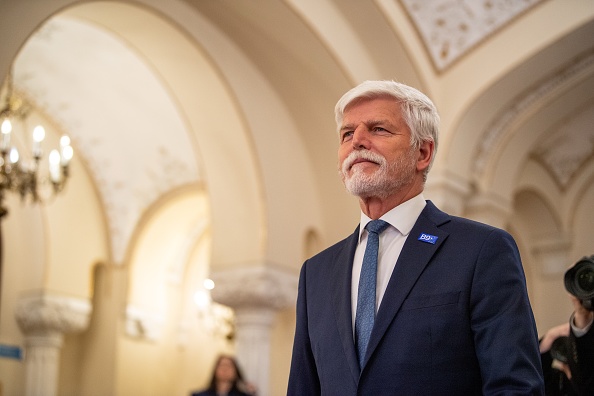
Czech President Petr Pavel has urged the Czech Republic to move toward adopting the euro, putting him on a potential collision course with Prime Minister Andrej Babiš’s new government, which has ruled out joining the single currency.
Speaking at the ReVize Česka conference in Prague, Pavel said the country should not cling to the Czech crown out of sentiment if the currency becomes an obstacle to development. He argued that the Czech economy is already closely tied to the eurozone and that adopting the euro would give the country a stronger voice in European decision-making.
“The very fact that our economy is significantly linked to the eurozone should lead us to say that it is clearly better to be at the table where decisions are made in such a case than to sit behind the door and then deal with these decisions,” Pavel said, as cited by Echo24.
The president said the Czech Republic’s absence from Euro Summit meetings, where eurozone leaders discuss issues affecting the currency area, leaves Prague outside key debates despite the country’s deep economic links with the bloc.
Pavel also criticized the domestic political climate around the euro, saying Czech society has avoided a serious discussion about the advantages and disadvantages of adopting the common currency. He said public skepticism is often reinforced by politicians who deliberately encourage negative attitudes toward the euro.
“I think that a successful Czech Republic can only be in an integrated and strong Europe, and we have all the prerequisites for that in Europe,” Pavel said. “However, we are not always able to fulfill them, because fragmentation still exists in many ways.”
He said EU member states should be prepared to set aside narrower national interests in favor of a stronger and more successful Europe.
His comments came after Babiš made clear that his ANO-led government, formed with the SPD and the Motorists, does not intend to introduce the euro. At the beginning of May, Babiš said the government would no longer prepare an annual report on the Czech Republic’s readiness to adopt the common European currency.
“It is pointless to discuss the position on the euro every year; we do not want the euro. Let the next government resolve this in the first quarter of 2030, there is no reason to talk about it for us,” Babiš said.
rejected the criticism, saying the Ministry of Finance would still prepare the material, but not every year.
“Why, if our government will not adopt the euro and will not take any steps towards it?” added Finance Minister Alena Schillerová.
To adopt the euro, a country must meet five Maastricht criteria covering inflation, long-term interest rates, public finances, debt, and exchange rate stability. Inflation must be no more than 1.5 percentage points above the average of the three euro area countries with the lowest price increases, while long-term interest rates must not be more than two percentage points above the average of those same countries.
The public finance criterion sets a maximum deficit of 3 percent of GDP and a maximum debt ratio of 60 percent of GDP. The final condition is exchange rate stability, requiring two years of membership in the ERM II exchange rate mechanism.
The Czech Republic pledged to adopt the euro when it joined the European Union in 2004, but no date has been set. The euro is currently used by 21 of the EU’s 27 member states, with Bulgaria the latest to join the currency area this year.
Public opposition in the Czech Republic remains strong. A recent CVVM survey found that two-thirds of Czechs oppose adopting the euro, while 30 percent support it.