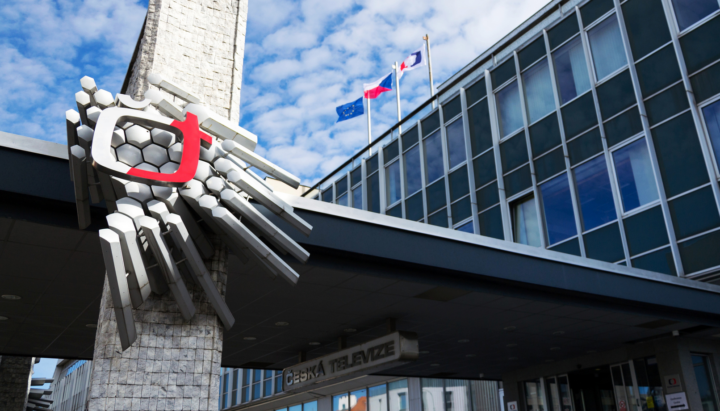
The Czech government has approved a proposal to abolish television and radio license fees and replace them with direct state funding for the country’s public broadcasters.
Culture Minister Oto Klempíř said the existing law on radio and television fees would be repealed and replaced with a new law on public broadcasting finance. Under the proposal, Czech Television would receive 5.74 billion crowns (€237.5 million) a year, while Czech Radio would receive 2.065 billion crowns (€85.4 million).
As reported by Echo24, the figures are based on the broadcasters’ 2024 annual reports. Compared with this year, Czech Television and Czech Radio would see their combined budgets fall by around 1.4 billion crowns (€57.9 million). Czech Television would lose about 1 billion crowns (€41.4 million) annually, while Czech Radio would lose roughly 350 million (€14.5 million).
The bill also includes an inflation clause, which would take effect once cumulative inflation exceeds 10 percent.
The abolition of license fees was included in the government’s program statement, with Prime Minister Andrej Babiš’s coalition arguing that the change would reduce the burden on households and businesses.
“We join the majority of European countries that have already withdrawn from this outdated instrument,” Klempíř said after the government meeting. “We are maintaining the current form of the Act on Czech Television and Czech Radio, with the exception of the passages on concession fees. We are repealing the Act on Radio and Television Fees and replacing it with the Act on Financing Public Service Media.”
Klempíř said talks with the heads of Czech Television and Czech Radio suggested their main concern was not funding itself, but preserving the current operation of both institutions. He said the government had been accommodating on that point.
The culture minister argued that the proposed funding level was sufficient, pointing to the broadcasters’ own 2024 reports and saying they had been strong market players at the time. He said Czech Radio’s Radio Journal station had led the market and claimed the reports did not present a lack of money as a central obstacle to development.
“I am convinced that both directors can prove that they are people in their place and, just as they were able to cope with the budget increase, they will also be able to work with a slightly lower budget compared to this year,” Klempíř said.
Babiš accused the previous government of breaking a promise not to increase the fees and said the public broadcasters had shown little interest in cutting costs.
“If we compare the money that these media received in 2024, it was 7.805 billion crowns (€322.9 million). If we compare it with 2026, the difference is 1.401 billion (€58.0 million). If the fees are abolished, the media will save at least 250 million (€10.3 million) in terms of collecting these fees, because people do not want to pay it, and then someone probably makes money from collecting them. None of the media has shown any interest in saving,” Babiš said.
The coalition wants the new system to take effect from Jan. 1, 2027, though Babiš acknowledged that the normal legislative process could take around nine months and that the opposition is expected to mount significant obstruction.
The plan has already triggered strong criticism from opposition parties, media experts, and employees of Czech Television and Czech Radio. Staff at both broadcasters are on strike alert and are planning a warning strike next Monday.
Critics say direct state funding could make the broadcasters more vulnerable to political pressure. Their demands for explicit legal guarantees against such pressure have not been met.
Klempíř rejected the need for additional safeguards, saying the government had not changed the other laws governing the operation and mission of Czech Television and Czech Radio.
The funding bill is now expected to face a heated debate in Parliament.