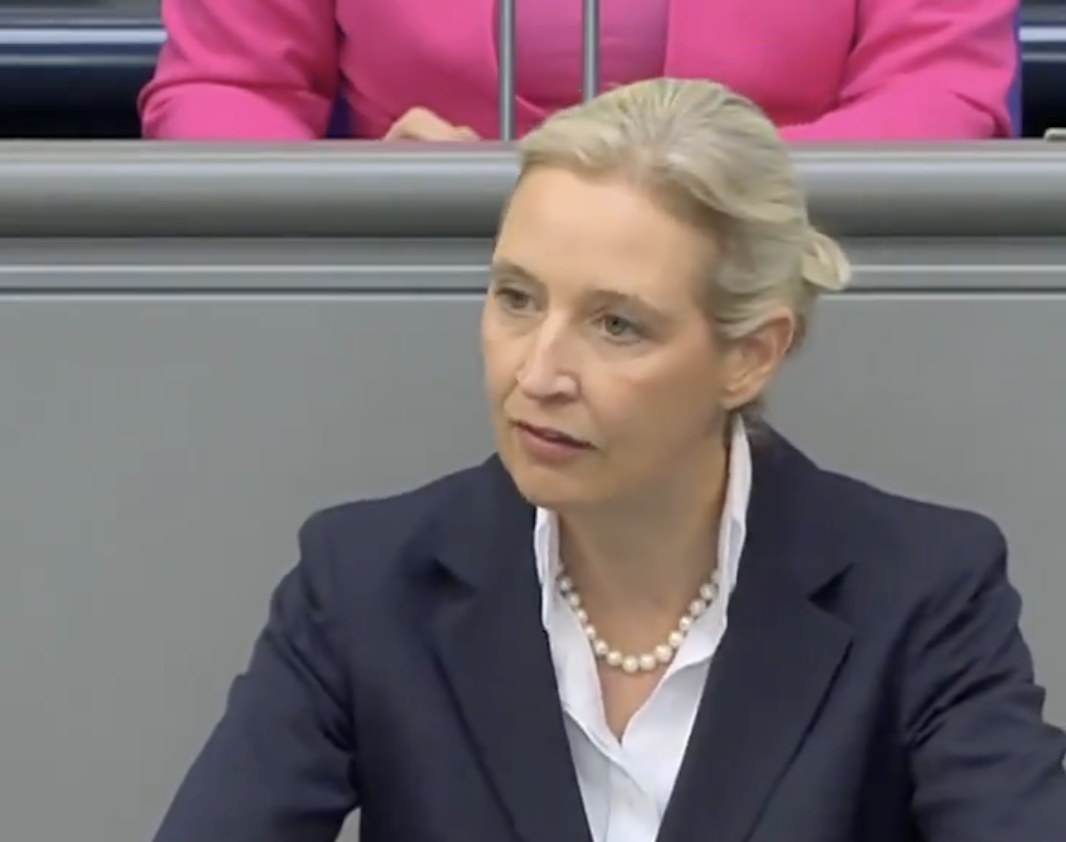
Fresh figures from Germany’s Federal Statistical Office (Destatis) confirm that company insolvencies are still climbing, extending a trend that has now persisted for several years amid a challenging economic environment. Now, Alternative for Germany (AfD) co-chief Alice Weidel is calling it an “insolvency tsunami” and decrying the federal government’s failure to turnaround the German economy.
“Suppliers and service providers are falling like dominoes, not a week goes by without bad news. Germany’s mid-sized businesses are running out of reserves. The insolvency tsunami is driving prosperity and good jobs out of Germany. Every 20 minutes, a German company goes bankrupt,” she said in a speech in the Bundestag.
„Zulieferer und Dienstleister fallen wie Dominosteine, keine Woche ohne Hiobsbotschaften. Dem deutschen Mittelstand gehen die Reserven aus. Der Insolvenz-Tsunami vertreibt Wohlstand und gute Jobs aus Deutschland. Alle 20 Minuten geht eine deutsche Firma pleite.“ pic.twitter.com/RWrwOiwIVv
— Alice Weidel (@Alice_Weidel) July 10, 2026In April 2026 alone, 2,276 companies filed for insolvency — a 7.1 percent increase compared with the same month a year earlier. For the first four months of the year, the total reached 8,551 insolvencies, up 6.7 percent from the corresponding period in 2025, according to German economic newspaper Handelsblatt.
Creditors’ claims in this period totaled approximately €13.9 billion, lower than the €22.5 billion recorded in the first four months of 2025, largely because fewer large-scale bankruptcies occurred early in 2026 than in the prior year.
On a per-10,000-companies basis, the insolvency rate stood at 24.1 through April. The hardest-hit sectors remain transport and warehousing, hospitality, and construction. Destatis notes that official statistics reflect insolvencies only after an initial court decision, meaning the actual filings often occurred several months earlier.
The Leibniz Institute for Economic Research Halle (IWH) paints an even starker picture for the economically most relevant segment — insolvencies involving partnerships and capital companies. In the first half of 2026, the IWH recorded 4,996 such cases, the highest level since the second quarter of 2005. Researchers at the institute warn that the wave now affects numerous sectors and regions simultaneously.
Corroborating data from the credit information agency Creditreform reinforces the scale of the problem. In the first half of 2026, approximately 12,900 company insolvencies were registered — a 7.8 percent rise year-on-year and the highest figure since 2013. These cases generated around €28.5 billion in damages and affected roughly 165,000 jobs.
Analysts attribute the sustained rise to a combination of factors: persistently high energy and labor costs, elevated interest rates that have made borrowing and investment more expensive, weak domestic demand, and structural challenges in key industries.
The IWH has highlighted that many smaller businesses, which make up the vast majority of insolvencies, have been particularly vulnerable after years of economic stagnation.
Some reports also point to the ripple effects of geopolitical developments, including energy price pressures linked to the Iran conflict, which have compounded existing cost burdens. However, with Europe’s decision to abandon cheap Russian energy, leaders and policymakers are scrambling to contain the fallout, with fears that gas reserves could run dangerously low in the winter.
Neither the IWH nor Creditreform anticipates a quick reversal to the economic strain. IWH insolvency researcher Steffen Müller has indicated that very high insolvency numbers are likely to continue through at least July 2026 and beyond, with no trend reversal in sight.