
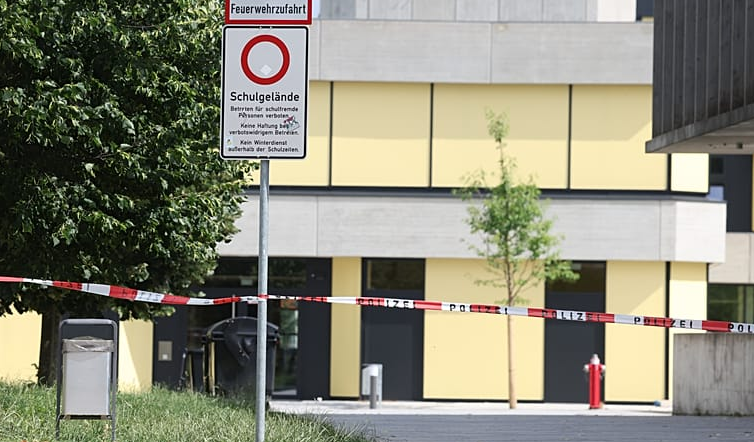
A German teacher has described a secondary school in the Rhineland where violence, drug dealing, and severe behavioral problems have become part of everyday life, including one case in which a 15-year-old girl allegedly prostituted herself in the school toilets for drugs and money.
Speaking anonymously to Bild, special education teacher “Carola S.” said around 75 percent of students at her school have a migrant background, with many having arrived from Syria, Iraq, Afghanistan or Ukraine.
“It’s all blowing up in our faces,” she said.
“Every day is a challenge. Fights, shouting — this happens in the classroom and on the schoolyard,” she told the German tabloid. “We are happy if we can teach for a few minutes at a time. Sometimes the police have to come several times a week.”
She said drugs are also dealt on school grounds and recalled an extreme case involving a 15-year-old pupil.
“A particularly egregious case involved a 15-year-old student who prostituted herself in the school toilets for drugs and money. She became pregnant and left the school.”
Carola said many newly arrived pupils initially speak little German and do not receive grades for their first two years. “After that, the students are graded regularly, but for many, their performance is still unsatisfactory. Some don’t return at all,” she said. “This year, almost 40 percent failed to obtain their secondary school leaving certificate.”
She also described clashes over cultural attitudes, including a Syrian father who objected to his son being taught by a woman. “It is very difficult for us to reach these parents,” she said.
Carola said she was punched in the face just three weeks ago while attempting to intervene in a fight between pupils.
“I got caught in a fight between students and ended up with a split lip because a student punched me in the face during the scuffle,” she said.
She reported the incident to police, but said the case was subsequently closed.
“This is not an isolated incident. Some colleagues are openly insulted, threatened, or ambushed after school, and this isn’t even reported,” she added. “Many talk about not being able to do the job until retirement. We have a high rate of sick leave.”
The German Teachers’ Association has long accused politicians of failing to respond quickly enough. Its chairman, Stefan Düll, said back in 2024 that preventive measures, social work, school psychology and other support systems had failed to expand in line with demand.
“For too long, politicians have primarily acted reactively,” Düll said. He warned that Germany’s education system is being overwhelmed by immigration, arguing that large numbers of children entering schools with little or no German were placing an unsustainable burden on teachers.
“Due to immigration in 2015, the war in Ukraine and other immigration, new people are constantly coming into the system, but the system is slow to keep up because it is moving too fast,” he said at the time.
“The higher the percentage of immigrants, the more difficult it is to motivate the class.”
Recent incidents have added to concerns over conditions in German schools. In May, a 20-year-old Afghan was remanded in custody after allegedly sexually assaulting an 11-year-old girl inside a school restroom in Koblenz while a 19-year-old suspected accomplice allegedly held the child down.
That same month, authorities announced a regular police presence at the Karolina-Burger high school in Ludwigshafen following 118 criminal complaints, around 100 fire department call-outs and a succession of knife attacks, assaults and threats.
Teachers there had reported death threats including “I’ll shoot you all,” pupils attacking one another, and extensive vandalism. In one of the most serious cases, prosecutors said a 16-year-old girl attacked a teacher with a knife “with the intention of killing her.”
Concerns have also been raised over religious intimidation. In April, Berlin youth worker Wolfgang Büscher warned that some schools were producing what he described as “mini-Islamists,” with pupils allegedly pressuring Muslim and non-Muslim classmates to conform to strict religious practices.
Back in the Rhineland, Carola said teachers increasingly feel abandoned by authorities.
“No one from the school board ever shows up. They’ve left us to fend for ourselves,” she said. “And then the politicians want to close the secondary schools. Where are the children supposed to go then?”