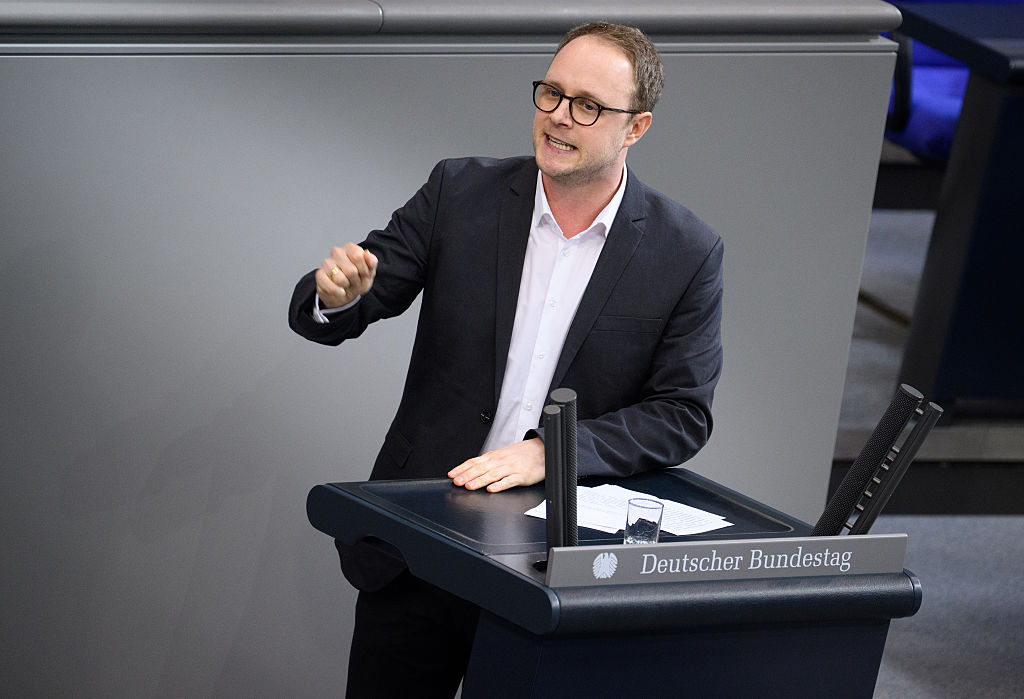
A prominent Green Party lawmaker from the German state of Baden-Württemberg is pressing the federal government to fly in more Afghan migrants who are currently awaiting entry to Germany from Pakistan. In an official correspondence addressed directly to Federal Interior Minister Alexander Dobrindt (CSU), MP Marcel Emmerich called for an expedited admission process so these individuals, who claim they worked with German armed forces and fear Taliban retribution, can resettle in his home constituency of Ulm along with their families.
Emmerich targeted the long delays facing former local personnel who assisted international forces prior to the Taliban takeover. He emphasized that “people who fought alongside the German Armed Forces in Afghanistan for democracy, freedom and the rule of law are still waiting to be admitted in Pakistan.”
He characterized the current administrative standstill as “unbearable.”
His demand comes at a time when data shows that Afghans are one of the most poorly integrated of all migrant groups in Germany, along with a number of high-profile terrorist and criminal attacks conducted by Afghan nationals in recent years.
The initiative follows a formal decision passed by the Ulm municipal council this past July, in which local authorities officially signaled to regional and federal officials their readiness to house and integrate incoming arrivals.
Emmerich’s appeal also draws legal backing from a recent landmark ruling by the Federal Constitutional Court. Karlsruhe judges determined that arbitrarily shutting down admission pipelines violates constitutional protections against arbitrary governance, forcing the government to fulfill existing entry promises made to vetted individuals.
Germans, however, have an entirely different views on refugees. Polling from last year showed that 68 percent of Germans wanted fewer refugees. Another poll from YouGov last year showed that a majority of Germans wanted a complete moratorium on immigration, which would mean a stop to all migration, whether legal or illegal.
Between August 2021 and January 2025, Berlin issued formal entry commitments to over 10,000 Afghans designated as particularly vulnerable. Though operations slowed significantly, state-backed support continued. As of March 16, 54 Afghans in Pakistan were actively receiving assistance through an admission program, aided significantly by legal actions spearheaded by the non-governmental organization “Kabul Airlift.”
Following successful litigation by civil society groups, the government resumed transport operations, gradually bringing individuals holding valid entry promises into Germany.
The total volume of admissions has sparked persistent political opposition and concerns about who actually worked with Western coalition forces in Afghanistan. The number of Afghans arriving in Germany through the program has been significant. By May 2025, total arrivals through local staff channels had grown to approximately 19,300 people, which is substantially more than the figure first presented, which was in the range of 300.
In April 2021, official military publications painted a relatively contained picture. According to an archived article from the German Armed Forces.
“Currently, around 300 local Afghan personnel are working for the German contingent of the NATO mission Resolute Support. Any local authority recognized as being at risk can apply for admission to Germany for itself and its nuclear family through the so-called local authority procedure,” read the article.
Addressing this divergence, CDU Parliamentarian Simone Borchardt noted that following the collapse of the Afghan government in August 2021, “the circle of those entitled to protection had expanded considerably.”
The criteria were widened beyond recent military aides to include long-inactive workers, media personnel, human rights advocates, and staff from civilian NGOs. Family sizes were also estimated upward. While planners originally estimated three to five dependents per worker, field reports indicated “that many affected local workers lived with significantly larger households.” As a result, the number of Afghans eligible for the program exploded.
Afghan family structures are also substantially larger and murkier than in the West, with far less documentation to provide evidence of their claims to Western authorities.
Afghans have been shown to submit false documentation to support a record with Western military authorities that never existed, including fraudulent letters of recommendation or employment verification logs falsely claiming association with allied military or contractor forces.
There is an absence of functional civil registries inside Afghanistan, which prevents standard cross-checking of births, marriages, and deaths. Authorities in the West have extreme difficulty vetting such claims, and incidences of fraud within Afghan family reunification and relocation structures involve fabricated biological relationships along with forged employment or civil documents.
As Remix News previously reported, only one in eight Afghans admitted through the program in Germany has been properly screened, according to news reports.
As European Conservative reported last year, the German program itself has faced widespread fraud accusations.
“German embassy officials in Islamabad warned of ‘highly concerning’ practices. Visa applicants often presented forged identity documents and unverifiable claims of persecution. Some were openly coached to lie during interviews. One man, whose story had been written for him by NGO handlers, messaged an activist asking, ‘What am I now—trans or gay?'”
The report continues, noting: “The abuse appears systemic. In one instance, a group of ten individuals submitted 21 fake Afghan ID cards claiming family ties to a man who had taught literacy classes. In truth, many had been living in Pakistan for years and may not have been Afghan nationals at all.”
It would hardly be the first case involving such scams. As the U.S.-based Center for Immigration Studies noted in 2001, “U.S. authorities are investigating some 4,000 Iraqis suspected of filing fraudulent applications for refugee resettlement in the United States and are re-assessing cases involving more than 104,000 others. Over 500 Iraqis already admitted as refugees could be deported or stripped of their U.S. citizenship.”
Reuters described it as “one of the biggest into refugee program fraud in recent history.”