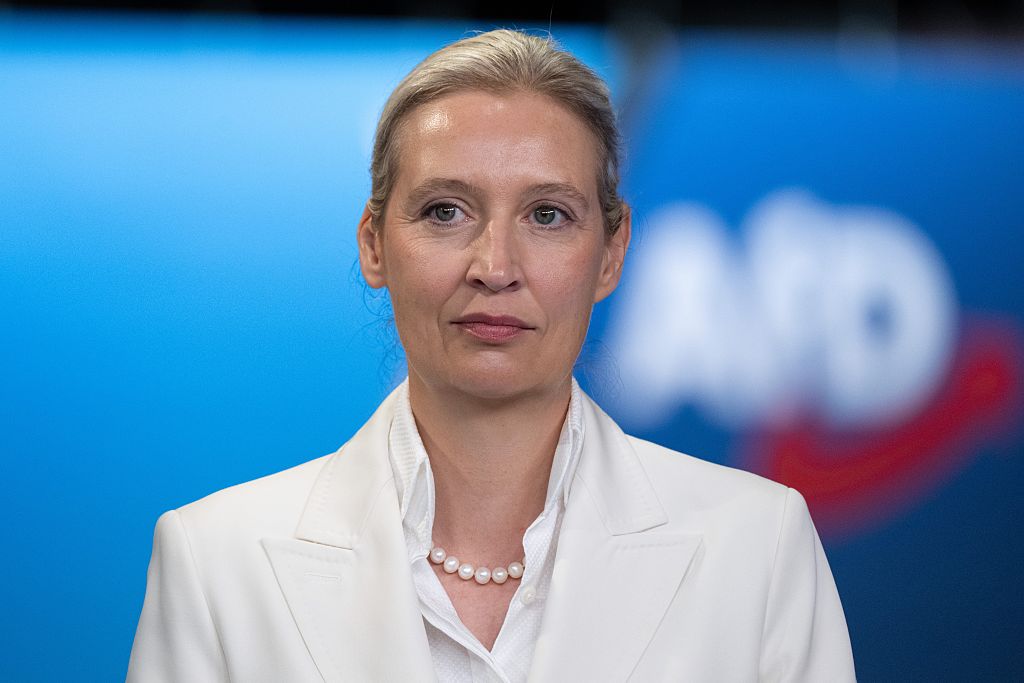
Alternative for Germany (AfD) co-leader Alice Weidel has launched a fiery attack against government-aligned NGOs, accusing them of illegitimately funneling public and private funds into state election campaigns to support the far-left Social Democrats (SPD) and the Green Party.
Speaking out against the massive capital deployment in Saxony-Anhalt, Weidel called for a full legal investigation into campaign spending practices.
“What is becoming apparent here is a democratic scandal that must be fully investigated legally,” Weidel stated.
At the center of the dispute is the left-leaning advocacy group Campact, which recently disclosed plans to spend hundreds of thousands of euros on targeted voter mobilization ahead of regional balloting. Weidel argued that such political intervention crosses the threshold into unregistered campaign financing.
“When organizations with substantial financial resources deliberately campaign in favor of left-wing parties, the question arises whether they are still operating within the limits of permissible party funding,” she said, emphasizing that a mere “relabeling as ‘campaign'” should not exempt third-party groups from statutory donation oversight.
The NGO industry in Germany is well-funded and overwhelmingly against the AfD, and as newspaper Junge Freiheit describes in a new article, “is descending like locusts” on the state to stop the AfD in September. The news about Campact comes after it was revealed that left-wing parties are pouring record sums into the race in Saxony-Anhalt.
The AfD is extremely close to securing an absolute majority in Saxony-Anhalt, which would enable the party to rule without a coalition. That may be necessary, since even with 42 percent of the vote, the AfD may be kept entirely from power through a coalition consisting of all other victorious parties. Much depends on whether certain parties, like the Greens, receive 5 percent of the vote, which is the threshold required for them to enter parliament.
Weidel pointed to the current ruling coalition of the SPD and Christian Democrats (CDU), targeting political hypocrisy surrounding state funding for civil society networks.
“It is an absolute scandal when left-wing NGOs claim political neutrality on the one hand, but on the other hand engage in massive fear-mongering against opposition parties critical of the government and advocate for the election campaign interests of the SPD and the Greens,” she said.
Chancellor Friedrich Merz had initially announced he would “clean up such negative developments” surrounding the explosion in the number of NGOs and their activities in Germany. However, Weidel says that the current black-red federal alliance has done the exact opposite by expanding federal allocations toward politically active advocacy organizations.
The AfD wants to completely revamp and likely strip much of the NGO sector in Germany of its massive power and financing, at least if that funding comes from the state. The party is pressing for strict statutory reforms regarding campaign operations and nonprofit privileges. The AfD leader demanded “complete transparency about all state funding to NGOs, but also – as in the case of Campact – about clients, major sponsors and their political activities.”
She argued that tax exemptions or state subsidies ought to be “bound to clear neutrality, transparency and control requirements.”
She is also calling for a level electoral playing field: “Anyone who intervenes in political decision-making must face democratic transparency and fair competitive conditions –regardless of whether it is a party, a foundation or an NGO.”
While Weidel may be focusing her ire on Campact, the NGO itself does not receive any taxpayer euros.
The controversy is centered around documents showing major third-party expenditures were formally submitted to parliamentary auditors. Disclosures show that Campact earmarked twin campaign budgets of 310,000 euros ($340,000) each aimed at boosting turnout for both the SPD and the Greens.
For its part, Campact maintains that its activities strictly adhere to electoral laws because the organization executes independent strategy rather than transferring funds directly to party treasuries. On its official website, the group asserted that the funds would be spent “without any mandate or control by these parties.”
Describing its initiative as a parallel campaign focused on “voting strategically,” Campact rejected assertions that its spending constitutes a party contribution, even though parliamentary transparency registries log third-party expenditures in similar disclosure frameworks.
“We do not transfer money to the SPD or the Greens,” the far-left organization stated, maintaining that they are urging citizens to vote for specific parties “on their own initiative.”
The move from Campact may be open to a legal challenge, but by then such a challenge moves through the court system, the election in Saxony-Anhalt will likely have long been decided.