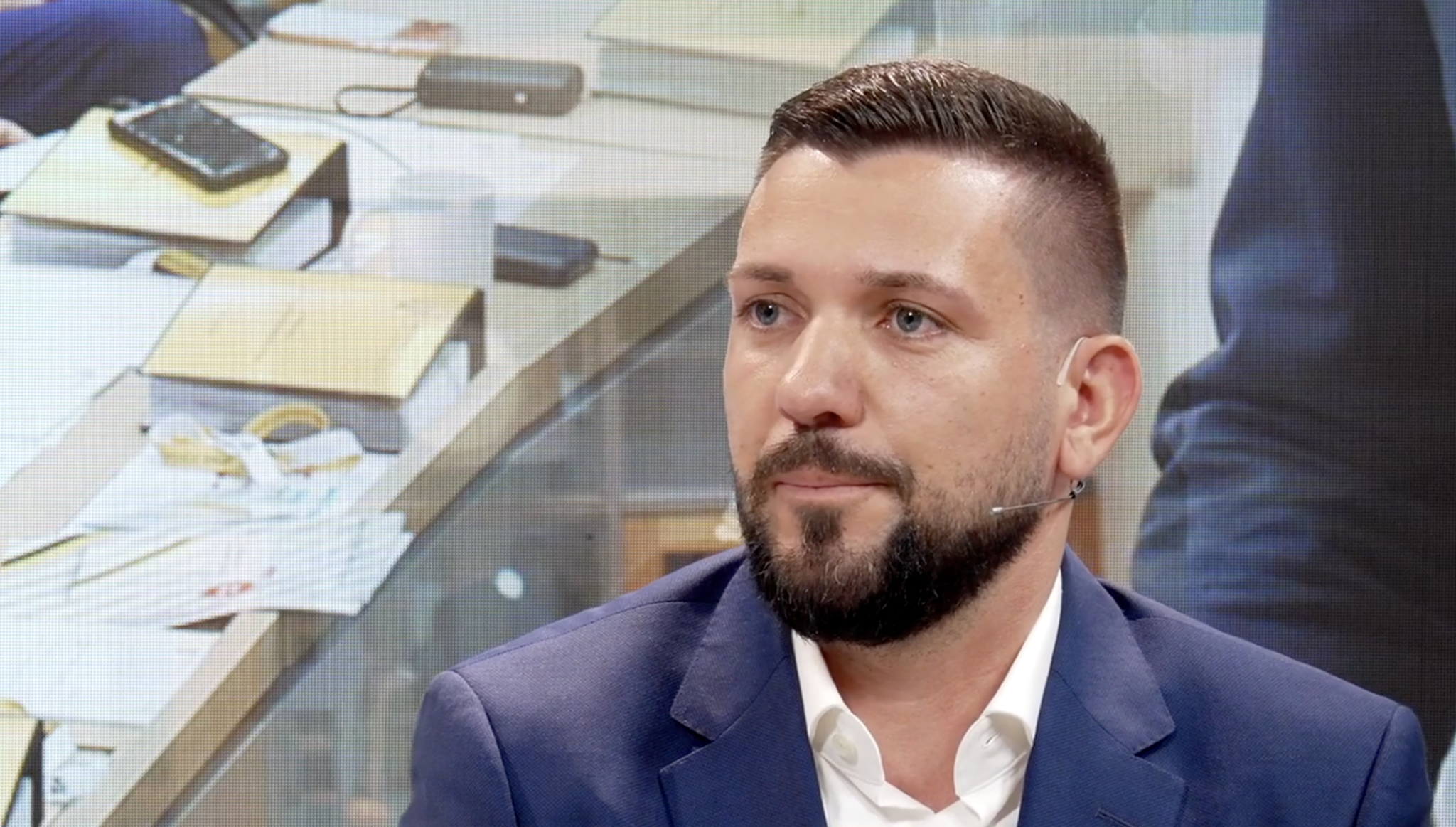
After yesterday’s vote in the Saxony-Anhalt Landtag, the Alternative for Germany (AfD) now holds the office of state parliament president for the first time in any German state. After winning the role, which is similar to a speaker position, 35-year-old Tobias Rausch sent shockwaves through the German political establishment when he confirmed he won with the support of Christian Democratic Union (CDU) votes. The backing of four CDU lawmakers could be one of the most concrete signs that the political firewall against the AfD is crumbling.
The newly elected president of Saxony-Anhalt’s state parliament said Wednesday that members of the conservative CDU voted for him. Perhaps even more importantly, he said that four CDU lawmakers have agreed to back the AfD’s candidate for state premier in December, which means Ulrich Siegmund could soon be the first AfD politician leading a state government.
Rausch gave a direct “yes” when Nius editor-in-chief Julian Reichelt asked on “Nius Live” whether CDU deputies had helped elect him. Asked whether Tuesday’s result signaled that AfD candidate Ulrich Siegmund would safely take office as minister-president in December, Rausch replied, “That is to be assumed.”
BREAKING NIUS: Bei NIUS Live bestätigt AfD-Landtagspräsident Tobias Rausch, dass er von CDU-Abgeordneten ins Amt gewählt wurde. Es habe dazu klare Absprachen zwischen AfD und CDU gegeben, und die vier CDU-Abgeordneten werden im Dezember auch für Ulrich Siegmund als Ministerpräsident stimmen und ihm damit die notwendige Mehrheit sichern.
— Julian Reichelt (@jreichelt) October 7, 2026He told the German press agency dpa that there were agreements with four CDU members of parliament for Siegmund’s election.
He added that more might become clear at a CDU state party conference on Dec. 5, but declined to elaborate. Acting state premier and CDU floor leader Sven Schulze did not comment on the claims when asked by dpa.
Rausch was elected Tuesday in the constitutive session of the 83-seat Landtag in Magdeburg with 48 votes, 29 against and five abstentions. It was the first time the AfD, parts of which are classified as extremist by German domestic intelligence, has held the presidency of a state parliament since the party was founded in 2013.
The AfD holds 39 seats after winning 43.8% of the vote in the Sept. 6 state election, three short of a majority. The five lawmakers of the Sahra Wagenknecht Alliance had said in advance they would support Rausch, accounting for 44 votes. The additional four came in a secret ballot. SPD, Green and Left lawmakers had said they would vote no. The CDU leadership had recommended that its members abstain; 14 of the party’s 15 deputies were present, but only five abstentions were recorded in the chamber.
The speaker chairs sessions, oversees the parliamentary administration and represents the Landtag externally, including at ceremonial events.
However, the far more consequential vote is expected in December, when lawmakers choose a minister-president. Siegmund needs at least 42 votes, and so far, the BSW has not committed to supporting him for that post.
Meanwhile, Schulze of the CDU remains acting premier until a successor is chosen.
Later Tuesday, AfD lawmaker Hans-Thomas Tillschneider was elected a vice president with 44 votes to 38, even though the BSW said its members would not support him because of statements he had made on armaments policy.
CDU lawmaker Carsten Borchert was chosen as another deputy president with 64 votes in favor and 17 against. SPD candidate Armin Willingmann received 33 votes and failed.
AfD national co-leaders Alice Weidel and Tino Chrupalla congratulated the party and described the result as an end to the “firewall” that mainstream parties have maintained against cooperation with the AfD.
However, the national CDU is not happy about the outcome in Saxony-Anhalt. CDU/CSU parliamentary group chairman Thorsten Frei said, “The fact that this is the case is, in my view, extremely concerning and worrying.”