

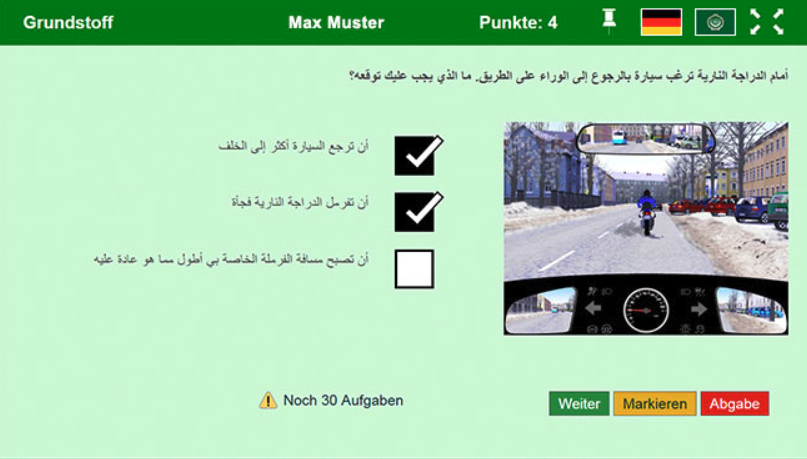
Starting on April 1, 2027, those seeking a driver’s license in Germany will be able to take the theoretical driving license examination in the northern Kurdish language Kurmanji and Ukrainian. This expands the existing list of foreign languages from 12 to 14 under an amendment to Driver’s License Ordiance (FeV) that was adopted in August 2026 and approved by the Bundesrat.
The change forms part of a broader package aimed at making it easier for foreigners to obtain a license and addressing the chronic shortage of professional drivers.
So far, future drivers have a broad selection of languages to take the test in, including Russian, Arabic, Turkish, and Polish, even though all road signs featuring text in Germany are still written in German.
Most other elements of the law already took effect around mid-August 2026. These include simplified, largely exam-free conversion of Ukrainian and Montenegrin licenses into German ones for certain categories, recognition of certain third-country licenses already exchanged in another EU state, and the option to take the accelerated basic qualification for professional drivers in nine foreign languages.
The practical part of the professional-driver qualification test was also shortened.
Federal Transport Minister Patrick Schnieder (CDU) stated the measures would ensure people obtain work as drivers.
“Without our professional drivers in logistics and local public transport, Germany would come to a standstill,” he said. The ordinance “removes access barriers and gets drivers into the job more quickly.”
Such a move may actually worsen the long-term situation for the logistics industry. China already has a commanding lead in self-driving semi-trucks, featuring at least 2,100 SAE Level 3+ autonomous heavy-duty trucks. China’s rapid progress allows the country to address labor shortages caused by demographic decline. In fact, Europe’s policy of consistently turning to cheap foreign labor to fill shortfalls has only exacerbated its huge disadvantage when it comes to autonomous vehicles, automation, and robotics.
Advocacy from the Kurdish community, represented by KGD in Germany, played a visible role. KGD representative Shilan Kurdpour told Kurdistan24 that the initiative offered a “dual benefit.” Kurdish residents gain easier access to a driver’s license, while the German state benefits from their contributions to the country.