Blog

  • Retaliation for the Czech soldiers killed in Afghanistan

    According to information that Lidové noviny gathered, an operation was carried out by the 601st Special Forces Group that had been operational in Afghanistan for quite some time. Reportedly, one person had been killed and one had been captured.

    As it usually is when it comes to a clandestine operation, there are no official statements. It is alleged that all those involved had been ordered to strict silence by Prime Minister Babiš.

    The three Czech soldiers – sergeant Martin Marcin, private Kamil Beneš and private Patrik Štěpánek – will receive state honors in memoriam from Commander-in-chief President Zeman on the occasion of the 100th anniversary of Czechoslovakian independence.

    The soldiers died when a suicide bomber detonated himself in front of their patrol at the Bargam base. In August after their remains were brought home, they were buried with military honors. According to their commanders, their actions on that day prevented an even worse tragedy and more causalities. 

  • “We are pro-European,” says Kaczyński

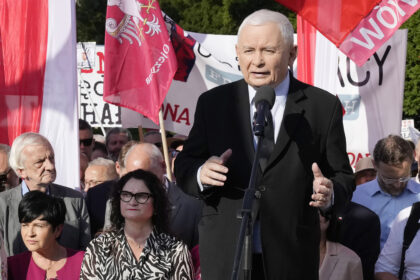
    “We haven’t changed our stance on the EU,” Kaczyński said in a television interview on Polsat News. “We have always been pro-European, that is, in favor of Poland remaining in the EU, and we still are. Nothing has changed,” he added. 

    Kaczyński believes that the problem of Polexit is simply a propaganda issue. According to the PiS leader “the real issue lies with Civic Platform (PO) that was seeking good jobs and posts for its politicians. Meanwhile, PiS is seeking to benefit Polish interests.”

    We have always been pro-European, that is, in favor of Poland remaining in the EU, and we still are. Nothing has changed

    Jarosław Kaczyński is not worried about minister of justice Zbigniew Ziobro’s recent notion to the Polish Constitutional Tribunal. Opposition parties said that Ziobro undermined European Union treaties when he asked the Tribunal to rule that Polish judges have no right to consult the European court’s opinion on the country’s controversial judicial reform.

     “He [Ziobro] has certain duties which stem from the Polish constitution,” said Kaczyński and added that these duties must be realized and that they “have nothing to do with Polexit or some kind of anti-Europeanness.”

    He pointed to the German Federal Court of Justice that has looked into similar cases and settled them in “the same direction as the one suggested by Ziobro in his notion.”

  • The mystery of the vanishing plate

    Polish Politico head editor Michał Broniatowski alerted the world on facebook that the Polish ambassador personally unscrewed the plate. Broniatowski suggested that the reason for the removal was the presence of the names of Jerzy Buzek and Donald Tusk.

    https://web.facebook.com/michal.broniatowski/posts/10218864849758757

    Donald Tusk claimed on Twitter that he doesn’t care so much about unscrewing the plate as he does about Poland’s position in the EU:

    “Never mind the plate. It’s important that they don’t unscrew Poland from the European Union.”

    https://twitter.com/donaldtusk/status/1052546353526661122

    Polish internauts were quick to respond to Tusk’s threatening with Polexit. Asia S. writes:

    “The greatest success of Poles and Poland in the last years?! Unscrewing you and your crew of liars from the trough.”

    https://twitter.com/asia_s8/status/1052553871715946496

    “Newsweek Polska” asked the Polish Ministry of Foreign Affairs to comment on the issue. The Ministry replied that the removal had happened due to renovations of the building.

  • Russia angry at removal of Soviet monument in Warsaw

    “This is rewriting history,” says Maria Zakharova the spokeswoman of the Russian Ministry of Foreign Affairs.

    Deconstruction works of the statue started this week. The decision stems from the bill of forbiddance of propagating communism or any other totalitarian system. This includes names of buildings and public spaces or devices.

    [block:views=related_articles_field-block]

    The monument commemorates the Soviet soldiers who died on September 1944 while fighting over the Praga district of Warsaw. The inscription on the monument says “Eternal glory to the heroes of the Red Army who fell in battle for the liberation of the Polish capital of Warsaw.”

    The statue has been painted red or covered with anti-communist slogans on multiple occasions. The “Fighting Poland” sign also appeared.

    The monument will be moved to the Institute of National Remembrance.

  • Poland will be buying American LNG gas for the next 20 years

    Each contract, signed with Venture Global Calcasieu Pass LLC and Venture Global Plaquemines LNG LLC, foresees an annual purchase of 1 million tons of LNG gas (1.35 billion m3 of natural gas after regasification), over the course of 20 years.

    The chairman of PGNiG Piotr Woźniak underlines that the LNG gas from America is 20 percent cheaper than gas from the East.

    Prime minister Mateusz Morawiecki has expressed his delight at the signing of the agreement: “I’m glad we can fulfill our aim of raising the sovereignty and competitiveness of our gas sector. Our predecessors wanted to sign a contract with Gazprom, which would have put us in gas manacles.”

    I’m glad we can fulfill our aim of raising the sovereignty and competitiveness of our gas sector

    “This agreement is the first of its kind in Central Europe and is a straight path to energetic sovereignty,” said energy minister Krzysztof Tchórzewski

    The gas supply may also be used for further revenue on international markets and will be realized in a free-on-board formula. This will allow Poland to independently decide whether to keep the LNG gas in Poland or redirect it for trade.

    [block:views=related_articles_field-block]

  • Hungary jumps 12 positions in competitiveness ranking

    Reacting to the news, the Hungarian Finance Ministry said the report is an accurate reflection of the strides the Hungarian economy has recently made in competitiveness. These gains have by now also been acknowledged by the markets, credit rating agencies and independent economic research institutes.

    The WEF, based in Davos, Switzerland includes 140 countries and territories in its global ranking, taking into account 12 measurements. Out of the 12, Hungary was best-placed in terms of infrastructure (28th place), innovation capabilities (39th) and macroeconomic stability (43rd).

    The report also measures 98 economic indicators, half of which Hungary has improved its position compared with 2017. This has also validated the government’s thinking that macroeconomic stability also helps improve qualitative indicators and competitiveness.

    This year’s WEF competitiveness ranking is headed by the United States, Singapore and Germany. There are six European countries in the top 10 and the Czech Republic has Central Europe’s most competitive economy, ranked 29th. 


  • Drought hits autumn crops

    A prolonged drought is seriously hindering the growth of cereals and rapeseed planted in the autumn while in many areas planting – that by this time of year should be well under way – hasn’t even begun as the soil is rock-hard, the article said.

    A recent analysis of the National Meteorological Service (OMSZ) said that except for a few short spells there hasn’t been almost any rain in Hungary since the end of July and in most of the eastern parts of Hungary the situation has reached critical levels. Farmers who were able to plant rapeseed shortly after the few days of rain at the end of September reported that crop growth has been slow and in the areas that had no rainfall the plants are beginning to die.

    The situation is the same or worse for autumn wheat, where planting has been severely delayed and growth is also minimal due to the drought. While the OMSZ forecasts minimal rainfalls over the coming weekend, more substantial precipitation could at best come in November.

    Farmers now fear that lacking enough rain, the autumn crops will not be strong enough to survive the winter.

    The good news is that the same drought has accelerated maize harvesting which is well ahead of the usual schedule, with three quarters of the crop already in. The maize crop is estimated at 7.5 million tons this year, compared with 6.62 million tons last year.

  • Police chief: Budapest is one of Europe’s safest capitals

    Since 2010 the number of crimes in the Hungarian capital has fallen, particularly that of the crimes most affecting people’s security perception such as car thefts and break-ins, Terdik said in the interview.

    He said the number and training of police officers in Budapest is sufficient to do their job effectively and meet the people’s expectations. He added that as the new head of the capital’s police he did not plan any major overhauls “only some fine-tuning”.

    Terdik said one of the crimes we wanted to fight more effectively was conmen targeting the elderly. A widespread type of crime in Hungary and other countries of the region is tricksters posing as lawyers or policemen calling elderly people asking for money to “help out” their children in trouble.

    He said that while he didn’t think crime statistics were the only thing that mattered, “numbers are numbers, but we do have to have some form of measurement”.

    Terdik said the percentage of solved cases has also increased the average response time in Budapest which now stands at 12 minutes. He said response time for serious crimes was a critical factor in apprehending perpetrators. Police will also increase its presence in a Budapest area where designer drugs are especially widespread.

    Title image: Col. Tamás Terdik at his appointment hearing in the Budapest general assembly, Mayor István Tarlós in the background. MTI/Noémi Bruzák

  • PM Orbán: We cannot accept any resettlement program

    “We are on our way to the airport. Our plane is about to take off, heading for Brussels,” PM Orbán said. The summitt he was headed to has migration and security among its main agenda points.

    “It will be an important meeting because the European Commission continues to produce resettlement programs at full throttle. They still want to take away our right to border protection and they want to decide who can stay in Hungary and other countries of Europe. We will discuss these proposals today or tomorrow at dawn.

    The Hungarian position is clear: our soldiers and policemen will defend the border and we cannot accept any resettlement program.

    Go Hungary, go Hungarians!”

  • Macron to visit Slovakia

    Initially Emmanuel Macron planned his trip in the spring, but the French President will make a visit to Slovakia next Friday instead. 

    “He has no special connection to the country, but in contrast with his predecessors has much bigger ambition regarding the change of France and the European Union. This is why he needs the support of member states. In comparison with the Czech Republic, Slovakia is more important to him due to the country’s membership to the Eurozone,” points out analyst Vladimír Bartovic.

    The time of Macron’s visit is symbolical, the French president is coming to the country two days before the 100th anniversary of establishing the independent Czechoslovakia and will continue his trip to the Czech Republic to meet Miloš Zeman and Andrej Babiš. France, after the First World War, was one of the initial supporters of the common Czechoslovakian state.

    During his visit, Bartovic believes Macron will present his plans regarding the next European elections, and try to find allies for his political project in Brussels. Immigration will be another crucial issue of the meetings due to the lack of the common European approach and the resistance of the Visegrád Group regarding the mandatory quotas.

    According to Bartovic, Macron feels closer to the Czech Republic and Slovakia than “problematic” Hungary and Poland and while he accepts the existence of the Visegrád Four, prefers negotiations with countries which are “more accessible.”

  • Cyber-attack hits Slovak Ministry of Foreign Affairs

    PM Pellegrini characterized the attack as a “sophisticated act of cybernetic espionage.” The source of the leak came from a foreign server, the incident was discovered by intelligence officials due to the suspicious behavior of the computer infrastructure in the ministry.

    According to Miroslav Lajčák, Minister of Foreign Affairs, the hackers were not targeting classified information which is “communicated through secure channels.” Despite this fact it is probable that the attackers gained access to several documents stored on the servers and internal network of the ministry. It is unclear if any documents were leaked during the attack.

    The Prime Minister was unwilling to specify the country of origin of the attackers, he believes the spy network is supranational and similar hacks happened in the Czech Republic, Germany and Great Britain. Pellegrini believes it is necessary to cooperate with other countries regarding the investigation of the case.

  • Chief of Czech diplomacy finally appointed

    Tomáš Petříček replaced Jan Hamáček who temporarily led the Foreign Ministry together with the Ministry of Interior. “If we want to be taken seriously, we cannot speak with many different voices,” said Miloš Zeman during the ceremony. He added that he is looking forward to a successful collaboration ahead and welcomes the fact that Czech diplomacy will be consistent. 

    The new minister announced that he is now putting together a team of advisers – academics, diplomats and former politicians – but didn’t rule out the possible engagement of Poche.

    According to Petříček, the key topics for Czech diplomacy are conflicts in the Middle East and in Africa, and relations within the EU. His first foreign visit will be to Germany to meet his counterpart Heiko Maas.

  • US Defense Secretary to attend centenary event for Czechoslovakia

    Czech Ambassador to the United States Hynek Kmoníček says Mattis will visit other European countries as well, but his schedule has not been finalized just yet. It is expected that Mattis will sit down with PM Andrej Babiš and the Czech Minister of Defense Lubomír Metnar. It’s unclear whether he will also meet with President Zeman.  

    The main reason for an invitation was the parade as part of the hundredth anniversary celebrations. Originally, we negotiated for Vice-president Mike Pence to attend, however it would collide with the upcoming Congressional elections, said Kmoníček.

    According to Lidové noviny, a planned purchase of military equipment for the Czech army may play a part as well. The army plans to spend tens of billions on helicopters, radars, artillery and infantry fighting vehicles. It would be the first Czech ‘made in the US’ purchase since we’ve joined NATO, thus increased activity on the American side is only logical, explained Kmoníček.

  • Zeman: State honors go to those fighting “economic fu**ers”

    Zeman said in an interview with Czech Radio that he considers the struggle against business fraud to be a link between Vitásková, Krúpa, and Lorencová, for which they deserve to be honored. However, the president used one of the strongest Czech expletives in the live interview to describe the “frauds”.

    This was not the first time Zeman used vulgar language in the media; he has already described the meaning of “pussy”, referring to Pussy Riot in a live Czech Radio interview four years ago. Following that appearance, Czech Radio wanted to record his regular interview slots in advance, which Zeman refused.

    Many Czech politicians have criticized Zeman for using such strong language. PM Babiš, who rarely questions the head of state, said he understands that Zeman became angry referring to businessmen Viktor Kožený and Zdeněk Bakala, but using vulgar language was inappropriate.

    Zdeněk Bakala responded in a statement for the Czech News Agency, that “Miloš Zeman dangerously dishonors the office of the President of the Czech Republic with his crude expressions.”

    ODS Chairman Petr Fiala described Zeman’s words as inappropriate and unacceptable. “Maybe it will not surprise us, but we cannot get used to it,” Fiala said on Twitter.

    TOP 09 Chairman Jiří Pospíšil said that “the business activities of Zdeněk Bakala in the Czech Republic must be investigated, but calling him a business fraud is utterly inappropriate and disgraceful”.

    MEP Tomáš Zdechovský said that Zeman does not deserve to be Czech president and considers the president´s words disgusting.

  • Activist disrupts cardinal’s sermon

    During her silent protest, the activist wore a crown of thornes and marked her body with ‘the love of the truth’ sign. She also tried to criticize Duka himself for openly supporting Piťha.

    Many high-level representatives were present at the sermon, new Foreign Minister Tomáš Petříček and the Ambassador of Poland, among others.

    The President’s spokesman Jiří Ovčáček immediately condemned the act. He wrote on Twitter that it’s symbolic that the far-left attempted to disgrace the sermon on the 40th anniversary of John Paul II’s papal inauguration. “We can´t get much lower”, he said in his widely discussed tweet, where he also criticized the spokesman of the Faculty of Arts at Charles University who backed the activist.

  • Poland’s foreign debt is in decline

    According to the latest data from the Ministry of Finance, Poland’s foreign debt is decreasing, which is due to the new strategy adopted by the government in September. 

    The Ministry states that in September, as part of foreign debt, the government paid PLN 2.5 billion and PLN 565.4 million in interest. As a result, PLN 15.4 billion remains in budgetary accounts. This is part of the strategy which foresees that the proportion of foreign debt will decrease compared to public debt.

    Avoiding the Turkish scenario

    To reduce the influence of foreign debt over state finance, Mateusz Morawiecki’s government has decided to tap into home debt rather than foreign, over the course of four years.

    The plan foresees that foreign debt will be less than 30 percent of GDP by the end of this year and 24 percent of GDP by 2022.

    The government is moving away from debt in foreign currencies and wants to lower its effect on Polish state finances, so in the case of international crises Poland will be able to avoid a similar situation to Turkey, for example.

  • German owned media influence over Tusk tapes

    In addition to being prime minister twice, Waldermar Pawlak (the former leader of the peasant party – PSL) was also the deputy PM in Donald Tusk’s government. In his conversation with one of the richest Poles, Michał Sołowow, they claimed that German owned media has a strong influence over Tusk’s government. These media outlets include: “Fakt”, “Newsweek” and Onet.pl.

    For the last few weeks Onet.pl has been releasing tapes with conversations of Mateusz Morawiecki in an attempt to discredit the current prime minister. The tapes revealed by TVP Info were previously unknown to the public. These show Onet.pl and their pre-election trickery in a different light and explain their motivations. All of the tapes were recorded a few years ago.

    The prime minister [Tusk] is more concerned about being besmirched in newspapers or on TV than about preparing good regulations and policies

    “The Germans have bought “Fakt”, “Newsweek” and Onet through Axel Springer investments. These are examples, where I can say that articles in “Fakt” have more influence over Tusk than the opinion of the Confederation of Polish Employers or the Trilateral Committee. (…) Today the influence of the media, which are controlled by different international concerns, is larger over the Polish government than all of the entrepreneurs combined,” Pawlak says in one of the recordings.

    In another, he criticizes the biggest Polish liberal TV news station TVN:

    “Just look at statistics – in how many cases had TVN attacked international global concerns, and in how many it attacked Polish entrepreneurs in their main programs. Then you’ll see. It’s not that journalists aren’t brainless and a bedlam. Sir, try to imagine that in Polsat a journalist would try to criticize the investments of Solorz [Polsat’s owner], Polkomtel or some others…”

    “The prime minister is more concerned about being besmirched in newspapers or in TV than about preparing good regulations and policies,” Pawlak said. 

    [block:views=related_articles_field-block]

  • The de-wojtylization of Pope John Paul II

    The heritage of Karol Wojtyła aka John Paul II is in decline. His history is being criticized and deemed anachronic.

    The majority of texts written by Pope Francis completely avoids the most important teachings of John Paul II concerning family, marriage and ethics. On the other hand, the texts which have to relate to the words and encyclicals of John Paul II, Francis manipulates them by selecting specific phrases out of context. He then presents them in a manner which benefits himself.

    He is falsifying what his predecessor had taught. The Polish Pope’s documents are being used to contradict their own message.

    It’s hard not to believe that today’s teaching is constructed in such a way, as to dodge or even avoid the long and important pontificate of John Paul II. To operate as if it never had happened

    It’s hard not to believe that today’s teaching is constructed in such a way, as to dodge or even avoid the long and important pontificate of John Paul II. To operate as if it never happened.

    In today’s world we are dealing with a real deconstruction of John Paul II’s heritage, especially in the institutional sector. Abortion supporters have been invited into Pontifical Academy of Life. Its goals have also been changed (such as the re-evaluation of the meaning of the word “life”).

    A different example is the dissolution of the John Paul II Pontifical Institute for Marriage and Family Sciences. In its place, the John Paul II Pontifical Theological Institute for Marriage and Family Sciences was created, which Francis warranted with “anthropological and cultural changes.”

    The issue with Wojtyła’s heritage isn’t any better in Poland. It’s true, Poles like to refer to his character, build statues and celebrate anniversaries. However, they ignore the core of his teachings.

  • A star is born in Joanna Kulig

    Kulig will take part in a panel dedicated to independent cinema, organized as a part of the AFI Fest 2018. The Polish actress has found herself among household names such as William Defoe, Rosamund Pike and Kathryn Hahn.

    Joanna Kulig herself has boasted about her accomplishment on Instagram:

    in

    The previous guests on the panel further highlight the prestige of the company in which Kulig finds herself: Richard Gere, Salma Hayek, Kate Beckinsale, Marion Cotillard and Damien Chazelle.

    Thousands of users congratulated Kulig with heartwarming words such as: “Pride times a million!”, “It warms the heart to see the world appreciate such talent, charisma, and personality!”, “You’re great!” and “Our national pride!”

    This is not the first time Kulig has been distinguished for her acting. She had recently appeared on the cover of the French magazine “Elle” which called her a “beautiful cinema sensation.”

    in

    The actress is also favored to receive an Oscar for her role in “Cold War”.

  • Seehofer: Migration issue must be settled before EP elections

    Seehofer said a “European solution” must be found for the issue of migration before the EP elections.

    “I would like to avoid migration becoming an EP election issue, as this would probably support forces we do not wish to (support),” Seehofer said in Berlin

    He also said that during the summer discussions with coalition partner CDU and Chancellor Angela Merkel regarding the repatriation of migrants “the tone and style was not always ideal” and that in the future he will seek “calm cooperation” with Merkel. 

    With regard to Sunday’s regional elections in Bavaria Seehofer said migration was not the central issue as the number of migrants leaving Bavaria was now almost equal to those arriving. “Once an issue is progressing in a satisfactory manner, it will will be relegated to the back in voters’ decisions,” he said.

    Seehofer said that according to the decision of the CSU’s steering board (Seehofer is the president of the party), their first priority will be to form a government in Bavaria and delve into a deeper analysis of the election result afterwards.

    At Sunday’s elections, Seehofer’s CSU came in first receiving 37.2 percent of the votes but lost ten percentage points compared with its previous position and no longer has a majority in the regional legislation. It means that it will have to find a coalition partner. The most likely candidate is Freie Wähler (Free Voters), an association of Bavarians not registered as a political party. Coalition talks are scheduled to begin on Wednesday.

  • Hungarian armed forces upgrade ground troop equipment

    The Hungarian Armed Forces continues the upgrade of its Air Force but will also upgrade its armored vehicles and anti-aircraft missile batteries, Defence Minister Tibor Benkő said.

    The upgrade of the air capability is mainly focused on three areas: improving combat capabilities of the Gripen multirole jet aircraft, restarting discontinued pilot training in Hungary and the acquisition of additional helicopters.

    In order to re-establish pilot training, Hungary will purchase an additional four ZLIN basic trainer aircraft from the Czech Republic (it now currently has two of those), while the infrared capabilities of the Gripen fighters are also being upgraded. The Hungarian Air Force has 12 Swedish JAS 39 Gripens in active service and another two converted for training.

    Benkő said that after Russia upgraded four of the Air Force’s Mi-24 attack helicopters (out of a total of eight), another four will be purchased from Russia.

    Regarding ground forces, Benkő said the current (Russian) KUB anti-aircraft missile systems will be complemented with newer and more capable batteries, but did not specify what type.

    He also said that the basic armored vehicles of the ground forces (600 Russian BTR-80 armored personnel carriers) will remain in service and will also receive armor and technological upgrades. The tank will also be upgraded, Benkő said, but did not provide any details. Hungary currently has 34 Russian T-72 main battle tanks in service, another 130 in reserve and an unspecified number used for target practice.

    Title image: Hungarian T-72 main battle tank at an exercise. MTI/Noémi Bruzák

  • Opposition attack against PM Orbán falls on its face

    Opposition MP of the green LMP party Márta Demeter recently asked the Defence Minister in a written question in Parliament why did an Air Force cargo plane take on board the daughter of Prime Minister Viktor Orbán on a flight from Cyprus to Hungary.

    Subsequently, opposition media carried the story on its front page, but the reply of the Defence Ministry was clear and unambiguous: the girl in question – while named the same as one of Orbán’s daughters – was not the Prime Minister’s (otherwise 14-year-old) child but the two-year-old daughter of an army captain whose surname is also Orbán.

    The Defence Ministry also said that according to army regulations the families of those serving abroad can request the transport of their close relatives and that taking the two-year-old on board did not incur any extra costs.

    Title image: Hungarian Air Force Airbus A-319 military cargo plane at the Kecskemét, central Hungary  airport. MTI/Sándor Ujvári

  • V4 ministers promise stronger cooperation

    The concept of stronger V4 cooperation was presented by Denisa Saková, the Slovak Minister of Interior after the joint meeting of V4 ministers and Austrian representatives in Bratislava. The idea of European border control and the coordination of police forces sent to the Western Balkans was also discussed at the meeting.

    Saková said there was a consensus regarding positive aspects of Frontex: the wider competences and the possibility of cooperation countries outside of the European Union. “The task of Frontex regarding the securing of the outer Schengen borders should only be supportive for individual member states, it shouldn’t replace the individual responsibilities regarding the protection of the states’ own borders,” emphasized the Slovak minister.

    Sándor Pintér (Hungary) also pointed out the importance of keeping the sovereignity of member states in relation to border protection, and said Frontex should act in line with local legal procedures. Pintér claimed there was a consensus over stopping immigration at the furthest possible locations from the Schengen borders.

    The representatives of the Visegrád Group discussed the desired tasks of Frontex, and considered the importance of the agency in the grand scheme of things. They also formulated a united front which they will represent to the European Commission on the issue.

    The second issue of the meeting was the coordination of police forces acting in the Western Balkans. The help they provide should be in line with the affected countries needs, a workgroup should also be arranged on this matter. Pintér claimed that the Balkan states know best, what kind of help they need in the future. The results of the negotiations will be presented in the Salzburg Forum.

  • Germany: The rise of alternative parties

    Under Söder, CSU gained just as many votes as the polls predicted, however the 51-year-old conservative politician will go into the history books as the person responsible for the end of a seemingly ageless domination of his party in Bavaria. If he finds a solution for how to govern further, it predicts a fundamental change in behavior towards the political opponents of the Christian Socialists.

    While the support of CSU fell nearly 10 percentiles to 37.2, no other German party is able to secure at least 35 percent of the total votes except the Social Democrats in Hamburg and CDU in Saarland and Schleswig-Holstein, the homelands of their leaders. CSU in Bavaria will still gather a significiant number of voters in a constantly changing political system but it became the target of criticism from the side of alternative parties.

    The Greens secured nearly 18 percent of all votes, the liberals and the AfD were convincing every fifth voter. The untraditional political conceptions and parties are not marginal anymore. While Bavaria was able to create a prosperous society with a vision for the future, the traditional parties such as CSU and SPD will be unable to challenge the fundamental changes of political culture. Horst Seehoffer wishes for a stable government in Bavaria. The issue is if he thought about a government, which could be created comfortably. If so, in Munich a red-black coalition could emerge, or a new cooperation with the Greens.

  • Hungary rejects Sargentini Report

    The Hungarian Parliament has rejected the report of the European Parliament’s (EP) LIBE Committee (the so-called-Sargentini Report named after the MEP who compiled it) and instructed the government to seek legal recourse.

    The Sargentini Report – passed with a slim majority by the EP in what Hungary says was fraudulent because abstentions have not been included in the vote tally – prompted EU proceedings against Hungary for breach of Article 7 of the Union’s Lisbon Treaty.

    “The resolution instructs the government to not yield to blackmail, reject any attempt of exerting pressure (on Hungary) and do not cede the right to defend borders,” Fidesz caucus leader Máté Kocsis told journalists after the vote.

    He said the vote also made it clear who in the Hungarian legislature represent national interests and who are those who side with the Brussels elite. All opposition parties voted against the resolution, except MPs of the far-right Jobbik, most of whom abstained and four of whom voted with no.

    Following the resolution, the Hungarian government will turn to the European Court of Justice seeking the annulment of the vote.

  • MEP Zdechovský: It’s about time to replace the EU leadership

    Zdechovský thinks that migration will remain an important topic for many citizens, mainly linked with security. There are still migrants involved in criminal activities and committing felonies, mainly in Germany and France, which cause extreme unrest and an anti-European sentiment. The EU has to become thinner, faster and much more capable in tackling issues like migration. The EU has to change after the 2019 elections, he said. 

    Political parties will open up the topic of EU reform in their campaigns before the European elections. According to the meeting of the European People’s Party in Austria, the topic will be addressed by Austrians, Slovaks, Hungarians and Poles, and Manfred Weber of the Bavarian CSU is also leaning towards it.

    “The European Union must no longer be socialist and neo-Marxist, it must be pragmatic and focus on topics linked to global challenges, not to be engaged in things that Member States should address themselves,” says Zdechovsky.

    Alongside this issue, there will also be a huge fall in social democracy in Europe, but changes will also occur in the People´s Party which will become more polarized. This was already reflected in the vote on Hungary. “We can communicate with Hungary. If there were someone other than Juncker or his deputy Timmermans, the situation would look different,” Zdechovský said, also highlighting Hungary’s influence in Slovakia, Romania and Slovenia.

  • General Pavel: We have a problem with political correctness

    General Pavel believes that efforts to protect religion or culture could be counter-productive. For example, we are irrationally over-protecting Muslims, he says, mentioning removed Christmas trees in order to not offend minorities. At the same time, Pavel said we have legal and moral obligations to take care of refugees. But it also has to be under control, because unregulated illegal migration is a serious problem. On the other hand, the migration issue in our country is purposely biased and overrated.

    The Czech political environment is full of labelling opponents without taking the time to think about their views. According to Pavel the reason behind this is an erosion of our values, we’ve become a player of fake news. He also speaks against an excessive push for gender balance, saying he doesn’t approve of gender quotas which are again an extreme example of correctness.

    Most people do not realize the real threat is Russia and its propaganda, believes Pavel. There are loads of websites, institutions and associations working as Russian bullhorns in order to undermine our values. Unfortunately, they’ve been successful so far.

  • Bavaria will remain moderate Right’s stronghold

    Since the CDU shifted its agenda to the left, its sister party CSU has been the only tolerated conservative force on the German political scene. And unlike CDU, it is critical towards the so-called ‘green consensus’, which is why CSU takes hits from all sides – the media, ‘Kulturschaffenden’ and the rest of the political scene including Merkel’s party.

    It seems like CSU was meant to fail, enough to be maneuvered into a shotgun wedding with the Greens, or it was an acceptable collateral damage at least. Well, this plan backfired, and Bavaria still has a chance to remain a stronghold of the moderate Right, as CSU can find a coalition partner in Free Voters and liberal FDP. Voters didn’t punish CSU because it went too far to the right. Actually, the 11 percent that the CSU is missing compared to the last elections spilled over to AfD, a party which hadn’t run for Parliament previously. By the way, 11 percent for AfD in Bavaria is much less than they usually gain in other parts of Germany.

    So, while CSU’s fall has been interpreted as a failure, worse results of the CDU in all the federal states and at a national level are usually accepted as fact. Even though you would have to decrease recent CSU results by 3 or 4 percent to get national support for CDU. And that’s where the drama begins – Merkel’s party is slowly dropping down to 25 – 20 percent and at the same time it’s losing its natural coalition partner. Soon there may be a previously unthinkable coalition between the Blacks with the Greens on a national level, only to prevent the so-called radicals from the AfD from rising to power.

  • Babiš and Morawiecki are on the same page before EU summit

    Higher spending on Frontex would ultimately mean less resources for structural and regional funds, explained Morawiecki. Whereas Babiš appreciated the role of the agency regarding migrants’ returns and its monitoring on the EU border. Still, he doesn’t understand proposals to expand Frontex when migration has dropped by 90 percent. 

    Both Babiš and Morawiecki believe it is necessary to help in the countries of immigrants’ origin. No one can force us to accept migrants, our common stance towards border protection of our countries is unchanged, it’s exclusively an internal affair, added Morawiecki.

    Juncker shouldn’t be involved in politics, he has other thing to do, said Babiš in reaction to the Commission chief’s comments about the V4 rejecting immigrants. As he told the media, Babiš wants to do something for the Syrian kids in Syria, therefore he is looking for land there to build houses and schools.

    According to Babiš, the EU should aim for more Balkan member states to join the Schengen zone, because it makes no sense to protect an area which is not really seamless.

    Both prime ministers are in full agreement on other issues as well, for example both countries support a ‘middle-ground’ Brexit.


  • Kaczyński urges Poland to catch up with the West

    Jarosław Kaczyński believes that today, Poland has a chance to bridge the historic gap with the West. He argued that “Europeanness is not a phrase at odds with Polishness. This is just the struggle to bridge the gap, which has lasted for the entirety of our history. Today, we have a chance to do so,” he said. 

    He also promoted the idea and importance of changing the ruling system in Poland, to achieve synergy between local and central governments. The issue is that in Poland these two forms of government often do not cooperate with each other.

    This is just the struggle to bridge the gap, which has lasted for the entirety of our history. Today, we have a chance to do so

    He gave an example of the Mazovian Voivodeship’s governed by the opposition and questioned: “do they cooperate with the central government, despite that government’s successes and good intentions? It’s very hard to achieve any kind of cooperation.”

    This negative phenomenon has spread across all of Poland. If it were to be limited, then it would strongly benefit the country. “Such cooperation, the ability to break administration barriers, often established because of EU laws is truly a great force and would accelerate many operations,” Kaczyński claims.

  • Satanical dilemma for Britain

    Boris Johnson blames the European Union for putting the UK before a “satanical dilemma” – the menace of the country’s disintegration or subjection to Brussels. Johnson is known for his brilliance, yet often not having much to do with reality. 

    This time, however, there is much truth to what he writes.

    The British have two options. The first is a hard Brexit which will lead to the return of border control between Northern Ireland and the Republic of Ireland. This will discredit peace processes, increase support in Belfast for uniting with Ireland and work as an example for Scottish nationalists. 

    The risk of the UK leaving the EU on the March 29th without any agreement is very real and would have dire consequences for both sides

    The other is to maintain an indefinite customs union with the EU, to keep open borders with Ireland. Such an agreement would deprive London the ability to conduct independent trade policies and will force them to adhere to EU commodity norms without having any influence over them.

    Neither of these solutions has support in the British parliament and probably not even in May’s cabinet. It’s hard to be surprised that she rejected them and led to the most serious crisis in negotiations with Brussels. The risk of the UK leaving the EU on the March 29th without any agreement is very real and would have dire consequences for both sides.

    Johnson is trying to replace May, but he should just admit that he’s largely responsible for the PM’s current predicament.

  • Slovak trust rankings place teachers at the top, politicians at the bottom

    Poštová banka reports that 514 respondents took part in the survey. Teachers were the most trustworthy group among men, women, younger and older respondents. According to sociologist Zora Bútorová this is a sign of the strong role and prestige of teachers in Slovak society. “However it is also true that during the teacher’s strikes the support of the public was not as high and parents are trying to influence the teachers much more frequently,” Bútorová added.

    The second most trustworthy group consists of doctors, while other institutions and professions received significiantly lower rankings. The army, which used to lead the polls for a decade is now just as popular as the police. The least trustworthy groups include bureaucrats, government officials and politicians. Interestingly, NGO’s trustworthiness is also fading.

    The results of the survey fall in line with Focus agency’s opinion poll, which identified universities as the most trustworthy institution, while the government, parliament and the court of justice was much less liked.

  • Hungary to phase out state grants for building societies

    In an accelerated procedure, Parliament is expected to debate and vote on the phasing out of state support for building societies. The proposal was put forward by Erik Bánki (Fidesz) head of Parliament’s Committee for Economic Affairs.

    Bánki said the reason for the proposal was that while building societies received massive state support over the past four years, none of that was passed on to their clients and very few apartments have been built as a result.

    In the 2015-2018 period the budget supported Hungary’s four building societies with a total of HUF 218.4 billion, but yields on building society deposits remained minimal and would been negative without state support. This year’s budget alone has HUF 71.1 billion earmarked for supporting building societies.

    Despite the minimal benefits for their clients, the three largest building societies (owned by Hungary’s OTP, Austria’s Erste Bank and Germany’s Bausparkasse Schwäbisch Hall) posted a combined after-tax profit of HUF 67.7 billion over the same period in the past four years.

  • “Our Pope” exhibition opens in Kraków

    In the main room, on the Papal Throne one can find John Paul II’s cassock positioned in such a way that everyone who enters will see a seated figure.

    One of the key elements is the ground stone from Saint Peter’s square in Rome on which the attempt on the Pope’s life in 1981 had been made. There is also a small altar gifted to John Paul II by the once leader of Palestine Yasser Arafat

    In addition to seeing everyday objects from the Pope’s life, the organizers have made sure to create the right atmosphere. One of the attractions will be hearing the famous “Habemus Papam” in a room filled with white smoke, reminiscent of that fateful day in 1978. 

    web

    A great supporter, as well as the architect of the exhibition is Joseph Ratzinger, retired Pope Benedict XVI. The exhibition is constructed on a text Ratzinger wrote on the 14 encyclicals written by John Paul II. For example, the compassion encyclical is illustrated by the stone from Rome.

    Each guest will also have the opportunity to spend some close time with the late Pope. The exhibition includes a full reconstruction of the room in Kraków’s curia in which John Paul would stay when he visited the city.

    The last element of the exhibition is a chapel with a portrait of John Paul II in which the guests can pray and meditate. The director of the Archdiocesian Museum underlines that “it’s not just about seeing some souvenirs from the past, but also to think over what we’ve seen, to meditate and to pray.”

  • Nazi shadow over Polish political campaign

    Grzegorz Furgo, PO’s MP posted a picture titled: “Bad spirits over your house! Support the EU and you will be saved.” In this picture one can see the faces of PM Mateusz Morawiecki, PiS Chairman Jarosław Kaczyński, the minister of justice Zbigniew Ziobro and former minister of national defense Antoni Macierewicz looming like bad ghosts over a house. 

    Furgo’s picture plagiarizes the World War 2 Nazi propaganda poster titled: “Bad spirits over your house! Cooperate with Germans and you will be saved.” The original depicted Joseph Stalin, Winston Churchill and Franklin Delano Roosevelt.

    We must mobilize all positive forces and shake these PiS locusts off of our healthy tree

    Moreover, during his party’s regional conventions, PO leader Grzegorz Schetyna compared PiS voters and members to locusts. “For the good of Poland and her citizens, for our place in Europe, we must win these elections. We must mobilize all positive forces and shake these PiS locusts off of our healthy tree,” he said. 

    These Nazi style attacks on PiS by PO provoked outrage among twitter users:

    “Locusts are but nothing. The Civic Platform has gone farther. This isn’t just a relation, this is plagiarizing German fascism.”

    https://twitter.com/Piotr_Wozniak/status/1051683895354294273

    After the scandal erupted, Furgo removed the picture from his account and apologized:

    “I have removed the controversial picture, though I admit I had no idea that a similar original existed from the WW2 era. I apologize to anyone I might have offended.”

    https://twitter.com/GrzegorzFurgo/status/1051750649094922240

    Tomasz Sakiewicz, editor in chief of Gazeta Polska Codziennie was quick to explain, however, that Furgo hails from an artistic background:

    “Furgo must have known that the poster was Nazi. He is a specialist in twentieth century painting and has an artistic background. We can tell that his inspiration was the small painter.”

    https://twitter.com/TomaszSakiewicz/status/1051767810890842112

  • Chestnut prices skyrocket in Hungary

    Chestnut prices have jumped by 66 percent in Hungary in just one year, reaching HUF 1,000 per kilogram compared with HUF 600 last year, the Hungarian Institute for Agricultural reported. By the time these winter delights reach the cities and are roasted by street vendors, chances are a small paper cone with about a dozen hot chestnuts will set you back about HUF 1,000.

    The report cites three reasons: on the one hand, chestnut trees are notoriously sensitive and require special ecological conditions such as very mild and rainy weather as well as an alkaline soil. As for the weather, rainfall in Hungary was well below the average this year, with a record low water level reported on the Danube where it enters the country from Slovakia – a mere 11 centimetres (4.3 in).

    The second reason is that chestnut trees have in past fifteen years have been decimated by the chestnut blight fungus and the aggressively invasive Oriental chestnut wasps which destroy part of the harvest on the remaining trees. Third, the last time chestnut trees were planted in significant numbers was back in the 1970s and most of those trees are approaching the end of their lifespan.

    So Hungarians are increasingly relying in Italian imports (as much as 2,500 tons per year) to satisfy their craving for the delicacy.   


  • EUAngela

    The ancient Greek word euangelion means Gospel. It is also the origin of the female name Angela. One of the key questions in the years ahead is how can a European Union led by Angela’s Germany be “good news”. In a world of the Christian white man, the Western civilization itself is in its deepest ever crisis. There is an ever growing number of signs supporting what Oswald Spengler wrote in The Decline of the West a century ago, that the West has reached the final phase of its decline.

    The only way forward seems to be backwards: a return to the traditional sacrality and the energies it is able to release. This could be good news potentially carried by Madam (EU)Angela, i.e. German Chancellor Angela Merkel. But can she deliver? In order to answer that question, we must first examine the current state of German society, its moral, spiritual and intellectual condition and ask whether upon a correct assessment of the situation can Merkel make the requisite historical decisions.

    The first stage in the destruction of a sacral German nation was the Thirty Years’ War in which half of the population of the Holy Roman Empire perished. Another two centuries later, Germany was finally allowed to establish the “Second Empire” between 1870 and 1918.

    But the traditions and values represented by the German nation proved too successful and attractive, prompting the masters of the world to put Germany under such pressure after 1918 which resulted in the rise of the “Third Empire”. Between 1931 and 1941 the global financial system offered him ten thousand billion dollars (at current value), leading the German nation into its next catalcismic event.

    The Fourth Empire created in 1945, came with the historical mission of obliterating all of the spiritual energies of traditional sacrality. The central message was that Germans have no past, no culture, no sacral self-identity, that they did not even exist. The gravest consequence of this process was the irreversible demographic suicide of the German nation. Subsequently Germany was also taken under foster care, and saw its economic relations with Russia and China dismantled. When she became Chancellor in 2005, Merkel’s rule was defined by her answers to the dual challenges of restoring the financial and physical existence (by reverting demographic trends) of Germany. For more than a decade, Merkel was quite successful in balancing the conflicting demands of the global power structure and the German way of life. But by now her manoeuvring room has all but vanished.

    One of her rule’s hallmarks was the frequent use of the expression “alternativelos”, meaning her policies had no alternative. In 2013 though, in response to that very statement Alternative for Germany (AfD) was born and the increasingly disillusioned German constituents elevated it to become the second most influential party.

    So it seems that Angela Merkel has forever lost her chance of being the “good news” Europe needs. 

  • Macron became the opposition of the opposition

    Next year’s European elections are clearly a matter of life and death for Macron. In a country where the president is more often than not the punching bag for every failed decision – like labor reforms. Macron is attempting to stay ahead of the issue by creating new ones while his own party is not a positive choice for many voters.

    But Macron is right that he should solidify his loose camp while Germany is dealing with its own problems. While Merkel’s overly strong personality virtually guarantees a political crisis there, Macron has found the solution in building the opposition of the opposition.

    The future European Union will be nothing like it is now. This is the old world, with a belt of poor countries allowed to join the richer fifteen countries, for whom Austria used to be the unattainable ideal.

    But an entire generation has grown up since. It no longer makes any sense to govern a country – let alone the entire Union – along the methods and principles of the 1990s. It is time to cater for the demands of the people – the people for whom the Union was established in the first place.

    Some bureaucrats in Strasbourg and Brussels may think they belong to a hereditary elite but those who think so are unfit for their positions and will only ruin the European community. And this is the essence of the “opposition of the opposition”. The idea is to brand anyone with their eyes open as radicals, those who do not want to give up their traditions, safety or state for the unattainable ideal of a Union without nations.

    As a result, Macron positions himself against these forces, without representing any actual values but going against other values. This may be the easy way, but it is also the less efficient one. Because – let’s face it – liberal ideology is losing its appeal in Western Europe and even these self-appointed leaders sprinkle their speeches with nationalist overtones. They don’t really believe in these false ideals, only want to look good in television debates.

    Macron’s number one ally is Dutch Prime Minister Mark Rutte, leading a barely functional four-party coalition without any real claim of actual popular support. This is the opposition of the opposition, always reacting, but never stating, who have been divorced from reality for too long and think that they are entitled to their positions.

    But these positions have to be earned, and not by presenting a nicely wrapped bottle of whisky to Juncker. These positions have to be earned by getting votes at home. By fighting – Hungarian for Hungarian, French for French. Because without a country all this would be for nothing.

  • Could a Czech become one of Europe’s leading ladies?

    Srnová admitted she is competing for the position that is crucial for promoting Czech interests in the EU. She would be responsible for attending key summits of EU leaders in the name of the Prime Minister, and preparations of the Czech EU presidency in late 2022.

    Even though there are more candidates, several high-profile sources say she is a front runner for the State Secretary seat. Another source told Aktuálně.cz that her possible nomination comes as a surprise as she has been almost exclusively focused on European funds, which is simply not enough for a challenging position like European Secretary. 

    However, Srnová believes her main asset is that her agenda is one of the Czech Republic’s priorities for the European multiannual financial framework negotiations. Also, her hands-on experience in Brussels should be a strong plus.

    What’s more, she is an expert on European funds, previously worked as an advisor to former European Parliament Vice-President Oldřich Vlasák and coordinated European policies at the Union of Towns and Municipalities of the Czech Republic.

    The State Secretary is the closest person to the PM in terms of Czech representation in the EU, as such Andrej Babiš’s trust is a main precondition for the job.

  • The Left continues on its own demise

    We should feel no sorrow for the communists and green extremists, but the decay of the Social Democrats is unfortunate as they tend to balance the moderate Right and even prevent a rise of far-left tendencies.

    The Social Democrats cannot blame anyone but themselves, because they stopped defending their own voters’ interest years ago and made up a new ideology to protect various minorities instead. They aim for absolute egalitarianism, act like European integration advocates and forget about the working class.

    Social Democracy is losing everywhere, maybe the exceptions being Scandinavia and Slovakia, and we will soon witness political divide in conservative and liberal camps. It’s happening in conservative Bavarian, the Labour party in the UK has been turned upside down, in France too and the list goes on.

    So, what does a polarized society indicate?The euro and debt crisis together with an ideology of absurd identities has hit European society hard. The post-war system has been exhausted and many issues are dividing the citizens – from an unequal and corrupt environment, global supra-nationalism, and immigration to the EU.

    The upcoming economic crisis could clean the air, hopefully in a good way.

  • Zeman: Kosovo war was a mistake

    In the interview, Zeman highlighted the coherence of the V4 in topics they agreed upon, which was primarily migration. But he also had a dig at Slovak President Andrej Kiska, who, at the press conference, addressed the Nord Stream 2 project and warned of confidence in Russia in terms of his own strategic interests. “That was the personal opinion of Andrei Kiska but again, at the press conference, I am used to commenting on only what was the subject of the meeting,” Zeman said. 

    At the end of the interview, Zeman also commented on the point that it is pointless to celebrate the 100th anniversary of the Czechoslovakian state that does not exist anymore. “If people do not have a sense of historical continuity, because today’s Czech Republic undoubtedly builds on Czechoslovakia, it is right to forget them.”

  • Zeman: EU shouldn’t interfere in V4 internal affairs

    The Czech President reacted to the European Parliament’s recommendation of a sanction process against Hungary. According to Zeman, the V4 presidents’ summit in Slovakia upheld a unity of the Visegrad Group. He said that together the group is strong, and only together will they be able to push things through within the EU.

    Zeman believes there would still be migrant quotas if it wasn’t for the united approach of the V4. Leaders of Hungary and Poland also defended the Visegrad approach regarding migration. János Áder reminded that we must protect the external borders of the EU and fund the countries where immigrants are coming to Europe.

    Duda added that the V4 countries were right when they pushed for help for migrants in their countries of origin. 

    Zeman spoke in favor of a higher minimum wage to motivate people to work and supported the reduction of social benefits to prevent a situation where many would rather live on benefits than work.

  • Poland progresses in League of Legends

    The European Team Vitality conquered the hearts of viewers and fans on Sunday as they eliminated Korean Gen. G, the defending world champions, and dealt losses to the previously undefeated Chinese team Royal Never Give Up (RNG). At Team Vitality’s helm were two Polish players – Mateusz “Kikis” Szkudlarek and Jakub “Jactroll” Skurzyński.

    From the very beginning, one could see that Vitality had been well prepared for their match against RNG. Owing to their aggressive style, they were able to create important picks against the Chinese players and succeed in team-fights. Jakub Skurzyński proved to be a key part in this success due to his skills in “crowd-control”, making sure that his team was unharmed during said team-fights.

    League of Legends is played by more than 100 million players worldwide, making it the biggest video game in history. In 2017, the finals had more than 60 million viewers on tv and internet streams

    When playing Korean Gen. G, the match immediately went according to plan as Mateusz Szkudlarek drew first blood against the Koreans. This enabled his team-mates to score a series of smaller victories across the map, which eventually led to the historic elimination of Gen. G.

    Both matches were a massive surprise for both fans of the Polish players and all of Team Vitality. The Poles helped prove that Europe could challenge the “group of death.”.

    Despite their historic successes, Vitality was eliminated in the group stages by the American team Cloud 9. Polish hopes now rest in the European G2 e-sports and their player Marcin “Jankos” Jankowski.

    League of Legends is played by more than 100 million players worldwide, making it the biggest video game in history. Its world championships are watched by millions across the globe. In 2017, the finals had more than 60 million concurrent viewers on tv and internet streams.

  • V4: One for all and all for one

    Marek Kuchciński denounced the triggering of Article 7 as interference into the internal affairs of other countries. He sees a solution to the Article 7 conflict in reminding EU institutions of the scope of their operations. The chairman of the Polish Sejm says that this could be a good way to introduce the discussion to strengthen the role of national parliaments in comparison to the EU institutions.

    The Speaker of the Slovak National Council Andrej Danko has questioned the viability of sanctions as a solution towards other EU members. He has called for a meeting with the President and Prime Minister of Slovakia to discuss the triggering of Article 7 against Poland and Hungary.

    There is a saying, that a friend in need is a friend indeed. The Visegrad Group has shown, that friends always stick together

    The Deputy Speaker of the National Assembly of Hungary Janos Latorcai thanked the other V4 countries for their support in the struggle with Article 7. “There is a saying, that a friend in need is a friend indeed. The Visegrad Group has shown, that friends always stick together,” said Latorcai.

    The chairmen of the parliaments of the V4 commented that the Group always promotes constructive solutions when unity in the EU is at risk. There is hope that after the elections to the European Parliament, EU institutions will change their approach and will not “overstep their areas of expertise.” 

  • Morricone announces Budapest concert

    Morricone, arguably one of the greatest film score composers of all time, has written over 500 scores for cinema and television and over 100 classical works. In 2015, Morricone received his first Academy Award for Best Motion Picture Score in Quentin Tarantino’s The Hateful Eight – his first win after many nominations.

    In interview with Origo Morricone said that despite his advanced age he is not quite ready to say his final goodbye to public performances.

    “I am slowly turning 90 and it has occurred to me several times to retire for good, at least from conducting. But I also hope that I will be in good health for some time, so everything going well and my health permitting, I am not ruling out anything,” he said 

    He said that as always, he is also preparing a few surprises for his 2019 World Tour. He will be conducting the Czech National Symphony Orchestra in – among other locations – Saint Petersburg, Paris, London, Krakow, Prague and Budapest.

  • FM Szíjjártó: Hungary will not approve any sanctions against Poland

    Hungary will not vote any sanctions against Poland and in turn it can count on the support of Poland during the Article 7 proceedings, Foreign Minister Péter Szíjjártó said in a statement sent from Luxembourg, just before the beginning of a one-day meeting of the European Union’s foreign ministers there.

    Minister Szíjártó said he had a late night meeting with Polish Foreign Minister Jacek Czaputowicz on Sunday and they both assured the other side of their mutual support. He said the meeting was mainly about the EU proceedings against Hungary and Poland and the challenges posed by migration.

    The two sides agreed that the attacks against their countries had purely political motivations while both the Polish and Hungarian measures criticized by the European Union were fully compliant with EU relevant EU legislation. The reason for the politically motivated attacks was clearly the migration policy of the two countries and both remained firm in their position that neither Hungary, nor Poland will accept any illegal migrants and will continue to reject any mandatory settlement quota, Szíjjártó said.

    Earlier on Sunday, Péter Szíjjártó attended a meeting of Britain, the Visegrád Four countries, Slovenia, Bulgaria, Croatia and Romania in Chevening hosted by the Foreign and Commonwealth Office. There Szíjjártó said that Hungary expects the EU to reach a Brexit agreement “that is deemed fair by both sides” and the lack of any such agreement would be detrimental to the interests of Central European countries.

  • Is God a Pole?

    Is God a Pole? I don’t know whether that is theologically correct, but many people have been recently saying so. It’s true, we’ve had a plentiful harvest of good news recently.

    In Strasburg the Parliamentary Assembly of the Council of Europe on request of Law and Justice delegates demanded Russia to return the Tu-154 plane wreckage and its black boxes. This is Poland’s success and Russia’s failure. It’s also proof that there will be no isolating of Poland if we’re able to force such a resolution among 46 countries.

    That’s not the end of the good news.

    Greece has officially demanded EUR 270 billion from Germany as war reparations.

    In the international picture, this shows the justness of Polish arguments and in an internal picture – the highly anti-patriotic stance of the Polish total opposition which came to succor Berlin.

    In the EU the socialists are at loggerheads with the Christian democrats.

    Timmermans wants to challenge Merkel for the seat of chairman of the European Commission even though both sides will lose many mandates in the upcoming European elections. Especially the Left, which has lost power in Austria, Italy, the Czech Republic, had to leave the government in the Netherlands and achieved its worst result in the German elections since 1945.

    How can one not be happy about being a Pole?

  • V4 leads Technology Fast 50 Central Europe rankings

    First place was taken by Czech firm Prusa Research and second by Czech’s Kiwi.com. Two Polish companies have also found themselves in the top 10 – TenderHut (7th) and Salelifter (9th).

    For the first time, a new special Social Impact Award was given to Polish Saule Technologies, for working on a new kind of solar panel.

    Overall, 18 Polish companies found themselves in the top 50 as well as 8 Lithuanian, 7 Czech, 7 Croatian, 3 Slovak and 2 Hungarian.

    The full report can be found here: https://www2.deloitte.com/content/campaigns/ce/technology/fast-50/ce-fast-50-2018.html

    Agnieszka Zielińska of Deloitte explained that “60 percent of companies are those which have found themselves in the rankings for the first time.” This shows how quickly new companies are developing and how tight competition is.

    The most commonly appearing companies were those from the software sector – 32. 11 companies are from “media and entertainment” and seven are computer hardware producers.

  • Ukraine more conciliatory in dispute with Hungary

    Ukrainian Foreign Minister Pavlo Klimkin attended an extraordinary meeting of the steering board of the Hungarian Cultural Federation in Transcarpathia (KMKSZ), the political body of ethnic Hungarians in the Ukraine.

    “First of all, we must reduce tensions in Ukrainian-Hungarian relations and the sides should improve dialogue regarding the issues of Hungarian education in Transcarpathia and dual citizenship.”

    Dual citizenship was the spark that ignited the conflict in the first place, after the Ukrainian state news agency released a hidden camera recording at the Hungarian consulate in Beregszász (Beregovo, Ukraine) taken during the Hungarian citizenship oath of ethnic Hungarians.

    Klimkin – who also explained the position of the Ukrainian government at the KMKSZ meeting – said at the press conference that while Ukrainian law does not recognize dual citizenship, neither does it sanction it, but regulations regarding public service employees do contain such requirements.

    He also said after the meeting that he now has a better grasp of ethnic Hungarians’ grievances regarding the unsolved issue of teaching Ukrainian in Hungarian minority schools and he reiterated that while Ukraine had no intention of assimilating the Hungarian minority, the requirement to learn the state language was aimed at better integrating Hungarians into majority society.

    Brenzovics said that while the two sides’ positions remained unchanged, it was a positive step that Klimko attended the meeting at KMKSZ’s invitation and took part in an open dialogue with ethnic Hungarians.

    Title image: KMKSZ President László Brenzovics (L) and Ukrainian Foreign Minister Pavlo Klimkin at a joint press conference in Ungvár (Uzhhorod, Ukraine). (Photo: MTI/János Nemes)


  • Bavarian elections signal a new Germany

    The elections in Bavaria are over. The Christian-Socialist Union (CSU) that has almost single-handedly led the province since WWII has suffered a historical setback. Bavarian politics has become more diverse and exciting – falling in line with federal-level German politics.

    The result shows that well into the 21st century political and social monoculture has come to an end in Bavaria, too. It is no longer compulsory to wear both Lederhosen and a laptop, not by a long shot. The traditional world of the CSU, that has given Bavaria its political and economic model as well as its Leitkultur (German for core culture) is in retreat.

    The Bavarian economic miracle which has lifted Bavaria from one of the poorest provinces to becoming one of the German economy’s engines is largely due to the CSU, but people no longer think they should thank the CSU for it.

    As in larger German society, Bavaria has also undergone a major change over the past decades. The traditional Social Democrat grassroots are gone, ruling the Social Democratic Party (SPD) out of the big political leagues. But much the same is happening to the traditional CSU bases, which – surprisingly enough – may well lead Merkel’s Christian-Democratic Union (CDU) into the future.

    Angela Merkel’s often-criticized pragmatic policies, total lack of ideology, her colorless, odorless and often soft-leftist and soft-green slogans have moved her party towards the center of the new German political scene and may have paved the way for an unavoidable role for the CDU for many years to come.

    Merkel’s policies have achieved exactly what the CDU has been trying to avoid for a long time: they gave rise to a measurable force right of them. This has also shifted the CDU towards the center, making it even more unavoidable and making any attempt to form a leftist government so much more difficult.

    The new German political landscape is an exact image of the new German social realities

    This led to the dismantling of the old social and political formations, mass immigration, massive loss of religiousness, a steadily marching economy, the postmodern attitudes of the affluent and the growing frustrations of the disenfranchised.

    The new Germany has arrived in Bavaria. One can rejoice or lament, but the country has been changed for good. New Germany is real and there is no turning back to jovial West Germany of Kohl, much less to the post-war miracle era of Adenauer. The present leaders of the old parties must thus adapt – the CSU will have to think in terms of a coalition (regional) government. But they will undoubtedly succeed, as they did in a mere two decades after total destruction.

    Los geht’s.


  • Danko doubts EU sanctions against Poland and Hungary

    Danko believes the Slovak parliament, following the Czech pattern should accept a resolution in which the MP’s support the concept of defending sovereign member states within the European Union. The chairman of the parliament is planning to meet with the Minister of Foreign Affairs and other members of the Slovak government to discuss the initiative and decide on further steps regarding this matter.

    Danko believes the parliament should declare that everything has to be done for a mutual dialogue of Hungary and the institutions of the European Union. This dialogue should answer all the issues and should be led in a constructive spirit without any negative effects on cooperation. The politician claimed, in similar situations the most important is to renew lost trust and overcome the barriers separating opposing sides.

  • Lajčák and Klus: The Security Council of the UN is in need of reform

    Lajčák, who from 2017 became the President of the United Nations General Assembly pointed out that there is ongoing reform on the issue, however the process is lengthy and slowed down due to differences of opinion between the member states of the UN. One tool which could be transformed in the future is the system of vetoing the decisions of the Council. Martin Klus (SaS), the head of Slovak Parliament’s Foreign Affairs Committee agreed with the minister, he thinks that in its current state the UN is unable to solve conflicts, like the war in Syria.

    Lajčák believes that the UN needs to be transformed into a platform where decisions are being accepted and Slovakia needs an effective international organization. The politician pointed out that the UN is trying to achieve an agreement regarding “secure and planned” immigration, which is on the agenda for the December gathering in Marrakesh, but the document is not setting up any commitments to individual countries. However, this strategy is different from the European Union and European Commission’s approach which saw an enforced solution package.

  • Online outrage after priest warned against ‘homosexualists’

    He claimed that the European Council Convention is based on Marxist and Nazi ideology, calling it an oppression from genderists and homosexualists.

    Piťha preached on St. Wenceslas day on September 28th and later added he is not against the Convention itself but sees the extensive explanatory report as the real threat. Ratification of the Convention would lead to a so-called unfreedom in the name of a lobby of genderists and homosexualists, said Piťha emphasizing the difference between the latter and homosexuals.

    ‘Homosexuals will be declared to be a superior ruling class, you will be the second-class people doing what the elites say, Piťha told to his listeners at the end of his speech. His opponents accused him of spreading hoaxes and conspiracy theories, while the Archdiocese of Prague supported him.

    Historian and a Roman Catholic member Martin C. Putna, who is openly gay, wrote on Twitter that “it’s unfortunate that Prof. Piťha is spreading conspiracies.” The Archdioceses of Prague on the other hand referred to a joint statement of Catholic churches from June in which they denounced the Convention for relativizing European values and degrading a relationship between a man and a woman.

    After the Czech Women’s Lobby had filed a criminal complaint against him, Piťha was partially supported by, for example, former Finance Minister Miroslav Kalousek. Altough Pitha, according to Kalousek, grossly misinterpreted the Istanbul Convention, his sermon should not be criminalized. “Criminalization of sermons ?? When do we start criminalizing speeches in Parliament or demonstrations?,” Kalousek asked on Twitter.

    Using irony, MEP Tomas Zdechovsky congratulated feminists in his tweet. “Better advertising of his views and the stupidity of the entire Istanbul Convention could not be done. They only confirmed his thesis that women will persecute men …” Zdechovský wrote.

  • There’s no freedom of speech when cartoonists are restricted

    Cliteur doesn’t believe fake news is the biggest threat to the freedom of speech, fake news has been around since the beginning of civilization. A bigger threat is that some governments and institutions claim they know exactly what a truth is, that they have to protect its citizens from fake news. Political correctness is a temptation we must resist.  

    The best way to fight racism for example is an open debate, not silencing different views. Freedom of speech is more or less dead when it comes to something sacred like Islam – that’s wrong and we have to change it. We must defend democracy from its enemies, we need new politicians who will fight for freedom of speech, Cliteur says. He hopes there will be politicians like Václav Havel who will say that freedom of speech cannot be treated as a matter of negotiation.

    For example, a cartoonist cannot be restricted when doing their job. There shouldn’t be sacred things and themes that are not allowed to be caricatured. Actually, I would love to see a militant form of democracy, he added. Current leaders of the EU are not strong enough in defense of basic human rights and freedoms. They criticize freedom of speech when they fear radicals and terrorists.

  • Austria to extend border controls for another six months

    Originally border controls were planned to end on November 11th. However, the situation is not yet stable and the number of people illegally entering Austria is high, stated Austrian Interior Minister Herbert Kickl in a note addressed to the European institutions.  

    As data published by the Austrian press agency APA shows, the number of asylum seekers in Austria has been constantly decreasing since the record year of 2015. From January to August this year, authorities received 9,337 applications, half seen during the same period in 2017. Austria first introduced border controls in 2015 after 46,144 people asked for asylum in the first eight months of the year.

    By keeping the controls, Austria wants to prevent a repeat of the 2015 situation, wrote Minister Kickl and pointed out that 10,000 immigrants have entered Bosnia and Herzegovina illegally this year. Also, an increasing number of immigrants coming to Europe through Turkey and a latent terror threat are worrying, added Kickl.

  • Babis opposed to raising Frontex budget

    Committee member Jan Farský from STAN said that if Member States were to handle the issue of migration themselves, it would not be dealt with at the European level. However, Andrej Babis is therefore going to Warsaw on Monday, October 15th to find out how the target number for Frontex staff was established.

    Among the topics discussed at the European Council, Babis also introduced Brexit, migration, internal security and the eurozone. He also announced that he will meet with Prime Minister May in London in late October and will hold a bilateral meeting with her.

    Babis also stated that Turkey should receive another EUR 6 billion from the EU and CZK 552 million from the Czech budget, and believes that common money should be found for financing projects in Africa. He stressed that the key operation is focused in Sofia, which is a tool against refugee migrants between Italy and Libya. Babis does not like the current struggle against smugglers when Europe saves overloaded ships and brings them here. He wants an agreement with Libya to ensure that ships cannot even leave there in the first place. 

  • Zeman praises V4 and calls for unity

    The Czech President has called for further unity of the V4 countries, because only the V4 will be able to push its agenda in the EU, his spokesperson wrote on Twitter. According to the spokesperson’s post, Zeman also praised the role of the V4 in regards to migration, saying that thanks to the V4 no one is forcing migrants upon us.

    Slovak President Andrej Kiska believes that V4 leaders should always publicly state their support for the EU project, despite the difficulties. It is important to limit voices that divide Europe into old and new, he said. 

    Leaders however remain divided over Russian sanctions. After the meeting in Tatras, Kiska criticized questioning the sanctions, saying it is damaging the relationships with citizens and the EU. Zeman on the other hand repeatedly spoke against the sanctions imposed on Russia.

    President Zeman also invited his V4 counterparts to Prague in July next year, when the Czech Republic will take over the Visegrad Presidency from Slovakia.

  • The final stretch

    This is the first time that party leaders have been so engaged in a local election campaign, which has become “centralized”. The tiring journeys of Mateusz Morawiecki have turned this campaign into a test of his position.

    Why does PiS need such a dress rehearsal before the next two campaigns (the parliamentary and presidential elections)? Does it leaders believe that their accomplishments on a state level are enough to guarantee the support of self-governments which have always been difficult for them to obtain? Do they really believe that the PM presenting himself as a determined technocrat will succeed in large towns which have till now rejected the Right?

    PiS debated its social benefit programs, fighting the VAT mafia and protecting the national treasury. Civic Platform (PO), on the other hand, continuously returned to the topic of defending the rule of law and Poland’s isolation in Europe. PO’s program of giving even more autonomy to self-governments doesn’t seem too well thought out either.

    No one really bothered debating the self-governing model

    No one really bothered debating the self-governing model. Morawiecki even went so far as to try to blackmail local governments: to choose our people, because only they will be able to cooperate with the central government.

    Although PO’s government had threatened local governments in the past, they never publically announced it. More so during a campaign.

    [block:views=related_articles_field-block]

    Candidates

    What about the candidates, however? PiS has put forward younger candidates in its most important battles in large cities. They fought using slogans opposing many local arrangements. People such as PiS’ candidate for Mayor of Warsaw, Patryk Jaki, have valiantly fought on hostile ground.

    Meanwhile PO has also sometimes reached for new faces. The main issue is that their current administrations have often been accused and criticized of working in the interests of lobbyist groups. This is especially true for PO’s candidate for Mayor of Warsaw, Rafał Trzaskowski over whose head hangs the shadow of the “criminal group in the city hall”.

  • We should open up our people to the Russian question, says Morawiecki senior

    Although PiS’s chairman and the PM have criticized Morawiecki senior over his pro-Russian views, he claims that they are wrong and that he is “broadening the electorate and opening people to the Russian question, which is very important.”

    “Kaczyński is presenting me as a supporter of Putin and Russia. Meanwhile, I’ve always been seen as an anti-Russian and anti-Soviet politician,” says Kornel Morawiecki.  

    A Member of Parliament Kornel Morawiecki is adamant that an improvement of relations with Russia is necessary: “This is a vital interest for Poland, for peace, for justice, for all of Europe because it is the biggest country in the world – economically, diplomatically and culturally.”

    This is a vital interest for Poland, for peace, for justice, for all of Europe because it is the biggest country in the world – economically, diplomatically and culturally

    Morawiecki agrees with the views of his son that Russia wants to turn Poland into its tributary, he argues, however, that it is “nothing new.”

    He tried to shed light on the Russian annexation of Crimea as a dilemma in which the self-determination of the people clashed with the inviolability of borders. “The “green men” took over Crimea without a bullet fired, because Crimea wanted to be Russian,” says Morawiecki senior.

    On the other hand, he claims that Russia’s invasion of Georgia in 2008 is “a much deeper issue.”

    Morawiecki believes that he stands in defense of the truth and criticizes both Russian and Polish governments for inciting conflict between their two peoples. “It cannot be, that our media, our government and our elites are pitting our nation against the Russians and vice versa. I want to encourage Poles to a serious debate. Russia is a great nation, our neighbor,” he said. 

  • All V4 countries against NS2, says Szczerski

    Asked whether the V4 group has agreed on a unified approach concerning the construction of NS2, Krzysztof Szczerski replied:

    “Poland and Slovakia are the champions and leaders when it comes to opinions on NS2. The remaining members of the Visegrad Group have accepted our position on the matter and by not participating in NS2, they will be supporting our critical position.”

    tt

    None of the V4 countries has declared participation in the Nord Stream 2 project and will not benefit from it

    The chief of cabinet of President Andrzej Duda underlined that “none of the V4 countries has declared participation in the Nord Stream 2 project and will not benefit from it.”

    Thursday saw the beginning of a two-day summit of the presidents of the V4 countries in Strbske Pleso, Slovakia.

    [block:views=related_articles_field-block]

    Nord Stream 2 refers to a pipeline project meant to transfer gas from Russia to Germany across the Baltic Sea. According to the newest timetables, it is to be completed by the end of 2019. Its owner is the Russian energy giant Gazprom.

  • EU tax changes aimed at Hungary, says Finance Ministry

    Tállai said the proposed changes would cause losses of hundreds of billions of forints to the state budget and were only aimed at destroying the competitive advantage Hungary has built up in recent years compared to fellow member states.

    One of the proposed tax changes recently approved by the European Parliament include setting an upper limit of 25 percent on value-added taxes in the European Union. Hungarian Socialist MEP Tibor Szanyi was among those who drafted the proposal.

    Currently Hungary is the only EU country with a VAT exceeding 25 percent (it stands at 27 percent), with some Scandinavian countries at 25 percent and all other member states below that threshold.

    “It is very difficult to get used to the fact that Hungarian liberal MEPs keep serving other countries’ interests, always at the detriment of Hungarian society,” Tállai said

    He added that the Hungarian taxation system was aimed at creating a competitive economy and increasing the budget for family subsidies, results the EU frowns upon.

    “Some players in the EU frown upon tax reductions in Central and Eastern Europe – including those implemented in Hungary – and are determined to create a level field of taxation, thereby reducing the manoeuvring room of smaller emerging nations.”

    Tállai said Hungary has the lowest corporate tax rate in the European Union, the third lowest personal income tax and there are ongoing reductions for other taxes on employers as well. Brussels seems intent on increasing income taxes and do away with tax benefits after children. He said a 25 percent cap on VAT does not have any demonstrable economic reason and is solely geared towards eliminating the competitive advantage of Hungary.

  • How does one deal with Kozlovska?

    “First of all, when it comes to Kozlovska, we’re dealing with information warfare,” said Polko. He criticized the Polish approach to the issue and argued, that perhaps if Poland had explained the situation better to Germany then things would have turned out differently.

    General Polko believes that it doesn’t matter whether Kozlovska is a foreign agent or not – the whole mess created by this situation is working in Putin’s favor anyway. The sole fact that Kozlvoska was let back into the EU is a scandal.

    What’s worse, in Polko’s opinion, is that “a person suspected of working against the interests of her country and other EU states, is being paraded under the banner of democracy.”

    tt

    A person suspected of working against the interests of her country and other EU states, is being paraded under the banner of democracy

    “Kozlovska – according to internet media – has been turned into a tarnished defender of democracy. This assertion must be proven false,” he said.

    “Poland should have raised the issue on the international forum, especially as part of NATO structures,” Polko argued and questioned why the voice in defense of Polish interests and democracy was being ignored.

    [block:views=related_articles_field-block]

    He underlined that the EU overall should improve its communication and not surrender to propaganda. Proof of the whole matter being unclear is the investigation being carried out by Ukrainian special services.

  • Hungary consulting NATO over row with Ukraine

    Asked about the Mirotrovec (Peacemaker) extremist Ukrainian website that has published personal data of 300 members of the Hungarian minority as being dual citizens of Ukraine and Hungary, Minister Szíjjártó said the data could only have come from official sources.

    “It is a lie that the Ukrainian state has nothing to do with the website that is listing suspected dual Ukrainian-Hungarian nationals,” Minister of Foreign Affairs and Trade Péter Szijjártó said on Kossuth Radio’s “Good Morning, Hungary!” show on Thursday morning

    The list includes Minister Szíjjártó himself. He said the publisher of the extremist site is a former member of the Ukrainian secret service and that the founder of the movement is even now a member of the secret service.

    Minister Szíjjártó said it was clear that the hate campaign against the Hungarian minority was sanctioned by Ukrainian Prime Minister Petro Poroshenko in an attempt to boost his popularity ahead of the legislative elections next spring.

    He said he has conferred about the situation with the deputy secretary general of NATO and has also briefed the U.S. State Department about the situation.

    Already strained Hungarian-Ukrainian relations took a nosedive last month, after the Ukrainian state news agency published a hidden camera recording of ethnic Hungarians taking the Hungarian citizenship oath at the Hungarian consulate in Beregszász (Beregovo, Ukraine).

    Ukraine expelled the consul and in response Hungary also expelled a Ukrainian diplomat from the Budapest embassy.

    Title image: Ukrainian security forces and troops deployed near the Hungarian border ( REUTERS/Valentyn Ogirenko)

  • Orbán is the new leader of Europe, says Basque politician

    Regarding the vote in the European Parliament against Hungary, Abascal said several of his party’s politicians have criticized the decision. In their view, the European Parliament went against the sovereignty of Hungary.

    He said his party supported the idea of a Europe based on the cooperation of sovereign nation states against the federal model that would render sovereignty meaningless.

    “This is why we are sympathetic with the point of view of Orbán, who can increasingly be regarded as the new leader of Europe,” Abascal said

    He praised Hungary for defending its borders at the onset of the migration crisis in 2015, having reduced migrant inflow by 99 percent. He added that while Spain also had a fence on its border, it is not defended by anyone.

    “In the 1970s we didn’t have a fence, but we did have the Spanish Legion, which in itself was sufficient to halt the inflow of migrants. Now we do have a fence, but nobody is defending it.”

    He said they agreed fully with Hungary, which was not content by establishing the means to defend its borders but also had the determination to actually use them.

    Referring to a secret meeting between billionaire George Soros and Spanish Prime Minister Pedro Sánchez, he said Soros was an “ideologically possessed international magnate who considers himself omnipotent”. He said Spain should do anything it can to curtail the activities of the Soros organizations in the country.

  • Kövér: There’s an East-West mental and political divide

    Looking back over so many years, one realizes how much simpler his world view was and how hot-headed in his habits he became.

    Kövér said he could have been more reserved and wise in his actions, but that was his young age and lack of experience.

    Regarding the decisions of (Hungarian ruling party) Fidesz, he said that we made mistakes, but we never did anything with ill intent nor – I think – did we cause any harm. 

    Kövér is a long-time friend and ally of Prime Minister Viktor Orbán, both co-founders of Fidesz. Earlier in his career he had often been criticized by the press for his outspoken statements and is widely regarded as “the conscience of Fidesz”.

    Orbán_Kövér_1989

    Viktor Orbán (L) and László Kövér in 1989

    He said the past thirty years have been a “huge disappointment” as the countries of the former Soviet bloc gradually realized the West was not all they imagined it to be and that the EU does in fact not work towards uniting Europe. Central European countries often feel betrayed, humiliated and their interests are being disregarded.

    “That’s probably part of the reason why the Visegrád Group  – despite their governments’ ideological and party affiliations – are increasingly finding a common tone,” Kövér said

    He said there is fundamental political and mental divide between Hungary and the West, due to processes that began in the 1960s and which are now culminating.

    “In the 1990s Europe was led by politicians like Helmut Kohl, Margaret Thatcher and François Mitterrand. They did not envision the same Europe as does Sargentini, Macron or Angela Merkel. They imagined a Europe building even its leftism on Christian values, not one intent on obliterating national sovereignty.”

    Orbán_Kövér_parl

    Orbán (L) and Kövér in Parliament.

    Kövér said that regardless of their political color, today’s leading European politicians are “plastic products”. They lack a sense of history and the 1968 generation is outdated, though the “aberrations” of that generation have left their mark on Europe. They also think that in a world where mass media is more important than ever, making conflicting statements and changing political orientations is normal behavior.

    The present ruling elite of the West does not have a solid value set.


  • Kiska’s credibility is fading

    According to Martin Slosiarik, Kiska’s fading popularity is the result of the president’s ambitions of creating and building his own political party. “He is getting into direct political conflict with the coalition and the opposition as well,” claims Slosiarik.

    The analyst believes that Kiska’s potential new party should gain its voters from people who otherwise support the opposition. That makes the president the direct political rival of opposition parties. While Kiska in the past was able to present himself as a political personality above all parties, this is becoming more problematic and his creditability ratings are suffering. The biggest governing party, Smer’s voters also view Kiska more negatively due to his “oppositional” behavior during the political crisis in the Spring. Slosiarik pointed out that Peter Pellgrini’s and Kiska’s support is now nearly identical. The previously relatively unknown Prime Minister is gaining more trust due to his position in the government.

  • Lajčák criticizes Juncker for mismanaged EU expansion and immigration policy

    Lajčák believes that Juncker was able to simplify the life of EU-citizens on practical issues, however warned of two political mistakes. “Juncker had unfortunate and politically damaging comments on the topic of expanding the European Union,” said the Slovak diplomat who believes that talking about not accepting new member states was an extraordinarily bad signal towards the countries in the Balkans. Lajčák also pointed out that Juncker’s stance on the issue has been slowly changing over the last two years and recently the president himself admitted the need for the expansion.

    The second mistake of the President was the European Commission’s position regarding immigration. “The power of the Union lies in the ability of listening and making agreements, creating a common platform for all 28 member states. This philosophy was abandoned in 2015 during the crisis,” said Lajčák. The minister believes the Commission enforced a mechanic, bureaucratic decision about the quotas and created a fracture within the organization.

    Lajčák characterized the permanently low turnout at the EU election in the country as “Slovakia’s shame.” In the last elections only 13 percent of the voters participated. “If the people who believe in the EU are not going to vote, then those who don’t will come,” said the Slovak politician.


  • If they wipe the floor with Britain, soon they will be wiping it with us

    However, the Czech Republic as a small member state cannot profit from Brussels wiping the floor with Britain and punishing it for sticking to national interests. If the EU rulers succeed, they will soon target us. It’s in our best interest to have the softest Brexit possible and to keep cooperation between the EU and UK at the highest level.

    Britain is not the one to blame for this crisis, unrealistic views of those who have been leading the EU are. Needless to say most Czechs do not approve of the EU’s policy towards the UK. So we should call for its recalibration and hold its bearers responsible, not help them to hide their incapability with calling Brits stupid or pointing at Russian propaganda and fake news.

    The current EU path towards the further centralization and weaker member states is threatening our country. Czech citizens didn’t vote for accession to the EU to be under rule of a new empire. Brexit is the first disaster on the EU’s path and it’s an obligation for Czech foreign policy to use it for its own good.

  • Prosecuted truck drivers ask for help

    The drivers are unjustifiably sanctioned for transporting migrants. After the already well-known case of driver Jiří Sagan, another one appeared.

    In June 2016, truck driver Tomáš Němec was inspected by both French and British police in the city of Calais. While French control found no persons in the cargo area, on the British side policemen discovered 14 refugees who entered his truck without the driver knowing about it. A couple of months ago (two years after the incident) Němec was fined £8,400 which is equal to the annual earnings of his entire family.

    “Thanks to our intervention, the fine was reduced by a total of 93 percent to £602. However, this case is not unique, unfortunately it is the only one with a more positive end. More and more drivers and transport companies are asking for help, sometimes even from Slovakia and Poland,“ Zdechovský wrote. He added that the approach of the British police and the British border authorities harms all drivers who are conscientiously fulfilling their duties.

    According to Zdechovský, it is necessary to deal with the situation systematically, not only in the European Parliament, but also in the Czech government. One possible solution could be to pressure the French authorities to ensure safety and more effective control of trucks in the area.

  • Bosnian post-election pressure cooker

    Further development in Bosnia and Herzegovina is not just important for the Czech Republic but for the whole of Europe as well. Its breakdown could cause another armed conflict at our doorstep and also create chaos at one of the new gates for migrants fleeing to Europe through the Balkans.

    BiH is a de jure federation formally governed by a Presidency of three, but de facto in the way the High Representative appointed by the international community is ruling the country. Each part of the council is aligned with a different actor – Serbians with Serbia and Russia, Croats with Croatia and Bosnians with Turkey – and the EU and the US are trying to keep an eye on it. The election winner, a Serbian nationalist Milorad Dodik, is discussing every move with Belgrade and Moscow. Now, he is going to meet the Serbian President before meeting the Presidency, in which he takes a seat alongside social democratic Croat Komsic and pro-Erdogan Bosniak Dzaferovic.  

    The new Presidency of BiH together makes an explosive mix, where only two options are possible. They may find a common ground and take a step toward a real federation, which is rather a unlikely scenario, or the country will be divided.

    Current forced unity is unsustainable, but there is no better option. Thus, it is only logical that the US rush to support united BiH and Russia. 

    Another conflict would only trigger a new migration wave that Europe must tackle. Something that the EU cannot risk, as it remains unclear what is going to happen with illegal migrants at the Croatian border, while China is trying to buy its way to Europe through BiH.

  • Migration will dominate the V4 summit

    However, given the historical bond, it wouldn’t be wise to reduce the V4 cooperation to just one issue, our shared past cannot be simply narrowed down to a debate on migration, Rudolf Jindrák, the Office’s International Department Director added.

    Even though migration is one of the crises Europe is currently facing, Jindrák believes that ‘we deserve more than to be just aligned in Orbán’s camp’. Slovakia for example, is ‘much smarter’ when it comes to offering unique topics than the Czech Republic, said Jindrák. We lack an ability to play a more important role on a multilateral level.

    During his two-day program, Zeman is also going to visit High Tatras. Slovakia was the first foreign country Zeman visited after he got re-elected and he has been travelling there frequently during both his terms. 

    Due to the V4 summit, the President postponed appointing the new Foreign Minister. Zeman’s spokesperson announced that Tomáš Petříček will be officially appointed on October 16th.

  • The highest authority of “Gazeta Wyborcza”

    “Gazeta Wyborcza” for years, to put it mildly, has been critical of conservative environments. The daily has become famous for deeming criminals as people of honor, fierce attacks on the Catholic Church and defending former communist agents as people who were unhappy, who  “happened to have signed something”.

    This time, however, “Gazeta Wyborcza” is defending not just anyone but Jerzy Urban, the head editor of “Nie” (“No”) weekly. Ubran was the spokesman of Poland’s communist government in the 80s. He was the main propagandist of the martial law and the author of the persecution of blessed father Jerzy Popiełuszko.

    After infamous communist leaders such as Czesław Kiszczak and Wojciech Jaruzelski, Jerzy Urban is “Gazeta Wyborcza’s” highest authority

    His press conferences were watched by the masses – people sat down before their televisions only to swear at Urban. He lied when it came to the Chernobyl catastrophe by claiming that there had been no contamination, for example.

    After 1989 Urban began to publish the extremely anti-clerical “Nie” weekly. It is for a mocking depiction of Jesus Christ in this magazine, that he had been sentenced and must now pay a PLN 120,000 fine.

    “One may not like Ubran, one may despise him, but in this case everyone who cares about freedom of speech and their conscience should defend him,” writes a “Gazeta Wyborcza” author.

    In the author’s opinion, Urban’s sentence is reminiscent of those dealt out for caricatures of Muhammad, though instead of a fatwa there is a court decree. After infamous communist leaders such as Czesław Kiszczak and Wojciech Jaruzelski, Jerzy Urban is “Gazeta Wyborcza’s” highest authority.

  • Record improvement of children’s lives in Poland

    The Polish Ministry of Labor and Social Policy reports that Polish families had received PLN 42.62 bln over the course of the last two years.

    Experts such as economist Jacek Tomkiewicz claim that poverty is decreasing in Poland due to the improvement of Poland’s economy and the Law and Justice’s (PiS) governmental social welfare programs such as 500+. “It is clearly visible that the social policies have a significant impact for reducing poverty in general. The 500+ program is for families with children, so for that group the program’s influence will be even greater,” he said. 

    500+ is not the only PiS social welfare program in 2018, the government also launched the “Good Start” program. 81 percent of schoolchildren received PLN 1.13 bln to purchase school accessories such as textbooks and notebooks.

    It is clearly visible that the social policies have a significant impact for reducing poverty in general. The 500+ program is for families with children, so for that group the program’s influence will be even greater

    Although Romania saw a 7.5 percentage point decrease (49.2 to 41.7 percent) in the Eurostat report, it still has the highest threat of child impoverishment in the European Union. Poland remains in the middle of the ranking.

    Poland’s position looks even better when compared to that of 2006. Back then, Poland was in the lead among countries where the threat of child impoverishment and social exclusion was the highest with 42 percent. Poland was second only to Latvia (42.7 percent) and Bulgaria (61 percent).

  • Full cast of The Witcher revealed

    In addition to Henry Cavill who plays the lead role of Geralt, nine more actors and actresses have joined the cast. The characters of Ciri, Geralt’s daughter and Yennefer, Geralt’s lover, will be played by Freya Alan and Anya Chalotra.

    “And that would be it for the memes concerning “The Witcher” cast,” writes Netflix Polska:

    tt

    The character of Calanthe will be portrayed by Jodhi May, most known for her role in “A World Apart” by Chris Menges. May is a Palme d’or laureate and the youngest person to achieve that distinction. 

    The rest of the cast include Icelander Bjorn Hlynur Haraldsson as Eist Tuireseach, Adam Levy as Mousesack, MyAnna Buring as Tissaia, Mimi Ndiweni as Fringilla, Therica Wilson-Read as Sabrina and Mille Brady as Renfiri.

    Some internauts have drawn attention to the fact that two important characters are still missing: Dandellion, Geralt’s closest friend and Triss Merigold, Geralt’s other lover

    The exact release date of the TV series is unknown, but it is slated for a 2019 release. The first season will run with eight episodes.

  • Soros-man Darian Pavli elected human rights court judge

    Pavli, born in the town of Vlora, the country’s third largest city, was one of three candidates nominated by Albania. Out of the three Albanian candidates, Pavli and Sokol Berberi have both held leading positions in the Albanina organisations of the Open Society Foundation.

    Over the past 25 years, Soros has invested US$130 million in Albania and his foundation has several offices there. He also finances the Albanian offices of Human Rights Watch and Amnesty International.

    Soros already has significant influence in the ECtHR. In 2007, Hungary nominated András Sajó, one of the founders of Soros’s Central European University made it to the same court. The judge from Bulgaria, Jonko Grozev has previously been an employee of the Soros-funded European Rights Centre and a member of the supervisory board of the Open Society Institute in Sofia, Bulgaria.

    This was Albania’s third attempt since 2016 to nominate an eligible candidate to the court. According to news reports the nomination process has been controversial as the Albanian government claimed to have vetted all three candidates, even though none of them actually passed the vetting procedure.

    Pavli has a BA in law from the University of Tirana and a double masters from the Central European University and the New York University. While he has extensive experience as a litigator, he has no experience as a judge.

  • Two superstars and a poster

    After meeting with Bono in Brussels Donald Tusk shared a post on twitter in which one can see him and the singer proudly pointing at the “KONSTYTUCJA” poster. This poster is used by liberal and the postcommunist opposition in Poland. Polish social media users couldn’t resist to promptly answer such a picture. There is a flood of memes with photoshopped photos of Bono and Tusk.

    A prevalent theme among the memes was replacing “KONSTYTUCJA” with Law and Justice election posters and logos or pictures of PiS leader Jarosław Kaczyński:

    tt

    Another post includes the words “prostitution” in German flag colors, referring to the criticisms of Tusk working for German interests:

    tt

    One user posted an “Amber Gold” poster referring to one of the Civic Platform’s biggest financial affairs and scams:

    tt

    And some drew attention to Bono’s cooperation with George Soros. “The sponsor pays, the sponsor demands” and posted a photo with Bono and Soros together:

    tt


  • Orbán’s outdoor working breakfast

    “A quick breakfast before István Tarlós” the caption read, which also set the most important agenda item of the day. Tarlós has been the conservative Mayor of the Hungarian capital since 2010.

    With the municipal elections coming up next year the press has long been speculating whether Tarlós will run for a third consecutive term. The meeting after the outdoor breakfast settled that, as Orbán announced thereafter that the parties of the ruling coalition will support his candidacy. Tarlós accepted the nomination and said he would run next year.

    Tarlós

    Budapest Mayor István Tarlós

    After the meeting, Orbán said that Tarlós had “tough conditions”, including the creation of a Budapest Development Council – the creation of which was decided on the same day at a cabinet meeting to which Tarlós was invited. The council will oversee development projects running up to the year 2030.

    Orbán said Budapest is not only home to its citizens, but the capital of Hungary and the natural center of the Carpathian basin. He added that in the past few years Budapest has seen developments of HUF 280 billion and ongoing projects totalling HUF 600 billion.

    He also said “the government is convinced that Hungary can only be a consequential country if its capital undertakes consequential things”. 

    Title image, from left to right: Chief of Staff Antal Rogán, Prime Minister Viktor Orbán and Minister in charge of the Prime Minister’s Office Gergely Gulyás at the Gerlóczy café in downtown Budapest.

  • The world before and after Trump

    Most of the 20th century was a battle between two world views. The hundred-year war ended with the triumph of the “democratization process” spearheaded by the United States. By 1989, the antagonist Soviet-type communism had run out of steam. From this point until the arrival of Donald Trump in 2016, American administrations and their allies shared this world view.

    When entering WWI, Woodrow Wilson – borrowing H.G. Wells’ idea – coined the slogan “make the world safe for democracy”. The ensuing peace forced the republic and democracy to the losing side. But also in 1917, the Soviet Communists heralded a global revolution resulting in a confrontation of the two models. In the interbellum period, neither succeeded in putting down enough roots in Europe. It took another war and the Americanization of Europe’s western half and the Sovietization of the eastern one. But – as we have mentioned before – fifty years later the Soviet model expired and

    thus began the Americanization of Central and Eastern Europe

    By the second decade of the 21st century the world has changed again. After its victory over the Soviet Union, the United States remained the only global superpower, the new status coming with enormous responsibility and new challenges. The powers of old, with a delayed development cycle, have emerged anew and become challengers. Trump came to the conclusion that the United States should give up Wilsonian political activism, forget the Americanization of the world and concentrate on gathering its power in order to face new challenges.

    Trump has thus introduced the America First doctrine and as a consequence, Europe also needs a new doctrine!

    But this freedom also comes with great responsibility for all. For the first time in a hundred years, we have been left without a valid narrative and explanation of the world. But what are we to do now? How to proceed when we lose the tutelage, pressure, guidance and – above all – the protective umbrella of the United States? Has that time already arrived?

    Mária Schmidt

    Historian Mária Schmidt, general director of the House of Terror Museum in Budapest.

    The European crisis and the disorientation of its politicians result from the above. People need an assessment of the situation, guidance and vision of the future. Neither Merkel, nor Juncker, nor Tusk nor any other current dignitary is able to provide that.

    In 2008, at a time when Americanization was still in full swing, Viktor Orbán [then leader of the opposition] announced that for us, Hungary is first and went on later to talk about the need for illiberal democracy, i.e. a return to Christian Democracy and social market economy.

    At the time, this was shocking because it went against the prevailing canon and now cannot be ignored because the U.S. President has also moved in the same direction. But it carries even greater importance because Orbán is the only one proposing anything at all. All the other leaders are sticking to old vinyl recordings at a time when you can no longer even buy turntables.

    Macron is trying to counter this with minority visions of a two-speed Europe or maybe a fully federal one – but at least he is putting forth something.

    All the others are only fruitfully attempting to turn the clock back. But you cannot go back to a time when, under the comfortable umbrella of the United States and in great prosperity, leaders could concern themselves with the problems of global peace, the fate of baby seals and the oppressed of the third world. The time of vinyl is over – it is time to embrace podcasts!

  • Komarno hosts international counter-terrorist drill

    The drill took place in the buildings of the Komárno fortress on Wednesday, the exercise was public. The joint special forces were coordinated by the special Slovak anti-terrorist unit, the Lynx Commando, which recently helped to take into police custody the supposed killers of investigative journalist Ján Kuciak and his fiancée.

    The president of the state, Andrej Kiska and Prime Minister Peter Pellegrini personally attended the event. Special mechanized units and helicopters, such as Bell 429, Mi-171 and Black Hawk Sikorsky UH-60 were also present at the exercise.

    According to the organizers the Atlas Common Challenge 2.0 involves more than 2,800 participants and contains numerous simulations regarding possible crises in subways, buses, ships and planes. The counter-terrorist units were practicing strategies against attacks involving chemical, biological and nuclear elements. 

  • Danko is not just a naïve rusophile

    Danko is having a hard time finding attractive topics for the Slovak National Party despite the fact that the age of identity politics should provide a couple of opportunities for the nationalists. His hands are partially tied: the Hungarian card does not work, it is out of fashion, Orbán is an ally in many issues and a Hungarian party is sitting in the “alternativeless” coalition with the SNS.

    NATO couldn’t be attacked, because the membership in the Alliance is the main reason for expanding the army, sometimes by securing the least sensible provisions. The topic of immigration and its risks is dominated by other politicians such as Fico and Sulík, both of them have better understanding of the issue, playing in a different league to Danko. The Russian card however remained – in a situation, when Kotleba and Harabin, standing right from the SNS are strengthening their positions.

    Danko has no doubts about the efficiency of the Russian topic. It is also proven by opinion polls. Nearly half of Slovaks see the natural geopolitical position of the country between the East and the West, the Slovak public is definitely less anti-Russian than Hungary and the Czech Republic, not even mentioning Poland. Danko as the head of the parliament is having lots of opportunities to talk about the issue, like public speeches in the Russian Duma. Now he has the image of a simple-minded, funny rusophile. But this image is partially false. He is playing with an emotional card, the only one left, which is working and he has a plan.

  • Tenenbom: Leftists are antisemites and hide behind humanism

    According to the author of the popular book Catch the Jew!, Tuvia Tenenbom, there is a gap between Jews and Arabs in Israel and Palestine. Tenenbom says they do not know each other and do not understand each other. Even the Jews who claim to love the Palestinians do not like them. Often, their love for the Arabs is only an expression of their resistance to their Jewishness. But why should the Jews hate the Jews?

    The answer is to look back in history. The people with the greatest hatred of Jews were Jews. These Jews were supported by the church, Kings, and Queens. Currently, according to Tenenbom, Jews who do not like the Jews are supported by European states that give them money – millions and millions each year.

    But Jews are not like Europeans, not even now. “The Jews have never been accepted by European society, perhaps for two, three years, but never for a long time. The Europeans have never taken them to their club. And now when we have created our own state, Europe tells us that we are Europeans? That’s not the case, ” says Tenenbom, emphasizing: “Screw you, we are no Europeans”.

    So why are the Europeans interested in Israel and the Palestinians? The reason is, according to Tenenbom, still the old antisemitism. Today, it predominates between the left and the so-called liberals. People, especially on the left, feel cleaner and righteous. Someone, however, prevents them from being totally in the right, preventing them from being truly pure. This results in antisemitism.

    Israel or Palestine is only a small dot in the atlas, only a local conflict. “We do not solve conflicts in the Middle East. We are not America, we are not Europe, we are not the West. In the West, when you have problems, you look for a solution. In the Middle East, we live with our problems. Leave us alone and solve your own problems in Europe,” the writer says, adding that Europeans are simply exaggerating the importance of the Israeli-Palestinian conflict.


  • Czech Republic helps countries affected by migration crisis

    A donation of nearly CZK10 million to the Republic of Iraq will be used to stabilize and restore the infrastructure of the liberated territories such as Anbar Province, one of the main battlegrounds of the war against ISIS.

    Also, the Interior Ministry is about to spend money on a refugee support project in West Mali to ensure the stability and economic self-sufficiency of refugees and the peaceful coexistence between returnees and local communities.

    A government-approved document says that, in particular, the project will build 300 homes for 300 families of returnees, restoring water resources as well as local health and educational facilities and also provide support for the return of about 60,000 refugees to Mali.

  • Former PM Fico: Nobody from Brussels can force us to do anything

    During the interview, the former PM touched on the issue of national interests in the European Council. According to Fico, the Czech and Slovak attitudes are similar. “Nobody from Brussels can force us to do anything. If we are to show solidarity, then on a voluntary basis. That is why I am glad that it was the Czech Republic and Slovakia that basically stopped mandatory quotas, which proved to be pointless, not functioning,” Fico said.

    According to Fico, the attitude of the Visegrad Four, which criticizes the mandatory quotas, can be explained as an answer to a local historical experience. Fico believes that in 1938, everyone betrayed us, and this event gave Central European states the feeling they have to rely mainly on themselves.

    Although Fico described V4 as an excellent organization whose existence he will always defend, he also talked about the need to be at the heart of European integration. “We have to be at the heart of the EU if we are to survive. But that is only our point of view,” Fico said, adding that he would never comment on the attitudes of Czech prime ministers and politicians.

  • Babiš heads to Poland and Austria

    A busy foreign program ends with a visit to London, where Babiš will meet Prime Minister Theresa May.

    Babiš will spend next Monday in Poland. At the Frontex headquarters, he will get acquainted with the agency´s activities. In September, during an informal summit, Babiš disagreed with the European Commission’s plan to extend Frontex’s officers from hundreds to 10,000. In Poland, Babiš will meet the Director of Frontex Fabrice Leggeri.

    In Poland, the PM will also attend a meeting with his counterpart Morawiecki. The discussion will focus on current topics of the European Union, such as migration and the long-term financial framework.

    The main point of a visit to Austria two days later is a lecture on “Business and Politics” at the University of Management in Innsbruck. Babiš is going to discuss the current situation in Europe with students. Babiš will also meet the Mayor of Innsbruck Georg Willi.

    Babiš will then travel to Brussels next Wednesday to attend the European Council meeting. In particular, the meeting will deal with migration, and following the September meeting in Salzburg. It will also hopefully yield conclusions on the issue of EU internal security. Also, Brexit and other foreign policy issues will be discussed.

    On Wednesday, October 24th, Babiš is going to hold the first bilateral visit of the Czech PM to London since February 2012. He meets Theresa May and the Mayor of London City Charles Bowman. With May, Babiš is going to discuss Brexit, future bilateral cooperation after Britain’s exit from the EU, and foreign and security policy.

  • Warsaw has lost billions

    The report of the parliamentary verification committee is out.

    “These numbers come not only from the reprivatized property, but also compensations,” says Patryk Jaki, Law and Justice (PiS) and chairman of the committee.

    The net worth of the buildings amounts to PLN18 billion and that of land property amounts to just shy of PLN2.497 billion. Together, Warsaw has lost PLN20.374 billion, but there is more. In addition to returning properties, there were refunds in cash in the years 2003-2016. These refunds amounted to PLN1.184 billion and the vast majority of this sum was given out under PO governing.

    According to Patryk Jaki, Warsaw had been set back by 12 years in development. He has posted an infographic on his twitter illustrating the losses:

    tt

    “For 21 billion Warsaw could have had: 40 metro stations, 4,000 parks, 19 bridges over the Vistula, 35 football stadiums, 3,800 nurseries, 5,000 new parkings.”

    Since the beginning in 2016, the parliamentary committee had been able to check over 3,000 of the 4,159 decisions to return properties. PO politicans had made 78 percent of those decisions, whereas the previous PiS local authorities in Warsaw, only 5 percent.

  • Cejrowski says homosexuals should be screened for pedophilia

    The most recent example of media presenting pedophilia in the Church is the film “Kler” (“Clergy”). Even though Catholic lecturers came to Poland to discuss the matter, leftist activists blocked their attempts and then called out that “Catholics are blocking “Kler” because they don’t want debates around pedophilia.”

    According to data released by the police, the highest number of pedophilia incidents is not among the clergy, but among teachers. But employment isn’t the biggest common denominator, homosexuality is. The largest research report carried out concerning “the pedophilia scandal in the American Church” – the John Jay Study (referred to by both Fox News and CNN) proved that the majority of victims of priests were boys.

    In the search for pedophiles, homosexual environments should be scanned first. Not just the Catholic Church, but all of them. Yet, the Left will never agree to that – they care more about the feelings and reputations of sex abusers than protecting innocent children from pedophiles

    Therefore, this was a homosexual scandal, not a clergy one, as the priests in question did not go after girls. Further police statistics even show, that there are significantly more pedophiles among homosexuals than anywhere else.

    But this debate will never come to Poland. Every time someone has tried to bring it up the defenders of sexual deviations reacted violently and kept on mindlessly chanting “the pedophile-priest” and “the gay is good.”

    [block:views=related_articles_field-block]

    For (proven) pedophilia one should be punished in the strongest way possible. The same punishment should be carried out on a pedophile priest, pedophile teacher, pedophile politician and LGBT pedophile.

    In search for pedophiles, homosexual environments should be scanned first. Not just the Catholic Church, but all of them. Yet, the Left will never agree to that – they care more about the feelings and reputations of sex abusers than protecting innocent children from pedophiles.

  • Visegrad states active in carbon dioxide emmission discussion

    The main conflict regarding the emissions revolved around the different priorities of the countries focused on car producing and environmental risks. The representatives of Germany warned of the possible negative fallout of the directive which could cause unemployment. The final decision will be made in negotiations between the European Parliament and the European Commission. The Parliament had earlier suggested a 40 percent reduction. 

    László Solymos, Slovakia’s environment minister pointed out that the topic of emmission reduction is a “problematic issue“ and Slovakia will back the Commission’s suggestion.

    The politician also emphasized the social-economic dimensions of the decision.

    “In Slovakia the car industry is strong, we would like to negotiate conditions, which are prosperous to the market, the citizens and the industry,” claimed Solymos and added that other countries of the Visegrad Four and Eastern Europe share the position on emissions.

    Slovakia, the Czech Republic, Hungary, Poland, Bulgaria and Romania also warned of the possible mass export of old diesel-engined cars to the countries of Eastern Europe, which could be caused by the expansion of non-emission zones in the Western European states. He believes the Union should find a solution to prevent exporting old vehicles to the Eastern parts of the EU.

  • Poland and Lithuania to guard Europe against contagious diseases

    Because increasingly more people are arriving from the East, in which measles or tuberculosis have returned, the European Commission has decided to increase border control. There will now be standardized conduct for all EU member states when it comes to prevention of contagious diseases.

    The specifics are creating environments for temporary isolation for patients with symptoms of a contagious disease. 

    Poland and Lithuania have been chosen to lead the project as they are the main border for civilians from the East. First, there will be control over land passages – on foot and railways. Then, the Polish National Institute of Hygiene in association with the Main Sanitary Inspectorate and their Lithuanian partners will write up criteria to be enforced across the EU. Polish officials do not want to say when this will be done.

    900 people vaccinated in less than three days

    Experts warn, that there has been an increase in the number of children not vaccinated. Not only in Poland, but also in the EU. Proof of the reality of the threat of an epidemic are the measles outbreaks in places of employment of Ukrainian workers in Poland. Over 900 people had to be vaccinated in less than three days to try to stop the disease.

  • Council of Europe calls for Russia to return wreckage of Polish Tu-154

    The Council of Europe will discuss the matter of the wreckage on Friday, on the last day of the Parliamentary Assembly. The proposed resolution outlines what Russia must do to be allowed back as part of the Council of Europe. Otherwise, Moscow is to suffer the consequences.

    If Russia refuses to return the Tu-154M plane wreckage, then in addition to economic sanctions there will be strong pressure on all of the member states to suspend investments and economic cooperation with Russia.

    Dominik Tarczyński will be making his case to return the Polish plane by referring to the Dutch plane shot down by the Russian military, the Russian intervention in Ukraine and the Skripal attack. He also claims to have received guarantees of support and votes for Poland’s cause from his fellow representatives.

    Russia still believes that it is a massive bear which can do anything it wants. It’s about to have a nasty surprise

    He also argues, that the proposed consequences will be a reputational blow to Russia, which he sees as a country that will only understand the argument of money. “Russia must conform to the new democratic norms of the world,” Tarczyński says referring to Russia’s unwillingness to cooperate with other European countries.

    “Russia still believes that it is a massive bear which can do anything it wants. It’s about to have a nasty surprise,” claims Tarczyński.

    After the Russian annexation of Crimea in 2014, the Council of Europe imposed sanctions on Russia. Russian delegates’ voting rights in the Council of Europe’s Parliamentary Assembly were suspended

  • Budapest Airport set for new passenger record

    According to the latest figures from Budapest Airport, the Hungarian capital’s international gateway is well on its way to reaching a new record of 15 million passengers this year. Last year, passenger traffic rose by 14.5 percent to 13.01 million while this year most months saw a year-on-year rise in excess of 10 percent. In the two busiest months, July and August saw passenger traffic exceed 1.5 million.

    According to statistics based on data reported by national aviation authorities, Budapest Liszt Ferenc Airport was 40th in terms of passenger traffic in Europe, ahead of Birmingham and behind Nice.

    In a regional comparison, neighboring Austria’s Vienna Airport had a lead of over 10 million passengers per year, while another regional airport named after a composer, Warsaw’s Chopin Airport had 15 million passengers. The Henri Coandă Airport of the Romanian capital Bucharest had 12.8 million passengers in 2017.

    Cargo volume at Budapest Airport also increased by 15.2 percent year-on-year in September reaching 12,203 tons. 

  • Orbán hiphop meme goes viral

    A Facebook meme factory named “Best of Viktor” – a self-confessed group of the Hungarian Prime Minister’s followers – found a match between a short excerpt of Orbán’s recent press conference and one of the greatest hits of popular Hungarian hip-hop band “Halott Pénz” (Dead Money). Orbán says “there’s something in the air”  and his words are followed by the same words sang by Halott Pénz in a loop.

    The video has of course gone viral.

    Orbánizmus

    The cover page of Hungarian meme factory “Best of Viktor” with the slogan “Because Orbánism is sexy”.

  • Babiš strengthening foothold on Slovak media

    The portfolio of Bauer Media SK sold to Mafra is focused on lifestyle-based titles, like Rytmus života, Eurotelevízia and Naša Záhrada. According to Radio Expres, one of the most popular radio networks in Slovakia, is not part of the acquisition. The Czech version of Cosmopolitan magazine, previously owned by Bauer Media is also changing its owner as part of the transaction.

    Babiš gained a strong presence in the media after 2013, when his syndicate, the Agrofert bought Mafra along with daily MF Dnes, Lidov; Noviny, Metro and various regional periodicals. Radio Impuls and Očko music television is also part of the portfolio. In Slovakia, Mafra also gathered economic daily Hospodárske noviny, Evita and Téma. Bauer Media has been present on the media market for 135 years, it is active in Slovakia, the Czech Republic, Germany, Great Britain, Poland, Hungary, Romania and in the United States.

  • “Journalist and fighter” defends Orbán in French paper

    L’Incorrect (The Incorrect), a new French monthly magazine that positions itself “between the right and the far-right” published a long interview with Bayer, one of the leading conservative journalists in Hungary. Asked whether he was a journalist or a fighter, Bayer responded that while in a purely theoretical approach there may be objective media outlets, in reality every anti-Communist journalist is still branded an activist.

    I am a founding member of (ruling Hungarian conservative party) Fidesz so I only find it logical that I am both a journalist and a fighter,” Bayer said in the interview

    He said that while online media remains dominated by the liberals in Hungary, conservatives there are in a better position to counter fake news than those in the West.

    “After decades spent behind the Iron Curtain, we are immune to brainwashing,” Bayer said.

    He said Orbán was able to become the leader of the country and stay in power for a long time (his party won its third consecutive four-year term with a two thirds majority this April) because “he understands the Hungarian psyche”.

    He said that after spending 500 years under various foreign rules Hungarians are particularly attached to the homeland notion. The notion of a European identity meant to obliterate the Hungarian national identity is incompatible with the Hungarian national psyche and even what the founding fathers thought in terms of nation states.

    “The supranational ideology is the creation of progressive-liberal idiots”.

    “European nations have realized that they must defend their civilizations. And in order to do so, we must go back to basics and rely on the nation states.”

    Incorrect

    Cover of the latest issue of L’Incorrect.

  • WSJ: George Soros’s march on Washington

    Asra Q Nomani wrote that the evidence she has gathered in support of her claim is an open secret, but most journalists simply avoid the issue. The article was translated to Hungarian by opinion aggregator site Mandiner.

    Nomani says she began her research into the financing of the “resistance” hours after the 2016 U.S. elections. She says that of the organizations taking part in the January 21, 2017 Women’s March the 50 largest ones all received financial support either directly from Soros’s Open Society Foundation or similar organizations within the “Soros-house” and the number of supported NGOs has since risen to 80.

    Nomani also writes that at least the 20 largest organizations taking part in the march against the nomination of Brett Kavanaugh as Supreme Court Justice are also supported by Soros.

    The banners displayed during Saturday’s March came from well-known democratic civil rights groups that have received millions of dollars from Soros. Such are the trade union ACLU, the umbrella organization Leadership Conference on Civil and Human Rights, the pro-abortion Planned Parenthood and NARAL Pro-Choice America, the leftist Center for Popular Democracy, gay rights group Human Rights Campaign and the lobby group established by Soros and with strong ties to the Democrats, MoveOn.org.


  • The Germans are holding back the unification of Europe

    Since World War II, European integration has been the main objective of German foreign policy. But a country with the size and economic strength of Germany, whether it wants to be, or not, is a regional power. Every German Chancellor is also a European regent and what he/she decides will affect the whole continent – an example could be Angela Merkel’s migration policy.

    The real aim of European integration is therefore to try to weaken Germany and use its strength for the benefit of the whole continent. This was also the main reason why Europeans led by France forced the emergence of a common currency.

    But today, Germany is economically ruling Europe. And the symbol of this domination is the same euro that was supposed to weaken German economic dominance in Europe. Germany, however, is incompatible for its performance and size with a multinational federation in which everyone has only one vote. It is really tragic that the most pro-European country is the obstacle to European integration.

    That is why we need to think about the balance in the post-EU era. It is conceivable to create three power centres – a group around the atomic power of Great Britain, France as a gravitational point for the Mediterranean states and Germany, which would be at the centre of the states in the middle and partly in the southeast of the continent.

    In this three-part Europe, it would be a looser grouping around three economic-centres. As these blocs would be more economical homogeneous and more politically legible, their members would suffice with bilateral agreements.

    An illusion? Perhaps, but certainly not greater than a united Europe.


  • Austria to ban knives for migrants

    Proposed amendments to the country’s weapons law would extend the prohibition on non-EU migrants owning firearms and now also bladed weapons. This law will enter into force from January 1st, 2019. According to the press, Herbert Kickl (FPÖ), minister of Interior, introduced this amendment because of the higher number of attacks with bladed weapons. Between 2013 and 2017, the number of such attacks doubled. In 2013, the police investigated 1,550 suspects using these kind of weapons, five years later it was 3,282 suspects. The statistics say, that the attacks are caused mostly by Afghans (287), Turks (169), and people from the Russian Federation (111), especially Chechens. If they have a knife, they will commit an administrative offense for which they can be fined or even imprisoned.

    Concerning stabbing and cutting weapons, Austrian legislation, perhaps in comparison with Germany, is rather benevolent. There was not explicit designation in the Austrian Weapons Law that governs the ownership of so called “cold weapons” till now.

  • Unemployment hits lowest rate in nearly 22 years

    “In September there was a decrease in unemployment. Economics is doing well, and employers take on additional staff. There were also 33,300 job seekers that started a new job in the previous month,” said Kateřina Sadílková, Director General of the Labor Office. The office also recorded 224,000 job seekers, which is exactly 3 percent of unemployment. 

    The numbers also show that graduates are doing well. This means that they can find a job immediately after studies which reduces the risk of long-term unemployment. Companies do not want much experience from graduates, they want to raise them. The problem is a lack of manpower. Jobs requiring only basic education (laborers and assistants in manufacturing, cleaning staff, drivers, warehousemen, welders or chefs) are the most sought after by Czech companies and they are looking for them precisely because of the structure of the Czech economy.

    The excess of vacancies is further increasing, with only 0.71 job seekers per vacancy. The labor market is heavily overheated, companies have the problem of finding suitable candidates and the room for a further drop in unemployment is thus rather limited. In some districts, even 1 percent of the unemployed are attacked. These are mainly the districts Rychnov nad Kněžnnou (1.1 pc), Jindřichův Hradec and Prague-East (1.3 pc). On the other hand, the districts of Karviná (7 pc), Most (6.3 pc) and Ostrava-City (5.5 pc) face the highest unemployment in the Republic.


  • Le Pen and Salvini fight against totalitarian EU

    “We’re not fighting against Europe but against the European Union that has become a totalitarian system,” Le Pen said. She also distanced herself from the project of former Trump´s adviser Steve Bannon, apparently because of his nationality.

    Speaking with Le Pen by his side, Salvini said the May vote to elect members of the European Parliament would signal a “common sense revolution” across the continent. “Europe’s enemies are those cut off in the bunker of Brussels. The Junckers, the Moscovicis, who brought insecurity and fear to Europe and refuse to leave their armchairs,” said Salvini.

    Le Pen, Salvini and other far-right anti-immigrant parties hope to upset the balance in the European parliament after the May vote. However, the French far-right leader distanced herself from US President Donald Trump’s former advisor Steve Bannon, who has shared platforms with several of Europe’s hard-right leaders, including Salvini, in recent months.

    “Bannon is not European. He is American,” Le Pen said, responding to Bannon’s plans for a Brussels-based foundation called “The Movement” to spark a populist right-wing revolt across the region.

    “It is we, and we only, who will shape the political force resulting from European elections,” Le Pen said. “We are today at an historic moment. History with a capital ‘H’ will be written in May. It will be the emergence of a Europe of nations,” Le Pen added.

  • IMF ups 2018-2019 Hungarian growth forecast

    In its latest World Economic Outlook, the IMF has cut its world economic growth forecast by 0.2 percentage points to 3.7 percent both this year and in 2019, mainly because trade disputes between the United States and its partners are beginning to show their effect.

    Meanwhile, the Washington-based organization has increased by the same amount its growth forecasts for Hungary to four percent this year and 3.3 percent in 2019. This is the second consecutive upward correction by the IMF, as it has also increased its Hungarian growth forecast in its previous biannual report released in April.

    The IMF expects Hungarian inflation to be 2.8 percent this year and 3.3 percent in 2019 after 2.4 percent last year, while unemployment is forecast at 3.9 percent this year and 3.5 percent in 2019, continuing a downward trend from 4.2 percent registered last year.

    In its five-year forecast the IMF expected Hungary to show a GDP growth of 2.2 percent, annual inflation of 3 percent and a current account surplus of 1 percent in 2023.

    The IMF’s World Economic Outlook is closely watched by both the public and private sector for its global forecasts.

  • Polish national brand is worth US$650 billion

    The national brand with the highest net worth was the United States (US$26 tn.), putting it ahead of China’s US$12.8 tn. and Germany’s US$5.1 tn. The other Visegrad countries found themselves respectively at: Czech Republic 35th, Hungary 54th and Slovakia 55th in the world.

    The full report can be read here: 

    http://brandfinance.com/images/upload/brand_finance_nation_brands_report_1.pdf

    Konrad Jagodziński of Brand Finance explained that Poland had seen a 14 percent increase in it the value of its national brand – compared to an average 12 percent increase across all countries.

    Jagodziński underlined that a brand’s worth comes down to macroeconomic factors and economy size, not current politics or promotional activities. Only an analysis of a brand’s strength (BSI) allows to evaluate a brand’s strength, as well as its potential on the international arena.

    The BSI index is based on data concerning society, such as living standards, services, investments and the market trade of goods in a country.

    In this category, Poland has advanced from 54th to the 51st position (19th in the EU) although the strength of Poland’s brand has dropped from 65.7 to 65 compared to last year. The strongest brands are those of Singapore, Switzerland, the United Arab Emirates, New Zealand and the USA.