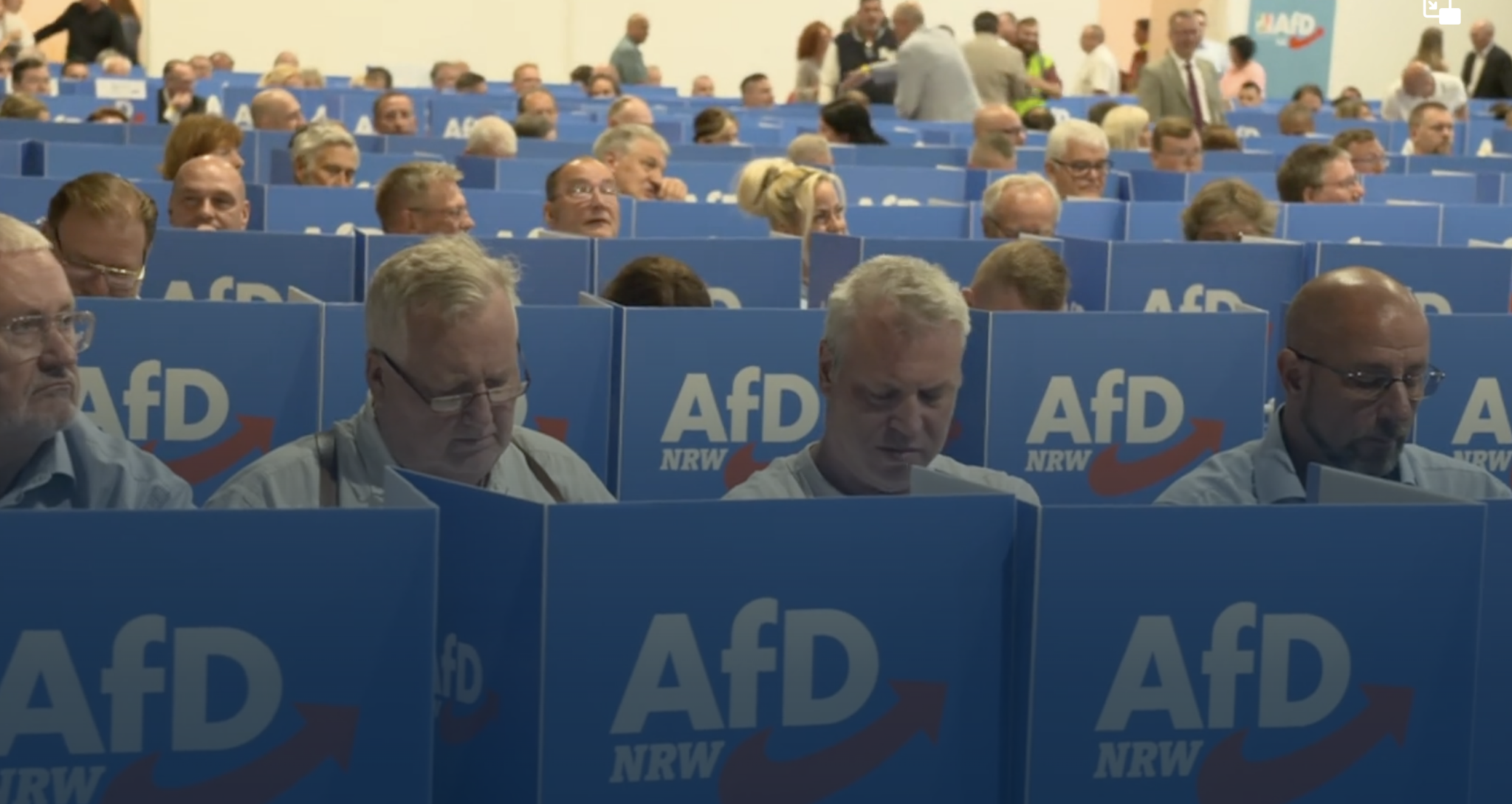
The anti-immigration Alternative for Germany (AfD) party is known for its strength in the east of the country, but its popularity in Western Germany is also only growing, including in the country’s most populous state, North Rhine-Westphalia.
This latest Forsa poll points to incredible growth of the AfD in a very short time in the voter-rich Western German state. It is now the most popular party in the entire state when measuring a national vote and would earn 24 percent of the vote.
NORDRHEIN-WESTFALEN | Sonntagsfrage Bundestagswahl Forsa/Kölner Stadt-Anzeiger
AfD: 24% (+2)
CDU: 22% (-4)
GRÜNE: 18%
SPD: 14% (+1)
LINKE: 12% (+3)
FDP: 3% (-1)
Sonstige: 7% (-1)
Änderungen zur letzten Umfrage vom 22. April 2026
Verlauf: https://t.co/BFZmdFPvIW#btw29 https://t.co/8HxWHdoMm3 pic.twitter.com/Aq1Ll352E8
— Deutschland Wählt (@Wahlen_DE) September 23, 2026Meanwhile, the Christian Democrats (CDU) fell four points to 22 percent, the lowest value Forsa has ever recorded for the party in the state. The previous low was 23 percent in December 2021.
However, in order to avoid confusion, it must be noted that the Forsa poll asked two very distinct questions. One question asked voters in North Rhine-Westphalia how they would vote at the federal level and also how they would vote at the state level.
At the state level, voters in North Rhine-Westphalia would still back the CDU over the AfD; however, the CDU’s advantage over the AfD has narrowed to just seven percentage points ahead of the April state election.
NORDRHEIN-WESTFALEN | Sonntagsfrage Landtagswahl Forsa/Kölner Stadt-Anzeiger
CDU: 29% (-3)
AfD: 22% (+2)
GRÜNE: 18% (+1)
SPD: 14%
LINKE: 8% (+2)
FDP: 3%
Sonstige: 6% (-2)
Änderungen zur letzten Umfrage vom 22. April 2026
Verlauf: https://t.co/abpZT4akVf#ltwnw #ltwnrw pic.twitter.com/7osvf3qadq
— Deutschland Wählt (@Wahlen_DE) September 23, 2026For Minister-President Hendrik Wüst, the drop in support for his CDU party comes at an especially sensitive time. Wüst recently became the only top CDU politician who called for the government to begin the process of investigating a possible ban of the AfD party. He is also seen a strong contender to replace Merz as chancellor.
The latest figures show that if a state election were held this Sunday, the CDU under Wüst would receive 29 percent, down from 32 percent in Forsa’s April survey. The AfD has risen two points to 22 percent. The gap between the two parties has therefore fallen from 12 to seven points in just a few months.
About a year ago, however, the lead was far larger, at 22 percentage points. In July 2025, 38 percent of respondents favored the CDU while the AfD stood at a mere 16 percent.
While this may be of some consolation to Wüst that he is still more popular than the CDU federal branch, the fact that the AfD is now leading in the state at the federal level represents a massive sea change in German politics.
North Rhine-Westphalia is one of the most diverse of all of Germany — outside of the city-states like Berlin — featuring 35 to 38 percent of the population with a migration background. It is also a state with numerous industries hit hard by Germany’s ongoing economic downturn.
The three recent state elections in eastern Germany have become a “turning point” for the CDU after a sharp setback in Saxony-Anhalt, the party’s failure to enter the state parliament in Mecklenburg-Vorpommern two weeks later, and disappointing results in Berlin. Chancellor Friedrich Merz said he was “deeply shocked” about the vote in Saxony-Anhalt and spoke of consequences. He also noted that he took responsibility for the election outcomes but would not resign the chancellorship or his role as chairman of the CDU party.
The question now is whether widespread dissatisfaction with Merz will continue to weaken the CDU’s prospects across Germany.