

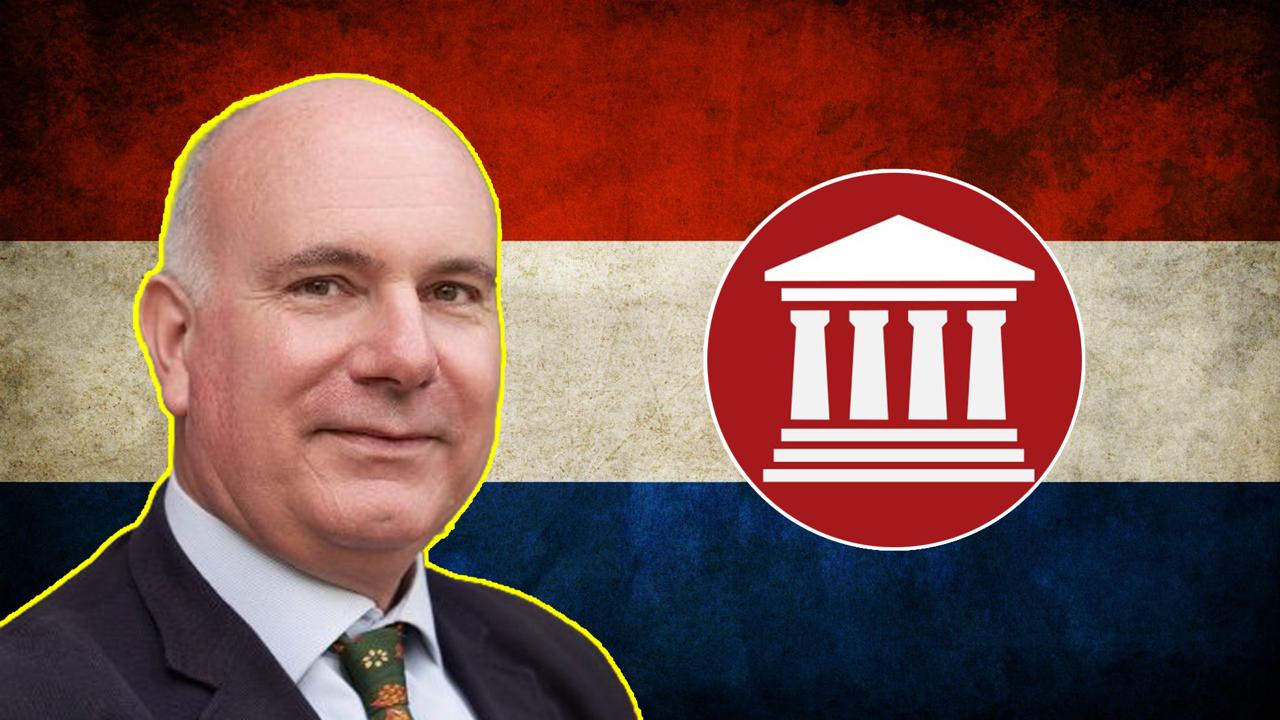
The right-wing Dutch party Forum for Democracy (FvD) – known for its opposition to both illegal and legal migration, skepticism on the issue of Israel, and its massive grassroots political base – has surged in popularity over the last year, rising to approximately 9 percent in the polls. However, the party packs a far greater weight than merely its share of potential voters.
In an interview with Remix News, John Laughland, the British conservative author, philosopher, and director of Forum for Democracy International, described how the party is participating in a metapolitical struggle that includes opening schools, a publishing house, and even a food distribution company that delivers farm goods to members.
The strategies used by the FvD may prove useful for other right-wing parties and activists locked out of power in Europe while looking to build a sustainable intellectual and cultural spearhead that could
Could you start by explaining your background with Forum for Democracy and what exactly your role is in promoting and advancing the party on the international level?
I think it is connected really with Thierry Baudet’s vision for the party as a whole. Thierry Baudet is the founder and leader of Forum for Democracy. Unlike most, in fact I think all other political parties, Thierry does not believe in politics in the narrow sense. He believes that political life—elections, getting elected to Parliament, to local and regional authorities, and so on—is only part of the metapolitical struggle. He is deeply convinced, and has said many times in public, that change does not come from politics alone. The creation of FVD International, and the attempt to give the party international visibility and to create an international network, is part of that much broader vision.
The FvD is a small party. How does it expect to change the politics of the country?
Well, it is a small party in terms of the number of members of Parliament. They have seven members of Parliament now, and three senators, but it is by far the biggest party in the Netherlands in terms of members. It has 80,000 members. This is nearly double what the governing liberal VVD has. It is 80,000 times more than the membership of Geert Wilders’ PVV, because his party only has one member—himself.
Eighty thousand is quite a large number. For example, the AfD in Germany, a country of more than 80 million people, while the Netherlands has 17 million. I believe the AfD has only about 80,000 members itself. If you added up all the membership lists of all the parties in Europe, British and German parties tend to have quite high memberships, partly due to history and the structure of German society. But FVD is up there in a very respectable position, particularly for a medium-sized country like the Netherlands.
The international aspect is part of this much broader understanding of politics. On the national level, FVD organizes events all the time, including social events. It has a school—they set up their primary school this year, which has started working.
They have a publishing house, they have a food company which delivers food directly to consumers from farmers. They have a whole range of activities which go beyond the purely parliamentary or political domain. That is how I would explain FVD International. Our goal is, apart from increasing the party’s profile internationally and creating networks, that we are part of the Europe of Sovereign Nations (ECR) party. We unfortunately do not have a member in the European Parliament, but we are part of the pan-European party, together with the AfD and others in Russia, Bulgaria, and so on.
One of the other roles of FVD International — and I am delighted that you have invited to speak this reason — is of course to raise the profile of the party. We want people to know what we do. We run twice a year intensive educational weekends. When I say educational, I do not just mean political training. We are not just teaching people how to distribute flyers in letterboxes or how to do political technology. No, we teach them history, philosophy, current affairs. We have interesting speakers on a whole range of subjects. Our very deep conviction is that metapolitics is what counts. Culture, famously, is upstream of politics, and that is very much our belief.
Even with a lack of parliamentary representation in comparison to the larger parties, your party has been growing quite a bit in the last year in the polls, going from approximately 4% to around 8 to 10% in the last few months. Why has your party grown so rapidly?
That is kind of you to notice. Dutch political polls are conducted not in terms of percentage, but in terms of seats that the various percentages would represent. You are right that in October of last year, which was the last general election, the party won seven seats, up from three—more than doubled its score. But since then it has gone way beyond that in the polls, and I think now stands at 17 seats in the opinion polls, which makes it the largest right-wing party currently.
The big left-wing party is the only party that has a higher score in the opinion polls in terms of seats. FVD at 17 has more than the other right-wing parties. Those are the right-wing parties: of course Geert Wilders’ PVV, but also a party that split off some years ago from FVD called JA21, and then other smaller parties like the Farmers’ Party (BBB) created also a few years ago, and a group of about seven members of Parliament who split off from Wilders’ party last year. So it is a fairly crowded field.
Why are we doing well? Because, obviously, I think we have the most coherent message. The PVV has been around for a long time. It is a single-issue party. It campaigns only on one thing—immigration—and frankly only on one aspect of immigration, namely Muslim immigration. It is not really interested in other aspects of immigration.
FVD has a much stronger intellectual posture than these other parties. It is not really a populist party at all; it is a party of intellectuals, and sociologically I think its voter base probably comes from higher education sections of society than maybe Wilders’ PVV. And then, of course, to be perfectly frank, the PVV having been around for 25 years, and having undergone a split, and having also been in government for over a year without having ever done anything, their star is very much on the wane, and people are looking around for alternatives.
Right-wing voters in the Netherlands are looking around for alternatives. And obviously I think FVD is the strongest contender in what remains a fairly crowded field.
Let’s say that Forum for Democracy can secure these seats. Is there any realistic expectation that they can form a coalition with any of these other right-wing parties, or is that very unlikely?
Right now the position is that there is a firewall, as in Germany the Brandmauer (firewall) against the AfD. We also suffer from that. We did very well in the local elections held earlier this year, but all the other parties have ganged up against us, and therefore there is no municipal council in which FVD is part of the local government.
So, of course, the fear would be that the same thing would happen at national level. On the other hand, we obviously see the firewall breaking down in Germany itself, in Sachsen-Anhalt, where, as I am sure you know, the election of the Landtag president was famously achieved with four CDU votes. It is breaking down in eastern Germany. And so of course we hope it would break down in the Netherlands as well.
The coalition issue is a very thorny one, I think also for FVD, because once again — and we saw this when Wilders’ party was in coalition for more than a year — the powers of ministers are very limited.
This is a structural problem with politics all over Europe. The powers of ministers are extremely limited. People come into power, and they sit in ministries, and they are in office but not in power. Why are they not in power? Because a lot of power has in fact been devolved away from ministries, away from Parliament — upwards, of course, to the European Union, sideways or outwards to various independent bodies, independent central banks, independent judicial bodies.
The powers of ministers are very limited, and of course the ministries themselves, the permanent staff of the ministries, are in a sense where power really lies. It is quite difficult for a minister to impose his or her will on his own ministry if that ministry does not want to cooperate. So one of the structural problems of modern Western democracies, certainly in Europe and also in the United States, is this problem of institutional inertia, precisely because in the name of all kinds of postmodern doctrines, power has been devolved away from democratically elected institutions.
I am not a party spokesman; I do not speak on behalf of the party. But I think even if there was not the firewall problem, a coalition would also pose big problems. I could foresee difficulties if such a coalition were to be possible.
It seems like it presents an interesting problem. As a result, is your focus then more on this metapolitics aspect of the party? And what is a party’s role in the Netherlands itself if it is possible it has no path to power? Over the long-term, the AfD, for instance, seems at a point where they feel there is some kind of chance to enter a coalition and wield some kind of power. How do you feel the party is going to be able to develop over the long term, 10 to 15 years from now?
I would prefer that you put those questions to Thierry Baudet or to one of the official spokespeople. I prefer, if you do not mind, to answer in a personal capacity, and as a political analyst, and as someone who teaches politics. Personally, I am very skeptical that the AfD will ever get anywhere near power.
Of course they have had this result in Sachsen-Anhalt. But I have said for many years in political commentary regarding other countries, including France, where I live, that the system still has a lot of life left in it, and that we would be foolish to anticipate any kind of inevitable political change.
Even in France, where I think the chances of the right coming to power are greater than for the AfD, I do not think that Marine Le Pen is necessarily going to win the presidency next year. Yes, she is well ahead of everyone else in the polls, so right now it looks likely that she will get through to the second round. It all depends on who opposes her in the second round. If it is Édouard Philippe in the second round, the centrist former Macron prime minister, I give him a perfectly good chance of winning. And if it is Mélenchon, I still think there is a good chance of the left winning. The left is very powerful in France.
In Germany the situation is different. The political structures are different, the electoral system is different. But I would still see there a good chance at federal level of the other parties, the cartel parties, ganging up against the AfD. The AfD is only at 30 percent, and that is not enough to win an absolute majority. So clearly the AfD’s role and goal, I assume, is to break down support for the CDU and to overtake the CDU as the main conservative party.
But that will take many, many years. In Britain we have had this challenge from the right from Nigel Farage’s Reform party. They may succeed. They have obviously succeeded to some extent in shifting the debate a little bit, pulling it a little bit in their direction. Farage himself helped win the Brexit referendum in 2016. But they are still a long way from power. Reform in Britain has five members of Parliament. The Conservative Party has, I think, 170. You need to reason in terms of seats in a parliamentary system.
You ask me what FVD’s strategy is for the next 10 years. Obviously they want to wield power. There is no point going into politics unless you want to wield power. But you need a huge base outside of Parliament. You need a huge base of people all over the country. That is partly why we run the Renaissance Academies—to prepare people.
Most of the people who attend our Renaissance Academies are in their twenties, so we hope that in a decade or two, all over the country there will be friendly people who, perhaps, may have themselves risen independently of the party within Dutch society.
But it is very difficult for me to say where the party will be. Of course the party wants electoral success. There are provincial elections coming up next year, and the party of course hopes to increase its share of seats in the Senate, because the provincial elections then indirectly elect the Senate. So I am not saying that the political aspect is unimportant. That would be absurd. But it is a very, very, very long haul. And yes, you were right to ask about coalitions, because all Dutch governments are composed of coalitions, and that is a big challenge.
In democracy, the will of the people is often not realized. You talked about these institutions, how they are often captured already before any vote happens. We saw this with a Trump administration already: installing a new department head does not necessarily mean the department is going to be operating in the interest in line with the new party in power.
Speaking of the United States, a fundamental issue is the Iran War and Israel, and how Trump has embraced the Israeli position in his second term quite a bit. Forum for Democracy seems like it has a big split with a party like Wilders’ on this issue as well, which makes almost a coalition seem impossible between the two parties.
So the first question is do you think this issue is going to dominate European politics and be an insurmountable obstacle for parties looking to make coalitions? And the second question is: where does the Dutch public land on this issue of Israel, the Iran War, and so on, and how does your party relate to their perception?
Those are very important questions. I am very happy to answer them. Yes, we are more than skeptical of the Iran war. I think we are critical of the Iran war. We are, like Tucker Carlson, very disappointed in Trump, who of course came to power promising no new wars, and who has done exactly the opposite, and who has, by the way, caused terrible damage to the world economy, directly through the blockage of the Strait of Hormuz and so on.
So we are definitely not with Trump on that. And yes, we are, let’s say, Israel-skeptic. I am not sure if that word has been used by the FVD leadership. Perhaps it has not, but we are not pro-Israel in the way that Geert Wilders is pro-Israel. Wilders, as I understand, has an Israeli flag in his office, and he is given to tweeting things like “I am 100% pro-Israel,” to which Thierry Baudet has replied, “I am 100% pro-Netherlands.”
So, these are important differences, and I think the Israeli issue does present a substantial challenge for Forum for Democracy, and also for other nationalist patriotic parties across Europe, because it is a matter of public knowledge now that Israel has targeted nationalist parties in Europe with the goal of recruiting them to the Israeli cause. That is what National Conservative (NatCon) is all about. NatCon is directed mainly towards the United States of America, but it has plenty of European speakers. And again, it is a matter of public record — I think this came out last year in 2025 — that the Israeli embassies around Europe have been instructed to target nationalist parties and to basically bring them in line with Israeli policy.
We have seen this in France: Jordan Bardella, the president of Rassemblement National (National Rally), and Marion Maréchal, the niece of Marine Le Pen, who runs the dissident party which is more or less within the orbit of the RN. They both went to Israel last year during the Gaza operation to show their support for the Israeli government and for Israeli policy.
So we have seen that, and of course in Austria the FPÖ has made very, very, very strong pro-Israeli statements. Herbert Kickl describing the FPÖ as the guardian of the Jewish people in Austria or something like that. So yes, this is a big split, I would say.
And frankly, I would say the number of nationalist parties who are Israel-skeptic, or at least neutral on the Israeli issue — in other words, not 100% pro-Israel, as Wilders is — is pretty few and far between.
The AfD is split on this, for example. It is maybe not so visible, but the AfD is split on it. There are pro-Israel and Israel-skeptic factions within the AfD. There are all kinds of factions within the AfD. But the number of nationalist parties who are, let’s say, Israel-neutral or Israel-skeptic are pretty small. So yes, I think that is quite an important issue.
You asked me what Dutch voters think. I have not seen opinion polls, but I am sure Dutch voters are like American voters, like voters everywhere. Everyone has seen the images. Everyone knows what is going on. Plenty of people, anti-immigrant people, have been brought up for some time, decades even, to be anti-Muslim, and therefore, if you like, are indirectly recruited into the Israeli worldview of Israel, which of course presents itself as fighting the good fight on behalf of everyone else.
So I think a lot of people, starting from that position, may initially have a pro-Israel stance. But I think that has been dramatically eroded since the events of 2023. I think there is no doubt that public opinion has shifted against Israel because of the brutality of the Israeli retaliation. Obviously these things take time to work their way through the system.
Besides Israel, there is another large split on the right. There are some right-wing parties who are fundamentally opposed to illegal and legal immigration, but a fundamental stance against both is likely a minority position for European right-wing parties. And you said, Wilders is more or less focused completely focused on Islamic immigration. Would you say that your party is the only party in the Netherlands that is opposed to the Great Replacement and legal immigration?
Excellent question. By the way, just to complete my earlier answer: Thierry Baudet, the party founder and leader, came to Paris, where I live, I think it was earlier this year, and attended a meeting with Tommy Robinson, the English anti-immigrant campaigner, and he had his photo taken with Tommy Robinson and posted it, and there was a big backlash, as I understand, in the comments under his X post, from party members, saying Robinson is a Zionist, and so on.
So there was clearly a strong feeling, at least among certain FVD members, that this had been a mistake. And Thierry responded to that and said: of course we disagree on Israel. Robinson is very, very pro-Israel, like Wilders. But he says, on the other hand, we agree on the most important thing, which is the Great Replacement. We agree on the dangers of immigration. And let’s agree to agree on that. Let’s work together on fighting that. And let’s, if we can, try to put the Israeli issue aside, because obviously the priority is national. The international issue is secondary to the national issue.
You asked me about the Great Replacement. Yes, the party definitely warns against the danger of the Great Replacement, and we are in a very odd position, because the word in Dutch for Great Replacement, omvolking, has been banned from the Dutch Parliament. We are not even allowed to talk about it within the Parliament. But of course the members of Parliament do try to talk about it, and they very much believe it to be a reality and a danger.
And so yes, your question is very good. The party is opposed to both legal and illegal immigration. Recently, for instance, one of the members of Parliament made a speech calling for the return of Ukrainian asylum seekers. The Ukrainians are obviously here legally in the sense that they have claimed asylum. They are working their way through the asylum system. But their asylum was granted on a temporary basis, and people are now saying, well, it is time to envisage them returning to their home country. As indeed many of them do on holiday and so on.
Now, this elicited some discussion within the party, because we are basically not particularly friendly to Ukraine, if you want to put it that way. We are in favor of peace. We do not think this war should have been waged. We think it should have an end put to it as soon as possible, if necessary on terms which some Ukrainians may not want to see. So that elicited a little internal discussion within the party, but I mention it to reply affirmatively to your question, which is that yes, the party is against both forms of immigration.
I personally spoke at a remigration conference in Oslo. The parliamentary leader, Lidewij de Vos, who is currently on maternity leave, before she went on maternity leave spoke at the remigration conference in Porto in Portugal. So it is very much a subject that we deal with, and I tried to make an original contribution in Oslo in June by talking about the structural causes of migration, both legal and illegal.
And I am convinced that the main structural cause is colossally high tax rates on labor across Europe. Labor is taxed at nearly 100% in Europe. So if you want to pay someone 1,000 euros, you basically have to pay 2,000 euros. And that is an unsustainable level of taxation. If you tax something, you make it more expensive. If you make something more expensive, a basic thing like labor, you push up inflation, and now for decades immigration, legal and illegal, has been a way of increasing the supply of labor in order to stem the effects of this artificially inflated cost of labor, artificially inflated by tax.
So it is a doom loop. You create a problem, and then you introduce another, what we believe to be a problem, in order to, as it were, solve the problem you have already created. But that second problem, immigration, does not solve the problem. Firstly, because immigration has a net cost. Again, it does not matter whether it is legal or illegal. Immigrants—we have done the figures on this. Our MPs have quoted this in committee hearings and so on.
Every migrant costs, whatever it is, every asylum seeker costs, I do not know, 80,000 euros a year or something. So the net cost to the country for immigration of whatever kind is colossal, and it greatly outweighs the benefits.
To the extent that, for example, at one point the party, I think if I am not mistaken, proposed giving people something like 75,000 euros each to go back home again. Now, that seems like a very high figure, but that figure was based on the annual cost to the overall society of migrants. So the whole migration issue is bedeviled by all kinds of statistical jiggery-pokery, privatizing the profits and socializing the losses. Immigrants are supposed to pay pensions, but if immigrants stay, they also grow old. They also have pension requirements, and sort of basic stuff like that.
Obviously they put a huge pressure on the education system, on the health system, if you have more people coming into the country. So all this stuff about immigration being an economic benefit is nonsense, dangerous nonsense. And that is why, and it is by the way particularly dangerous for a small country like the Netherlands, which obviously has a great shortage of land. Everyone knows the Netherlands is a very, very highly, very densely populated country. It cannot afford to build the hundreds of thousands of new homes that are needed for the thousands of migrants arriving in the country every week. And so it is a doom loop which needs to be stopped and cut, in my view, at its root.
A lot of economists would argue that without this immigration you are not going to have enough workers, the country will stop building house, and so on. They argue this will harm GDP, and the economy is going to go into its own doom loop. What is your answer to that kind of argument, and how does the right effectively counter this argument? Because it seems like that is the argument that has been made for decades now, and it seems to work quite effectively on the public.
I am not an economist, but I try to get interested in these things. There is a study by Ewan Stewart of the Growth Commission in Britain. The Growth Commission is a group of people who try to promote growth and who try to attack low growth at its root. They published a very interesting paper last year. And in that paper they show that growth rates are higher in countries with low immigration. Slovenia, for example, Poland. Poland has relatively low levels of immigration. We all know that the Poles do not accept, or at least did not accept under the old regime, the immigration quotas from the rest of Europe, and generally speaking Poland does have lower rates.
So if you look at these countries like Poland, I think Slovakia is one of the examples as well, but definitely Slovenia and Poland. They have better growth rates than countries with very high immigration in the west of Europe. So, I do not think the GDP argument stacks up. It works only in absolute terms. But that is a no-brainer. If you have more people coming into the country, and if those new people coming into the country are economically active, then of course GDP will go up. Because if you dig a hole and then fill the hole again, if you pay 100 euros to dig a hole and then pay 100 euros to fill the hole in, then your GDP goes up by 200 euros. It does not mean your prosperity goes up.
And particularly it does not mean that your per capita GDP goes up. So I do not buy that argument, and I repeat that the labor market is, to call it severely distorted would be an understatement. When you are taxing something at 100%, that is a very, very severe distortion, particularly when you are not taxing other things at 100%. You are not taxing imports at 100%. Imports are typically taxed at about zero. So if you make one thing much more expensive than it really should be by taxing it, and another thing you tax at zero, of course you are going to have more imports than labor. It is just obvious to me. And that is the doom loop.
We all have relatively high levels of unemployment in our countries. Britain has colossal numbers of people living not on unemployment benefit but on sick benefits, same in France. Absolutely colossal numbers, millions and millions of people. The numbers have gone up recently as well because the system is being abused. And by the way, the increase in population will push up the GDP by definition, because you have got more people, obviously. If you have more people, you will have a higher GDP. That is just absolutely inevitable.
But again, we also know that this and other factors — it is not the only factor — has extremely negative social effects, particularly on property prices. Property prices have also risen for monetary reasons, and that is a big problem and needs to be addressed.
But obviously if you have more people coming into the country, then you have a greater demand for housing, and the prices go up. And that has a social catastrophe. We all know that young people cannot afford houses. That in turn depresses the birth rate.
WATCH: 🇩🇪🇪🇺 Mass immigration is fueling the West’s housing crisis.
Here’s how it’s happening in Germany.
In a powerful speech in the German Bundestag, @AfD politician Carolin Bachmann slams the ruling government for allowing 2 million migrants into the country while families struggle to find affordable housing.
— Remix News & Views (@RMXnews) February 15, 2024No country, very few countries have natalist policies to encourage people to have children, or tax breaks for people having children. So that is the doom loop. It is not the fact that we need ever-increasing numbers of people coming into the country from outside. Instead, the whole thing needs to be recalibrated. First, drastic reductions of tax on labor. If necessary, obviously, drastic cuts in spending, particularly on abusive spending like on welfare and sick pay and all the rest of it. But also, I would say, a recalibration of tax to tax other things at a similar rate, and not unfairly tax labor at such a high rate.
Beyond Europe, countries like South Korea and Japan are demonstrating that massive amounts of cheap labor are actually an obstacle to automation and technological implementation. Those countries are still world leaders in many areas. There is no doubt that the Netherlands is still a very advanced manufacturing country even with cheap labor, but the question is how much of this cheap labor is impeding actual growth?
It is a very important point. And again, if I can use the British example: Britain’s rates of immigration are, I think, the highest in Europe. Many multiples of the rates in France, for example. France has been complaining about high immigration for decades, but Britain is in a category of its own. Literally the rates have been two or three times the rate of French immigration for 20, 25 years, for a quarter of a century.
And that has had the inevitable effect. Supply creates demand. So if you have a lot of cheap labor coming into the country, well, what happens? So you see growth in low-productivity industries. So suddenly, for example, in Britain you had a whole load of raspberry farms growing up. I use that as an example. I do not have a statistic, but you have a lot of fruit picking. So if you import people whose only skill is picking fruit, then you will get a lot of fruit-picking farms.
Well, that is great if you like strawberries all the year round, or raspberries or whatever. Everyone is very happy to have that. But it is not a high-productivity activity.
And as you imply in your question, that is the key, as you say very rightly with Japan and South Korea and so on. That is the key for developed economies. It is not having more fruit farms. It is having microchips and other high-technology industries, and those are not favored by immigration.
On the contrary, immigration, again with its public subsidy — because very often immigration only works because of public subsidy. Again, this is the craziness. Social housing is given to non-nationals, social housing is given to immigrants all over Europe. This is madness. Social housing should be given to nationals. It should be restricted to nationals.
Reform in Britain have recently brought that out as a flagship policy, as if that should not already have been the policy. What kind of crazy world are we living in where we give social housing to foreigners? That literally does not make sense. A lot of immigration would disappear if they did not have housing. It is a classic case of socializing the costs and privatizing the benefits. And this introduces terrible distortions into the economy, distortions which are not favorable at all to growth.
Just to bring it back to your party, you talked about these sort of local outreach with farmers and food distribution, is this a farm-to-table kind of thing?
That is right. It is a company that is not, if you like, legally linked to the party, but the people who run it are the same people who run the party. It is obviously legally independent. But they do it because they are interested in food, they like food, they want to make money, and also of course because they want to support farmers, and they sell, as it happens, extremely high quality meat, for example, absolutely exceptional meat.
And do you think this brings in people, a kind of who would not be political otherwise?
Again, I would rather you put that question to them. It is an independent company with its own balance sheet and income and costs and all the rest of it. Maybe it does, yes. Obviously it is intended to help farmers. Farmers are one of the targets of various green policies, both at European level and at Dutch level. And yet of course the Dutch agricultural sector is very, very productive. It is one of the biggest, I think it is the biggest actually agricultural exporter, certainly in Europe. So yes, it has a metapolitical dimension to it, but it is a commercial enterprise.
John Laughland is a British eurosceptic conservative author, journalist, and political philosopher. He holds a doctorate in philosophy from the University of Oxford and has taught at universities in Paris and elsewhere. He previously served as European director of the eurosceptic European Foundation think-tank and as Director of Studies at the Institute of Democracy and Cooperation in Paris.
Since 2021 he has been a lecturer in political science, political philosophy, and history at the Catholic Institute of the Vendée in western France, and since 2022 he has been director of Forum for Democracy International, the international arm of the Dutch party Forum for Democracy (FVD) under Thierry Baudet.
He has written extensively on international affairs, sovereignty, European integration, and political philosophy for outlets including The Guardian, The Spectator, The Wall Street Journal, and National Review.