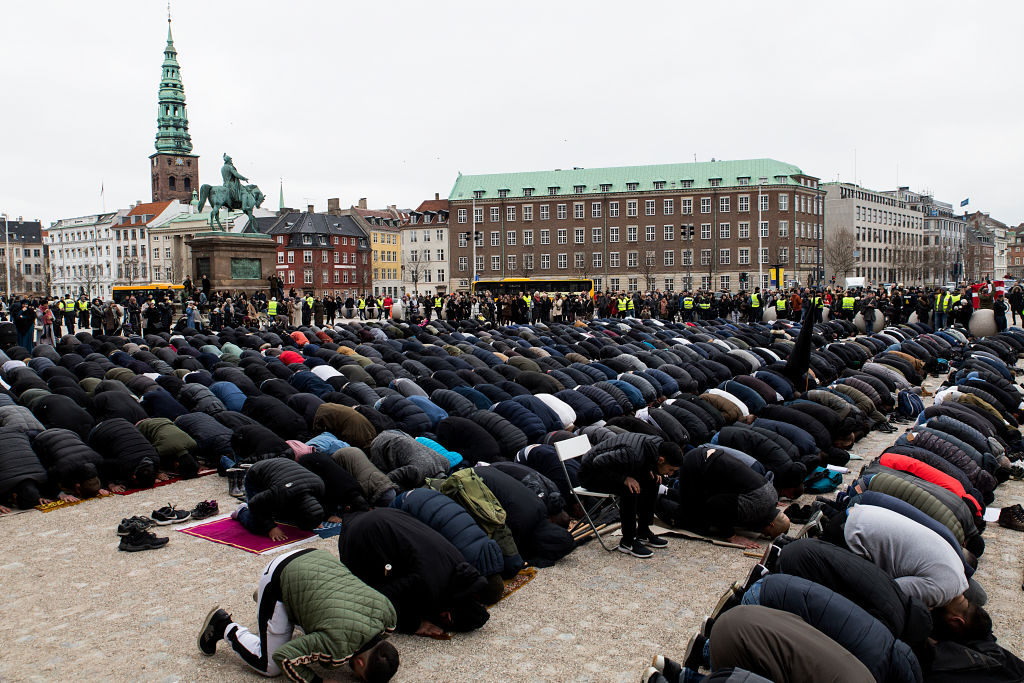
Denmark’s government, led by the center-left Social Democrats, has once again announced plans to pursue a nationwide ban on the public broadcast of the Islamic call to prayer via loudspeakers. This now amounts to the third time the center-left government is trying to ban the call to prayer.
Immigration and Integration Minister Morten Bødskov stated that the government is investigating a legal framework to prohibit amplified calls to prayer from mosques.
“The call to prayer should not ring out above the Danish rooftops. It has no place in Denmark; one should not wonder if one is in a suburb of Islamabad when walking around the country,” he told the press.
However, this is the third attempt by the ruling party, with previous efforts in 2020 and 2025 failing to pass. Will the third time be a charm?
One of the major hurdles is that Danish law protects religious freedom, and any blanket national ban on amplified calls to prayer has raised concerns about violating the rights of Muslims. The government needed to investigate whether such a prohibition could withstand legal scrutiny when balanced against residents’ rights to a quiet environment. Past efforts stalled during this review process without advancing to enforceable legislation.
Furthermore, many areas of the country have already banned the call to prayer, such as the biggest city, Copenhagen. These areas have achieved this through existing local noise bylaws or municipal regulations, reducing the urgency for a sweeping national law. This has historically made a new nationwide framework harder to justify or pass.
One attempt to ban the call to prayer was also reportedly interrupted by parliamentary elections, which led to a shift in government priorities at the time.
Denmark is arguably the Scandinavian nation most hostile to mass immigration, with the left-wing parties there considered to have right-wing policies on the issue. However, parties to the right, which call for remigration and even stricter action, argue that legal migration, including from Third World and Muslim countries, has been steadily increasing under the left-wing Social Democrat government.
The current immigration minister, Bødskov, is actually considered “softer” on immigration than his predecessors, such as Rasmus Stoklund and Kaare Dybvad Bek, who were known for their harsher rhetoric against mass immigration. His tough public statements are often viewed as necessary political positioning to align with the party’s established tough stance towards immigration under Prime Minister Mette Frederiksen, rather than his personal views on the subject.
Nevertheless, it remains unclear how far Bødskov is willing to go or if this announcement is more political posturing. The Danish government is reviewing legality, including compatibility with religious freedom protections in the constitution. The current effort would move beyond local noise regulations to a national prohibition, but no final bill has been introduced yet, and implementation details, such as the exact scope and potential penalties, are still at the discussion phase.
While this renewed push builds on Denmark’s stricter immigration and integration policies, including a recent ban on Islamic full-face veils like the niqab and burqa, it remains to be seen if the government can pull this new proposal off.