

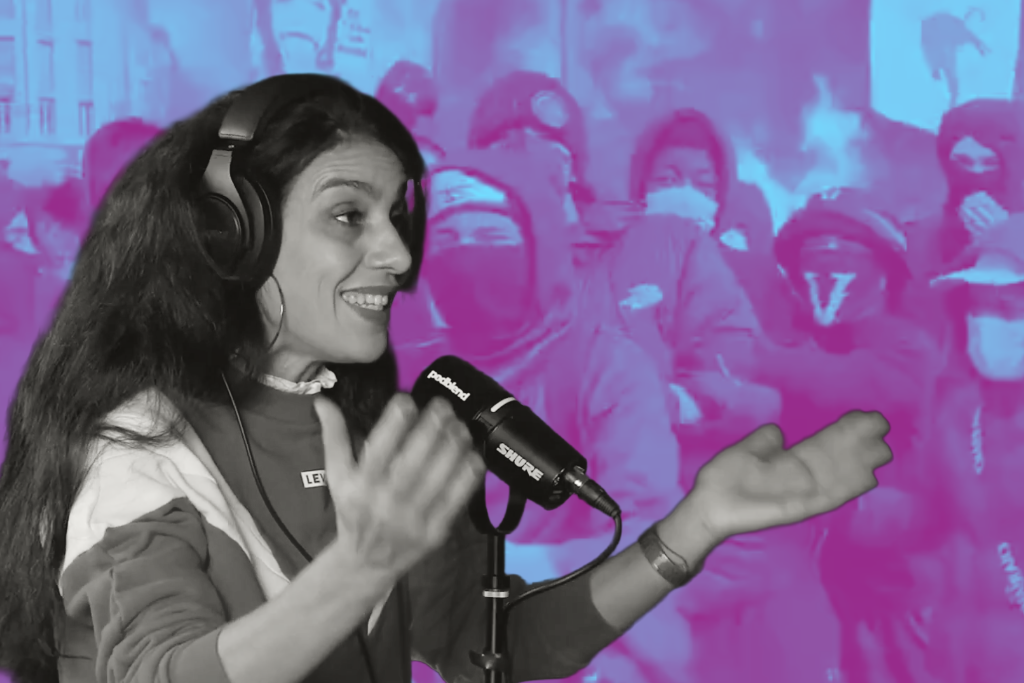
In a lengthy interview, Moroccan-born activist Fatima Ouassak described recent student protests and riots as a fully legitimate revolutionary movement. She argued that the participants, mostly Black and Arab youths, “are going to change the country. And they will even change Europe, which is considered white and Christian.” She then said that she is proud of these children for their destruction and that they are “endangering this white and Christian Europe.”
During the interview, she also expressed her support for burning down police stations, past bomb attacks, and even suggested subtle approval of the Great Replacement.
🇫🇷🇩🇿"When we see who is breaking things, it’s mostly Black and Arab people," said Moroccan-born activist Fatima Ouassak about the riots in France.
Everyone should listen to exactly what she says:
"Our pride is that these are our children. These children—well, tomorrow, they are going to change the country. And they will even change Europe, which is considered white and Christian. Well, these children are endangering this white and Christian Europe."
She expresses her support for burning down police stations, bomb attacks, and even suggests subtle approval of the Great Replacement.
She then whines about France colonizing Algeria without noting that Algeria was a global hub for the African slave trade for centuries.
One estimate notes roughly 65,000 enslaved Africans were brought to Algeria between 1700 and 1880.
Historians generally estimate between 1 million and 1.25 million European slaves were taken by Barbary pirates operating out of North Africa, including Algeria.
She openly calls for breaking the law and says she does not even belong to France.
"So yes, it was necessary to break the law, to hack it, and in any case, not to respect it—that is obvious."
"Plus, I wasn’t even born in France, so my country is Morocco."
Follow: @RMXnews
— Remix News & Views (@RMXnews) November 20, 2026She singled out the revolutionary force was specifically coming from the migrant suburbs. “It must be noted that if there are revolutionaries, the revolutionaries come from the suburbs. They are Black and Arab. They are Muslim. It is this working class living in the housing projects that is leading the revolution today.”
“Our pride is that these are our children. These children — well, tomorrow, they are going to change the country. And they will even change Europe, which is considered white and Christian. Well, these children are endangering this white and Christian Europe.”
🇫🇷🔴 The Great Replacement is driving the French riots, says right-wing politician Éric Zemmour.
"I believe that what we saw yesterday is the true face of the Great Replacement. It has an appearance: hordes of North African and African barbarians who ransack cities."
Follow: @RMXnews
— Remix News & Views (@RMXnews) October 19, 2026“The social protest movement, the high school movement—it is a revolutionary movement,” Ouassak said. “It’s a beautiful movement, in fact, that is completely legitimate in its entirety. Everything is legitimate in this movement. That is to say, including the expression of anger. It is a protest movement that shows these individuals—so these young people, in fact—are resisting.”
Ouassak acknowledged that images of property damage can create a “bad image,” particularly because “when we see who is breaking things, it’s mostly Black and Arab people.”
At the same time she insisted on pride: “Our pride—even if, once again, there is a degree of anxiety—our pride is that these are our children. These children—well, tomorrow, they are going to change the country.”
🇫🇷🔴 JUST IN: A White male staff member at Stéphane Hessel High School is viciously attacked while trying to extinguish a dumpster fire.
The violent blockades at French schools coincide with nationwide public-sector union strikes that are paralyzing the country.
Police are now threatening to intervene at a time when a diesel shortage could send France into further chaos.
Follow: @RMXnews
— Remix News & Views (@RMXnews) September 29, 2026She portrayed the fear these protests generate as rooted in a colonial mindset that has never been abandoned. “They are frightening because, I know this country, I know that what people see is: ‘They are going to lead an insurrection, they are going to slit our throats. They are barbarians, in reality. They won’t simply settle for carrying out their social protest with social demands that can be answered, like repealing Parcoursup, and so on. No, no, not only will they “Great Replace” us, but they might also come and eat our children—our own children.’”
When asked whether resistance requires disobeying the law, Ouassak pointed to Algeria’s 132-year colonization and the FLN’s armed struggle. “In Algeria, for example, where there was the longest colonization, 132 years—when there was an uprising, it was against the law, it was against the French state. Those people even had to plant bombs in order to free themselves. Today, well, we rejoice in it. And we say, ‘Thank goodness,’ and ‘Bravo to those countries, to our countries of origin, in fact, for freeing themselves from the colonial regime.’ So yes, it was necessary to break the law, to hack it, and in any case, not to respect it—that is obvious.”
She applied the same logic to the 2023 riots that followed the death of Nahel Merzouk, a notorious and violent recidivist who was driving without a license and attempted to ram a police officer when he was shot and killed.
🇫🇷🔴 The mother of Nahel Merzouk, who died in 2023 after being shot by a French police officer, says she wishes the officer received the "death penalty."
17-year-old Nahel was driving a rented Mercedes without a license at the time of the shooting.
Nahel was "known to police," particularly for resisting arrest. Just the weekend before, he had been charged with resisting arrest an astounding 5 times.
According to information leaked to Europe 1, his police file (TAJ) included 15 criminal records, including the driving without insurance and using fake license plates.
Nahel’s mother, however, claims that "he used to help the mothers carry their shopping home."
She added, "I thank God I taught my son very well. I made him a man until he was 17."
After Nahel was shot and killed, mass riots broke out across France.
🔺5,000 vehicles were set on fire
🔥1,000 buildings burned or looted, including historic libraries and landmarks
🚨250 police stations and gendarmeries were attacked
👮700 police officers were injured
— Remix News & Views (@RMXnews) July 16, 2025“The children of working-class neighborhoods, the teenagers, they rose up, they did the job, so to speak. That is to say, the police station in my town, Bagnolet, was burned down a few days later, and it was in the name, with the cry of, ‘This is for you, Nahel.’ You don’t burn down just any building—you burn the police station, and say, ‘This is for you, Nahel,’ two days after the murder of Nahel Merzouk. Burning down that building at that moment is saying, ‘Since we aren’t allowed to grieve, in fact, we aren’t allowed to express our anger, our sadness, our solidarity, etc., well, we’re going to do it ourselves with our own small means… These young people got the work done. They did their job, they rose up, etc., and it needs to be done. I think that yes, they are right to do it.”
Ouassak is currently developing what she calls a concept of “maquis.”
“Maquis, yeah—places, in fact, where we will be able to take refuge first of all. We must be able to concretely protect our children where we live. And yes, I think we need places where we can not only take shelter… And also, I own up to saying it: to resist, to defend ourselves, in fact. Among the conditions for struggle is having maquis, in fact—places where we will be able to hatch our plans, devise strategies, organize politically, and so on. And yes, I think that is truly the absolute urgency for us.”
In fact, she does not even believe she is French despite living in France and having French citizenship.
“If you ask me, my nation here in mainland France is Seine-Saint-Denis. My people are the people of the 93, not France, you see. I don’t care about France, you see. My people are the people of working-class neighborhoods, and especially Seine-Saint-Denis, especially Bagnolet. … Plus, I wasn’t even born in France, so my country is Morocco. And I want to be buried in this land that is mine, the land of the Rif,” she said.
Seine-Saint-Denis is generally considered the most multicultural department in all of France, with the native French population almost completely gone from many of its neighborhoods.
The interview places Ouassak’s earlier public comments in a context of conquest. She presents the demographic transformation of France and Europe not as an accidental consequence of migration but as a deliberate, prideful project carried out by Black, Arab, and Muslim youth from the housing projects.
She explicitly links this revolutionary project with the need to break the law, draws on anti-colonial armed struggle as a model to implement in France, defends the burning of a police station as legitimate political action, and prioritizes identification with specific banlieues and Morocco over the French nation-state and its indigenous people.
While complaining about France colonizing Algeria, she also fails to mention that Algeria was a global hub for the African slave trade for centuries. One estimate notes roughly 65,000 enslaved Africans were brought to Algeria between 1700 and 1880. Historians generally estimate between 1 million and 1.25 million European slaves were taken by Barbary pirates operating out of North Africa, including Algeria.
Ouassak’s aggressive and ethnocentric predictions are hardly unique, with foreigners increasingly arriving in Europe, gaining citizenship, and then speaking with glee and confidence about the displacement of indigenous White Europeans.
In 2025, a Muslim influencer on X, Mohammed Hijab, of the Sapience Institute, called for the Muslim birthrate to increase in order to influence politics in Europe. Hijab, known for his promotion of Islam on X, earned him nearly half a million followers.
“If we increase our birthrates Muslims can be assured to be 10% of Britain and 20% of France (population) in 2050 despite any policy changes in immigration. We are not the Zionist lobby our strength is not in our ability to influence politicians our strength is in our numbers,” he wrote.
Also in 2025, a politician for the Social Democrats (SPD), Sawsan Chebli, caused a stir over her Instagram post where she claimed changing demographics in Germany also has political implications in favor of migrants against the right, which is broadly reminiscent of the central claims of the Great Replacement theory.
In her post, which was targeted towards migrants who are considering emigrating over what she claimed were Germany’s xenophobic tendencies, she noted that the demographic situation will help shift power to these migrants.
“It is incomprehensible that we have come this far,” wrote the 46-year-old former Berlin State Secretary, who has Palestinian roots. “Please don’t give up! It is your country too. Demographics will create facts. Get involved, raise your voice — even if they don’t want you to.”