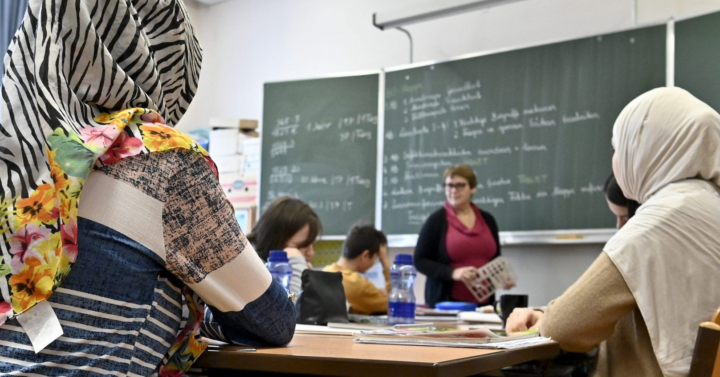
Almost half of students in Vienna’s public middle schools are now Muslim, according to new figures from the Vienna Education Directorate, marking the latest sign of a rapid demographic and cultural shift inside the Austrian capital’s classrooms.
The data, cited by Heute, shows that Muslim students account for 49.4 percent of children in Vienna’s public middle schools — just short of an absolute majority. Across the city’s public compulsory schools more broadly, including elementary, middle, special needs, and polytechnic schools, Muslim students now make up 42 percent, up from 41.2 percent in the previous school year.
Catholic students, once the dominant group in the city, now account for just 16.7 percent of children in the public schools included in the figures. Orthodox students make up 14.2 percent, while children with no religious affiliation account for 23.2 percent.
The figures also reveal a stark divide between Vienna’s public and private schools. In private schools, Catholics remain the largest group at 45.39 percent, followed by students with no religious affiliation at 25.1 percent and Orthodox students at 10.6 percent. Muslim children account for just 7.6 percent of students in Vienna’s private schools.
Taken together, across both public and private schools, Muslim students now form the largest single group at 38.3 percent. Even when Catholic and Orthodox children are combined, they reach only around 33.6 percent.
The numbers reveal how the city’s public schools are becoming the front line of a much broader cultural transformation. Earlier this year, Remix News reported that more than half of first-grade students in Vienna were listed as Muslim for the first time, while separate reporting from Profil described one secondary school where a Christian boy was allegedly the only Christian in his first-grade class.
At that school, 230 of the 390 students were Muslim, while 99 percent of the students had an immigration background. Only five children in the entire school were reported to have no migrant background. The Christian boy was reportedly mocked by classmates and called a “pig,” while teachers described classrooms marked by language barriers, social problems, and growing religious pressure.
The school was said to include students speaking 32 different languages, with Turkish, Arabic, and Chechen among the most common home languages. One teacher said that the problems were so extensive that every class could use its own social worker.
Concerns over integration have also spilled into the school canteen. In October 2025, the Austrian Farmers’ Association warned that pork dishes such as schnitzel, ham noodles, and roast pork had become rare or had disappeared entirely from some Viennese school menus. The association said some schools now offered only vegetarian meals or meat dishes without pork, citing a mother who said her daughter could choose only between vegetarian food and “pork-free” food.
“No one has to eat pork, but it must be offered. Pork is part of our culinary culture,” said Corinna Weisl, director of the Farmers’ Association. The group’s president, Georg Strasser, said preserving choice was the key issue, arguing that “diversity on the plate means freedom of choice for everyone.”
For some parents, however, the question is whether public schools can still deliver basic education. In February, Remix News reported the case of a Vienna mother who withdrew her daughter from a public primary school in Rudolfsheim-Fünfhaus after two years, saying only four children in the class spoke German fluently.
The mother, identified as Sabine G., said teachers spent much of the day translating instructions and managing basic communication rather than teaching. By the end of the first school year, she said her daughter still could not recite the alphabet, while several classmates had to repeat the grade.
She also said her daughter had begun refusing pork after being told it was “unclean” and had started rejecting certain summer clothing. “I felt my child was being strongly influenced,” she said.
Teachers’ representatives have voiced similar concerns. In November last year, Thomas Krebs of the Christian Trade Unionists Group warned that some students and parents were increasingly unwilling to learn German or accept local values. He said female teachers had faced disrespect, insults, and even physical assaults from male students and parents, and claimed that religious rules were often being placed above Austria’s national curriculum.
“Our educational principles are often rejected. For example, religious content is prioritized over the content of the curriculum prescribed by Austrian law,” Krebs said. He called for mandatory German-language instruction and compulsory integration programs outside school.
The cultural tensions have also reached school leadership. In December, Christian Klar, headmaster of the Franz Jonas European School in Vienna-Floridsdorf, used his book “How Do We Save Our Children’s Future?” to warn of what he called a growing “clash of cultures and religions” in the classroom.
Klar cited the case of a gay teacher at a public elementary school whose sexuality prompted a Muslim father to demand his removal. The school refused to dismiss or transfer the teacher, but allowed the father’s son to change classes. Klar called the decision “de-escalating” but questioned what precedent it set.
“When is it time to say ‘Stop!’? I think we should have done that a long time ago!” he said.
The school figures reflect wider demographic changes across Vienna. In January, Statistics Austria data showed that 40.5 percent of babies born in the capital did not have Austrian citizenship, double the share recorded two decades earlier. In districts such as Favoriten, Ottakring, and Rudolfsheim-Fünfhaus, the figure has passed 50 percent.
At the same time, more than 44 percent of Vienna’s roughly 16,700 first-graders reportedly lacked sufficient German to follow lessons. In the 2018/2019 school year, the share was 30 percent. Officials have noted that around 60 percent of those children were born in Austria, intensifying concerns that poor German language skills are being passed on inside migrant communities rather than solved by birth and schooling in the country.