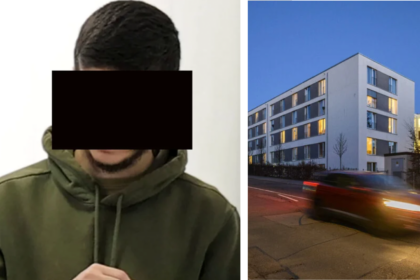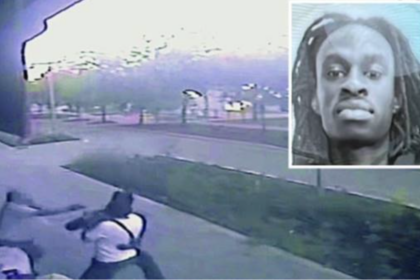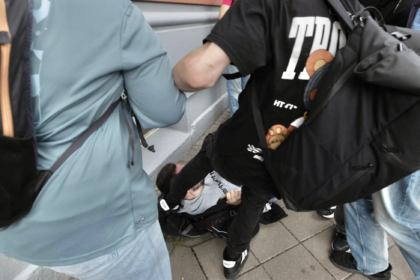
An Afghan man allegedly plunged his knife 26 times into his manager, who ran a “New Yorker” clothing store in the downtown area of Krefeld in Germany. Another shocking femicide, but one that could have been prevented, as the man was supposed to have already been deported.
Dating back to May 7 of this year, Sayed Akbar S. is now on trial in the Krefeld Regional Court for murdering Magda M.
Sayed Akbar S. already had his asylum application rejected. However, German authorities allowed the man to stay due to a deportation ban, as Afghanistan was allegedly “too dangerous” for Sayed Akbar S. to be sent back to.
The 25-year-old Afghan man is accused of surprising his boss on the third floor of the clothing store, where he stabbed her 26 times in the chest and stomach. Sayed Akbar S. used an 8-centimeter-long knife during the attack and is described as stabbing the woman in “frenzy.” After the act, he was completely covered in the victim’s blood.
The woman was described as “popular” and had many friends, colleagues, and family who gathered at the man’s trial on Nov. 3. Magda’s mother and her partner faced the accused killer in court as well.
The Afghan suspect “remained silent” during the first day of trial, according to German newspaper Rheinische Post. The man’s lawyer “declined to comment on the charges on the first day of the trial.”
As a result, the first day of trial only involved the recording of the defendant’s details, and was then adjourned after just eight minutes. This “caused discontent” among those gathered to witness the trial, according to the Rheinische Post.
The frustration boiled over once the proceedings ended. “Some complained about the lack of results on the first day of the trial.” Another person “directed wild insults at the defendant after the opening proceedings,” leading to the man being asked to leave the courtroom.
The public prosecutor’s office assumes that the man was not criminally responsible at the time of the incident “due to paranoid schizophrenia.” Following an examination, the man was transferred from pretrial detention to a psychiatric hospital. The jury court must now decide whether the man must remain there permanently.
In yet another example of the massive foreign crime wave engulfing Europe, new data shows that foreigners in Italy are vastly overrepresented in violent crimes and predatory crimes such as robbery and sexual assault.
The 2024 data shows that a significant number of arrests in Italy are targeting foreigners, making up 34.7 percent of arrests.
However, when it comes to more serious predatory crimes, the figure is much higher. For public street robberies, foreign make up 60.1 percent of suspects and for robberies in total, it is 52.3 percent. Foreigners are responsible for 61 percent of burglaries, and 69 percent of pickpocketing cases, according to new crime data analyzed by Italian newspaper Il Sole 24.
For sexual assault, foreigners are responsible for 43 percent of all such cases.
This is despite foreigners making up only a small share of the Italian population. According to the Ismu Ets report, as of Jan. 1, 2024, there were 5.7 million foreign people in Italy. Of these, 5.3 million were residents, making up 9 percent of the Italian population. This is compared to 8.2 percent in 2014.
For drug dealing, foreigners are responsible for 39 percent of cases, 24.5 percent of car thefts, 29 percent of smuggling cases, and 23.7 percent of homicides.
Italy does not track the foreign background of Italian suspects, but in recent years, a many high-profile cases have involved exactly these type of citizens.
The data is also skewed for a number of reasons. While citizens from other European countries like Austria and France are also counted as foreigners, they make up a very small percentage of foreign criminals, with suspects from Africa and North Africa even more vastly overrepresented.
Approximately 321,000 of these foreigners were illegal migrants, making up a very small share of the overall Italian population.
Italian journalist Francesco Totolo, citing this data, wrote: “Nearly 1 in 2 sexual assaults is committed by the 9% of the resident population in Italy, foreigners. Thefts, pickpocketing and robberies: over 6 out of 10 arrested are foreigners.”
Analisi del Sole 24 sulla criminalità in Italia (e la correlazione tra criminalità e immigrazione)
👉 quasi 1 violenza sessuale su 2 è commessa dal 9% della popolazione residente in Italia, gli stranieri
Irregular immigrants — those without a valid residence document or with an expired permit — represent 5.6 percent of foreigners in Italy and are thought to have a greater impact on crime than legally resident immigrants.
One influential study on the subject (Barbagli, Colombo, 2011), which analyzed data from 1988 to 2009, found that 70 percent of crimes committed in Italy by immigrants were committed by illegal migrants.
According to Paolo Pinotti, vice-rector of Bocconi University in Milan and founder of the Clean study center on crime, this dynamic remains true today, although Interior Ministry data does not disaggregate between regular and irregular immigrants.
Pinotti suggests that if this breakdown were available, it would show that the disproportionate share of foreigners in total arrests is mainly due to illegal migrants who commit small predatory crimes for economic reasons, or even crimes such as sexual violence, https://rmx.news/crime/milan-is-out-of-control-due-to-migrant-crime-italian-conservatives-claim-after-illegal-migrant-stabs-policeman/
“Foreigners who are regularly present in the territory, however, they have a propensity for crime in line with that of Italians,” he stated.
The province with the greatest weight of foreigners in the total number of arrestees is Prato (62 percent), a figure nearly double the national average. This is partially explained by the high percentage (around 25 percent) of foreign residents in the Tuscan province.
Other areas with high percentages include the large metropolitan areas of Milan (55.8 percent) and Florence (56 percent), where street crimes like thefts and robberies have multiplied. Border territories also show high figures: Imperia (54.8 percent), Bolzano (54.7 percent), Trieste (51.5 percent), and Gorizia (48.8 percent).
Antifa has claimed responsibility on the far-left platform IndyMedia for an arson attack that destroyed the car of AfD member of parliament Bernd Baumann in Hamburg, along with his wife’s vehicle and two others.
The politician’s car was deliberately set on fire and burned to a husk outside his home on Monday night, Nov. 3, 2025. The fire subsequently spread to three other parked cars nearby.
🇩🇪🔥In Hamburg, the car of AfD politician @DrBerndBaumann was set on fire.
Antifa has claimed responsibility, writing: “All you damn MAGA freaks, you will follow Kirk to hell.”
The case has shocked Germany and laid bare the brutal and murderous tactics they are willing to use.… pic.twitter.com/tMmwi8ewbd
Baumann, no stranger to arson attacks from Antifa, took to social media to describe the attack against him.
“Dear friends, another Antifa attack on me, 4 cars burned in front of the house. The police woke me up at around 5 a.m., another cowardly terrorist attack, my and my wife’s car completely burned out. This time, Antifa attacked in such a way that the meters-high flames spread to three other cars. They belonged to my neighbors, all total losses, all completely burned out. So many families damaged without a second thought,” he said.
🇩🇪🔴AfD politician speaks out after Antifa burned his car to a husk outside his home in the German city of Hamburg.
"Dear friends, another Antifa attack on me, 4 cars burned in front of the house. The police wake me up at around 5 a.m., another cowardly terrorist attack, my and… pic.twitter.com/Vw2qrCuLIt
“The whole neighborhood is shocked. This morning I also saw the stunned, frightened children on their way to school with their parents. The school is only 200 meters away. And they all had to pass this long row of smoking rubble with the acrid smell of burning. ‘Mummy, Mummy, what’s going on here,’ they asked,” Baumann continued.
He then goes on to describe how Antifa is not only powerful on the streets of Hamburg but also amongst the political elite in both his city and the federal Bundestag, including with funding and active support from government institutions.
“Yes, what’s going on in Germany? It’s not just in my hometown, my street, my house that I have to put up with the power of the Antifa. Their arms, their power, their fervor and their zeal reach all the way to Berlin, right here in the Bundestag, right into the plenum. Here, the left-wing MP Ferat Kocak shouts the historic battle cry of the violent Antifa in the middle of the plenum with impunity,” said Baumann.
The statement, whose authenticity has not yet been confirmed by the police, claimed that Baumann’s BMW was destroyed with an incendiary device. It opened with a defiant message: “Fiery greetings to the accused, imprisoned, and fugitive Antifa members!”
Antifa publishes letter on Indymedia
The alleged reason for the attack is the upcoming trials “against Antifa in Dresden and Düsseldorf,” involving 13 individuals: “Thirteen comrades are accused of multiple attacks on Nazis and their structures in Germany and Hungary,” the statement read.
The group criticized the legal system’s increasing crackdown on militant leftists: “The harsh sentences in the first so-called Antifa East trial and against Hanna in September signal a strong will to repress and convict. Until now, the judiciary has often struggled to hand down sentences for membership in a criminal or terrorist organization against militant leftists who were not involved in guerrilla warfare. Now those in power are trying to set new standards.”
The statement emphasized the urgent need for militant action, referencing anti-immigrant and racist practices:
“In times when the everyday, murderous, racist practices of Nazis, ordinary citizens, and cops are constantly increasing, when the military sealing off of Europe, Germany, and the USA against refugees is intensified, and the US president babbles about loving the smell of deportations in the morning and uses the military against anti-racist protest and resistance, in these times it is urgently necessary to organize militantly against fascism. In other words, to do exactly what the accused antifascists are now being charged with.”
The group concluded with a specific call to action and a threat directed at certain political groups: “Form one, two, three, four hammer gangs! Antifascist alert, whether with hammers or Molotov cocktails!” and “We don’t want to see any sexists, racists, or fascists in the city! All you damn MAGA freaks, you will follow Kirk to hell!”
The message ended by expressing solidarity with the accused: “Clara, Emmi, Luca, Nele, Moritz, Paula, Henry, Johann, Julian, Melissa, Nanuk, Paul, and Tobias: much strength to you, the fight continues! Freedom for Maja, no extradition of Zaid to Hungary!”
So far, there has been no arrest of any suspects in the attack on Baumann, but he has been the victim of several arson attacks in the past, including having his neighbor’s vehicle lit on fire this year.
The authenticity of the statement published on IndyMedia also remains open, as anyone can publish on the platform. However, many statements in the past have been verified, and the platform is seen as the preeminent platform for leftist groups to publish their claims of responsibility and other manifestos.
Antifa is especially active in cities like Hamburg, where it spreads terror and fear among anyone involved in right-wing politics. Just earlier this month, Remix News reported on three AfD politicians being doxxed in an extremely dangerous manner.
🇩🇪🔴Wave of Antifa terror continues in Germany. Are there parallels with America's Antifa terror?
3 AfD politicians were doxxed in Germany, with stickers of their faces and home addresses put up around their neighborhoods in the city of Hamburg. This follows years of arson… pic.twitter.com/8w7AtqRXb4
The far-left extremist portal “Indymedia,” associated with Antifa, was used to target three politicians of the Alternative for Germany (AfD) party in Hamburg, including the publishing of their home addresses and calls to take action against the “fascists.” The information was published both on the platform but also on stickers, which were put up all over the neighborhoods where the three politicians live.
As a result, a state investigation has been launched.
Two AfD city council members were targeted, as well as a district council member, with the stickers distributed in the neighborhoods of all three individuals. The stickers featured the address and photos of all three politicians, along with a message that read: “Attention, AfD fascists in your neighborhood.”
German police have now alerted the public about a dangerous Algerian man who escaped on Oct. 31, 2025, Halloween night, from a psychiatric ward in the city of Leipzig.
The 34-year-old Toufik H. was sentenced to nearly eight years in prison in 2023 for stabbing the boyfriend of his German ex-girlfriend. He was being held in a psychiatric facility due to his drug addiction.
On Oct. 31, between 10:40 a.m. and 12:30 p.m. the prisoner partook in a daring escape by taking advantage of a changing of staff at the Clinic for Forensic Psychiatry in Leipzig-Dösen. While going unnoticed by security staff and supervisors, he climbed over a fuse box, over a fence, and then balanced along a wall before jumping on a steel beam and walking away towards freedom.
The man tripped a burglary alarm, but security staff thought someone had broken into the property, rather than someone escaping. The staff went nearly two hours before they noticed Toufik H. was missing.
German police have launched a nationwide search for Toufik H., and there are fears he could target his 21-year-old ex-girlfriend and try to kidnap their 4-year-old daughter, according to German news outlet Tag24.
Toufik H. attacked his ex-girlfriend in Leipzig in the summer of 2022 because he would not accept the end of their relationship. When her new boyfriend tried to intervene against the Algerian, Toufik H. stabbed him.
Toufik H. also suffers from various addictions, which led him to being admitted to a rehabilitation and psychological treatment center. Police say it is very possible he will attempt to travel to Berlin.
Police also say Toufik H. poses a serious threat, and nobody should actively confront the man if they see him. Instead, they should contact emergency services immediately.
A 22-year-old Syrian man is now in pretrial custody in Berlin following his arrest on suspicion of planning a jihadist-motivated attack, with prosecutors also alleging the main promoted videos from Islamic State (IS) before the attack.
Police arrested the man on Saturday, and a judge issued an arrest warrant against him on Sunday evening. He is accused of preparing a serious crime endangering the state. The suspect is believed to have arrived in Germany in 2023.
The investigation continues, with authorities currently focused on analyzing the evidence seized from searches at three addresses in the Neukölln and Köpenick districts, according to a report from German news media outlet Taggeschau.
Michael Petzold, spokesman for the Berlin public prosecutor’s office, stated that the next step will be the evaluation of electronic storage media and other evidence seized.
The man is accused of planning to use a homemade explosive against targets in Germany and law enforcement stated that he already required several suitable components to make such a device.
According to ARD terrorism expert Holger Schmidt, authorities were “alerted to the man by a tip from a foreign intelligence service.” The initial challenge was locating him, as he “apparently had several registered addresses in the city.”
The arrest on Saturday took place near Potsdamer Platz, shortly after the opening of the Winter Wonderland. Petzold addressed speculation about the Christmas market being a target, stating:
“Of course, the investigation is proceeding in all directions. And the target must naturally be determined, but that is all part of the investigation.”
Much remains unclear regarding the specifics of the man’s plans, including the potential attack location. It is also unknown why multiple locations were searched or whether investigators suspect accomplices.
The suspect had also drawn the attention of investigators through his activity on social media. According to the public prosecutor’s office, he allegedly shared propaganda from the terrorist organization Islamic State on several occasions. This included songs or anthems with a jihadist context, and he faces a charge of disseminating propaganda materials of unconstitutional and terrorist organizations.
A new study shows that youth in Germany are becoming drastically more violent, which is a finding backed by statistics. However, German children are actually becoming more peaceful, while the complete opposite development is seen in migrant children.
The study found that more and more of the criminal suspects in the German state are children, with attacks on teachers, police officers, and emergency responders reaching alarming figures. In particular, the study shows that children with a migration background are causing significant damage.
Over the course of several months, researchers surveyed 3,800 students in grades seven through nine at 27 different schools in the area of Gelsenkirchen, Marl, and Herten. These are known as especially high-crime areas in the western German state. The same study was conducted in 2015, with dramatically different results this time around.
The study showed that violence, hatred, and disrespect are all increasing among young perpetrators.
The study leader, Professor Clemens Kroneberg, points to the growth of social media and the pandemic, as many other researchers have done before.
“During the COVID-19 pandemic, there was more experience of domestic violence, which increases the risk of becoming violent oneself,” said Kroneberg.
However, what the study does not explain is why violence is falling among German youth and rising among migrant youth, even though both groups experienced the pandemic.
The study also cites a lack of authority in the schools.
“Students today experience that rule violations go unpunished. Teachers intervene less and less,” the researcher said.
The interior minister, Reul, said that discipline is no longer a major factor in many schools.
This does not only apply to high-profile violent crimes, but also values, mores and social attitudes.
In 2015, 32.5 percent of students found it unacceptable not to do their homework, while last year, this figure fell to just 15 percent. In 2015, 80 percent of students considered truancy to be wrong, while last year, this figure fell to just under 60 percent.
Teachers are also checking out.
In 2015, 68 percent of students agreed with the statement that teachers take action when there is a fight on school grounds, but last year, this figure fell to only 39 percent.
Respect between teachers and students is also falling. In 2015, 35 percent agreed with the statement that students and teachers respect each other and get along well. Last year, that figure had dropped to only 20 percent. The study also found that students have less fear of being caught, and when they are caught, they have less fear of being punished.
“If children and young people believe they can do whatever they want, that has to change,” he said.
However, crimes among German students aged 11 to 13 actually fell 17 percent between 2013 and 2024. Nevertheless, the growing cohort of foreign students actually saw a triple-digit increase between the same period in the three cities researchers studied.
Reul pointed to an environment where violence is considered a conflict resolution method, saying it is “no coincidence that many of the suspects grow up in problematic environments.”
Reul said he believes this is all leading to a “system of impunity.” Children under 14 cannot be charged with crimes, leaving police and the courts unable to take any action.
Reul wants a debate on lowering the age of criminal responsibility; however, if that were to happen, Germany would once again be confronted with changing the nation’s entire law structure to cater to the growing problem of imported violence.
“If children and young people believe they can do whatever they want without consequences, this must change,” he said. He pointed to the Swedish model, which features juvenile detention centers for problematic and criminal youths.
Another concerning factor is the rise in violence from women. Attacks involving females under the age of 14 have grown by nearly 150 percent in the troubled cities of Gelsenkirchen, Herten and Marl, while for boys, they rose 104 percent.
“Girls seem to deal with aggression more freely – experiencing a kind of equality,” said Kroneberg.
German federal government statistics indicated that young foreigners are disproportionately represented as suspects in numerous crimes, with particularly significant differences in street crime and shoplifting.
The suspect burden figure (TVBZ) has been compiled by the Federal Criminal Police (BKA) and published in the Police Crime Statistics (PKS) starting this year. This ratio shows the total number of identified suspects over the age of eight, and is calculated per 100,000 inhabitants per population group. It examines all crimes except for immigration law violations, and the data presents a concerning trend.
For German suspects across all age groups, the TVBZ is 1,878.
In contrast, Syrian suspects have a TVBZ of 8,236, and Afghan suspects are at 8,753 — more than four times higher.
A 20-year-old man was shot dead early Sunday morning on Flying Dutchmanstraat in the Rotterdam district of IJsselmonde. Police arrested five suspects. The same street saw two explosions earlier this year at a luxury home.
Rijnmond noted the shooting was reported around 6:30 a.m. Police and emergency services responded in large numbers, with two ambulances and a trauma helicopter dispatched to the scene. The victim was resuscitated on the street and taken to hospital, where he later died. According to police, he was a 20-year-old man from Rotterdam with no fixed address.
The five suspects are reported as being three men from Rotterdam aged 18, 21, and 24, a 20-year-old man from Krimpen aan den IJssel, and a 17-year-old boy from Capelle aan den IJssel.
It was the second shooting in Rotterdam this weekend. A man was killed on the Zevenkampse Ring between Friday night and Saturday morning, prompting renewed concern about ongoing violence in the city.
Residents of IJsselmonde say the area has changed sharply in recent years. Richard, who has lived there for years, said he heard a bang on Sunday morning. “My daughter suddenly said, ‘There’s been a shot, there’s someone lying in the street,’” he told De Telegraaf newspaper. “I saw a car and boys running away. I told the police, ‘There they are, heading towards the main street.’ Then one of them came over to say hello. I thought, ‘Yes, there’s someone there.’”
Police later found a machete in nearby bushes. “They found that. I was quite shocked,” Richard said. “Bombs have already been dropped here twice at number 32. It used to be a really nice neighborhood, but since that apartment complex was built, it’s not fun anymore. It’s commonplace.”
He said he is now considering moving. “I will look into moving. Maybe to Zeeland or Brabant. Just because of this. It used to be quiet here. Not anymore.”
Other residents say the atmosphere has worsened since the construction of a nearby apartment complex. “It’s gotten worse in the last year and a half or so,” said one man who wished to remain anonymous. “This used to be a nice neighborhood. Now it’s just become a disaster.”
Mr. and Mrs. Rog, who have lived in the area for over 25 years, said similar things. “Nothing’s ever happened here in 24 years,” said Mr. Rog. “And now suddenly we have all these shady characters walking around. You don’t want to judge, but they’re just different people.”
His wife added, “Since that apartment building was built, it hasn’t been as pleasant. I don’t know who lives there; they all have expensive cars. I don’t like the feeling.”
Mrs. Rog said she woke up Sunday morning to find the street cordoned off. “I opened the curtains and everything was taped off. Then you think: What’s going on now? I really hope it doesn’t get any worse.”
The shooting adds to a growing list of violent incidents in IJsselmonde. Earlier this year, police reported that 24-year-old Sendric S. had confessed to killing three men in the district between December 2024 and January 2025.
The victims, aged 63, 58, and 81, were shot in separate attacks.
Four men of North African origin, aged between 20 and 33, have been arrested in Pamplona for the gang rape of a young university student during a large student party last Friday night.
Three of the suspects are in Spain illegally and were already subject to unenforced deportation orders, according to police sources cited by El Mundo and Antena 3.
The attack occurred near Media Luna Park in central Pamplona, close to the Amaya sports complex, where the annual event to celebrate the new academic year was taking place. Organized by students from the Public University of Navarre, the annual celebration drew more than 2,000 attendees.
Shortly after 10:00 p.m., several people walking through the park discovered the victim lying semi-conscious under a tree. She was visibly disoriented and showed signs of sexual assault. Her phone and several personal belongings were missing. Police officers arriving on the scene noted that her clothing was torn and that she appeared intoxicated. The young woman told them she had been raped, initially recalling only fragments of the attack.
Medical examinations later confirmed that she had suffered what investigators described as a “high-impact” sexual assault by multiple attackers. She was transferred to the University Hospital of Navarra for medical and psychological care.
Evidence gathered from the area, combined with security camera footage, led to the identification of four suspects who lived together in a makeshift encampment along the river.
All four men were arrested on Tuesday in the San Juan neighborhood of Pamplona. The suspects are acquaintances who shared the same tent in the migrant ghetto, where police believe they returned after the assault. Officers later brought them back to the encampment for a reconstruction of events.
According to Antena 3, the men are of Maghrebi nationality, and three of them are in Spain illegally with pending deportation orders.
Investigators have seized their mobile phones amid suspicions that they may have recorded the assault. DNA samples collected from the victim and the scene are being compared with biological traces from the detainees. Authorities say the results will determine whether all four participated in the rape.
Spain has seen an alarming rise in sexual violence over recent years, culminating in a record-high number of rapes, which reached 5,206 incidents in 2024, according to official statistics published by the Ministry of the Interior in May.
Last month, VOX leader Santiago Abascal posted on social media after news of two other rapes by migrants in Tenerife and Bilbao made headlines.
“Today again. Every day, our women, mothers, and daughters are attacked. Every day, the government of the PSOE and the PP remain silent. Feminism disappears when the rapist is not Spanish,” he wrote on X.
Six in ten long-term unemployed people in Belgium are of foreign origin, according to newly released government figures, just as a major reform of the unemployment system is set to take effect.
The data, disclosed by Employment Minister David Clarinval in response to a parliamentary question, show that only 41.5 percent of unemployment benefit recipients in 2023 had Belgian parents.
As reported by 7sur7, nearly 13 percent of the unemployed population has North African roots, primarily from Morocco, Algeria, Tunisia, Libya, or Mauritania. A further fifth have origins in other European Union member states, including neighboring and southern European countries. The figures confirm a long-standing pattern observed in earlier studies: employment rates are lowest among foreigners from outside the EU.
In total, Belgium’s long-term unemployed population consists of 41.5 percent Belgians, 12.8 percent with Maghreb origins, 9.2 percent from southern EU countries, 7.7 percent from neighboring countries, 4.5 percent from other Asian countries, 4.5 percent of unknown origin, 4.2 percent from other African countries, 3.9 percent from Turkey, 3.8 percent from other European countries outside the EU, 3.4 percent from eastern EU countries, 3.1 percent from the Democratic Republic of Congo, Burundi, or Rwanda, and 1.2 percent from South or Central America. Taken together, those of non-EU origin account for roughly one third of all unemployed people in Belgium, and possibly closer to 38 percent when including those whose origin is listed as unknown.
“These figures confirm what we already knew,” Stijn Baert, professor of labor economics at Ghent University, told the Belgian news outlet. “When we focus on migrants from countries outside the European Union, Belgium almost always ranks among the worst performers in Europe. More than half of unemployed non-European foreigners have been out of work for more than a year. Only Greece performs worse.”
The release of these figures coincides with a far-reaching reform of the unemployment system that will, from January 2026, abolish the right to indefinite benefits. Under the new rules, most people under 55 will be entitled to unemployment benefits for a maximum of two years, while those over 55 can continue to receive them only if they have accumulated at least 30 years of professional experience, rising to 35 years by 2030. The National Employment Office has already begun notifying affected claimants, with the first wave of exclusions — around 10,700 people — expected early next year. More than 100,000 people will eventually lose their entitlements.
Employment Minister David Clarinval, a Liberal, defended the reform as necessary to restore fairness and encourage people to re-enter the labor market. “Unemployment is not a career plan,” he said. “The main message is that everyone must work, including people of foreign origin. There is no reason why these people should be condemned to unemployment and exclusion.”
Speaking on RTL’s morning program on Wednesday, Clarinval said, “More than one in two unemployed people who will be excluded from benefits in the coming year and the year after are of foreign origin. That’s a rather astonishing figure, as far as I’m concerned.”
Clarinval said the numbers raised questions about both oversight and support. “Do all these people actually reside within the country?” he asked, noting that 5,800 cases of home fraud were detected last year. “That applies to everyone, but it means there are undoubtedly more checks to be carried out. Although now that we’re going to limit them, the question won’t really arise anymore.”
The publication of the figures provoked sharp political debate after several Belgian media outlets reported that “six out of ten people to lose their benefits are not Belgian.” Socialist MPs accused the government of stigmatizing people of immigrant background, prompting multiple fact-checks clarifying that the data refers to origin, not nationality. Many of those included in the figures were either born in Belgium to non-Belgian parents or have since acquired Belgian citizenship through naturalization.
A regional court in Germany has ruled that Enamullah O., the Afghan asylum seeker who fatally stabbed a two-year-old boy and a 41-year-old man who tried to intervene during a daycare outing in January, was not criminally responsible for his actions and will be permanently confined to a psychiatric hospital.
Presiding judge Karsten Krebs announced the decision on Thursday, stating that the 28-year-old suffered from a severe mental illness at the time of the attack, which rendered him incapable of understanding the nature or wrongfulness of his actions.
“The highly dangerous suspect no longer poses a threat to the public due to his confinement,” Krebs said during sentencing.
The attack took place on Jan. 22 in Schöntal Park, Aschaffenburg, when Enamullah O. approached a group of daycare children out for a walk with their teachers. Without warning, he removed a two-year-old boy’s hat and scarf before stabbing him multiple times with a 32-centimeter kitchen knife. The child died at the scene.
A 41-year-old passerby who intervened was also fatally stabbed, while three others — a two-year-old girl, a teacher, and another man — were seriously injured. Both the prosecution and the defense agreed that the suspect’s psychiatric condition made criminal punishment inappropriate, instead recommending indefinite psychiatric confinement.
As cited by Zeit Online, court-appointed psychiatrist Hans-Peter Volz testified that without medical treatment, the accused was likely to commit further “highly aggressive acts.” Volz said the man suffered from severe psychosis and delusions, claiming he had been ordered to kill children. The expert rejected any suggestion that the man was faking his illness.
Defense lawyer Jürgen Vongries described his client as “a very sick man” who selected his victims at random, saying, “Why, we do not know. We will be asking precisely this question. We cannot answer this.”
Investigations revealed that the Afghan national had already come to the attention of police several times before the killings, including for assault and property damage. He had been treated in psychiatric facilities but repeatedly discharged, as authorities did not assess him as an imminent threat.
He arrived in Germany in November 2022 after traveling through Bulgaria, Austria, and France. His asylum claim was rejected, and he had been under a deportation order since late 2024. However, he was not removed from the country. In December, he wrote to immigration authorities stating that he would leave voluntarily, but failed to follow up and remained in Germany.
Judge Krebs acknowledged the “devastating” consequences for the victims and their families, stating that while the court had done all it could, “nothing can undo what happened.”
In many of Germany’s schools featuring a high percentage of migrant schoolchildren, ethnic Germans are the targets of bullying and assault. Now, another story highlights the trend, involving 10-year-old Emlia, who was attacked and injured four different times by her classmates on school grounds. She has now been diagnosed with psychological disorders due to the constant attacks, including post-traumatic stress syndrome (PTSD).
The four different incidents, dating back to February of this year, resulted in the fifth grader Emilia suffering from death threats, bruises on her body, abrasions, and even a headbutting attack at the Tempelherren Elementary School in Berlin.
🇩🇪❓"Why don’t you have any German friends?"
🔺"Because they don’t belong to us. I can’t stand the Germans too much."
Thousands of German students now face discrimination and sometimes outright assault from foreigners in their school systems.
The school has a high proportion of non-native German speakers, totaling 213 out of 323 students. That means nearly 67 percent of students are non-native German speakers.
The parents have gone so far as to write an open letter accusing the school of inaction and the police of failing to act against the constant assaults and death threats.
“We demand more supervisors in the schoolyard and decisive action from the school administration to protect all children,” wrote the girl’s parents, 33-year-old Julia and the 35-year-old Robert P., while appealing to school authorities to take action.
Beaten and kicked
The parents describe the incidents first beginning at the Carnival celebration In this first incident, like many other children, she wore a costume to school and brought an inflatable baseball bat with her. According to the mother, a number of boys tried to take it from her, leading her to lock it away.
“Then she was pushed to the ground in the schoolyard and kicked several times,” Julia P. stated, adding: “There was no supervisor nearby at the time of the incident.”
🇩🇪🔴 A young German girl spoke of the nightmare she experiences from her Muslim classmates.
"Sometimes they say to me that I’m German. And yeah, then they laugh at me, curse at me and tease me. Others are always Muslim, and they ask me why I am not a Muslim. I said I am a… pic.twitter.com/gggVOm9IPs
The principal reportedly advised the parents to press charges, but despite filing a police report, the police dropped the investigation because the suspects were under 14 years of age.
Death threat
In April, Emelia once again became the victim of her classmates. One classmate allegedly threatened to bring a knife to school and kill the young girl.
Another police report was filed.
“On doctor’s advice, Emilia stayed home for a week,” said Julia P. “The only school-related measure for the boy was a temporary transfer to a lower grade.”
Emilia spoke to Bild about the violence rife in the school, which not only stalks her, but also stalks other students every single day.
“The bullying in the schoolyard is a sad daily occurrence,” writes Bild newspaper.
Emilia told the paper: “Someone gets beaten up every break.”
Pushed to the ground and kicked, “Shoe prints clearly visible on her body.”
It is not just fellow fifth graders targeting Emilia either. Just two weeks ago, three second-graders first insulted Emilia, with one of them saying, “I’ll f**k your mother.”
Emilia was then pushed to the ground and kicked. The girl said her classmates were egging the children on during the attack.
When she was picked up from school, there were still shoe prints on her body.
“The shoe prints were clearly visible,” said her father.
School response
Bild contacted the school, and Susanne Gonswa, spokesperson for the school board, stated: “The incidents that came to light at the school have been investigated, meetings with parents have been held, and measures have been initiated in accordance with the school law and the principle of proportionality.”
Bild also writes that “the class teacher, the school social worker, the school psychological and inclusive education counseling and support center, the responsible school supervisory authority, and the parents were all involved in the investigation. A working group on ‘violence prevention’ is scheduled to begin its work at the elementary school after the autumn break.”
Now, there are a number of police criminal complaints against numerous violent children, but police can do little against such young perpetrators.
Meanwhile, their daughter is suffering from anxiety, depression, and post-traumatic stress syndrome (PTSD), all diagnosed by a psychologist due to the violence she has faced. She is receiving trauma therapy and is attending a self-defense class.
“How long are we going to let our children remain at risk before a serious accident, permanent psychological damage, or something worse happens?” they stated.
In their open letter, they wrote: “School must not be a place of fear – but of education and togetherness.”
The two parents note that there is a severe staff shortage at the school, and oftentimes, incidents of violence occur because nobody is watching what is occurring on the school grounds.
As with many German children, changing schools is often the only option, and that is exactly what Emilia’s parents say will be happening. In fact, it mirrors many similar cases, such as Yara, who Remix News reported on in the past, and who was bullied because she was German. She was also forced to change schools.
🇩🇪🔴 Yara was the last German in her classroom, and she ended up being bullied and stabbed.
Yara was only 6 but was "bullied and ostracized, and in the end even seriously injured."
Yara's father said that parent-teacher meetings required a translator.
This is not just an isolated incident. As Berlin’s school population has grown more diverse, it has also grown more violent.
Data shows that as of October, police officers have already been called 1,129 times to schools in the capital due to physical violence.
Over the last five years, since 2020, there has been a significant increase in such incidents. In 2020, there were a total of 1,043 incidents for the whole year.
A 20-year-old Iraqi migrant who had previously served prison sentences for drug offenses was discovered to have filmed and mocked elderly dementia patients while employed as a caregiver at a municipal care home in Ängelholm, southern Sweden.
The man, identified in court documents seen by the Samnytt news outlet as Azhi Mahmodi, is now charged with four counts of offensive photography and four counts of breach of confidentiality, alongside aggravated weapons and narcotics offenses.
Police uncovered the material earlier this year after stopping a car in Helsingborg that Mahmodi was traveling in. Officers seized drugs and a mobile phone, leading investigators to execute a search warrant a month later. A firearm and large sums of cash were found, prompting further searches.
When police examined Mahmodi’s seized phone, they discovered several clips filmed inside a dementia care home showing elderly residents being ridiculed and humiliated. Investigators later learned that the municipality had employed Mahmodi as a caregiver despite his criminal record.
The videos were also found to have been distributed by Mahmodi on Snapchat.
Helsingborgs Dagblad reports the care home in question was contacted in the summer to help identify the residents whose confidentiality had been breached in the humiliating videos.
Confronted with the evidence, Mahmodi admitted to filming and sharing the videos. “There is no good excuse for it. There isn’t. I am ashamed. So extremely. It is literally shameless what I have done. I cannot deny that,” he told police.
Municipal officials have refused to release documentation relating to his hiring. In a formal response to a request for disclosure, Ängelholm Municipality declined to provide the relevant records, citing confidentiality.
Mahmodi, born in Iraq but holding Iranian citizenship, cannot be deported under the current law as he is a dual national, having also been granted Swedish citizenship.
In recent months, several other migrant caregivers across Sweden have been convicted or charged for serious abuses against elderly patients. Earlier this month, a 26-year-old Syrian man named Mahamad Almousa was sentenced to one year in prison and issued a 10-year expulsion order after sexually assaulting a 67-year-old woman under his care in Vänersborg.
The victim, who managed to call her son during the assault, died weeks later under unclear circumstances. The Vänersborg District Court rejected Almousa’s claim that the encounter was consensual, ruling that his account was “completely inconsistent” with the woman’s frail condition.
In May 2025, a 33-year-old Iraqi man was arrested in Umeå for a series of rapes and sexual assaults against elderly women. Despite an earlier report of harassment, the municipality had allowed him to continue working in care homes, enabling further attacks. Prosecutors allege that he assaulted three elderly women between February and March of this year, with detention hearings conducted via an Arabic interpreter.
In January 2025, a Somali national, 28-year-old Baasim Yusuf, was sentenced to eight years in prison by the Uppsala District Court for multiple aggravated rapes and sexual assaults of women aged between 77 and 88, as well as for filming his victims. Yusuf, who obtained Swedish citizenship in 2018, cannot be deported despite the severity of his crimes.
There are once again efforts to ban the Alternative for Germany (AfD) in the Bundestag, with the far-left Social Democrats (SPD) leading the way. However, there is some difficult math facing the proponents of an AfD ban, which makes it unlikely — but not impossible — for the party to be banned.
In order to understand why a ban is unlikely, let us first look at what would actually happen if a ban of the AfD went forward.
The AfD is currently the most popular party in the country, according to multiple polls, scoring between 25 and 27 percent of the vote. This alone makes a ban unthinkable to many, but the German establishment does not especially care what the electorate thinks on a number of key issues, so why not just ban the party?
For starters, and most importantly, a ban of the AfD would radically reshape the German electorate in favor of the left. This would translate into the Christian Democrats (CDU) losing a massive amount of power, and potentially being relegated to the political dustbin. Due to this cold, hard reality, a ban could be suicidal for the CDU.
How one local elections tells us about the federal election
What happened in the local mayoral election in Ludwigshafen tells us what the likely outcome of an AfD ban would be for the country at the federal level. In Ludwigshafen, the AfD’s Joachim Paul was leading the polls to become mayor before he was banned from running through backroom bureaucratic channels, a move later confirmed by judges during a number of appeals. The judges all argued Paul would have to challenge the ban after the election. Paul is still filing legal actions against the decision, but the outcome of the appeal could take months or even years.
Regardless of the outcome of Paul’s appeal, the election had some interesting outcomes.
First, the voter participation rate crashed to a record low of just 29.3 percent. In 2017’s mayoral election in Ludwigshafen, the then-SPD candidate Jutta Steinruck won with 60.2 percent participation. That means voter turnout was cut in half from that election.
That is not all. For those who did vote, many of them appear to have submitted “spoiled” ballots. A record-high number of ballots were ruled invalid, at 9.2 percent. Eight years ago, that number was just 2.6 percent. The number of “spoiled ballots” jumped by nearly 400 percent.
If this same outcome occurred at the federal level, including a dramatic crash in the voter participation rate as AfD supporters boycott the election, it would be a disaster for the CDU’s electoral chances.
The way the German system works means that the pool of right-wing voters would shrink dramatically, leaving CDU voters and the left as the only remaining voting pool. However, this remaining, much smaller pool, would then feature a dramatically larger share of left-wing voters consisting of the SPD, the Greens, and the Left Party.
These three parties would be looking at a potential supermajority.
Even with a CDU scoring 30 to 35 percent of the vote, the party could be easily sidelined by this new far-left coalition.
This is what the CDU fears.
To understand this, it is important to understand that the German left does not need to increase the number of votes it receives; it just needs to increase its share of the vote. Let us consider an imaginary scenario where only 35 percent of the population votes in the next German federal election. It would be a disaster for democracy, but it could still be a huge win for the left. If the right drops out of the voting process. Suddenly, the remaining voting pie looks more left-wing, and the left can win a bigger share of this smaller voting pie.
Voilà, the left now have a super majority with just a small fraction of voters coming out to vote.
The trouble for the left is that it still needs the CDU to vote for an AfD ban in the Bundestag, otherwise they would not have the majority needed to pass such a motion. However, the CDU has no incentive to do this.
Death of democracy, rise of the left
On top of this electoral math problem for the CDU, it would not only make the electoral map vastly more favorable to the left, but it could also tear a giant hole in the CDU party itself.
A plurality of voters are against a ban on the AfD. A new Insa poll shows that 43 percent of respondents are against a ban, while 35 percent are in favor. Another 10 percent were indifferent, and 12 percent refused to comment.
However, for CDU voters, the issue was evenly split, with 42 percent supporting a ban, while 41 percent were against it.
Many CDU voters have already switched their voting intentions towards the AfD. A ban could further fuel an exodus towards the AfD party while the ban works its way through the system, all the way to the Constitutional Court, which is the final arbiter of the ban process. That could take well over a year, plenty of time to enact massive damage on the CDU.
Chancellor Friedrich Merz already said that a ban of the AfD “smacks to much of the elimination of political rivals.” CDU voters all heard this statement. For him and his party to backtrack now on this issue would not sit well with many voters, many who are already dissatisfied with the economy and migration.
The Insa poll also shows that while a majority of supporters of left-wing parties back a ban, they are by no means in full agreement. Many Germans, even those on the left, believe a ban on the AfD would be a stake in the heart of democracy.
If a ban goes through, and a national vote is held featuring an abysmal voter participation rate due to mass boycotts, it would likely send the German system into chaos, leaving a massive democratic hole in the country’s landscape. It could even shake the entire foundation of the German state, calling into question the legitimacy of any government that is elected into power with an extremely low voter share and a ban on the most popular party.
What is the most likely scenario?
The left is likely to continue with its full-court press to proceed with a ban on the AfD. It would only benefit them, after all. The CDU is also likely to continue to talk of a ban, demonize the AfD, and try to snipe at the party using all the tools of the state, but is unlikely to actually back a ban. Doing so would be very foolish from a purely strategic point of view.
Of course, that is not a foregone conclusion. There are potential political realities, power struggles, and wild cards that could lead Merz and much of the CDU leadership to reverse course. However, the current risks of such a move outnumber the potential benefits by a clear margin.
Geert Wilders’ right-wing Party for Freedom (PVV) has lost its commanding position in Dutch politics to finish tied with the liberal D66, the big winners in Thursday’s general election.
Both parties secured 26 seats, but arrived at that figure from very different starting points. The PVV reduced its parliamentary cohort by 11 seats, while D66 gained 17 seats from its last election result in 2023.
According to near-complete results, the Netherlands is facing another complex coalition process, with some form of centrist coalition the most likely.
The PVV’s support fell sharply from its previous high, dropping to around 16.8 percent of the vote. D66, led by Rob Jetten, surged by more than 10 percentage points to match Wilders’ total — the best result in the party’s history. “Millions of Dutch people today turned a page,” Jetten told supporters. “They have said goodbye to the politics of hate and division.”
De positieve krachten hebben gewonnen! Ik wil voor alle Nederlanders aan de slag, want dit is het land van ons allemaal! pic.twitter.com/Chs6T7XMcf
Jetten’s “Het kan wel” (“Yes, we can”) slogan, pinched from former U.S. president Barack Obama, appeared to resonate with an electorate that turned away from both the left and the right to favor the center ground.
Wilders had urged voters to make the PVV such a dominant force in parliament that it would be impossible to sideline, but fell well short of achieving that goal. With all other major parties refusing to work with him after his party’s resignation tanked the previous center-right coalition, hopes of forming a government have quickly evaporated.
De PVV wil het voortouw bij de formatie als we de grootste zouden worden. Zolang daar geen 100% helderheid over is kan er geen verkenner van D66 aan de slag. We zullen alles doen om dit te voorkomen. #PVVOP1
Still, he appeared undeterred. “The PVV wants to take the lead in forming a coalition if we become the largest party,” Wilders wrote on X on Friday morning. “As long as there’s no 100 percent clarity on this, no D66 scout can get started. We will do everything we can to prevent this.”
The Christian Democrats (CDA) also staged a comeback, gaining 13 seats to reach 18, while JA21 climbed to nine, up eight. The center-right VVD slipped slightly to 22 seats, maintaining its relevance but losing ground to both D66 and the CDA.
The left-wing GroenLinks–PvdA alliance also suffered a disappointing night, dropping to 20 seats. Its leader, former EU climate commissioner Frans Timmermans, resigned soon after the results were announced, admitting, “I have not been able to convince.”
With turnout at 78.5 percent, down only slightly from 2023, the Netherlands once again faces a fragmented parliament and protracted coalition negotiations.
Despite finishing level at the top, Wilders is isolated, while D66 now appears best placed to attempt to form a centrist coalition alongside the CDA, VVD, and possibly JA21.
Data presented by the German government shows that 63,977 women were victims of sexual violence in 2024 alone, and the perpetrators were disproportionately foreigners.
In fact, 35 percent of all perpetrators were foreign nationals, despite making up just 15 percent of the German population, according to government data released as a result of an inquiry from the Alternative for Germany (AfD) party in the Bundestag.
In addition, the data shows that women were the victims of over 265,000 physical assaults and more than 155,000 crimes against their personal freedom.
Approximately 12,600 women with German citizenship were the victims of sexual violence perpetrated by those who were not German citizens. In 4,000 of those cases, the perpetrator was an asylum seeker, someone with protected status, or someone with tolerated status.
Syrians, Afghans, and Turks stuck out in the statistics, with 1,530 Syrian suspects recorded as committing sexual violence, 1,063 Afghans, and 1,059 Turks.
Data over 10 years
In addition to the AfD’s request for information above, another request also revealed other shocking figures.
The data, obtained by Freilich magazine, also shows large numbers of victims of crimes committed by suspects from other countries of origin, including 82,960 linked to Afghanistan, 69,946 to Iraq, 39,918 to Morocco, and 32,383 to Algeria. Altogether, more than 460,000 crimes were recorded in the 10-year period involving suspects from the 10 main countries of origin: Syria, Afghanistan, Iraq, Iran, Morocco, Algeria, Nigeria, Pakistan, Somalia, and Eritrea.
AfD co-leader Alice Weidel said in a press release that the figures show “the government’s failure in migration and security policy.” She stated, “More than half of all women in Germany no longer feel safe in public spaces. This alarming figure is further proof of the government’s failure. Between 2015 and 2024, 135,668 Germans were victims of crimes committed by suspected Syrian perpetrators. This development is not only extremely alarming but also the result of government mismanagement and uncorrected political misjudgments.”
Data does not include immigration background of suspects
However, this data does not tell the whole story. There are millions of Germans in the country with dual citizenship, and despite these citizens also committing crimes, they are only counted as German in the crime statistics at the federal level. Furthermore, there are millions of people with a migration background who only have German citizenship, and despite proposals from the AfD, their migration background is not recorded.
There is only one German state that is taking a different path. North Rhine-Westphalia started recording dual citizens in the crime statistics, a move harshly protested by the left. Neighboring Denmark goes a step further and records the migration background of all suspects, which the country argues can give a fuller picture of integration efforts.
One measure used to ascertain the foreign background of suspects is the request for first names, which the AfD has done in North Rhine-Westphalia. There, half of all gang rape suspects are foreign nationals, but when the names of suspects are revealed, it becomes clear that approximately 75 percent of all rape cases involve a foreign national or German citizen with a migrant background.
The German government has disclosed that a total of 135,668 crimes against German victims have been committed by Syrian suspects between 2015 and 2024, amounting to one every 39 minutes over the past 10 years.
The figures, released by the Federal Ministry of the Interior in response to a parliamentary inquiry from the AfD, have reignited the party’s demands for tougher migration controls and deportations.
The data, obtained by Freilich magazine, also shows large numbers of victims of crimes committed by suspects from other countries of origin, including 82,960 linked to Afghanistan, 69,946 to Iraq, 39,918 to Morocco, and 32,383 to Algeria. Altogether, more than 460,000 crimes were recorded in the 10-year period involving suspects from the 10 main countries of origin: Syria, Afghanistan, Iraq, Iran, Morocco, Algeria, Nigeria, Pakistan, Somalia, and Eritrea.
In respect to Afghan suspects, that’s one crime every 63 minutes; for Iraqis, one every 75 minutes; for Moroccans, one every 132 minutes; and for Algerians, one every 162 minutes.
According to police crime statistics cited by the German publication, the number of Syrian suspects has continued to rise. In 2024, there were 101,265 criminal cases involving Syrians, excluding immigration offenses — up from 94,158 the previous year. The federal interior ministry reported particularly sharp increases in violent and sexual offenses. In 2024, there were 12,512 violent crimes involving Syrian suspects, the highest in 10 years. Cases of rape, sexual coercion, and serious sexual assault rose to 648, more than 60 percent higher than in 2020.
Mehr als jede zweite Frau in Deutschland fühlt sich im öffentlichen Raum nicht mehr sicher. Diese alarmierende Zahl aus der repräsentativen Civey-Umfrage ist ein weiterer Beweis für das Regierungsversagen bei der Migrations- und Sicherheitspolitik: Wie das Bundesinnenministerium… pic.twitter.com/ccerdx7nXY
AfD co-leader Alice Weidel said in a press release that the figures show “the government’s failure in migration and security policy.” She stated, “More than half of all women in Germany no longer feel safe in public spaces. This alarming figure is further proof of the government’s failure. Between 2015 and 2024, 135,668 Germans were victims of crimes committed by suspected Syrian perpetrators. This development is not only extremely alarming but also the result of government mismanagement and uncorrected political misjudgments.”
Weidel also criticized Chancellor Friedrich Merz directly, claiming that the governing coalition refuses to “honestly identify the causes of the problems” and instead engages in “ideological debates about racism.” She said the victims are “young women and children, who are often defenselessly exposed to violent attacks,” calling the situation “a declaration of bankruptcy by this federal government in terms of security policy.”
AfD Bundestag member Christopher Drößler, who initiated the parliamentary inquiry, said the figures demonstrate the need for a large-scale deportation campaign. “Numbers don’t lie. The statistics confirm once again: Germans are primarily victims of criminal foreigners from [Middle] Eastern countries,” Drößler toldFreilich. “We need a massive deportation offensive that focuses primarily on migrants from the main countries of origin, especially Syria, Afghanistan, Morocco, and Iraq.” He said deportations to all these countries “must finally be possible.”
The AfD argues that uncontrolled migration is worsening social tensions in Germany, including competition for housing, benefits, and public safety, and says it is the only party offering “clear solutions” such as border security, deportation of criminal foreigners, and increased police strength.
This month alone, Remix News has reported on several cases involving Syrian suspects across Germany, including the trial this week of a man accused of attempting to murder his former partner and their infant son by setting fire to her apartment while they were inside.
Last week, five Syrian men aged between 17 and 26 were arrested in connection with the alleged gang rape of a 17-year-old girl in Heinsberg, near Aachen. The teenage victim was reportedly persuaded by her ex-boyfriend to meet him, but when he picked her up, three other men entered the car. He then drove them to an apartment in Heinsberg, where two additional men were waiting to rape her under threat of a Taser.
Earlier this month, a 14-year-old Syrian boy accused of committing around 200 crimes was arrested in northern Germany after years of violent offenses that terrorized towns in Schleswig-Holstein. Mohamad H. was charged with three counts of grievous bodily harm, but is accused of committing dozens of offenses, including knife possession, attacking police officers, and multiple thefts.
Amid a deepening housing shortage in the German capital, Berlin authorities have confirmed that the first new construction at the site of a planned residential district in East Berlin will not be homes for locals, but a large temporary accommodation center for asylum seekers.
The State Office for Refugee Affairs (LAF) said a new container complex with 500 places will be built at Blankenburger Pflasterweg 101, where the future “Blankenburger Süden” neighborhood — eventually comprising 8,600 apartments, schools, and commercial buildings — is set to rise.
Construction of the asylum center is scheduled to begin in April 2026, with completion expected by early 2027. Authorities maintain the site will be in operation for three years before being dismantled in 2030, when work on the new urban district will, in theory, begin.
The €20 million project will form part of Berlin’s broader plan to create 6,000 new places for refugees across 16 container settlements at a total estimated cost of €200 million. “The accommodation will be operated by an experienced provider who will also employ qualified social workers,” LAF spokesperson Sascha Langenbach told Tagesspiegel.
Local officials in the Pankow district, which already houses around 6,000 asylum seekers in 18 facilities, have warned that the plan will place further strain on public services. Education Councilor Jörn Pasternack of the CDU said the shortage of school places is already severe, and that the district may need to establish classrooms directly within the new refugee accommodation.
The Blankenburger project follows another major decision by the Berlin Senate earlier this year to authorize construction of a 1,000-bed asylum facility on Tempelhofer Feld, overriding a 2014 law banning new development on the site, which once served as a Nazi labor camp and later as an airport.
Social Democrat Senator Cansel Kiziltepe defended the move, citing overcrowded shelters. “We cannot leave people without accommodation,” she said, adding that the facility would open in late 2028.
Meanwhile, plans to use Tempelhofer Feld for urgently needed housing for Berliners remain stalled, with six redevelopment proposals under review and a possible public referendum required. The asylum project will proceed regardless of the outcome.
Berlin’s prioritization of migrant housing has become a recurring point of contention. In 2023, a 128-apartment complex in Spandau built by the city-owned WBM housing association was reserved entirely for refugees, accommodating 570 asylum seekers while thousands of residents remain on waiting lists.
At the same time, Germany’s major cities face an estimated shortfall of 800,000 apartments, even as office vacancies reach record levels. Bureaucratic red tape, high construction costs, and rising interest rates have slowed the conversion of empty offices into housing.
Despite these pressures, Berlin’s government continues paying premium rents for migrant accommodation, with contracts including €165 million for 1,500 people in Kreuzberg, €143 million for 1,200 in Lichtenberg, and €118 million for 950 in Westend — in some cases nearly double normal market rates.
Portugal’s parliament has approved an amendment to the Penal Code that will allow courts to revoke Portuguese nationality from dual citizens convicted of serious crimes.
The amendment, approved on Tuesday with 157 votes in favor and 64 against, gives judges the power to impose the loss of citizenship as an additional penalty on those sentenced to at least four years in prison for grave offenses.
It applies only to individuals who acquired Portuguese nationality within the last 10 years and hold another nationality, ensuring that no one becomes stateless as a result.
The measure was backed by the center-right Social Democratic Party (PSD), the conservative CDS–People’s Party, the right-wing Chega, and the liberal party Iniciativa Liberal (IL). Left-wing parties, including the Socialist Party (PS), the Left Bloc, and the Communist Party (PCP), voted against it.
Chega assisted the center-right minority government in getting the bill over the line, but had pushed for even stricter terms, calling for an automatic 20-year loss of nationality rather than the optional 10-year limit now written into law.
The law also stipulates that anyone stripped of nationality may only reapply 10 years after their criminal record has been cleared, under the general rules of the nationality law.
The move follows another divisive parliamentary vote last week, when lawmakers approved a proposal to ban the wearing of burqas and niqabs in public spaces. The initiative, led by Chega, again passed its first reading with the support of PSD, CDS, and IL.
The bill would prohibit “the use of clothing designed to conceal or obstruct the display of the face in public spaces,” except for health reasons, religious sites, or diplomatic premises. Offenders could face fines ranging from €200 to €4,000.
Chega leader André Ventura said the measure was necessary to defend women’s rights and public security. “A woman forced to wear a burqa ceases to be free and independent and becomes an object,” he told parliament. He accused the left of hypocrisy, saying it “defends women’s rights while accepting a culture that oppresses them.”
"If you want to wear a burqa, there's a good solution. Catch a flight and go back to your country. It's easy to get to Portela Airport and buy a ticket back to Pakistan, Saudi Arabia, Morocco, wherever you want."
Speaking to reporters after the vote, Ventura addressed immigrants directly: “If you want to wear a burqa, there’s a good solution. Catch a flight and go back to your country. It’s easy to get to Portela Airport and buy a ticket back to Pakistan, Saudi Arabia, Morocco — wherever you want. You’re not needed here, sorry, but that’s the way it is.”
Chega lawmaker Madalena Cordeiro echoed the sentiment, telling parliament, “This isn’t Bangladesh, where everything is done as they please. Enough of pretending that all cultures are equal.”
Both measures now head to the Constitutional Affairs Committee for further examination. The burqa ban will require presidential approval before becoming law, while the nationality penalty amendment is expected to face legal scrutiny amid warnings from pro-immigration advocacy groups that such a move is a violation of human rights.
A new Czech coalition government will be announced next week in what will be the latest administration in Europe that is skeptical of Brussels’ migration pact, Green Deal, and ongoing funding of the war in Ukraine.
ANO leader Andrej Babiš announced on Wednesday that his movement, along with the Freedom and Direct Democracy (SPD) and Motorists parties, has finalized a coalition agreement that will be signed on Monday, Nov. 3, coinciding with the inaugural session of the new Chamber of Deputies.
“We have an agreed coalition agreement. We agreed to sign it on Monday, the day the new Chamber of Deputies meets for the first time,” Babiš said in his regular morning video.
Babiš added that discussions will continue on the program statement of the incoming government and on appointments to parliamentary committees and leadership roles. According to Prague Castle, cited by Echo24, he is expected to present the coalition agreement and its program priorities to President Petr Pavel later this week.
He also said the ANO movement would propose new rules of procedure for the Chamber of Deputies to make parliamentary work more efficient. “Today, we will discuss the new rules of procedure of the Chamber of Deputies, our proposal, which the current government has been calling for, in particular, to be changed so that the Chamber of Deputies is effective,” Babiš said.
The pledge comes after years of obstruction tactics by ANO and SPD in opposition, which repeatedly delayed proceedings in the lower house. President Pavel had previously urged lawmakers to reflect on whether parliamentary debate rules should be reformed to prevent gridlock.
The new Chamber is expected to elect its leadership on Nov. 5, for which SPD chairman Tomio Okamura is considered a strong contender for Speaker.
The incoming government is poised to adopt a more nationalist and eurosceptic stance, potentially aligning Czechia with Viktor Orbán’s Hungary and Robert Fico’s Slovakia. The three coalition parties have pledged to reject the European Union’s migration pact and the ETS2 emissions trading scheme for transport and buildings.
“The European Union will not govern us. We will respect certain rules that apply there, but we are accountable to our voters,” said ANO First Deputy Chairman Karel Havlíček earlier this month, adding that the pact could be rejected “at the first meeting” of the new cabinet.
Babiš reiterated the stance, saying, “In our first government, we will reject the migration pact and we will reject ETS2.”
SPD leader Tomio Okamura confirmed that the coalition had reached a “compromise” on tightening residency permit rules, stating, “We have already agreed that we will reject the migration pact at the first meeting of the new potential government and that we will reject ETS2 emission permits because it only brings about higher prices.”
It means a possible rejuvenation of the Visegrád Four, or perhaps Visegrád Three-And-A-Half, with Polish President Karol Nawrocki sympathetic to the positions of Budapest, Bratislava, and Prague, but who faces political opposition in his own country with a Donald Tusk-led left-wing government.
A man living in an asylum accommodation has been convicted by the Tübingen Regional Court for pushing a male acquaintance out of a window and raping him, an incident that was captured by a surveillance camera. The 30-year-old man has been sentenced to 11 years in prison for aggravated assault and rape.
The incident date back to November 2024 in the city of Reutlingen and involved the 30-year-old man was drinking alcohol and smoking marijuana with the victim inside an asylum accommodation.
The two men reportedly began arguing with one another, when the defendant pushed him, according to the victim. The man fell seven meters out of the window (approximately 22 feet), according to a report from SWR.
The victim was critically injured on the ground when the asylum seeker came outside, pulled down his pants, and then raped him. A surveillance camera captured the rape.
Pedestrians eventually arrived and began shouting for help, with one of them striking the rapist with a handbag. However, this did not deter the man from continuing to rape the injured victim, according to a judge, who cited the shocking details in his verdict.
The prosecutors in the case demanded 12 years, while the defense attorneys argued for an acquittal, saying the rape could not be proven.
The suspect has no prior convictions but the judge stated that the man has no mental illness or addiction issues that could have mitigated the sentence. Even though the defendant was on drugs at the time of the incident, they were not a significant amount. The judge ruled the man acted “deliberately.” The migrant also did not care that the man was seriously injured or that witnesses were trying to stop him.
A 26-year-old French police officer, Éric G., has been imprisoned for 15 months in pre-trial detention for shooting an illegal Algerian migrant to death after the man broke into his 94-year-old grandmother’s garage in Bobigny in Seine-Saint-Denis, one of the most multicultural neighborhoods in Paris.
All of Éric G.’s requests to be released from pre-trial detention have been systematically denied — rejected a total of seven times. The officer’s lawyer indicates that the officer is being persecuted by the judge because he is a White man who shot an Algerian.
“Basically, it was a blond man with blue eyes who shot an Algerian,” said Éric G.’s lawyer, Laurent-Franck Lienard.
Remarkably, the case has not even gone to trial, well over a year after the officer shot the Algerian man to death. However, the officer remains incarcerated in extreme conditions.
The officer’s lawyer dismissed the court’s main argument for continued detention—the risk of recurrence—as nonsensical:
“The main argument [for continued detention] is the risk of recurrence. As if he were going to find himself tomorrow morning in his grandmother’s garden with his service weapon, in front of another squatter. It makes no sense,” Lienard stated. He also rejected the hypothesis of his client pressuring the civil party, denouncing the situation as “a profound injustice” rooted in political bias.
On Saturday, June 29, 2024, police officer Éric G., a 26-year-old, shot and killed Slimani, who had previous arrests on his record, including for illegal cigarette sales.
Éric G. maintains he was acting in self-defense.
The sequence of events began around 6:00 a.m. when Éric’s mother alerted him to suspicious noises at his elderly grandmother’s house, following an incident from the day before in which someone was trying to force open the garage door.
Éric G. was off-duty at the time of this incident. He said he took his service weapon and went to the house. He said that he believed his grandmother might be prone to hallucinations, which is why he did not want to call emergency services right away.
In a report written by Éric G. after the incident, he described the situation when he first arrived.
“Arriving at his home, I put on my police armband, climbed over the fence, and headed towards the garage, the area that had been damaged and squatted the day before,” reads the report.
The garage, a small outbuilding, contained the individual, Amar Slimani, visibly asleep.
Éric, who was off-duty but wearing his police armband, contacted 17 (the police emergency number) after confirming the man’s presence. He stated, “I announced my position, told him he was being arrested for trespassing, and told him to stay calm, with which he initially seemed to cooperate,” in his report. While on the phone, the situation escalated.
According to Éric, the suspect became increasingly hostile. The man “became increasingly uncooperative and ended up confronting me in a very provocative and threatening manner.” Éric drew his telescopic baton, issuing a final warning:
“I gave him my final order, pointing with my left hand toward the back of the garage. And brandishing the telescopic baton in my right hand, I told him in a strong and firm tone to move away and back off.”
The police officer claims that after a brief stare-down, Slimani grabbed what he mistook for a metal sledgehammer, later identified as a caulking gun, and armed himself.
“He had won the balance of power,” Éric stated in his report.
🇫🇷🚨A French anti-crime officer was beaten savagely by a group of thugs in the French city of Tourcoing.
Spectators watched on and filmed the brutal assault.
He suffered severe injuries and remains hospitalized.
Fearing for his life, Éric said that he tried to flee but realized he was cornered, as the man was chasing him:
“I immediately made the decision to flee toward the street. During this escape, I realized he was chasing me and that I could no longer escape.”
Éric drew his service firearm, turned, and fired seven times, hitting Slimani five times. The victim died shortly after, despite Éric’s attempt to administer first aid.
In his report, Éric described his immediate actions: “My priority is to help him. I place his body in the lateral safety position and take his pulse: I feel movement. […] I try as best I can to apply what I was taught in police school and during continuing training regarding self-defense. I think the individual is alive but unconscious. I call 17 again to request medical assistance and to be guided. I am still alone.”
Prosecutor initially recommended not to prosecute
Éric G. was immediately placed in police custody and subsequently in pretrial detention, against the initial advice of the prosecutor’s office. Fifteen months later, despite guarantees for his release, including offers of employment and housing outside the department, every request has been rejected.
His mother, Michelle, expressed her despair: “He needed people to welcome him outside the department and a promise of employment. Well, there are two families waiting for him and two employers ready to put him to work!” she swore.
She questioned the severity of his detention: “Why don’t they let him go out with an electronic bracelet? Why are they treating him as if he were the worst serial killer?”
She added: “My son shot to avoid dying, not to kill! What’s the point of persecuting him like this?”
National Rally backs officer
The Algerian’s family is claiming that the Algerian man, who broke into the grandmother’s garage, is the victim of a “racist crime.”
Clearly, the case has become political, with the National Rally backing the officer. Yassine Bouzrou, the lawyer for Amar Slimani’s relatives, confirmed this reality, saying, “We believe it more than ever, now that we know the family has the support of the National Rally.”
The psychological assessment of Éric G. is now being used against him. The report claims he is “rigid” psychologically and expressed little sympathy for the Algerian man.
The lawyer for the Algerian is also going on the attack, saying that continued pretrial detention is “the least we can do.”
The laywer claims that the putty gun did not represent a weapon and that the seven shots fired by the officer showed his determination to kill the Algerian. He said Éric G.’s version of events featured “numerous lies” and is “completely contrary to the truth.” He said that Slimani may have simply been an illegal worker doing “odd jobs” for the grandmother. The officer’s lawyers vehemently deny this claim, saying that the man had no tools when he was found at the scene.
Furthermore, Éric G.’s family completely denies this claim. The officer’s mother said her family has now been destroyed and that it appears their son is the victim of revenge.
“I recognize that their family is destroyed, but what’s the point of destroying ours now? Is this revenge?” the mother asked.
Éric G.’s mother further confirmed her son is struggling in prison. In French prisons, police officers are targets and must be kept in extreme isolation.
“He has dark thoughts, it breaks my heart. He told me that if we weren’t there, he would have hanged himself already,” said Éric G.’s mother.
As for Éric G.’s grandmother, she passed away months ago. She was never told her grandson was incarcerated. This measure was taken by the family to “spare her” the pain, according to the officer’s lawyer, Lienard.
A 34-year-old Algerian man living illegally in France appeared in court on Tuesday to face charges of raping a 79-year-old woman in her Paris apartment after meeting her in a grocery store and offering to carry her groceries home.
The incident occurred in April 2024 in the 20th arrondissement of the French capital. The suspect has been remanded in custody since that time.
According to prosecutors, cited by Le Parisien, the man met the victim on April 14, 2024, around 6:30 p.m. at her local grocery store, where he offered his assistance. The elderly woman accepted his help and invited him in for a glass of wine. Prosecutors allege that he then began to touch her and raped her despite her pleas for him to stop. He reportedly left the apartment afterward, telling her they might see each other again.
The elderly woman called the police that same evening to report a sexual assault. When officers visited her the next day, the suspect allegedly phoned her home. A police officer who answered heard him identify himself under a false name. DNA collected from the victim’s chest and clothing later matched the suspect following his arrest.
During questioning, the accused initially denied any sexual contact but later admitted to “sexual gestures,” insisting there had been no penetration. His defense attorney, Julien Zanatta, argues that the case rests largely on the testimony of a vulnerable woman. “When she first called police, she described a sexual assault, and as time went on, the allegations escalated to rape,” Zanatta said. “Her daughter and stepson have said she suffers from cognitive disorders and has previously made false accusations against others.”
“I did not rape this woman,” the man told the court on Tuesday. A mechanic by trade, he has lived in Seine-Saint-Denis for nine years without legal status. He has no prior criminal record, and a psychiatric assessment found no sign of mental illness. Investigators, however, described him as “a man who lives in constant concealment,” with no official address, no registered job, and a drinking problem.
The defense maintains that the DNA evidence only confirms his client’s presence at the apartment and, at most, limited sexual contact, not rape.
Sexual assaults in France by foreign nationals, particularly involving elderly victims, have increased at a disturbing rate in recent years.
Earlier this month, a Guinean migrant living illegally in France was sentenced to 12 years in prison for the rape of an 83-year-old woman during a daytime burglary at her home in La Penne-sur-Huveaune last year.
In September last year, a convicted rapist from Guadeloupe was handed a 20-year prison sentence for the attempted rape of a 102-year-old resident of a nursing home in Rouen.
Specifically, when it comes to Algerians, most criminals are not deported back to their home country after serving their sentences. Remix News previously reported back in 2022, after the murder of 12-year-old Lola by an Algerian migrant with a deportation order, that just 22 of the 7,731 Algerians set for deportation between July and January 2021 were returned.
A Syrian bus driver is on trial in Germany, accused of attempting to murder his former partner and their infant son by setting fire to her apartment while they were inside.
At the Munich Regional Court, prosecutors alleged that Abdulrahman K., 31, acted out of anger over €367 a month in child support payments.
According to the indictment, Abdulrahman K. crept into the stairwell of the apartment building one evening in March 2024, poured gasoline through a crack in the door of his ex-partner Jenny G.’s flat, and ignited it.
Jenny G., 31, told the court that she woke to an explosion and escaped through the flames carrying her 1-year-old son. She suffered burns to her face and arm, while the child was unharmed. The fire caused €62,000 in damage and rendered the apartment uninhabitable.
“The shock still runs deep,” she told the court, as cited by Bild. “I have anxiety attacks, constant nightmares. My ex wanted to burn me and my son.”
The defendant has admitted to starting the fire but denied intending to kill. “I didn’t want to kill anyone,” he said in court, claiming that he had five liters of gasoline but only poured out a glass in front of the door. He added, “Family is the most important thing to me.”
Prosecutors reject this, saying he planned to kill both mother and child to escape his financial obligations. At the time of the attack, he was reportedly €1,700 in arrears on maintenance payments, burdened with €110,000 in debt, and earning around €2,000 a month.
The couple met in 2023, and Jenny G. became pregnant shortly after. Prosecutors say Abdulrahman K. showed little interest in the child after the relationship ended and became enraged when ordered to pay child support.
He faces life imprisonment if convicted of attempted murder.
A migrant from the Congo with a long history of fraud remains on the run from law enforcement after being sentenced to over six years in prison for posing as a fake psychiatrist. The man, Clive Lygidre Etitie, was convicted for treating 521 psychiatric patients, many of them in a fragile mental state, at the New Psychiatric Hospital in the French city of Navarre.
For nearly two years, between November 2015 and May 2017, the Congolese man utilized a fake Romanian psychiatric diploma to treat patients, including making diagnoses and distributing psychotropic medication. He was also involved in counseling patients, in which patients are said to have divulged sensitive information about their mental state.
There is no telling how much damage the man did to hundreds of patients, all due to authorities failing to conduct a proper background check on the fake foreign doctor.
The convicted man, Etitie, had already been tracked in the past for posing as a nurse by the Jura Primary Health Insurance Fund (CPAM), which is seeking €125,000 in damages against the man in a civil case. CPAM actually discovered the man was working at the New Psychiatric Hospital while it was conducting research on his various medical frauds dating back to 2014.
Just to highlight what a failure French authorities were is the fact that when he was hired as a psychiatrist, he had already been convicted in 2014 by the Lyon Criminal Court for “illegal practice of nursing.”
As the French newspaper Paris Normandie wrote, “His whole life is nothing but lies. And running away.”
During searches of his home and car, police discovered 16 false administrative documents, including fake diplomas, and ink stamps issued by French and foreign government agencies. It was also during this search that investigators discovered that, in addition to his psychiatric treatment, he had also been receiving Responsible Social Security (RSA) social benefits since September 2015.
In October 2024, the African migrant was sentenced in his absence to four and a half years in prison and “a permanent ban on practicing a health-related profession by the Évreux Criminal Court.” However, the fraud appealed the decision.
He was imprisoned at the time, but the court ordered his release. Now, Etitie remains on the run.
Etitie’s appeal did not go as planned either, with the Rouen Court of Appeal only adding to his sentence. On Oct. 20, 2025, he was sentenced to six years in prison. If police ever find the man, he will have to serve his sentence.
Remarkably, French police have not released any mugshot or photo of Etitie, despite the man being on the run from law enforcement for his grave medical fraud.
Medical fraud and foreigners
The case harkens back to the major fraud problems that are presented with foreign medical labor, with this type of case being seen again and again. In Germany, Saudi national Taleb al-Abdulmohsen treated psychiatric patients for years before driving a vehicle into a massive crowd at a Christmas market last year. Remix News reported on the man’s extraordinary case, in which he received medical licenses despite incredible red flags and fraud. He was seen as so incompetent at his job that fellow medical staffers named him “Dr. Google.”
As Remix News previously detailed in 2023, Europe has been pillaging Africa’s doctors. The doctors who are valuable should be available to those in Africa, where medical services are far worse off. However, the report details how many fraudsters are making their way into Europe’s medical system.
While many doctors and nurses in the Middle East and Africa have legitimate medical credentials, it cannot be denied that Africa and the Middle East feature some of the most corrupt countries in the world. In turn, there has been a serious issue with medical degree corruption. This has been seen in a range of countries, including South Africa, in which students trade cash bribes for diplomas and other qualifications. The reality is that many of these schemes go largely undetected. In Liberia, officials claimed one medical school was a “diploma mill,” only for the school operator to turn around and claim the officials threatened to shut down his university if he did not pay them bribes.
In countries such as the U.K., doctors have been found to have been working for up to 19 years with fake medical degrees.
🇸🇾🇩🇪 German politicians are spreading misleading information about Syrian doctors working in Germany.
5,000 Syrian doctors may sound like a lot, but there are 420,000 doctors in Germany. The number of Syrian doctors is approximately just enough to cover the 1 million Syrian… pic.twitter.com/fHJh9945y9
The practice of fake doctors carrying degrees from fake medical schools is widespread in Africa, Asia, and the Middle East. While a fake degree may not be enough to gain a visa to Europe, more elaborate schemes have a far better chance of fooling European authorities.
Even in Europe, the issue of cash for medical diplomas exists, particularly in countries such as Ukraine. The country’s universities not only train Ukrainians for the medical profession, but also a wide range of foreign students who earn their degree in the country. Other nations like Romania face a medical system so corrupt that many doctors are choosing to work elsewhere, but that same corruption may follow these workers into their new host countries.
While there are many talented doctors and healthcare workers outside of Europe, the problem for these nations is that more money and a better quality of life can be had in the West. For both the fraudsters and the skilled, the West remains a major draw.
Award-winning broadcaster, writer, and former politician Sir Trevor Phillips has said that Muslim grooming gangs have targeted “tens of thousands” of White children across Britain, describing the abuse as “industrial” in scale and protected by political fear.
Speaking to Times Radio, Phillips said the ongoing grooming gangs inquiry has been hindered by authorities’ reluctance to confront the link between race and sexual predation.
“What’s coming together here is a really horrid combination that nobody really ever wants to talk about — the intersection of race and sexual predation,” he said. “Let’s be honest, a lot of this is bringing those two things together in an unpleasant way.”
🇬🇧 “We’re talking about tens of thousands. It’s industrial. These children are chosen because they are White.”
An important shift in the language being used by mainstream broadcasters in relation to Asian grooming gangs operating in the U.K. pic.twitter.com/Ps6D0eyQd4
Phillips accused successive governments and local Labour councils of failing to act for fear of inflaming community tensions. “The government clearly never wanted these two things to be put together,” he said. “Much of this took place in areas run by local Labour councils, and the authorities who ought to be watching over this — stopping it, monitoring it — did nothing.”
He said that, unlike other forms of child abuse, these crimes were not hidden. “The difference with this grooming gangs thing is that everybody knows. It happens in public. The girls are first attracted by young men from within those communities — flash cars, cigarettes, drugs — and then they’re passed around amongst older men,” Phillips said.
Drawing on decades of reporting on child abuse, he added that the victims were deliberately chosen “because they are White and because they are outside the community of the groomers.”
Phillips, who won a Royal Television Society award for a 1988 documentary on pedophiles, said this form of abuse stood apart due to its vast scale and the complicity of public institutions. “These people know that they are protected,” he said. “They’re protected politically, by social workers, by local police, because everybody says we don’t want to ramp up tensions in the community.”
The remarks come as the government’s ongoing inquiry into grooming gangs faces criticism for being too limited in scope. The investigation follows revelations such as the 2014 Jay Report, which found that more than 1,400 girls were abused in Rotherham between 1997 and 2013, often by groups of men of predominantly Pakistani heritage. Similar networks were later uncovered in Rochdale, Telford, Oxford, and dozens of other towns, primarily across England.
Phillips warned against attempts to downplay the racial and cultural dimensions of the scandal, calling it “completely different” from other forms of child exploitation. “This could not be more different,” he said. “That’s the scandal here.”
Me and the other survivors have come together to speak about the main issues that lead to us resigning and we have responded to the home secretary's statment last night with conditions that would need to be met to ensure that this inquiry runs smoothly for us to consider… pic.twitter.com/l6JTzHO811
In recent months, the government’s inquiry into grooming gangs has faced renewed controversy after several victims resigned from its advisory panel, saying their voices were being ignored and that the investigation had become “toothless.” Former participants accused officials of narrowing the inquiry’s scope to avoid confronting the ethnic and religious factors of the abuse.
Rape gang survivor Ellie Reynolds tells the truth about real racism in Britain. pic.twitter.com/jHgbbYTKZX
At a press conference with Reform U.K. leader Nigel Farage on Monday, one rape gang survivor, Ellie Reynolds, told journalists, “It’s taken the media decades to recognize grooming gangs that are coming over and raping our children because they are White.”
In a joint letter addressed to Home Secretary Shabana Mahmood last week, four survivors who resigned from the Victims and Survivors Liaison Panel said they had been “dismissed, silenced, and called liars” by government officials, including Safeguarding Minister Jess Phillips, whom they accused of publicly contradicting their accounts.
They said they would only consider rejoining the inquiry if Phillips resigned, if survivors were consulted on the appointment of an independent chair, and if the inquiry’s focus remained strictly on grooming gangs and group-based child sexual exploitation. The survivors said their conditions represented the “bare minimum” required to restore trust, warning that without them, the process risked becoming “yet another exercise in protecting the reputations of failed institutions rather than seeking truth and justice for victims.”
Women say they are increasingly afraid of traveling on Paris’s RER C line, particularly after the attempted rape of a woman in Choisy-le-Roi by an Egyptian illegal migrant earlier this month.
Several female commuters told Le Figaro they have adopted precautionary measures as part of their everyday routine. Some avoid traveling alone, others choose seats carefully, or carry pepper spray.
“Every woman has a story to tell about the RER,” said Alicia, a café worker who lives between Paris and Amsterdam. “I feel much safer in Amsterdam,” she added.
Le Figaro listed several techniques used by women to deter would-be attackers. It wrote:
“Clothilde has learned never to ride a train alone. Inès takes off her headphones to ‘listen to her surroundings.’ Adèle holds her keys between her fingers, like claws. Lisa ‘creates a protective bubble’ for herself with earphones stuck in her ears. Joe never lets a man sit behind her. Lola wears several layers of clothing. Tiphaine sits next to a man who inspires confidence. Élodie always carries pepper spray in her bag. Hortense carries an umbrella with a spike on the end. Some use the ‘turkey technique’ in cases of imminent danger: making animal noises to mimic madness.”
🇫🇷🔴 Many young women in France have a "subway shirt" for avoiding harassment on the train system.
It has become a "reflex" to put on more clothing before getting on public transport, even in summer.
Studies show such behavior is widespread. A 2022 Paris Region Institute report found that most women develop strategies to avoid harassment. Sociologist Julien Noble of the CNRS said the RER network, a hybrid commuter rail and rapid transit system connecting central Paris with outlying areas, “concentrates a greater social mix,” making it perceived as less safe than the metro.
In March, Remix News reported on new data from the National Observatory on Violence Against Women, which showed an 86 percent uptick in sexual violence on French buses and trains in the last decade. Young women are most targeted; 75 percent of victims are under the age of 30, while 36 percent are minors.
Some 63 percent of those arrested for sexual assault were foreign nationals. That does not include naturalized French citizens who are categorized in statistics as French.
🇫🇷🚨 Sexual violence against women on French public transport has increased 86% since 2016, according to new data released today from the National Observatory on Violence against Women (Miprof)
“While most violence against women is committed by members of their close circle, the fact remains that public spaces, and particularly public transport networks, remain places where women are exposed to sexist and sexual violence as soon as they enter them,” noted Miprof Secretary General Roxana Maracineanu at the time.
The survey also showed that 7 out of 10 women who live in the Île-de-France region have already been victims of sexual violence during their lifetime.
Few victims pursue legal action. “We tell ourselves that it’s a waste of time and that it’s unlikely that the perpetrator will be found,” said Claire Geronimi, founder of Éclats de Femmes, an association supporting assault survivors. She founded the association after being sexually assaulted herself by a foreign national.
🇫🇷🔴 On a Paris metro: "You French are poor sons of b**ches. It's Africa that’s rich. You motherf**ker."
"I f**k your mothers, in the name of Allah, in the name of Allah, I f**k their mother, in the name of Allah, you will see!" pic.twitter.com/pAWhgKH5lh
Le Figaro notes that transport operators and regional authorities have introduced several measures in response. Île-de-France Mobilités has expanded surveillance, installing 80,000 cameras and increasing security staff. Regional president Valérie Pécresse wants AI-based video monitoring to immediately identify assaults occurring on public transport.
Proposals for women-only carriages have been suggested but not adopted. Feminist associations argue that such a measure would normalize the problem rather than solve it. “It would mean that we have accepted insecurity,” said Geronimi, “and that separating men and women is the only solution.”
Le Figaro’s investigation comes after Jhordana, a Brazilian tourist visiting her brother in Paris, was subjected to an attempted rape by an Arab attacker on a morning commuter train on Oct. 15.
🇫🇷‼️ A Brazilian tourist was subjected to a vicious sexual assault on a French train on Wednesday morning, and only escaped being raped thanks to the intervention of a brave woman who filmed the assailant to scare him off.
At Choisy-le-Roi station around 8:30 a.m., most passengers got off, leaving Jhordana alone with her attacker. She soon realized a man had been staring at her. He briefly stepped off the train but then returned as the doors closed, leaving only the two of them inside.
“He walked towards me without speaking. I was panicking, I stood up,” she told Le Parisien through her brother, who translated her account. “Then he pushed me, still without a word. I tried to escape, but he pulled down my pants. It’s clear he was trying to rape me.”
The attacker bit her on the lip when she resisted, slapped her, and groped her buttocks and breasts. When she tried to call for help, he placed his hand around her throat to stop her from screaming. “He choked me to silence me. That’s when I felt like I had no more strength,” Jhordana recalled. “I saw myself dying.”
Thankfully, a woman from another carriage noticed the assault and stepped in, opting to record the attacker, who subsequently exited the train at the next stop and fled.
On Sunday evening, Parisian authorities confirmed they had charged a homeless Egyptian national, who was the subject of an unenforced deportation order, with the attack.
🇫🇷🔴 "it seems he is looking for prey."
Serial groper, Tunisian migrant Nidhal O., sexually assaulted 3 different women in the Paris Metro — all on camera.
He was arrested in December 2023 and was finally sentenced to 11 years in prison on Sept. 26.
Earlier this month, a Tunisian national. 26-year-old Nidhal O., was sentenced to 11 years in prison and a permanent ban from France after being found guilty of six sexual assaults and one attempted rape, committed primarily on the Paris metro system.
Hungarian Prime Minister Viktor Orbán announced that the meeting between Donald Trump and Vladimir Putin in Budapest is a foregone conclusion, despite both parties canceling the meetup.
“This summit will take place. Take it as a fact,” he said in an interview with M1 television. He said that although a specific date had not yet been announced, “the framework for this meeting already exists” and when both Putin and Trump decide to meet, the meetup “can be finalized very quickly.”
He referred to the Sharm el-Sheikh peace summit on the Gaza Strip as an example, which he noted was finalized in just three days after prior, behind-the-scenes preparations.
Given that some commentators signaled that the meetup cancellation could mean the war is set to drag on for years, Orbán’s statement appears to be a drastically more optimistic assessment of the situation. Furthermore, Trump has stated that he will not meet with Putin again unless a firm peace deal is hammered out beforehand.
“I’ll need to know that we’ll reach an agreement. I won’t waste my time,” Trump said during his visit to Qatar. He said his goal is peace and said he maintained a close personal relationship with Putin, although he said that Putin’s current stance was “very disappointing.”
Orbán emphasized that the Trump-Putin talks should address European security more broadly and not be limited to negotiations solely about the war between Ukraine and Russia. He also urged Europe to begin direct negotiations with Moscow to help hasten the peace process.
Russia appears to be holding the door open to the Budapest meetup. A few days ago, Kremlin spokesman Dmitry Peskov spoke about the cancellation.
“There were no clear agreements on a specific date. Therefore, it would be inappropriate to say that the summit has been canceled,” he said in an interview with Pavel Zarubin. He added that there was a desire from both sides to resume dialogue in the near future.
Polish Prime Minister Donald Tusk stated that Putin should be arrested if he attempts to fly to Budapest, as Hungary is an EU country. Other leaders in Europe may also pounce at the opportunity to bring Putin into custody, as he is wanted on war crime charges by the ICC>
Peskov also noted that “not everyone is interested in holding the summit,” but did not specify anyone or any countries.
One major point of concern for the Hungarians is their continued flow of Russian gas and oil, which helps Hungary achieve some of the lowest energy bills in Europe.
The Hungarian prime minister said he wanted to persuade Trump to lift sanctions on the Russian oil sector.
“Donald Trump is wrong,” he said during a visit to Italy, referring to restrictions imposed on Rosneft and Lukoil. Foreign Minister Péter Szijjártó said that Orbán could appear in Washington “even next week” if necessary.
Ukrainian President Volodymyr Zelensky has estimated that new sanctions could reduce Russian oil exports by 50 percent, which would mean a loss of up to $5 billion per month for Russia. Some experts believe this could significantly reduce financing for Russia’s war, although others point out that Moscow has learned to circumvent “simple energy sanctions” that are implemented.
A 26-year-old taxi driver from Eritrea has been charged with raping a female passenger during a ride in the Swedish city of Östersund last year, but prosecutors face an uphill battle in having his deportation approved.
Prosecutors are seeking both imprisonment and deportation, but the Swedish Migration Board has reportedly refused to allow expulsion, arguing that the man would face “inhumane or degrading treatment” if returned to his home country.
The assault occurred in September 2024 when the woman, who was heavily intoxicated, entered the taxi. During the journey, the driver inserted his fingers into her vagina — an act legally defined as “a sexual act comparable to intercourse” in Sweden. The woman reported the attack soon afterward, prompting a police investigation and rape charges.
The Eritrean, who came to Sweden in 2017 as a dependent relative of his parents, admitted during questioning to inserting his fingers into the woman’s vagina but denied committing rape. The victim told police she was too drunk to consent to any sexual act.
Chief Prosecutor Stefan Ekeroth has requested that the man be deported after serving a prison term. However, Migration Board lawyer Michael Rönndahl disagreed, writing in a statement cited by Samnytt that “he risks being subjected to inhumane or degrading treatment or punishment upon return to Eritrea” because of the country’s forced conscription policy.
“The Migration Board therefore assesses that there are obstacles to enforcing a deportation decision,” Rönndahl added.
The case is one of several recently reported in Sweden involving foreign nationals accused of sexual offenses.
In a separate case, a 44-year-old taxi driver, also from Eritrea, was convicted of sexual assault after propositioning a 17-year-old passenger and commenting on her appearance throughout the ride.
She was returning home from her father’s birthday party when the middle-aged man told her he would like to sleep with her and that she “needed love.” Despite showing no interest, the harassment continued throughout the journey. The court found the teenager’s account credible and sentenced the man to pay an 8,000-krona (€732) fine.
Separately, 16-year-old Meya Åberg from Skellefteå was raped by African migrant Yazied Mohamed while walking home from her job at McDonald’s. Despite being convicted and sentenced to three years in prison, Mohamed will not be deported, with the Court of Appeal for Upper Norrland ruling that the crime was not “extremely serious” enough to justify expulsion.
Four of the five judges on the panel cited the “duration” of the rape in their reasoning, rejecting the prosecutor’s deportation request. One judge, Sammy Lie, dissented, saying Mohamed should have been expelled from Sweden.
“I want to say that I hate him and that he has destroyed me,” Meya told Swedish news outlet Norran, describing how she later suffered panic attacks after repeatedly encountering her attacker around town and eventually stopped attending school.
As an example of what is considered sufficient enough of a crime to justify deportation in Sweden, an Afghan migrant was sentenced to five and a half years in prison and will be expelled from the country after brutally raping a woman who was in Gothenburg to serve as a bridesmaid at her sister’s wedding.
In May last year, the intoxicated woman was lured to a park where she was raped by her attacker, who choked her until she lost consciousness before fleeing with her credit card.
Sadly for the victim, the Afghan had already been the subject of a deportation order, having been rejected for asylum on several occasions. However, this order had not been enforced prior to the attack.
Remix News has long covered the case of Mila Orriols, who has received tens of thousands of death threats and insults to the point that she requires constant police protection. Now, Mila is being prosecuted in a Lyon court for “racist insult” for a post she made on the X platform.
Mila’s X post from February 2024 read as follows: “I’ve noticed that many people with a background of inbreeding have very small foreheads. A huge part of families from North Africa are inbred, and many of them have misshapen and quite ugly faces, as well as very small foreheads. This especially applies to the twisted immigrants who attack us on the street every day.”
She deleted the post 10 minutes after writing, but someone took a screenshot and filed a complaint.
A number of men have been cyberstalking Mila since 2020, and at least 10 have been convicted in court in Paris. However, despite the threats, the 22-year-old Mila remains an activist and routinely posts on X, and some of her posts have been controversial. She is now being prosecuted in a Lyon court for her comment on North Africans on Oct. 21. A judgment is expected on Dec. 16. The prosecutors are demanding a €1,500 fine, according to Le Parisien.
Mila was arrested for the comment last July and has been active talking about her arrest on social media.
Following the trial, Mila remains defiant, stating that she regrets the form of her comments, but not their content. She also said that scientific studies back her comments that North Africans have high rates of inbreeding.
🇫🇷🔴French feminist activist Mila is being prosecuted for "racist insults" for saying many North Africans are inbred and many have "quite ugly faces."
Her post from 2024 read: "I've noticed that many people with a background of inbreeding have very small foreheads. A huge part… pic.twitter.com/3ITmvabUlD
“Every day since I was 16, I have been the victim of hundreds of thousands of insults, threats and degrading and increasingly absurd defamations,” said Mila while speaking to reporters.
She further stated that her comments were, in part, a result of years of death threats and that the main content of her comment was based on factual scientific studies.
“I get up in the morning being hounded, spied on, reviled and demonized all the time. So one time, I slipped up in response to this torrent of hatred. The answer was clumsy. I don’t regret the content, but I may regret the form, but the form is no offense. The damage caused by inbreeding is factual, backed up by science. I have a number of scientific studies to back this up. I’m sorry I offended people, but just because you offend people doesn’t make it an offense,” she stated.
Her lawyer also was defiant, stating: “We showed quite clearly, unlike the public prosecutor, that there was nothing to be ashamed of, apart perhaps from a clumsy or provocative expression, and that provocation is still freedom of expression and that we are in France and that it must be respected.”
Inbreeding shockingly common across the Arab-Muslim world
It is well documented that in many Arab-Muslim communities, marriage between family members is a deeply rooted custom. This fact has also been confirmed by university studies, including from the Algerian Ministry of Health, which indicate that 23 percent of all marriages in the country are between family members, and in certain regions, this rate is much higher.
Furthermore, a simple Google search can produce a wealth of articles about the high rates of family inbreeding among Muslims across the world.
“In 2011, it was estimated that intra-familial unions made up to 20-50 percent of all marriages in North Africa, the Middle East and West Asia. Besides Muslims, some Jews and Arab Christians in the Middle East have a history of cousin marriage,” reads the top search result from Wikipedia.
Furthermore, Arab countries have had “some of the highest rates of consanguineous marriages in the world,” according to the journal Reproductive Health, which is archived in the National Library of Medicine, run by the NIH. In Saudi Arabia, the rates of cousin marriage are estimated to be a high as 58 percent.
The data is shocking in part because the age-old stereotype, shared by many liberal White people in the West, is that American southern Whites are the ones who are “inbred,” but this is actually a distorted stereotype countered by hard data. Not only is cousin marriage illegal in many southern states, but the practice is not widespread even where it is still legal. An estimated 0.2 percent of all marriages in the U.S. are between second cousins or closer, showing that Hollywood and liberal stereotypes, once again, are completely divorced from reality.
However, what may have gotten Mila in hot water is not necessarily her claim about interbreeding between Arab-Muslims, but her comment about their foreheads and “ugly faces.” It remains to be seen how the court will rule in this case in Lyon.
While her words may appear crude, the perils of inbreeding after centuries of the practice in the Middle East have been known for decades, to the point that many North African and Middle Eastern countries are actively warning against the deeply rooted tradition.
A report from the New York Times details the risks prevalent in Saudi Arabia, which has seen a number of recessive genetic disorders increasingly presenting medical problems amongst the general population.
The Times report details the devastating health consequences, especially when so many inbred people are having many children, and many of those children are born with disorders.
“The couple had two healthy boys, now 22 and 20, but their third child, a girl, was born with spinal muscular atrophy, a crippling and usually fatal disease that was carried in the genes of both parents. Their fourth, sixth and seventh children were also born with the disorder.
Spinal muscular atrophy and the gene that causes it, along with several other serious genetic disorders, are common in Saudi Arabia, where women have an average of six children and where in some regions more than half of the marriages are between close relatives.
Across the Arab world today an average of 45 percent of married couples are related, according to Dr. Nadia Sakati, a pediatrician and senior consultant for the genetics research center at King Faisal Specialist Hospital in Riyadh.
In some parts of Saudi Arabia, particularly in the south, where Mrs. Hefthi was raised, the rate of marriage among blood relatives ranges from 55 to 70 percent, among the highest rates in the world, according to the Saudi government.”
Europe, on the other hand, has already faced strict prohibitions against marriage to close family members for centuries, in large part due to prohibitions issued by the Catholic Church, which banned cousin marriage. The ban was issued in 1091, nearly a thousand years ago, in the Code of Canon Law, which was used to reduce nepotism and family-based clan alliances within Europe.
The prohibition on family marriages was put forward by a number of key Christian religious thinkers, including St. Augustine. The law was not always followed by everyone. For example, many royal families intermarried within Europe, but for the general population, cousin marriage remained forbidden. This prohibition led to a dramatic drop in clan structures and, as a knock-on effect, helped diversify the European genetic pool to some extent and increase trust in institutions, including the state and the Church. This may, in part, account for why European societies, particularly Northern Europeans, have lower corruption rates, higher trust in the state, and are among the most innovative countries in the world.
Originally from northern Isère, Mila Orriols is known for her outspoken stand against Islam in 2020, when she was just 16 years old.
She received an estimated 50,000 death threats from Muslim internet users, prompting her to leave her school in Villefontaine and go into hiding with police protection. However, she did not back down and became an outspoken activist on behalf of women facing cyber harassment.
Mila is facing multiple prosecutions, including for revealing the identity of a man who was sentenced to three months’ suspended imprisonment for harassment. The fact that she is actively hunted by Islamists and other groups, and considering France’s history of Islamists murdering their targets in France, seems to be of little concern to the left that continues to label her as “far right.”
Catalan police are investigating an attempted kidnapping of an 11-year-old girl in the town of Torelló, north of Barcelona, after four North African men attempted to bundle her into a vehicle as she returned home from her local supermarket.
The incident occurred shortly after 8:15 p.m. on Tuesday, when the girl went to buy yogurt at a store on Sant Fortià Square, only a few meters from her home and visible from her mother’s balcony.
According to reporting by El Caso, two of the men entered the supermarket as the girl arrived, while two others waited in a parked car outside. When she left the store, one of the men in the car called her over and offered her €10 if she would get in. When she refused, the two men from inside the shop came back out and joined in trying to persuade her.
The girl ran home screaming for help. Her mother, who had been watching from the balcony, managed to photograph the vehicle before the men drove away. The perpetrators allegedly shouted insults at the mother as they left. Police patrols were dispatched, but the suspects had already fled.
The girl suffered an anxiety attack after the incident and has since been afraid to leave the house. “She used to go out to play in the park, but now she doesn’t want to go outside,” her mother told El Caso, adding that the child has struggled to sleep and remains unsettled at school.
🇪🇸‼️ In Barcelona, North African migrants were caught on camera trying to bundle an 11-year-old girl into a car while she was on the way to the shop opposite her home.
Her mother speaks out, "She burst into the house in tears, trembling. That night, she couldn't sleep or eat. It… pic.twitter.com/9LL7lxHQUL
In an interview republished by Remix News, the mother said, “It was terrifying to see my little girl suddenly start to run, screaming. She burst into the house in tears, trembling. That night, she couldn’t sleep or eat. It was horrible.”
Investigators from the Mossos d’Esquadra have reviewed footage from the supermarket’s security cameras, confirming the presence of the suspects and their vehicle. Police say the four men have now been identified and located.
They are believed to be squatters living on Sant Josep Street, a property known locally for recurring disturbances that have alarmed nearby residents.
No arrests have yet been made, and the investigation remains open. The family has requested a restraining order to protect the girl.
The incident follows multiple cases of attempted kidnapping by foreign nationals across Europe in recent days. Two men were arrested for allegedly attempting to kidnap a young girl in Córdoba last Monday, described by media outlets as being of “North African origin.” Neighbors who witnessed the scene intervened and managed to stop the attempted kidnapping before alerting the National Police, who quickly arrived and arrested the suspects nearby.
Similarly, a Gambian minor was arrested in Bologna, Italy, after allegedly attempting to kidnap a newborn baby from a stroller on Via Carracci, near the city’s high-speed train station, on Sunday, Oct. 19.
According to reports from Corriere della Sera, the 17-year-old, who is living in a community center for unaccompanied minors, suddenly reached into a stroller and tried to take the baby, despite the presence of both parents and several witnesses. With the help of passersby, the child’s parents managed to fend off the migrant teen who fled the scene, but was later arrested.
Police in Bremen are searching for 38-year-old Kayahan Özdemir, who is suspected of killing his ex-girlfriend, Anna R., and seriously injuring her 12-year-old son in a brutal knife attack on Oct. 19.
The assault took place in broad daylight on Agnes-Heineken-Straße in the Kattenturm district of Bremen.
According to investigators, the 30-year-old mother of three bled to death at the scene, while her son survived with serious injuries. Police believe Özdemir, a businessman of Turkish origin, fled Germany shortly after the attack and may now be hiding in Turkey.
“At around 1 p.m., emergency personnel were called to Agnes-Heineken-Straße because an injured woman was believed to be lying there. At the scene, emergency personnel found the 30-year-old woman bleeding heavily. They immediately provided first aid until paramedics arrived. An emergency doctor could only pronounce the Bremen woman dead,” the police report read.
It noted the attacker was wearing a mask and attacked both victims with the knife, leaving the boy with minor injuries. He was transported to the hospital following the attack.
Authorities have issued a European arrest warrant and released photos of the suspect to the public. “Özdemir may be armed and dangerous. Anyone who sees him is asked to notify the police,” Bremen police said in a public statement.
Kayahan Özdemir is considered to be armed and dangerous. source: bremen polizei
The suspect is the father of Anna R.’s youngest daughter, aged two. Investigators are examining whether the killing was driven by jealousy or a relationship dispute.
Police and prosecutors in Bremen are reviewing eyewitness statements and nearby security camera footage to reconstruct the events leading to the killing.
“The reason the woman was targeted is not yet clear. We are investigating whether it was a random attack or a personal grudge,” a police spokesman said.
In the Swiss city of Benglen, a man living inside an asylum home was photographed fleeing a family home through a window. The man had entered the 25-year-old daughter’s room and is believed to have stalked the younger daughter earlier in the evening. The police have already released the man, saying they cannot detain him.
The story first began circulating on WhatsApp, and dates back to Oct. 13, when a man dressed all in black gained access to a single-family home in Benglen. It happened to be the daughter’s room, who had just been in the room but was in the bathroom at the time.
The mother, 62-year-old Adrianna, was in the kitchen when he heard noise coming from the daughter’s room. The mother went to check upstairs and saw the suspect inside.
“Knowing that my daughter (Petra) was in the bathroom, I went to check – and saw a strange man standing in her room. I yelled at him, whereupon he immediately fled and climbed out the window again. I managed to take a photo of the man. He ran away towards the woods,” said Adrianna.
The mother, however, had the presence of mind to take a photo of the suspect before he fled out of the window.
Speaking with Blick, Adrianna told the paper: “Someone who enters a brightly lit bedroom at half past eight in the evening is ready for anything, ready to rape or even ready to kill.”
Earlier encounter?
However, the Blick article reveals that the daughter may have actually been targeted.
Just hours before, the same man had struck terror in another family member, when the 23-year-old sister, Elisa, was out with her dog on her usual route.
“A man sat on the bench on a hill next to the table tennis table,” said Elisa. When she walked past, the man kept shouting and following her, saying, “Hello.”
Elisa then changed her route and returned to her home through a detour to lose the man.
An hour and a half later, the same man allegedly entered into the other daughter’s window.
The sister, Elisa, immediately recognized the man as the same one who followed her in the park earlier from the mother’s photo. The police were informed about both incidents.
Police secured forensics at the scene and the man was arrested the same evening. Although he lives at an asylum home, the man apparently has Swiss citizenship.
“The exact circumstances and motive are the subject of the ongoing investigation,” the police told Blick. “According to the investigators, it was not an attempted theft, but there was suspicion of another motive. However, after questioning, the man was released from custody because further detention was not legally possible.”
Remarkably, despite the man being accused of stalking and sneaking into a young woman’s window, the police say he has been released.
“The man was released after questioning,” the police told Blick.
The suspect is a 35-year-old Swiss man who lives in an asylum home. However, he appears to be a welfare recipient who is living at an individual room inside the asylum home, which is possible for individuals on welfare even if they are not asylum seekers.
Two Ukrainians suspected of working for foreign intelligence agencies have been detained in Poland after a joint operation by the Internal Security Agency (ABW) and the Military Counterintelligence Service (SKW). Due to the message found on one of their phones, there is suspicion both of them worked for Russian intelligence services.
“Joint actions of the Military Counterintelligence Service and the Internal Security Agency led to the detention of Ukrainians in Katowice who were carrying out activities for foreign intelligence,” Jacek Dobrzyński, spokesman for the coordinator of special services, reported on platform X on Monday morning.
“A man and a woman, aged 32 and 34, carried out intelligence assignments, including identifying Poland’s military potential and installing devices for covert monitoring of critical infrastructure. The information they collected concerned soldiers of the Polish Armed Forces and critical infrastructure located on Polish territory, including transport infrastructure providing logistical and military support to the fighting Ukraine,” he explained.
The investigation into the suspected offense under Article 130, Section 3 of the Penal Code is being overseen by the Military Affairs Department of the District Prosecutor’s Office in Lublin. By court order, the suspects will spend the next three months in custody.
Article 130, paragraph 3 of the Penal Code concerns ties to foreign intelligence services and espionage. This provision stipulates that anyone who provides assistance to a foreign intelligence service or organizes its activities in exchange for remuneration or the promise of remuneration shall be subject to a prison sentence of six months to eight years.
A 24-year-old Ukrainian was caught during a police check.
In early October, police officers in Biała Podlaska searched two 24-year-old Ukrainians and found drugs in their possession. One of them had correspondence sent to a Russian-speaking recipient on his phone. The correspondence included photos and coordinates of critical infrastructure at the disposal of the Polish Army.
“Materials collected by ABW officers indicate that the suspect was in conversation with a Russian-speaking user in order to carry out further advanced sabotage activities aimed at the security of Poland and Ukraine. In his statements, the man presented pro-Russian views, questioning the sovereignty of Ukraine. The court arrested him for three months. The court decided to apply non-custodial measures against the second suspect. He will be charged with possession of narcotics,” the statement read.
An Egyptian migrant subject to an unenforced deportation order has been charged over the attempted rape of a young Brazilian woman aboard a commuter train near Paris, French authorities announced on Sunday evening.
The Créteil public prosecutor’s office said it had requested the 26-year-old suspect be placed in pre-trial detention and that a judicial investigation had been opened “to identify other potential victims.”
The attack occurred on Oct. 15 between Villeneuve-le-Roi and Choisy-le-Roi, in Val-de-Marne. The victim, Jhordana, a 26-year-old Brazilian woman who had recently moved to France, told Le Parisien that the man approached her without speaking. “He walked towards me without speaking. I was panicking, I stood up. Then he pushed me, still without a word. I tried to escape, but he pulled down my pants. It’s clear he was trying to rape me. He strangled me to make me shut up. Then I felt like I had no more strength,” she said.
Her cries drew the attention of another passenger, Marguerite, who intervened, filming the man and forcing him to flee. “I saw his mouth, his hands touching her. Something had to be done. I took out my phone and filmed. I told him I was going to call the police, I asked him to back off,” Marguerite told the newspaper.
🇫🇷‼️ A Brazilian tourist was subjected to a vicious sexual assault on a French train on Wednesday morning, and only escaped being raped thanks to the intervention of a brave woman who filmed the assailant to scare him off.
Regional president Valérie Pécresse later praised the woman’s “bravery” and said she would be awarded the Île-de-France medal. Jhordana, left bruised and traumatized, was granted five days of medical leave.
The suspect was tracked down and arrested nine days later in Mantes-la-Jolie (Yvelines) after investigators used CCTV footage, witness statements, and mobile phone data. Police found him carrying a bag containing a box of permanent hair dye, suggesting he had intended to alter his appearance to evade capture, according to French media.
During questioning, the man reportedly admitted to being involved in an “altercation” with the victim but denied any sexual intent. Prosecutors confirmed he is of Egyptian nationality, 26 years old, under an order to leave French territory (OQTF), and not previously known to law enforcement.
Jhordana’s lawyer, Eduardo Mariotti, said his client “praises the efficiency of the investigators’ work, which led to the rapid arrest of the individual.”
Since the footage of the attack was circulated on social media, police have received additional reports from women who recognized the suspect.
One 20-year-old student said he had sat beside her on the same train line and began “touching himself” beneath his clothing, while another woman’s daughter said her mother had experienced similar behavior weeks earlier.
Prosecutors have asked any further victims to come forward as the investigation continues.
A 15-year-old Irish girl, Kaiden McKenna, an active boxer in her hometown of Castleblayney, has delivered a moving speech against mass immigration. In the video, she describes her fear of taking public transportation and simply going for a jog in her hometown — all due to rising immigration and the presence of migration centers in her area.
“As a young person, especially a young girl, I feel more unsafe now than ever…After a few scary encounters, I can’t even walk alone to the bus anymore,” says McKenna,
“I’m here to give my perspective on the IPAS centers and the unvetted (migrants) moving into our town,” she says.
🇮🇪🔴Many European teenage girls now live in fear due to mass migration. There needs to be free debate on this issue — not repression.
A brave 15-year-old Irish girl, Kaiden McKenna, speaks out against local migrant centers in Castleblayney.
She directly blames IPAS centers, short for International Protection Accommodation Service, which are migrant accommodations sprouting up across Ireland. She also expresses her worries about future centers being built in her area.
“Every morning, either my mom just after a night shift or my dad dragging my brother out of bed, one of them has to walk me to the bus,” she stated.
McKenna also expresses her fears about going running in her own town.
“Going for a run with my mom meters behind me in the car because it’s not safe is unacceptable. It’s only going to get worse if there are more IPAS centers in Blaney,” she warns.
🇮🇪 "This has happened about three times in the last two weeks. It's very, very intimidating."
An Irish woman is too afraid to leave her car to walk to work because hooded migrants are lurking outside her workplace and staring at her. pic.twitter.com/BCvSiPLJL3
Like McKenna, many women in Europe no longer feel they can no longer freely move about in public. Just like Ireland, other countries such as Germany and France have seen a dramatic increase in sexual assaults and violence against women associated with mass immigration.
The situation has left many European youths with a growing sense of hopelessness as the situation rapidly deteriorates.
🇩🇪🚨 "I can no longer go out alone. I need a bodyguard."
A German woman is sexually harassed in Bad Dürrenberg.
"This happens to me so often. I have contact with people like that every day when I go out."
The state of fear McKenna describes echoes similar stories across Europe, which are often fueled by high-profile cases, such as the rape and murder of 12-year-old Lola in Paris by an Algerian migrant, who was just convicted yesterday and sentenced to life in prison. The heinous crime may have even had ties to North African occult beliefs.
However, it is the day-to-day crime and harassment that typically burdens European women the most.
A number of similar accounts from young European teens have sparked a continent-wide discussion about mass immigration. Much like McKenna’s video, a recent video featured a teen German girl speaking out about how dramatically life has changed due to mass immigration.
“I can hardly recognize the Germany you tell me about today. And since then, I’ve been asking myself. What would it be like if you could go to the outdoor pool without fear?” she said.
🇩🇪🔴 A young German teen ponders what Germany would be like if Merkel had not welcomed over 1 million migrants.
She was only 4 when the former chancellor made her decision, but life has dramatically changed.
There have always been sexual predators in every society, but statistics from every country that has embraced mass immigration in the West tell the same story: Sexual violence is growing worse and worse. While some may find McKenna’s worries about going for a jog overblown, going for a jog for many women in certain areas can mean harassment. In many cases, it has ended in disaster, as seen here,here, here, here, here, here, here, here, here, and here.
🇫🇷🚨 Female joggers in France face wave of rape and knife attacks in recent months.
A 44-year-old woman was stabbed several times in her back and neck while she was jogging in Gard. The suspect is still on the run.
A Swedish court is under fire after an African migrant raped 16-year-old Meya Åberg, with the court ruling the migrant could not be deported because the rape did not last long enough.
She is just one of many horror stories out of Sweden, including the heartbreaking case of Luna, who still remains in a coma after being nearly strangled to death by an African migrant who attended her own school and has a history of violence and watching pornographic strangulation videos on school computers.
Just like McKenna’s fear of taking the bus, there is also good reason for women to fear public transport in general. In Germany, foreigners commit 59 percent of all sexual violence on public transport. It has gotten to the point that in Berlin, the Green Party is calling for “women-only train cars.”
🇩🇪‼️ "Gold help me."
A thief stole a young German woman's phone and then tells her, "in a mixture of English and German, that he would only give it to me if I had sex with him."
It all happened in Berlin's famed Görlitzer Park, where migrants gang raped a woman last year. pic.twitter.com/wt0j674bji
While there are many young women who either ignore this data, or have different life experiences or values that lead them to embrace open borders, many women are also turning to right-wing parties such as the Alternative for Germany (AfD).
🇩🇪🚨 "Germany needs the AfD"
Young women are increasingly promoting the AfD party on TikTok.
Many of them feel increasingly unsafe in Germany, and they believe AfD is the answer. pic.twitter.com/iXemPYBV0c
🇩🇪‼️ Young German woman explains why voters are turning to the AfD
"I’m afraid to travel by train, afraid to go into town, afraid to do anything in public. And they talk about people being afraid of the AfD. The AfD has done nothing to anyone, unlike other people." pic.twitter.com/hYlQVKXb1Q
Women across Europe are increasingly resorting to different methods to deal with the increasing sexual violence and harassment, whether it is avoiding certain areas at night, or simply avoiding going out entirely. Many are also using their smartphones as a method of self-defense.
🇳🇱🔥 A Dutch woman being harassed on the streets of Amsterdam by a Black male films herself for safety.
Then, her hero shows up. He pulls up his bike and holds her hand.
She's now asking TikTok to help her find the unknown man who came to her aid. pic.twitter.com/ljFnjDI1Yi
Some are even resorting to self-defense training and other non-lethal defense tools, such as “smurf spray” in the Netherlands.
🇳🇱🇩🇪 Women in the Netherlands and Germany are now trying to defend themselves with "Smurf spray" after an asylum seeker raped and murdered 17-year-old Lisa.
"Since Lisa’s death, many of (self-defense) products have been sold out, including the Smurf spray."
Regardless, the trend is clear. There will be more and more migration and, in turn, more and more suffering for Europeans.
As McKenna warns, “It’s only going to get worse.”
Correction: An earlier version of this article placed McKenna’s speech in October 2025. However, her speech date back to the summer of 2025. Her speech has only gone viral after it was reposted on social media this month, which accounts for this error.
Two men arrested for allegedly attempting to kidnap a young girl in Córdoba have been released on bail pending investigation.
According to police sources, the alleged incident occurred around 9 p.m. on Monday in the city’s Sector Sur neighborhood, when two men reportedly tried to abduct a minor against her will. Neighbors who witnessed the scene intervened and managed to stop the attempted kidnapping before alerting the National Police, who quickly arrived and arrested the suspects nearby.
No Spanish media outlets have provided further information about the two suspects. However, images circulating online, including from the account Visegrad24, claim to show the two suspects and describe them as “North African migrants,” though authorities have not confirmed their identities or nationalities.
The Córdoba judicial authority has now agreed to release the two men on charges while the investigation continues. Provincial government deputy Ana López told reporters that the National Police “continue to work on the case,” noting that statements have been taken from the two suspects and that “various investigations” are underway.
The Córdoba case follows a similar incident reported in Bologna, Italy, over the weekend. There, a 17-year-old Gambian minor was arrested after allegedly attempting to kidnap a newborn from a stroller on Via Carracci, near the city’s main high-speed train station.
According to Corriere della Sera, the baby’s parents and bystanders intervened immediately, preventing the abduction. The suspect was later apprehended by police and now faces charges of attempted kidnapping and resisting a public official.
A 13-year-old boy with a non-Western migration background was arrested in Norrköping on May 11 while carrying a bag containing a loaded pistol, a magazine, and 15 cartridges after traveling from Katrineholm on what prosecutors say was a planned assassination mission to Stockholm.
Prosecutors now want a court to establish the facts, but the boy cannot be found criminally responsible due to his age.
According to reporting by Samnytt and TV4, the boy told police at the scene, “I am here to murder,” and in later questioning said he had been threatened: “I had to… if I don’t do it, they’ll kill my family.”
Prosecutors say the child soldier had been instructed to travel to Stockholm, meet a contact in Hallunda, and then “shoot him, and everyone in the house” in return for a promised payment of 300,000 kronor, around €27,500. The boy told investigators he had been given a train ticket and that he later missed his intended departure and spent a night in an apartment in Norrköping. When police stopped him outside a Co-op store, they found the weapon in a shopping bag.
Because of his age, the 13-year-old cannot be criminally prosecuted under Swedish law, but the prosecutor has filed an evidentiary case asking the court to examine whether he prepared for murder and committed aggravated weapons offenses. The requested hearing will establish whether the facts are proved even though he cannot be sentenced.
An 18-year-old Stockholm resident, identified in the indictment as Antoine Martin Galleguillos, has been charged with preparation for murder, aggravated weapons offenses, and involving a minor in crime. The prosecutor alleges that the 18-year-old, together with others, recruited the 13-year-old, arranged weapons and transport, provided accommodation, and accompanied him on part of the journey. The indictment notes that Galleguillos has an existing criminal record for aggravated drug offenses and related crimes. Galleguillos denies the allegations.
The prosecutor’s case cites multiple lines of evidence, including encrypted chat conversations recovered from seized phones, fingerprints, and DNA matches on the weapon and related items, image and film comparisons, and telephone analyses that show contact chains. According to the indictment, aliases such as “Patheko” and “Hemskt Hehe” appear in chat logs that the prosecutor says are tied to the recruitment of minors for other violent crimes.
Investigators also recovered several mobile phones in the apartment where the 13-year-old slept that had messages from his siblings and mother, who had begged him not to carry out the attack.
Under Swedish law, a person under the age of 15 cannot be convicted, but courts may still examine responsibility in a hearing.
Recruiting child soldiers to carry out attacks has become the modus operandi of criminal gangs in Sweden, a disproportionate number of which involve foreign nationals.
Last month, two 14-year-old boys with a migration background were convicted of a grenade attack on a family villa in Eskilstuna while the family and children were still inside. They were immediately released following the conviction and will not be punished.
“If they were 15, I could have arrested them and maybe remanded them into custody. But now it didn’t work, so they were handed over to social authorities immediately after the deed,” said prosecutor Anton Larsson Forsberg at the time.
In April last year, a Polish father was shot in the head by a gang of youths in front of his 12-year-old son. The man in his 40s and his son were cycling towards the local swimming pool in Skärholmen, southern Stockholm, when they were confronted by the gang, who pulled out the firearm and shot.
Similarly, in October last year, a 16-year-old was arrested, accused of shooting dead a man in his 50s in Malmö — an assassination police believed was a case of mistaken identity.
Five Syrian men aged between 17 and 26 have been arrested in connection with the alleged gang rape of a 17-year-old girl in Heinsberg, near Aachen.
The Aachen public prosecutor’s office confirmed that the suspects are all Syrian nationals and have been remanded into custody.
According to information reported by Bild and Focus Online, the teenage victim was persuaded by her ex-boyfriend to meet him on Sunday evening. When he picked her up, three other men entered the car. He then drove them to an apartment in Heinsberg, where two additional men were waiting.
The woman was allegedly raped there by the five Syrians, who, according to investigators, threatened her with a Taser during the assault.
After the incident, the suspects reportedly contacted the ex-boyfriend, who picked up the girl and dropped her off at a friend’s house. The victim then informed her friend about what had happened, and the friend’s parents contacted the police.
Senior public prosecutor Katja Schlenkermann-Pitts confirmed that a Special Operations Command (SEK) was involved in the arrests. During the subsequent search of the apartment, officers seized both a Taser and a pistol. Four of the suspects were arrested immediately after the crime, and a fifth later surrendered to authorities.
The Aachener Zeitung reported that the attack took place on Anton-Loevenich-Straße in the Unterbruch district of Heinsberg, in a residential area containing a former school building that had previously served as emergency refugee accommodation but has not been used for that purpose for some time.
Schlenkermann-Pitts said the suspects include both juveniles and adults under German law. Arrest warrants have been issued against all five. For reasons of victim protection, the public prosecutor’s office has declined to provide further details about the victim or the precise circumstances of the assault.
The decision to deploy a SEK unit in a rape investigation was described by local media as unusual. Prosecutors have not commented on the reason for the deployment.
A 37-year-old Algerian migrant, well known to the police, was arrested in the German city of Soest Sunday night for allegedly raping a 20-year-old woman for hours in an abandoned building. Police say her boyfriend had tried to intervene to stop the rape, but the migrant had knocked him unconscious.
“After several hours, the woman and the witness managed to leave the location and call the police,” the police said.
According to a report from German newspaper Soester-Anzeiger, the couple was only able to escape once the Algerian man fell asleep after hours of rape. The building is a well-known location for homeless and transient people. Police report that the woman is also likely homeless.
Once the couple reported the crime, the police were able to arrive on scene and arrest the man inside the abandoned building. They identified the suspect as living in a refugee accommodation (ZUE) in Soest. Police also found a knife in his possession.
The migrant was already wanted for another crime and was on probation, according to a police spokesperson.
A police source told Focus Magazine: “He is well known to the police.”
The Algerian already has convictions for bodily harm, robbery and theft; however, he has no charge related to sexual crimes on his record.
The Algerian is now being charged with rape. The Arnsberg public prosecutor has obtained a warrant from the district court.
The 20-year-old is currently undergoing medical and psychological treatment. There is no medical information about her male partner who was knocked unconscious.
Leaders of the ANO, the SPD, and the Motorists party said this week that they are united in rejecting the European Union’s migration pact and will make its rejection a top priority once a new government is formed.
“The European Union will not govern us. We will respect certain rules that apply there, but we are accountable to our voters,” said ANO First Deputy Chairman Karel Havlíček, adding that the pact could be rejected “at the first meeting” of the new cabinet.
ANO leader and likely future prime minister Andrej Babiš reiterated the stance earlier this week, declaring, “In our first government, we will reject the migration pact and we will reject ETS2,” referring to the EU’s emissions trading system for transport and buildings.
Both the Freedom and Direct Democracy (SPD) and the Motorists movement share ANO’s opposition to the measures. SPD chairman Tomio Okamura said the parties had reached a “compromise” on tightening residency permit rules and confirmed that “we have already agreed that we will reject the migration pact at the first meeting of the new potential government and that we will reject ETS2 emission permits because it only brings about higher prices.”
The EU’s migration pact requires member states to either accept relocated migrants, pay €20,000 per migrant they refuse, or contribute alternative assistance to states most affected by illegal migration. ANO and its allies have long criticized the outgoing government of Petr Fiala for supporting the pact, calling it a violation of national sovereignty.
Hungary, Poland, and Slovakia have all vowed to also reject the pact, setting up a potential showdown between Brussels and the Visegrád Four.
Havlíček said there was “consensus in the emerging coalition” to reject the pact and dismissed concerns about potential EU sanctions, insisting that “politicians are accountable to Czech voters, not the European Union.”
Last week, Slovak Interior Minister Matúš Šutaj Eštok spoke to iROZHLAS about the incoming Czech government, saying Bratislava would stand in solidarity with Prague on both the migration pact and ETS2. “It is a social massacre,” he said of the EU’s proposed emissions allowance system. “For the average Slovak household, it means a burden of €3,000, which is literally impoverishment.”
On the migration pact, Eštok added, “We refuse to pay financial penalties for not wanting illegal migrants. I am convinced that, just like the meaningless Green Deal, the entire European Union will reconsider.”
Talks between the three Czech parties appear to be nearing completion, with the coalition expected to secure a parliamentary majority. Under the current agreement, ANO would control nine cabinet posts, including the premiership, the SPD three, and Motorists four, according to iDNES.cz. SPD leader Tomio Okamura is expected to become Speaker of the Chamber of Deputies.
“We have agreed on everything,” said Motorists leader Boris Šťastný. “We will manage to agree on everything by Friday, 99.9 percent of the time.” Havlíček confirmed there were “no fundamental contradictions,” and Okamura added that “we are able to come to an agreement.”
A Gambian minor has been arrested in Bologna after allegedly attempting to kidnap a newborn baby from a stroller on Via Carracci, near the city’s high-speed train station, on Sunday, October 19.
According to reports from Corriere della Sera, the 17-year-old, who is living in a community center for unaccompanied minors, suddenly reached into a stroller and tried to take the baby, despite the presence of both parents and several witnesses.
The child’s mother and father immediately intervened, shouting for help as others nearby rushed to assist, preventing the abduction.
The baby girl, who was strapped into the stroller, was unharmed. The suspect fled the scene but was located and apprehended minutes later in Villa Angeletti park by police officers responding to the parents’ call.
Authorities said the suspect resisted arrest and now faces charges of attempted kidnapping and resisting a public official. Police confirmed that he has no previous criminal record.
Investigators have not ruled out the possibility that the boy may have mental health issues, though no medical documentation has yet been presented. He had been residing in a shared accommodation for unaccompanied migrant minors in the city.
Because both the suspect and the victim are minors, officials have withheld further details.
The SIULP police union praised officers from the Bolognina-Pontevecchio station for their quick response, noting that cooperation between police and citizens was essential to the arrest.
“Thanks to the timely reporting to the Operations Center and the description provided, the patrols in the area quickly coordinated, managing to locate and arrest the perpetrator after a brief chase. The cooperation of citizens was essential, in addition to the minors’ parents,” the union stated in a post on Facebook.
Prosecutors are continuing to investigate the motive behind the act. The baby has since returned home safely with her parents.
Hungarian Prime Minister Viktor Orbán marked the anniversary of the 1956 Revolution in Budapest with a public address portraying his government as the spiritual heir of those who rose up against Soviet tanks nearly 70 years ago.
Speaking before tens of thousands gathered for a Peace March on the national holiday, Orbán cast modern-day Brussels as Hungary’s new oppressor and vowed that the country would remain “a strong and sovereign nation with dignity” standing for peace while the rest of Europe “marches with the war alliance.”
“The pro-war countries have already formed a coalition of the willing,” Orbán declared. “They are willing to send others to die. If Brussels had not blocked the U.S. President’s peace mission, the war would be over. Everybody knows that if Donald Trump had been president, the war would not have broken out, and if he were not chained now, there would be peace.”
Throughout the speech, Orbán repeatedly drew parallels between the 1956 uprising against Soviet domination and his government’s present-day confrontations with the European Union. “From there, the Soviets have left, the IMF has gone home, and the pro-migration Brussels will go the same way,” he said to loud applause. “None of them could swallow us. We were stuck in their throats.”
🕊️ The day of the Budapest Peace March has come. Today we send a message to the whole world: Hungary says NO to war! We will not die for Ukraine. We will not send our children to the slaughterhouse at Brussels’ command.
Portraying Hungary as the “only migrant-free country in Europe,” Orbán praised supporters of his Fidesz movement for defending “families against the whole Brussels snake pit,” expelling “LGBTQ activists from schools,” and maintaining a “Christian and patriotic constitution.” He described his supporters as “the largest national patriotic movement in Central Europe, and perhaps in Europe as a whole.”
On foreign policy, Orbán insisted that Hungary would not be drawn into the conflict in Ukraine, calling it “not our war.” “We will not give our money, we will not give our weapons, we will not go to war, and we will not die for Ukraine — but we will live for Hungary,” he said. He rejected any prospect of Ukraine joining the European Union or NATO, asserting that such membership “would bring the war in, take our money out, and destroy our economy. Partnership, yes; membership, no.”
As the 2026 elections draw closer — Hungarians will head to the polls in April next year — Orbán framed the coming months as a historic choice between “peace or war, freedom or slavery.” He urged his followers to convince “misled Hungarians” that opposition parties “sent here from Brussels” are tools of “the Brussels bureaucrats who want to impose the migration pact on us.”
Calling on Hungary’s youth to “wake up, rebel, your country is waiting for you,” Orbán warned that “the Brussels empire wants you to be homeless Europeans… It wants you to stay in the virtual world, hooked up to a computer.”
Concluding his speech on Kossuth Square, Orbán declared: “In 1956, Budapest was the European capital of freedom. In 2025, Budapest will be the European capital of peace. God above us all, Hungary above all!”
Berlin police searched the home of journalist and commentator Norbert Bolz on Thursday over a sarcastic tweet ridiculing the title of a newspaper article, with prosecutors alleging he used a banned Nazi slogan.
Bolz described the incident as a “joke” that had been grossly misunderstood.
Bolz told Bild after the house search that “the sad, despotic reality that I have only ever described in recent years has caught up with me. Scary.“
Bolz has been regularly interviewed and quoted as an expert by Bild.
The Berlin public prosecutor’s office launched an investigation accusing Bolz of using symbols of unconstitutional organizations. The charge stems from a post in January in which he wrote, “Good translation of woke: Germany awaken!” The tweet was a play on words referencing an article published in the left-wing newspaper Taz, originally titled “AfD ban and Höcke petition: Germany awakens.” The headline was later changed.
Prosecutors argue that “Germany Awake” was a slogan used by the Nazi Party, making its use a potential criminal offense. However, the search warrant reportedly attached little weight to the context.
Bolz rejected any suggestion of intent to promote extremist ideas. “I thought it was a good joke,” he told Welt. “The Taz newspaper had written something about Höcke with the conclusion ‘Germany is awakening.’ I thought that’s actually a good definition of ‘woke,’ because ‘woke’ also means ‘awakened.’ The madness has changed sides. I couldn’t imagine that this could be misunderstood.”
Bolz said four police officers arrived at his home at around 9 a.m., took a screenshot of the post, and advised him “to be more careful in the future.”
A spokesperson for the Berlin public prosecutor’s office confirmed that the search was not part of a broader crackdown on social media posts. “Only a 72-year-old man is accused in this matter. The investigation is ongoing. Further information cannot be provided to protect the investigation,” the office said.
The warrant reportedly bore the logo of the Federal Criminal Police Office (BKA), indicating possible federal involvement. Bolz’s lawyer, Joachim Steinhöfel, sharply criticized the authorities’ actions, calling the case “another worrying loss of control by the criminal justice system.”
“The irony in Bolz’s tweet is so obvious that one would have to be deliberately misunderstanding to construct a criminal offense here,” Steinhöfel said.
“It is unacceptable that agency heads apparently can no longer distinguish between punishable propaganda and permissible expression of opinion. This incompetence is no small matter — it undermines trust in the rule of law,” he added.
Hausdurchsuchung wegen eines Posts. Junge, nette Polizisten, die mir abschließend den guten Rat gegeben haben, in Zukunft vorsichtiger zu sein. Das werde ich tun und nur noch über Bäume sprechen.
Bolz later took to social media to comment on the raid. “A house search because of a post. Young, friendly police officers who gave me the good advice to be more careful in the future. I’ll do that and only talk about trees from now on,” he wrote.
The German journalist and author has previously published books criticizing the woke culture visible across Western Europe in the modern day. In an interview with the Berliner Zeitung back in June, Bolz said, “I assume that this cultural revolution of the woke has been taken to such extremes that we are now on the verge of an implosion. For years, wokeness has been taking over from the top. It worked. The terror was effective.
“But now there are more and more people who are making fun of it and distancing themselves from all the rituals associated with it.”
Welt newspaper, where he routinely also appears as a guest, had the house search as the number one story on its front page today. The editorial staff is also aghast at the house raid.
WELT editor-in-chief Jan Philipp Burgard told Bild: “Welt stands for freedom of expression. According to all the information we currently have, the authorities’ actions seem completely excessive.”
WELT editor Ulf Poschardt also said, “In a constitutional state, it is assumed that everything that is not forbidden is allowed. Irony has not been forbidden so far. However, the current trend towards house searches and prosecutions of so-called opinion crimes is an alarm signal for the state of our liberal constitution. The house search with Prof. Dr. Bolz must shake every liberal Democrat. Time for politics and justice to reflect and turn back.“
Czech Foreign Minister Jan Lipavský became aggressive in an interview with Politico after former Prime Minister Andrej Babiš won the Czech elections and is expected to become prime minister again.
Lipavský addressed the future prime minister, saying: “He will behave like Orbán’s puppet. That’s a big difference. To behave like Orbán and be someone’s puppet. And he will be all about [being a] puppet.”
The foreign minister fears that the politician could reduce the Czech Republic’s weight and credibility in the European Council if he follows Orbán’s “confrontational” strategy in EU discussions.
Babiš — who has not yet formed a government — has stated that he does not want conflict with the European Union, but according to the foreign minister, his rhetoric and alliances tie him to the “hardline” V4 direction.
The Czech Republic has been one of the EU’s most prominent pro-Ukrainian actors in recent years, supplying Kyiv with more than 3 million rounds of ammunition and severely restricting the movement of Russian diplomats. However, Lipavský says this policy could soon change radically.
“I am very pessimistic that Czechia will keep its place on the world stage in terms of support to Ukraine, because he’s [Babiš] is criticizing the ammunition initiative,” said the foreign minister.
“He’s saying that he will not provide any new money for Ukraine,” he added.
According to the minister, this could undermine the Czech Republic’s credibility among countries that take a tougher stance against Moscow, and at the same time could allegedly strengthen Orbán’s regional influence.
Politico notes that Babiš is often compared to Donald Trump, with whom Viktor Orbán also regularly compares himself. Lipavský, on the other hand, sees Czech-American relations as weakening under the Babiš government because the politician opposes increasing defense spending, and he also criticized the purchase of the F-35 fighter jets manufactured by the United States.
“Donald Trump is saying: ‘Spend more money on defense.’ What will Andrej Babiš do? Most likely spend less money on defense,” said Lipavský, according to Politico.
According to the Czech foreign minister, this could remove the Czech Republic from the United States’ strategic alliance circle, and the country
“It could end up in a position like Spain: with little influence but a lot of compromise,” he claimed.
Lipavský summarizes that Babiš’s policies are not independent, but subordinate:
“It creates the illusion of a strong leader who pounds the table in Brussels, but in reality, he would veto along with Orbán and bring nothing home,” said Lipavský.
In another shocking case out of Sweden, Swedish girl Meya Åberg was assaulted and raped by African migrant Yazied Mohamed while on her way home from work at McDonald’s in Skellefteå when she was only 16 years old.
However, despite the migrant being sentenced to prison, he will escape deportation, with the four judges out of a five-judge panel citing his belief that the rape did not last long enough to merit deportation.
In fact, after the rape, the victim was confronted with seeing her rapist, Mohamed, at school, at work, and around the town she lived in, showing just how little protection victims of sexual assault face in so-called “progressive” Sweden.
“I want to say that I hate him and that he has destroyed me,” Meya said about the perpetrator during an interview with Swedish newspaper Norran.
The assault dates back to Sept. 1, 2024, when the young Swedish girl missed the bus and had to walk through an underpass after getting off from work at McDonald’s.
At that point, the African suspect, Mohamed, grabbed her phone and held her down while he raped her. During the rape, she managed to break free and run away from her attacker.
The case was immediately reported to the police, both by the victim and her family. Mohamed was placed under arrest, but her sense of safety appears to be permanently shattered.
“I was completely destroyed,” said Meya.
The young girl then missed school for a few days. However, on her first day back at school, she caught sight of the African man who raped her while he stood by a pool table near the school cafeteria.
“I had a panic attack, ran away, and locked myself in a toilet,” said Meya after observing Yazied Mohamed.
From that point on, she saw him several times around town, at school, and while at work. Due to her fear of running into her rapist again, she decided to stop going to school entirely.
The 18-year-old convicted African, who arrived in Sweden as an asylum seeker when he was a minor, was detained and acquitted in a district court due to a lack of evidence. However, after the prosecutor appealed at the Court of Appeal, Yazied Mohamed was convicted and sentenced to three years in prison due to rape, and must pay a 240,000 Swedish kronor (€21,000) fine to Meya Åberg.
The prosecutor had also demanded that Yazied Mohamed be deported back to his home country of Eritrea. However, the Court of Appeal for Upper Norrland stated the man has “refugee status” and under the law, in order to justify deportation, it must involve “an extremely serious crime and it would entail a serious danger to public order and security to let him remain in Sweden.”
The judges in the court argued that the crime was not serious enough to meet the criteria for a deportation order, with the court citing, among other factors, that the “duration” of the rape was not long enough.
“Rape is therefore in many cases to be regarded as such an extremely serious crime that can lead to a refugee being deported, but an assessment must be made of all the circumstances of the individual case. Taking into account the nature and duration of the act in question, the Court of Appeal finds that the crime is indeed serious, but that there was no question of such an extremely serious crime that could lead to a decision on the expulsion of Yazied Mohamed. The deportation request must therefore be rejected,” writes the Court of Appeal for Upper Norrland in its judgment.
However, one judge dissented, Sammy Lie (SD), who wanted Mohamed deported.
“Unlike the majority, I believe that the crime is an extremely serious crime and that it would entail a serious danger to public order and security to let Yazied Mohamed remain in Sweden. Yazied Mohamed’s connection to Sweden is not such that he should not be deported. I therefore believe that Yazied Mohamed should be expelled from the country and forbidden to return here,” wrote Lie in a dissenting opinion.
The five-member panel was made up of appellate judges Lars Viktorsson and Elida Sundkvist along with temporary appellate judge Hanna Hamrén as rapporteur. In addition, lay judges Lena Berggren and Sammy Lie were also on the panel. Lie is the only dissenting judge.
Meya has undergone psychiatric treatment for the rape, and she is now actively speaking with the media about her story and encouraging other women to report sexual assaults and rapes.
Statistics Sweden data reports that there are 49,000 people born in Eritrea who were residents in 2024. Sweden’s crime data indicates there were 25,879 sexual offenses recorded in 2024, up 7 percent from 2023, including 10,167 reported rapes. This figure also represents a 7 percent rise year-over-year, with foreign-born assailants making up a staggering 72 percent of the cases. Overall, the Swedish population is 20 percent foreign-born.
Sweden has long been beset with sexual assault and rape cases involving foreigners, but the establishment has consistently persecuted anyone who points this fact out, including academic researchers.
In 2022, two top academic researchers were prosecuted for their research that tied mass immigration to the drastic increase in sexual crimes in Sweden.
Prof. Kristina Sundquist from Sweden’s Lund University, alongside two other colleagues, conducted detailed research into the profile of those who commit sexual violence in Sweden. The research was not aimed at racially profiling the offenders, as the scientists themselves put it, but they nevertheless have discovered some facts about the ethnic profile of rapists by accident.
The published results show that immigrants are not only disproportionately over-represented in rape cases, but despite being a minority in Sweden, they commit the vast majority of sexual violence. This is despite the fact that the study only analyzed cases between the period of 2000 and 2015 — that is, before the enormous 2015 influx of migrants from the Middle East and Africa.
They based their study on a sample of 3,000 convictions in rape cases. As mentioned above, the goal of the study was not to inquire into the perpetrators’ ethnic background, but to see if there were common denominators in health issues, social status, employment, etc. The revelations about the ethnic profile were only an ancillary finding, but they were impossible to ignore.
“Immigrants were just a variable, and it turned out to be quite a remarkable discovery as there were many immigrants and foreign-born people in this group,” said Kristina Sundquist.
The scientific research was conducted because, as the paper says in its introduction, “Sweden has witnessed an increase in the rates of sexual crimes including rape. Knowledge of who the offenders of these crimes are is therefore of importance for prevention.”
The findings of the study actually align with the same trend found in other reports and studies conducted in the past in Sweden regarding sexual assault and gang rape. Even in other crime areas, such as murder, migrants are vastly over-represented. Such studies have been rare, but to date, nobody has been threatened with prosecution for conducting scientific research up until now.
The Swiss Federal Council has launched a public consultation on plans to prevent people in the asylum system from traveling abroad, in line with rules previously adopted by Parliament.
Under the proposal, asylum seekers, provisionally admitted persons, and individuals granted temporary protection would no longer be allowed to leave Switzerland, except in narrowly defined circumstances authorized by the State Secretariat for Migration (SEM).
A press release from the Federal Office for Spatial Development (ARE) explained how the ban applies not just to their countries of origin but to all Schengen countries, effectively limiting their free movement across Europe.
The only general exception will apply to refugees from Ukraine who hold the temporary “S” protection status, the Federal Council said in a statement issued in Bern on Wednesday. These individuals will continue to be allowed to travel abroad, although their permitted stays in Ukraine will be limited to 15 days per half-year, down from the current 15 days per quarter.
The restrictions stem from legislative reforms passed by Swiss lawmakers in December 2021, which amended the Federal Act on Foreign Nationals and Integration. Their implementation was delayed following the outbreak of the war in Ukraine, which led to a refugee crisis across Europe.
The Federal Council said several orders will now be amended to implement the new rules, including provisions defining the “specific personal reasons” under which SEM may grant exceptional travel authorization. Such exceptions could apply, for instance, to those needing to visit another country to prepare for voluntary return or permanent resettlement.
Italy has experienced yet another femicide, this time involving a man originally from Morocco, who brutally beat and stabbed his ex-partner, the 50-year-old Nadia Khaidar. She suffered for three months in the hospital from horrific injuries before finally succumbing to her wounds.
The suspect, her 44-year-old ex-partner, Redouane Ennakhali, allegedly attacked her three months ago, on July 27. His charge of attempted murder has now been upgraded to murder.
Ennakhali, who has Moroccan origins and has various criminal records, was arrested by the carabinieri of the Bologna Mobile Radio Unit outside the victim’s home in the Santa Viola area, according to Italian newspaper Bologna Today.
Neighbors had alerted authorities after being alarmed by loud noises and screams coming from the apartment. Authorities found the man in a state of confusion, repeatedly uttering disjointed phrases, including: “I killed her.”
Police investigations reconstructed the events, determining that Ennakhali had gone to Khaidar’s home and violently attacked her with punches, kicks and stab wounds after she had decided to definitively end their relationship.
The victim’s condition was immediately critical, and 118 rescuers rushed her to Maggiore Hospital. She spent a month in the intensive care unit before being transferred to a private clinic, where she passed away after a long period of agony.
“Reports of men killing their wives, ex-partners, or daughters because they don’t behave as they wish are increasing,” she noted.
She cited research by forensic scientist Frank Urbaniok showing that Afghans are reported for serious violent crimes five times more often than Swiss citizens, Moroccans eight times more often, and Tunisians nine times more often.
“The disproportionate crime rate has a lot to do with cultural influences. It is about how violence is dealt with, the image of women, or the role of the rule of law in these countries,” Urbaniok told the same newspaper in April.
A government report has revealed that nearly three-quarters of all people convicted under Denmark’s “gang section” are immigrants or descendants from non-Western countries.
The figures, released by the Ministry of Justice in response to a parliamentary question from Conservative MP Mai Mercado, show that between 2018 and 2025, a total of 213 people were convicted under Section 81a of the Criminal Code — a clause allowing courts to double sentences if an offense is likely to provoke gang violence.
The response, seen by Remix News, presents data compiled by Statistics Denmark and the Attorney General, showing that 54 convicts were of Danish origin, 36 were immigrants from non-Western countries, and 117 were descendants of non-Western immigrants. That means 72 percent of all convictions under the gang clause involved individuals with non-Western roots.
The statistics, first reported by Berlingske, surprised Conservative immigration spokesman Frederik Bloch Münster, who said the figure was “remarkably high.”
Researcher Lars Højsgaard Andersen of the Rockwool Foundation said that several countries — including Iraq, Turkey, Somalia, and Lebanon — stand out in the statistics, suggesting that cultural attitudes toward law and authority may play some role.
Notably, Denmark’s population of foreigners and those with a foreign background only totals 15 percent, which makes it all the more remarkable that 72 percent of those convicted of gang crime have a migration background.
According to the Statistics Denmark data, Lebanon is the most common foreign country of origin for those convicted of gang crimes with 35 cases, followed by Somalia (29), Iraq (23), and Turkey (17).
Prime Minister Mette Frederiksen has repeatedly described uncontrolled immigration as Denmark’s “biggest threat.” In May, she warned: “If too many people come who commit crimes, who are not democrats, and who threaten our trusting and open society, then that is the greatest danger.”
The new data arrive as the Danish People’s Party (DF) advances one of Europe’s most hard-line immigration platforms ahead of a general election expected next year. In its latest manifesto, DF pledges mass repatriations, citizenship reviews, and bans on Islamic practices, claiming that mass immigration from the Middle East and North Africa has brought “crime, parallel societies, and cultural change.”
The party warns that immigration from countries such as Turkey, Syria, Iraq, Lebanon, Pakistan, Afghanistan, and Somalia has caused “the largest demographic change in Danish history” and insists that “Middle Eastern conditions must be pushed back so that everyone in the country can feel at home.”
Notably, unlike countries like Germany and France, Denmark keeps crime data on those with a migration background. With this data, Denmark argues it can better keep track of the integration efforts of those who have gained Danish citizenship but also have foreign parents. The data is shocking, showing that second-generation migrants actually have higher crime rates than first-generation migrants, which are already astronomically higher than ethnic Danes.
Following a statement by German Foreign Minister Johann Wadephul to the Turkish newspaper Hürriyet, in which he claimed that Turkish migrants were behind Germany’s “economic miracle,” he has been sharply debunked. In fact, the Welt newspaper’s senior history editor not only lambastes Wadephul but the entire foreign ministry.
“The CDU politician is spreading economic-historical nonsense in the Turkish newspaper Hürriyet,” writes Sven-Felix Kellerhoff, the Welt’s senior history editor.
Germany’s Foreign Minister Johann David Wadephul adjusts his headphones during a press conference with Romanian counterpart Oana Toiu, in Bucharest, Romania, Tuesday, Oct.14, 2025. (AP Photo/Andreea Alexandru)
Here is what Wadephul had to say about Turks building Germany.
“It was crucially important that women and men from Turkey made the so-called economic miracle possible through hard work under sometimes very difficult circumstances – they helped build the modern industrial nation of Germany,” said the foreign minister.
However, the Welt historian editor notes that the CDU politician is experienced enough about the history of international relations and should know about the real significance of the 1961 recruitment agreement between Germany and Turkey.
“From a historical perspective, this is utter nonsense. Is the Federal Foreign Office, with its current workforce of more than 13,000 employees worldwide, really incapable of protecting its own minister from such false statements in a prepared, by no means spontaneous, press conference?” slams the Welt history editor.
Kellerhoff then goes on to write that it only takes “a few seconds” to correct the record on this piece of misinformation.
He notes that the Bundestag Printed Paper IV/859 of December 21, 1962, entitled Foreign Workers in the Federal Republic details how Germany had increased the number of foreign workers in the country from 0.4 percent in 1954 to 3.1 percent by June 30, 1962.
Based on this data, he then examines when the peak period of Germany’s “economic miracle” was, when the country experienced annual growth rates between 5 and 11 percent. During that time period, the Welt history editor writes that 99.6 to 96.9 percent of the workforce were native Germans.
Of the remaining workers, Turks hardly factored in. As of mid-1962, there were exactly 265,978 workers from Italy. Italy was the first nation with which Germany entered into a recruitment program. In addition, 87,327 were recruited from Spain, 69,146 were from Greece, and 47,427 came from Austria.
Remarkably, there has been much propaganda about Turks building modern Germany, but in fact, there were only 15,318 Turks in the country during that period.
Kellerhoff is not done embarrassing the foreign ministry either. Germans are known for keeping data, statistics, and records of nearly everything, and Kellerhoff uses this data, which is all available freely online, to further blow up the narrative being presented by the federal government.
“It takes only a minimal amount of effort to look up the official Statistical Yearbooks for the Federal Republic of Germany,” writes Kellherhof. He then goes into the data from the 1950s and 1960s.
“For example, the number of Turks employed in the Federal Republic of Germany increased sharply from mid-1962 to June 30, 1969, ultimately reaching 212,951. However, this group of foreign workers still ranked third behind Italians with 340,234 and Yugoslavs (who were only officially recruited since 1968) with 226,290,” writes the history editor.
Turkish guest workers wait with luggage for the weekly bus to Istanbul from Frankfurt, Germany, around Dec. 2, 1978. (AP Photo/Rolf Boehm)
“At this time, the much-vaunted ‘economic miracle’ had already come to an end, following the first economic slowdown in 1963/64 and the first crisis in 1967. And Turks still made up significantly less than one percent of the total workforce in West Germany: Turks certainly hadn’t played a ‘decisive’ role in the upswing of the West German economy. Such a false claim would have caused any history student to fail their intermediate exams in the 1990s – which doesn’t reflect well on the qualifications of today’s German diplomats,” Kellerhoff writes in what looks like an indictment on the entire foreign ministry.
The historian points out that the extremely low unemployment rate in Germany was part of the recruitment drive in foreign countries. Most of these countries were located in Europe, but Turkey was an exception. Still, Turkey’s workers played a minuscule role in Germany’s economic miracle. If Turks were the driving force, then perhaps Turkey itself would have been a global economic powerhouse, but that was never the case.
In 1968, the unemployment rate was only 1.5 percent, and in fact, unemployment remained below 1 percent until 1972 when the oil crisis began. In November 1973, a recruitment ban was imposed, which ended foreign workers coming to Germany.
Kellerhoff then further notes the dramatically different mindset behind this immigration in the past, which emphasized that workers should return home at the end of their work. The deal was that they make money, and eventually, they return home.
“In any case, it was actually intended that the employees would return to their home countries after the agreed period and be replaced by other compatriots. This ‘rotation principle’ was intended to discourage permanent immigration. However, this changed at the end of 1973: Because no new guest workers could come, the existing ones stayed – and brought their families from their homeland to Germany. At that time, in the economically difficult 1970s, the proportion of Turks among foreigners in the Federal Republic rose to more than 1.5 million,” Kellerhoff wrote.
The historian then ends his article by slamming the false claims from the foreign ministry.
“One could write off Wadephul’s false statement as a minor error, one that at most reflects poorly on his own ministry. If, indeed, it weren’t for the reaction of all sorts of semi-reputable to dubious online services and blogs. Here, the foreign minister’s claim is widely seen as evidence of the allegedly planned ‘repopulation’ of Germany, an attack on a central achievement of the Germans after 1945. Since the statement in the Hürriyet interview is truly beyond salvage and simply remains inaccurate, Johann Wadephul has made it quite difficult to counter such absurd conspiracy theories,” he writes.
However, this claim about Turks is not limited to Wadephul. It remains a piece of standard propaganda and misinformation widely claimed by the German federal government for years now.
In fact, in 2022, German President Frank-Walter Steinmeier claimed during a visit to one of the traditional industrial zones in the Ruhr area that Germany is a country with an immigrant background, and its wealth and prosperity would not have been possible without immigrants.
“I always say that it is not the people who have an immigrant background, but Germany, the country itself, that has an immigrant background,” the federal president said in a speech to the workers of the Friedrich Wilhelm Ironworks in Mülheim an der Ruhr, where 45 percent of the factory workers are of foreign descent.
Referencing the guest worker deal with Turkey, he said that “the guest workers came to help build a fast-growing economy. Without their work, much of the prosperity experienced in our country would be impossible.”
Notably, as the Welt historian noted, it was mostly Germans who were responsible for the economic miracle of the 1950s and 1960s, but guest workers played a minor role. Most of them were also supposed to go back home.
Turks, in particular, are considered the worst-integrated of all immigrant groups despite their long track record in the country, according to a report from the Berlin-based Institute for Population and Development.
The report found that immigrants of Turkish origin were the “least successful of all immigrant groups in the labor market and they are often jobless, the percentage of housewives is high and many are dependent on welfare… The state of Saarland was found to have the worst record — 45 percent of its Turks had no educational qualification of any kind.”
Even second- and third-generation Turks struggle to integrate into German society despite having decades-long roots in the country. They feature some of the highest rates of welfare of any immigrant group and high crime rates, including a large organized crime network. As Der Spiegel wrote, many young Turks have failed to integrate into German society, and some of them openly state there is “nothing” good about the country. In terms of work prospects, severe challenges remain, as Spiegel writes:
“Almost a third of all men and women with foreign roots between the ages of 25 and 35 have no professional qualifications. The data is especially alarming for the roughly three million Turkish immigrants, Germany’s largest minority. The share of young Turks with no professional qualifications rose from 44 to 57 percent between 2001 and 2006. This figure alone — 57 percent — perfectly illustrates the sheer magnitude of the failure on both sides.
A research report by the Federal Office for Migration and Refugees concludes that four out of five Turks in Germany between the ages of 38 and 64 have no more than a junior high school education, while only a little more than a quarter have at least five years of schooling.”
The Remix News report continues to detail the various integration challenges presented by Turks. That is not to say that none integrated into Germany, but to say they built Germany or even contributed significantly to the German economic miracle is a gross overstatement.
The West’s founding myths are no longer grounded in reality
So, why does the German government partake in such narratives? The reason is that there needs to be a myth built around the “immigrant,” and even if this myth does not correspond to reality, it must be promoted, almost as a religious mantra.
These are temples to a new religion of open borders, just as Cologne once raised the famed Cologne Cathedral to the heavens, they are now raising new cathedrals to their new ideals.
Just as doubt is death for any religion, the dissenters and the naysayers will be persecuted who challenge this new religion — just as Galileo stood before the Roman Catholic Church, punished for puncturing the myth that the Earth was the center of the universe.
The German government will also continue to promote misinformation on this topic, or at the very least, not provide the full picture, including all all the benefits and all the costs. That would encompass the complete story of mass immigration in Germany, but that presents far too messy a picture for the myth — and the religion — to survive.
It is nearly the same myth promoted in the United States, where Americans are all told that Black slaves built the country, despite slaves being involved in labor-intensive agricultural industries, mainly cotton, which did not play a key role in America’s technological advancement and industrial development. Technology and organization were, in fact, the key factors that fueled America’s growth into a global superpower.
It is not worth going into all the misinformation on this topic, but most of America’s rise to power was built in the industrial north, where patents, inventions, and industrial might were the key players in the rise of the country. Cheap manual labor, while important for any nation, has not played a key role in the rise of any country. In fact, slavery was banned far later in South America, in countries such as Brazil, yet Brazil never rose to be a prominent industrial or technological player in the history of mankind.
These founding myths, both in Germany and the U.S., have not only become dogmatic, but it is becoming close to illegal to challenge them. Yet, for any semblance of truth to exist, historians like Kellerhoff need to challenge them everywhere, regardless of how powerful the preachers are.
A 43-year-old mother from Martigues, near Marseille, died after what her family and lawyers describe as a chain of “catastrophic failings” by French emergency services. The woman, identified as Sylvia Iannello, succumbed to internal bleeding hours after being violently kicked in the stomach by her partner, Samir M., during an argument on the night of Aug. 2.
Despite making nine calls to France’s emergency services between 2:30 a.m. and 6:00 a.m., Sylvia was denied help and told by dispatchers to “take a taxi” or “see a psychiatrist.”
According to Le Figaro, emergency responders initially visited her home after she reported being assaulted, but when Sylvia refused to be taken to the hospital — saying she wished to file a complaint the next day — the team left. Within hours, her condition deteriorated sharply due to a ruptured spleen and massive internal bleeding.
Recordings obtained by investigators from the Marseille Territorial Crime Division reveal that when Sylvia called again for help, a dispatcher accused her of “joking” and told her “to think about it first.” Another operator reportedly told her, “We came once, do you think we’re taxis?” A doctor on the line suggested she was having psychiatric problems and dismissed her symptoms. Sylvia’s final words were faint: “I’m exhausted, I can’t get up.” She was later found dead on her balcony by a neighbor.
“I can’t find the words. It’s unimaginable,” her father, Pierre, told Le Figaro. “My daughter would still be alive if the emergency services had done their job seriously.”
Sylvia’s family has filed a criminal complaint for “failure to assist a person in danger,” a charge now under investigation by prosecutors in Aix-en-Provence. Her father, mother, and brother say both firefighters and medical responders ignored clear signs of life-threatening trauma. “They are lifesavers, not people who kill people,” her mother, Angèle Formoso, said.
“This failure to provide assistance probably deprived Sylvia Iannello of a chance of survival and contributed to her death in particularly sordid and unacceptable circumstances,” said lawyer Julien Plouton, representing the family.
Samir M. was arrested days later and charged with “violence resulting in death without intent to cause it.” He was initially hospitalized in a psychiatric facility before being placed in pre-trial detention.
Sylvia’s father revealed how his daughter had met Samir around 18 months ago, and abusive behavior was apparent from the outset.
“Two or three times, my daughter called me in the middle of the night to tell me that he didn’t want to leave her house. I told her that she had to leave him, that she shouldn’t let him come back to her house, but I think she was in love with him,” he said, as cited by BFMTV.
The father recounted his first time meeting Samir. “From the start, I found him strange. He drank a lot. I told my daughter I didn’t trust him,” he said, adding that his daughter’s new partner had a problem with both alcohol and drugs.
No media outlet has published any further information regarding Samir — a typical Arabic name — opting not to disclose his immigration status or country of origin.
A crowdfunding campaign has been launched by Sylvia’s relatives to support her two children and pursue legal action against those they believe failed her.
Slovak Prime Minister Robert Fico has accused some within the European Union of attempting to sabotage peace by disrupting the now-canceled meeting between Russian President Vladimir Putin and U.S. President Donald Trump in Budapest.
“The foreign minister of a European Union member state says that Russian President V. Putin could be detained during a flight over this country, and the European Commission’s media environment is warning Hungary that it should implement an international arrest warrant,” Fico said in a statement released by the Slovak Government Office.
“I have always maintained that the EU has turned into a war cabinet, that a significant part of EU member states support the war in Ukraine in the naive belief that this way Russia can be weakened and even defeated,” he added, calling attempts to derail peace talks a “sad sight.”
Fico criticized what he called a paradox, where “some leaders are pushing for the Budapest summit” while others are undermining it. He said there were also efforts to include Ukrainian President Volodymyr Zelensky, describing this as “throwing pitchforks into a possible agreement.”
The foreign minister referred to by Fico is Poland’s Radoslaw Sikorski, who warned that his government could not guarantee Putin’s safe passage through Polish airspace, citing the International Criminal Court’s arrest warrant for the Russian leader over alleged war crimes. “I cannot guarantee that an independent Polish court won’t order the government to escort such an aircraft down to hand the suspect to the court in The Hague,” Sikorski told Radio Rodzina.
Sikorski said Poland, as a member of the ICC, is obliged to act if Putin enters its jurisdiction. “I think the Russian side is aware of this,” he added. “And, therefore, if this summit is to take place, hopefully with the participation of the victim of the aggression, the aircraft will use a different route.”
Fico had urged the European Union to do everything in its power to ensure that the Trump-Putin peace summit in Hungary goes ahead “as quickly as possible and without obstacles.” He declared: “The Trump-Putin summit in Budapest as soon as possible, without any obstacles and with the full support of the EU—that is my official position.”
Prospects for such a summit now appear to have dimmed. President Trump said on Tuesday that he did not want a “wasted meeting,” and the White House confirmed that there were “no plans” for a Trump-Putin meeting “in the immediate future,” following earlier suggestions that the two leaders would meet in Budapest within two weeks.
Trump said the sticking point was Moscow’s refusal to halt fighting along the current front line, noting, “Let it be cut the way it is. I said: cut and stop at the battle line. Go home. Stop fighting, stop killing people.”
Kremlin spokesman Dmitry Peskov said that Moscow’s position “doesn’t change,” insisting that Russia would only accept a “long-term, sustainable peace.” Foreign Minister Sergei Lavrov said the current proposal floated by Ukraine and the United States amounted merely to a temporary ceasefire and that “the root causes of the conflict” had to be addressed.
A preparatory meeting between U.S. Secretary of State Marco Rubio and Russian Foreign Minister Sergei Lavrov was due to be held this week, but the White House said the two had had a “productive” call and that a meeting was no longer “necessary.”
Hungarian Prime Minister Viktor Orban has previously stated that “Budapest is the only suitable place in Europe for a USA-Russia peace summit. With long-standing pro-peace leadership and trusted partnerships, we provide a reliable, secure, and politically stable setting. There was no other option. Simply put: They can count on us.”
Austria’s decision to deport a convicted rapist to Afghanistan has provoked criticism from Amnesty International, which called the move a “betrayal of human rights,” while the nationalist Freedom Party (FPÖ) accused the NGO of “perpetrator worship.”
The deportation, carried out on Oct. 21, was Austria’s first to Taliban-controlled Afghanistan since the terror group took power in 2021. The 31-year-old Afghan man, convicted in Austria of rape and grievous bodily harm, was deported from Vienna via Istanbul to Kabul, accompanied by Austrian police officers. According to the interior ministry, the operation was coordinated directly with Afghan authorities, following months of preparatory talks in both capitals.
Amnesty International denounced the move as a “clear violation of human rights,” accusing Interior Minister Gerhard Karner of the center-right Austrian People’s Party (ÖVP) of pushing “deportation fantasies” and undermining Austria’s legal obligations. Aimée Stuflesser, the NGO’s asylum spokesperson, said, “Politics that deport responsibility is giving itself up! Anyone who extradites people to a state that commits crimes against its population is breaking the law. This betrayal of human rights must be stopped immediately!”
The interior ministry rejected the criticism, saying Austria would continue to deport convicted criminals regardless of conditions in their home countries. Karner said similar deportations to Syria and Somalia had already taken place, adding that Austria would “not offer safe haven to violent offenders.”
Wer sich nicht an unsere Regeln hält, muss gehen.
Heute Früh wurde ein wegen schwerer Straftaten verurteilter Mann nach Kabul abgeschoben – die erste Abschiebung nach Afghanistan seit 2021. Damit setzt Österreich ein klares Zeichen:
Chancellor Christian Stocker backed the decision, saying in a post on X that “those who do not abide by our rules must leave,” calling it a “clear message from Austria: zero tolerance for those who have forfeited their right to stay through criminal acts.”
The FPÖ, the Austrian parliament’s largest party, applauded the expulsion, but questioned the government’s newfound commitment to dealing with foreign criminals. It sharply condemned Amnesty International and other NGOs opposing the move, with FPÖ General Secretary and homeland security spokesman Michael Schnedlitz calling Amnesty’s protest “an unbelievable and perverse act of perpetrator worship.”
“If an NGO has a problem with a convicted rapist having to leave our country, then this organization clearly also has a problem with our constitutional state and our laws,” Schnedlitz said. “This is a mockery of the victims and a slap in the face of our society. Anyone who murders, rapes, or robs here has forfeited their right of hospitality.”
He went further, accusing the ÖVP of hypocrisy for funding NGOs it now criticizes. “The ÖVP is now crying crocodile tears and criticizing a problem it itself created and financed,” he said. “For years, it has developed an asylum industry with taxpayer money, which is now working with all its might against the interests of Austrians.”
According to public broadcaster ORF, the deported man had completed a four-year prison sentence before being returned to Afghanistan. The interior ministry confirmed that additional deportations of convicted offenders are being prepared, describing them as necessary to protect public safety.
A Slovak court has sentenced Juraj C., the 72-year-old man who shot Prime Minister Robert Fico in May 2024, to 21 years in prison after finding him guilty of committing a terrorist attack.
The Specialized Criminal Court in Banská Bystrica delivered the verdict on Tuesday, ruling that the shooting was politically motivated and aimed at destabilizing the government. The verdict is not final, as the defendant retained the right to appeal, though the prosecutor waived that option.
The convicted pensioner was charged with committing a terrorist attack against a protected person and faced a possible life sentence. While the court accepted that there was no doubt he carried out the attack, the legal classification of his crime was contested. Alternatives such as attempted premeditated murder or assault on a public official were considered, but the judges sided with the prosecution’s position that the act amounted to terrorism.
As reported by TASR, the court concluded that Juraj C. had not attacked Fico “as a citizen of the Slovak Republic” but explicitly as the prime minister, targeting him because of government policies he opposed. “He was against this government and incited people to overthrow it,” the presiding judge said during Tuesday’s sentencing hearing.
Although the maximum penalty for a terrorist attack is life imprisonment, the court applied exceptional mitigating circumstances, noting Juraj C.’s age, poor health, and previously good character, and set the sentence at 21 years, just above the 20-year legal minimum.
Juraj C. admitted during the trial that he had planned to harm Fico so the prime minister would no longer be able to perform his duties, but claimed he did not intend to kill him.
NEW: 🇸🇰 "I'm even more afraid now than I was before."
A year ago today, Slovak Prime Minister Robert Fico was the subject of an assassination attempt by an opposition activist.
On May 15, 2024, during a government event in Handlová, he legally carried a firearm and fired five shots at Fico as the prime minister approached supporters. Fico suffered serious injuries and was airlifted to hospital where he underwent surgery in Banská Bystrica.
The trial, which began on July 8, 2025, stretched over eight hearings and featured extensive evidence, including witness testimony from Fico’s security detail, video footage of the shooting, audio recordings of conversations between Juraj C. and an undercover agent, and even the bloodstained clothes worn by the prime minister.
In her closing argument, prosecutor Habčáková described the attack as “an assault on the basic principles of democracy and the stability of the state.” She argued that Juraj C. sought to reverse government policy, force the cabinet’s resignation, and trigger early elections, and that he had attacked “the entire government of the Slovak Republic as a collective body headed by the prime minister.”
In his own closing remarks, the defendant delivered a poem and a lengthy account of his life before being reminded by the judge to focus on the case.
Prime Minister Fico, who spent more than six weeks recovering from his injuries, did not attend the trial but, through his lawyer, publicly forgave Juraj C. for the attack.
“It’s time for forgiveness. I have no hatred for the assassin, I don’t want to take revenge or seek compensation. I forgive him and leave him to sort out his thoughts,” Fico said in June last year.
“It is clear that he was only a messenger of evil political hatred from the failed and frustrated Slovak opposition,” the Slovak prime minister added.
Fico himself provided testimony during the trial, albeit through a recording played in the courtroom in July.
“I heard sounds that I did not identify as gunfire. At the same time, I felt a sharp blow to the abdomen. I absolutely did not register any person who resembled the accused,” he said.
The Slovak leader was once again the target of an assassination attempt in October last year, but that time the gunman, a radical supporter of Ukraine, was discovered in time beforehand.
“What’s worse is that these attempts appear even afterward. We had an incident at Dukla, which the public was not yet informed about,” Fico told Standard newspaper in an interview.
Five German state premiers have launched a direct challenge to Chancellor Friedrich Merz over plans to replace the Bundeswehr’s aging “Fuchs” armored personnel carriers with vehicles from Finnish manufacturer Patria, warning that such a deal would undermine both national security and Germany’s defense industry.
Hesse’s Minister-President Boris Rhein of the CDU, who first raised the alarm in September, has now been joined by Winfried Kretschmann (Green Party, Baden-Württemberg), Markus Söder (CSU, Bavaria), Olaf Lies (SPD, Lower Saxony), and Hendrik Wüst (CDU, North Rhine-Westphalia). Together, they penned a highly critical letter to Merz, urging the government to abandon the planned purchase and prioritize German-made systems.
“In the context of the urgently needed expansion of the Bundeswehr, we see the necessity of giving priority to products of the national defense industry, not only from an economic perspective, but also from a technological and security policy perspective,” the letter states, as cited by the Bild newspaper.
The row centers on the planned successor to the Fuchs, which has been built for decades by German defense giant Rheinmetall. The federal government is considering buying Patria’s 6×6 armored vehicle as part of a €2 billion order for up to 1,000 units, despite Rheinmetall offering its own alternative, the Fuchs 2.
The premiers complain that Berlin is already moving ahead with procurement from foreign manufacturers, including the Patria heavy mortar system and the CAVS “Pioneer Group” variant, even before domestic options have been properly considered. Although parts of the Patria vehicles would be assembled in Germany, the state leaders warn that “even if a foreign system were to be finally assembled in Germany, the added value would still largely take place abroad.” They also argue that switching from the Fuchs platform after decades of use would generate additional costs that have not been adequately calculated or taken into consideration.
Their concerns are heightened by the scale of Germany’s planned involvement in the multinational Common Armored Vehicle System (CAVS) program. Under a deal first announced in July 2025, Berlin is in talks to buy around 3,500 Patria 6×6 armored vehicles worth up to €5 billion. The CAVS initiative, which includes Finland, Latvia, Sweden, Germany, and Denmark, aims to standardize armored vehicles across participating nations, but critics say it risks sidelining domestic manufacturers and exporting jobs abroad.
“We ask you to also consider purely national solutions, from domestic production with domestic added value, when considering the successor to the Fuchs,” the premiers urge.
The German government is seeking to increase its defense spending from 2 percent of GDP to 3.5 percent by 2029, and therefore, significant expenditure is expected. However, state leaders want to ensure that “Made in Germany” is prioritized before looking further afield.
Police in Dublin have launched a criminal investigation after a 10-year-old girl was allegedly raped by an African man in his 30s at the Citywest Hotel, a facility being used as an emergency accommodation center for asylum seekers.
The alleged attack took place on Monday morning on the hotel’s grounds and has sparked renewed public anger over Ireland’s handling of rejected asylum cases and enforcement of deportation orders.
According to The Irish Times, the suspect had already had his asylum claim rejected last year and has been under a deportation order since March 2025. Despite that order, he remained in the country and was still living at the Citywest facility, which has become one of the largest accommodation centers for asylum seekers in the country since the start of the migrant influx.
The man was arrested on Monday and remains in police custody.
The victim is believed to have been under the care of Tusla, Ireland’s Child and Family Agency, which is responsible for child protection and family support. In a statement issued Monday evening, Tusla confirmed that a young girl who had been placed into the agency’s care by her family earlier this year due to significant behavioral issues was involved in a “serious incident” over the weekend.
The agency explained that the girl had been living in a fully staffed residential placement operated by a funded community partner. She absconded from staff supervision during a planned recreational trip into Dublin city center, prompting staff to report her missing to An Garda Síochána. She was later found to have visited a relative’s home but absconded again later the same day.
She later informed them that she had been involved in a serious incident. Staff were eventually able to ascertain her whereabouts based on the details she provided and alerted the authorities, who located her.
🇮🇪 “Rapists out!” — Irish patriots descend on the Citywest Hotel in Dublin where police have launched an investigation amid reports an African failed asylum seeker in his 30s raped a 10-year-old girl.
The rape allegedly occurred on the hotel’s grounds on Monday morning.
The alleged rape has provoked anger among local residents and reignited debate about the government’s handling of asylum seekers whose deportation orders are not enforced. On Monday evening, protesters gathered outside the Citywest center, chanting “Rapists out!” and demanding the closure of the facility. Many residents say they have been warning for months that the situation was unsafe.
Saggart resident & Mother Ann protesting tonight after reports of a sexual assault on a 10 year old at the CityWest IPAS Mega hub. Locals are very concerned at being ignored by officials as to how dangerous their small once safe village now is for residents. HT @PhilipDwyer_MOIpic.twitter.com/P4iiOWkyIT
One local mother, Anne, spoke to citizen journalist Philip Dwyer at the scene, describing how the presence of the center has affected daily life in the community and increased fears for children’s safety. “My name is Anne, and I live in the village here. I have a young child that goes to the primary school that’s three minutes away from this hotel and complex,” she said. “The guys that are here in this center are drinking alcohol and smoking drugs on the steps of the primary school. I had to call the Gardaí to remove them. This is an everyday recurrence.”
Although police have responded to complaints, Anne said the problem remains persistent. “The Gardaí came last week and moved them on, but our children were about to walk out the door of the school. They’re drinking alcohol, they’re smoking drugs in the village in the little square facing the pub. This is what we’re faced with every day. Drug paraphernalia on the streets. This is not an exaggeration. None of us want to be here, but this is our reality. And now a young girl, 10 years old, allegedly sexually assaulted in these grounds. We’ve been saying this. People have been protesting for a long time. We’ve begged our government, we’ve begged our TDs, we’ve appealed directly because we could see this was going to happen.”
Anne also expressed concern about a public gymnasium next to the facility frequented by young girls. “What could possibly go wrong? Our worst nightmares are already happening,” she said.
Locals have also pointed to evidence of drug use in nearby areas. “We found burnt tin foil and drug paraphernalia hidden in bushes,” Dwyer reported. “Anybody who thinks the people here are exaggerating — we can show you photographs.”
Despite the gravity of the allegations, Irish political leaders have so far remained largely silent. Gardaí have declined to provide further information, citing the ongoing investigation. Meanwhile, Taoiseach Micheál Martin’s most recent social media post — congratulating Japan’s new female prime minister — prompted a plethora of responses criticizing his failure to address the most viral topic across the Irish capital.
Russia’s ambassador to Italy has issued a stark warning to Rome against taking part in European plans to use frozen Russian assets to support Ukraine, describing the proposal as “the theft of the century” and threatening swift retaliation if it goes ahead.
In a statement published on the Russian embassy’s Telegram channel, Alexei Paramonov said any Italian involvement in the plan would “substantially undermine, for many years to come, the very possibility of restoring economic and trade cooperation with Russia.” He warned that “any unauthorized conduct involving frozen Russian reserves will be characterized by the Russian side as theft, regardless of the pseudo-legal maneuvers implemented by the European Commission, which, by definition, are null and void under international and contractual law.”
Paramonov added that Russia would “immediately initiate a mechanism of countermeasures aimed at compensating for the losses caused by such hostile conduct, with similar damage to those who have undertaken such conduct.” He urged European countries, and Italy in particular, to “stop and reflect” on the consequences, saying they “will be very serious.” Among them, he listed a potential loss of confidence “in the Western financial system, and therefore also in the euro,” as well as a worsening of Europe’s economic climate.
The ambassador, who has previously accused Italy of “Russophobia” and “Ukrophilia,” said he hoped Rome would “demonstrate common sense” and make decisions “based on the interests of its own citizens.”
“Bureaucrats in Europe are increasingly eager to dip into other people’s pockets and solve their own problems with frozen Russian assets,” he added in a post cited by Il Giornale newspaper.
The warning comes as the European Union considers expanding its use of Russian central bank reserves frozen since the start of the war. Around $300 to $350 billion of Russian assets have been immobilised in Western jurisdictions, roughly half of the country’s total reserves at the time.
So far, the EU has limited itself to using interest from the frozen funds to repay a $50 billion loan to Ukraine, but falling returns are prompting calls for more drastic steps. Officials are now discussing a plan to replace the Russian assets with zero-coupon bonds issued by the European Commission, with repayment only once Ukraine receives reparations from Moscow.
Financial institutions and some EU member states have warned of the risks involved. Belgium has cautioned that outright seizure could potentially trigger a financial crisis, while bankers fear it could undermine global confidence in Western government bonds, Reuters reported.
Moscow has repeatedly threatened retaliation if Western governments move beyond using interest income. A person close to the Russian government told Bloomberg earlier this month that Russia could nationalize and quickly sell off foreign-owned assets under a new privatization procedure, potentially targeting hundreds of Western companies still operating in the country, including UniCredit, Raiffeisen Bank, PepsiCo, and Mondelez. Russian officials have also suggested that as much as $285 billion in Western foreign direct investment could be at risk.
Foreign Ministry spokeswoman Maria Zakharova warned last week that the global financial system would “feel the consequences” if Russian assets were seized.
Prague will ban shared electric scooters from its streets starting in January under a new transport regulation system approved by city councilors.
The move follows years of complaints from residents and central city districts, who say parked scooters clutter pavements and that users, particularly tourists, pose risks to pedestrians by riding on sidewalks.
According to Echo24, the city’s new regulatory framework will rely on contracts between the Technical Road Administration (TSK) and operators of shared bicycles and e-bikes, which will be allowed only in designated parking zones. Shared e-scooters will not have such zones and will therefore be effectively barred from operation. Any scooters found parked on public streets will be removed by TSK.
Companies such as Lime and Bolt, which currently operate scooter-sharing services in the Czech capital, had sought to negotiate with resident associations and local councils, but those efforts failed to halt the incoming ban.
Lime had even launched instructions on its website detailing how one should correctly park a scooter in the city, urging riders not to park closer than 4 meters to bus and tram stops, not to park near intersections and crossings, and not to block emergency access roads.
Operators of permitted transport options will be charged a monthly fee of 25 crowns per vehicle for use of city parking spaces. Deputy Mayor Zdeněk Hřib of the Pirate Party, who introduced the measure earlier this year, said the decision followed recommendations from the Ministries of Transport, Interior, and Industry and Trade.
The city cited a series of problems linked to shared scooters, including a high number of accidents, frequent traffic violations, and public order issues. Officials also argued that the vehicles are rarely used for everyday transport by Prague residents and instead serve as a form of entertainment in inappropriate locations such as parks and sidewalks. Privately owned scooters will not be affected by the new rules.
Opposition to shared scooters has been especially strong in Prague 1, the city’s central district, where a local referendum held alongside recent parliamentary elections showed support for limiting or outright banning them.
“We are finally introducing clear and enforceable rules that will bring order to the public space and end the uncontrolled operation of shared e-scooters,” Hřib said, as cited by Expat.cz. “In the city center, they were often used more as a tourist attraction than as a means of transport, creating chaos on sidewalks and in pedestrian zones.”
In a potentially unprecedented move from Austria, two underage brothers, dubbed “system breakers” by police and Interior Minister Gerhard Karner (ÖVP), could face deportation. In fact, the two have such an extensive criminal history totalling 2,200 reported criminal offenses, that their case is setting records in Austria and could reshape how underage criminal migrants are handled in the future.
The Interior Ministry is reportedly moving to revoke the residence permits of the pair, who have Serbian roots and live in Vienna, due to the sheer volume of criminal charges against them—the highest among all juvenile offenders in the country. The news magazine Profil reported the story, noting the two are currently in pre-trial detention.
The boys, a 14-year-old and his 16-year-old brother, were reported to authorities over 2,200 times last year. The younger brother is allegedly responsible for approximately 1,500 burglaries, many of which occurred before he turned 14 and were thus initially unpunishable under the law.
He was jailed this March, shortly after his 14th birthday, following the wreck of a stolen car in Vienna.
The Federal Office for Immigration and Asylum (BFA) has already begun proceedings to revoke the teenagers’ residence permits. However, the Interior Ministry stressed that a conviction is a necessary precursor for the revocation.
“An investigation is underway – criminal proceedings will follow,” the Interior Ministry stated. If successful, the revocation would be “linked to further measures – such as deportation to the country of origin,” which Profil indicates would be the first such case.
The brothers’ family situation is complex: Their mother lives in Vienna but reportedly does not have custody, and their father has already been deported.
The grandparents in Serbia have refused to assume custody, so the Vienna Child and Youth Services is managing the case and assessing whether state institutions in Serbia could take responsibility for the boys.
Nikolaus Tsekas of the probation service association Neustart warned Profil against adopting a purely “repressive” strategy against such offenders, arguing that juvenile criminals require “long-term support.”
Tsekas cautioned that deportation would merely displace the issue, potentially promoting “a life underground.”
A notorious Syrian crime family whose members are accused of more than 160 offenses in Germany has left the country under a state-funded “controlled exit,” with officials confirming that each received cash payments before departing.
The Baden-Württemberg Ministry of Justice announced on Monday that 17 members of the family, many of whom were already known to police, had voluntarily returned to Syria. The family, originally from Syria and who arrived in Germany between 2015 and 2020, had been living in Stuttgart and had terrorized local communities for years.
The total crime count from the family came to light after a parliamentary inquiry from the Alternative for Germany (AfD), which was then released by the state interior ministry in December last year. It showed members had conducted 47 physical assaults, 11 threats, two robberies, three robbery-related thefts, and one case of smuggling of foreigners, while attempted murder charges had also been added.
One of the youngest criminals in the family is 17-year-old Khalil H., who committed 34 crimes in just two and a half years. He is now serving actual prison time after brutally stabbing a young woman. He also has three brothers who are in prison as well, all of whom are serving multi-year sentences.
According to Focus, four others had already left the country earlier this year, departing directly from prison or pre-trial detention in June and August. Bild reported that the remaining 13 boarded a scheduled flight from Stuttgart Airport to Turkey on Saturday, alongside regular passengers unaware that several serious criminals were among them.
According to the ministry, each departing family member received an average of €1,350 under Germany’s voluntary return program, totaling around €18,000 in taxpayer cash. Officials argued that this approach was cost-effective compared with deportation, which is currently not possible to Syria.
State Secretary Siegfried Lorek defended the move, describing it as “money well spent.” After months of unsuccessful negotiations, family head Almudy H., who is also a convicted criminal, accepted the state’s offer, with the prospect of family reunification back in Syria becoming more appealing once some members had already returned and others faced deportation upon completing their sentences.
Almudy H. has previously blamed the German Youth Welfare Office for the crimes, claiming the agency “spoiled his children” with handouts instead of having them work and earn their own way.
“The message is clear: Those who commit criminal acts have no future in Germany,” Lorek said, a somewhat confusing message considering the family only returned to their country of origin voluntarily.
Asked about the risk of the family trying to re-enter Germany, Lorek noted that human smuggling typically costs around €10,000 per person. “Therefore, the current funding cannot be used for this purpose,” he said.
Huge copper deposits have been discovered in Poland, and they present an opportunity for the country — and even all of Europe — to benefit from a resource seen as vital to the artificial intelligence and green tech revolution.
A recent report from experts at EY and Lumina Metals has revealed a significant discovery of copper deposits in Poland, potentially the largest in Europe in over 70 years. The research indicates that there are deposits totaling 165 million tons in the country.
Crucially, up to 98 million tons of this raw material lie at depths that allow for economically profitable exploitation, a finding that could elevate Poland to the status of a copper superpower, according to a report from Polish news outlet Do Rzeczy.
As experts point out, starting mining operations is still a long-term prospect. Further field research is required to fully confirm and document the discovered deposits. However, both investors and employees of the National Geological Institute-National Research Institute (PIG-PIB) remain optimistic about the findings.
The potential economic impact is vast: exploiting these newly discovered deposits could guarantee copper availability for the domestic market for the next 300 years. Furthermore, it could supply the entire European Union’s import needs for 60 years.
Copper is a vital raw material. Besides artificial intelligence, the resource is also essential for weapons production and green technologies. A report from UNCTAD suggests that global demand for copper may increase by over 40 percent by 2040.
The market context for this discovery is one of increasing copper value. According to Michał Stajniak, deputy director of the XTB Analysis Department, the price of copper may continue to rise toward historical peaks if a disaster impacts one of the market’s largest mines, potentially creating a raw material deficit.
Stajniak shared his market perspective in a recent conversation with ISBnews:
“Apart from the precious metals market, it is worth paying attention to copper, the price of which already reaches significantly above €10,000 per ton. Copper prices reacted strongly to the disaster at the mine in Indonesia, which caused copper mining there to drop to almost zero. It is the second-largest copper mine in the world, responsible for approximately 2%-3% of all global supply. This situation may lead to the market, which was still in slight oversupply, experiencing a deficit in 2025,” Stajniak told ISBnews.
Portugal’s parliament has approved a proposal to ban the wearing of burqas and niqabs in public spaces, with right-wing party Chega leading the initiative and its leader, André Ventura, telling those who disagree to “catch a flight back” to their countries of origin.
The bill, supported by the Social Democratic Party (PSD), Iniciativa Liberal, and CDS, passed its first reading on Thursday despite opposition from the Socialist Party (PS), Livre, the Communist Party (PCP), and the Left Bloc.
It will now be examined by the parliamentary committee on Constitutional Affairs, Rights, Freedoms and Guarantees, and must receive presidential sign-off before becoming law.
The proposal states that “the use of clothing designed to conceal or obstruct the display of the face in public spaces” will be prohibited, with exceptions for health reasons, places of worship, and diplomatic or consular facilities. Penalties for violating the ban would range from €200 to €4,000.
Ventura argued that a woman “forced to wear a burqa” ceases to be “free and independent” and instead “becomes an object.” He accused the left of hypocrisy for defending women’s rights while “accepting a culture that oppresses them.”
"If you want to wear a burqa, there's a good solution. Catch a flight and go back to your country. It's easy to get to Portela Airport and buy a ticket back to Pakistan, Saudi Arabia, Morocco, wherever you want."
Speaking to journalists after the vote, Ventura addressed immigrants directly. “If you want to wear a burqa, there’s a good solution. Catch a flight and go back to your country. It’s easy to get to Portela Airport and buy a ticket back to Pakistan, Saudi Arabia, Morocco — wherever you want. You’re not needed here, sorry, but that’s the way it is.”
Chega lawmaker Madalena Cordeiro echoed the party’s stance, telling parliament, “This isn’t Bangladesh, where everything is done as they please,” and declaring, “Enough of pretending that all cultures are equal.”
Ventura also noted that several European countries, including France, Austria, Belgium, and the Netherlands, have already enacted full or partial bans on face coverings, citing a European Court of Human Rights ruling that upheld France’s law as compatible with the European Convention on Human Rights.
The bill still requires the approval of President Marcelo Rebelo de Sousa, who could sign it into law, veto it, or refer it to the Constitutional Court for review.
The debate in Portugal comes amid a broader European push to limit Islamic dress in public spaces. In Denmark, the Danish People’s Party last week pledged to ban the hijab — a headscarf that does not cover the face — in all public places. “We must have Denmark back. A Denmark where there are no scarves in schools, where Danish is spoken in nursing homes, where the Danes are masters of their own house again,” party leader Morten Messerschmidt said.
In the Netherlands, both Geert Wilders’ Party for Freedom (PVV) and Caroline van der Plas’s Farmer–Citizen Movement (BBB) have promised to extend the current partial burqa ban across all public institutions ahead of next week’s parliamentary elections.
Ever since an Algerian woman, Dahbia Benkired, allegedly raped and murdered 12-year-old Lola Daviet in Paris in 2022, there have been rumors that the gruesome murder was connected to occult practices. Now, the horrific occult theory behind her murder has come more into light after the first day of the Algerian woman’s trial.
French journalist Amaury Bucco, who is covering the trial for Valeurs, stated on X that investigators had a number of solid leads to support the theory of witchcraft.
“Various elements of the investigation point to the lead of witchcraft: The investigator, for example, recounts having heard a witness during the investigations who would recount that Dahbia had a discussion a weekend before the events, in Pornic. Friends of this witness had started a philosophical conversation about zero and death, which would have interested Dahbia, who would then have mentioned an Algerian custom for finding treasure,” wrote Bucco on X. He has been providing live updates from the courtroom throughout the ongoing trial, which took nearly three years to actually bring Dahbia Benkired into a courtroom.
🔴 @Valeurs | AFFAIRE LOLA. Différents éléments de l'enquête évoque la piste de la sorcellerie:
L'enquêteur raconte par exemple avoir entendu un témoin durant les investigations qui racontera que Dahbia avait eu une discussion un week-end avant les faits, à Pornic. Des amis de…
From there, the details grow darker, including a fringe North African custom involving the killing of a White child with blonde hair.
“According to this custom, she would have recounted, one must kill a White and blonde child and cut off their head, then observe the direction of the blood flow to find a treasure,” writes Bucco.
“Other elements point to a context of witchcraft, Dahbia having, for example, stated that she had collected Lola’s blood in a bottle and drunk it. According to the investigations, Dahbia also conducted searches on her phone to find out how to perform a human sacrifice,” he continues.
Notably, one fact that has been established is that Lola had the numbers 1 and 0 drawn on her hands and feet, pointing to an occult element to her death.
The fact that investigators have now confirmed that Dahbia Benkired was searching for information about human sacrifice before the murder of Lola also raises suspicions.
Whether this theory is ever confirmed remains to be seen, but certainly Lola herself was a young girl with blonde hair and blue eyes.
In fact, such a tradition does indeed in North Africa and the broader African regions involving the ritual use of children, often with specific traits such as being blonde or albino.
“Specifically, in Morocco and some North African traditions, the concept of ‘Zuhri’ children exists—these are children believed to possess supernatural abilities to locate hidden treasures. The ritual can involve reading Quranic verses and sometimes spilling the blood of the Zuhri child as a sacrifice to appease spirits or djinns associated with the treasure. The child may also be left in a near-death state or killed as part of these ceremonies. This practice is tied to beliefs in djinns guarding treasures and the power of the child to uncover such wealth,” according to an article on the topic on Wikipedia. In addition, kidnappings of such children have been reported in Algeria itself.
Video footage, which has been leaked to Le Parisien after the first day of trial, shows Dahbia Benkired carrying the corpse of Lola around in a suitcase in a Paris bar.
BREAKING: This shocking video shows Algerian migrant Dahbia Benkired carrying a suitcase into a bar containing the body of 12-year-old French girl Lola.
Benkired raped and tortured Lola.
This video was leaked and played in court today during the first day of Benkired's trial. pic.twitter.com/O0N88A0RAx
More details have also come to light regarding Dahbia Bankired’s background, although her past still remains shrouded in mystery.
So far, her two sisters have refused to speak to investigators, and both her parents are dead. The investigation has relied on a few loosely related witnesses and acquaintances of Dahbia Bankired’s, and they all highlight the strange background of the suspect.
As for Dahbia Bankired herself, she has given different versions of her checkered past to investigators. From what has been established, she was born in Algiers, the youngest of three children.
However, once her mother left for France, she was given to her aunts, while her father, a violent alcoholic, was imprisoned in Italy. The aunts were prostitutes, and they allegedly forced the young girl to listen to their various sexually explicit tales and even made her watch pornographic films. She was also allegedly forced to fondle men in the family apartment, as well as in a local forest.
At the age of 17 or 18, she left for Algiers to France, in 2016, where she lived in a bar hotel together with her sisters and mother. Dahbia Bankired enrolled in school there, but was reportedly often absent from her classes and internship related to the catering industry. Nevertheless, she obtained her vocational diploma due to her intellectual abilities and the efforts of her teachers.
However, once her mother and father died, both of cancer, she lost her apartment due to her lack of income. The locks were changed, and the electricity was shut off. She also lost her identity papers and entered into an irregular situation in France.
She became addicted to cannabis and allegedly began prostituting herself, both on her own behalf and at the request of her aunts and her ex-partner, Moustapha. As Valeurs reports, however, “Dahbia Benkired seems to maintain a distant relationship with the truth. As if, over time, she had built a world for herself to cover her tracks. The head of the investigation would also say that the more the investigations progressed, the less clear Dahbia’s life trajectory seemed.”
One police officer called to the stand during the trial says he still does not know the true motive for the murder, even after three years of investigations, but Lola was forced to undress and was raped in both her anal and vaginal cavities, as lesions and lacerations in her genitalia revealed. She was also stabbed and suffocated with thick black tape. The forensic doctor described during the trial today that Lola had particularly deep anal penetration wounds that were inflicted approximately 30 minutes before her death. She was also stabbed so many times that it was impossible to assess how many times she was actually stabbed.
The suspect used a pair of scissors, but also inflicted two blows to the face with a 20-centimeter Ikea knife.
Lola died in agony in an apartment hallway while Dahbia Benkired drank a cup of coffee.
While the Algerian may have never secured any treasure from the murder of Lola Daviet, certainly a treasure was robbed from the Daviet family.
Lola Daviet’s father, Johan, passed away in 2024 from grief at the age of 49. He fell into depression, lost his family, was divorced, and quit working following the death of his daughter.
🇫🇷🔴 Many know the story of the 12-year-old French girl, Lola, who was raped and killed on this day in 2022.
Many have no idea that Lola's father, Johan Daviet, also died two years later as he descended into a pit of grief.
A Brazilian tourist who thought she would be safe in France says she no longer dares leave her home after a shocking attempted rape by an Arab attacker on a morning commuter train.
The victim, Jhordana, had boarded the train in Paris to travel to Juvisy-sur-Orge in Val-de-Marne on Wednesday morning, where she had recently moved to live with her brother. At Choisy-le-Roi station around 8:30 a.m., most passengers got off, leaving the carriage empty. Believing she was alone, she soon realized a man had been staring at her. He briefly stepped off the train but then returned as the doors closed, leaving only the two of them inside.
“He walked towards me without speaking. I was panicking, I stood up,” she told Le Parisien through her brother, who translated her account. “Then he pushed me, still without a word. I tried to escape but he pulled down my pants. It’s clear he was trying to rape me.”
The attacker bit her on the lip when she resisted, slapped her, and groped her buttocks and breasts. When she tried to call for help, he placed his hand around her throat to stop her from screaming. “He choked me to silence me. That’s when I felt like I had no more strength,” Jhordana recalled. “I saw myself dying.”
🇫🇷‼️ A Brazilian tourist was subjected to a vicious sexual assault on a French train on Wednesday morning, and only escaped being raped thanks to the intervention of a brave woman who filmed the assailant to scare him off.
A fellow female passenger who heard her screams intervened, stopping the attack and filming the suspect as he fled onto the platform. Remix News has published the footage showing a middle-aged woman demanding the attacker stay on the train and wait for the authorities.
The end of the footage shows the assailant exit the train at the next stop and proceed to run away on foot.
“I don’t have enough words to thank her,” Jhordana said of the woman. “What would have happened if she hadn’t come while he was strangling me? I might have died.”
Police have launched an investigation into the attack, but at the time of writing, the suspect remains at large.
“The fact that he’s out there makes me very nervous. I don’t dare go out anymore,” Jhordana said. “I also think about all the women he could attack in the coming days. I’m convinced that he’s done this before, and will do it again.”
Her brother Cicero said they were shocked such an attack could happen in France. “As Brazilians, we would never have believed that something like this could happen here,” he said. Jhordana added that she had assumed public transport would be safe in a developed country: “We are told that France is a highly developed country, but I don’t see anything here that truly protects women from assaults on public transport. On Wednesday, I was left to my own devices.”
She pointed out that in Brazilian cities, women-only carriages are common. “Nothing here truly protects women from assault on public transport,” she said. “I don’t know if I want to stay in France after this.”
Her concerns come amid growing alarm over the safety of women on French buses and trains. According to the National Observatory on Violence against Women (Miprof), the number of victims of sexual violence on public transport has risen by 86 percent in the last 10 years. In 2024 alone, 3,374 people were victims of sexual violence on public transport – 6 percent more than in 2023 and 9 percent more than in 2022.
Women make up 91 percent of victims, and three-quarters of them are under 30. Forty-four percent of all victims are in the Paris region. The data also shows that foreigners are disproportionately represented in such crimes: 63 percent of those arrested for sexual assault and 92 percent of those arrested for petty theft on public transport in 2019 were foreign nationals.
“While most violence against women is committed by members of their close circle, the fact remains that public spaces, and particularly public transport networks, remain places where women are exposed to sexist and sexual violence as soon as they enter them,” said Miprof Secretary General Roxana Maracineanu.
Figures published in September from the French agency INSEE show that 64 percent of violent robberies, physical assaults and sexual violence on public transport in Paris are committed by foreigners, with North Africans – who represent just 3.4 percent of the population – accounting for 43 percent. Across France, foreigners were responsible for 41 percent of such crimes in 2024.
🇫🇷🚨 Sexual violence against women on French public transport has increased 86% since 2016, according to new data released today from the National Observatory on Violence against Women (Miprof)
A majority of women in the Paris region now say they feel unsafe on public transport — 56 percent reported being afraid to use the rail network, and 80 percent said they remain constantly on alert.
Hungary is now the safest country in Europe because of Viktor Orbán’s leadership and its commitment to diplomacy over war, Foreign Minister Péter Szijjártó declared on Sunday, announcing that Budapest is preparing to host a peace summit agreed by the American and Russian presidents.
Szijjártó said Hungary is “the most vocal European member of the international peace camp” and praised Orbán as the only European leader who has maintained “mutual respect” and cooperation with both Washington and Moscow through the war in Ukraine.
He said that from the very beginning of the Russian invasion, Hungary had offered to act as a mediator and is now ready to host a summit aimed at ending the conflict.
“We have just reached the point where the American and Russian presidents have agreed that the peace summit will be held in Budapest,” Szijjártó said. He echoed Orbán’s description of Hungary as “an island of peace,” contrasting this with what he described as “war policies” pursued by almost all other EU member states except Slovakia and Hungary.
“Brussels is preparing for war; it wants to arm Ukraine, wants to finance Ukraine with the money of the European people, while Hungary is organizing a peace summit. That is the difference,” he added.
The minister said Budapest had already been mentioned as a possible venue during preparations for a previous summit in Alaska. Orbán recently spoke with Donald Trump and Vladimir Putin, and Hungarian officials have held talks with U.S. and Russian diplomats. Preparatory meetings will now be organized, after which the summit’s agenda and date will be finalized, Szijjártó said.
Rejecting accusations that Hungary had isolated itself, he argued the opposite was true: The European Union has isolated itself from the world’s most powerful political players.” He accused Brussels of alienating itself from the United States through hostility toward Trump, from China by calling it a “systemic rival” and imposing tariffs on Chinese electric cars, from Russia through sanctions and soaring energy costs, and from Africa by attaching “gender-mad conditions” to trade cooperation.
Szijjártó also accused European politicians of trying to block peace efforts. “We can be sure that the vast majority of European Union politicians will do everything in the coming weeks or days to prevent this summit from taking place, because if the summit takes place, it offers a chance for peace, and they are interested in prolonging the war,” he said.
A 35-year-old man from Albi, Abdelkader K., a French national with a migrant background, was arrested for sexually assaulting a 16-year-old girl and masturbating on a highway. Once in custody, he responded to a policewoman’s questions with “incessant farting.”
The man has a lengthy criminal record, and was arrested in late September on suspicion of sexually assaulting a teenage girl, which included “rubbing his genitals” on a 16-year-old girl, according to French newspaper Le Depeche.
His next court appearance is on Nov. 18. His time in police custody following the arrest did not go smoothly, leading to additional charges.
His strange and anti-social behavior also led to additional charges once he was in police custody. He called a female police officer a “bitch” and made “inappropriate comments about her breasts.”
Whenever she asked him a question, he responded with “incessant farting,” according to a police report.
He also resisted officers’ efforts to take a fingerprint or provide other biological samples.
🇫🇷 "This is the life I live every day."
A terrified French woman is sexually harassed by two different men, one after another.
One even makes handgun motions while running up behind her.
"I can’t even begin to explain the hatred and fear — and yet, I stood my ground." pic.twitter.com/t6AMY5kr1k
The man also has a long criminal record, including an indecent exposure charge related to an incident from January in Albi, where he allegedly masturbated near a public highway in front of a local woman, whom he then followed home.
Appearing before the magistrate presiding over the Albi criminal court, the defendant, Abdelkader K., was asked, “Are you okay today? Are you calm?” He nodded in response, standing alone in the dock under the observation of prison officers.
Abdelkader K. has been in pretrial detention since Sept. 25 and appeared in court on that same day to request release until his trial. The presiding judge read out a long list of charges related to various crimes he has allegedly participated in.
🇫🇷 A 15-year-old French girl was abducted and brutally raped by a 41-year-old French-Arab man named Radouane.
"This teenager is yet another victim of a system that lets criminals go free and victims be forgotten."
Abdelkader K. is homeless, unemployed, and with an already extensive record. Abdelkader K. refused to participate in an initial “social investigation” into his psychology, leaving the judges with little information to assess his character. Abdelkader K. stated his wish to live with his father in Toulouse.
The Albi public prosecutor, Stéphanie Bazart, opposed the release, citing the defendant’s lack of “no address or job.” She also noted that there was no information about Abdelkader K.’s father and that checks showed no visits to his son since he was incarcerated.
She further stressed the risk of reoffending for the defendant, whose record is already “particularly extensive, particularly for sexual offenses.” The man has accumulated over 15 convictions since 2007, including violence, vandalism, theft, extortion, contempt, several counts of indecent exposure, and one sexual assault.
The court rejected his request for release, ruling that he will remain incarcerated until his trial.
A 28-year-old Afghan man is on trial before the Landshut Regional Court in Bavaria, accused of attempting to murder his three-year-old daughter by placing a bag of rat poison in her mouth in an alleged plot to avoid paying child support.
Prosecutors say the man, identified as Elias G., planned the crime for at least a month in late 2024 after separating from the child’s mother. He is accused of inserting a plastic wrap seal containing 560 milligrams of aluminum phosphide — a highly toxic pesticide used to kill voles — into his daughter’s mouth.
According to the indictment, cited by Die Zeit, he wanted to make the girl’s death look like the mother’s fault and later handed the still-living child over to her.
Shortly afterward, the girl vomited violently and expelled the poison bag. She was rushed to a children’s hospital, where she survived without lasting injuries. “He pursued unbridled and ruthless gain at any cost, including the loss of a human life,” prosecutors said of the defendant.
The child’s mother recalled smelling garlic on her daughter — a distinctive sign of aluminum phosphide poisoning. “I was afraid of him,” she told the court, describing a strained relationship with the Afghan national that had involved violence and even a restraining order. The defendant’s relatives, however, insist he is innocent, describing him as “a loving father.”
Defense lawyers rejected the accusations entirely, claiming their client is being framed. They alleged that the mother orchestrated the poisoning to pin the blame on their client, criticized the police investigation as inadequate, and questioned the evidence.
In a twist, Bild later reported that paramedics testified that they suspected the poison bag had been placed in the vomit after the fact, and the defense claimed the child may never have swallowed it at all.
The trial also heard that an anonymous letter written in broken German had been sent to police, alleging that Elias G. was planning to harm his wife and might attempt to smuggle illegal substances upon his return from a November 2024 trip abroad.
The defense questioned the child’s mother about the letter in court, but she denied any involvement, despite having described details from it during her emergency call.
The prosecution maintains that the poison package recovered by police proves the defendant’s intent to kill.
Several further hearings are scheduled, and a forensic pathologist is expected to testify on the key evidence. A verdict is expected in early November.
A 17-year-old Ukrainian boy was stabbed to death in a frenzied knife attack at an Irish refugee center just four days after arriving in the country, police confirmed.
Vadym Davydenko was killed on Wednesday morning at emergency accommodation provided by the Irish Child and Family Agency (Tusla) in the Grattan Wood apartment complex in Donaghmede, north Dublin.
He was stabbed multiple times in the head, eyes, and chest with a kitchen knife during the attack, which also left a female staff member injured as she tried to intervene, according to the Daily Mail.
A Somali teenager, currently under medical supervision in a Dublin hospital, has been identified as the prime suspect in the investigation. Irish authorities said his injuries are not life-threatening, but that he cannot be questioned yet due to his condition.
“It will be a number of days before the investigating gardaí can talk to the suspect to try and piece together why this happened because he’s going to be under medical supervision for a while,” a police source noted.
The Somali youth was one of four teenagers housed at the Tusla facility, which accommodates minors who arrived in Ireland unaccompanied by adults. Vadym, who had fled Ukraine in search of a better life and education, was due to move to accommodation designated for Ukrainian refugees.
The Kyiv Post reported that two other teenagers were also attacked, though one managed to fight off the assailant.
A female care worker also suffered injury and was hospitalized after attempting to stop the assault. “I came home to chaos,” a resident of the apartment complex told the Irish Times. “There were people running around everywhere, some of them covered in blood. The guards were asking them if they were injured. The first thing I saw was the Emergency Response Unit running into the apartments, and then chaos. One of the women, she looked like a care worker, had blood on her hand and she didn’t realize she was stabbed until she washed her hands.”
The Ukrainian Embassy confirmed it is in contact with Vadym’s family and Tusla and is making arrangements for his body to be repatriated to Ukraine. “We express our deepest condolences to Vadym’s family and loved ones during this time of profound grief,” a spokesperson said.
Plans are being made to repatriate Vadym’s body to Ukraine.
The authorities confirmed they are not seeking anyone else in connection with the incident and are “following a definite line of inquiry.”
Several Ukrainians who fled war in their homeland have been murdered or attacked in their Western refuges.
Iryna Zarutska, 23, was stabbed to death on a light rail train in Charlotte, North Carolina, in August, as horrifying surveillance footage showed the moment the young woman was brutally attacked with a pocket knife by a repeatedly convicted Black man named Decarlos Brown.
This was Liana.
She was 16.
She was on her way home from her dental assistant apprenticeship when she was pushed in front of a freight train in Friedland, Germany, on Aug. 11, and killed.
An Iraqi migrant claiming to have schizophrenia has been arrested. His DNA was recovered… pic.twitter.com/NaHeQmU4QL
Also in August, 16-year-old Ukrainian, Liana, was pushed in front of a freight train in Friedland, Germany. An Iraqi migrant claiming to have schizophrenia was arrested in connection with the fatal attack.
While in February, a 19-year-old Afghan asylum seeker was tried in Frankfurt, Germany, for attacking a Ukrainian woman with a box cutter in broad daylight back in June 2024. The man, identified as Mohammad Zaman A., stabbed her multiple times in the head and neck before fleeing.
An Iraqi migrant, Ayad A., is accused of murdering his 37-year-old mother of seven, Laila A., whose children are aged six to 16, on May 12, which also happened to be the same date as their 16th wedding anniversary.
The event, which occurred in the middle of a residential area in Varel, Lower Saxony, is being prosecuted as malicious murder. The last words a witness heard Laila’s eldest daughter say were: “Daddy’s just left.” Seconds later, Laila was dead.
The marriage was deeply troubled. After 16 years, Laila separated from Ayad in April 2025 following a complaint that he had beaten and strangled her. He was under a restraining order that forbade him from approaching his wife. Despite this, he suddenly appeared, and a witness reported that an argument ensued.
The final, fatal moments saw Laila walking home before her husband rapidly approached in an Opel Meriva. Though it was a 30 km/h zone, he was recorded driving at 71 km/h (44 miles per hour). The car struck Laila with full force, throwing her onto the hood before her head smashed against the windshield. She died at the scene.
Ayad A. is also said to have dragged his lifeless wife’s body behind the nearby construction fence before first responders arrived.
The husband’s defense is already in question.
In court, Ayad A. pleaded not guilty to intentional murder, having his statement read out for him due to his limited German.
The statement read: “I didn’t intentionally run her over. I was coming home from work, I was tired, and I was taking pills. I dropped my cell phone; I probably accidentally stepped on the gas. I was driving at a normal speed.”
Laila’s sister, Lamia, is a co-plaintiff and sat weeping in the courtroom, where the judge told her: “Take care of yourself. You can leave the room at any time.” Lamia has moved from Stuttgart to Varel to care for the seven orphaned children.
She told Bild newspaper about the situation: “None of us are well. The little ones cry a lot; they miss their mom every day. It’s a catastrophe.”
The trial will resume on November 4, with Ayad A. facing life imprisonment.
Remix News has reported on a wave of femicide involving foreigners in Europe in recent years.
A Swiss-Tunisian scholar and political Islam activist, Saïda Keller-Messahli, addressed the topic earlier this year. After Switzerland reported a surge in domestic murders, with 15 femicides recorded in the first half of 2025, she wrote in a commentary for the Neue Zürcher Zeitung that offenders disproportionately often come from Muslim countries and that the role of Islam in shaping attitudes toward women must be openly acknowledged.
“Reports of men killing their wives, ex-partners, or daughters because they don’t behave as they wish are increasing,” she noted.
She cited research by forensic scientist Frank Urbaniok showing that Afghans are reported for serious violent crimes five times more often than Swiss citizens, Moroccans eight times more often, and Tunisians nine times more often.
“The disproportionate crime rate has a lot to do with cultural influences. It is about how violence is dealt with, the image of women, or the role of the rule of law in these countries,” Urbaniok told the same newspaper in April.
Terror suspect Ayoub M., 23, who carried out a deadly stabbing spree at Rotterdam’s Erasmus Bridge last year, should be sentenced to prison and compulsory psychiatric treatment, experts have told a Dutch court.
They say there is a strong connection between his jihadist and extremist motives and his severe psychosis, and while he may have been of diminished responsibility at the time of the attack, he should still face prison to reduce the risk of reoffending.
On Sept. 19 last year, Ayoub M., an Amersfoort resident, attacked random passersby with meat cleavers near the bridge. Thirty-one-year-old German national Philipp Winter was killed, a 33-year-old Swiss tourist was seriously injured, and a third person was wounded before bystanders overpowered the attacker.
As reported by Algemeen Dagblad, the defendant told investigators he had been in a psychotic state and did not stab “fully consciously.” Nevertheless, prosecutors say there is clear evidence of a terrorist motive. He shouted “Allahu Akbar” during the attack, referred to the fatal victim as an “infidel” afterward, and performed a purification ritual before the killings.
At the time of the attack, then-Rotterdam mayor Ahmed Aboutaleb was criticized for claiming that many Muslims say “Allahu Akbar” “dozens of times a day,” describing the phrase as “filler.”
“Whether it has a meaning here in the context that you might be thinking of, terrorism, I do not know. That will be determined by the investigation,” he added.
Experts from the Pieter Baan Center, the Netherlands’ central forensic psychiatric observation clinic that provides psychological assessments of suspects accused of serious crimes, concluded that the defendant was of diminished responsibility at the time and warned of a high risk of reoffending. They recommend that he receive compulsory psychiatric treatment in addition to a prison sentence.
The case has raised serious questions about why Ayoub M. was free at all. On Feb. 3, 2022, he stabbed his own mother during a psychotic episode, claiming he acted on the orders of voices.
“The suspect attacked his mother with a knife and cut her neck and throat with it. She used all her strength to protect herself and tried to stop the suspect. Eventually, she managed to grab the knife from the suspect, causing her to sustain cuts to her hand,” the Gelderland District Court in Zutphen ruled at trial.
He was ultimately acquitted of criminal responsibility for the attack, with a judge ruling he was completely insane and imposing a conditional psychiatric treatment order, allowing him to avoid detention in a forensic psychiatric clinic if he complied with treatment conditions.
Despite repeated warnings from healthcare providers about the risk of further violence, authorities judged that compulsory detention was unnecessary and that the conditions in place provided “sufficient guarantees” to limit the risk to the public.
However, in the months leading up to the Erasmus Bridge massacre, Ayoub M. repeatedly violated those conditions. He missed medical appointments, failed drug tests, and was arrested in Amsterdam for selling counterfeit drugs. The situation became so alarming that prosecutors and probation officials considered escalating his order to compulsory TBS – a measure that would have placed him in a secure clinic – but ultimately did not, enabling the Islamist to be free to travel to Rotterdam and commit the attack.
BMW sales may be falling through the floor, but Cedomir R. has found a use for the luxury vehicle brand, with the defendant now facing an attempted manslaughter charge for allegedly purposefully running over a cyclist in Düsseldorf.
Not only did Cedomir R. strike the victim, but then screeched his tire and rolled over the legs of the cyclist after the initial impact.
The two individuals had earlier had an argument. The 24-year-old Cedomir R. and the victim, 19-year-old Karim M. had been feuding for weeks. After shouting insults at each other, Cedomir R. threatened to run the victim over, according to Karim M.
#Düsseldorf: Bereits Wochen zuvor hatte sich der Streit zw Cedomir R. (24) und Karim M. (19) hochgeschaukelt. Als Karim M. mit dem Fahrrad am Wagen vorbeifahren wollte, gab Cedomir Gas und schleuderte ihn vom Rad. Anschl überfuhr er d Beine seines Opfers.https://t.co/jBWq0a1sqTpic.twitter.com/XXDFzfvDJo
At 11:00 p.m. on the day of the incident, Cedomir R. was with three friends in Düsseldorf, driving a borrowed BMW 118i, when he saw Karim on a bicycle.
Karim M. tried to pass the back of the car, but Cedomir R. then quickly reversed into the victim while traveling at 25 kilometers per hour, sending the rider flying. Then, he quickly accelerated forward and ran over the legs of Karim M.
Karim M. was seriously injured and began crawling to the side of the road, where he managed to avoid being hit a third time by Cedomir R.
“I spent two weeks in the hospital afterward and am still suffering from my injuries,” Karim M. told Bild. “I still can’t exercise and will have to undergo another operation soon.”
Cedomir R. confessed to the crime in court through his lawyer, Nicolai Mameghani. However, he said he did not intend to kill his victim.
“My client wanted to fight, but then he hit the man while reversing, causing him to fall,” said Mameghani.
Cedomir R. is presumably a German citizen. If so, his crime will be recorded as a German national.
Cedomir is a Slavic name, which means the suspect likely has a migration background. In terms of measuring integration and cultural assimilation, and to gain a more accurate view of criminal statistics, the Alternative for Germany (AfD) is calling for the recording of the migration background of suspects, which is the standard in Denmark.
The decision to bar Israeli fans from attending Maccabi Tel Aviv’s Europa League match against Aston Villa on Nov. 6 has sparked a political firestorm in Britain, with critics warning it sends a “shameful message” about antisemitism and public order in the country.
Aston Villa confirmed on Thursday that no away fans will be allowed into Villa Park, Birmingham, for the fixture following an instruction from the Safety Advisory Group (SAG), which issues safety certificates for all matches at the stadium. The club said the decision followed concerns from West Midlands Police about “public safety outside the stadium bowl and the ability to deal with any potential protests on the night.”
“The club is in continuous dialogue with Maccabi Tel Aviv and the local authorities throughout this ongoing process, with the safety of supporters attending the match and the safety of local residents at the forefront of any decision,” Aston Villa said.
The ruling follows weeks of campaigning by local Independent MP Ayoub Khan, who represents Birmingham Perry Barr. Khan, who had called Maccabi fans “violent” and argued the club should “not even be participating in European competition,” welcomed the SAG decision. “From the moment the match was announced, it was clear that there were latent safety risks that even our capable security and police authorities would not be able to fully manage,” he said. “With so much hostility and uncertainty around the match, it was only right to take drastic measures.”
I will do everything in my power to guarantee Jewish communities the security they deserve. pic.twitter.com/IceYvBXOvu
The decision has been widely condemned by political leaders. Prime Minister Keir Starmer, who only hours earlier had pledged to Jewish communities that he would “do everything in my power to guarantee Jewish communities the security they deserve,” wrote on X that the decision was “wrong.”
“We will not tolerate antisemitism on our streets,” he said. “The role of the police is to ensure all football fans can enjoy the game, without fear of violence or intimidation.” However, Starmer offered no indication that the government would intervene to overturn the ban.
Former immigration minister and current Shadow Justice Minister Robert Jenrick was among the first to demand that West Midlands Police reverse the decision. “Use Public Order units. Use mutual aid,” he said. “We can’t be a country where the safety of Jews cannot be guaranteed in some areas. The Home Secretary must be clear that if this isn’t reversed, she’ll intervene and heads will roll.”
Last week I was attacked for pointing out that parts of Birmingham were a failure of integration.
But now Israeli football fans are banned from watching their team play at Villa Park as the police can’t guarantee their safety.
Jenrick linked the decision to his earlier comments about Birmingham’s integration challenges, remarks that were widely criticized last week. “Last week, I was attacked for pointing out that parts of Birmingham were a failure of integration. But now Israeli football fans are banned from watching their team play at Villa Park, as the police can’t guarantee their safety. Maybe I wasn’t wrong after all,” he said.
Opposition leader Kemi Badenoch called the development a “national disgrace.” “How have things come to this?” she asked. “Starmer pledged that Jews are welcome and safe in Britain, that he stands shoulder to shoulder with the Jewish community, and will use the full force of his government to prove it. Will he back those words with action and guarantee that Jewish fans can walk into any football stadium in this country? If not, it sends a horrendous and shameful message: there are parts of Britain where Jews simply cannot go.”
Aston Villa's have barred Israel's Maccabi Tel Aviv FC fans due to Muslim intimidation.
Astar Rashid, an Islamic preacher says when the Jewish team & fans arrive they will shown no "rahma" or mercy. pic.twitter.com/qzN1neyX6K
The controversy was further inflamed by a widely shared video of Birmingham Imam Asrar Rashid calling for attacks on visiting Maccabi fans. “We will show no mercy toward Maccabi Tel Aviv fans who will arrive in several weeks for the match against Aston Villa,” he said in a recent address to Muslims.
Reform UK leader Nigel Farage said the decision “takes racial discrimination to a whole new level.”
Videos from the incident showed Jewish fans being beaten, thrown into canals, and even run over by vehicles, with one assailant shouting, “That’s for Palestine, motherfucker,” as he repeatedly kicked a victim lying motionless on the ground.
The Jerusalem Post reported that mobs attempted to storm buildings where Jewish supporters had barricaded themselves, and former Israeli Prime Minister Naftali Bennett urged people to “act by any means” to save their lives.
Much of the German national media is in an uproar after Chancellor Friedrich Merz connected problems with Germany’s “cityscape” and immigration.
At a press conference in Potsdam, Merz spoke about migration policy and his party’s strategy against the Alternative for Germany (AfD), stating they are “very far along” in confronting the AfD on the issue.
However, then the remark came that has the left attacking him.
“But of course we still have this problem in the cityscape and that is why the Federal Minister of the Interior is now making deportations possible on a very large scale,” said Merz.
The pro-migration left jumped on the comment, calling him a racist. Green Party leader Felix Banaszak considers Friedrich Merz to be “dangerous“ and “unworthy of a chancellor.”
The Green Party MEP Erik Marquardt stated that “the chancellor should apologize for this racist derailment.” He added that “calling people of different skin colors a ‘problem in the cityscape’ is simply racism. The fact that such a statement simply slips out of his mouth makes it clear.“
Former Bundestag Vice President Katrin Göring-Eckardt, also with the Greens, only wrote on X: “Cityscape. I just can’t believe it.“
Green Party politician Andreas Audretsch wrote on X: “Friedrich Merz didn’t understand anything.” In a video, he stated that “Mr. Merz, you got stuck in another time.“
The Alternative for Germany (AfD), also a bitter rival of the CDU, comes at the issue from the totally opposite angle, blaming Merz for failing to fix the issues his party is largely responsible for. AfD politician Jörg Baumann stated, “Did Merz mean ‘this problem in the cityscape’”?
In a subsequent post, he said he was not writing to support Merz, and that he was in fact working to actively remove Merz from power.
Merz’s statement is being defended by some in his party as well as the news outlet Welt, which is considered close to the CDU.
“Anyone who considers this sentence from the chancellor to be an inadmissible exaggeration should take a walk through Duisburg, where the post office in the White Giant’s high-rise development temporarily stopped delivering parcels – for security reasons. Because the authorities do too little to combat crime and violence between different ethnic groups, some residents have decided to arm themselves. The Green Party leader Banaszak, who himself comes from Duisburg, apparently has the talent to close his eyes to these undesirable developments,” wrote Welt columnist Jan Philipp Burgard.
He continued, writing that “public order is not as eroded everywhere as in Duisburg, but all over Germany people are discussing changing the image of their city at the dining table, conference table or regulars’ table. Some seasoned men avoid walking home from the pub. Some women no longer go jogging in the park. According to the opinion research institute Ipsos, concerns about immigration will arise for the twelfth time in a row in September 2025 at the top of the ‘worry barometer.’”
PM Viktor Orbán: 🇭🇺🇩🇪 "Now, Germany is no longer Germany. It’s a colorful, changed multicultural world, where migrants coming in are no longer guests in this country… They are not here as guests of the native Germans, but in their own right. It is now their country, too." pic.twitter.com/yjjArFvYNA
A poll from last year found that 72 percent of respondents say it is right to carry out asylum procedures outside the EU’s external borders, while only 16 percent say the measure is wrong. The poll also showed that Germans are not only against illegal immigration, but want lower levels of all immigration, including legal immigrants. The poll shows 69 percent of respondents would like (rather) less migration to Germany, while only 11 percent would like (rather) more migration.
In other words, Merz’s “cityscape” comments are not far off the mark from what a majority of Germans think on the issue.
Jan Philipp Burgard writes for Welt: “There are still around 220,000 people who live illegally in Germany and would have to be deported – the result of a historic loss of control that began 10 years ago and whose collateral damage is obvious. Foreigners in Germany are more than twice as involved in violent crime as Germans. Perpetrators from Muslim countries from Algeria to Afghanistan are particularly well represented in crime statistics.”
However, even deporting 220,000 illegal migrants is not necessarily going to seriously change the ongoing demographic transformation of Germany at a time when schools are in shambles, the German economy continues to teeter, and crime continues to soar. In addition, German citizens with a migration background are often the very children in classes causing serious problems, and they are often the suspects in serious crime case. This group cannot just be “deported away,” yet finding solutions to these difficult problems remains no easy task.
Merz, like Macron, may be throwing “red meat” to the right with such proclamations. His CDU is now losing out to the AfD in all major polls, which means he has to present a tough face on the issue of immigration — an issue that is not going away, regardless of how much the left screams “racism.”
Often, there is not enough real racism to go around, so it has to be created out of thin air. Now, a Moroccan teacher from the French city of Libourne has been convicted and sentenced to prison for aggravated fraud and false reporting after it was revealed she was behind racist death threats, which she then reported to the police.
Notably, her death threats sent the entire school into disarray, and led to a number of false accusations against individuals within the school.
The teacher, from the Jean Monnet high school, was sentenced to 13 months in a suspended sentence by the Libourne court.
The 43-year-old woman, described as having a “psychologically fragile” disposition due to past traumas (accidents, sexual assault, etc.), faces significant professional consequences., according to a report from media outlet France Bleu.
She is banned from working as a teacher for five years, must undergo psychological treatment, and will be required to compensate the education authority for the resources deployed to protect her. Despite her issues, the psychiatric assessment confirmed she is “responsible for her actions” and suffers from no mental illness.
The job, which she claimed was “my whole life,” is now lost. She collapsed in the courtroom after the verdict, an act that her colleague Thierry Crespin, a boilermaking teacher, dismissed as potentially staged:
“She’s already had this kind of reaction in high school, where she supposedly fainted. I don’t believe it for a moment,” said Crespin.
The woman, who is of Moroccan origin, apologized to the police, the education authority, and her colleagues during the hearing.
While she confessed to sending the final, threatening text message in April 2025—which she did only after video evidence showed her buying the SIM card—she maintains she did not write the three preceding handwritten letters.
The public prosecutor asserted she was caught “in the spiral of her lie,” “in her victim persona.”
The teacher claimed, “I don’t know what went through my mind,” explaining that she fabricated the evidence to jumpstart the investigation, which was on the verge of being closed.
Her lawyer, Séverin Djè, supported this, arguing, “The investigation management regularly told her that her investigation was over because there was no new evidence, and that without it, it would be closed. This explains this mistake of fabricating evidence.”
This defense, however, did not convince the court.
The revelation left colleagues feeling deceived. Corinne, a lab technician, shared her deep sense of betrayal: “I was always her confidant in the lab when she had problems. She would come to my house to cry, I would take her to the lab, and I would talk with her. I felt cheated. She gave her own version of events to everyone, and we never all had the same version. So, in conclusion, we realize we were all cheated.”
Edwige, a management teacher, expressed profound personal distress, saying: “I’m devastated because I supported her so much. I was on the phone with her constantly. Learning it was her devastated me.”
She also highlighted the long-term impact on the high school community, noting that the affair “has undermined the school’s educational community. There are still many tensions. Students have been suspected, teachers have been suspected, and school staff have been suspected. Students have been taken into custody. There are people who no longer speak to each other. It has left its mark on the school. As soon as you type ‘Jean Monnet Libourne High School,’ it’s the first thing that comes up. It’s a shame.”
While some hate crime hoaxes go viral, such as the Jessie Smollett case, many feature little in terms of reporting. In fact, numerous studies have shown has many hate crimes are actually hoaxes, up to one in three, according to the Manhattan Institute. However, the number may be much higher, as many who participate in hate crime hoaxes are never discovered.
The Danish People’s Party (DF) has set out one of the most hardline immigration platforms in Europe ahead of a general election expected next year, pledging mass repatriations, sweeping citizenship reviews, bans on Islamic practices, and a fundamental reversal of four decades of immigration policy.
In a detailed manifesto published this month, the party declares that Denmark must “remain Danish” and warns that mass immigration from the Middle East and North Africa has brought crime, parallel societies, and cultural change.
DF argues that immigration from countries such as Turkey, Syria, Iraq, Lebanon, Pakistan, Afghanistan and Somalia has caused “the largest demographic change in Danish history” and is responsible for “ghettoization, ethnic conflicts, radicalization, clan culture, honor-related crimes, social control, persecution of Jews and sexual minorities, infiltration of public authorities, Islamic censorship and gender segregation.”
“Immigration from the Middle East and North Africa in particular brings a lot of crime and is fundamentally changing our country,” the manifesto states. “If you do not want to adopt Danish culture and Danish values, the Danish People’s Party will work to ensure that you stay somewhere else.”
The party says the proportion of people with a non-Western background has risen from 1 percent in 1980 to 10.1 percent today, with more than 500,000 people of non-Western origin now living in Denmark. It argues that Danish culture is “being replaced by Islamic culture” in several areas and says “Middle Eastern conditions must be pushed back so that everyone in the country can feel at home.”
The manifesto goes far beyond existing policy, calling for a comprehensive “immigration” program to send back those “who should never have been here in the first place.” Proposals include a review of all citizenships granted in the past 20 years and reconfirmation of those granted in the last eight through new language and citizenship tests, with those failing to pass losing their citizenship. Citizenship would also be revoked for anyone convicted of a crime, and Denmark would seek to withdraw from or amend international conventions, such as the Convention on the Status of Stateless Persons, that limit such measures.
REMIGRATION OG HJEMSENDELSER NU! ✈️
Siden Mette Frederiksen blev statsminister, er den islamiske masseindvandring steget med svimlende 124%.
Faktisk har hun lukket hele 40.000 islamiske udlændinge ind i vores land, siden hun satte sig på magten i 2019.
The party also wants permanent and strengthened border controls, the withholding of development aid from countries that refuse to accept deported nationals, and the imposition of economic sanctions on such states. Migrants who accept repatriation support would be banned from re-entering the country, and DF proposes establishing a dedicated Ministry of Repatriation to oversee policy.
In domestic policy, DF calls for a ban or heavy tax on halal products, a prohibition on foreign funding of mosques and religious associations, and the withdrawal of state recognition for Islamic religious communities. It also wants to ban the Islamic call to prayer, prohibit the wearing of the hijab in public institutions, close Muslim independent schools, abolish permanent residence permits except for people of Danish descent, and deport foreign nationals listed by police as gang affiliates.
Party leader Morten Messerschmidt has sharpened his rhetoric in recent weeks, calling for sweeping repatriation policies and accusing Prime Minister Mette Frederiksen of presiding over what he calls “the great immigration failure.”
“We must have Denmark back. A Denmark where there are no scarves in schools. Where Danish is spoken in nursing homes. Where the Danes are masters of their own house again,” Messerschmidt posted on social media last week. “The most important issue of all is the issue of repatriations. That is why we need a remigration policy.”
In another statement shared online, he said: “REMIGRATION AND HOME SHIPMENTS NOW! Since Mette Frederiksen became Prime Minister, Islamic mass immigration has increased by a staggering 124 percent. In fact, she has allowed as many as 40,000 Islamic foreigners into our country since she came to power in 2019.”
DF has seen a sharp rise in support over the past six months. After polling around 5 percent in May, the party now averages around 9 percent in most surveys and reached as high as 12 percent in a recent Epinion poll — a level that would make it the joint second-largest party in the Folketing alongside the Green Left (SF).
The governing Social Democrats of Prime Minister Mette Frederiksen remain ahead of their rivals, polling at around 20 percent, but their support has slipped by three to four points since the spring.
A general election is required to be held in Denmark no later than the end of October next year.
An African migrant has been arrested for stabbing a 25-year-old man to death, Melvin Mendy, on Friday evening last week. The incident occurred after Mendy and other residents asked the man to leave the area near his 19th arrondissement building in Paris. Local residents denounce what they say are major security flaws in the area including a persistent issue with dangerous squatters.
The parking lot in the area still features large bloodstains from Mendy, according to a report from Le Parisien. It was on the sidewalk at Rue Mathis that Mendy was stabbed in the stomach on Oct. 10. Police say Mendy and other residents of the building approached the African migrant, who was sitting in a chair in their parking lot. They asked him to leave, at which point he punched one of the neighbors and charged Mendy with a knife.
Melvin went into cardiorespiratory arrest due to the stab wounds and was treated by the Paris Fire Department. Later, despite efforts to save his life, he perished at the La Pitié-Salpêtrière Hospital the next day.
Families and friends flocked to the small apartment in the area, with many of them there to support the grieving mother. Le Parisien reporters indicated that the mother’s cries could be heard throughout the building. Notes from neighbors were posted to the family in the building, with one message reading: “Strength to you.”
The paper reports that, unlike many other buildings, there is a warm atmosphere among neighbors, with many residents knowing each other. The residents are currently struggling to understand how such violence could happen to someone from their community, describing Melvin as an “adorable” young man.
Melvin, who had lived in the building for a few years, was described as a “great kid’ by one of the neighbors. “He was discreet, he always helped me carry the groceries. It was a shock.”
While the suspect, who is from Guinea-Bissau, has been arrested and charged with murder, there are questions about whether he will see any prison time. As is the case again and again in Europe, a source told Le Parisien the man allegedly suffers from “psychiatric disorders” and has recently been released from a specialized psychiatric facility.
The mother of the 28-year-old suspect was the one who alerted police about the stabbing attack, which led to his arrest.
Residents say that entering the building is not hard. Even the garage door to the underground parking lot has not closed properly for weeks.
Le Parisien reporters said they easily gained access to the buildings, where they saw trash piled up and were hit with the strong smell of urine in the stairwells.
“It’s a mess,” said one neighbor, who was close to Melvin. “There’s no security here. Look, we can open it however we want,” he said while showing Le Parisien reporters how easy it was to open the door.
All residents spoke of intruders who routinely gain access to the underground parking garage, where they squat. A number of young squatters routinely show up and have “settled” inside the parking garage.
It still remains unclear whether the man was a part of this squatting group. However, there are concerns that these squatters could eventually kill more residents. In May, a fire broke out in the parking garage of the building, and the reporters indicated that five months later, the smell of the fire is still present.
“No one has come to clean it up,” said one tenant.
European countries like Germany continue their education downfall, with students now performing worse and worse on key subject areas, according to a new study. Experts are pointing to a number of key factors, including mass immigration, digital distractions, and lingering effects of the Covid-19 lockdowns.
According to the “IQB Education Trend 2024,” which Humboldt University in Berlin presented today, and which were leaked to Bild newspaper, “fewer and fewer of the 48,000 students tested are achieving the standard standards and are failing the minimum requirements more often than in 2012 and 2018.”
These tests focus on math, biology, chemistry, and physics, considered key areas that underpin Germany’s technology and industrial edge.
Bild reports that in 2024, almost 9 percent of all ninth-graders failed to reach the minimum standard for a math certificate for a Hauptschule. The German school system is broken into different types of “schools,” with a Haupschule considered the “vocational school.” In other words, many students are even failing to reach the minimum math standards for the much lower standards expected in the “vocational track.”
Furthermore, those students who go on to high school are increasingly failing to receive the Mittlere Reife (MSA) in 10th grade, equivalent to a high school diploma in the United States. The study found that a whopping 34 percent fail to reach the minimum standard in math for this certificate.
Nearly a quarter of students (24 percent) aiming for this school-leaving certification (MSA) completely fail the math requirement, and another 25 percent fail in chemistry. In physics, this figure reaches 16 percent, and in biology, it is 10 percent.
This all marks worse scores than in past studies, showing a 5 percent higher number of students failing the biology exam, 9 percent more failing the chemistry exam, and 7 percent more failing the physics exam.
Many Gymnasium students, considered to be the best students in Germany, are also falling short of these standards.
Mass migration, a driver of education failure
Although there are a number of factors driving this collapse in the German education system, mass migration continues to be a major factor, if not the most definitive factor.
The study from Humboldt notes that the children of foreign nationals and refugees continue to perform worse in all subjects, including math, chemistry and physics, than classmates without a migration background.
The Humboldt study offers the same “solutions” that nearly every other researcher has offered for years, including better language support. This mantra has been repeated while the German education system continues its free fall. Notably, there is no suggestion for immigration restriction.
They also call for fewer career changes, such as teachers leaving for a new school. The problem is that many of the migrant-heavy school districts feature high-stress environments. In schools across Germany, violence is growing, in large part due to foreigners and students with a foreign background. Teachers point to violence in their schools, harassment of women, and conflict between different ethnic groups.
Last month, the new education monitor from the German Economic Institute (IW) and the New Social Market Economy Initiative (INSM) documented the increasingly dire state of the education system. The study’s author, Axel Plünnecke, said the already bad situation has “further deteriorated slightly compared to 2024“ and noted the “situation in Germany’s schools remains bad.“
Plünnecke’s study found that there have been massive drops in the quality of the education system since 2013 compared to 2025. His large-scale study found that “integration and educational opportunities” saw a 43.7-point drop, while school quality saw a 28.2-point drop, and educational poverty rose by 26 points.
He points to 2015, the same year that Angela Merkel opened the border to mass immigration, as the turning point, describing it as a “watershed.”
The main reason? “Excessive demands due to high migration,” wrote Plünnecke.
He noted that many more children arrived in schools than the education ministers thought would be coming.
“In 2015, the school system was overwhelmed and no quick answers were found to the challenges of increased refugee migration,” he wrote.
🇩🇪🚨German classroom nightmare
Teachers mocked, lessons disrupted, and even physical assaults.
"I am no longer in control of the situation. I feel like a failure. The children here are just 12 years old."
The decline in test scores and educational achievement has long been predicted by figures like Thilo Sarrazin, the former Bundesbank board member, who wrote in his 2010 book “Deutschland schafft sich ab” (“Germany Is Abolishing Itself”) that test scores, including in PISA, would continue to fall due to mass immigration.
Recently, Sarrazin stated that his predictions of educational decline have proven accurate, arguing that international benchmarks such as PISA now show a marked drop in student performance across the board, a trend he attributes largely to immigration-related demographic changes. While acknowledging that digital distractions like mobile phones also play a role, he maintained that the growing share of students from lower-performing backgrounds is the primary driver.
“The fact is not only that the decline of primary education has progressed much further than I expected, but also that there remain roughly the same differences in performance between groups of pupils based on their background,” he said.
Other considerations
Mass immigration is not the only factor, however, driving falling educational achievement. The Humboldt study noted that a drop has been seen across the board, regardless of social or family background.
Nevertheless, a significant gap still remains between students with a migrant background and those without.
The study notes that students are increasingly suffering from mental and social problems at school, and many girls are distracted by war and climate change issues being promoted on social media. The study found that girls complain about social and mental problems on average more than boys; however, these are self-reported results.
The researchers point to the coronavirus years as a potential reason for continued issues in school.
“This disruption could have severely impacted their development and continue to have an impact four years later,” they note.
However, as many other researchers have noted, these downward trends were already in place before the coronavirus crisis, and the issue of mass migration has only accelerated since then.
France’s demographic landscape is shifting rapidly, with new official data showing that more than one-third of babies born in 2024 had at least one parent born abroad — and nearly one in five were born to two foreign-born parents.
According to figures released by the national statistics agency INSEE, out of 660,787 babies born in France last year, 225,591 – or 34.1 percent – had at least one parent born outside the country. Of these, 125,440 babies – 19 percent of all births – were born to two foreign-born parents, the highest level recorded to date.
Within that group, 114,325 births were to parents who were both born outside the European Union, while a further 7,434 were to parents both born in other EU countries. Another 100,151 babies were born to couples where only one parent was foreign-born.
By contrast, babies born to two French-born parents accounted for 435,196 births, or just 65.9 percent of the total — a share that has been steadily declining over the past two decades.
A total of 71.8 percent of babies born in France in 2013 had two parents born in the country, as evidenced in the table below from the French Institute for Demographic Studies (INED), citing INSEE data. By 2015, that share had slipped to 70.4 percent, falling below 70 percent by 2016 and reaching 66.9 percent by 2023. Over the same period, the share of babies born to at least one foreign-born parent rose from 28.2 percent in 2013 to 33.1 percent in 2023.
The trend is likely to continue. INSEE data published earlier this month revealed there are now a record 6 million foreigners living in France, close to double the 3.6 million residing in the country back in 2006.
The majority of newcomers are not Europeans — just 22 percent of those arriving in the last five years did so from another European country. The continent of origin with the most arrivals was Africa, with 59 percent.
A Dutch town is on edge as plans to build two asylum reception centers within two kilometers of each other have sparked fierce protests, political backlash, and warnings of deepening community divisions.
Residents of Uithoorn, a town southwest of Amsterdam, have taken to the streets over proposals that would see one 250-person asylum center built in their town and another 280-person facility constructed just over the municipal border in Amstelveen. The proximity of the two sites has triggered widespread anger and fears that the town is being asked to shoulder more than its fair share of the burden.
“Many people came with the best intentions,” 55-year-old resident Sandra told De Telegraaf, who joined a protest near the town hall on Tuesday evening. The peaceful demonstration quickly turned violent when a group in the crowd started throwing fireworks and eggs at police officers, leading to four arrests.
Residents have since resorted to flying the Dutch national flag in peaceful protest at the move, mirroring a movement taking place in the United Kingdom, but authorities have been quick to take them down, citing intimidation.
Local officials acknowledged the anger felt by residents. “We had the impression that the asylum seekers’ center in Uithoorn was largely supported, but since the plans in Amstelveen, a tipping point has been reached,” said Petra van Leeuwen, chair of the Gemeentebelangen party on the local council.
Uithoorn had already agreed to host an asylum center for 250 people, a decision taken by the city council in November 2024. “That wasn’t easy, but there seemed to be understanding,” Van Leeuwen said. “Until Amstelveen announced its plans. Then the mood changed.”
The new Amstelveen facility would host 280 asylum seekers and sit directly on the border with Uithoorn. Van Leeuwen said the impact would be felt almost entirely on the Uithoorn side. “The nearest residential area in Amstelveen is miles away. No one there notices anything, but here we do. We’re getting two asylum centers less than two kilometers apart. I completely understand that residents think that’s too much.”
“Tuesday’s demonstration showed how high emotions have run. That’s okay, but we will not tolerate threats, violence, or disrupting the democratic process,” a spokesperson said. The council warned of “growing division” and urged residents on both sides of the debate to express their views peacefully. “Everyone should feel safe to express their opinion, whether you’re for or against.”
The municipality of Amstelveen said it “understands” the concerns but insisted the new center was within its rights and obligations. “We informed Uithoorn from the beginning,” a spokesperson told the Dutch newspaper, adding that the location was chosen because Amstelveen already hosts two other reception sites.
Many Dutch municipalities have previously said they are struggling to cope with national asylum demands and insist they have little choice but to comply with government orders on migrant quotas. An objection can still be filed against the permit COA has applied for to renovate the Uithoorn site.
The unrest in Uithoorn reflects a broader backlash against asylum reception across the Netherlands, driven by concerns over safety, social cohesion, and public finances. A survey by broadcaster AT5 this year found that seven in ten Amsterdam residents, for instance, now avoid parts of the city because they feel unsafe — a figure that rises to 85 percent among women, with half reporting harassment, intimidation, or assault.
Amsterdam, which was ranked Europe’s safest city by The Economist as recently as 2019, has seen public confidence erode sharply.
In Berlicum back in March, a protest against another proposed asylum center saw fireworks thrown at a town hall, eggs hurled, and pigs’ feet hung on a fence. “My 25-year-old son has been trying to find a place to live for years, but there’s nothing available,” one resident said. “Yet housing for people from far away appears overnight. How is that fair?”
Fears about safety have been heightened by high-profile crimes involving asylum seekers. In January, five underage asylum seekers were convicted of gang-raping a 31-year-old homeless woman in a park in Helmond.
Other problems have arisen near reception centers. The Dutch railway operator NS has considered removing the Maarheeze station from its service routes due to harassment, fare evasion, and other incidents linked to a nearby asylum facility. In 2024 alone, 2,700 incidents were reported there, forcing NS to spend €2.3 million annually on security, including fences, cameras, and five full-time guards.
The strain on the asylum system is also financial. At the beginning of this year, the Immigration and Naturalization Service (IND) paid a record €36.8 million in penalty payments to migrants last year due to delays in processing their applications — more than triple the previous year’s figure. Nearly 30,000 asylum seekers successfully sued for compensation, with payouts of up to €7,500 each. A recent ruling by the European Court of Justice could see those costs surge beyond €100 million if the Dutch state is found liable for thousands of more overdue cases.
Meanwhile, the government is spending billions on temporary accommodation, including housing thousands of asylum seekers in hotels and even cruise ships. Rates paid by the state have exceeded €300 per night in some cases, with more than 100 hotels and ship operators profiting from the arrangement.
Geert Wilders, the leader of the right-wing Party for Freedom (PVV), has vowed to suspend asylum applications and implement far stricter measures. His party is expected to win the upcoming snap election at the end of this month, but without a majority in parliament, it is unlikely that he will have the power to follow through on his election promises.
A mother of young children will spend the rest of her life in a wheelchair after a brutal knife attack allegedly carried out by her Ghanaian former partner, a court in Bremen, Germany, heard this week.
Marie G., 33, was left with life-changing injuries after prosecutors say she was stabbed in the neck and back, beaten, and dragged by her hair through her apartment by 39-year-old Raymond Richard King A. in the early hours of April 24 this year.
As reported by Bild, prosecutors allege that the attack was triggered by Marie’s decision to end the relationship. The defendant, they say, entered her home in Bremen-Hastedt without warning at around 3:10 a.m. and attacked her as she slept. Armed with a 19-centimeter knife, he is accused of stabbing her in the neck, a blow that sparked Marie to wake up covered in blood and try to flee.
However, the court heard how Marie was punched repeatedly in the face and dragged into the living room, where prosecutors say she was stabbed again in the back. Her lawyer, Christina Walter, told the German tabloid, “Her young children had to witness parts of the crime.”
In a desperate attempt to escape, Marie jumped from a second-floor window, landing legs first. She survived but suffered multiple fractures to her nose, foot, bones, and leg in addition to the stab wounds. “My client is not doing well at all,” Walter said. “She sustained severe injuries, could only be saved by an 11-hour emergency surgery, and has been paralyzed ever since.”
Speaking to RTL, Walter described the assault as “extremely brutal” and said it was “gender-based violence” and an “attempted femicide.” It is also, however, yet another incident of brutal violence by a foreign national in Germany.
“The defendant could not and would not accept that she was separating from him and would rather see her dead than separate from him,” Walter added.
The prosecution is seeking the maximum possible sentence. “We are dealing with gender-based violence here, with an attempted femicide. We demand the maximum penalty,” she told Bild.
Court spokeswoman Henrike Kull noted that “the law generally provides for life imprisonment for murder. Since the alleged crime remained an attempt, the sentence can be reduced.” The maximum sentence for attempted murder in Germany is 15 years.
The defendant’s immigration status has not been made public.
Poland has reached its capacity when it comes to accepting Ukrainian refugees and must instead concentrate on integrating those already living in the country, Marcin Przydacz, head of Poland’s Presidential Office of International Affairs, has said.
“Poland cannot constantly accept Ukrainian refugees because Warsaw should focus on the integration and adaptation of people already staying in Poland,” Przydacz said in an interview with RMF24.
Currently, about 1.5 million Ukrainian citizens live in Poland, but only 26,000 have received Polish citizenship over the past five years. He warned that Poland’s capacity to integrate newcomers is being stretched and that “separate migrant districts” are already forming.
“When the scale exceeds the capacity of inculturation, problems begin. We don’t want such problems in Poland. I think we’re already at the limit – we can’t accept any more,” Przydacz added.
A new study published this week by Germany’s Ifo Institute drove home the challenge facing European nations that have accepted large numbers of Ukrainians, with polling showing a tiny fraction realistically plan to return home after the conflict.
A new study warns that the vast majority of Ukrainian refugees living in Europe may never return home unless Ukraine regains its territory and secures Western security guarantees.
Just 3 percent of Ukrainian refugees in Europe would return to their home country in the most pessimistic post-war scenario, the study found, with respondents regarding territorial integrity and security guarantees as the most decisive factors when weighing up their decision.
While nearly half of refugees (46.5 percent) would return if Ukraine fully restored its 1991 borders, joined NATO, cut corruption, and boosted incomes, this hypothetical is not politically realistic while NATO members like Hungary oppose its accession.
Just 2.7 percent would do so if Russia retained most occupied territories, no peace deal was signed, security guarantees were absent, and the economy worsened.
Przydacz also urged NATO to strengthen its deterrence posture in response to Russian provocations on the eastern flank. He said the alliance’s reaction so far had been “appropriate,” but called for more troops and advanced equipment, “especially anti-drone equipment.”
Referring to reports of “little green men” on the Russian-Estonian border, Przydacz warned that Moscow “will constantly test our reaction and our internal cohesion” and said similar incidents could occur on the Polish-Belarusian frontier, where a border wall built by the previous government had proven effective.
The presidential adviser also commented on public frustration with the current government, citing a new Opinia24 poll showing that 80 percent of Poles see no improvement since the change of power, with only 12 percent saying their lives are better and 31 percent saying they have worsened. “This government was supposed to bring hope,” Przydacz said.
Discussing the situation in the Middle East, Przydacz welcomed a newly signed peace agreement with “cautious optimism” and said that “violations of international and humanitarian law have certainly occurred” in Gaza, which should be “assessed in an appropriate manner by experts.”
New data shows that foreigners account for a substantial share of people living in absolute poverty in Italy, even as the poverty rates of families with two Italian parents drops. One director of La Verita newspaper, Maurizio Belpietro, has run an opinion piece in his newspaper lamenting that Italy is “importing poverty.”
“We are importing poor people. Of the total immigrant population, 35.6 percent live in absolute poverty. This rate is five times higher than that of Italians,” writes Belpietro, who is an influential voice in Italian politics with 360,000 followers on X.
He further notes that although foreigners make up a small percentage of the population, they represent a huge share of the number of people living in poverty.
“Of the 2.2 million households living in poverty, i.e., do not have enough income to support a minimum standard of living, 1.5 million are Italian and 733,000 are foreigners. This means that, despite being less than a tenth of the population, poor non-EU citizens are one third of the total,” he wrote.
The data, from the Italian government’s Istat, shows that for those families with one Italian and one foreign parent, the absolute poverty rate is only slightly lower, at 30.4 percent.
Claims that mass immigration would “save” European pension systems are increasingly running into reality.
Citing the article, Italian commentator Francesca Totolo wrote on X: “No, immigrants do not pay pensions to Italians. The absolute poverty rate among families of only foreigners is 35.2%, while among families of only Italians it is 6.2%. This means that it is and will be Italians who have to pay for assistance, subsidies, housing, and pensions to foreigners without resources.”
No, gli immigrati non pagano le pensione agli italiani.
Il tasso della povertà assoluta
👉 fra le famiglie di soli stranieri è pari al 35,2%
👉 fra le famiglie di soli italiani è pari al 6,2%
Ciò significa che sono e saranno gli italiani a dover pagare assistenza, sussidi,… pic.twitter.com/MqxL8XnN5K
This finding has been replicated in many other countries, which shows that the left’s promise that foreigners would feed into the pension system falters when confronted with the data. Notably, there are substantial differences between EU and non-EU foreigners, with EU foreigners often boosting GDP and contributing to the tax base, in particular those from certain EU countries.
According to a landmark study from the Netherlands, the report found that migrants had cost the state €400 billion between 1995 and 2019.
In Germany, the estimated cost of migrants is currently at €50 billion a year, including social benefits, housing, integration, education, and child allowances.
In 2021, French author and academic Jean-Paul Gourévitch said in an interview with Radio Sud that employment data show that it is a myth that immigration to France has economic benefits.
“I have studied this topic extensively and today everyone in France, from the left to the right agrees that immigration costs more than it brings in,” Gourévitch said. “There is a major difference between left and right (oriented) economists regarding the costs: the leftist economists say the deficit is six to ten billion [euros per year], while those on the right say it is 40 to 44 billion. My own scientific research shows that the deficit is 20 to 25 billion [euros],” he said.
As Remix News recently reported, the rapid economic progress of China in relation to the EU — despite China’s extreme immigration restrictions policy — has blown up the myth that foreigners are needed to fuel the wave of future innovation and support the pension system.
Germany is a case example, with China dominating the nation in a wide range of industries, including green technology and automobile manufacturing.
An 18-year-old student from Maastricht was raped by three Syrian men last October, and one of the suspects also sexually assaulted a 15-year-old girl in the same city, Dutch prosecutors alleged during an initial court hearing on Tuesday.
The three men on trial are Ibrahim al I., 19, Ahmed al A.,24, and Mohamad A., 22, all of whom are described by the authorities as asylum seekers or refugees.
As reported by De Telegraaf newspaper, authorities believe one of the suspects may have gone on to commit another sex crime in Sittard just days after being sent away by police who failed to detain him when he voluntarily came forward as a suspect.
When police released images of the suspects in the initial rape, Ibrahim al I. reported himself to the authorities along with another man. However, according to his lawyer, the police sent him away. The prosecutor called that decision a mistake, noting that Ibrahim allegedly assaulted another person in Sittard. Despite this, investigators delayed making arrests until August.
Ibrahim has reportedly confessed to sexual acts with the 15-year-old girl but denies they were non-consensual or involved coercion, violence, or threats. According to prosecutors, the assault occurred on May 9 during a public event between two churches on Vrijthof Square, in the presence of several men. It remains unclear whether the same suspects were involved.
Three of the four Syrians captured on surveillance footage from the October incident are accused of being complicit in the rape, with prosecutors alleging the involvement of coercion, violence, or threats, which constitutes an aggravating circumstance.
50% van alle verdachten van seksuele misdrijven is allochtoon.
Alleen de PVV gooit dat criminele tuig het land uit en voert meteen een asielstop in.
The student victim encountered the group while trying to find her way home after a night out, having recently moved to Maastricht. The men offered to walk with her, but instead forced her into a building on Hoogbrugstraat, where she was allegedly raped.
According to prosecutors, the student testified about the role of only one suspect, Ahmed al A. Camera footage from the night shows the woman was heavily intoxicated, and prosecutors say there was no indication of consent.
Ahmed al A. and Mohamad A. each accused the other of raping the student, but authorities believe all three suspects took part. Ibrahim admitted to having oral sex with the student on the street, but claimed he was not involved in what happened inside. Mohamad confessed to having sex with the student but denied it was against her will, telling the court he “felt like it” when he saw Ahmed already having sex with her.
The court rejected requests from the lawyers of Mohamad A. and Ibrahim al I. for their release or suspension of pre-trial detention. Both men argued they needed to work to support families in Syria with seriously ill relatives, but the court dismissed the appeals. “It’s unfortunate that your brother is ill, but it hasn’t deterred you from possibly committing new crimes,” the court told Ibrahim.
The case comes amid the Dutch snap election campaign following the collapse of the previous government over asylum policy. The Party for Freedom (PVV), currently leading in polls, has called for the strictest asylum measures in Dutch history.
PVV leader Geert Wilders highlighted this particular case on social media, claiming that, in the Netherlands, “50 percent of all suspects of sexual crimes are of foreign descent.”
“Only the PVV will throw that criminal scum out of the country and immediately introduce an asylum freeze,” he added.
The PVV also advocates for the chemical castration of convicted sex offenders, including the measure in its election manifesto.
Wilders confirmed the policy in September when commenting on another case involving a Somali migrant accused of kidnapping and attempting to rape a 14-year-old girl.
In the German city of Ulm, the principal of a vocational school complains of soaring violence, female students being harassed, and fear among the teachers, with the story reaching a national audience.
The principal of the school, Lorenz Schulte, speaks of the “massive problem of violence” at the Ferdinand von Steinbeis School.
Schulte stated that five students had to be expelled in just the last two and a half weeks. Among these incidents were mass brawls, bite wounds, and students arranging to fight each other, according to a report from German media outlet Südwest Presse.
🇩🇪🔴 Yara was the last German in her classroom, and she ended up being bullied and stabbed.
Yara was only 6 but was "bullied and ostracized, and in the end even seriously injured."
Yara's father said that parent-teacher meetings required a translator.
On Sept. 25, a 17-year-old Syrian is said to have hit a 16-year-old Syrian, who then responded by biting the 17-year-old, according to a report
Schulte said one of the students involved had already been sent to him from another school, and that once in Schulte’s school, the student “didn’t even last a day.”
Three Syrians were also attacked with hammers and metal rods, with police speaking of a serious crime.
The case has even ended up as a topic of discussion in the Baden-Württemberg state parliament. Free Democrat (FDP) MP Dr. Timm Kern expressly praised the principal for his openness:
“The fact that the school opens up and talks about violence is courageous and deserves respect. We must not leave affected schools alone,“ he said.
The school is massive, featuring 2,200 students, many focused on learning valuable trades such as carpentry, construction, and nursing. However, Schulte said that since the start of the school year, insults and fights have increased, while teachers’ fears have grown simultaneously.
🇩🇪🔴 A young German girl spoke of the nightmare she experiences from her Muslim classmates.
"Sometimes they say to me that I’m German. And yeah, then they laugh at me, curse at me and tease me. Others are always Muslim, and they ask me why I am not a Muslim. I said I am a… pic.twitter.com/gggVOm9IPs
Women “harassed every day” for not wearing a headscarf
The rector pointed especially to the VABO classes as the biggest problem areas, with these classes focused on students with a migrant background who have almost no knowledge of the German language.
These classes are focused on integration and language learning, but Schulte notes that girls without headscarves are harassed every day in them.
It is not only students who are facing pressure, as he stated that teachers are also living in fear.
“My colleagues are afraid,” the principal told a school advisory board.
🇩🇪‼️ A 14-year-old schoolgirl was brutally beaten up by a Libyan and Syrian gang of girls, who were known for sharing Islamic State (IS) videos in a chat.
When the victim tried to help her sister, she was pulled to the ground, brutally kicked and taken to hospital.
“I am horrified by the recent outbreaks of violence at vocational schools in Ulm. What else has to happen before schools finally receive more support, especially for the integration of young refugees in the VABO classes? The calls for help from school management and our warnings have been ignored for over a year now. At BLV, we expressly support the courageous path of the school management of the Ferdinand von Steinbeis School to make the incidents a public issue. Students and teachers have the right to a conducive learning atmosphere in a safe environment,” said Speck.
If his case was an isolated incident, it may not be of much relevance, but there is currently a national conversation around the issue of mass immigration and violence in German schools. Now, politicians are once again chiming in about fixing the problem, but so far, year after year, the problems appear to be only growing worse.
Just three weeks ago, the state of Baden-Württemberg, where Ulm is located, released shocking 2024 figures on school violence. The data shows that 2,800 students became victims of crime. In addition, 157 teachers were insulted, injured or bullied – an increase of 158 percent.
🇩🇪🚨German classroom nightmare
Teachers mocked, lessons disrupted, and even physical assaults.
"I am no longer in control of the situation. I feel like a failure. The children here are just 12 years old."
Around 36 percent of the suspects are foreigners, 264 violent criminals came from Syria alone, followed by Afghans (72), Ukrainians (67), Iraqis (61) and Kosovars (51). Many other suspects likely have an immigration background, but they are not recorded in the data.
Overall, 40 percent of violent crime suspects in German schools are officially foreigners nationwide. There are now at least two knife attacks a day, on average.
In some schools, there are nearly no native German speakers left, with student populations featuring up to 98 percent or more with an immigration background.
A new study warns that the vast majority of Ukrainian refugees living in Europe may never return home unless Ukraine regains its territory and secures Western security guarantees.
Just 3 percent of Ukrainian refugees in Europe would return to their home country in the most pessimistic post-war scenario, according to a major new working paper by Germany’s Ifo Institute. The study, based on surveys of 2,543 refugees across 30 European countries, found that territorial integrity and security guarantees are the most decisive factors in shaping return decisions — outweighing economic opportunities and even peace agreements.
The researchers presented refugees with a range of hypothetical post-war conditions, varying factors such as Ukraine’s territorial control, NATO membership, corruption levels, and economic recovery. They found that the difference between best- and worst-case outcomes is vast: Nearly half of refugees (46.5 percent) would return if Ukraine fully restored its 1991 borders, joined NATO, cut corruption and boosted incomes. On the other hand, just 2.7 percent would do so if Russia retained most occupied territories, no peace deal was signed, security guarantees were absent, and the economy worsened.
“Territorial integrity is the strongest driver of return intentions,” the authors write, noting that restoring Ukraine’s 1991 borders raises the average probability of return by 10.8 percentage points compared to scenarios where Russia retains control. NATO membership increases return probability by a further 7.1 points, while cutting corruption boosts it by 3.2 points — roughly the same effect as a 20 percent rise in income or the prospect of EU accession.
The study also found significant demographic differences. Women showed higher overall return intentions than men and were more sensitive to economic and institutional improvements. Younger refugees, aged 18 to 34, placed more weight on job opportunities, income prospects, and potential EU membership, but their average return probability was just 26.3 percent — a worrying sign for Ukraine’s long-term reconstruction given its low birth rate.
“Credible security arrangements and the restoration of territorial integrity are prerequisites for large-scale voluntary return,” the authors note. Given that NATO membership and EU membership are currently off the table without unanimity among members — Hungary, for example, proving to be a stumbling block in both instances — the percentage of returnees in reality would likely be at the lower end of the scale, with Ukraine unlikely to achieve the conditions the Ifo Institute identifies as prerequisites for large-scale return.
The realistic return rate is far lower than previous surveys, such as one conducted by the Kyiv International Institute of Sociology (KIIS) last year, which revealed that 64 percent of Ukrainian refugees living in Poland, Germany, and Czechia, were satisfied with their new lives and intended to pursue citizenship in their respective host countries.
The longer the conflict drags on, the less likely Ukrainian refugees are to return home, as seen by a February 2023 survey from Germany’s Federal Office for Migration and Refugees (BAMF), which revealed 34 percent of respondents would return immediately after the war without qualification.
According to Eurostat data, as of the end of August 2025, 4.37 million Ukrainian refugees were living in the European Union under the EU’s Temporary Protection Directive — equivalent to 9.7 refugees per 1,000 people across the bloc. Poland and Germany host by far the largest numbers, with 1.21 million and 995,925 respectively, followed by the Czech Republic (385,855) and Italy (171,200).
Substantial Ukrainian populations are also present in Spain (244,165), France (129,350), and Romania (192,835).
At 34.4 per 1,000 persons, Czechia has taken in the most refugees per capita, followed by Poland (27.3) and Estonia (25.4).
Fayaz Husseini, who illegally entered the U.K. on a small boat under a false name, has been sentenced to five years in prison after threatening to shoot Reform U.K. leader Nigel Farage in a TikTok video — despite years of criminal convictions and multiple deportation orders in Sweden that were never enforced.
Husseini, who called himself Fayaz Khan and “Mada Pasa” online, pointed to an AK-47 tattoo on his face and said he would “pop, pop, pop” the MP for Clacton in an October 2024 video. Husseini’s remarks were in response to a video Farage made that included the Afghan migrant, in which the politician bemoaned “young males of fighting age coming into our country, about whom we know very little.”
Husseini crossed the English Channel with 64 other migrants and livestreamed the journey to hundreds of thousands of viewers.
Authorities later established that the man, described as 26-year-old Fayaz Khan in British media, is likely 31-year-old Fayaz Husseini, who arrived in Sweden from Kabul in 2015. He had been rejected for asylum, ordered to be deported, and convicted of a string of offenses — including knife possession, threats, drug crimes, vandalism, and possession of counterfeit currency — but remained in the country for nearly a decade due to legal appeals and political decisions.
Speaking after the sentencing at Southwark Crown Court, Farage called the outcome a “win” against a “violent criminal.”
“The only reason we know about this guy is because somebody sent it to me on TikTok,” he said. “It makes me wonder how many other mada pasas are there now in this country?”
The court heard that Husseini gave a false name “because he had enemies,” but prosecutors argued it was more likely he was hiding his criminal history in Sweden. He also claimed ignorance of U.K. immigration law, but prosecutors said his livestreamed Channel crossing was intended to “encourage others” to follow.
Farage described the video as “pretty chilling” during the trial, adding: “Given his proximity to guns and love of guns, I was genuinely worried.” In the TikTok clip, Husseini said: “Don’t talk about me more. Delete the video. I’m coming to England. I’m going to pop, pop, pop.”
The illegal migrant who threatened to kill me has been sentenced to 5 years in prison.
This violent criminal will be back on the streets in just 18 months time.
Husseini first arrived in Sweden in 2015 during the European migrant crisis and was rejected for asylum in 2017, with the Migration Court of Appeal upholding the decision in 2018. That same year, Sweden’s controversial “Upper Secondary School Act” — supported by the Social Democrats, Greens, Center Party, and Left Party — allowed around 10,000 Afghan migrants without asylum grounds to stay if they enrolled in education.
Husseini received a new residence permit under the law, but did not pursue studies and instead continued committing crimes.
As reported by the Samnytt news outlet, among his convictions was a 2019 incident aboard a train, where he threatened a female employee, saying he would urinate on her and “cut” her, while making throat-slitting gestures. Police boarding the train in Sundsvall found 61 counterfeit 500-krona banknotes. He was convicted of threatening an official, possessing counterfeit money, and drug offenses, and a court again ordered his deportation — which was never enforced.
Despite repeated rejections of new residence permit applications and final expulsion orders, Husseini remained in Sweden until at least 2024, when he traveled to the U.K. by small boat.
During sentencing, prosecutors highlighted his 17 previous convictions in Sweden and argued that he remained a danger. The Telegraph reported how Husseini shouted from the dock that he wanted to return to Afghanistan, accusing Farage of exploiting him “because you want to be prime minister.”
“I am not guilty, I want to fix my life. I want to go back to Afghanistan. I want to go back to my country, to see my family. I am not here because I want to kill him. I have a son,” he said.
“You want to fuck my life because you want to be prime minister, you want to put me in prison? You fuck my life.”
French pharmaceutical company Sanofi will create 500 new, high-value-added jobs in Budapest, according to an announcement from the company.
Those jobs come on top of the 1,700 jobs already in operation at Sanofi’s international service center in Budapest, writes István Joó, who serves as the government commissioner responsible for investment promotion in Hungary’s foreign ministry.
Hungarian Foreign Minister Péter Szijjártó lauded Sanofi’s decision to expand its Budapest center. He said the center will now play a significant role in clinical trials, automation, and data analysis, as well as financial, customer service, and human resources management issues.
Hungary’s foreign minister also said a number of international companies are expanding their service centers in Hungary, which is positive for job development.
“This is largely due to the fact that companies already operating in Hungary are also bringing their service functions here, building on the positive experience they have gained in manufacturing,” he said.
The Sanofi Budapest Hub provides services to the company’s subsidiaries globally in 14 languages and is a key player in the company’s AI-powered transformation, according to a report from Hungarian news outlet Mandiner.
According to a report from MTI, Szijjártó stated that over the past 10 years, the government has disbursed 20 billion forints (approximately €51 million) to support 116 such investments, which have created more than 22,000 new jobs.
These jobs tend to attract highly educated staff who tend to be well paid.
Sanofi is one of the most important players in the French economic presence in Hungary, representing a decisive weight with its industrial and research and development activities.
The Hungarian foreign minister also highlighted the strong connection between Hungary and France, noting that French companies form the fifth-largest investor community in Hungary. The Hungarian government has supported the investment of 60 French companies over the past 10 years, amounting to approximately 430 billion forints, which equates to €1.1 billion.
Following a historic Middle East peace deal and an end to the Gaza War, Hungarian Prime Minister Viktor Orbán is celebrating an end to the bloodshed and drawing a stark contrast between the attitude of America’s leader and European leaders.
The entire world turned its attention to Egypt on Monday, where the international community celebrated the historic peace agreement in Gaza. Following the summit, Prime Minister Viktor Orbán wrote on X that Trump set an example in terms of diplomacy that would serve EU leaders well to follow.
“The guns have fallen silent, the hostages are free, and long-awaited peace reigns in the Middle East. President (Donald Trump) has made it happen! Now it’s Europe’s turn. President Trump’s success proves that we must never give up on negotiations. Without talks, there’s no peace. It’s time for us Europeans to follow President Trump’s example!” wrote Orbán.
🕊️ The guns have fallen silent, the hostages are free, and long-awaited peace reigns in the Middle East. President @realDonaldTrump has made it happen!
Now it's Europe’s turn. President Trump’s success proves that we must never give up on negotiations. Without talks, there's no… pic.twitter.com/6ItOcDj3db
According to the Hungarian prime minister, the U.S. president’s success sends a message that peace negotiations are not a sprint, but a marathon.
“Failure in peace negotiations is not a reason to retreat, but to continue,” he wrote in another post.
Orbán’s statements came after Trump lavished praise on Hungary’s leader during the summit.
Trump slams EU leaders indirectly. They hate Viktor Orban because he defends Hungarian culture.
“We have Hungary. Where is Viktor? We love Viktor. You are fantastic. I know a lot of people don't agree with me, but I'm the only one that matters."pic.twitter.com/qMGcFyhCCt
In a Facebook post, Viktor Orbán further criticized the impatience and offensiveness of European politicians.
“This perseverance and steadfastness is what Europeans lack. If something doesn’t go the way they think, they get offended and withdraw. It can’t be done that way,” wrote Orbán..
According to the Hungarian leader, Trump’s example shows that consistent, repeated diplomacy can bring about a breakthrough even in the most difficult conflicts.
“It could be like President Trump is doing. You have to fight him again and again. Sooner or later, he will succeed,” Orbán wrote.
He then concluded his message with a firm appeal, writing: “Get to work, dear Europeans!”
A Syrian home care worker convicted of sexually assaulting a 67-year-old woman in Sweden told police during questioning that he “was horny,” newly released interrogation records have revealed.
The victim, who was dependent on home care services following a stroke, died just over two weeks after the attack.
Mahamad Almousa, 26, was sentenced earlier this month to one year in prison and ordered to be deported from Sweden for 10 years after the Vänersborg District Court found him guilty of aggravated sexual assault. The assault took place on April 3 last year when Almousa, working as a home care aide, attacked the woman in her own home.
The woman told investigators that Almousa pushed her onto the bed, groped her breasts beneath her clothing, and rubbed himself against her while “moaning.” “He rubbed himself, and I felt he was hard,” she said during questioning. “He lay there rubbing himself and moaning. He was hard, I felt that. I didn’t see it, but I felt it.”
In the newly disclosed interrogation records cited by the Samnytt news outlet, Almousa denied wrongdoing and claimed that the woman had hugged him, causing them both to end up on the bed. He admitted, however, that he was sexually aroused during the incident. “I was horny, but not for her. Not intentionally towards her,” he told police. Asked why he had felt aroused, he replied: “I felt horny because I felt that way.” He also admitted that he ejaculated, claiming it occurred later in his car. “In the car, I just felt horny. I put my hand on my crotch,” he said.
The victim described the assault as deeply humiliating and said she had suffered anxiety and depression as a result. “I feel mentally unwell, I cry and have had anxiety,” she told police. “You see how they look at me like a whore and a sex object,” referring to the migrant employees. She said she felt “worthless,” was relying on sleeping pills to cope, and felt that the attack had stained the memory of her long-time husband, whom she had recently lost.
The district court rejected Almousa’s version of events that she had dragged him on top of her, ruling that the woman’s poor health and limited physical strength made his account implausible. “In view of this and the other circumstances, Mahamad Almousa’s version of the incident can be disregarded,” the court wrote in its judgment.
Almousa was ordered to pay 152,000 kronor (€13,800) in damages to the woman’s estate and her son. The woman died on April 20, just over two weeks after the assault, while Almousa was in custody. The cause of death remains unclear.
A German citizen, of Albanian descent, destroyed three police vehicles with an iron bar and smashed up a bank window in the city of Arnsberg. Eventually, a police officer shot the rampaging man in the leg, but video of the incident has police coming under fire for their inaction.
The police report indicates a “40-year-old German citizen of Albanian descent had previously used an iron rod to cause significant damage to buildings and three police emergency vehicles.”
Officers arrived on scene at Clemens-August-Straße. The report notes that officers approached him and he responded by threatening them and approaching them with an iron bar.
As the video of the incident shows, the officers held back from using force for quite some time, and at one point, the suspect chases one officer around a vehicle with his iron rod.
A German man, of Albanian descent, destroyed 3 police vehicles with an iron bar and smashed up a bank window in the city Arnsberg.
German police are being criticized for not taking action sooner.
Eventually, one of the officers opened fire on the man, shooting him in the leg. So far, there is no video of this incident. The man was seriously injured, but his wound was not life-threatening. He is being treated in the hospital.
The exact reason behind the rampage still remains under investigation.
Users on social media noted that Arnsberg is where the official residence of the German chancellor, Friedrich Merz, is located.
Notably, in the German federal statistics, all crimes recorded for this individual will be recorded as a “German national” due to the fact that the man has German citizenship. As Remix News and many others have noted, this creates a highly distorted picture in terms of crime statistics.
A prominent defense lawyer in Germany has sharply criticized prosecutors for failing to issue an arrest warrant after a brutal knife attack on a local mayor — carried out, according to investigators, by her own 17-year-old adopted daughter.
Despite evidence that the teenager tortured Social Democrat (SPD) mayor Iris Stalzer for hours, tried to set her on fire, and stabbed her 13 times, prosecutors are treating the case only as “bodily harm” rather than attempted murder.
“I wish every accused person fair treatment, but I can’t understand this,” defense attorney Adam Ahmed told Welt TV. “Why no arrest warrant was issued for attempted manslaughter or even attempted murder is beyond me.” He questioned the prosecutor’s reliance on the fact that the girl later called emergency services, which they argue shows a lack of intent to kill. “With at least 13 stab wounds, criminal lawyers speak of an intent to kill – if the crime had been completed, one could even speak of overkill,” Ahmed said. “If the emergency call was not voluntary but part of a deception, then there is no withdrawal exempt from punishment – and thus at least an attempted manslaughter.”
The attack on 57-year-old Stalzer in her home in Herdecke on Oct. 7 shocked Germany. Remix News previously reported how the mayor was held in the basement and subjected to hours of torture. The teenager allegedly tried to ignite her mother’s hair and clothes with deodorant spray and a lighter before stabbing her repeatedly with two kitchen knives. Police later found one of the knives and blood-stained clothing in the backpack of Stalzer’s 15-year-old adopted son, while a second knife was discovered in his bedroom.
Despite this, Senior Public Prosecutor Bernd Halldorn told reporters there were “no plans” to seek an arrest warrant. He said investigators believed the daughter did not intend to kill her mother because she had called emergency services after the assault. Both adopted children have since been released into the care of the youth welfare office.
The daughter initially told police that “several men” had attacked Stalzer, a claim now believed to have been fabricated to mislead investigators. Forensic teams also found that blood had been scrubbed from the scene.
Ahmed argued that the prosecutor’s interpretation of the case overlooks evidence suggesting premeditation and deception. He pointed to a previous incident over the summer in which police were reportedly called after the daughter threatened Stalzer with a knife. “It could even be relevant for assessing the characteristics of a murder,” he said. “There’s a lot of evidence pointing to a planned crime. The emergency call doesn’t seem spontaneous, but rather well-thought-out.”
UPDATE: The German mayor of Herdecke, Iris Stalzer, is now conscious and can speak, according to reports.
German media outlets, including Focus, are reporting that her adopted 17-year-old daughter is said to be a focus of the investigation.
Halldorn’s handling of the investigation has fuelled further criticism. He admitted that the 15-year-old boy, in whose possession key evidence was found, has not even been formally questioned because he lacked legal representation. When asked if the boy had supported the stabbing, Halldorn called it a “good question” and said the facts were still being established.
Stalzer was airlifted to a hospital in Bochum with life-threatening injuries, including lung punctures and blunt force trauma to the skull. Police believe the attack began in the basement and that she dragged herself upstairs afterward.
Prosecutors continue to insist the daughter lacked intent to kill, but critics argue that the attempt to deceive police and clean the crime scene contradicts that view. Ahmed said the Ministry of Justice may ultimately have to intervene. “It’s incomprehensible to anyone that they’re only assuming grievous bodily harm,” he said. “In my view, a directive from the ministry would be appropriate to reassess the case.”
Remix News also checked the facts of the case with major AI programs, including Gemini. They all showed that given the reported facts in this case, the daughter’s “withdrawal” would not be relevant in light of the fact that she took various actions that show she did not truly act with remorse and work to save her mother’s life.
In addition, defense attorney Adam Ahmad is not the only one questioning this case. Remix News reported over the weekend on other defense attorneys who note the withdrawal of the attempted murder charge does not make sense in light of the facts in this case.
“The decisive factor is the perpetrator’s perception when aborting the crime. The perpetrator must therefore be subjectively aware that if he stops now, his actions will not lead to the victim’s death. I consider this extremely dubious in this case, given the blatant use of violence. Furthermore, the perpetrator is said to have covered up evidence and led the police on a false trail,” stated well-known defense attorney Hans Reinhard.
German police are on the hunt for a 37-year-old Somali man with “bad teeth” after he nearly murdered a 37-year-old acquaintance of his.
The suspect, Yaasin Abdilaahi Mahamed, is described as “dangerous,” with police accusing him of stabbing a victim several times on Oct. 10 inside an apartment in the town of Bad Salzuflen in the state of North Rhine-Westphalia.
The police indicated that the two men knew each other.
The stab wounds were so severe that by the time rescue workers arrived, the victim was nearly dead.
However, medical workers were able to save the man’s life, according to a report from Bild.
Yaasin Abdilaahi Mahamed fled the apartment after the stabbing and remains on the run. A homicide squad is currently on a manhunt for the suspect and have released the suspect’s image along with a detailed description.
Police are warning Germans not to approach Mahamed. They describe him as dark skinned, with curly hair, brown eyes, 30 to 40 years old, and a strong physique. Police also point out the “very poor condition of his incisors” as well as the fact that he speaks in broken German.
On Dec. 14, 2024, 51-year-old suspect Mohammed A.K. got into an argument with a 29-year-old man in his asylum center in Halstendbek in the German state of Schleswig-Holstein. Both men drew knives, with Mohammed A.K. killed the man. He was slated for deportation but then disappeared from his refugee accommodation.
In fact, there are at least 3,657 Somalis in Germany who are required to leave the country, as of 2024.
🇩🇪 Violent crime in Germany hit a record high in 2024, and now more and more Germans are afraid to leave their homes.
🔺55% believe the police have lost control of public spaces 🔺38% fear falling victim to crime in public spaces versus 28% in 2018 🔺Only 39% believe the police… pic.twitter.com/4sW5uiCPJA
There is a lie being told that millions of migrants are needed to revitalize Western economies, but one simple meme is enough to dispel this entire claim. The meme shows that there are fewer foreign nationals residing in all of China than in just one German city, Berlin.
All of China has less foreigners than the city Berlin.
In contrast, Berlin alone, just one city in Germany, has over 1 million foreigners living in it. That does not even count all the people with German citizenship with a foreign background. One estimate put the share of people with an immigration background at 39.4 percent of the Berlin population, which would put the number close to 1.8 million in total.
The disconnect from reality is so extreme that the “open borders” ideology is clearly becoming more of a religious mantra than anything grounded in facts and data.
Germany is just one Western nation, but its rapid and ongoing decline tells the story of much of the West. German NGOs, left-wing activists, mainstream journalists, and various left-liberal parties and free marketers are looking on as Asian countries leapfrog German industry and make a laughing stock of its economy, all while eschewing mass migration entirely.
In fact, a large part of Asia’s strength is the fact that they have been highly restrictive when it comes to immigration. These Asian countries are not free of problems, but they feature safe cities, dominant manufacturing industries, and infrastructure projects that Germany and other European countries can now only dream of.
In China, and much of the rest of Asia, this is achieved with a native workforce, and even with falling birthrates, the native workforce is offering enormous benefits.
China, a green energy powerhouse
A recent Bloomberg article detailed how Western venture capitalists traveled to China to determine firsthand what threat — or opportunity — Chinese companies pose to the renewable and clean tech sectors.
This group of Western investors visited Chinese factories and told Bloomberg the shocking verdict, which is that Europeans and Americans are remarkably behind China in terms of solar panels, wind turbines, electric vehicles, battery technology, and hydrogen. In fact, so much so, that it is no longer even worth investing in Western startups focused in these areas.
Instead, these Western investors are choosing to work with, and invest in, Chinese firms. These same Chinese firms are entirely reliant on homegrown talent, and certainly are not importing millions of Indians, North Africans, and Middle Easterners to drive the amazing success they are seeing across nearly all industries.
One of the venture capitalists told Bloomberg: “it’s very clear that Western investors live in a bubble in their misconceptions about China.”
Bloomberg news further wrote that these venture capitalists “knew China had raced ahead in sectors like batteries and ‘everything around energy,’ but seeing how big the gap was firsthand left them wondering how European and North American competitors can even survive, says Talia Rafaeli, a former investment banker at both Goldman Sachs Group Inc. and Barclays Plc who’s now a partner at Kompas VC.”
The media outlet continues, writing: “Planet A Ventures, a Berlin-based VC, has decided that investments in Western startups spanning battery manufacturing and recycling, electrolysers, solar and hardware for wind are no longer viable, says Nick de la Forge, general partner and co-founder of the firm. He says before the trip he’d suspected China was way ahead; but after going there, those sectors are now ‘strictly off the list.’”
Does China sound like a country that needs waves of foreign migrant labor to compete with the West?
Europe’s automobile industry is losing out
This reality is also playing out in Germany’s automobile sector, the crown jewel of the country.
Automobile production in Germany has declined dramatically over the past 10 years. In 2017, 5.7 million passenger cars were produced in Germany, while in 2024, this figure fell 29 percent to 4 million, according to the Cologne Institute for Economic Research (Cologne Institute). The analysis is based on data from the International Automobile Manufacturers Association (IAM).
Meanwhile, China is extending its lead over the EU and Germany, producing 30 percent more cars during the same period. In 2024, China produced 27.48 million cars, compared to only 21.08 million in 2015.
Remarkably, Germany has taken in 6 million foreigners during this time period, from 2015 to 2024, with many of these foreigners expected to fuel the German automobile sector. During this same time, China kept its borders remarkably shut.
Countries that refused to accept migrants, such as China, which also faces a growing aging population just like Germany, were supposed to be the big losers. Now, German institutions are releasing white papers urging German firms to copy China’s innovation success.
Key takeaways from a report by ITIF show that “Chinese automakers produce 21 percent of the world’s passenger vehicles—a figure analysts estimate will reach 33 percent by 2030— and as of 2022, they produced 62 percent of the world’s EVs and 77 percent of EV batteries. From 2020 to 2023, China’s global EV exports increased by 851 percent, with the largest share of those exports (nearly 40 percent) going to Europe.”
Asian firms are strong AI leaders (with almost zero immigration)
When it comes to the biggest industry of the future, despite record immigration to Germany, there is not a single AI firm of note in the entire country, a fact that the country’s press continuously bemoans. Meanwhile, Nvidia CEO Jensen Huang recently stated that the “Chinese market is home to 50 percent of the world’s AI researchers.”
Even the U.S. lead in AI is now being questioned, with the BBC just writing last week about “how China is challenging Nvidia’s AI chip dominance.” Chinese firms are increasingly producing their own AI chips and tech.
Again, how is China doing this without diversity? How is it doing with a 92 percent Han Chinese population and nearly zero foreign immigration? The left should start asking itself some hard questions.
Meanwhile, neighboring Taiwan remains the world’s top producer of AI chips for companies like Nvidia and AMD. Taiwan, an economic powerhouse in its own right, also features a highly anti-migrant set of policies that are often compared to Japan. Despite a population that is made up entirely of various Asian groups of mostly Han Chinese, the government is considering making its policies even more extreme, including a clampdown on naturalization rights.
Foreigners make up only 3.8 percent of the Taiwanese population. Additionally, many of the foreigners are spouses from Southeast Asian countries like Vietnam and Indonesia, which are not all that culturally dissimilar from Taiwan’s population.
In short, the immigration-restrictive countries of Asia seem to be leading the way in many areas of AI, manufacturing, green tech, and “cities of the future.”
Does Germany need more immigrants? It appears to be mass-firing its own workers
It is just a reality that the high-skilled industries that once fueled the German economy are not only faltering, but they are not even necessarily looking for new employees. Instead, they are shedding them at a rapid pace.
In the last 12 months, German firms have announced huge layoffs, including 35,000 at Volkswagen, 40,000 at Mercedes, 7,500 at Audi, 5,000 at Daimler Truck, 14,000 at ZF Group, and Bosch just announced 22,000 layoffs.
If anything, German firms are increasingly not hiring, in large part due to AI advances making new roles obsolete. A commentary from NIUS details this ongoing process.
“Because more and more companies in Germany are switching to automation and AI. This means that positions will be eliminated or vacant positions will simply no longer be filled — because AI takes over the jobs. At the same time, this is a ticking time bomb for the German social and pension system: more and more people are retiring, fewer and fewer people are paying into the system – because AI takes over the job but does not pay social security contributions,” writes Andreas Moring.
He warns that “while politicians continue to say that immigration is intended to solve the problems of the shortage of skilled workers in the labor market, German companies are heading in a completely different direction. They are using more and more artificial intelligence to automate work that humans previously did. To achieve this, massive job cuts are being made. And many more positions are not even filled or created. However, this is not an issue for the government of Merz and Klingbeil. It is a ticking time bomb for the German social system.”
While German firms are not developing much of the AI technology of the future, they are certainly using these tools to automate their workforces. In short, many of the immigrants arriving in Germany are not necessarily going to be needed.
Yet, left-wing parties and the CDU are still participating in this mirage, because it is core to their ideology.
“While all left-wing parties in Germany, but also the Union, are still telling the story that immigration is necessary because of demographic change, companies in Germany are switching work from people to AI. More and more companies in Germany understand that immigration is of practically no use to them in terms of the shortage of skilled workers and the need for personnel,” writes Moring.
This is not just the opinion of Moring, but even the position of what many consider the leading asset management firm in the world, BlackRock.
“You know, we always used to think shrinking population is a cause for negative growth. But in my conversations with the leadership of these large developed countries that have xenophobic immigration policies, they don’t allow anybody to come in, shrinking unemployment, excuse me, shrinking demographics. These countries will rapidly develop robotics and AI and technology. And if the promise, I didn’t say it’s going to happen, but as a promise of all that transforms productivity, which most of us think it will, we’ll be able to elevate the standard of living of countries and the standard of living of individuals even with shrinking populations,” said Fink.
“And so the paradigm of negative population growth is going to be changing. And the social problems that one will have in substituting humans for machines is going to be far easier in those countries that have declining populations,” he added.
Certainly, many of the skilled positions of the past will be filled with robotics, automation, and AI, alleviating the need for more foreign immigrants to enter Europe. This is a reality that many politicians do not even want to discuss, let alone acknowledge, even in their own heads.
Engineering and Infrastructure
If the students of today are the economy of tomorrow, then the situation in Europe is set to become even worse.
China continues to outperform Germany in the PISA rankings and is now innovating more than Germany. It is also pursuing more and more daring engineering feats, even when a country like Germany, once renowned for its own engineering prowess, faces humiliation over projects like the Stuttgart 21 rail project. That project originally was supposed to be completed for €1.5 billion and has now ballooned to more than €11 billion, and is still not completed.
NEW: China officially opens the world’s tallest bridge, completing the project in under 4 years.
The bridge features a restaurant at the top, a whopping 2600 ft above the river.
The bridge not only cuts a 2-hour drive to 2 minutes, but also features as a theme park with a glass… pic.twitter.com/5lUA2XwjbV
Certainly, more Uber drivers and a race to the bottom on wages will not translate to a rosier economic outlook in Europe.
Even in areas like healthcare, where human labor is still needed in many areas, there were always alternative solutions to bringing in millions of people with vastly different cultures. A mandatory social year of work for young people in nursing homes, more AI and automated solutions (such as seen in Japan), and better pay could all massively improve the situation. In addition, tighter conditions for social benefits could still push many into these fields. In fact, these solutions are still on the table.
Reality does not matter
It is perhaps time for the West to rethink the entire basis for its open borders policies, but of course, there is a religious movement behind this belief. No amount of facts, figures, or statistics is going to dissuade these people. Not only is the left’s political power wrapped up in this belief, but diversity and mass immigration are core to their very identity and drive their feeling of moral superiority to anyone who questions it.
In many ways, the EU is looking to take the restrictive path of China, just not on immigration. That means a clampdown on democracy and increasing surveillance — all without even being able to complete a railway project on time. European countries with the highest levels of immigration are now seeing the social fabric tear at the seams, as seen in countries like Germany.
The EU and Berlin’s solution? Just cancel democracy altogether, all while claiming to protect democracy. In Germany, the Alternative for Germany (AfD) is challenging the tenets and ideological assumptions of the German ruling class to such an extent that their only solution is to ban the party.
The reality is they cannot fix the problems they created, and in Germany, they cannot bear the idea that the AfD and all of those “bad people” could ever be right. So, their solution is to censor, to ban, to ostracize, and so long as their world is protected — via private schools, upscale neighborhoods, and enough disposable income — they will fight for their ideology tooth and nail, even if their ideology costs them everything in the end.
Meanwhile, expect China to continue to move from strength to strength, as, despite its problems, it features an educated, dynamic, and cohesive society that Europe increasingly is unable to compete with.
Juvenile crime among Syrian youths in Austria is rising at a dramatic pace, according to new figures released by the Ministry of the Interior.
In 2024 alone, authorities recorded around 1,000 reports against Syrian suspects aged 10 to 14 — a huge increase from just 25 such reports in 2015.
Overall, the number of criminal reports against minors in this age group has more than doubled in less than a decade, from about 5,160 in 2015 to over 12,000 last year, setting a new record, but Syrian nationals in particular are disproportionately represented.
Vienna is attempting to combat the rise. The Austrian government initially suspended family reunification rules for Syria from July to September 2025, and has sought to introduce an “integration barometer” to determine immigration quotas. It is also looking to mirror Germany’s weapon-free zones, which give police broader powers to conduct checks, despite Germany’s federal police union dismissing the measure as ineffective.
Austrian police will also introduce a mandatory educational course for first-time offenders, with fines of several thousand euros for those who fail to attend with their parents.
For repeat juvenile offenders, police, youth welfare services, schools, and the judiciary will be required by law to hold joint case conferences. The government also plans to establish secure, prison-like accommodation for the most troubled young offenders. “The Ministry of Justice is developing a legal basis for this,” the ministry said, as cited by Exxpress, adding that the goal is to provide young people with “a structured daily routine with clear consequences.”
The liberal party NEOS has surprisingly called for even tougher interventions. “Anyone who rapes or robs at 13 is old enough to face the consequences,” said NEOS parliamentary group leader Yannick Shetty, who demanded mandatory anti-violence camps for juvenile offenders. These programs, he said, should be court-ordered and strictly structured, “not feel-good workshops in a circle of armchairs.” Shetty warned that “the age at which children and adolescents become violent continues to decline.”
Recent cases in Austria have highlighted the growing problem of violent and sexual crimes committed by Syrian youths. Earlier this month, a 15-year-old Syrian living in Lower Austria was convicted of robbery, assault, and theft after shoving another teenager onto train tracks in Korneuburg on April 27. The victim narrowly escaped serious injury, suffering only cuts and bruises, but the attacker walked free from court despite the convictions.
In another high-profile case from January 2025, a 17-year-old Syrian was acquitted of raping a 12-year-old girl after the court ruled there was insufficient evidence that the schoolgirl had not consented, sparking outrage among the public and politicians alike. The defendant left €100 with the victim’s legal representative as a “gesture of goodwill” following the verdict.
Austria’s experience mirrors trends seen in neighboring Germany, where Syrians are also significantly overrepresented in crime statistics. A series of recent cases has drawn national attention, including the rape of a 19-year-old Czech tourist in Dresden by two 15-year-old Syrians, and a Syrian father in Cuxhaven allegedly ordering his son to kill his sister over “honor.”
Two express trains collided in eastern Slovakia on Monday morning, injuring dozens of people and leaving two in critical condition, authorities said.
The crash happened shortly after 10 a.m. near the village of Jablonov nad Turnou, where the railway line transitions from double to single track.
Slovak Interior Minister Matúš Šutaj Eštok told reporters that three people were trapped in the wreckage and confirmed there were no deaths reported so far. “Two people are in critical condition, 100 were slightly injured, and three others were stuck in the trains,” he said, adding that “according to initial information, no one died in the accident.”
Eštok said investigators believe the collision was caused by human error rather than a technical fault. “I don’t want to speculate about the causes at this point, but according to initial information, it is not a system error, but a human factor failure. It turns out that one of the locomotive drivers made a mistake and probably did not give way,” he told reporters, as cited by TASR.
🇸🇰 Two passenger trains collided head-on in eastern Slovakia this morning, resulting in dozens being injured.
The crash occurred at the entrance of a tunnel near the village of Jablonov nad Turňou.
Slovak police said around 80 passengers were on board the trains.
According to information from the Railpage.net portal, an express train heading from Zvolen passed a “Stop” signal prohibiting further travel. The driver was transported by helicopter from the Košice depot to the hospital.
The state rail operator ZSSK confirmed in a statement that “shortly after 10 a.m. today, express trains R 913 and R 914 GEMERAN collided near Rožňava, at the transition to a single-track line. The cause of the accident is under investigation. All emergency services are on site, and replacement bus transport has been arranged.”
Police said on Facebook that “in front of the tunnel near the village of Jablonov nad Turňou (district Rožňava), two opposite-going express cars collided with a large number of passengers.” They added that “all components of the Integrated Rescue System intervene on site. Passengers are gradually leaving the trains.” Later, police wrote: “According to preliminary information, there were approximately 80 passengers on the trains. According to information so far, no one was killed!”
Footage from the scene showed one of the trains remaining upright on the tracks after the impact, while the other was partially derailed and was left hanging from a cliff next to the line.
Dozens of firefighters, police officers, and paramedics, with six ground ambulances and two rescue helicopters, were deployed to the crash site and remain at the scene.
Both train drivers survived the crash, with one reportedly jumping from his train before the collision, according to Railpage.net.
A 14-year-old Syrian boy accused of committing around 200 crimes has been arrested in northern Germany after years of violent offenses that terrorized towns in Schleswig-Holstein.
Known to police as Mohamad H., the teenager was taken into custody on Thursday and brought before the district court in Husum on Friday, where a juvenile court judge issued an arrest warrant on three counts of grievous bodily harm.
Images of him arriving at court show him giving photographers the middle finger.
Authorities say the boy, who arrived in Germany with his family nine years ago, began committing crimes at the age of nine and became increasingly violent by 12. He is alleged to have carried out numerous assaults — some involving knives — attacked police officers, and committed multiple thefts in Husum, Bredstedt, Kiel, and on the island of Sylt.
As reported by Bild, the most recent incident occurred in late August, when Mohamad H. allegedly attacked a 52-year-old man with a knife in an underpass at Bredstedt train station, injuring the victim’s leg.
Police and paramedics responded quickly and transported the man to the hospital. Investigators soon identified the attacker, who lived nearby with his mother and three siblings.
The teenager is also believed to be part of the so-called “Heide Gang,” a group known for violence and intimidation around the Heide train station. Members of the gang have repeatedly assaulted other youths, robbed them, and issued threats in the area.
Because Mohamad H. turned 14 earlier this year — the age of criminal responsibility in Germany — authorities were finally able to act and detain him. He has been placed in pre-trial detention.
Syrians are the nationality that is attaining German citizenship faster than any other, according to naturalization data published in June, but arrivals from the Middle Eastern country are disproportionately represented in federal crime statistics.
Earlier this month, a 19-year-old Czech tourist was reportedly raped at Dresden’s main train station by two 15-year-old Syrians, who threatened the man with a knife before robbing and sexually assaulting him.
The same month, German federal prosecutors arrested a Syrian man in Berlin accused of committing torture, murder, and crimes against humanity as part of a pro-Assad militia during the Syrian civil war.
A naked refugee from Africa is continuously causing chaos in the small German town of Neuffen in the state of Baden-Württemberg. The man routinely strips naked and rampages through the town, with authorities “unable” to stop him for two years.
The town, like many German towns, is known as a tranquil place close to the city of Stuttgart. However, the town of 6,000 is no longer as tranquil as it used to be. The African refugee arrived from Africa two years ago, has a variety of mental issues, and easily loses his temper, according to Bild newspaper. Among his victims are children and the elderly.
On Thursday morning last week, the 36-year-old African once again stripped naked and rampaged through the town.
An eyewitness, Alexander S., said: “The man ran naked through the town, smashing cars, and banging on glass doors behind which shopkeepers and their customers had barricaded themselves.”
Another man, Ahmad H., apparently also with a migration background, told Bild: “My three-year-old daughter panicked and started crying. Other children on their way to school ran away screaming.”
Ahmad H. told the paper he saw the African man attack an elderly victim.
“The naked man pushed the man to the ground and hit him. I then armed myself with a street traffic sign and ran over,” said Ahmad.
Together with innkeeper Alexander S., they managed to free the victim and hold down the asylum seeker until the police arrived.
The African man has struck fear in residents for his past actions, including targeting the elderly and children.
Dirk F., who is a neighbor of the man, said: “He’s also been standing naked in front of my door. He harasses and threatens other people, and the police are called repeatedly.”
Ahmad H. added that the man targets children, which could prove foreboding for future encounters.
“The man pushes children away and tells them, ‘You can’t go to school today!”’ said Ahmad H.
Like many other cases across Germany involving criminal foreigners, some of whom have dozens of criminal acts on their record, authorities are showing that they are unable to effectively combat repeat migrant offenders.
Alexander S. asked why authorities have failed to take action against the man and worries that something tragic in the future may occur.
“Does someone have to be seriously injured or die before they take care of the man?”
Alexander S. said the man has even told him that he knows he has a mental illness.
There is now an open police investigation for the charge of assault; however, Reutlingen Police Spokesperson Christian Wörner did not respond to a request for comment regarding the man’s criminal record and a request for his nationality, although other police sources have indicated the man is from the African nation of Togo.
The man has reportedly been taken to a psychiatric hospital since the latest incident, but there are worries he could be quickly released again.
In fact, a police source from Neuffen said they expect the man to be released soon, which means the man could soon be back on the streets of the quaint town.
Polish Prime Minister Donald Tusk was met with a barrage of abuse from his own country’s football fans during a World Cup qualifying match in Kaunas on Saturday, as chants of “Jebać Tusk, jebać!” — a crude slogan meaning “F*** Tusk” — rang out around the stadium.
Tusk, attending the Poland-Lithuania Group G match alongside Lithuanian Prime Minister Inga Ruginiene, became the target of banners, chants, and hostile imagery accusing him of betraying Polish interests and siding with Berlin and Brussels.
Supporters unfurled a banner declaring, “You are not, you have never been, and you will never be a fan of the Polish national team,” echoing similar messages displayed by Lechia Gdańsk ultras earlier this season.
🇵🇱❕ "Jebać Tusk, jebać!" ("F**k Tusk!")
Polish football fans had a message for Donald Tusk during tonight's World Cup Qualifier match in Lithuania, for which the Polish prime minister was in attendance. pic.twitter.com/Y17Lq3irDf
Another widely shared image showed Tusk with a Hitler-style mustache and a German flag painted on his forehead, symbolizing the belief among many Poles that his government is too subservient to Germany, and acted too authoritarian in its targeting of public broadcasters and legal proceedings against opposition figures early in his tenure.
12.10.2025, Lithuania🇱🇹 – Poland🇵🇱, Polish fans banner for Donald Tusk in Lithuania “You are not, were not, will not be a fan of the Polish national team”, click for more here: https://t.co/QD0boerRNr
The hostility escalated with the revival of a well-known chant from previous years: “Donald, you idiot, your government will be overthrown by hooligans.” Social media clips from the stands showed large sections of the Polish contingent repeatedly shouting the slogan.
Despite the abuse, Tusk remained seemingly undeterred. He was seen sitting alongside Ruginiene wearing a half-and-half Poland-Lithuania scarf and posted a selfie during the game with the caption: “There is a goal for Poland, but the Lithuanian prime minister is still smiling.”
Tusk’s social media post was heavily ratioed by Poles expressing their dissatisfaction with his administration and posting videos of the abuse.
On the pitch, Poland beat Lithuania 2-0 with goals from Sebastian Szymański in the first half and Robert Lewandowski, who sealed the win with a second-half header.
Since more details have emerged about the hours-long torture of SPD mayor-elect Iris Stalzer, in which the chief prosecutor himself said the adopted daughter appeared to be responsible, the case has become highly politicized. Now, the fact that the adopted daughter, 17-year-old Zoe, is not being arrested has sparked sharp controversy.
Using the German legal code, Spiegel is one of the outlets attempting to explain away why the girl was not charged with attempted murder. However, this analysis is coming into question. Not only are legal scholars questioning the lack of an attempted murder charge — and why there is no arrest at all — but every AI system tested clearly states that, given the reported facts of the case, the attempted murder charge should stand.
First, it is worth going through the details of the case again. For starters, Zoe reportedly already had a worrying history of domestic violence, including threatening her mom with a knife in the past, according to reports from multiple German newspapers, including Bild, Focus, Welt, and Spiegel. This is all despite her being taken in at an early age, 17 years ago, from the African country of Mali, which has seen unbelievable violence during its ongoing civil war. In other words, Stalzer may have saved her from a literal “hell” existence in Africa. The brother, Frantz, was adopted from Haiti when he was 5.
Bild also released a report two days ago detailing how, before the torture session, Stalzer went to the police station to state she was terrified of her daughter and felt her life was in danger, but the police reportedly did not help her.
In other words, this was not a one-time moment of insanity, but a long and ongoing issue the mother faced with her daughter.
Second, Stalzer was stabbed a total of 13 times, including in her lungs and stomach. Bild also noted that Stalzer was hit on her head with a blunt object, causing a skull fracture. The daughter allegedly did this out of “revenge.”
“At 12:05 p.m., the adopted daughter herself dialed the emergency number, claiming that her mother had been ambushed and seriously injured by several men. The mayor was found covered in blood in a living room armchair: 13 stab wounds in the upper body, with hematomas, and a skull fracture,” writes Bild.
Stalzer’s daughter also reportedly used a deodorant spray can with a lighter to set Stalzer’s hair and clothing on fire.
“The girl is said to have tried to use deodorant spray and a lighter to set her adoptive mother’s hair and clothes on fire. Then she tortured her for hours in the basement and finally stabbed her with two knives – out of ‘revenge’ because, unlike the family’s adopted son (15), she felt neglected and disadvantaged,” Bild further writes.
There are also reports from police sources that the daughter allegedly scrubbed a crime scene of numerous large blood stains. They were only later revealed by forensic investigators.
So, Bild and many other news outlets have established that Stalzer was subjected to incredible levels of torture. Numerous papers also note that Stalzer nearly died from her injuries. However, again, the public prosecutor so far has said the girl will not be arrested, and instead she was sent to a Youth Welfare Office. She has since been reportedly transferred to a psychiatric ward.
Spiegel’s opinion
Regarding Spiegel, the essential claim from the magazine — and this is also the claim the chief public prosecutor also uses — is that because the girl called the police at the last moment after a grueling torture session of her mother, this constitutes a “withdrawal from the attempt.” It therefore makes sense that she was not charged with attempted murder.
“The decisive factor is the perpetrator’s perception when aborting the crime. The perpetrator must therefore be subjectively aware that if he stops now, his actions will not lead to the victim’s death. I consider this extremely dubious in this case, given the blatant use of violence. Furthermore, the perpetrator is said to have covered up evidence and led the police on a false trail,” stated Reinhard.
Can someone really just torture someone else in Germany, wait until they are close to death, and then call the police and say: “Hey, sorry about the life-changing torture, my bad?”
“Naturally, such a crime raises the suspicion of homicide. Given the potentially particularly gruesome nature of the method, including numerous stab wounds to the upper body, at least one element of murder would likely be met. The victim, the mayor-elect of Herdecke, Iris Stalzer (SPD), survived. This leaves only attempted murder or attempted manslaughter as a possibility. When questioned, Stalzer implicated her adopted daughter and not her adopted son, who was also in the apartment.”
The magazine goes on, noting:
However, and this is where things get a little complicated, it was apparently the adopted daughter who called the emergency services when Stalzer lay seriously injured on the ground. In doing so, she apparently ensured that Stalzer did not succumb to her injuries.
In legal terms, she would have prevented the so-called success of the crime from occurring. When a perpetrator does this (or abandons the commission of the crime early on), it is referred to as a “withdrawal from the attempt.” This exempts from punishment, meaning that a punishment for this specific offense is ruled out. The same applies to manslaughter. This also applies to assault offenses.
Here is the essential point. What did the daughter do to actually save her mother’s life? After she called the police — and blamed a “group of men” for the torture session — what did she do? Did she work to save her mother’s life?
All reports indicate that she did not. Instead, she scrubbed the crime scene.
Does that sound like someone truly “remorseful” who is looking to “withdraw” from murder, or someone more interested in covering their tracks?
Spiegel argues the only charge she could be tried for is “dangerous bodily harm,” for which a somewhat lower penalty is imposed, but the daughter has not even been arrested on this charge yet.
At the very least, this “withdrawal,” based on what all sources are reporting, is so flimsy that only a trial can clarify the facts in this case. “Withdrawal from the attempt” should not apply when you are actively scrubbing a crime scene while your mother continues to bleed out.
It should not be the case that a human being can torture another human being for hours, but as long as they call the police and they are saved at the last moment, they avoid an attempted murder charge, especially if they are not truly working to save a life, but instead are working to mislead and obfuscate.
German law does not allow a “get-out-of-jail” free card here.
Spiegel even notes that the entire basis for the phone call to the police only came after the mother promised she would not reveal the daughter’s role in the torture. Another extremely dubious element of this entire case.
The case is now political
Notably, the right has been all over this case, claiming it is an example of “two-tier” justice. Many social media users are saying it is a symbol of “Europe” — the altruistic left-wing career woman, who becomes mayor for the left-wing Social Democrats (SPD), who takes in children from foreign countries to be a “good person,” only to have one of those children nearly torture her to death. Everyone on the right making such claims may be entirely wrong, but in the end, such comments should also be irrelevant to the facts of the case.
However, they are not “irrelevant.” Why? Now, the case is political, and questions are being asked about how this case is being handled.
Spiegel is very much in the “establishment” camp.
It could be running “fact checks” on this case in a pushback against the right.
Both sides are hardened in their positions on a range of issues, and nobody wants either side to score political points. No matter what, when a case becomes political, it can take on other dimensions that go beyond justice and the law.
Can AI give us an answer?
Beyond the issue of attempted murder, the girl has not even been charged — so far. AI is not omnipotent, but Remix News asked all the top AI programs (ChatGPT, Perplexity, Grok, and Gemini), about whether it would the fact that you called the police to save someone’s life would save you from being tried after torturing someone for hours, including whether it would constitute a “withdrawal of attempt.”
In fact, all the AI tools came to the same conclusion. All of them agreed that if the perpetrator really did scrub the crime scene while the mother was in the process of coming close to dying, then this would not constitute a “genuine” withdrawal of the act. Furthermore, even if the case was not an attempted murder, all tools agreed the suspect should face trial for various other serious charges.
Spiegel legal writers should think about running their article through an AI check before publication. This is not meant to be an insult. A Harvard Law School study has shown that top legal firms in the U.S. are increasingly turning to AI to solve tough legal problems and produce more accurate outcomes for clients. Again, AI is not the final say on all matters, but if AI tools all offer the same conclusion, then it is a factor legal writers should take into consideration.
Google’s Gemini actively contradicts the Spiegel article. Here is the text:
“That is a crucial distinction under German law. When the perpetrator is bleeding out and actively scrubbing the crime scene instead of rendering aid, it generally nullifies any claim of a valid “withdrawal from the attempt” (Rücktritt vom Versuch).
Requirements for a Valid Withdrawal
According to §24 of the German Criminal Code (Strafgesetzbuch, StGB), a withdrawal from an attempted murder or manslaughter requires the perpetrator to either:
Give up the further commission of the crime (Unfinished Attempt): The perpetrator simply stops before believing the crime is irreversible.
Actively prevent the completion of the crime (Finished Attempt): If the perpetrator believes they have done everything necessary for the victim to die, they must then perform a voluntary and genuine counter-act that causes the prevention of the victim’s death.
In your scenario, since the victim is “bleeding out,” the attempt is likely considered finished. The perpetrator believes their actions (the torture and stabbing) will lead to death.
2. The Failure to Act (No Genuine Counter-Act)
For a withdrawal to be valid in a finished attempt, the counter-act must be genuine and aimed at saving the victim’s life.
Calling the police can be a valid counter-act if it is the decisive, life-saving measure.
However, if the perpetrator is concurrently scrubbing the crime scene, this action directly conflicts with the necessary genuine remorse and intent to save the victim. Cleaning up blood is an act of collusion/obstruction(Verdunkelung), which proves that the perpetrator’s primary motivation at that time was self-interest (avoiding punishment), not saving the life.
A withdrawal is an act of penitence that must show the perpetrator has truly turned away from their criminal goal. Actions that run parallel to an attempt to save the victim, but are intended to conceal the crime, severely undermine the required voluntariness and genuineness of the saving act.
The Spiegel authors also fail to note that hours-long torture can also produce serious psychological trauma, even if there is no lasting injury, and under German law, this can also fall under the more serious category of “grievous bodily harm.” It is also not entirely clear how Stalzer will recuperate from this incident, but either way, it could lead to lasting psychological impairment.
“German jurisprudence (court decisions) consistently recognizes that severe, lasting psychological trauma—such as Post-Traumatic Stress Disorder (PTSD), severe depressive disorders, or irreversible psychological changes resulting from the violence—can constitute such a ‘severe impairment of health,’ thus qualifying the crime as grievous bodily harm. This is especially true after an hours-long torture session. The impairment does not have to be physical to qualify as ‘serious.”
When in doubt regarding an incredibly rare and severe case of torture, attempted murder and “grievous bodily harm” seem more appropriate.
It is not worth copying and pasting all the AI tool responses, but Grok was also asked about whether the case would also be brought to trial, even if the “withdrawal” clause is in effect. Here is what Grok stated:
Yes, you would be arrested in Germany for such actions, as they constitute multiple serious criminal offenses under the German Criminal Code (Strafgesetzbuch, StGB), including dangerous bodily harm (§224 StGB), grievous bodily harm (§226 StGB), and potentially coercion (§240 StGB) or ill-treatment if the victim qualifies as defenseless (§225 StGB, which explicitly mentions “tortures” in this context).
These are public prosecution offenses for severe cases, meaning the state would pursue charges regardless of the victim’s wishes.
Bringing the victim nearly to death could also qualify as attempted manslaughter (§212 StGB) or murder (§211 StGB), depending on intent. While voluntarily abandoning an attempt and preventing completion (e.g., by calling emergency services) could exempt you from punishment specifically for the attempted offense under §24 StGB, the hours of prior torture would still be treated as completed acts of bodily harm, which are independently punishable with imprisonment ranging from months to 10+ years, depending on severity.
Rendering aid afterward might be considered as a mitigating factor during sentencing under principles like victim-offender mediation or restitution (§46a StGB), potentially reducing the penalty, but it does not prevent arrest, investigation, or conviction for the harm already inflicted.
A dangerous precedent?
Ultimately, this case could be setting a very dangerous precedent.
It is scary to think about, but if there is indeed no arrest and no trial, it could effectively mean another suspect, such as Zoe, can torture another human being for hours at a time, lie to investigators, scrub a crime scene, and then walk away without any arrest — so long as they call the police.
In fact, a person does not need to even show “remorse” and work to save the victim’s life. They can simply start working on scrubbing a crime scene while a tortured individual continues bleeding out.
Is this really the precedent Germany wants to set?
The reality is that what happened to Stalzer is one of the more shocking cases in the German Republic’s history. Has a politician in modern Germany ever been tortured in such a manner?
If a trial determines Zoe, the daughter, is innocent of all criminal offenses because she called the police while reportedly scrubbing a crime, then let the courts decide that. It would be a horrible precedent, but it would have at least been tried in a court of law.
Furthermore, if the daughter did not torture her mother, stab her 13 times, set her hair on fire, fracture her skull, and did not lie to investigators and scrub the crime scene — which is what every major newspaper in the country is reporting right now — then she deserves to clear her name in a court of law.
However, this level of torture cannot stand in a civilized nation if it did indeed happen as the media is reporting.
Regardless of how this case develops, Stalzer herself did not deserve what happened to her. She is not only a tragic figure, but a victim of torture, allegedly from her own adopted daughter. Her world is likely shattered.
This should never happen again. Trying the suspect in court is vital to ensuring deterrence and justice for the victim, as well as set an important precedent: Torture will not be accepted in Germany.
Residents of a municipal housing complex on Franklinstrasse, in Vienna’s 21st district, say their neighborhood is unrecognizable from what they remember, and have complained to the media about a migrant family with six children they accuse of terrorizing residents, threatening violence, and behaving as though they “own everything.”
“I’ve lived here for 55 years – but it’s never been like this,” 62-year-old Brigitte R. told Heute. “People used to greet each other, but now there’s fear.”
According to Brigitte, the family’s children repeatedly damage her car. “The kids climb on my wheel arch and hit it with iron bars. If it breaks, I have to pay,” she said. When she told them to stop, the children’s mother “screamed that I had attacked her children and threatened: ‘I’ll kill you, I’ll really kill you!’”
She added that residents are regularly insulted if they speak out, revealing she had been called a “shitty Austrian” and told to “move out if she didn’t like it.”
Brigitte filed a police report but says, “The police, [Vienna housing association] Wiener Wohnen, and [social housing support service] Wohnpartner — everyone knows, but nobody does anything.”
Other tenants say the situation has spiraled out of control. “They behave as if they own everything,” Pejman M., a 50-year-old musician, told the Austrian newspaper. “If you politely ask them to be quieter, you’re immediately insulted or threatened.”
Even the children, he said, speak to adults with contempt: “Look, the old man is back!” According to Pejman, “You can hardly breathe here without an argument breaking out.”
🇦🇹 An Afghan caregiver raped an 82-year-old woman with dementia in her own apartment in Vienna, according to Austrian prosecutors.
The victim's son was forced to helplessly watch the rape in real-time on his smartphone after he installed a surveillance camera in his mother's… pic.twitter.com/P41zm1iEHD
Freedom Party of Austria (FPÖ) housing spokesperson Michael Niegl accused the authorities of “failing across the board here. When neighbors are threatened and insulted, we can no longer stand by and watch. The house rules apply to everyone. Anyone who constantly disrupts, threatens, or attacks must expect consequences – up to and including eviction. People need protection, not a hotline.”
Social housing services told the newspaper they were aware of “several complaints,” but admitted that “resolution was not possible” because complainants were afraid to come forward and make themselves public in order to mediate.
A Wiener Wohnen spokesperson said court-ordered evictions were only possible “if there is evidence of intolerable behavior and it is witnessed by multiple tenants.”
The Franklinstrasse tensions are part of a much larger story about Vienna’s decline under the strain of uncontrolled migration; the Austrian capital is increasingly defined by gang violence, cultural fragmentation, and collapsing public order.
“The only solution left to restore order is the deployment of the military,” warned FPÖ Vienna chairman Dominik Nepp in September 2024, calling for soldiers on the streets after a wave of violent clashes between Syrian and Chechen youth gangs and a daily average of 460 reported crimes — more than half involving suspects with migrant backgrounds.
“Just as the armed forces can protect embassies, they must also be able to protect ordinary people,” he said.
The city’s schools reflect the same pressures. Around 70 percent of children in Vienna do not speak German in daily life, and 39 percent are not Austrian citizens. One headmistress told Kronen Zeitung that 80 to 85 percent of her students have a migrant background, most of them from Syrian families who “don’t speak any German at all.”
Teachers report escalating violence, including mock executions in classrooms, parents demanding they wear burqas, and students attacking staff.
“The school is getting worse and worse,” said one principal.
Veteran educator Christian Klar has warned of “rapid Islamization” and rising anti-Semitism in schools, saying, “Islam is changing our society in ways we do not want.”
The breakdown of order is also visible on Vienna’s streets. A 43-year-old man was stabbed in the back in June 2025 after asking a group of Syrian and Iraqi teenagers to turn down their music on the subway. A month earlier, a man was beaten to death by a Pakistani attacker, who told police he acted out of “bloodlust.”
An Afghan caregiver raped an 82-year-old woman with dementia in her own apartment in Vienna, according to Austrian prosecutors.
The victim’s son was forced to helplessly watch the rape in real-time on his smartphone after he installed a surveillance camera in his mother’s apartment due to suspicions he had. The perpetrator, 26-year-old Sarafaz Z., confessed to the crime after his arrest on the same day of the incident.
The family says the mother is constantly talking about suicide and has lost her will to live. Her lawyer, Manfred Arbacher-Stöger, told the Krone newspaper, “My client’s psyche was completely destroyed by the atrocity committed against her. She has therefore suffered lasting psychological damage.”
The son informed the organization that sent the Afghan caregiver to the woman’s house. They turned around and said the Afghan can now sue the family.
“I was told quite harshly that my mother’s continued care would only be possible if I deactivated the cameras on her premises. And I was told that her tormentor actually had the right to sue me because I filmed him without permission,” he said.
Estonia, Latvia, and Lithuania are drawing up detailed plans to evacuate vast numbers of their citizens to the countries’ west in the event of a Russian invasion, with officials warning that Moscow could attempt to overrun all three Baltic states in less than a week.
Reuters reported that planning has accelerated since May, when the three countries agreed to coordinate civil protection efforts amid mounting concern over Russian aggression.
The Baltic governments have doubled their defense spending since Russia’s invasion of Ukraine began in 2022, citing repeated Russian cyberattacks, disinformation campaigns, and recent violations of Baltic airspace by Russian fighter jets and drones as signs of growing hostility.
“It is possible that we will see a massive army along the Baltic borders with the obvious goal of conquering all three countries within three days to a week,” said Renatas Požéla, head of Lithuania’s fire and rescue service, as cited by Denník N.
While a conventional invasion remains the most serious scenario, governments are also preparing for a range of other destabilizing events, from sabotage of transportation networks and mass migration waves to civil unrest among Russian-speaking minorities and disinformation campaigns designed to trigger panic.
Exercises are already taking place. A recent drill in Lithuania involved evacuating just 100 people from Vilnius, but Požéla said real plans envision moving around 400,000 residents — roughly half of those living within 40 kilometers of the Russian and Belarusian borders. Kaunas, Lithuania’s second-largest city, has prepared to accommodate 300,000 people in schools, churches, universities, and a stadium. The city is located further west than the capital Vilnius, which lies close to the Belarusian border.
Those fleeing west by car would be diverted to secondary roads to keep main routes clear for mobilization, with maps showing where evacuees could seek refuge already having been distributed.
None of the Baltic states currently plan to relocate civilians beyond their borders, which would require military convoys to negotiate Poland’s Suwałki Gap, sandwiched between Belarus and Russia’s Kaliningrad exclave. “We have to take into account the risk presented by the Suwałki Corridor,” said Estonian security expert Ivar Mai.
Estonia is preparing to move around 10 percent of its 1.4 million residents into temporary shelters, with many more expected to stay with relatives. In Narva, a city with a large Russian-speaking population, two-thirds of its 50,000 residents could be evacuated, with the government assisting at least half. “It’s only for those who have nowhere else to go,” Mai explained.
Latvia is preparing for even larger displacements. Around one-third of its 1.9 million citizens could be forced from their homes in the event of war, said Ivars Nakurts, deputy commander of the Latvian Fire and Rescue Service. “Count on everything,” he warned.
Incidents involving Russian incursions into EU airspace have been reported more frequently in recent months, including the drones reported in Poland and fighter jets entering Estonian territory last month.
However, Moscow insists it has no intention of invading any EU member state.
Speaking at the U.N. General Assembly in New York last month, Russian Foreign Minister Sergei Lavrov said, “Threats of force against Russia, accused of practically planning an attack on NATO and the European Union, are becoming increasingly common. President Putin has repeatedly debunked such provocations.
“Russia has never had and does not have such intentions, but any aggression against my country will be met with a decisive response.”