
Tag: Hungary

  • This week will show who’s who in Polish and European politics

    The coming week will be reminiscent of the pressure faced by Poland’s ruling party Law and Justice (PiS) ahead of the presidential election when the opposition cynically attempted to delay the vote so that it would be held in the middle of the second wave of the pandemic.
    It was a painful experience for the ruling bloc as a part of it buckled under domestic and international pressure and some delay in the vote — although a minor one — could not be avoided.
    Now, we are seeing something similar.
    We are learning about who is who in Polish politics. At the same time, what we already know has been confirmed that the European media functions as an information outlet for the European Commission, which is actively engaging in uprooting national sovereignty, destroying EU treaties and attempting to blackmail opponents.
    Poland and Hungary have been attacked on all fronts. It is hard not to see how the sex scandal involving a key Fidesz member was anything other than the European People’s Party putting pressure on its recalcitrant member party. The union is rejecting attempting to work on the basis of agreement and compromise. Pressure, force and blackmail are in the ascendancy. German pressure is also being brought to bear on potential weak links, such as Portugal, reported to be unhappy with forcing the rule-of-law conditionality mechanism. And Germany is getting a free pass for its deceit against Hungary and Poland following the July EU summit, which did not agree to EU funding being conditional on rule-of-law mechanism compliance .
    Something ugly is happening in the EU. The Union is rejecting attempts to work on the basis of agreement and compromise. Pressure, force and blackmail are now the foremost tools to gain compliance from those member states that oppose centralization of power in Brussels. It is a setup which will hurt the smallest members the most and not necessarily Poland either.
    Fortunately, public opinion in Poland is responding to this threat with common sense.
    According to research conducted by the “Social Changes” agency for Polish news outlet wPolityce.pl, 50 percent of Poles see advantages for both Western European and Poland in Polish EU membership but 26 percent observe that Western companies and economies are benefiting the most, with only 24 percent believe that Polish companies are the main beneficiaries.
    The Polish opposition’s hysterical claims about how Poland is biting off the hand that feeds it are being rejected by voters, and the public does not see anything wrong with Poland using its rights within the EU to veto measures it disagrees with.
    Poland’s position in this struggle against a power grab from Brussels is far from hopeless. It has public opinion on its side, and the head of state is backing the government. Perhaps most importantly, Poland has the law on its side, and it is clear the rule-of-law conditionality mechanism is a clear violation of EU treaties.
    Finally, Poland’s strong economy is also a significant asset in its hands. Poland can wait for the EU recovery fund unlike other countries, and this gives it room to maneuver. Polish Prime Minister Mateusz Morawiecki is not up against the wall. It is others who are facing far greater pressure than Poland.

  • The real name of David Manzheley, organizer of sex parties in Brussels, is Przemysław P., says his Polish family

    David Manzheley, the man accused of having organized the sex party that led to the arrest and resignation of Hungarian MEP Jozsef Szajer in Brussels, is actually named Przemysław P., according to a family member contacted by Polish commercial television channel Polsat News
    The news outlet reached out toManzheley’s family in Wadowice, South Poland, and they confirmed that he is their relative.
    “That’s him,” said a family member who identified him as Przemysław P., referring to the sex party organizer.
    The man, who attracted public attention for his role in organizing of sex parties in Brussels, is notorious in Poland for a spate of court cases against his own family and others. Many of the cases are still being processed by the courts.
    According to his relatives, Manzheley is not in contact with them, but they allege that he is a member of a gang and is attempting to extort over $250,000 from his family, and even larger sums from others.
    They also confirmed that the man had changed his name and ID number following a same-sex relationship with a Kazakh citizen
    Manzheley, who in Brussels has been claiming he completed a law degree in Israel, has only completed the first year of high school, according to his family. But they do suspect that their relative may be well-connected since he has, they argue, been treated favorably by the courts.
    After a Belgian police intervention at a sex party organized by Manzheley, MEP Jozsef Szajer from Hungary’s ruling Fidesz resigned his seat after being outed for participating in the event, which contravened Covid-19 restrictions, and possessing drugs. Manzheley claims that he has dual nationality and plans to return to Israel.
    He denied to Polish and Hungarian media outlets that he is being pursued by the Polish authorities and alleges that the Polish investigation is perhaps connected to his knowledge about the sexual activities of Polish officials. The sex party organizer told Polsat News that he knows Polish and Hungarian ruling party politicians and that they have participated in events he has organized.
    The Polish police have yet to confirm the identification of Manzheley as the very same person they are seeking. They have just confirmed that the man is wanted for fraud and has already been sentenced to serve over a year in prison but fled rather than serve his sentence.
    According to the public prosecutor, Manzheley is also suspected of defrauding individuals seeking compensation from a local hospital while pretending to be a lawyer. If the Brussels sex party organizer is confirmed to be the same individual, a European arrest warrant could be issued by the Poles.
    Title image: Polsat News Brussels correspondent Dorota Bawołek during the interview with David Manzheley vel Przemysław P., source: Polsat News.

  • France’s unique laws strangle press freedom and target conservatives

    Although the left is protesting France’s controversial new Global Security bill, they have had little issue supporting campaigns and laws to stifle free speech in France and harm conservative news platforms in the past.
    In fact, the Global Security bill, which is making its way through the French National Assembly, has sparked violent protests with far-left activists conducting vicious attacks on police officers last Saturday. Sixty-two police officers were left injured, and 81 protesters were arrested at so-called “freedom marches” across France. On Monday, the French government announced it would rewrite the bill’s most controversial article, which would forbid the publication of pictures or footage where police officers on duty can be identified when such a publication is ill-intentioned.
    Part of the opposition, in particular from the left and the far-left, sees this as an attack against the freedom to report about police brutality. On the right side of the political spectrum, National Rally leader Marine Le Pen was much less critical of the bill but pointed out that existing laws already offer police officers sufficient protection, at least in theory, of their privacy and personal safety. However, those laws are never enforced, she said , asking whether courts would duly enforce the added protection brought about by the new Global Security Law.
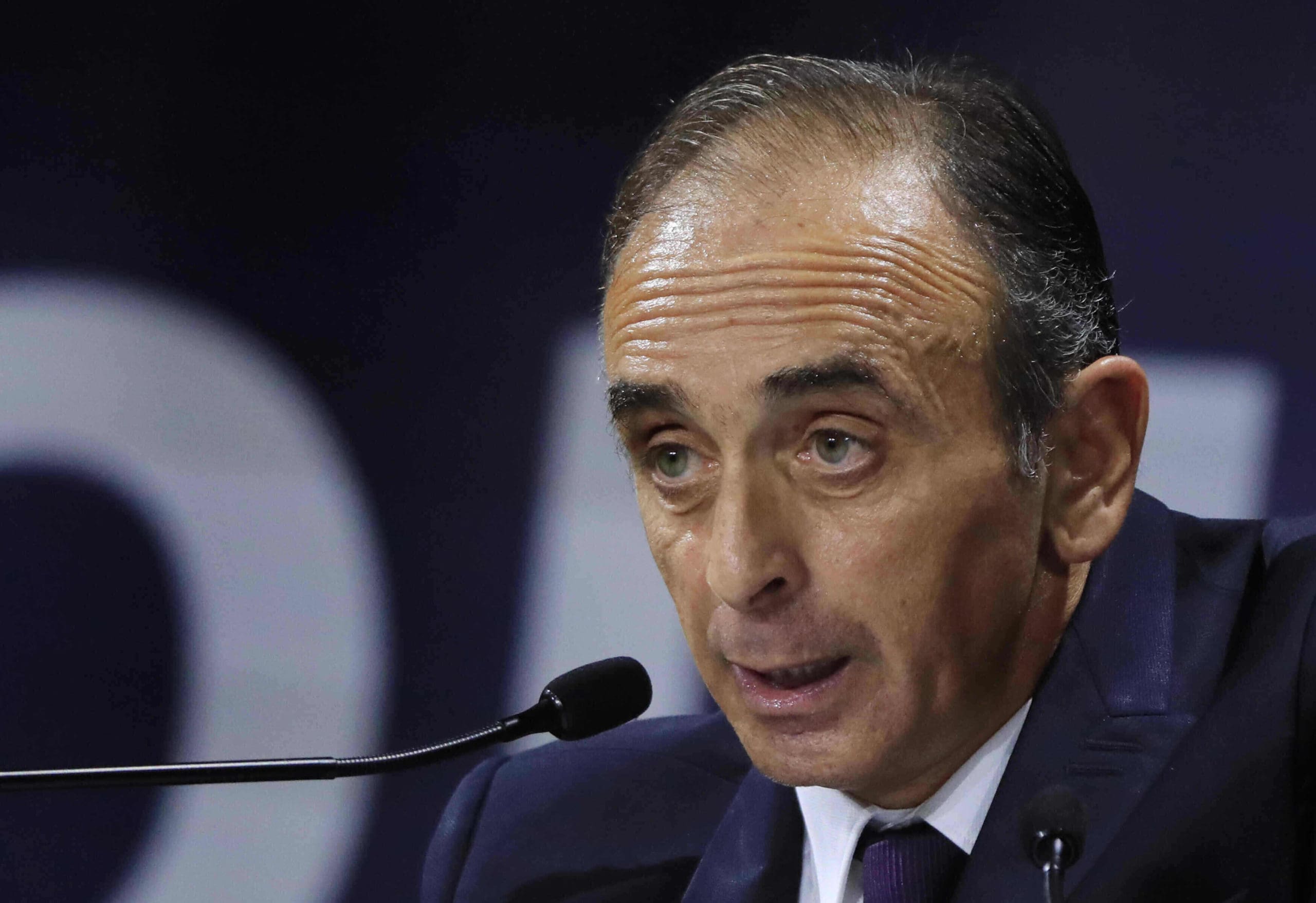
    The left’s fresh concerns about freedom of the press raise eyebrows among French conservatives. In fact, the same who protest so loudly about a bill meant to protect police officers applauded when, bowing to the far-left Sleeping Giants pressure group, companies such as the French sports retailer Décathlon and Ferrero, the Italian manufacturer of Nutella and other chocolate and confectionery products, decided to withdraw all their adverts from the CNews TV channel as long as CNews hosted right-wing, conservatives voices, such as that of renowned author and commentator Éric Zemmour. Éric Zemmour, perhaps the most popular conservative thinker in France, has been fined in the past for speaking his mind on immigration Décathlon had already withdrawn its adverts from other right-wing media outlets such as the Valeurs Actuelles weekly magazine and conservative websites like Boulevard Voltaire. Unfortunately for the press’s freedom and media pluralism in France, Décathlon and Ferrero are not isolated cases. A year ago, Valeurs Actuelles published a very long list of companies which had already answered positively in France to the far-left’s demand not to publish adverts through conservative, right-wing media outlets, thus depriving those outlets of an essential source of income.
    And this is not the only problem France has with freedom of the press in the country. Starting with the Pleven law enacted in 1972, France has put in place a unique set of laws allowing a myriad of state-funded, left-wing NGOs to go to court against anyone who says something they consider racist, revisionist, homophobic, or label “hate speech” for some other reason. Over the years, such laws have developed an unrivaled — at least in Europe — level of self-censorship among journalists. Those who do not abide by the expected standard of political correctness know they may have to face costly and time-consuming processes and sometimes endure heavy fines or even jail.
    Last September, Éric Zemmour was fined €10,000 by a French court for his speech at a “Convention of the Right” a year earlier. Zemmour’s speech was heavily criticized in the mainstream media, making the LCI news channel apologize for its live broadcasting. In that speech, Zemmour stressed the threat posed by the temporary alliance of liberal totalitarianism and Islamic totalitarianism, which he compared to the Ribbentrop-Molotov Pact between Nazi Germany and communist Russia. The target of both brands of totalitarianism, he emphasized, is primarily the White, heterosexual, Catholic French man, and the French state has become a tool in the hands of those who want to destroy the nation and replace the French with a different people, which referred to as an alien civilization. The French court considered that making such distinction between French people of European origin and French Muslims is paramount to inciting religious hatred.
    The Pleven law of 1972 against “racist” speech (which in practice has subsequently been used to cover any criticism of immigration or Islam) was only the first in a series of such laws. Since then, new laws have provided for harsher punishment and extended forbidden speech to those who question the genocide committed against the Jews by Nazi Germany, the Turkish genocide against Armenians, anyone who denies the European slave trade was a crime against humanity, and any kind of “discriminating” speech towards races, religious groups or LGBT communities, and so on.
    For all those speech crimes committed in public, NGOs can take anyone, including politicians and journalists, to court. This feature of the law distinguishes France from other countries where usually only public prosecutors are able to perform such an action. Thus, even when they know they are not inciting hatred and not breaking the law, French journalists, and also politicians, have to be very careful if they do not want to spend years defending their case in courts.
    In spite of all this, in the “Media Pluralism” chapter of its first Rule of Law Report presented this year (which is supposed to serve as a basis for the new rule-of-law mechanism ), the European Commission chose not to criticize France but rather Poland and Hungary where media pluralism and freedom of expression of journalists are far greater than France . The European Commission only mentions France — very briefly — regarding “some cases of physical threats and attacks” against journalists but makes no mention that conservative outlets in the country have been essentially muzzled for years.
    France is also unique in other ways, as evidenced by the fact that some journalists have to live under close police protection. It is the case, for example, of former Charlie Hebdo journalist Zineb El Rhazoui who has been living for years under constant police protection because of the numerous death threats she has received due to her criticisms of Islam.
    Abortion is just another topic that requires journalists to watch what they say in France. Last October, while discussing the possible extension of the legal deadline to abort on demand from the 12th week of pregnancy to the 14th week of pregnancy, pro-life activist Virginie Mercier showed on CNews a picture of a baby at 14 weeks and gave a factual description of what an abortion procedure looks like at that stage. Her opponent, a pro-abortion lawyer, answered her: “Let me remind you that there is [in French law] an offense of obstruction [to abortion]. What you have just said and the pictures you have shown could clearly fall under this offense”.
    Just as in France, in Hungary abortion on-demand is legal up to the 12th week of pregnancy. Last Summer, I asked Hungarian pro-life activist Lidia Meuwissen whether she was able to present her views in the Hungarian media, and she told me, referring specifically to conservative media outlets among all others: “Yes, I talked several times on television and they are open to us participating in discussions… We do not have much visibility, but our situation is probably better than that of pro-life activists in Western Europe”.

  • PM Orban to Manfred Weber: Rule-of-law mechanism is clearly about harming Hungary and Poland

    The European Union’s plans to tie the rule-of-law mechanism to cuts in EU funding are directly targeting Hungary and Poland despite claims to the contrary from European People’s Party group leader Manfred Weber, writes Hungarian Prime Minister Viktor Orbán.
    Orbán was responding to Weber’s online press conference on Dec. 3 where Weber claimed that the EU’s rule-of-law mechanism, which would enable Brussels to influence policies in nation states across the bloc, was not focused on Hungary and Poland.
    “Manfred Weber stated in an online press event on December 3rd to correspondents accredited to Germany that the notorious rule of law mechanism is not being set up expressly against Hungary and Poland. He added that his goal is to depoliticize rule of law questions and remove them from political party debates. The truth, however, is completely the opposite, as the following statements prove,” wrote Orbán in an official letter.
    Orbán goes on to cite the many instances in which top European Commission officials have either made statements clearly opposed to Hungary and Poland or openly pointed to how rule-of-law could be used as a tool to punish both countries:

    ” There are rule of law crises in some Member States, particularly in Hungary and Poland,” said European Commissioner of Justice Didier Reynders.
    Helena Dalli, the European Commissioner for Equality, said, “This mechanism is a means for making Member States fall in line.”
    “Orbán is building a sick democracy,” claimed Vera Jourová, the vice-president of the European Commission for Values and Transparency, to German magazine Der Spiegel .
    Franz Timmermans, the executive vice president of the European Commission for the European Green Deal, claimed that a “free press in Hungary is virtually non-existent.”

    In all of these instances, there is either a clear or implied threat directed at Hungary and Poland. For example, Timmermans statement on the press freedom in Hungary can be tied directly back to the EU’s rule-of-law hearings on “press freedom” in Hungary that have already occurred and almost certainly will in the future. Unlike Western European states where liberal media remains the dominant force, Hungary’s media landscape is more pluralistic, and features a balance between conservative and liberal news sources. This balance, however, is not looked favorably upon those in the EU who want to see a media model where conservative voices are censored or seen in the minority, as seen in many countries in the West.
    Orbán also points to statements from members of the European Parliament:

    “Hungary and Poland must be financially starved out,” said European Parliament Vice President and MEP Katarina Barley said in October in a statement that sparked outrage from both the Polish and Hungarian governments.
    MEP Guy Verhofstadt, the leader of the Alliance of Liberals and Democrats for Europe, said, “There is no need to prove whether the functioning of Hungary and Poland is in line with the system that’s about to be established. This has already been proven. It must be put into action immediately.”

    Top government officials have also been open about what rule of law is all about, according to statements provided by Orbán in his letter:

    “Finally, we will have a mechanism that is going to be very painful for Hungary and Poland,” said German Foreign Minister Heiko Maas.
    “This cancerous tumor must be removed. Hungary is a dictatorship like Belarus,” claimed Luxembourgian Foreign Minister Jean Asselborn.

    Despite Weber’s claims, Orbán wrote, “The situation is clear, dear Manfred: You want to alter the current legal status in order to create a mechanism that you immediately turn against Hungary and Poland. In light of the statements by the European Commission, European Parliament and national governments, you can no longer deny this. Now, you want us, Hungarians to give our consent.”
    “Over the course of history, Germans have asked for many things from us, Hungarians. Yet, you are the first ones to consider us Panscher. That we are not,” Orbán concluded the letter, with the German word “Panscher” translating to “adulterer” or “cheater’ in English.

  • Hungarian MEP was probably targeted by secret services, former spymaster says

    József Szájer, the Hungarian MEP who resigned his mandate after being caught at a Brussels house party, was very likely the target of secret services, László Földi, former director of the Hungarian Information Office (the Hungarian equivalent of the CIA) told conservative daily Magyar Nemzet in an interview .
    “It is probable that the Hungarian politician fell victim to an intelligence operation, who, as a target, obviously contributed to getting himself in such a situation. This was a fatal mistake on the part of József Szájer,” Földi said, adding that the coronavirus epidemic provided a good opportunity and appropriate conditions for the operation.
    “After the curfew was ordered, the plan was put in motion. From then on, all they had to do was persuade Szájer to attend the gathering,” he said. “All the intelligence services quite obviously knew his sexual orientation and what company he kept. Presumably, an acquaintance moving in similar circles — fulfilling an assignment — simply invited him to the party. They exceeded the permitted number at the gathering, so the violation of the law took place immediately. As Szájer tried to escape and was on the street, he had already violated the curfew.”
    “That must have been a desperate attempt on his part,” Földi said regarding Szájer’s escape through a window. “What is very important, however, is that drugs are involved in the case. If we accept Szájer’s statement that he did not know about the pills, then someone put the illicit drugs in his backpack. So the participants in the operation wanted to ensure their success.”
    While on the surface, the case was a simple police raid on a banned gathering, Földi said the circumstances would indicate political motive.
    “Current politics indicate this is the case. After all, as I have already mentioned, Szájer’s sexual orientation has been a known fact to all intelligence agencies for many years. The timing of the action, and the way the details of the case were leaked to the press, make it completely clear to me what happened,” Földi said.
    He pointed out that due to the Hungarian-Polish veto, there is a huge conflict of interest between the individual member states of the union. This explains the timing.
    “Oddly enough, the media made it easy only to identify Szájer. However, the identities of several other diplomats attending the party remain unclear. Ensnaring him was a very serious warning from somewhere to be careful, we know a lot about you,” he said, adding that since his sexual orientation was well known, that in itself could not have been grounds enough for making him a blackmail target.
    “But under the circumstances, due to the restrictive measures imposed because of the epidemic, the politician committed a violation of the law, which was conducive to character assassination. And let us not forget that Fidesz, in the person of József Szájer, lost its best-equipped politician in the EU, which is a huge blow to the party. There is a life-and-death struggle with Brussels and the Soros network. We live in a period when you can’t make mistakes. We must learn from the successful elimination of József Szájer.”
    Title image: László Földi, former director of the Hungarian Information Office.

  • Organized people smuggling switches to German drivers after numerous Romanians apprehended

    On Thursday alone, Hungarian police had to intervene in 307 illegal border-crossing attempts in the country’s southeastern Csongrád County, conservative daily Magyar Nemzet reports . As a large number of Romanian drivers have been caught in the past few months, people smugglers are now recruiting drivers from other countries, mostly Germany.
    Among the seven people smugglers apprehended in recent days, the Hungarian police have not prosecuted any suspects holding Romanian citizenship, but Bulgarian, Hungarian, Serbian and three German men have been charged, Magyar Nemzet writes.
    In the first three days of December, smugglers attempted to take 72 illegal immigrants from Hungary to Austria. According to Magyar Nemzet, after the successive failures of Romanian drivers and the confiscation of vans registered in Romania, organized crime gangs operating in Serbia have started using new smugglers of alternate nationalities.
    In an attempt to replace Romanian drivers, gang leaders were looking for new contractors to transport migrant groups crossing the border to Austria and Germany. The criminals operated on the assumption that the Hungarian police would only check the closed vans with Romanian registration plates, suitable for use as “migrant buses,” and cars with German and Hungarian registration could pass through the checkpoints easily.
    On the first day of December, a German man seeking to smuggle Ethiopian refugees into Germany was apprehended in the immediate vicinity of the southern border section. On December 2, a 29-year-old German man transported seven Iranian men to Nagycenk, and the migrants entered the country illegally. The next day, the police stopped a 34-year-old German man in downtown Szeged (close to the Serbian border); he had 12 Syrian migrants in the back of his van.
    The illegal entrants were expelled from the country by the police, the people smugglers were detained, criminal proceedings were instituted against them, and their cars were seized. One noteworthy fact is that the armed smuggler who committed suicide with a hand grenade at Vitnyéd at the end of October was also a German national.
    Meanwhile, the Border Police Directorate of the Intervention Police discovered another tunnel dug during the night in the section of the border close to the Kunbaja settlement early on the morning of December 3. It appeared the tunnel had already been used.
    According to criminal intelligence, people smugglers use these tunnels dug in the dam of the Tisza river, where there is no fence for flood protection reasons, and they are then transported further by van. The 40 migrants captured on the outskirts of Mélykút on the morning of December 3 — the largest group who illegally crossed the border last month — were also waiting for a van to transport them, according to Magyar Nemzet.
    Title image source: police.hu.

  • Avengers – commentary

    Western Europe’s liberal politicians are unwilling to admit that there are viable alternatives to liberal democracy and they look down on Central European countries’ efforts to shed their second-rate status, Magyar Hírlap columnist Mariann Őry writes .
    EU decision-makers do not like criticism, especially when it concerns liberal democracy. First, they believe that liberal democracy is the only conceivable form of democracy. Secondly, if they are confronted with the application of a double standard when picking on, for example, Hungary and Poland, they reluctantly admit that neither German nor French democracy is perfect and say that they are dealing with this as well. Of course, they don’t really believe this, nor are they dealing with it.
    In the eyes of Western liberals, our region, including the Visegrád Group and the countries that joined the EU after 2004 in general, are second-class members. The regime changes may have happened 30 years ago, but we are still the ones in need of supervision, reprimands, rebukes, punishments.
    One sign of the crisis of authority already mentioned is that Central Europe, and especially the Visegrád Four, no longer want to be second-class, and this is very annoying to intellectuals in Brussels, Berlin and other major cities who consider themselves first-class. We are talking about economies that are now growing above the EU average and are confident players in European politics. And it turns out that copying Western models and doing everything they say — liberal democracy, open society, Soros Foundation — is not the only viable alternative for the countries of this region. There will be no national pride in daring to be small. Because why should we be small?
    More and more people believe that Western authority, which was slavishly accepted 30 years ago, is now much worse for wear. Parallel societies, no-go zones, terrorist attacks, economic problems, identity crises — there are many examples, all of which show that most countries in Western Europe have for decades been on a path that we should not follow. The Hungarian and Polish strategies, on the other hand, are to find a specific national path, to respect sovereignty and subsidiarity. Within the European Union, we are building a democracy that respects our own traditions and principles, which are accepted by the vast majority of citizens, and promises a safer, more stable country than an open society.
    However, important decision-makers in Brussels, Berlin and elsewhere are unwilling to accept this and refuse to acknowledge that democracy can be something other than liberal. So they find a way to force the reticents into the same dead end they are heading towards.
    The so-called “rule of law” charade and the years of fighting within the European People’s Party are also indicative of this. Just yesterday, the Advocate General of the EU Court of Justice said that the Hungarian action on the Sargentini report should be dismissed, saying that the Hungarian Government was wrong in claiming that a document full of lies was pushed through disregarding the number of abstentions.
    The Advocate General’s arguments even included some linguistic reasoning to the effect that abstention was asking to be treated as if one had not voted at all. Regardless of the apparent absurdity of the argument before the European Court of Justice, the only point of the long-awaited opinion is that the perfection of the Brussels democracy cannot be questioned under any circumstances.
    Double standards? Of course, as always.
    The defenders of EU bureaucracy are violent and angry avengers. Let us have no doubts, there are some fierce battles ahead of us.
    Title image: Hungarian Prime Minister Viktor Orbán. (MTI/Zsolt Szigetváry)

  • Organizer of gay sex party in Brussels is a Polish man wanted by the Polish police for fraud

    Dawid Manzheley, known as a frequent organizer of parties in Brussels and the host last Friday, November 29, that led to the resignation of József Szájer, is wanted by the Polish police regarding several cases of fraud, according to Polish news portal Onet . Polish Journalist Klaudisz Slezak posted a copy of the police file concerning Manzheley on Twitter: On Thursday morning, liberal portal Onet.pl published an interview with David Manzheley, who introduced himself as a 29-year-old with a PhD in economics. Manzheley claimed that Law and Justice (PiS) politicians also participated in the gay events he organized in Brussels. The interview was published prior to the revelation of allegations of criminal history.
    Onet however emphasized in the article that it is unable to verify the authenticity of Manzheley’s claims, while other sources have outright disputed them, and later on Thursday, Onet.pl reported that several judicial proceedings in Poland are being carried out against Manzheley. He resportedly also has not even graduated from high school, contrary to his claims of finishing a PhD in Belgium.
    According to police criminal records, Dawid Manzheley is 36 years old and comes from the southern Polish town of Wadowice. The police have been searching for him since June 2019, although, apparently, officers were attempting to locate him even before that.
    Police confirmed to TVP Info that Onet’s interlocutor is most likely the same person. They also stated that his identity will be verified when he is visited by Belgian police. The initial version of the story published on Onet also reported that he is probably the same person wanted by police in Poland, but the story was updated in the afternoon reporting that sources have confirmed that they are indeed one and the same.
    The case of fraud for which Manzheley is wanted concerns accepting work as a “lawyer” to prepare official documents on behalf of third parties, which he then could not deliver. In the past, he had also sued judges and attorneys for defamation using forged documents. He even impersonated a lawyer who had graduated in Israel as well.
    Last Friday, Brussels police shut down an illegal party which was being held despite the current coronavirus restrictions. One of the participants was Hungarian MEP and Fidesz member Jozsef Szajer, who later resigned.
    Update: The real name of David Manzheley, organizer of sex parties in Brussels, is Przemysław P., says his Polish family
    Title image: Print screen of the Polish police’s website listing wanted persons – poszukiwani.policja.pl

  • German EU presidency should formulate budget proposal that can achieve consensus

    Germany, holding the revolving presidency of the European Union, should come up with a solution to the current budget crisis that can receive the approval of all member states, said Hungarian Minister of Foreign Affairs and Trade Péter Szijjártó in Mrosvásárhely (Târgu Mureş), Romania, on Wednesday, Romanian news agency Agerpres reports .
    “This was our position from the outset, and no one should be surprised. That is why the German Presidency of the European Union must find a way out of this situation and formulate a proposal that will be accepted by consensus,” Szijjártó said. “With regard to the budget of the European Union for the next seven years, and with regard to the economic recovery plan of the European Union, respectively, in terms of the use of funds for these, I would like to tell you the following: Brussels must let go of the misleading perception it uses to create the false image that European resources are coming from the good will of our friends in Western Europe or as if they were humanitarian donations for Central Europe.”
    Szijjártó pointed out that those funds — regardless of which country’s budget they come from — are the common result of European economies and not mercy handouts from Western member states.
    “They were created as a result of the common economy of the European Union, in which Romania, Hungary, Poland, the Czech Republic and Slovakia all participate, as well as the citizens of Western Europe,” Szijjártó said, adding that these European resources are equally due to both Hungary and Romania, because “we have all contributed to them.”
    “And for this reason, a subjective criterion […] to be a condition for obtaining these funds is unacceptable to us. But not only is it unacceptable, we also consider it contrary to European values ​​and European treaties,” said Peter Szijjarto.
    In a preliminary vote at last week’s meeting of the permanent representatives of the EU states, Poland and Hungary implemented their intention to veto the EU’s multi-annual budget for the period 2021-2027 (€1.074 billion) and the “Next Generation” recovery fund (€750 billion), if the agreement reached earlier this month between the European Parliament and the German presidency of the EU Council on the introduction of the conditionality criterion is adopted.
    This agreement, adopted at that meeting by qualified majority, provides that, at the proposal of the European Commission and with the approval of a qualified majority of member states, European funds may be suspended if member states are suspected of violating the rule of law, a mechanism considered by both the Polish and Hungarian governments to be an arbitrary instrument based on political and ideological criteria.
    Meanwhile, a meeting of the member states’ EU ambassadors on Wednesday failed to find a solution to the impasse. Even worse, the German presidency now has another potential veto to contend with: France has warned that it would veto a Brexit agreement with the United Kingdom if the terms are not to their liking.
    Title image: Hungarian Minister of Foreign Affairs and Trade Péter Szijjártó in Marosvásárhely (Târgu Mureş in Romanian). (MTI/Gábor Kiss)

  • Hunting season on conservative Hungarian MEPs is on – commentary

    The liberal forces, having realized that Viktor Orbán’s power cannot be undermined at home, have now launched a systematic hunt for his party’s MEPs, Dániel Bohár writes in a colum n on conservative news portal 888.hu.
    Even before I wander in this direction, let me first make it clear that József Szájer made a mistake that a politician in his position is not allowed to make. A Christian Democrat politician does not go to such a “house party,” especially in the midst of a coronavirus epidemic. At the same time, Szájer accepted the consequences, resigned, ended his political career, and retired from public life.
    “A Belgian news story appeared today in the Belgian press about a house party in Brussels on Friday, which I attended,” Szájer wrote in his statement. The Belgian authorities initiated proceedings against József Szájer for finding drugs in his bag. He denied that they were his.
    “I didn’t use drugs, I offered the police on the spot to have an official test done, but they didn’t. Police said an ecstasy pill was found. It’s not mine, I don’t know who placed it and how. I made a statement to the police about this.”
    Though Szájer did make a mistake, the case is a textbook example of a well-organized secret service action. The authorities most likely had been watching the Hungarian representative for some time, getting to know his habits, so it was easy to set a trap for him. At the same time, it is clear that an MEP who has been moving in politics for 30 years should not have made such an amateur mistake. Of course, this is easy to say, but a similar case occurred with former Austrian Interior Minister Heinz-Christian Strache. Surely everyone remembers the videos. It was a perfect job, too.
    An important detail in the case is the drug charge, and here we should read between the lines. Szájer writes in his statement that he did not consume any mind-altering drugs, but ecstasy tablets were found in his backpack. To clarify the situation, Szájer requested an immediate drug test, which was rejected by the authority. Why? Most likely because then it would have turned out that there were really no drugs in his system, and the well-informed Belgian and Hungarian press wouldn’t have even been able to report on it.
    The leak of the story is also noteworthy. In addition to the Hungarian MEP, several other diplomats attended the party, yet we have not heard anything about them. In any case, the fact that information from the Belgian prosecutor’s office appeared the next day in the Belgian press raises serious questions. Privacy rights, among others, seem to be unknown concepts in the developed rule of law in the West.
    The timing also suggests that this is a well-organized action, as Hungary is engaged in its biggest debate with the European Union in recent years. With the “shooting” of József Szájer, Viktor Orbán lost one of his most important allies in the European Parliament.
    To sum things up: This case foreshadows what to expect in the next year and a half. It is quite clear that all the foreign opponents of the Orbán government have come to the conclusion that left to the “domestic” opposition alone, there will be no change of government anytime soon. The network, complemented by the secret service, is already working hard, collecting everything from everyone. The case of Szájer is a warning sign. It doesn’t matter that someone has been a politician, a pioneer of the regime change for 30 years and the author of Hungary’s new constitution or that he is one of the most prominent minds in the country.
    Let’s take care of ourselves and take care of each other, for the sake of each other!
    Title image: A general view of the room before a plenary session at the European Parliament, in Brussels, Monday, Nov. 23, 2020. (Kenzo Tribouillard, Pool via AP)

  • Once elected, EU Commission President has turned her back on Hungary

    Contrary to the high hopes many had for the new European Commission, Ursula von der Leyen has disappointingly continued to act as a political agent, just like her predecessor, Jean-Claude Juncker, did, Attila Kovács, analyst at the Hungarian think tank Center for Fundamental Rights said in an overview of the new Commission’s first year.
    According to Kovács, the previous Juncker Commission committed two political blunders: It misunderstood the 2015 migrant crisis, and Brexit also happened under its watch. In 2019, therefore, there was a sense of hope that the new Commission, led by von der Leyen, would be less of a political body and more focused on smoothing conflicts between member states.
    This expectation has not been met: The new Commission also sees itself as a political actor, and what is more, its political objectives are exacerbating the differences between the member states. It has become clear that the President of the Commission relies more on the left-wing majority of the European Parliament in her work.
    Kovács said that it is a particular disappointment for Hungary that, although von der Leyen needed Hungarian support to win the presidency, she turned her back on Hungary after taking office.
    The Commission has been strong in churning out papers but weak in crisis management
    Kovács also said that the Commission has recently put a very dangerous proposal on the table regarding migration. The distribution of migrants between member states is still included, albeit covertly, in its September proposal; furthermore, under the November action plan, the Commission would give migrants the right to vote as part of encouraging political participation.
    Regarding the coronavirus crisis, Kovács said that the Commission had made a number of mistakes: It was late in recognizing the severity of the crisis, its response to the economic damage caused by the crisis was to drive member states deeper into debt, and it reserves the right to decide what vaccines member states can use to protect their citizens.
    In conclusion, he said the Commission had been strong in producing papers in its first year but weak in crisis management. Deputy project manager of the think tank Orsolya Kurucz emphasized that in her speech on the state of the Union that von der Leyen also raised the possibility of moving from the rule of unanimity to qualified majority voting on certain foreign policy issues, which clearly undermines member states’ competences and is unacceptable from the point of view of national sovereignty.
    Rule of law: Continue on Juncker Road
    On the issue of the rule of law, the current European Commission has not only continued but surpassed the work of the Juncker committee. At the end of September, it presented its first annual report on the rule of law in the member states, which, instead of the objective and comparable criteria it had promised in advance, was a subjective assessment subject to political pressure, with several factual errors.
    Moreover, linking the resources of the EU budget and the European Recovery Fund to the rule of law has generated an even greater division between member states rather than focusing on joint and effective action in times of crisis.
    Kurucz emphasized that the EU institutions and member states are also significantly behind in the process of defining the future of the EU. For years, no substantial progress has been made in laying down the principles on which we envisage future cooperation within the EU.
    The institutions and member states have been debating for months who should chair this process. However, this inaction not only projects a bad image of the European Union to the outside world but is also a distress signal to EU citizens about the future of the organization.
    Title image: European Commission President Ursula von der Leyen speaks during a plenary session at the European Parliament in Brussels, Wednesday, Nov. 25, 2020. (Olivier Hoslet, Pool via AP)

  • Ukrainian police raids on Hungarian cultural institutions draw ire of Hungarian government

    Hungarian Foreign Minister Péter Szijjártó has summoned the Ukrainian ambassador to Hungary over a special police unit raid on a number of cultural and educational institutions belonging to the Hungarian ethnic minority in Ukraine’s Sub-Carpathia.
    On Nov. 30, heavily-armed commandos from the elite SBU unit turned up at the doors of the Ferenc Rákóczy II. Institute in Berehove, the Ede Egán Foundation in Uzhhorod, and raided the private apartment of László Brenzovics, the president of the Cultural Alliance of Hungarians in Sub-Carpathia (KMKSZ).
    Officers wearing protective gear and carrying machine guns were accompanied by special investigators who have taken away hard-drives and documents from the institutions, yet authorities are not forthcoming about the reason for the raids. Although they have declined to clarify the exact reasons for such a heavy-handed intervention, unofficial sources speak of an investigation into alleged separatism and armed insurrection threatening the territorial integrity of Ukraine.
    The raids could be a continuation of an earlier court case against representatives of the Hungarian minority filed in Zaporizhzhia, a city in East Ukraine. So far no weapons or incriminating documents have been found to support the serious accusations, and there was no evidence presented that would explain such a heavy-handed police raid. In fact, young men from the Hungarian minority have been drafted into the army to take part in military operations in the Eastern of the country. AP Photo/Laszlo Balogh In this Friday, Oct. 19, 2018 photograph, children attend class at the Velyka Dobron High School in Velyka Dobron, Ukraine. A new education law that could practically eliminate the use of Hungarian and other minority languages in schools after the 4th grade is just one of several issues threatening this community of 120,000 people. Many are worried that even as Ukraine strives to bring its laws and practices closer to European Union standards, its policies for minorities seem to be heading in a far more restrictive direction. According to representatives of the Transcarpathian Hungarian minority, the police action is a witch-hunt against ethnic Hungarians designed to put pressure on the Hungarian government, as well as to cater to ultra-nationalist voters. József Barta, the deputy-leader of KMKSZ, had stated that “in the past period, there were many provocations against us, as a result of which we, Transcarpathian Hungarians, do not feel safe any longer, and we have the impression that sometimes we are persecuted. And the powers in whose interest it would be to guarantee us this sense of security and to protect us from persecution, are failing to do so and are in fact often the initiators of such acts.”
    Given the comparison between the size and military might of the two countries, accusations of Hungary trying to re-annex its former territories lost in the 1920 Versailles treaty remain far-fetched. Yet sources such as the Ukrainian news agency Interfax lists a historical map of pre-WWI Hungary allegedly found in one of the raided offices as indication of such conspiracy.
    The root of the conflict lies in the Ukrainian language law that restricts the use of the languages of ethnic minorities in culture, education and public life that was heavily criticized by a number of national governments as well as international bodies, such as the Venice Commission . As a result of this legislation, and subsequent intimidation of Hungarian minority representatives, Hungary is currently blocking Ukraine’s NATO and EU membership ambitions. On the other hand, Ukraine seems to be responding to the obstacles placed in the way to its international strategic interests by allowing radical nationalist groups to intimidate members of its ethnic minorities, which has resulted in death threats and repeated arson attacks against institutions.
    Hungarian Foreign Minister Péter Szijjártó had posted a video on his social media account where he states that “there is a NATO member country, against whose nationals such criminal acts can be committed in a non-NATO country, and no one utters a word… When such an open insult and aggression is committed in an un-cultured and un-European manner which is unacceptable in the 21st century against a national community, everyone is quiet. When I have raised this question in the meeting of NATO foreign ministers, there were only two countries who said that we are right to show solidarity and that it is not right that such incidents occur. There was no other reaction.”
    The foreign miniser has also asked the Organization for Security and Co-operation in Europe (OSCE) to send observers to Transcarpathia to investigate the unprovoked insults against Hungarians committed in Ukraine. The observers are already in the area where these incidents have occurred and will be in touch with representatives of the Hungarian minority.

  • Hungarian MEP scandal: why him, why now?

    The scandal involving Hungarian MEP József Szájer raises a series of troubling questions that go well beyond his transgression, András Pulai, CEO of Hungarian liberal think-tank Publicus Institute points out in a recent Facebook post. Other sources, such as the liberal HVG , have even pointed to the possible involvement of secret services.
    In the Szájer case, it cannot be completely ruled out that the Friday night police raid was part of an intelligence operation András Dezső, HVG.hu Szájer (59), an MEP for Hungary’s ruling conservative Fidesz party unexpectedly announced his resignation on November 29, citing personal reasons, saying that the daily political struggle put too much strain on him.
    “Those who are on the battlefield must be in a state of combat readiness,” Szájer wrote in his resignation letter published on Sunday.
    On Tuesday, two days after his resignation, a Dutch-language newspaper based in Antwerp was surprisingly the first to publish the story that two days prior to the resignation, on Friday, November 27, Brussels police raided an illegal party with over 20 attendees, in violation of current coronavirus restrictions, which include a social bubble of one and a curfew between 22:00 and 06:00 hours. Several Hungarian and Belgian outlets rapidly picked up the story.
    The Belgian Public Prosecutor said in a statement that “A passer-by reported to the police that he had seen a man fleeing along the gutter; he was able to identify the man. The man’s hands were bloody. It is possible that he may have been injured while fleeing. Narcotics were found in his backpack. The man was unable to produce any identity documents. He was escorted to his place of residence, where he identified himself as S. J. (1961) by means of a diplomatic passport.”
    The same day, Szájer admitted in a statement that he had attended the party, but categorically denied any drug use. He called his actions irresponsible and apologized.
    Pulai points out several difficult questions regarding the case. “Thinking aloud,” he writes, “this is probably not the first such party in Brussels.”
    Secondly, he continues, “over the years, dozens, if not hundreds, of MEPs, diplomats, Brusselites and Bruxellois have taken part.” Thirdly, special services and other relevant bodies that are already particularly active in Brussels must have known about these for a long time.”
    “But still, the question arises: Why did it transpire right now? If there were many important people there, why has only Fidesz’s most important EU politician been named (so far)?” Pulai asks.
    “At exactly the moment when this politician’s boss is trying to block a package of thousands of billions of euros that is important for the entire EU, the next budget and the introduction of a system of rule of law criteria [and] when he softly raised the possibility of his country leaving the EU, right on the back of Brexit [and] when the EU cannot afford any more disintegration, in its own interest?”
    “Could it be that what we see today is part of a political battle that has another, bigger and more important arena? Millions of torturous questions,” according to Pulai.
    Title image: Rue des Pierres, Brussels, where the gathering allegedly took place (Source: Google Street View).

  • Automakers prepare for disaster in Germany, Poland, Hungary, and Czechia over planned EU emission standards

    The European Union’s plan to bring forward the stricter Euro7 emission standard to 2025 means that car manufacturers in the EU will no longer be able to sell cars with internal combustion engines, which could leave countries like Poland, Hungary, Czechia, and Germany with tens of thousands in job losses and numerous plant closures.
    According to German Sunday paper Bild am Sonntag , a committee of scientists from across Europe, the Advisory Group on Vehicle Emission Standards, has recommended the European Commission set much stricter standards, with nitrogen oxide (NOx) emissions of either 30 or even more drastic 10 milligrams per kilometer, compared with the current 60 milligrams for gasoline and 80 milligrams for diesel vehicles.
    Bild also quoted the report recommending that “carbon monoxide should get reduced from 1,000 respectively 500 mg to 300 respectively 100 mg,” according to sources from Business Insider.
    While the new rules did not say so, they will amount to the effective ban of internal combustion engines, still the overwhelming majority of the European output.
    This will mean that all European car manufacturers will either have to close down their internal combustion engine plants — the Volkswagen group’s largest plant is in Hungary — or pour a lot of money into investments to meet the new standards. The only clear beneficiary of the proposed new rules is Tesla, which by 2025 will be capable of producing millions of vehicles per year.
    Hildegard Müller, president of the German Association of the Automotive Industry (VDA), told Bild am Sonntag that the new emission standards would also require cars to stay within the limits even going uphill or in congested urban traffic, which is practically impossible with current internal combustion engines.
    With the planned new norm, which Commission President Ursula von der Leyen earlier wanted to adopt as soon as 2021, the new limits should be as low as the current margin of error.
    “The European Commission is indirectly displacing internal combustion engines by hiding behind technical rules. It would be more honest to openly state that it is forbidden to produce petrol or diesel cars in Europe. The only question that can be asked is whether there are suitable alternatives,” Müller said.
    While the new regulations will also be bad news for Central European countries which have gained significant car manufacturing and supplier capacities in recent decades — Poland, Hungary, Czechia and Romania — the German car industry is the most vulnerable.
    The production of modern internal combustion cars is one of the few value chains that are still entirely in Germany. Many regions, such as Bavaria, Baden-Württemberg, the Saarland, Saxony, or North Rhine-Westphalia, stand to lose tens of thousands of highly qualified jobs.
    Title image: Audi Rs3 models roll off the production line in Győr, northwestern Hungary. (source: audi.hu)

  • Poland’s veto of EU budget over rule of law blackmail is necessary, says Justice Minister Ziobro

    Poland’s Justice Minister Zbigniew Ziobro, who leads a junior partner in the ruling Law and Justice (PiS) bloc, believes that the rule of law issue is just a pretext for reducing national sovereignty and making the payment of EU funds dependent on political criteria.

    Ziobro feels that Poland has no alternative but to categorically reject such an approach.

    The settlement negotiated by the German EU presidency with the European Parliament includes a mechanism which would allow the European Commission to move to stop EU funding on the basis of non-compliance with the rule of law.

    Such a sanction could be imposed with a qualified majority in the EU Council of ministers, thereby bypassing the Article 7 of the Lisbon Treaty which states that any sanctions must be levied unanimously by the European Council of member states.

    Minister Ziobro argued that the “German presidency’s proposal is aimed at Poland’s sovereignty”. In his view, “this is not about the rule of law but it is an attempt at an institutional and political enslavement radically limiting national sovereignty.”

    He was certain that both Polish Prime Minister Mateusz Morawiecki and the Hungarian Prime Minister Viktor Orbán will use their power of veto to stop a measure which is against the national interest of both countries.

    In a conversation, he told me that in the 1960s he had heard unimaginable things about Poland from his older colleagues, such as being able to have beards and long hair, or monks and nuns walking down streets in their robes or even rumors about a Catholic university.

    He had been shocked to hear that there were no kolkhozes in Poland and that Jazz clubs could be found everywhere. Even literature and theater had greater freedom than in Hungary.

    Szalai had arrived in Poland for the first time in 1968.

    “I will never forget how, with my friend, we were travelling to the Baltic Sea and were hitchhiking near Olsztynek. We had a Hungarian flag with us, which worked like a magic wand,” he said.

    Szalai explained that a Polish father had stopped his car, filled with his family, and got out to hug him and his friend and made room for them in his small car. When they tried to protest, the Polish man had told them, “I will not hear it. You must come with us.”

    Szalai had travelled Poland far and wide. He fell in love with the country and moved to Warsaw permanently in 1976. He mainly worked on Hungarian translations of Polish literature, wrote about Poland for Hungarian literary magazines and conducted broadcasts about Poland for Hungarian radio.

    During “Solidarity” movement time of the 1980s, he had cooperated with the anti-communist opposition and during the era of martial law, he joined the underground. He was a liaison between Warsaw and Budapest for the anti-communist opposition in both countries.

    After the fall of communism, he returned to Hungary in which he held many functions in media and diplomacy. He was the editor-in-chief of Új Magyarország and Napi Magyarország and also the director of the Hungarian Institute of Culture in Warsaw.

    A few years ago, he fell ill with a serious disease but never gave up. Unfortunately, the illness took him from us when he still had so much to do.

    In his last years of life, he worked on editing for his journal. It was published in Hungarian in 2019 and contains notes from 1976-1990.

    It would be good for the memories of our Hungarian friend to appear in Polish someday. He deserves at least that from us.

    Good bye, friend! We will see each other again!

  • A Hungarian’s view on churches being attacked in Poland

    Shocking news is coming from Poland. Demonstrators against new abortion restrictions are disrupting masses, damaging churches, insulting believers and priests at church services, and most recently in Poznań, also attacking a statue of Pope John Paul II.

    At the heart of Poland and the Polish nation is Christianity — more exactly Catholicism.

    Poland was wiped off the map of Europe three times, and the Poles were saved by their faith — their unshakable faith. In Poland, workers at the Gdańsk Shipyard regularly attended Mass during the Solidarity strike and struggle, and their priests visited the factory and celebrated Mass there. It is no coincidence that the communist killers of the military coup brutally murdered the very heart of the Polish nation — the Catholic Church — and Father Jerzy Popieluszko on its behalf.

    And now these protesters are picking up where the former communists left off. Their actions are greeted with great joy in the liberal media, a media which neglects to mention that the protesters are mostly young people who are attacking the very heart of Poles.

    God, how inescapable, how self-evident, how sad, and how symbolic it all is. How awful it to see the 21st century knocking on the doors of Poland.

    Saint John Paul II’s first journey to Poland as pope was a monumentous occasion in 1979. He delivered Mass next to Kraków to almost two million Poles and said, “Don’t be afraid!” (Then came Ali Agca, the Turkish “gray wolf” to kill him, and let us not forget that the trigger was actually pulled by the Bulgarian secret service on behalf of the KGB).

    Even today, we cannot say anything else to our dear Polish friends. “Don’t be afraid” and don’t back down. After all, the 21st century is attacking the very heart of your nation. In fact, the 21st century is now attacking the heart of every nation with a sick, miserable, rootless, and infinitely ruthlessness

    In the coming weeks I will describe in these columns everything I know about Poland, Polish history, the soul of Poles. Not so much to help them, because they may not even need help. Perhaps I would rather help myself — ourselves now — by finding solace in the example of the Poles.

    Title image: Angered women’s rights activists and their supporters confront police and a far-right group on the fifth day of their nationwide protests against a recent court ruling that tightened Poland’s restrictive abortion law, in Warsaw, Poland, on Monday, Oct. 26, 2020. The court said it was unconstitutional to terminate a pregnancy due to fetal congenital defects, effectively banning almost all abortions. (AP Photo/Czarek Sokolowski)

  • Why a Biden victory in November could spell trouble for Central and Eastern European conservatives

    The outcome of the presidential election in the United States could have a profound impact on the nationalist conservative governments that predominate in Central and Eastern European countries such a Hungary and Poland, with a number of nations in the region now weighing up their options as they prepare for the outcome of the Nov. 3 vote.

    The rapidly polarizing US political landscape is in many ways mirrored by the European Union’s political discourse, where old historic alliances are being replaced by ones situated on political or ideological fault lines. Traditional conservative politics has been redrawn to reflect the enormous changes in Western societies taking place mostly as a result of nation-states transforming into multicultural open societies. European and American historic left-wing political movements are disappearing at an event faster pace, transforming themselves into well-financed radical globalist movements vying to control international big business, rather than to look after the interests of local working-class communities.

    It is in this context that world-leaders from outside the US are weighing in on the battle between Joe Biden and President Donald Trump. Hungarian Prime Minister Viktor Orbán, who represents a nation-state oriented around conservative politics, has strongly backed the reelection of Trump both in the Hungarian and English-speaking press. 

    “With the election of Donald Trump and the arrival of [outgoing US Ambassador to Hungary] David B. Cornstein, everything changed, and Hungary felt an openness, honesty, and friendly approach on the part of the United States,” Orbán said this week at an award ceremony for Cornstein. 

    Orbán also told Reuters in September that he was convinced Trump would win reelection and that if Biden were to win, it would likely lead to worse relations between Hungary and the US. 

    Orbán’s fears were likely confirmed when a few weeks later Biden referred to Hungary and Poland as “totalitarian regimes” during a debate with Trump. The comment came as a shock to the Hungarian government, with top officials, including Foreign Minister Peter Szijjártó, slamming Biden.

    “US President Donald Trump and Prime Minister Viktor Orbán share a similar view on illegal migration, border protection, security, family support and the protection of Christian communities,” said Szijjártó.  The foreign minister said that this is why Biden obviously involved Hungary in the presidential election campaign.

    Orbán’s decision to voice his support for Trump likely reflects the welcome change at the helm of the US embassy after the departure of former President Barack Obama’s appointee, Ambassador Colleen Bell, who was a fierce critic of. Orbán’s government. Bell, who now works as the Director of the California Film Commission, had accused the Orbán’s government of “systematic corruption” and “xenophobic characterizations of refugees as invaders” over the government’s stance on the 2015 migrant crisis, 

    The appointment of Ambassador Cornstein by Trump had brought a much desired normalization in US-Hungarian relations as far as the Orbán government was concerned, a fact that has not been welcomed by the Hungarian opposition. In fact, Hungarian opposition leader Ferenc Gyurcsány has also been candid about his preferred candidate, saying“It is in the interest of Europe, including Hungary, that Joe Biden be the next president of the United States.”

    Gyurcsány no doubt remembers the support the US showed Hungary’s opposition during Obama’s term in office. Given the vitriol Biden has directed towards Hungary and Poland, Gyurcsány likely expects further support from the Democratic candidate.

    Biden’s harsh rhetoric could indeed develop into concerted policies directed at Orbán’s government. For example, the State Department under Obama had planned a $700,000 grant to fund so-called independent media in rural areas of Hungary, largely seen by the Hungarian government as an attempt to promote media that would be hostile to Hungary’s conservative government. Although Trump’s State Department canceled the planned project, such programs may resume if Biden assumes office.

    Another important factor may be billionaire financier George Soros. Soros has openly expressed his hostility to the governments in Poland and Hungary. The substantial funding he ha directed a Biden’s campaign to the tune of over $50 million may provide further incentive for Biden to turn his attention towards the two countries if he wins the presidency.

    The Hungarians, however, are not as invested in political and economic relations with the United States as some other countries such as Poland, where a radical shift on the US political landscape could bring complex challenges not only with regard to their strained relationship with the EU elite, but also in their security arrangements in relation to a perceived threat from Russia. At the same time, the threat of Russia is likely to keep US forces directed towards the country’s Eastern flank regardless of who wins office. 

    Another European leader who has publicly endorsed Trump’s bid is Slovenian Prime Minister Janez Janša, who had claimed that a possible Biden win would mean the US was appointing “one of the weakest presidents in history”. The endorsement likely has little to do with the fact that the current First Lady, Melania Trump, is a native of Slovenia. Instead, Janša, an ally of Orbán’s, sees an ideological ally in Trump. Slovenia was one of the first nation to erect a fence against the migrant invasions following the Hungarian example, and had openly criticized the European Union’s lack of response to the crisis. Janša is also a proponent of strengthening national institutions and identity, as well as family friendly policies that are meant to stop negative demographic trends.

    As is a trademark feature of Czech diplomacy, Prime Minister Andrej Babiš, has been more cautious in expressing any preferences or direct endorsements with regards to the current presidential duel. Although personally he sees eye-to-eye with Orbán on key issues such as migration and gender ideology, his party ANO is a formation that encapsulates a number of different ideological profiles, ranging from liberal views (such as Věra Jourová, Vice President of the European Commission for Values and Transparency), to conservative ones. He has thus been careful not to cause a rift within his own party, and especially not with his governing coalition partners, the Czech social democrats (ČSSD), who would certainly not support the incumbent US president for a second term.

    Whoever wins the US presidential elections, the consequences for European conservative governments will be of critical importance. A Democrat in the White House would make it exponentially more difficult for national governments to resist migration-friendly policies championed by the European Union’s dominant left and green movements. Equally, NGOs that promote open societies, a multicultural world-view and radical gender or racial theories would most likely also see a major boost not only in their finances, but also in their access to the power structures of EU member states. Conservative governments that have no options or desire to open Eastwards economically and in terms of political alliances, would without a doubt feel increased pressure over the next four years.

  • Facebook deletes Hungary’s far-right Our Homeland page for ‘violating community standards’

    Hungary’s far-right party Our Homeland (Mi Hazánk) earlier this week had its Facebook page with nearly 80,000 followers terminated for allegedly violating the site’s so-called ‘community standards’.

    According to representatives from the party, on Oct. 23, the social media company first took down a livestream of the party’s event commemorating the 1956 Hungarian revolution, before it later removed the party’s page entirely, the Hungarian weekly political news magazine Hetek reported.

    Aside from claiming that the page had violated is community standards, the Silicon Valley tech giant gave the party no further explanation as to why its page had been terminated.

    Last year, on the heels of the 2019 European Parliamentary elections, the Facebook page of Our Homeland President László Toroczkai — which had more than 200,000 followers — was also deleted.

    Now, Our Homeland is demanding that the government take action against the social media company, saying that “political censorship of foreign-owned Facebook is not only anti-democratic and unacceptable, but also illegal”.

    Dóra Dúró, the spokesperson and MP for the party, called on the Hungarian Justice Ministry’s digital work group to step up and put into place regulations that would protect Hungarian citizens against the overreach of big tech companies like Facebook and Twitter.

    Hungarian legislation must combat “Facebook’s left-liberal dictatorship of opinion,” Dúró said, adding that the government cannot waste any more time in confronting the dominance of the global tech monopolies.

    The right-wing MP also argued that Big Tech “censorship systematically disregards the rule law and bans right-wing Christian content worldwide.” Dúró then added Facebook has made it impossible for party’s like Our Homeland to put forward their policy ideas which address issues like bans on LGBTQ propaganda, gender ideology, and anti-white racism.

    Earlier this month, Dóra Dúró sparked controversy after she publicly tore up and shredded a copy of “Meseország mindenkié” (“Wonderland Belongs to Everyone”) – an alternative story book which reinterprets the protagonists of traditional Hungarian folktales and fairytales as “oppressed minorities,” Remix News reported.

    “The Our Homeland Movement does not accept that children are being subjected to homosexual propaganda (…). Homosexual princes are not part of Hungarian culture,” Dúró said at a press conference where she also tore out pages from the book and placed them in paper shredder.

  • PM Orbán unveils George H. W. Bush statue in downtown Budapest

    Hungarians have always thought of the United States as the homeland of freedom, Prime Minister Viktor Orbán said at the inauguration of the statue of the late US President George H. W. Bush on Freedom Square in Budapest on Tuesday.

    “Every Hungarian knows that America is the land of freedom, which welcomed Lajos Kossuth [the exiled leader of the 1848 revolution] with sincere love, and the building of the US Embassy in Budapest’s Freedom square provided refuge for Cardinal József Mindszenty for 15 years [after the failed 1956 anti-Soviet uprising],” Orbán said.

    “We will never forget that the gate of the embassy — thanks to the personal commitment of Mark Palmer, the American ambassador to Budapest from 1986 to 1990 — was always open to the regime-changing youth,” said Orbán, who at the time was one of those young politicians protesting the communist government.

    He also reminded that Lajos Batthyány, prime minister during the 1848 revolution, was executed near Freedom Square on Oct. 6, 1849, in a barracks located nearby.

    “The first prime minister of the Hungarians ended his life before the execution squad of the occupiers. This is a clear message to all his successors,” Orbán said.

    He also pointed out that on one side of the square stands a monument to the German and on the other to the Soviet occupation, conveying a clear message: “if you are Hungarian, you can only choose between two options, or you are either in favor of the occupiers or freedom”.

    “Today we pay homage to our friend George Herbert Walker Bush, the 41st President of the United States, with a statue,” Orbán said. Referring to the fact that the square also has a statue of Ronald Reagan, the 40th President of the United States, Orbán said, “Here are two men from America who have jointly fought against world communism”.

    The prime minister recalled George H. W. Bush’s visit to Budapest in 1989, saying that when the president arrived to parliament, Hungarians asked him to “save us from Yalta”. He was referring to the 1945 Yalta conference, during which US President Franklin D. Roosevelt, British Prime Minister Winston Churchill, and Soviet Premier Joseph Stalin agreed on the division of Europe, which stood in place until the collapse of the Soviet Union. 

    Bush “understood that whatever was deaf to him by his comrades in there, we Hungarians do not want to make a better deal with the Soviet Union, but to break with it. We don’t want to make communism more comfortable with American money, we want to decide. We do not want to get closer to the free world, but we want to be a part of it,” Orbán said, recalling Hungarians’ demands at that time.

    Title image: U.S. ambassador to Budapest David B. Cornstein (L) and Hungarian Prime MInister Viktor Orbán (R) unveil the statue of former U.S. President George W. Bush in Budapest on October 27. (MTI/Zoltán Máthé)

  • Hungary is rooting for a Trump victory, says PM Orbán

    Hungary is rooting for the victory of US President Donald Trump in next week’s American presidential elections, Prime Minister Viktor Orbán said on Tuesday in Budapest.

    “With the election of Donald Trump and the arrival of David B. Cornstein, everything changed, and Hungary felt an openness, honesty, and friendly approach on the part of the United States. Thanks to the ambassador’s work, Hungarian-American relations are once again evoking their old shine,” Orbán said, according to Hungarian news outlet Magyar Nemzet

    Orbán was speaking during a ceremony where departing US ambassador to Budapest David B. Cornstein was awarded the Middle Cross of the Hungarian Order of Merit. Cornstein has served in the role of ambassador to Hungary since June 2018.

    The Hungarian prime minister said it is rare for a country to find a friend in someone, and emphasized that “we received this rare gift from providence and President Donald Trump”.

    The ambassador has managed to set bilateral relations between the US and Hungary right again, he said. Orbán added that no one would have thought that there would be such extensive cooperation in diplomatic and foreign policy matters between the two countries, with the US helping Hungary as a friend, and Hungary in turn acting as a friend to the US in international politics.

    Orbán also congratulated Amy Coney Barrett on her confirmation to the Supreme Court. This is the first time in living memory that traditional American values ​​have had such a strong majority in the court, he said, adding that Trump has “saved conservative America and joined the ranks of the greatest American presidents”.

    It was not the first time Orbán endorsed Trump’s reelection. In September, Orbán wrote in a major long-form article in Magyar Nemzet, “We root for Donald Trump’s victory, because we know well American Democratic governments’ diplomacy, built on moral imperialism. We have been forced to sample it before, we did not like it, we do not want seconds.”

    A few days later, Orbán told Reuters in an interview that he believed Trump would win reelection and that he has made no other plans for any other outcome, saying, “I always believe in my plan A”.

    Other European leaders and politicians have also endorsed Trump’s reelection, including Slovenian Prime Minister Janez Janša and Italy’s League party leader Matteo Salvini. 

    Orbán thanks Cornstein for his service

    At the award ceremony, Orbán thanked Cornstein for bravely sidelining those interested in stoking tensions between the United States and Hungary. The ambassador knows Hungarians well, he continued, and Cornstein understands how Central Europeans, the European Union and the United States all think. Orbán also believes that Cornstein understands “what kind of spring the minds of Hungarians go to and what kind of key opens their hearts”.

    The diplomat treated the Hungarians fairly, he fell in love with the country, and the country locked him in his heart, Orbán said.

    In his speech, Cornstein emphasized that he had found a friend and partner in the prime minister. The relationship between Viktor Orbán and Donald Trump is great, and they like each other very much, he said, adding that bilateral relations could not be better, and that is the only way forward for both countries.

    A successful former businessman, Cornstein’s appointment was approved by the US Senate on May 24, 2018, and the ambassador presented his credentials to the president of the Republic of Hungary on June 25, 2018.

    In a recent farewell interview Cornstein said that in contrast to his predecessor — Colleen Bell, who served as US ambassador to Budapest from 2015 to 2017 and appointed by then President Barack Obama — he tried to avoid publicly criticizing the Hungarian government. 

    Title image: Departing U.S. ambassador to Budapest David B. Cornstein receives the Middle Cross of the Hungarian Order of Merit from Prime Minister Viktor Orbán in Budapest on October 27, 2020. (MTI/Szilárd Koszticsák)

  • Illegal migrant trafficker blows himself up with hand grenade while fleeing Hungarian police

    On Monday evening, a human trafficker detonated a hand grenade when stopped by Hungarian police officers, which resulted in a blast that killed him. The incident occurred only a few kilometers from the Austrian border, near the village of Vitnyéd, in the northwestern part of Hungary.

    When police officers spotted a suspicious vehicle carrying six passengers heading towards Austria, they ordered the driver of the vehicle to stop. When the car pulled over, five foreign nationals were found in the passenger compartment.

    The driver, however, jumped out of the vehicle and tried to flee. He was seen holding a handgun and what appeared to be a hand grenade while running away from the vehicle. The officers have instructed the driver to stop, but he had refused to comply with the police officers’ instructions, which prompted the officers to fire a warning shot in the air. It was at this moment that the alleged trafficker, while running away, had turned the muzzle of his handgun towards himself and the explosive device detonated in his hand. The suspect was declared dead at the scene.

    It is not clear whether his death was an intentional suicide or the suspect had set the device off by accident while fleeing, yet this incident is being shown as an example of the risks and dangers that those guarding the Hungarian borders face from an increasingly brazen and ruthless organized people smuggling network. Although the nationality of the deceased suspect was not released by the police, he was reportedly driving a car with Hungarian number plates.

    Two of the five passengers of the car, said to be foreign nationals, were apprehended at the scene, while three of them have fled. Police are still searching for them with helicopters and trained dogs. There have been no updates on the whereabouts of the suspected illegal migrants on Tuesday.

    The news comes on the same day as police have reported the apprehension of another 28 stowaways in a Turkish lorry trying to enter Hungary from Romania. The illegal passengers have claimed to be from Iraq, Afghanistan and Syria. The driver of the car was reportedly a Turkish national and was arrested by Romanian border guard, where he is facing charges of human trafficking.

    Despite the wire-fence and constant patrols, the number of daily illegal border crossings from Serbia or Romania can range from a dozen to several hundreds. As the official border-crossings are closely monitored, most illegal migrants find their way though the fence or via underground tunnels. They are later picked up by people-smugglers at locations nearby. In 2019, 150 people-smugglers were apprehended by authorities in Hungary alone, which is dwarfed by the 2020 statistics when over 320 traffickers were arrested and charged to date. By October this year, the number of apprehended illegal migrants had surpassed 28.000, but this number is widely regarded as only the tip of the iceberg.

    The European Union’s response to the migrants crisis, or its lack thereof, has been criticized by many, yet its political leaders still favor a distribution system rather than effective measures to stop the flow of millions of economic migrants from Africa and the Middle-East. Hungary and Poland have often been criticized over their rejection of mandatory migrant quotas. European leaders have been trying to agree on new measures for spreading the increasing costs and effects of mass migration. The latest such measure was the 2020 European Migration Pact, that was regarded by many as a migrant quota system through the backdoor.

    Zoltan Kovacs, the spokesman for Hungarian Prime Minister Viktor Orbán, said that ‘though it appears under a different name in the European Commission’s new package of proposals on migration and asylum, the migrant quota is still there, and Hungary opposes it, along with Poland and the Czech Republic”.

    Czech Prime Minister Andrej Babiš has also criticised the quota system and claimed that the main approach to migration must be the protection of Europe’s borders and the financing of anti-trafficking initiatives in countries where most migrants come from.

  • Potato sack stunt costs far-right Hungarian MP 4.4 million forints

    Speaker of the House László Kövér (Fidesz) slapped the highest ever fine for unruly conduct on Péter Jakab, leader of the far-right Jobbik party, for last week’s stunt when he offered Prime Minister Viktor Orbán a small sack of potatoes, news portal Alfahír reports.

    The fine is 4.4 million forints (€12,081), the equivalent of three and a half month’s wages for Jakab.

    As we reported earlier, Jakab, whose candidate recently lost a by-election in the northeastern Borsod county, accused Prime Minister Viktor Orbán and his ruling Fidesz party of bribing and blackmailing constituents to vote for their candidate, asking, “What does a victory bought with fear and poverty taste like?”

    He then held up a small sack of potatoes, presumably meant to symbolize a bribe, saying he is returning it to the sender. 

    Then he left his bench, attempting to hand over the sack to Orbán, sitting in his usual front-row seat. Fidesz MPs also stood up and blocked Jakab from approaching Orbán.

    Speaking to Alfahír, Jakab said the fine was yet another example of the lack of rule of law in Hungary.

    “In a constitutional state, the issue could be solved through legal channels, but we are not living in a constitutional state. All we can do is appeal to the immunity commission (of Parliament), but we are not expecting any miracles,” Jakab said.

    Alfahír, established as barrikad.hu in 2009, is operated by the Balanced Media Foundation, which is owned by Jakab’s party.

    Title image: Leader of far-right opposition party Jobbik attempts to hand a sack of potatoes to Prime Minister Viktor Orbán Parliament on October 19, 2020. (source: Zoltán Fischer/Prime Minister’s Office)   

  • Ukrainian government lashes out at Hungary over alleged ‘election interference’

    The Foreign Ministry of Ukraine has issued an unusually strong-worded protest towards its neighbor Hungary for allegedly interfering in its elections held on Sunday, Oct. 25. The protest is a reaction to a social media entry by the Hungarian Foreign Secretary Péter Szijjártó in which he urged ethnic Hungarians to vote for candidates representing Hungarian ethnic minorities in Sunday’s local elections.

    The move from Szijjártó was interpreted by the reigning government of President Volodymyr Zelensky as an interference in Ukrainian internal affairs and as an “underhanded strike” against Ukraine’s declared efforts to sort out its long-standing disputes with Hungary regarding its state language-law that severely restricts the use of minority languages in the country. The letter from the Foreign Ministry of Ukraine accused the Hungarian authorities of “whispering to Ukrainian voters”, called it a provocation, and threatened a “strong reaction.”

    The strong-worded statement could be interpreted as a hangover from Sunday’s elections in which the governing Servant of the People party had suffered significant losses, according to exit polls. The meteoric rise of former comedian Volodymyr Zelensky into power — who in the 2019 presidential elections has managed to beat his rival with a 73-percent landslide victory — is now seen as reversing as his popularity plummets.

    Analysts predict a wave of defections from his party that currently holds 254 seats in the 450 member parliament. If Zelensky does not manage to turn around his image as an indecisive leader lacking clear political direction, some predict that early elections in 2021 will be inevitable.

    Tensions between the Ukrainian and Hungarian government date back to the 2019 signing of Ukraine’s draconian language-law, which restricts the usage of languages of ethnic minorities living on its territory in education, cultural life, official communication, media, and other important areas of society.

    There are strict penalties for violating the language law ranging for financial sanctions to imprisonment. Although the language law was primarily designed to suppress Russian identity in regions inhabited mostly by Ukraine’s populous Russian minority, it also had a devastating effect on the cultural life and education of other minorities in the country. Representatives of Ukraine’s 150.000 strong Hungarian minority have often voiced their concerns that the new law will lead to a persecution of their members and would eventually result in the assimilation and a loss of identity for the Hungarian minority.

    In reaction to the language law, the Hungarian government announced in 2019 that it will veto any efforts from Ukraine’s part to become a member of the European Union or NATO, both of which Hungary is a full member. This move blocks vital economic and security resources from Ukraine as it grapples with serious economic difficulties on the one hand, and an armed separatist movement from the East on the other.

    Despite Zelensky’s promises to review the controversial law before his election as president, no tangible progress has been made in answering the concerns of minority leaders in the country.


    The Venice Commission, which is an advisory body of the Council of Europe, has strongly criticized the law, warning that it may stoke inter-ethnic tensions within the country. Members of the council were of the opinion that the law “extends to other areas the differential treatment that the Commission considered in its 2017 opinion as very problematic from the perspective of non-discrimination… The State Language Law includes several provisions which impose limitations on the freedom of expression and the freedom of association.”

    In other words, the Ukrainian language-law has an effect not only with regard to the use of minority languages, but also violates basic human rights in several other areas.

    Despite the unambiguous conclusions of the Venice Commission, European Union leaders have shown no interest in following up on its advice and resolving the human rights violations in Ukraine. The reasons for this are essentially two-fold.

    On the one hand, EU leaders regard the country as a buffer-zone between the EU and Russia. As a result of this perception, both the EU and the US have been in recent years pouring economic as well as military resources into Ukraine and are reluctant to engage in criticism that could weaken the position of its pro-Western government.

    On the other hand, Hungarian minorities living in surrounding countries, such as Ukraine, Romania or Slovakia are predominantly supportive of the Viktor Orbán government. In the ongoing political dispute between Hungary and some key European leaders, the EU has been seen as tolerating certain anti-Hungarian sentiments that are affecting mostly the Hungarian diaspora — a position could weaken the current Hungarian government’s geopolitical position, and could make the emergence of regional alliances rivaling Brussels’ exclusive dominance — such as the Visegrad Four — more difficult to maintain.

    In recent years, Hungarian minorities have been the victim of a string of violent incidents organized by ultra-nationalists, such as the double arson attack on the offices of the Trans-Carpathian Hungarian Cultural Association in Uzhhorod, Ukraine, or the desecration of a Hungarian military cemetery in Valea Uzului, Romania.


  • Hungary sends Czechia 150 respirators as coronavirus cases surge, EU sends 30

    Responding to the Czech Republic’s plea for European Union aid in fighting a severe spike in coronavirus cases, Hungary has sent 150 respirators, Hungarian State Minister of the Ministry of Foreign Affairs and Trade Tamás Menczer told national news agency MTI on Sunday.

    “The Hungarian government considers that in the current situation, solidarity with each other is needed both inside and outside the country in order for humanity to successfully defend itself against the virus,” Menczer said.

    Hungary’s swift move after the European Union sent 30 respirators from a common emergency reserve in response to the Czech plea, prompted thanks from both Czech Prime Minister Andrej Babiš and European Commission President Ursula von der Leyen.

    “Hungary will help us with 150 lung ventilators. Thanks Viktor, I appreciate this quick and significant help. Firefighters will transport the fans to the @SSHR_SSHR in the coming days, from where they will be taken to hospitals as needed,” Babiš said in a tweet.

    Currently, the Czech Republic is dealing with one of the worst surge in coronavirus cases in the entire European Union, prompting the country to institute lockdown measures. 

    “I welcome such solidarity between member states. We need each other even more during this pandemic,” von der Leyen tweeted, with the message also translated into Hungarian. 

    In the Czech Republic, according to the latest data, there are 1,941 lung ventilators in hospitals, of which 51.4 percent are currently occupied with a patient. 

    Yesterday, the Minister of Defense, Lubomír Metnar (for YES), announced on Twitter that the North Atlantic Treaty Organization (NATO) had approved the delivery of 60 ventilators from the alliance’s reserves. Austria also plans to send ventilators to Czechia as well. 

    The United States has also sent 28 National Guard doctors to aid the Czech Republic. They are expected to work in field hospitals and provide expertise from their time fighting the virus in the US. 

  • Amnesty International and other Soros-backed NGOs accuse Orbán of homophobia and hate-mongering

    Amnesty International and seven other NGOs filed a complaint with Hungary’s constitutional ombudsman against Hungarian Prime Minister Viktor Orbán accusing him of excluding the LMBTQI community from society, humiliating them, and violating their human dignity guaranteed by the constitution.

    According to these organizations, the Orbán reinforces certain negative stereotypes that can be found in Hungarian society against sexual minorities.

    The complaint comes as a reaction to the prime minister’s words during a radio interview in which he commented on the publication of a children’s storybook published by Labrisz Lesbian Society. Orbán remarked that the Hungarian legislation regarding homosexuality is based on “a very tolerant and patient approach, as Hungarians are tolerant towards this phenomenon. Moreover, Hungarians are tolerant to the point that they will put up with very provocative demonstrations… Hungary is a tolerant and patient country with regards to homosexuality, however, there is a red line that must not be crossed, and I will sum up my opinion henceforth: Leave our children alone!”

    Perhaps unsurprisingly the publishers of the children’s gender education story book, the Labrisz Lesbian Society, is one of the signatories of the petition against Orbán. They are generously funded by the same Norwegian Funds that, as far back as in 2014, have come under criticism by the Orbán government for actively undermining the democratically elected government. They were also accused of financing organizations involved in party political activities while pretending to be charities.

    Chief among these organizations is another signatory of the petition, the Ökotárs Foundation, which was the NGO entrusted with the actual distribution of the Norwegian funds. The foundation has been accused of political bias for actively discriminating against non-progressive and conservative foundations applying for financial support and handing out the money in a non-transparent manner.

    Other names that pop up all too often in international criticism against the current Hungarian government are Amnesty International, Budapest Pride, The Hungarian Civil Liberties Union and the Helsinki Committee, all partly funded by organizations tied to American billionaire oligarch George Soros. All of them are also signatories protesting the Hungarian Prime Minister’s alleged homophobia.

    In their statement, Amnesty International is complaining about what it claims is homophobic state-sponsored hate-mongering. They also allege that all the negative campaigning against the children’s storybook comes despite the fact that it contains no sexual content and is not trying to inspire children to become homosexuals.

    The content of the story-book itself somewhat contradicts these claims, as one of the stories describes a young boy who returns from kindergarten and asks his parents whether he could try on his sister’s skirt. When his shocked parents ask why he wants to do this, he explains that the caretaker at the kindergarten has encouraged them to do so by reading them stories about shifting genders. The book also details a case of a gay partnership, in which two princes fall in love with one another.

    The involvement of NGOs with a long history of criticism and activism against the Orbán government may raise concerns that their potential bias and partisanship may discredit the genuine efforts of those who have been instrumental in raising awareness of sexual minority issues in the former-Soviet-block countries, where such a topic was generally regarded a taboo during the Communist regime. The element of a foreign funded gender-identity campaign might also ultimately not bode will in Hungary, as there is very little support among the native population for such issues. 

    Many parents are also concerned about what their children are reading and learning about during their formative younger years. To underline how contentious the debate has become, when a professional psychologist, Emőke Bagdy, expressed an opinion contrary to those supporting the book’s agenda, she not only came under intense criticism from the LGBT movement’s supporters, but has even received death threats.

    Bagdy asserts that children receive key impulses between the ages of three and five that will help them to adopt a social identity corresponding with their biological gender, and that children’s stories and other influential inputs play a key role during these years. It is during this time period  that messages can be transferred to their minds that they accept without any critique, as they have neither critical mechanisms nor comparative experience.

  • Hungarian and Italian right-wing joined by love of European freedom, says Giorgia Meloni

    With Prime Minister Viktor Orbán we share the same views regarding the future and mission of Europe, which are also represented by the Oct. 23 national holiday, Fratelli d’Italia leader Giorgia Meloni told national news agency MTI on Thursday.

    “Together with Viktor Orbán, we believe that we need brave peoples like Hungary’s 1956 heroes fighting for freedom, who remind Europe of its true identity, because that is the only way to build a future,” Meloni said.

    She was attending the awarding of Pier Francesco Pingitore, the author of the Italian song “Avanti ragazzi di Buda”, which translates to “Go, boys of Buda”. The song, which became the anthem of the Italian right, was born in 1966, on the tenth anniversary of the October Revolution. Pingitore was awarded the Officer’s Cross of the Hungarian Order of Merit. The song has also become the unofficial anthem of the SS Lazio football team and the Italian right.

    “I always feel at home among Hungarians, not only because of the national flag of the same color and strong historical ties, but also because with Viktor Orbán we see the perspectives and mission of Europe in the same way, and this is included in the Hungarian national holiday on October 23rd,” Meloni said.

    She added that the young Italian people had been standing by the Hungarian freedom fighters with heart and soul for generations knowing that “the Hungarians had made sacrifices for the whole of Europe. The Europe that has been created through so many struggles to protect borders, to secure Europe’s roots, its identity, its values, must continue to prevail today,” Meloni added.

    “Today’s Europe, on the other hand, wants to be supranational sovereignty by restricting the freedom of its member states. That is why I think it is completely natural for the peoples of Europe to react when they want to shake that yoke off,” she said.

    Speaking earlier in the Italian Parliament, she said to Prime Minister Giuseppe Conte that Italy, as a vassal, was unable to defend itself, its independence, its freedom, its strategic interests, while other “less powerful nations like Hungary and Poland were raising their heads”.

    Giorgia Meloni called it unacceptable that the EU “blackmails” through its rule of law procedure Budapest and Warsaw, which protect their borders, roots and identity, attempting to deprive them of  the resources of the Economic Recovery Fund. She once again thanked Prime Minister Viktor Orbán, who congratulated Meloni on her election as head of the European Conservatives and Reformists.

    “Together with Viktor Orbán, we believe that Europe needs brave peoples, reminding us that Europe is not Maastricht, not the Stability Pact, not all those oppressive bureaucracies, but a civilization to be defended because that is the only way to build a future,” Meloni said.

    She also recalled that the audience greeted Orbán completely spontaneously by singing “Avanti ragazzi di Buda” when he attended the right-wing meeting called Atreju in Rome last September.

    Title image: FdI leader Giorgia Meloni (L) and Hungarian Prime Minister Viktor Orbán (2nd from R) meet in Rome on February 3, 2020. (Vivien Benko Cher/Prime Minister’s Office)

  • Paris beheading of Samuel Paty is tied to mass migration, says Hungarian security official

    The terrorist attack in Paris, involving the beheading of history teacher Samuel Paty by an 18-year-old Chechen, is linked to mass and uncontrolled immigration in France, said György Bakondi, the Hungarian prime minister’s chief security officer, on the M1 channel. 

    “The threat of terrorism is high in France. There have also been several acts of terrorism in the recent past,” said Bakondi. He noted that France has been unsuccessful at reducing the threat of terrorists coming into the country, according to Magyar Nemzet

    Information has also come to light that Poland, with its strict immigration policies, rejected the asylum application of the Chechen murderer, Abdoullakh Abouyedovich Anzorov, ten years ago. Hungary and Poland were harshly criticized for refusing to accept migrant quotas, but the countries point to the fact that they have remained free from terrorist attacks as one of many reasons why they will continue to reject mass migration.

    Over 250 people have been killed in terrorist attacks in France since just 2015, which was also the same year Hervé Cornara was beheaded by an Islamic terrorist — a case that has receded from public memory but which has taken on new meaning since the beheading of Paty.

    Last month, 25-year-old Pakistani Zaheen Hassan Mahmoud severely injured two people outside the former offices of the satirical Charlie Hebdo magazine over its decision to republish the Prophet Muhammad cartoon, which led to the 2015 terrorist attack that killed 11 people. Mahmoud, who was praised by his father for his attack last month, confessed to lying about his age when he first arrived in France in 2018, admitting he was not 18 but actually 25. 

    National Rally leader Marine Le Pen slammed France’s immigration policies in response Mahmoud’s attack, and said all unaccompanied minors in France should be deported to their country origin due to their costs on the state and the threat they pose in terms of crime and terrorism. 

    France, with the largest Muslim population in Europe, is facing rapid demographic change, and there are concerns that the problem of terrorism may only accelerate.

    During his appearance on M1 channel, Bakondi also pointed out that the coronavirus epidemic could lead to a serious situation in the autumn and winter. In such cases, the issue of securing borders is of paramount importance, including for Hungary. 

    He said the European Union was thinking of a single border management, however, despite the threat to nations, the plan is continuously delayed. 

    “The protection of the population and the maintenance of the health care system require urgent measures,” said Bakondi.

    Title image:  György Bakondi, the Hungarian prime minister’s chief security officer, left, and a photograph of Samuel Paty.

  • German and Hungarian education systems take radically different approach to nationalism

    German education ministers have expressed their support for altering subject material of school lessons to help eradicate what they describe as the challenge of increasing populism and nationalism, highlighting a growing divide to educational approaches among Western European countries and Central European countries like Hungary. 

    The Conference of Ministers of Education and Cultural Affairs (KMK), in a recent press release, announced the adoption of a 13-page paper which urges schools to cover the topic of “Europe” more in their lessons in order to quicken the process of European integration and cultural homogenization.

    “The word ‘Europe’ implies a shared historical legacy that is inextricably linked with the values ​​of democracy, peace and freedom. For Europe to succeed, it needs knowledge, experience, experiences and exchange,” the president of the KMK, Stefanie Hubig of the leftist Social Democrat Party (SPD), said.

    It is for this reason that the ministers of education across Germany’s federal states have revised their recommended educational program “European Education in Schools” — the primary aim of which is to raise “responsible citizens” of Europe.

    “School is the central place where the European idea can be conveyed and pupils can develop the necessary knowledge and skills for shaping the future of Europe,” Hubig continued.

    “The word Europe implies a shared historical legacy that is inextricably linked with the values ​​of democracy, peace and freedom,” the SPD politician said, adding that Germany would not only “benefit economically”, but that populists and nationalists would have no room in this new Europe.

    Western Europe and Central-Eastern Europe go their separate ways on education

    KMK President Stefanie Hubig’s words highlight the ever-growing ideological rift between Western and Central-Eastern Europe. In Hungary, the government increasingly focuses on instilling a sense of national pride in its student body, and modified the national curriculum in 2020 to include, among other changes, an emphasis on traditional values and traditions within Hungary. For example, Hungarian soldiers are referred to as “heroes” in the country’s long war with the Ottomans.

    Hungarian officials are also open about the importance of “Christian identity” in education.

    “In order to defend our Christian identity, it is important that the state perform its duties, but we also must fill it with faith, in which Christian schools and the pupils there will form the next generation of intellectuals through a unity of knowledge and spirituality,” Deputy Prime Minister Zsolt Semjén said during the opening of the school year in Hungary in September. He also noted in the same speech to students that Hungary has not converted a single church in their country to a mosque unlike many other Western nations. 

    He also said that unlike in Western Europe, where schools are mostly forbidden from sharing particular world views, the religious schools in Hungary both enjoy a better reputation than state-owned schools and provide an education where spiritual and material knowledge are in harmony.

    Since 2010, the number of church-run schools has doubled in Hungary.

    At the same time, the demographic composition of students is also another area of stark divide between West and East, with countries in Western Europe featuring educational systems increasingly made up of migrants, creating integration challenges in countries like Germany, Austria, and France.

    While the policies adopted by Western European governments have resulted the in mass replacement of their native populations with young migrants from the third-world, the governments of Central and Eastern Europe have implemented pro-family policies which seek to increase the birth rates of their own populations. 

    Data released by the Hungarian Central Statistics Office (KSH) last summer revealed that Hungary’s pro-family policies have worked to reverse negative demographic trends that have been present in the country for years, with both marriage and birth rates increasing significantly.

    “The recent demographic figures speak for themselves, the number of marriages is at its 40-year high, the fertility rate at its 20-year high, while the divorces haven’t been as low as last year in the last six decades,” Katalin Novák, State Secretary for Family, Youth, and International Affairs, announced last spring.

    “The Hungarian point of view is that we have to rely on our internal resources, namely supporting families and enabling young couples to have children. The other approach says that there is overpopulation in one half of the world, while there is a population decline in the other, so let’s just simply balance the difference,” Novák added.

    “[We] are lectured and stigmatized simply because we took a path that is different from the mainstream… [and] exposed to continuous attacks for years, but facts are facts, our results are clear, and we also enjoy the support of the Hungarian people.”

    Earlier this week, Novák, in a video statement directed at the Hungarian people, announced that the government would be doubling the amount of resources it allocates toward IVF treatment (artificial insemination) to assist families who want children but are having issues conceiving, Remix News reported.

  • Hungary doesn’t deserve its terrible PR image, says departing US ambassador to Hungary

    During his tenure as US ambassador to Budapest, US-Hungarian relations have improved significantly, but the country has a much poorer image than it deserves due to poor public relations, David B. Cornstein told news and opinion portal Mandiner in a farewell interview.

    “When I came here, it would have been hard to imagine a worse relationship. Now that I’m leaving, the relationships are much better,” Cornstein said. “I’m glad I was able to contribute to that. You know, if you have good relationships, you can achieve things. If there is no dialogue, it is difficult to get to anything. The relationship is good now, and we have achieved a lot. I’m very happy about it.”

    Cornstein also said that Hungary’s image needs improvement and even after leaving the country he will still help in that respect.

    “My most serious criticism of the Hungarian government is that its PR is the worst possible. The government is really doing poorly in this,” Cornstein said. “The image of Hungary in the European Union and the United States is completely different from reality. I hope when I get home from the post of ambassador, I can help a little. However, the government must also work on the matter.”

    A successful former businessman, Cornstein’s appointment was approved by the US Senate on May 24, 2018, and the ambassador presented his credentials to the president of the Republic of Hungary on June 25, 2018.

    Cornstein said that in contrast to his predecessor — Colleen Bell, who served as US ambassador to Budapest from 2015 to 2017 and appointed by then President Barack Obama — he tried to avoid publicly criticizing the Hungarian government.

    “I do not think that the Hungarian government is perfect, nor do I think that the American government is perfect. But if I had anything to say to the Hungarian government that I would have done something different, I only spoke about it publicly once,” Cornstein said. “If I saw something that should be done differently, I talked about it behind closed doors.”

    Asked about Hungarian Prime Minister’s Viktor Orbán’s early endorsement of Donald Trump before the 2016 elections and whether his second endorsement for the 20202 election is politically risky, Cornstein said both leaders have frank personalities which he finds refreshing.

    “I know the president of the United States better than the Hungarian prime minister, but I know both of them, and I know that they are both straightforward people who say what they think,” he said. “I can honestly say this is very refreshing. Most politicians say what is politically correct. And these two people say what’s in their head and what’s in their heart is on their mouth.”

    Referring to the trauma Hungary suffered 100 years ago, when it lost two-thirds of its territory to neighboring countries due to the Treaty of Trianon ending World War I, Cornstein said that while the past must not overshadow the present, he understood the Hungarian policy of protecting its minorities living in neighboring countries.

    “When you mention Trianon while talking to foreigners, the answer is usually ‘it is the past, get over it’. Well, I can imagine what Americans would say if a third of their homeland was given to Canada and another third to Mexico. I don’t think they would be happy.”

    Title image: U.S. ambassador to Budapest David B. Cornstein. (Mandiner/Árpád Földházi)

  • Hungarian Justice Minister Varga in quarantine after positive coronavirus test

    Hungary’s most effective weapon in its uneven fight against the European Union’s double standards has just been temporarily disabled. Justice Minister Judit Varga has tested positive for coronavirus and is currently in home quarantine, she announced on her Facebook page last night.

    “I inform the public that my coronavirus test today was positive. I currently have mild respiratory symptoms,” Varga wrote. “As of today, my family and I are at home quarantine and working from home, not attending government meetings.”

    The 40-year-old lawyer and politician was appointed justice minister last September, and has since established a firm reputation as an effective representative of her country on international forums, especially in the European Union.

    As we reported at the time, Dutch political weekly Elsevier Weekblad included her in its list of the 20 most influential women in European politics, alongside the prime ministers of Belgium, New Zealand and Finland as well as the president of Slovakia, with the weekly dubbing her Viktor Orbán’s “charm cannon”.

    Varga previously worked as an advisor for Hungarian MEPs and was state minister in charge of EU affairs from 2018 until her ministerial appointment. She is married with three children.

    Title image: Hungarian Justice Minister Judit Varga.

     
  • Barcelona steamrolls past Hungary’s Ferencváros 5:1

    Much to the disappointment of Hungarian football fans who were hoping for a miracle, FC Barcelona playing at home beat guest Ferencváros 5:1 in a Champions League match on Tuesday.

    Older fans still remember the Hungarian team’s previous showing in the Champions League back in 1995 when they beat Grasshoppers Berne (Switzerland) on their home turf 3:0 in torrential rain.

    Back with the big boys after a 25-year hiatus, Ferencváros made a promising start, even scoring an offside in the first minutes, but after the first quarter-hour, the Spanish team’s technical and physical superiority began to prevail. They took the lead with Lionel Messi’s penalty shot, followed by Ansu Fati’s goal, ending the first half 2:0.

    Early in the second half, Philippe Coutinho scored the Spanish side’s third goal, but this time Ferencváros at least managed to respond by scoring its single goal in the match thanks to Ukrainian midfielder Ihor Kharatin.

    But that was also Ferencváros’ last appreciable move in the match. Even though Barcelona was one man short in the last 20 minutes, they still managed score to more goals from Pedir and Ousmane Dembélé, establishing their 5:1 victory.

    “In the beginning, we seemed to be able to keep Barcelona in check pretty well, but after the first 15 to 20 minutes, they rose above us and their individual qualities began to show,” Ferencváros goalkeeper and captain Dénes Dibusz told sports channel M4 after the match. “Regardless, I think we have nothing to be ashamed of, although I do regret the last two goals.”

    Sports economist Ferenc Dénes told Hungarian radio station Kossuth that given the transfer value of the opposing teams, the outcome was never really in question. Barcelona’s lineup has a transfer value of €880 million against Ferencváros’ €25 million. Still, the presence of the team in the Champions League could give the Hungarian team a boost.

    “With the funds coming from UEFA and being in the limelight will increase their players’ value and that could be a good foundation to build on,” Dénes said.

    Title image: FC Barcelona scores against Ferencváros in the Champions League match on October 20, 2020 (source: Nemzeti Sport/Attila Török)

  • Biden emails ‘not part of Russian disinformation campaign’, says US Director of National Intelligence

    US Director of National Intelligence John Ratcliffe said in an interview on Monday that Hunter Biden’s laptop is “not part of some Russian disinformation campaign”. Ratcliffe then slammed Congressman Adam Schiff (D-CA), who heads the House of Representative’s Intelligence Committee, for claiming otherwise on national television.

    Over the weekend, following the revelations that came from the emails that were retrieved from Hunter Biden’s laptop, Schiff, during an interview with CNN, said, “We know that this whole smear on Joe Biden comes from the Kremlin. That’s been clear for well over a year now that they’ve been pushing this false narrative about this vice president and his son.”

    When asked by Fox Business anchor Maria Bartiromo whether the allegations made by Schiff, who over the weekend appeared on several shows aired by the mainstream press, actually held any water, President Trump’s spy chief set the record straight.

    “Let me be clear: the intelligence community doesn’t believe that because there is no intelligence that supports that. And we have shared no intelligence with Adam Schiff, or any member of Congress.

    “Hunter Biden’s laptop is not part of some Russian disinformation campaign,” the intelligence chief said, adding that “this is not part of some Russian disinformation campaign.”

    Ratcliffe, during the interview, also confirmed that the laptop is presently “in the jurisdiction of the FBI”.

    “The FBI has had possession of this. Without commenting on any investigation that they may or may not have, their investigation is not centered around Russian disinformation and the intelligence community is not playing any role with respect to that.”

    Radcliffe’s statements have been supported by a senior intelligence official who also spoke with Fox News.

    “Ratcliffe is 100% correct. There is no intelligence at this time to support Chairman Schiff’s statement that recent stories on Biden’s foreign business dealings are part of a smart campaign that ‘comes from the Kremlin.’ Numerous foreign adversaries are seeking to influence American politics, policies, and media narratives. They don’t need any help from politicians who spread false information under the guise of intelligence,” said Ratcliffe.

    Details from the emails in question emerged last Wednesday, Oct. 14, when the New York Post published a bombshell article which revealed that Joe Biden’s son Hunter had introduced him to a top executive at the Ukrainian gas company Bursima, less than one year before he pressured Ukrainian state officials to fire prosecutor Viktor Shokin, who had been looking into the firm’s shady business dealings.

    Shokin himself said that he had made “specific plans” to investigate Burisma which “included interrogations and other crime-investigation procedures into all members of the executive board, including Hunter Biden.”

    On Monday, Fox News reported that it had obtained documents which appear to show Hunter Biden’s signature on paperwork from the computer repair shop in Delaware, where the Democratic Presidential nominee’s son is said to have left the laptop containing the damning information.

    The paperwork reportedly signed by Hunter Biden details repairs done on three MacBook Pro laptops at “The Mac Shop” in Wilmington, Delaware. In addition to the signature, Biden’s name appears  on the document in the “bill to” section.

    Last week, following slanderous comments made by Joe Biden at town hall event where he labeled Hungary and Poland as “totalitarian” states, Hungarian Foreign Minister Peter hit back against the presidential hopeful, urging him to address the corruption allegations against he and his son before commenting on Hungary, Remix News reported.

    “It would be great if Joe Biden could tell us why he put pressure on the Ukrainian government to fire its chief prosecutor, and how all of this related to the investigation into his son’s Ukrainian energy deals grinding to a halt,” Szijjártó said in a video response to Biden’s comments.

    Szijjártó then urged Biden to explain to public how he used his position as vice president of the United States to generate enormous profits for his son Hunter and Burisma.

  • Despite criticism, Hungary doubles subsidies for IVF treatment for families struggling to conceive

    The government is doubling its resources for IVF treatment (artificial insemination) to help families who want a child but are struggling to conceive, announced Hungarian Minister of State for Family, Youth and International Affairs Katalin Novák yesterday.

    In a video statement, the minister reassured people that despite difficulties the Hungarian healthcare system is facing due to the COVID-19 crisis, the treatment will continue to be state-subsidized. Moreover, the government will further expand its financial support for the project.

    Since the start of the government funded project in 2017, tens of thousands of Hungarian couples have benefited from IVF. Many young couples could not afford the treatment due to high financial costs, since a single treatment in a private clinic could cost as much as €3,000. The average salary in Hungary currently stands at €1,100 per month, yet this is significantly lower outside the capital of Budapest. The Hungarian government is currently funding the first five treatments under general health insurance plans.

    This is part of the government’s family support program, which was designed to tackle long-term negative demographic trends. The population of Hungary has shrunk from over 10 million to just over 9.5 million in the past two decades, largely due to shrinking sizes of nuclear families, although the effects of emigration from the country have also been felt. This is a trend experienced throughout the European Union and is seen globally in countries with developed economies.

    Some Western European policymakers have used the phenomenon to explain the need for large-scale immigration from third-world countries in which demographic trends are positive, or from ones that are struggling with population explosion. On the contrary, the government of Viktor Orbán had outlined a different vision for handling the decline of native populations, drafting policies that are designed to help young couples to raise children not only from an economic point of view, but through a large-scale social reform that improves on services available for those who raise children.

    In Hungary, those raising children receive significant tax-breaks. Working professionals who have three or more children are exempt from taxation up to a certain annual quota. Significant state-subsidized loans and grants have been made available for those who need to buy larger family cars, or those who want to scale up their properties to accommodate a larger family. From January 2021, the Hungarian government will pay 50 percent of the price of home improvements for families with children.

    Couples in Western nations are increasingly plagued with infertility issues, including couples struggling with conceiving as they begin their families at more advanced ages. Other factors are contributing to the crisis, including a 50 percent decline in sperm rates over the last few decades. As a result, the Hungarian government is attempting to help provide aid to those couples suffering from reduced fertility or infertility issues. 

    The Orbán government has often been criticized from home and abroad for its family-centered policies, and its subsidies for IVF treatment have also been scrutinized by the opposition as well as some church leaders.

    The president of the Hungarian Catholic Bishops’ Conference András Veres has called the IVF program a ‘sin’ because some ovums may be destroyed during the artificial insemination process. Opposition media have also criticized the government for its state subsidies for the program as it has put some private-sector IVF clinics out of business.

    In 2018, the European Parliament’s Committee on Women’s Rights and Gender Equality had condemned the Hungarian government for its family-centered policies and for alleged violations of gender equality in the country in general, pointing out, for instance, that only 10 percent of Hungarian MPs are women, which is the lowest ratio from all EU countries, although it is worth noting that from the European Parliament’s committee features only six males out of its 65 current members, which only makes up 9 percent.

    According to the committee, the government’s rhetoric and symbolism reduces women solely to a mother’s role and only gives them respect in this context. It also calls for respecting women’s reproductive right, which equates with offering more abortion options. On this basis, the committee has recommended Article 7 rule-of-law violation proceedings against Hungary.

  • First Hungarian private satellite ends successful mission in a blaze

    Having had outlived its designed six-month lifespan by another four months, the first Hungarian private satellite, ATL-1, has ended its decaying orbit by burning up upon reentry into the atmosphere, news portal Origo reports.

    It orbited the Earth for 10 months, which was well beyond its planned six-month period of operation. The satellite also successfully performed a special materials science experiments. 

    The ATL-1 satellite was a 5x5x10 centimeter column, jointly developed by ATL Kft. And H-ION Kft, with the co-financing of the European Union and the Hungarian state. It was designed to perform tests of heat insulating materials and it orbited the Earth for ten months on an average orbit of 365 kilometers, completing some 5,000 full orbits during its lifetime, covering about 205 million kilometers.

    The satellite signals were received by 4.5- and 3-meter-diameter satellite dishes located at the Budapest Technical University (BME). Every time the satellite was in view of the dishes, data transfer rate was increased, allowing larger amounts of data to be downloaded per unit of energy consumption. During the 10-month mission, 254,000 data packets were received.

    Hungarian experts have never before performed materials science tests in the cosmos

    The satellite’s main mission was to perform tests on a new family of thermal insulation materials in a real space environment. Hungarian companies have never performed such material testing and certification experiments in space.

    The ATL-1 had four onboard batteries. Three of these were coated with thin but different alumina-based special layers, which were one milimeter thick on average. The fourth, with a traditional insulating material, was the reference battery. Employees of the companies investigated which version has better thermal insulation properties against the cold of outer space.

    As the satellite passed from hot sunlit zones to the Earth’s shade several times a day, the resulting huge temperature differences provided an ideal environment for testing the Hungarian-developed thermal insulation materials. According to the first data, results produced by the new materials are promising.

    Title image: The ATL-1, Hungary’s first private micro-satellite. (source: Attila Komáromi, ATL Kft.)

  • VIDEO: Opposition MP offers sack of potatoes to PM Orbán in parliament in bizarre moment

    In a bizarre and largely inexplicable PR move, Péter Jakab, leader of the far-right Jobbik party, offered Prime Minister Viktor Orbán a small sack of potatoes in parliament on Monday during a regular Q&A session, daily Magyar Nemzet reports.

    Jakab, whose candidate supported by seven opposition parties recently lost a by-election in the northeastern Borsod county, accused Orbán and his ruling Fidesz party of bribing and blackmailing constituents to vote for their candidate, asking, “What does a victory bought with fear and poverty taste like?”

    At the end of his allotted five-minute time, Jakab held up a small sack of potatoes, presumably meant to symbolize a bribe, saying he is returning it to the sender. 

    He then left his bench, attempting to hand over the sack to Orbán, sitting in his usual front-row seat. Fidesz MPs also stood up and blocked Jakab from approaching Orbán. The incident can be seen at the five-minute mark in the video below.

    Jakab was the only MP at the session not wearing a face mask. He offered no evidence for his claims of bribery.

    In his reply, Orbán ironically said he was glad to finally see Jakab in parliament, adding that Jobbik is incapable of two things: winning and losing.

    In a subsequent reply to another question pertaining to corruption, Orbán said Jobbik was the country’s most corrupt party.

    “One cannot buy influence in Hungary, anyone who attempted to do so ended up within [the ranks of] Jobbik. Thus, has Jobbik become Hungary’s most corrupt party,” Orbán said.

    Title image: Leader of far-right opposition party Jobbik attempts to hand a sack of potatoes to Prime Minister Viktor Orbán Parliament on October 19, 2020. (source: Zoltán Fischer/Prime Minister’s Office)   


  • Future prime minister? Hungarian PM Orbán welcomes fifth grandchild

    Monday morning, Hungarian Prime Minister Viktor Orbán — as was his custom on all previous occasions — proudly announced on Facebook the birth of his fifth grandchild, Bertalan.

    “Nearly a football team. God bless you, Bertalan,” he wrote.


    By “nearly a football team”, Orbán meant that the combined number of his children and grandchildren has reached ten with the arrival of Bertalan — the Hungarian version of Bartholomew.

    As a strong advocate of bigger families in Hungary and someone who places an emphasis on family policies that encourage higher birth rates instead of more immigration, Orbán also leads by example. The 57-year-old prime minister of Hungary has five children, four girls and a boy, and now also five grandchildren — three from his daughter Ráhel and two from Sára.

    Hungary’s pro-family policies have led to an increase in the country’s birthrate, and Orbán but has refused to embrace the mass migration as a solution to declining population, as has been the case in other European nations. 

    “In all of Europe there are fewer and fewer children, and the answer of the West to this is migration,” said Orbán in 2018. “They want as many migrants to enter as there are missing kids, so that the numbers will add up. We Hungarians have a different way of thinking. Instead of just numbers, we want Hungarian children. Migration for us is surrender.”

    In July of this year, Orbán announced the birth of his fourth grandchild

  • Poles in America demand Biden correct himself after calling Poland and Hungary ‘totalitarian regimes’

    Representatives of Polish diaspora organizations in the United States have sent a letter to Joe Biden, the Democrat candidate for US president, underlining their disappointment with his comments concerning Poland’s democracy.

    The letter referred to Biden’s statements during his town hall event in Philadelphia on Thursday last week when the Democrat’s candidate classified Belarus, Poland and Hungary as “totalitarian regimes” and questioned the stability of NATO.

    “There is a risk of initiating a process of cracking NATO. You can see what is happening everywhere from Belarus, to Poland to Hungary and the rise of totalitarian regimes in the world,” Biden claimed.

    The letter to Biden was signed by Tadeusz Antoniak of the Smolensk Catastrophe Commemoration Committee and Maciej Rusiński, the coordinator of the Gazeta Polska Clubs in America, according to Polish news outlet wPolityce.pl. The authors also emphasized that the joint goal of the diaspora representatives is to strengthen Polish-American relations and cooperation.

    “Like most Poles in America, we are deeply disappointed with your comment on Poland, which was made on October 15 during the event at the town hall.” the letter reads. They further wrote that the comments “appeared to expose your failure to understand Central Europe
    and were a harmful, false characterization of Poland.”