
Tag: Hungary

  • Will the CIA intervene to defeat Viktor Orbán? Hungary’s opposition prays for foreign intervention

    Will the CIA intervene to defeat Viktor Orbán? Hungary’s opposition prays for foreign intervention

    Nothing describes the pre-election despair of the Hungarian anti-Orbán camp better than a recent interview on Hungarian Klub Rádió, the flagship mouthpiece of the liberal opposition, that was previously taken off air by the Hungarian media council for violating broadcasting rules.

    The guest of the morning show, Gábor Bruck — long-term campaign advisor for a succession of socialist prime ministers, such as Péter Medgyessy or Ferenc Gyurcsány, or that of former opposition prime ministerial candidate Klára Dobrev, and currently an MEP for the left-wing Democratic Coalition — offered some welcome insight into the anti-Orbán camp’s state-of-mind.

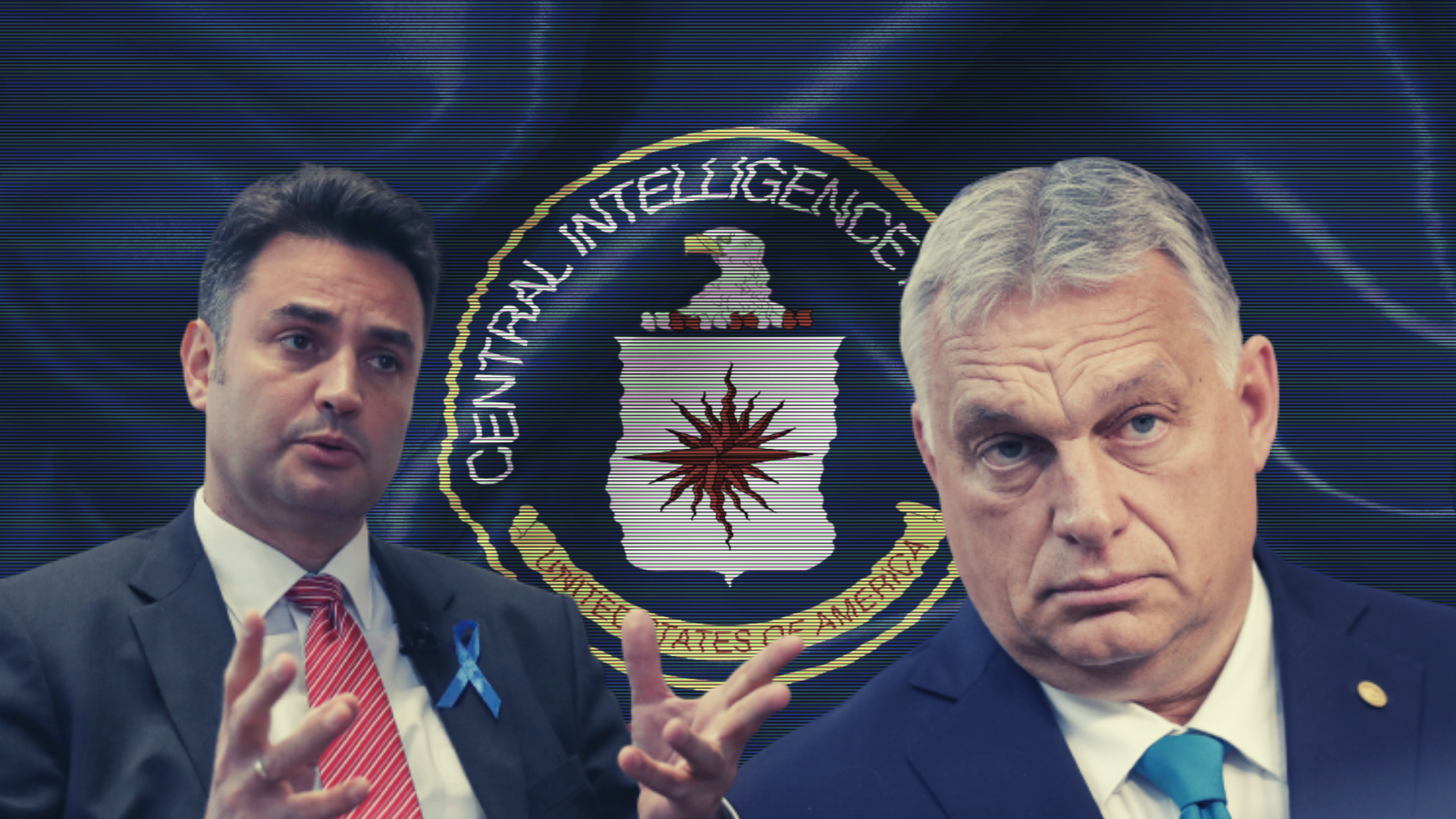
    The liberal politician remarked that there is still hope for the far-right to far-left opposition coalition to sweep into victory in the April parliamentary election, since they (i.e. the current conservative government) are “pounded by Brussels” and, according to Bruck, it is still a possibility that the FBI or the CIA could step into the elections against the current government.

    “Trump is not America. Let’s say the FBI or the CIA is America in situations like this, we don’t know,” speculated the advisor. “In neighboring countries, however, they were doing it at a pretty good pace. My suspicion, but I know nothing about it, is that they are watching, and if the opposition is strong enough, they will step in. They will publish information that will make unhappy whoever is in power. They, in my opinion, know a lot about this; the question is, will they make it public or not?” theorized Bruck.

    One could state with a reasonable amount of confidence that reputable intelligence agencies as the ones quoted above will not share any information with characters such as Bruck precisely because people like him have a precedent of attention-seeking that often leads them to disclosing confidential information in radio or television studios.

    Furthermore, despite the currently ongoing fundamental confusion about the global role of the United States in the White House, the superpower’s intelligence agencies are, broadly speaking, manned with top-tier professionals who, if given a choice, will not seek the advice of politicians like Bruck. He was a member of the now-defunct liberal SDS party that, while in government until 2010, was widely perceived by Hungarians as a party that had been involved in industrial-scale corruption and kleptocracy, especially with their infrastructure and property dealings in the capital Budapest.

    Bruck’s outburst is an indicator of the delusional state of the liberal opposition who, lacking the conviction and professionalism needed to create a winning election formula, are delighting in the fact that Brussels, i.e. the European Union’s institutions, is doing the dirty job of undermining a democratic government on their behalf, and weaving fantasy theories about some CIA operators dropping pre-election bombshells on Budapest, which could swing the vote in their favor.

    It is not that U.S. intelligence agencies are not active globally even within democracies, nor that they do not exceed their democratic remit with their surveillance work, as we have learned in the phone tapping scandal involving Angela Merkel. In fact, the recent Bulgarian election — which swept Kiril Petkov to power with a party founded only two months prior to the elections — has the fingerprints of the U.S. State Department’s helping hand all over it. But the U.S. and indeed the EU’s power brokers know that Hungary is not a banana republic; Orbán is not Noriega and, crucially, the Hungarian electorate is exceptionally resistant against hybrid-warfare methods employed by the NGO and media networks financed by U.S. oligarch George Soros. While in Czechia, the so-called “Pandora papers” artificial scandal revealed just one week before the elections may have cost prime minister, Andrej Babis, his post, the same hybrid warfare method employed in Hungary as the “Pegasus spyware” story did not even make a dent in the popularity of the Orbán government.

    Bruck is an influential figure among the top tier of the Hungarian left-wing opposition, his opinion cannot be simply dismissed as the ramblings of a private citizen. Yet it is all the more damning that since his radio interview no opposition figure has distanced themselves from his views. According to the latest polls, the current government is leading with a comfortable seven-point margin; if elections were to be held today they would still gain a two-thirds majority in the parliament.

    Signs are that the incumbent government has the formula to winning elections, and it does not consist of dreaming up a victory through foreign intervention.

  • Hungary’s top court gives green light to child protection law referendum

    Hungary’s top court gives green light to child protection law referendum

    Through the child protection act introduced by Viktor Orbán’s government, there are now tougher penalties for child-abuse and radical LGBTQ propaganda is banned from schools, kindergartens and television programs meant for kids. Since the law was introduced, it has been a subject to vicious attacks from Hungary’s left-wing opposition, from EU institutions and gender activist NGOs.

    Despite the pushback from the left, Hungary’s government has deemed the legislation necessary, pointing to the radical gender activists who have begun targeting Hungary’s educational institutions with “sensitizing” programs without the consent of parents, which is the same agenda already seen in the Western European and U.S. school system As a result, the Hungarian government proposed a referendum regarding the legislation, where every citizen will have the chance to express their opinion, which could lead to either the withdrawal of the law in case of a negative outcome, or in the opposite case, its democratic legitimization.

    Drag queen story hours have made their way into public libraries and schools all the way from Sweden to the United States, in which drag queens or trans individuals read children storybooks, sometimes on controversial subjects.

    However, instead of welcoming the opportunity for the child protection act’s reversal via a referendum, the opponents of the law had attacked the decision at Hungary’s Constitutional Court. It is rather telling that the person or persons who have attacked the referendum wished to remain anonymous, which most probably means that the initiative can be traced back to Hungary’s left-wing opposition, rather than to radical NGOs which revel in publicity and controversy. The petitioner’s objection was that the questions put to voters during the proposed referendum have not been properly legally examined.

    Viktor Orbán’s government knows the child protection legislation is popular with the general public, which may be why they are tying the success of a referendum on the issue to their reelection chances in April of this year. (John Thys, Pool Photo via AP)

    The questions the government of Viktor Orbán had proposed for the referendum are as follows:

    • Do you support the holding of sexual orientation lessons for minor children in public education without parental consent?

    • Do you support the promotion of gender reassignment treatments for minors?

    • Do you support the unrestricted introduction of sexual media content to minors that affects their development?

    • Do you support the display of gender-sensitive media content to minors?

    Despite efforts by clandestine groups to stop the referendum, the Hungarian Constitutional Court has given the go ahead, dismissing the objections brought against it. Many are questioning why there is such fierce opposition to the referendum, especially from those who routinely claim Hungary is no democracy, given that a referendum represents perhaps the purest form of democracy, and provides an opportunity for citizens to voice their opinions, especially regarding controversial issues.

    A participant poses with a rainbow flag during a gay pride parade in Budapest, Hungary, Saturday, July 24, 2021. (AP Photo/Anna Szilagyi)

    The problem for Hungary’s left-wing opposition is that in the present case, there is a tacit understanding that the government’s child-protection law has overwhelming public support. According to a recent opinion poll, 92 percent of Hungarians believe that pedophile crimes should get tougher sentences, and 60 percent believe that gender propaganda directed towards children should be restricted. Only 33 percent believe that previous legislation was sufficient in regulating LGBTQ education in schools.

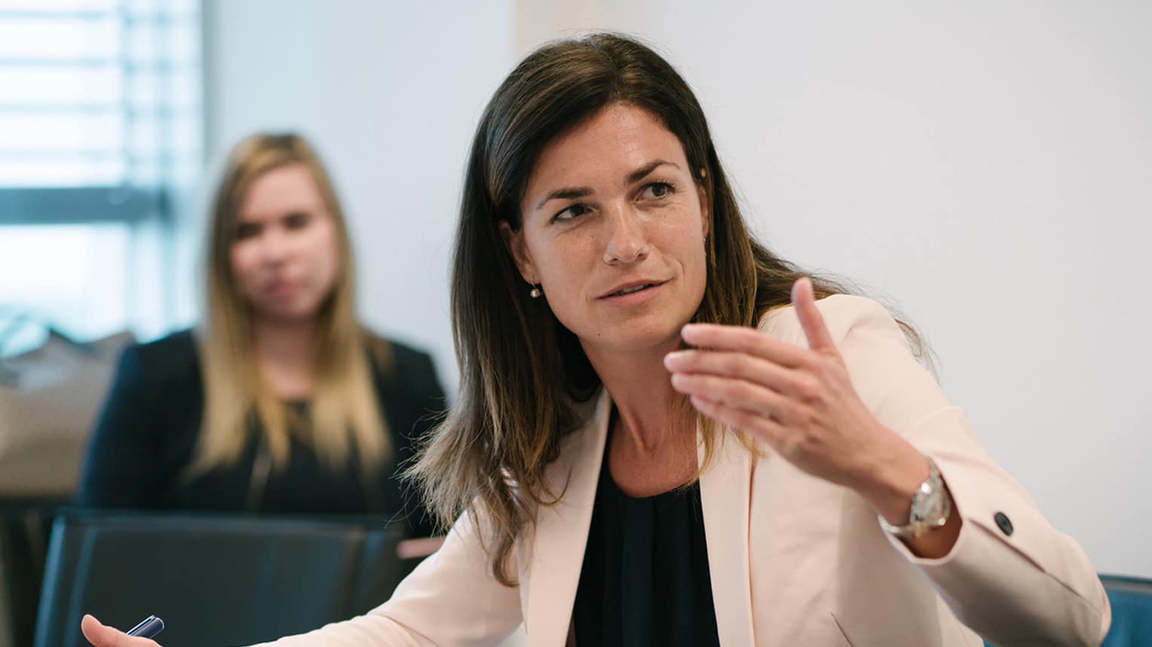
    Justice Minister Judit Varga has welcomed the court’s decision, saying “the Constitutional Court has decided: there is no obstacle to the child protection referendum! The Hungarian Constitutional Court found in its decision that the motions against the referendum are unfounded. Finally, the Hungarian people can directly express their opinion on child protection. Let’s protect families and parents’ rights!”

    A Hungarian conservative think-tank, The Center for Fundamental Rights (Alapjogokért Központ), has also released a statement, writing,

    “While the left, intoxicated by gender ideology, considers the referendum to be ‘stupidity,’ it has itself initiated referendums on two other issues… The Center has been raising awareness to the dangers of the insanity of questioning the difference between biological males and females for years, and of the rainbow propaganda that is increasingly targeting minors, trying to ‘sensitize’ them towards asexual fluidity and non-binary agendas in an open and coercive manner. In the West, political elites have virtually ‘formalized’ a mental illness called gender ideology without asking people.

    “However, in the child protection referendum, as in the case of migration, Hungarian citizens will be able to decide for themselves on important issues affecting their daily lives and the future of their children, such as the sexual education of children, the promotion of gender reassignment or media content.”

  • Egyptian national arrested for attempting to smuggle 30 illegal immigrants across the Austria-Hungary border

    Egyptian national arrested for attempting to smuggle 30 illegal immigrants across the Austria-Hungary border

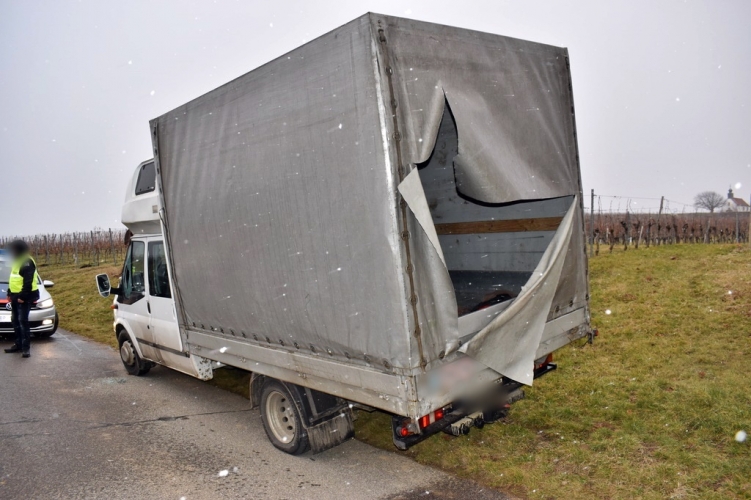
    Hungarian police officers had to resort to gunfire to stop a rogue truck attempting to smuggle thirty illegal immigrants out of the country via its border with Austria, a national police report confirmed.

    The incident occurred on Jan. 6 at 1:45pm (CEST) after border officials had initially stopped a Lithuanian-licensed vehicle which they had reason to believe had been acting as a forerunner for a people smuggling vehicle behind.

    Police units were called and shortly after sought to stop a van with Hungarian license plates from crossing the border in Harka, western Hungary using conventional police methods. However rather than stopping, the suspect vehicle accelerated, driving at speed towards one Hungarian officer who barely managed to jump out of the way.

    Consequently, a fellow patrol officer fired several shots at the van as it proceeded to cross the border into Austria. Despite evading the Hungarian police, the van broken down a few hundred meters into Austrian territory where the driver of Egyptian nationality was apprehended by local police.

    Following a search of the vehicle, thirty illegal immigrants of unknown nationality were found.

    Police confirmed there were no injuries as a result of the gunfire.

  • The culture of the European Christian White male is being eradicated. Who will step up to save it?

    The culture of the European Christian White male is being eradicated. Who will step up to save it?

    The year 2022 is the year of the tiger in the Chinese calendar. The tiger is a symbol of strength, courage, dignity, and perseverance, and there can be little doubt that these virtues may never have been as much needed as they will be in the year ahead of us.

    The recent war of identity between humanity, and in particular the war against the European Christian White man, will also come at a critical juncture. The artificially-generated chaos of gender identities is destroying the concept of family as a fundamental principle of humanity. With the help of artificially-fabricated false realities, they destroy the nation as the ultimate framework of moral and spiritual self-identity.

    And finally, with this, the last remnants of the sacred great culture of the European Christian White man are eliminated. For the “non-existent” lords of the world, “liquidation” seems to be becoming more and more urgent, and without a radical demographic turnaround in the 21st century, a very significant reduction in humanity, is likely.

    All this coincides with another historical turn in the global order of power, as the decline of the American Empire will reach its final stage within a decade or two, with its successor at the helm of the global power pecking order yet to reveal itself — one possibility which stands out as the next world empire of course is China.

    In order to prolong the agony of the American Empire, the U.S. continues to make every effort to weaken its three main rivals (European Union, Russia, and China) and disintegrate their relationship system to prevent the emergence of Eurasian cooperation, which poses its greatest threat.

    The intellectual and demographic suicide of the European Union and its leading force, Germany, seems a done deal. Its ruling elites are promoting the complete eradication of European cultural identity — the main guardians of identity have become its most zealous destroyers.

    The chances of turning back from this slope are not zero, but for the time being, the spiritual and moral energies that would provide a suitable basis for this are not visible. Although an initiative is emerging, mainly from Central Europe — the main aim of which is to create a pan-European political construct that would institutionalize the forces and energies capable and intent on facing the liquidation of Europe — a coherent narrative has not yet been established.

    Meanwhile, Hungary is looking ahead to crucial elections after 12 years of conservative rule. The corrective attempt since 2010 has brought hopeful changes whilst generating intense global conflicts of power, the consequences of which could even decide the fate of this year’s election.

    We will need all of our courage in the Year of the Tiger.

  • German paper: Bashing Poland and Hungary is ‘toxic’

    German paper: Bashing Poland and Hungary is ‘toxic’

    The more we speak about common values, the more the differences in defining them will become obvious, Lucia Puttrich writes in daily Frankfurter Allgemeine Zeitung.

    “This not only has to do with the behavior of the Polish and Hungarian governments, it is also becoming increasingly clear that the member states have a common set of values, but not a uniform definition of these values,” Puttrich writes.” The most recent attempts to unify these values ​​politically are leading the EU into a dead end in terms of integration policy.”

    Puttrich argues that Germany should therefore take care to calm this debate down as much as possible. Not only because there are reservations against excessive centralization tendencies also in Germany, but above all because these debates stand in the way of the further development of the EU as a whole.

    Hungary and Poland-bashing is “toxic”

    “The Poland and Hungary bashing of recent years did not correspond to the spirit of cooperation on an equal footing, but had a toxic effect on the internal cohesion of the EU,” the author writes. The younger member states in particular only achieved their freedom and full independence shortly before joining the EU. They also chose the path to the EU because they saw their sovereignty better protected against Russian aggression.

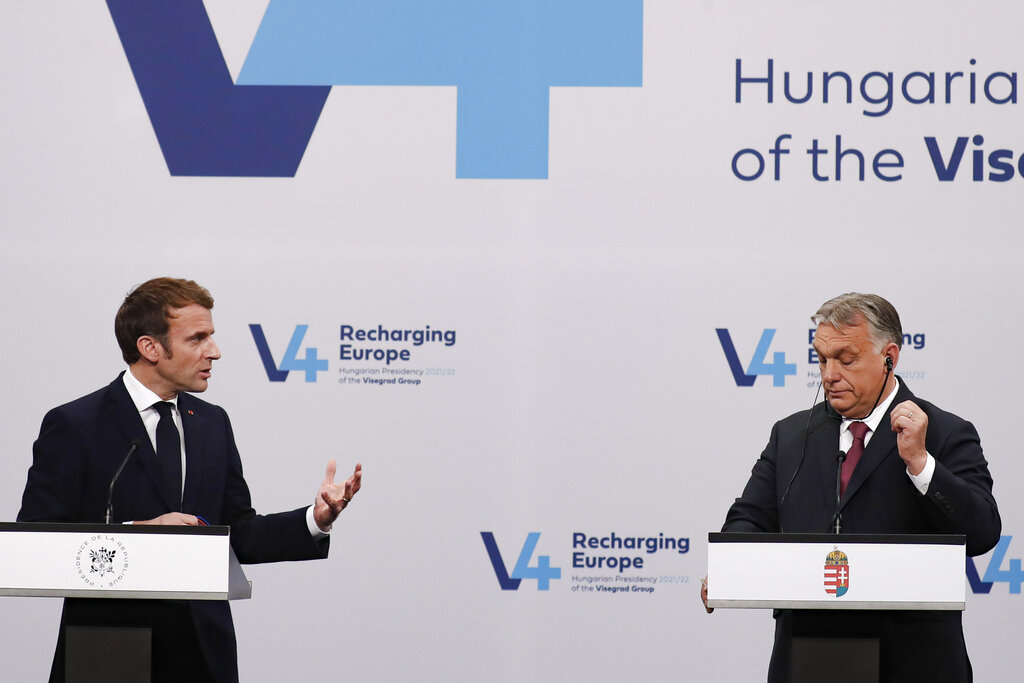
    Germany should therefore find its way back to the mediator position between East and West and between large and small member states, as Helmut Kohl once did. Friendly in tone and authoritative in the matter. French President Emmanuel Macron already seems to be taking this step and visited Hungarian Prime Minister Viktor Orbán.

    “Without the unity of all member states, further integration, and even deeper cooperation on the basis of the existing treaties, will fail. This unity can only succeed in diversity, in the acceptance of diversity,” Puttrich writes.

    “European unification was never designed as a merging of European identities and values, but rather as a cooperation between sovereign states for mutual benefit. Unity in diversity does not mean the standardization of diversity. The younger member states are reminding us of that. Sometimes louder, sometimes quieter.”

    The article in Frankfurter Allgemeine Zeitung follows another recent warning in Germany’s Der Freitag newspaper that the EU is acting with “arrogance” in its dealings with Poland and Hungary.

  • Germany isolated with its anti-nuclear climate hysteria

    Germany isolated with its anti-nuclear climate hysteria

    As 2021 drew to a close, there were fireworks across Europe in more ways than one, as a European Commission draft proposal revealing the bloc’s intention to classify some nuclear and natural gas energy as ‘green’ sparked anger in some member states.

    Whilst the majority of nations welcomed the proposals as pragmatic and realistic, understanding the need to embrace such energy resources for the foreseeable future, the left-wing Green ministers within Germany’s newly-appointed government exploded in indignation at the plans.

    German Economy and Climate Minister Robert Habeck addresses the media after the handover of the office at the Economy Ministry in Berlin, Wednesday Dec. 8, 2021. (Odd Andersen/Pool via AP)

    The Commission’s working paper makes it clear that these resources should be viewed only as a means for a smooth transition to future greener energy, stating: “It is necessary to recognize that the fossil gas and nuclear energy sectors can contribute to the decarbonization of the Union’s economy.”

    Under the plans, certain natural gas and nuclear power stations that meet the highest efficiency and environmental standards could receive a green label by the EU, and should the majority of EU member states agree to the plans, the proposal could be ratified into EU law by 2023.

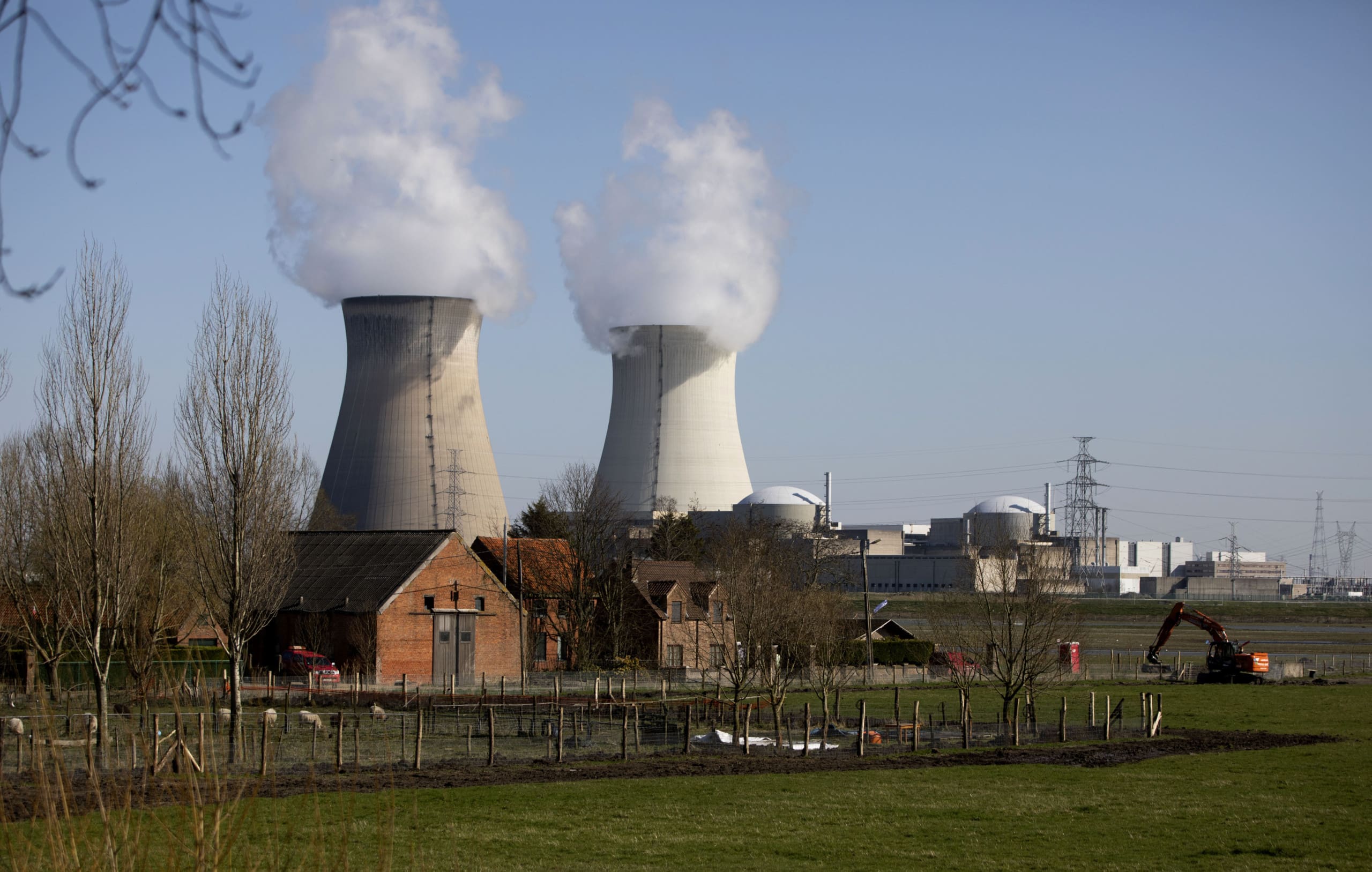
    FILE – The nuclear power station is seen in Gundremmingen,southern Germany, May 23, 2006. Germany on Friday, Dec. 31, 2021 is shutting down half of the six nuclear plants it still has in operation, a year before the country draws the final curtain on its decades-long use of atomic power. (AP Photo/Christof Stache, file)

    Rather unsurprisingly, Germany’s Greens are less than enthusiastic about the proposal, regarding it a betrayal of the EU’s green transition. The country’s Environment Minister Steffi Lemke declared it “absolutely wrong that the European Commission intends to include nuclear power in the EU taxonomy for sustainable economic activities,” and also expressed concerns over nuclear waste and possible nuclear disasters. Economy and Climate Protection Minister Robert Habeck added that the Commission’s plans would “water down the good label for sustainability” and called them “green-washing.”

    Just a month ago, similar statements from the now-retired Merkel government would have meant an almost certain death sentence for such plans, but the new government does not possess anything like the leverage and authority across Europe as its predecessor. To make matters worse for the Scholz government, the proposal had to a large extent originated from Germany’s arch rival, France, who relies on nuclear energy for 70 percent of its electricity, and is unlikely to pay much attention to the concerns of Germany’s radical left-wing politicians — not to mention the fact that three out of Germany’s nuclear power stations were decommissioned at the end of the year, making an energy U-turn for the nation highly problematic.

    Germany is also holding the Nord Stream 2 gas pipeline hostage to the praise of Polish politicians who view Russian fossil fuels as an instrument of hybrid warfare and political interference from Moscow. However, the blocking of the Russian gas pipeline comes amid exasperation from consumers who continue to see their energy bills skyrocket due to a shortage of heating fuels, and from governments who have supported the new routes for the Russian gas pipeline bypassing the politically-volatile Ukraine.

    FILE – German Chancellor Olaf Scholz delivers a speech during a meeting of the German federal parliament, Bundestag, at the Reichstag building in Berlin, Germany, on Dec. 15, 2021. Russia’s natural gas pipeline to Europe is built and ready to flow. But not so fast. The Nord Stream 2 pipeline faces a rocky road ahead. There’s also the statement by the U.S. secretary of state that gas won’t flow if Russia launches military aggression against Ukraine. (AP Photo/Michael Sohn, File)

    It is not surprising then that Balázs Orbán, the Hungarian state secretary for strategy, had welcomed the Commission’s proposal to “green list” some nuclear and natural gas generated energy. Commenting on the plans in a social media post, Orbán highlighted the fact that the Commission’s proposed green labeling scheme would open the door to new investment in the energy sector.

    Furthermore, Orbán pointed out that nuclear power plants should be considered sustainable if they can ensure that they do not cause significant damage to the environment, which includes the safe disposal of nuclear waste — this move follows a joint resolution of 10 member states in October, which emphasized the importance and legitimacy of nuclear energy.

    The main proponent of nuclear power is France, which currently holds the presidency of the European Council. “The V4 member states, including Hungary, whose four reactors produce 48 percent of the country’s electricity, have also played a significant role in recognizing that the nuclear sector can also contribute to the clean energy needed to decarbonize the EU economy,” Balázs Orbán explained.

    The Hungarian state secretary concluded by claiming the proposal would become a positive development in several respects, as embracing nuclear energy will not only make it possible to achieve climate neutrality, but will also play an important role in reducing high energy prices and in mitigating the EU’s energy dependence.

  • Norwegian aluminum group may move to Hungary from Slovakia

    Norwegian aluminum group may move to Hungary from Slovakia

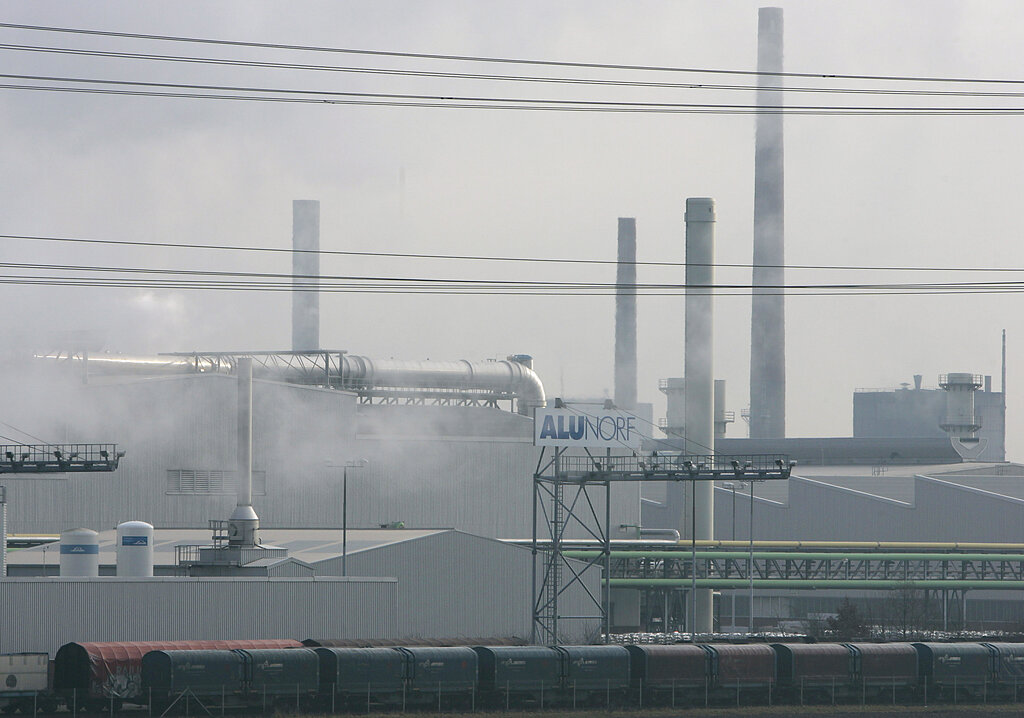
    Norsk Hydro, one of the world’s largest aluminum producers, may leave Slovakia in favor of Hungary, news portal Mandiner reports.

    The Slovak aluminum industry’s Norwegian subsidiary in the Slovakian town of Garamszentbenedek (Žiar nad Hronom) may soon stop production, unless the government yields to its demands for higher energy price subsidies.

    At the end of September, Norsk Hydro, the majority owner of the smelter, announced that if the Slovak government does not provide more help to compensate for the increased energy costs for energy-intensive plants, the plant in Kramszent will close by the end of 2022.

    Another co-owner of the plant, the Penta investment group, pointed out that the government had not given more aid to keep the plant running despite its promises. Slovak Economy Minister Richard Sulík said he still wants to fight for the factory, but “his options are limited.”

    Three months have passed since then, and it is increasingly likely that the plant employing 450 people directly and an additional 2,000 indirectly in the region will close.

    However, the Slovak public has expressed its displeasure that in addition to the possibility of closing the Slovak plant, the Norwegian group had announced a major investment in aluminum production in Hungary.

    An aluminum recycler is planned for Székesfehérvár in central Hungary, where the aluminum extracted from waste would be made into automotive components. The investment amounts to €88 million and will create 70 new jobs.

    No major investment has been made in Slovalco in Garamszentkereszt since a complete modernization of the plant in the 2000s. If the Norwegians withdrew from the aluminum plant in Garamszentkereszt, the minority Slovak investor group, Penta, would not be able to realistically operate it.

    Unless the company receives some kind of compensation, they can post massive losses at current energy prices. They say they will close the company at the end of next year when the electricity contracts, pre-purchased at one fifth of the current price, will run out.

  • PM Orbán: National and cultural identity is a human right

    PM Orbán: National and cultural identity is a human right

    In the latest edition of his so-called “Samizdat” series (a genre referring to literature banned during Communism, and circulated in secret), Hungarian Prime Minister Viktor Orbán reacts to the decision of the Hungarian Constitutional Court, in which it returns powers to the hands of the authorities to control or prevent the flow of illegal migration through their borders.

    Last year, the European Court of Justice ruled that the detention of migrants in so-called transit zones on the southern borders of Hungary was illegal, and it violated their human rights. Additionally, according to the court, the authorities are obliged to start asylum proceedings with each illegal entrant, instead of turning them back to safe countries that they arrived from.

    Orbán reiterates in his Samizdat that the meaning of the EU court’s decision is just precisely this: Hungary has to admit all migrants into the country who have been detained by its border guards while crossing illegally. This, he states, is contrary to his country’s Basic Law. For this reason, the government had asked the Constitutional Court to advise on the matter. In the prime minister’s interpretation, the court came back with three distinct decisions in the matter:

    1. It reaffirmed that the government must protect the country’s constitutional identity, even if this is contrary to the ruling of the European Court of Justice.

    2. It stated that if the shared competences between the EU and Hungary were not effectively exercised or enforced by the Union’s institutions, the Hungarian authorities could exercise them.

    3. It also stated that the relationship between migration and human dignity should also be examined from the point of view of the indigenous populations.

    Orbán calls this in his Samizdat a “decision of historical significance.”

    He believes the ruling of Hungary’s top court puts people and human dignity at its center, something now seldom seen in European court decisions. In the prime minister’s opinion, under the guise of protecting human dignity, international courts have followed the same path as the societies of a progressive Europe in general. The individual was torn from his or her natural national, linguistic, cultural, and religious communities, as well as from his or her families. These courts have denied that belonging to such communities is part of one’s self-identity and thus of human dignity in general. They deny that this identity deserves fundamental protection.

    “Today, there are only individuals who are people without qualities: they can live anywhere, they can speak any language, they can pray to any god,” wrote Orbán.

    In the Hungarian prime minister’s assessment, traditional communities have become completely defenseless. Today, it is not only progressive politics that is against them, but also the law. Europeans have thus no right to decide who they want to live with in their own homelands — even if mass immigration leads to the disintegration of the traditional communities that underpin their individual identities.

    As a result, in the sense of fundamental rights, Europeans today have no right to their own homelands, their language, their culture, their family, and their God.

    The decision of the Hungarian Constitutional Court takes the opposite view. It restores the human rights system from head to toe. It confirms that the Hungarian state has a duty to prevent significant harm to citizens’ identity, even if this contradicts rulings by the European Court of Justice or if this were to develop as a consequence of the EU failing to exercise its competencies.

    The traditional social environment of those living in Hungary cannot change without democratic authority and state control, writes Orbán.

    “Home is only where people’s rights are upheld,” writes the prime minister. According to the Constitutional Court, Hungarians have the right to their own country, concludes the Samizdat.

  • EU predictably fails to resolve Europe’s energy crisis

    EU predictably fails to resolve Europe’s energy crisis

    The European Union’s final summit of the year had been poised to drag on long into the weekend, with a desperate EU diplomat already joking to Politico by Thursday evening that its correspondents should have brought their sleeping bags.

    The suggestion, however, proved to be unnecessary, as plans to discuss reform of the bloc’s energy market were cut short in the middle of the night, with EU leaders predictably failing to reach an agreement on how to address Europe’s soaring energy prices.

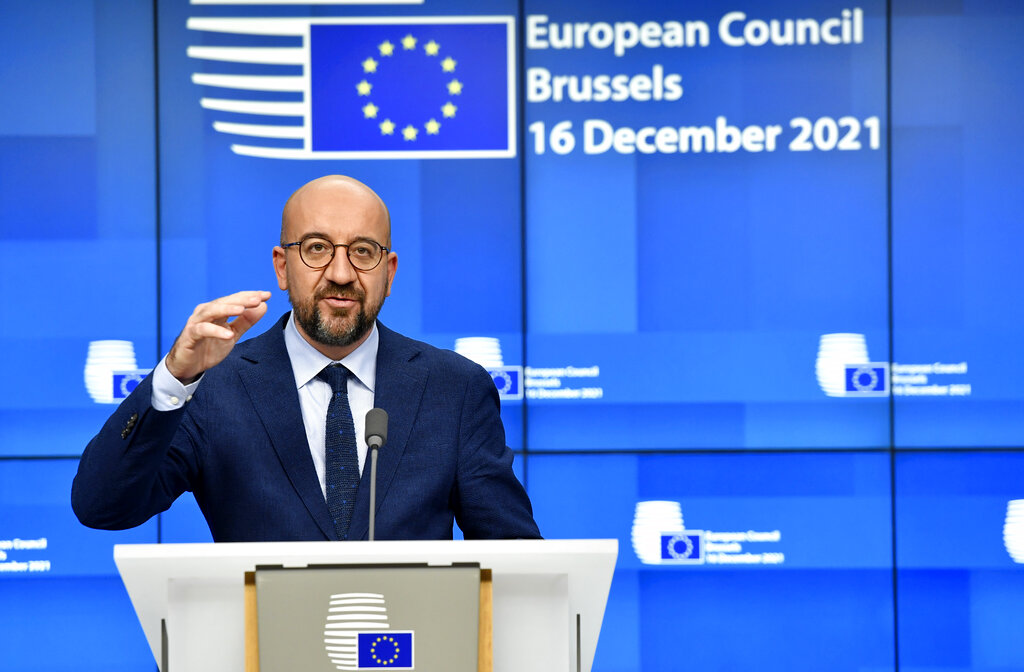
    President of the European Council Charles Michel even had to suspend the debate at one point on Thursday to give EU leaders the opportunity to address other key issues facing the bloc and ensure that the summit was at least somewhat productive.

    In the concluding press conference, Michel began his comments by offering tough talk on Russia, a futile attempt at drawing attention away from the bloc’s own failure to resolve the energy crisis. The European Council president vowed to crack down on Russia, threatening “massive consequences” if the nation escalated its military action against Ukraine. In doing so, the European Union failed to acknowledge its own impotence on the word political stage. In the case of Russia, it is not attempting to intimidate a third world nation desperate for EU development funds here, but a great power.

    It has been obvious for years that the European Union cannot even deal with the conflicts in its own back yard, of which this summit’s inability to resolve the energy crisis demonstrates, and yet the bloc persists with these empty threats to Russia.

    Putin must be quaking in his boots.

    The problem that must now be addressed is the skyrocketing cost of energy across Europe, with the price of natural gas and electricity rising to a multi-year high. All this is influenced by the combined effect of many factors, and the important lesson is that ensuring a secure energy supply has become a matter of sovereignty. Action is needed at a national level, by member states, and pragmatism is needed in Brussels.

    The goal of Hungary and its Visegrád partners at this summit was to defend the reduction in overheads, and they also made concrete proposals to deal with rising energy prices. As Secretary of State Balázs Orbán put it, “Brussels has driven the market into a price bubble with its flawed, poisonous green climate policy.”

    Commenting on the summit, Hungarian Prime Minister Viktor Orbán said in a Facebook video on Friday that the most important thing was the issue of energy prices and protecting Hungarians from the soaring cost: “The Czechs, the Poles, the Slovaks and we Hungarians insisted that the rise in energy prices, whether electricity or gas prices, should be curbed, speculators should be removed from the system and the results of the overhead reduction should be protected, and they should not be allowed to introduce another energy tax.”

    The Visegrád Group, rightly so, refuses to accept the approach that there is nothing to be done about high energy prices, as they are caused by external factors, and it is not such a major problem anyway. As long as the V4s nations fight the overhead in Brussels, as the debate on energy prices will continue at the next meeting next year, there are advocates in Hungary that it is not up to governments to take action to reduce the burden on families.

    A good example of this is Péter Márki-Zay, the current messianic candidate for the Hungarian left, who has embarked on a crusade against the reduction in overhead and even a number of widely-supported decisions beyond the Fidesz camp, such as the Child Protection Act and Fidesz’s strict immigration policy.

    So, as the Hungarian prime minister said in Brussels, “the battle continues,” on several fronts.

  • EU migration deal with African countries is ‘madness,’ says Hungary’s foreign minister

    EU migration deal with African countries is ‘madness,’ says Hungary’s foreign minister

    After a session of the EU Foreign Council in Brussels, Hungarian Foreign Minister Peter Szijjártó remarked while speaking to journalists that the European Union should not make agreements with Africa about how to transfer their citizens to Europe, but about how they can stay in Africa. The minister stated that according to the Hungarian position, Europe should help African countries to create the right conditions for their people to stay in their homelands.

    Szijjártó pointed out that, in contrast, the European Commission was negotiating with 79 African, Caribbean and Pacific countries on “a pro-migration agreement” under the so-called post-Cotonou agreement.

    Peter Szijjarto, Hungary’s minister of foreign affairs and trade, speaks during an interview with the Associated Press at United Nations headquarters, Thursday, Sept. 23, 2021, during the 76th Session of the U.N. General Assembly in New York. (AP Photo/John Minchillo)

    “It is unacceptable for us that Brussels is preparing to commit another madness. We consider this to be deeply against European interests, and we will continue to speak out against it in the future,” he said.

    Szijjártó stressed that Hungary has shown through example that such an agreement is not necessary at all, as it is possible to ensure the security, health and economic development of neighboring continents without allowing mass migration into Europe.

    The implementation of the post-Cotonou agreement, signed last year, has again come up during the Brussels meeting of EU foreign ministers. It is basically a smaller, European equivalent of the UN’s global compact for migration, that wants to create “safe and regular routes” for migration to the developed world. Similarly, the Cotonou agreement wants to speed up migration from Africa and the Caribbean, and instead of a largely spontaneous, self-propelling phenomenon, it aims to create a controlled mechanism that would help the mass settlement of third-world citizens in Europe. In an entirely unequivocal manner it lists “peace and security, migration and mobility” among its main priorities, or in other words, the organized and rapid altering of Europe’s demographic and political systems.

    Hungary’s Foreign Minister Peter Szijjarto, center, speaks with ministers as he arrives for a meeting of EU foreign ministers at the European Council building in Brussels on Monday, Dec. 13, 2021. European Union foreign ministers met Monday to discuss how to thwart the threat of a possible new Russian invasion of Ukraine and what measures to take should Moscow decide to send its troops across the border. (AP Photo/Virginia Mayo)

    Earlier this year, during a meeting with Disregard Four countries of Hungary, Poland, Czechia, and Slovakia along with the Turkish foreign secretary, Hungary’s foreign minister already pointed out the irony of Western politicians trying to justify the need of importing millions of unskilled workers into Europe when at the same time millions had lost their jobs during the pandemic across EU member states.

    Szijjártó called the plans unacceptable and vowed to oppose them with his Visegrád partners. Just like the UN’s Global Compact for Migration, the Cotonou agreement completely omits any concerns about the links between migration and social tensions, crime, terrorism, parallel societies, sexual violence and the rise of anti-Semitism.

    The EU’s pro-migrant agreement describes in exclusively positive terms the mass importation of people to Europe, many of whom have no knowledge or appreciation of European culture.

    In contrast, the Hungarian government for years has insisted that aid should be sent directly into regions of the world in need, and the transfer of masses of people into Europe is not the answer. Szijjártó pointed out that, for example, Hungary had sent troops to the EU mission in Mali, and that 80 Hungarian soldiers would also take part in the operation of the European forces supporting the Malian army in order to strengthen security in the region and reduce migration pressure.

    In addition, the government has launched a 45 billion forint emergency loan program in three African countries, mainly in the field of water management. Also, within the framework of the Hungary Helps program, it has implemented 60 projects using 4.5 billion forints, thus helping members of local, typically Christian communities, resist the type of pressure that typically forces people from their homes.

    The Hungary Helps program is designed to provide aid to those in need in their country of origin, with a special focus on highly-persecuted Christians.

    In addition, Hungary provided 1,400 scholarships to Hungarian universities in 25 African countries. He added: Hungary is also supporting the fight against the coronavirus epidemic on the continent, among other efforts, by providing 1.5 million doses of vaccines to six countries so far.

    In the meantime, the EU is working full-speed-ahead with implementing its plans for the mass importation of people from Africa.

    Earlier in December it accepted an action plan for 2021-2027 where, among other pro-migration measures, it calls for full housing for all migrants, legal or illegal, by the end of the period, and orders member states to treat migrants as their own citizens.

    In the midst of a pan-European housing crisis, where even key workers and young families cannot afford to buy their own homes, Brussels aims to put new arrivals at the front of the line. Tamás Menczer, Minister of State for Communication, reacted to these plans by saying that his government will reject these plans, and when it comes to assistance with housing, it will prioritize Hungarian families over migrants.

    He stressed that the phenomenon of migration should not be organized, instead, it should be stopped.

  • Hungary’s top court gives government wiggle room on immigration policy

    Hungary’s top court gives government wiggle room on immigration policy

    On Friday, Hungary’s Constitutional Court published its long-awaited decision concerning an unfavorable judgement from the European Court of Justice, which condemned Hungary’s treatment of illegal migrants and branded transit zones established on its southern borders unlawful and against European treaties.

    The European Commission sent an official notice to Hungary — within the framework of an infringement proceeding — where it claimed the Hungarian government’s provisions of the Fundamental Law on asylum violate the relevant regulations of the European Union. In reaction to this, the Hungarian Ministry of Justice then turned to the country’s Constitutional Court for interpretation.

    The Constitutional Court of Hungary’s new ruling has given the government some room to enforce the country’s immigration policies , but has not gone as far as the Polish courts in ruling that the national constitution has primacy over EU law.

    Regarding the status of foreign nationals illegally residing in the territory of Hungary, the Constitutional Court stated that if the joint exercises of competences between the European Union and Hungarian authorities remains incomplete, or is unenforceable, it “shall not limit the inalienable right of Hungary to determine its territorial unity, population, form of government and state structure.” The court’s judgement, however, adds that “the Constitutional Court has not been able to examine whether the exercise of joint jurisdiction is incomplete in the specific case.”

    The judgement must not be interpreted as a guidance on whether the Constitutional Court or EU treaties have the last word in some disputed matters, such as in the case of the Polish courts, where the Polish Constitutional Tribunal recognized the superiority of the Polish constitution over EU law for laws outside those contained in the founding treaties. On the other hand, Hungary’s highest court had decided that based on the interpretation of the European Clause of the constitution, if the exercise of joint competence with the Union is incomplete, Hungary is entitled to exercise the non-exclusive EU competence in accordance with the presumption of reserved sovereignty until the EU’s institutions succeed in creating the necessary conditions for the joint exercise of competences.

    The Constitutional Court also stated that if the incomplete exercise of joint competence leads to a violation of citizens’ right to self-identify, the Hungarian state is obliged to ensure the protection of this right. The Hungarian court also found that the protection of Hungary’s inalienable right to dispose of its territorial unity, population, constitutional form, and state system is part of its constitutional identity.

    The Hungarian court’s decision did not specify whether the Hungarian government’s claim that the European Court of Justice’s decision, according to which migrants would become de facto part of the population of the country if they were given all the social benefits and legal protections that citizens enjoy, was right or wrong either. In effect, the government is entitled and even obliged to protect the indigenous community of Hungary and the right to self-determination of its people, who could feel threatened by the influx of migrants that could change the ethnic make-up of their community.

    Prime Minister Viktor Orbán already stated on Friday that what matters to his government are the decisions of the Constitutional Court, because as members of the government and parliament, they have taken the oath to the Hungarian constitution. The Hungarian Helsinki Committee, which has interpreted the Hungarian court’s decision as a defeat for the government, concluded that the “inhumane treatment” of refugees must now come to an end on the basis of the court’s interpretation.

    Hungarian Justice Minister Judit Varga, however, reacted in a social media post by writing that “the Constitutional Court made it clear that we have the right to refuse to live with peoples other than with whom we have shared a common destiny for centuries. Migration endangers not only our sovereignty and self-identity, but may also harm our human rights and human dignity… The judgment of the Constitutional Court clarified that as long as the complete effectiveness of EU rules on migration is not ensured, Hungary has the right to exercise such competences. In order to effectively protect its borders, Hungary shall also be entitled to adjust its national rules to reality by adopting additional, individual measures. With this judgment, the Constitutional Court has built a strong legal barrier in addition to the physical closure of our borders. The debate also pointed to the inevitable need of reforming EU rules on migration.”

  • PM Orbán writes farewell to Merkel in German newspaper

    PM Orbán writes farewell to Merkel in German newspaper

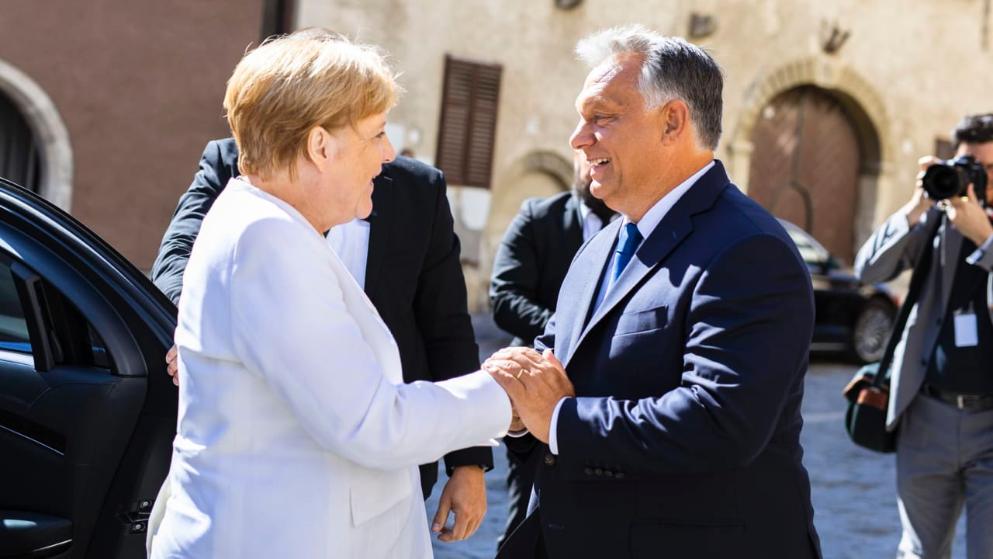
    On the day Social-Democrat politician Olaf Scholz was elected chancellor of Germany, Hungarian Prime Minister Viktor Orbán published a farewell article in tabloid Bild Zeitung, a farewell from Chancellor Merkel, after whose departure from politics Orbán becomes the longest-serving prime minister of the European Union.

    The article, entitled “The migration crisis of 2015 broke our unity”, is largely the same as Orbán’s Samizdat 14 one, published on the prime minister’s homepage a few days ago, in which he wrote:

    “The loyal and disciplined Germans, the rebellious and reckless Hungarians, stood together for a common goal: a Europe in which all nations can feel at home.

    And then the rupture, or rather fracture of the 2015 migratory invasion — the kind of injury from which an athlete’s movement will no longer be what it once was. He rehabilitates, he tries, he struggles, but more out of honor than anything else. He knows, and after a while he admits, he can’t get his old form back.”

    Orbán wrote that it is too early to tell whether Merkel’s stance on migration “opens the door to trouble.” He concluded that article with saying that “One thing is for sure: the era of ambiguity, stealth politics and drifting has ended with Merkel. The gloves are now off as we enter a new age.”

    The Bild Zeitung article has an additional two paragraphs at the end, which are a message to the future government of Germany, pointing out the basis of one thousand years of cooperation on which it is possible to build the future.

    “Our two peoples have a much closer emotional bond than others because they are the only ones who have never been at war for over 1,000 years. It was the Hungarians who knocked the first stone out of the Berlin Wall and thus laid the foundation stone for a free Europe in 1989,” Orbán wrote.

    “The development (of bilateral relations) under the future government in Germany will show whether different views are perceived as enrichment and mutual respect in a colorful Europe or seen as a burden.”

  • Blow to Hungary and Poland after top EU lawyer backs rule-of-law sanctions

    Blow to Hungary and Poland after top EU lawyer backs rule-of-law sanctions

    The European Court of Justice signaled yesterday that it is willing to open the door for punishing disobedient EU member states with financial sanctions in case they disobey the political dictates of the left and liberal parties currently dominating the union.

    Manuel Campos Sánchez-Bordona, the advocate general of the European Court of Justice of the European Union, published his legal advice on Thursday regarding the joint action brought by Hungary and Poland against the EU’s rule-of-law conditionality regulation. On the European Court of Justice’s Twitter page, he stated that “the actions brought by Hungary and Poland against the #RuleOfLaw conditionality mechanism of EU payments should be dismissed.”

    This means that, in his view, it is permissible for EU’s bodies to withhold recovery funds or EU subsidies from member states who are found to be in violation of EU treaties or fundamental values. The advice published by Sánchez-Bordona is in practice only an opinion, but at the same time it gives a directive that the EU court judges are advised to follow, and from which they rarely divert in their rulings.

    Roster of judges serving on the European Court of Justice as of 2019 (Source: European Court of Justice)

    The court’s final ruling is expected sometime next year, and it will form the basis for the European Commission’s decision to launch the conditionality mechanism against Hungary and Poland. In effect, that would lead to the direct withdrawal of EU funds from member states in case of political disagreements over rule-of-law issues and disputes regarding European treaties.

    At first sight, it seems completely justifiable to slap financial penalties on members of a club unwilling to conform to the rules of a group they are part of, but the present dispute between Hungary, Poland and the EU is arguably a political, ideological and cultural dispute wrapped in the cloak of European treaties, the interpretation of which is determined by the increasingly radicalized left that rules Brussels.

    In the current dispute, the dominant left has gone as far as dismissing the legitimacy of Poland’s Constitutional Tribunal, calling it “illegitimate, unfit to interpret the constitution.”

    Hungary, on the other hand, is being brought to task by liberal and green political groups for trying to strengthen its legal system in order to protect its children from sexual predators, and stopping LGBTQ lobby groups from expropriating children’s sexual education while preventing parents from having a say in the matter.

    Poland’s Prime Minister Mateusz Morawiecki, center, delivers his speech Tuesday, Oct. 19, 2021 at the European Parliament in Strasbourg, eastern France. The European Union’s top official locked horns Tuesday with Poland’s prime minister, arguing that a recent ruling from the country’s constitutional court challenging the supremacy of EU laws is a threat to the bloc’s foundations and won’t be left unanswered. (Ronald Wittek, Pool Photo via AP)

    With its ideological crusade against member states, the EU is now behaving exactly like a superstate that treats countries as provinces, and citizens like subjects obliged to follow dictates from Brussels. The sanctions for not complying with the direction set out by Brussels have so far been fairly toothless, but if next year the European Court of Justice were to rule against Hungary and Poland, giving the Commission the green light to introduce financial penalties against member states over political disputes, the situation would radically change.

    Given the power of balance in the European Parliament and Commission, where the ideological left and progressive parties are ruling unchallenged, this will mean that conservative national governments could be destabilized and made to look like pariah states whenever they will introduce conservative policies in line with the will of their voters. Vote conservative, and we will punish you with crippling financial penalties, is currently the message from Brussels.

    The European treaties have never been an obstacle when it comes to the Franco-German interests that are currently shaping the EU. As Hungarian Justice Minister Judit Varga wrote, “the opinion of the Advocate General ignores the fact that the conditionality regulation suffers from a manifest error in law, which alone would justify the annulment. Furthermore, its legal basis remains erroneous while it circumvents the Treaties and infringes basic rule of law requirements.”

    Polish Minister of Justice Zbigniew Ziobro also pointed out that the meddling by Brussels is “encouraging Polish judges to anarchy and is creating judicial chaos, which strikes at the safety of citizens.”

    The leader of the Polish junior coalition partners, Zbigniew Ziobro, speaks to reporters alongside in Warsaw, Poland, Saturday, Sept. 26, 2020. .(AP Photo/Czarek Sokolowski)

    The new European superstate is now without a doubt behaving like an imperial power that refuses to take no for an answer, even though national parliaments have the democratic legitimacy established by the votes of the electorate that European institutions clearly lack.

    The ideological golden calves that define Brussels — such as environmental fundamentalism, LGBTQ rights, the vision of open society created through mass migration, and the replacement of the continent’s indigenous population — are what shapes every other decision the EU bureaucracy makes. Keeping their hands on the EU funds will make their influence on what type of governments are allowed to be elected in members state direct and irreversible.

    The only chance Europe now has to reverse the dictate of the Brussels radical left is for citizens to elect national governments that will oppose the colonial plans that are suffocating European nations.

  • Our freedom is in the hands of Poles and Hungarians

    Our freedom is in the hands of Poles and Hungarians

    Social Democrat Peter Struck, then German defense minister, said in 2002, “Germany’s security is being defended at the Hindu Kush today.” In retrospect, we must acknowledge he was right. For 20 years, NATO’s operation in Afghanistan has protected us from the problems we have been facing up close since the shameful summer troop withdrawal.

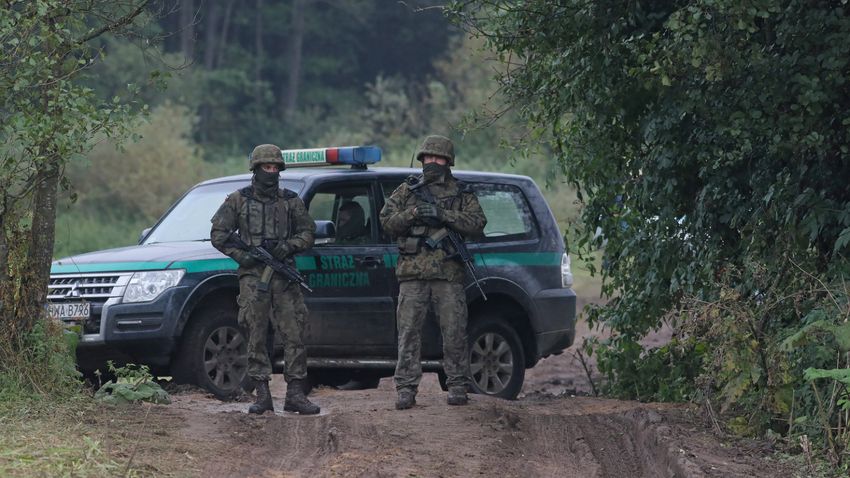
    The EU’s external borders are now been besieged at Poland, Lithuania and Latvia.

    Therefore, all three countries switched to the border protection model utilized by Hungary to protect the European Union in 2015. No thanks came from the EU then or now. On the contrary, the Central and Eastern European states that joined the EU in 2004 are being rebuked for their protectionist measures stemming from their accession obligations to the EU’s external borders, while glorifying Western non-governmental organizations (NGOs) which act as people smugglers in the Mediterranean through their efforts to bring migrants into the EU.

    This lie, which increasingly defines the EU, must fail, and it is to be hoped that Poles, Hungarians and other Central and Eastern Europeans will be able to bring about this failure.

    I am sending a message to the German Greens who are against securing borders and the uncontrolled influx of predominantly young people: It is about individual honesty after all, isn’t it? I took my share of this back in 2015, when I offered my parents’ small apartment, which is not being used, to the regional housing office to accommodate immigrants. In addition to four greetings in German, English, Arabic and Urdu, I also posted the text of the German Constitution in the living room.

    The European Union’s raison d’être is based on the combined economic, social and security benefits of its equal members. Failure to fulfill these basic conditions will quickly lead to a perilous situation. It is possible that if Peter Struck were alive today, he would say: “The security of Germany and the European Union is ensured today at the EU’s external borders in Central and Eastern Europe.”

    I would add here that Brussels must settle the bill for the necessary border protection instruments for those member states which were only performing a task for the common European community.

  • Hungary assures Poland of full support during Belarus-engineered migration crisis

    Hungary assures Poland of full support during Belarus-engineered migration crisis

    Minister Judit Varga openly assured “Polish friends” of Hungary’s full solidarity and support when it came to the migration crisis caused by Belarus on the Polish-Belarusian border.

    “We are connected by a common fate because geography and history located us on the EU’s external borders,” she said. Varga recalled that both Poland and Hungary decided to protect the European community against increasingly severe waves of migration.

    “This is why we, Hungarians, also believe that the time has come for Brussels to share at least half of the cost of the Polish and Hungarian border fences. That would be fair,” she said.

    The Hungarian justice minister emphasized that Hungary supports Poland’s belief that the EU should not support any state which has “direct or indirect association” with migration pressure on the Polish border and therefore the EU’s external border.

    “European decision-makers should finally admit that by protecting the Polish border, not only Poland but the entire EU is protected from illegal migration,” she said.

    Minister Judit Varga:

    It is time for the European Commission to admit that the defense of the EU’s external borders is an undeniable expression of European solidarity.

    Varga pointed out that the current system entails that everyone must be ensured a right to enter the territory of an EU member state without having to check the background of a person applying for asylum prior to them receiving permission to enter. She warned that this meant that no trace would be left of the applicant before EU authorities made their decision, as that person could be anywhere in the EU due to the Schengen zone freedom of movement.

    Varga emphasized that a border fence also prevents secondary migration by barring entry to the EU of migrants of unknown origin.

    The Hungarian justice minister also pointed out that, in 2015, Hungary decided to finance the construction of a border fence meant to protect Europe from crowds of illegal migrants.

    “Back then, we heard only words of condemnation from everyone. Six years later, we can see, however, that the border fence is being supported even by those who previously attacked us the most aggressively. It is time for the European Commission to admit that the defense of the EU’s external borders is an undeniable expression of European solidarity. The efforts of member states in this direction deserve recognition and support,” she said, adding that Hungary has spent EUR 1.6 billion on border protection so far, while Brussels has offered to cover a scant 1 percent of that cost.

    “The time has come for Brussels to appropriately contribute to our efforts and spending,” Varga declared.

  • Europe under ‘unprecedented’ migration pressure

    Europe under ‘unprecedented’ migration pressure

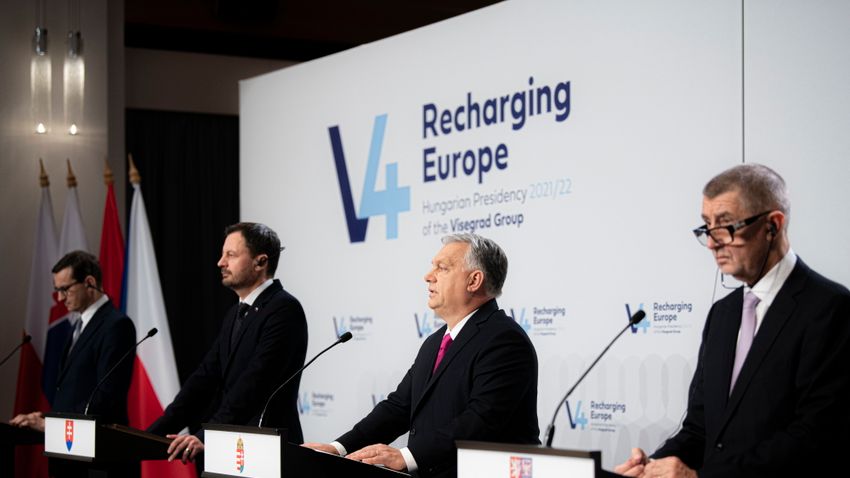
    The European Union has never been under such migratory pressure from three directions at once, which is a huge challenge for the whole EU, Hungarian Prime Minister iktor Orbán said at the Budapest summit of the Visegrád Heads of State (V4) on Tuesday.

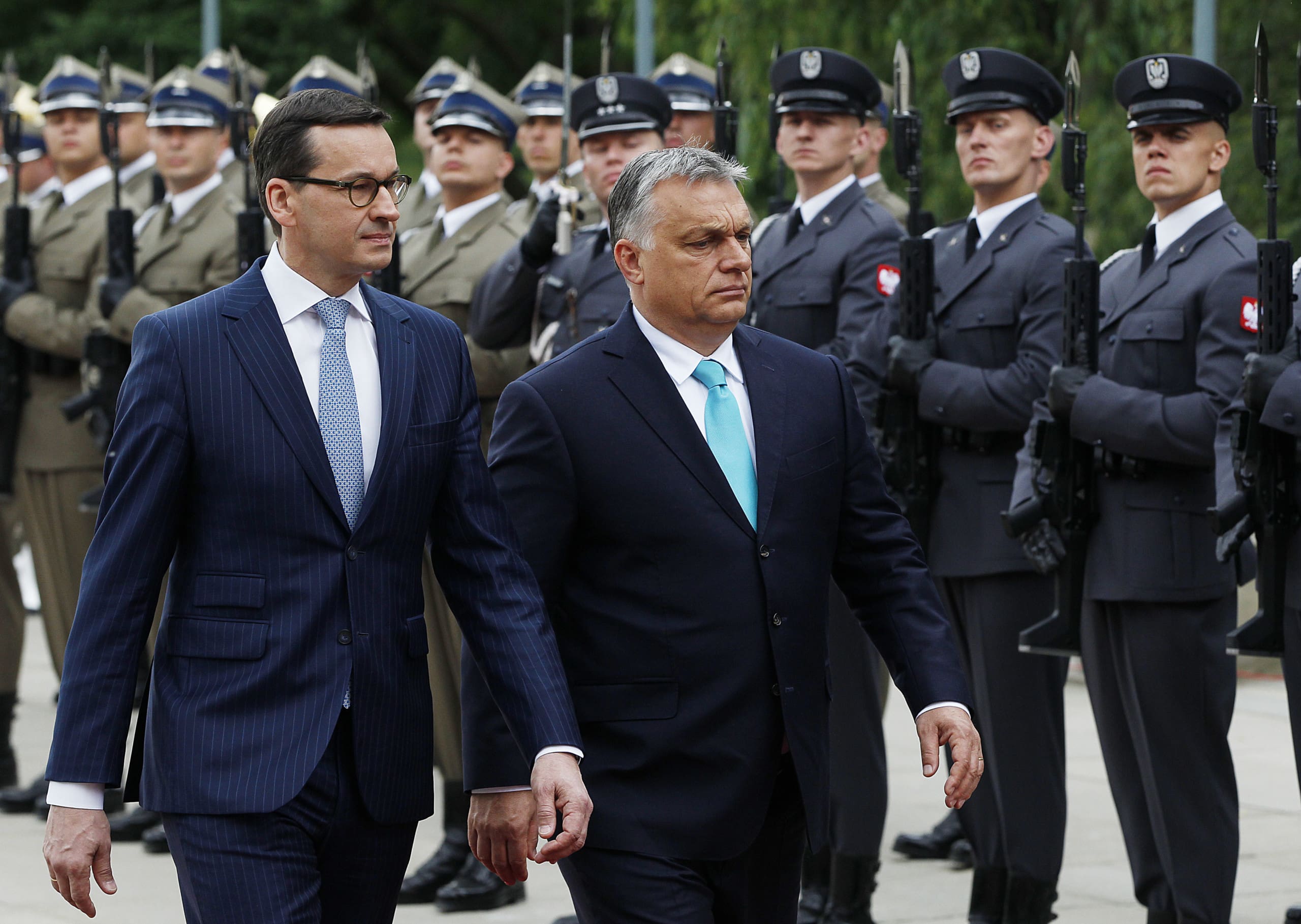
    Orbán, Eduard Heger and Andrej Babiš assured Poland of their solidarity over the migration situation on its eastern border. According to Polish Prime Minister Mateusz Morawiecki, the term “migration crisis” does far too little to describe the situation.

    The meeting of V4 leaders was convened at Poland’s request.

    “The Union is under pressure from three directions. The influx from the sub-Saharan region is steady. NGO ships are constantly transporting migrants to European shores via the sea, and the route in the Western Balkans is full again,” Orbán said.

    He thanked outgoing Czech Prime Minister Andrej Babiš and “our Czech friends” for sending border guards to the Hungarian border, who have arrested more than 4,000 illegal immigrants at the southern borders of Hungary. Orbán said that those leaving Afghanistan will also be coming to the Balkan route, where so far 100,000 illegal migrants have been stopped at the Hungarian border this year.

    “Thirty thousand to 35,000 people leave Afghanistan every day and the European Union must expect pressure on the Balkan route to increase,” said the Hungarian prime minister. He said now there is a third direction, “another attack that the Poles are suffering, our Polish friends are under attack because of the migration to the east.”

    “Brussels has a flawed policy, funding virtually everything that increases migratory pressures. It supports NGOs, it advertises integration programs. It doesn’t give money for one thing: to physically protect the border,” Orbán said.

    The Hungarian position is still that the EU must pay the costs of European border protection. The financial burden of this cannot be borne solely by the countries that have been put “by geography and history at the external borders of the European Union.” The Hungarian prime minister said that Hungary had always recommended a fair agreement to the Union:

    “It would be fair if we Hungarians at least halved the costs, half of the costs are borne by us, but the other half should be given by Brussels, given that we are defending not only ourselves but the whole of Europe,” Orbán said.

  • Will Czechia’s new government abandon Hungary and Poland?

    Will Czechia’s new government abandon Hungary and Poland?

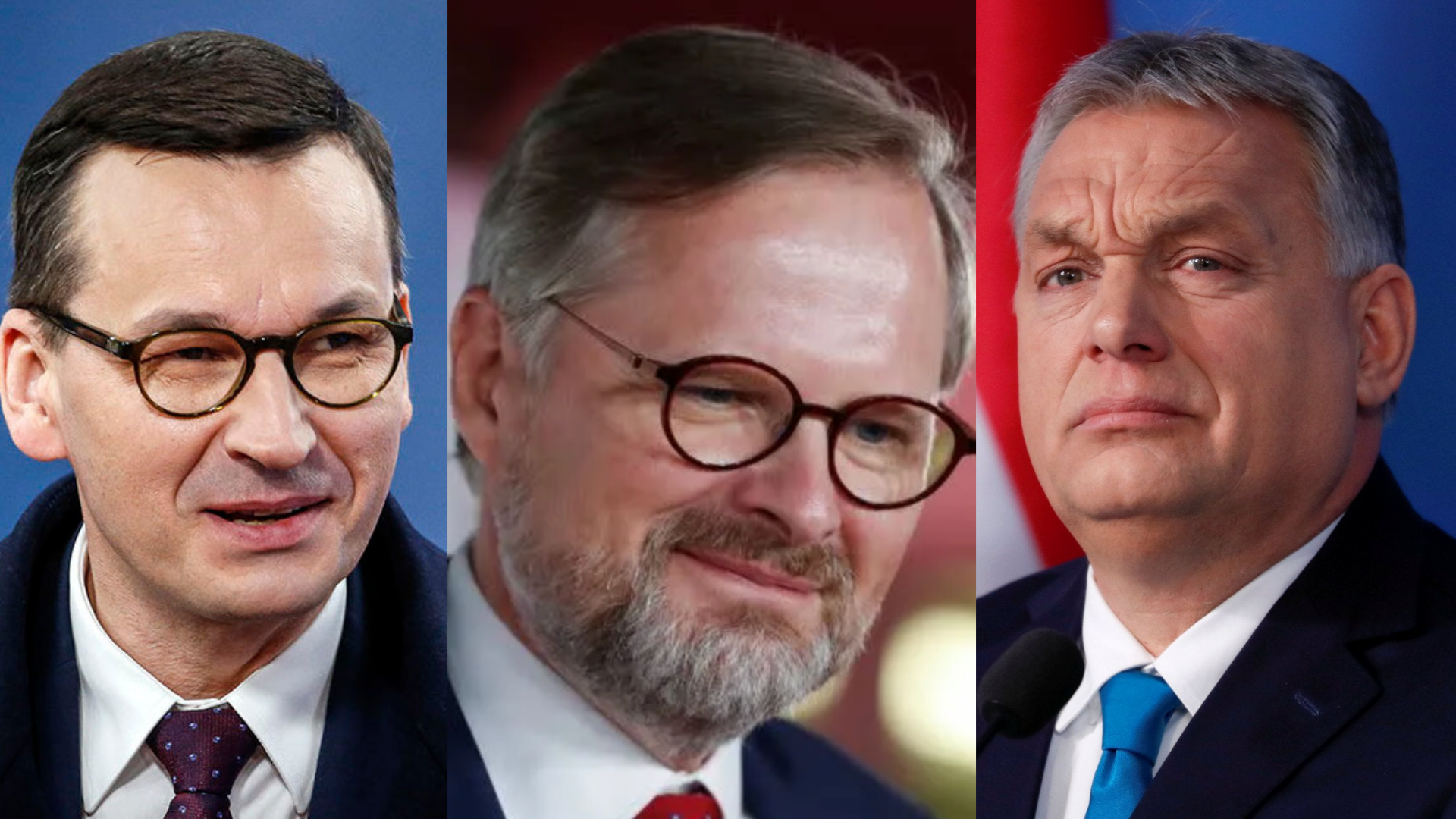
    During the years that Czech Prime Minister Andrej Babiš held office, the Visegrád Four (V4) countries have presented a mostly unified front against the political expansion of the European super-state, with only reluctant Slovakia occasionally lagging behind in its enthusiasm for regional interests over orders from Brussels. The governments in Prague and Budapest were very close in their interpretation of migration policies, family values and a resistance to progressive ideologies from the West.

    Prime ministers Babiš and Viktor Orbán even considered each other to be friends.

    From left, Slovakian Prime Minister Peter Pellegrini, Czech Republic’s Prime Minister Andrej Babis, Polish Prime Minister Mateusz Morawiecki, and Hungarian Prime Minister Viktor Orban wait for the arrival of European Council President Charles Michel prior to a meeting on the sidelines of an EU summit at the European Council building in Brussels, Friday, Feb. 21, 2020. In a second day of meetings EU leaders will continue to discuss the bloc’s budget to work out Europe’s spending plans for the next seven years. (Kenzo Tribouillard, Pool Photo via AP)

    However, there are clouds gathering over the bilateral relationship with the cabinet appointments of the new prime minister-elect, Petr Fiala, who has made some surprising choices for his government’s foreign and diplomatic representation. His choice for a minister of foreign affairs is Jan Lipavský, a member of the radical leftist protest movement Pirates (Piráti). Furthermore, he chose Mikuláš Bek for his minister for European affairs, a member of STAN, a party conceived by regional mayors and independent candidates whose only discernible common political goal is “localism,” but as members of the European People’s Party, they draw their policies both from the left as well as the right.

    Surprisingly, it is the STAN candidate, Mikuláš Bek, who has already managed to cause some concern with statements that do not bode well for the Visegrád Four cooperation.

    In an interview for the Czech news portal aktualne.cz, Bek said that in his view the “V4 alliance is overrated.” He was of the opinion that “our colleagues from Poland and Hungary only wanted our support in their ideological conflicts with Brussels. We had more useful debates with the Austrians and Germans. I will not bet on the V4,” said the new Czech candidate for the minister of European Affairs. With this strong opinion, Bek is not only raising eyebrows in the capitals of their regional allies, but also with his other coalition partners, since the recently signed coalition agreement states that “The cooperation within the V4 group will be a part of our relationships on all levels.” To this point, Bek only added: “I will want to speak with the prime minister about this.”

    Mikuláš Bek, a harsh critic of the V4 alliance, is slated to become minister of European affairs in Czechia.

    As to Bek’s ideological background, it is perhaps relevant to mention that before the end of the Communist regime in Czechoslovakia, in 1988, Bek applied for a membership in the Czech Communist Party. The only reason he did not join it was the fall of the Iron Curtain in 1989, as the Communist Party fell apart before it had the chance to process Bek’s membership request.

    Another candidate who could make the cooperation within the V4 fairly difficult, and whose appointment was almost universally criticized by the Czech media both from the left and the right, is the foreign minister elect Jan Lipavský, a member of the Pirates party, a strongly progressive left-wing political movement. Lipavský, however, when pressed about his views concerning regional cooperation between Poland and Czechia, formulated his view more carefully than Bek.

    In an interview for the news portal echo24.cz, Lipavský stated that he is for the preservation of every country’s right to protect its own borders against migratory pressures, but at the same time everyone should also respect international agreements concerning border protection. Up until that point, his view is largely in line with the current position of the V4. Yet, when asked about the rule of law proceedings against Hungary, he emphasized that the EU is also a “cultural alliance,” an opinion that implies that member states should somehow conform to the ideological and cultural mainstream prevalent in Brussels.

    Lipavský was less ambiguous when asked about his views on Poland. He clearly stated that in the current dispute between Poland and the EU over whether a member state’s constitution, or the EU’s treaties have the primacy in legal disputes, Lipavský said that without a doubt, it is the EU that should have the last word. About the Turow coa lmine conflict, in which the Czech government won an important EU court legal battle over Poland, Lipavský pledged to keep the policies of the outgoing Czech government, and to defend the interests of the Czech population living in the polluted areas around the coal mine, even if it means continued tensions with Warsaw.

    Cars drive slowly to block a border between Czech Republic and Poland near the Turow mine near Bogatynia, Poland, Tuesday, May 25, 2021. People in their cars protested against the decision of the European Union’s top court on Friday, that ordered Poland to immediately stop extracting brown coal at the Turow mine near the border with the Czech Republic and Germany. (AP Photo/Petr David Josek)

    Whether the appointment of two V4-skeptics into foreign policy positions is a genuine Europhiliac enthusiasm, or political inexperience from the incumbent Prime Minister Petr Fiala, will no doubt be revealed in the coming months. On the other hand, however much the opportunity to divide the V4 alliance in Brussels will be welcomed, in time Fiala will no doubt be made to understand that this is not enough to buy Brussels’ unreserved good-will. This can only be achieved through complete conformity to the two defining political goals of the EU elite: open societies, i.e. the unconditional and unlimited opening of one’s societies to non-European migration, and second, to the adoption of anti-nuclear family and gender policies that are ravaging Western societies.

    Selling out Orbán and Morawiecki will not be enough for Fiala to be allowed into the inner-sanctum of Brussels. The question is, will he be able to go this far, or will he be forced to seek the support of his neighbors and regional allies when these progressive idelogica demands inevitably land on his desk?

  • EU gears up for sanctions against Hungary, Poland

    EU gears up for sanctions against Hungary, Poland

    The European Commission sent on Friday one letter each to the Hungarian and Polish governments gearing up for the launch of the rule-of-law mechanism, Politico writes. According to the news outlet’s information, the letter to Hungary raises concerns about public procurement and corruption risks, whie Poles are being targeted over judicial reform and “respect for EU law.”

    The letter to Budapest and Warsaw was signed by Gert-Jan Koopman, the commission’s director-general for budget with the approval of Commission President Ursula von der Leyen. According to the Brussels press, the letters can be considered as the first informal step before Brussels formally activates the rule-of-law mechanism against Hungary and Warsaw.

    The sanctions for breaching rule of law is the new instrument in the hands of Brussels, which, following heated debates, entered into force on Jan. 1, linking the execution of payments from EU budgets to respecting the conditions dictated by the rule of law in Brussels. Although there are legal experts and commentators who claimed that the rule-of-law mechanism is not legal and that Poland and Hungary never signed any agreement that would allow its use, Brussels appears to be moving ahead with sanctions.

    Unsurprisingly, due to the politicized nature of the legislation, Hungary and Poland argued against a mechanism that threatened to withdraw EU funds from the outset, and both Budapest and Warsaw even vetoed the EU framework budget and rescue fund, as it was known that the legislation was just another weapon in the hands of liberal-dominated Brussels institutions in an ideological war against national governments.

    At the EU summit last December, a resolution was finally adopted on a Hungarian-Polish-German proposal, which, among other things, provides an opportunity to challenge the rule-of-law mechanism in court. Budapest and Warsaw took this opportunity, and in March they jointly filed an action against the rule-of-law mechanism to the European Court of Justice.

    The hearing of the Hungarian-Polish action began in Luxembourg in mid-October, and the Advocate General’s opinion is expected to be delivered on Dec. 2, and the judgment is expected early next year. According to a high-level agreement reached unanimously last December, the European Commission will not apply the rule-of-law mechanism until the Luxembourg judgment is delivered.

  • After EU court rejects ‘Stop Soros’ law, what comes next?

    After EU court rejects ‘Stop Soros’ law, what comes next?

    As Remix News reported earlier, the European Court of Justice (ECJ) has ruled against a 2018 Hungarian legislation nicknamed the ‘Stop Soros’ package which penalized aiding illegal migration. The law was drafted after the peak of the migrant invasion of Europe, during which millions of economic migrants and asylum seekers flooded the EU’s member states, generously aided by NGOs and political lobby groups financially supported by U.S. billionaire oligarch George Soros.

    The law addressed the social responsibility of organizations promoting illegal migration, it imposed an obligation to register organizations that promote mass migration, as well as to support people who commit illegal border crossings and do not receive asylum protection.

    FILE – In this Sept. 22, 2015 file photo hungarian soldiers work on a fence that is being built at the border with Croatia, near the village of Beremend, Hungary. The Hungarian government has submitted to parliament Constitutional amendments and a new draft law further tightening the country’s laws on refugees and asylum-seekers. The legislation submitted Tuesday, which complements draft bills presented earlier this year by Prime Minister Viktor Orban’s Cabinet, seeks to prevent Hungary “from becoming an immigrant country.” (AP Photo/Petr David Josek, file)

    According to the bill, an organization supporting migration must notify the courts of any donations from abroad, and this report will be made public. An additional obligation of any organization supporting migration is to provide the National Tax and Customs Board with information on the persons and organizations that have received such financial benefits, as well as the amount of these donations. The bill also sets out the legal consequences of non-compliance. The Immigration Financing Act imposes an obligation on organizations supporting migration to pay a levy, the rate of which is 25 percent of the donations. If the organization supporting migration fails to pay the fee, the state tax authority may impose a fine equal to twice the unpaid fee.

    However, according to the European Court of Justice, Hungary failed to fulfill its obligations by allowing refugee applications for international protection to be rejected as inadmissible due simply to the fact that the applicant entered its territory through a state where there is no risk of persecution, such as Serbia.

    FILE – In this Oct. 5, 2015 file photo, a man walks by the European Court of Justice in Luxembourg. The European Court of Justice said in a statement issued Tuesday Nov. 12, 2019, that “foodstuffs originating in the territories occupied by the State of Israel must bear the indication of their territory of origin.” with special labels indicating that provenance. (AP Photo/Geert Vanden Wijngaert, FILE)

    The EU directive lists various situations in which member states may consider an application for international protection inadmissible. However, according to the court, the ground of inadmissibility accepted in the Hungarian legislation does not correspond to any of these situations. In addition, according to the EU court, the country has failed to fulfill its obligations by imposing criminal sanctions under its domestic law on the conduct of any person who assists in organizing or submitting an asylum application in its territory if there is any reasonable doubt.

    Infringement proceedings against a member state for failure to fulfill its obligations under EU law may be initiated by the European Commission. If the European Court of Justice finds that there has been a failure to fulfill obligations, the member state concerned must comply with the judgment as soon as possible. And if the European Commission finds that a member state has not complied with the judgment, it can take another action or impose financial sanctions.

    The Hungarian government had promised to comply with the law but pledged to continue its struggle against international NGOs financing and supporting illegal migration, many or most of whom are supported by Soros’ Open Society Funds.

    Government spokesman Zoltán Kovács said in his reaction to the European Court of Justice’s decision that the Hungarian government maintains its position, according to which help should be brought to people in need, and not the other way around. Migrants heading towards Europe should be stopped and the future of Europe must be based on families, instead of imported populations, he added.

    He reminded the European Commission and the plaintiffs of the court case against Hungary that Hungarian citizens were petitioned about issues concerning mass migration in a number of referendums, and they have clearly voted for measures designed to stop the uncontrolled flow of foreigners. The Hungarian “Stop Soros” legislation therefore had a strong democratic mandate, and was an expression of the will of the citizens. Kovács concluded by saying that, “Whilst there is a national government in Hungary, it will act on the will of Hungarian people and will stop attempts to transform Hungary into another migrant country.”

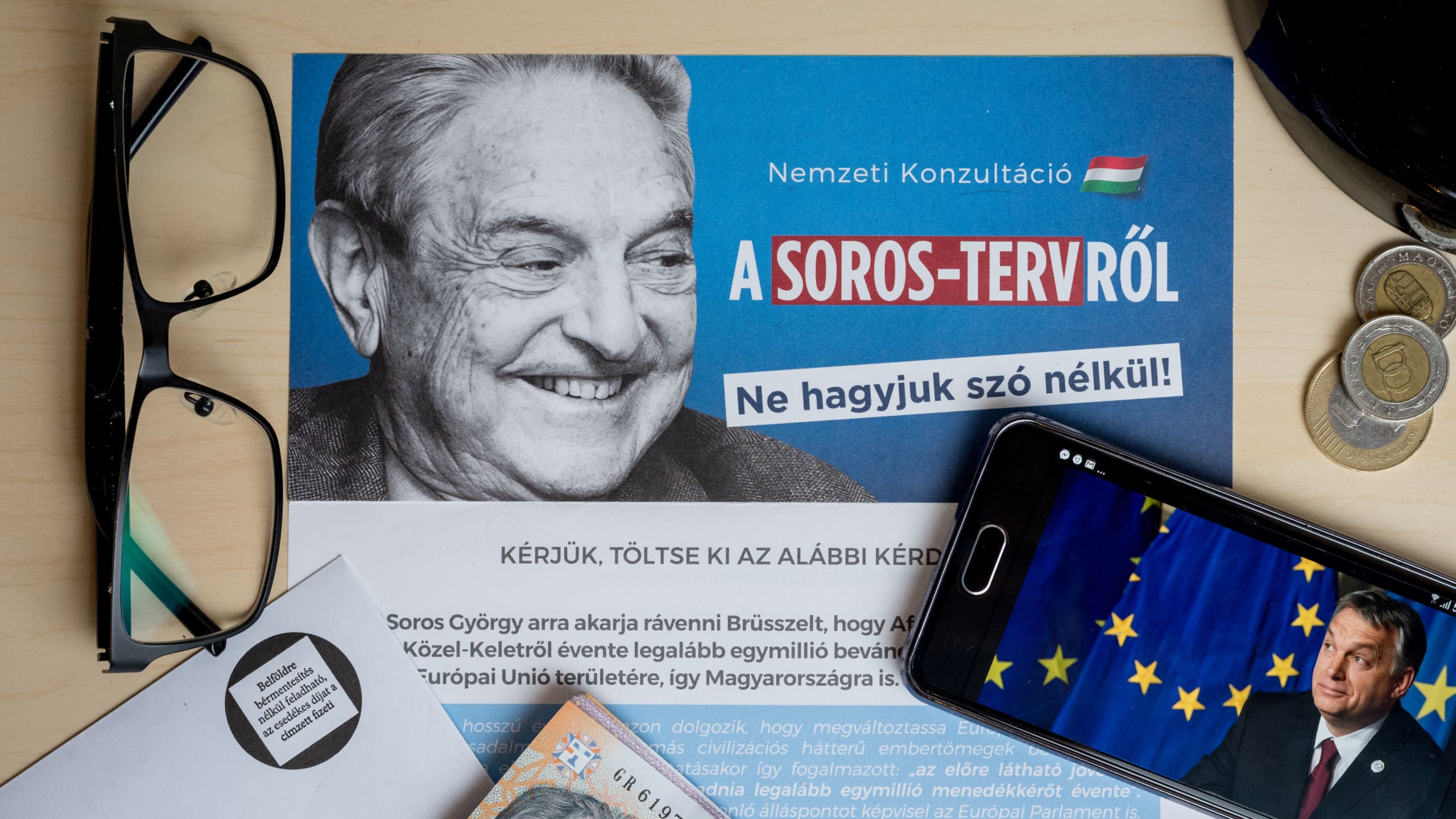
    People stand on a street by a billboard from Prime Minister Viktor Orban’s Fidesz party reads “Let’s stop Soros’ candidates!” showing American financier George Soros, center, and, from left, Bernadett Szel of Politics Can Be Different party, Ferenc Gyurcsany from Democratic Coalition, Gergely Karacsony of the Dialogue party and Gabor Vona of the Jobbik party, in Budapest, Hungary, Saturday, April 7, 2018. (AP Photo/Darko Vojinovic)

    The left-wing media and international human rights NGOs based in Hungary have triumphantly celebrated the European Court of Justice’s decision, all despite the overwhelming support for the anti-migration measures expressed by the Hungarian people in referendums.

    Official records show that between 98 percent to 99 percent of those who cast their votes in the national consultations supported the Hungarian government’s measures for more transparency and accountability around internationally-funded, pro-migration NGOs. This fact did not stop the affected pro-migrations NGOs, chief among them the Open Society Funds-financed Amnesty International, to claim that the EU court’s ruling is a clear win for democracy. On their website, Amnesty, who have in recent years abandoned any pretense of political neutrality, wrote, “We are very pleased with the decision of the ECJ. We have been working on repealing this shameful law since it was passed, so it’s good to see that the European Union does not tolerate the Hungarian government’s intimidating campaign against those who, unlike the government, are serious about human rights.”

    The most likely outcome of the ruling will be a partial amendment of the law by the Hungarian government, which in turn will result in more complaints from the European Commission and the affected NGOs.

    In the coming months, there will be a lot of wrangling about the interpretation of the ruling, and it is more likely than not that the European Court of Justice will impose fines on the Hungarian government for non-compliance with the ruling.

    The government of Viktor Orbán had, however, in the past showed a good amount of flexibility and creativity in implementing rulings of the European institutions or those outside the EU but whose decisions are binding for the government. Yet one thing is certain, the April 2022 Hungarian parliamentary elections are approaching, and the European Court of Justice decision will, if anything, strengthen the Orbán government’s image as an anti-migration political force that plays well with Hungarian voters.

    On the other hand, it will also confirm the opinion of those who see the European Commission, and the European Court of Justice — despite their declared intention to manage migration — as instruments of the Soros network’s open borders and open society utopia.

  • Polish MEP: Poland was right once again, this time concerning migrants

    Polish MEP: Poland was right once again, this time concerning migrants

    “May you live in interesting times,” is a Chinese proverb which gains a special meaning today during the coronavirus pandemic, which started in China. Indeed, we live in interesting times, at least because the European Union is behaving like a child which is telling its mother that it won’t do something “just because,” and later is forced to change its opinion anyway because it clashes with reality.

    The EU has treated Poland, the Baltic states and in some cases other countries in our region as Russophobes who were exaggerating their “prejudices” towards Moscow. Years later, quietly at first and then increasingly louder, they admitted that we were right.

    The case was similar when it came to migrants. The EU and several Western, Northern and Southern European member states admitted that Central Europe was right, but did so very quietly. After all, if they had admitted loudly, then they would have to strongly apologize towards their own voters to whom they have been lying to for decades about the necessity to accept migrants.

    It is now known that Poland and Hungary were right on the topic of migrants and not France, the Benelux, Germany, or even the UK.

    Now, the situation has repeated itself once more in the context of the border wall between Poland and Belarus. Poles want to build one, but the EU first opposed the notion, then declared that there were no funds to support such a project and finally announced a symbolic sum to be included in the 2022 budget. Spain was allowed to build such walls in its enclaves in Maghreb, but Poland was not to be given that same permission?

    The feeling of once again being proven right is encouraging but also annoying in the long-term. Those who for years refused to admit that Poland was right, and who continue to refuse, are still unable to fully admit to their mistakes and are unable to suffer the consequences of their errors, omissions, or poorly conducted policy.

    Meanwhile the unfortunate ranking of the countries with the highest numbers of coronavirus infections has changed: India has dropped out of the top and the UK has swapped places with the U.S. in the top three (the UK is now second with 36,500 daily cases and the U.S. is third with 24,000). For the first time since the start of the pandemic, Russia, a country neighboring Poland, has become the leader in the ranking.

    The current situation on the Polish-Belarusian border is slightly drawing attention away from what is a permanent threat, which is the pandemic. What’s worse, we are beginning to experience a cumulative effect that could quickly produce a serious crisis.

  • Hungary could see increase in migration through Ukraine

    Hungary could see increase in migration through Ukraine

    As the Baltic states and now Poland are quickly ramping up their defenses on their border with Belarus, the migrants stuck there will have to resort to alternative routes, including going through Hungary, security policy expert László Földi told daily Magyar Hírlap.

    “In any case, the situation will continue to escalate, as it is already more complicated than a border situation, the current migration is in fact an invasion. And Lukashenko wants to put the Union at the negotiating table. Poles, on the other hand, will not allow migrants under any circumstances,” said Földi, who is the retired former director of operation of Hungary’s foreign intelligence agency.

    Belarus borders three European Union member states: Latvia, Lithuania and Poland (from north to south) while its southern neighbor, Ukraine borders Poland, Slovakia, Hungary and Romania.

    Asked by the newspaper whether the migrant flow will make its way through Ukraine and Hungary, as other routes are blocked, Földi said that is a likely scenario.

    “This is also included in the scenario, such a provocation is conceivable before the Hungarian elections in the spring. It is possible that they would want to trigger a domestic political crisis in Hungary with such a step,” Földi said.

    He added that the EU should step up its efforts to find a negotiated solution to the crisis that has already gone beyond Cold War levels.

    “The current situation is beyond the form of a Cold War,” he said, “Further escalation should be avoided by all means, with the parties focusing on the agreement rather than new sanctions.”

    As we previously reported, in a recent interview with another Hungarian paper, Földi said that although the crisis is intensifying, Europe remains divided by internal strife.

    “Another issue is that instead of European countries taking over the protection of Europe, internal tensions are being exacerbated and created where they have not been before, such as Russia-Poland, Poland-Belarus, and Belarus-Russia,” Földi said, adding that the conflict is partly generated by forces who want to dismantle European nation states.

  • Hungary: PM Orbán reelected as ruling party leader at Fidesz Congress

    Hungary: PM Orbán reelected as ruling party leader at Fidesz Congress


    “It’s not the bread that is small, it’s your mouth that is too big,” is the communist-era joke that Viktor Orbán told his audience during his party’s 29th National Executive Congress, where he was reelected as Fidesz’s leader. The joke was a reference to what Orbán says is the approach of the country’s opposition to solving problems.

    In his speech to party members, the Hungarian prime minister said that since the existence of Fidesz, he has remained loyal to himself, loyal to Hungary and its people. In the last 33 years, more Hungarians have voted in favor of his party than for any other party in Hungary’s parliamentary history, he stressed. We are successful, he said, because what Fidesz does, it does it with passion.

    “We are aiming at the top and we want to get Hungary there,” he emphasized.

    Orbán stated that 16 years in opposition and 16 years in government can only be spent with unwavering optimism, trust and deep faith. He said there are three kinds of patriotism: the orator, the mourner, and the creator. He emphasized that he is a believer in creative patriotism and a productive life, and in his view this is what described the political community of Fidesz best.

    He explained that without clear goals, there is no successful government, no successful country, and no nation living in peace and happiness with itself. According to him, Fidesz has been an outspoken group of politicians for 12 years and have preserved their goals, which he summed up in ten points:

    1. To create one million jobs
    2. Not to be slaves to debt
    3. To restore public order and security
    4. To protect pensioners and the value of pensions
    5. To focus on families
    6. To restore Budapest’s old glory
    7. To save the banks sentenced to death by the socialists
    8. To improve the lives of the Roma community
    9. Keeping together Hungarian communities torn apart
    10. Hungary will not be a colony, they will not be subordinates in Brussels, but they will always stand up for the interests of the Hungarians

    He said that when his government came back to power in 2010, they inherited a bankrupt country from the socialists, recovered it and moved it forward.

    “This is our moral basis, and therefore we can ask for the confidence of the Hungarian electorate again with confidence and a good chance,” he pointed out.

    He said that the government’s most important ally is reality itself, but the left and the liberals do not share his passion for facts.

    “Our task is doing our job, theirs is being liberals,” he said. He added that the left cannot show any serious results for their efforts, but they are proud liberals whose only knowledge is to tell others how to live their lives and how to think.

    “We can become a developed country. We can also eradicate the remnants of poverty. We can be a country of people who are green, healthy, preserve their natural treasures and beauties, and live healthier and longer lives,” he said. Orbán said that only a few countries manage to be among the most developed, but there are some who have achieved that, so it is not impossible.

    “We here in Fidesz know exactly how to do it,” he said, listing tax cuts, investment, university development, research, innovation, greater respect for work and workers, rural development and even better government work. He pointed out that in the age of epidemics and migration, security is the most important issue in Hungary.

    Orbán reminded his audience that he is in a dispute with an international network in Brussels that wants to impose brutal taxes on people under the guise of climate protection, and that people’s financial security is at stake because they want families to pay for climate protection instead of large multinationals who are responsible for most pollution.

    The prime minister also said Brussels must be completely renewed before it falls to pieces out of its own momentum. He described an EU that is stumbling from crisis to crisis, a “rainbow-colored shadow of itself,” and if it goes on like this, it will disappear like “the moon during a lunar cycle.” That is why Fidesz supports the Polish initiative to reorganize the entire European right into a new political bloc, emphasized Orbán.

    Hungary’s prime minister added that he wants sovereignty for Hungarians, but also aims for European unity instead of further integration. He explained that Hungary joined the EU because integration with the EU was explained to them as a beneficial thing. Yet, in his interpretation, integration means doing things together and only doing them in a friendly and collaborative way. We have agreed, said Orbán, that only certain types and a limited number of things need to be decided at EU level, and everything else must remain a national competence.

    He also emphasized that the Hungarian government will not give up the right to border protection, nor the right to stop migrants, and his government will insist that “in Hungary, marriage requires a man and a woman, the father is a man, the mother is a woman, and our children are left alone.”

    Kinga Gál, member of the European Parliament, was also confirmed as the party’s vice president during the party’s congress.

  • What is Viktor Orbán up to in Bosnia?

    What is Viktor Orbán up to in Bosnia?

    As clouds gather over the small Balkan country of Bosnia and Herzegovina due to signs of strengthening separatist moods among its Serbian population, one regional politician seems to be undeterred in his effort to enter the powder keg and speak to all sides involved. Hungarian Prime Minister Viktor Orbán visited Banja Luka last week, which is the capital of the autonomous Serb enclave within the country, and met with Milorad Dodik, the Serbian member of Bosnia-Herzegovina’s presidential troika.

    The official visit to Banja Luka was met with predictable attacks from the international press and left-wing opposition figures in Hungary, accusing Orbán of maintaining relationships with a politician, “whose war criminal predecessors have committed genocide and caused a migrant crisis in Europe.”

    This image has an empty alt attribute; its file name is AP21288332584550-1024x675.jpg
    A man walks by graffiti that showing Serbian flags and soldiers in northern, Serb-dominated part of ethnically divided town of Mitrovica, Kosovo, Friday, Oct. 15, 2021. Tensions between Kosovo and Serbia resumed Wednesday after Kosovo police clashed with ethnic Serbs during an anti-smuggling operation. Kosovo, a Serbian province before it declared independence in 2008, was in a war in 1998-1999 between Serbian troops and ethnic Albanian separatists fighting for independence until a NATO air campaign pushed Serb forces away. (AP Photo/Darko Vojinovic)

    As to the charge of causing a migration crisis in Europe, the Western media seems to be exceptionally selective to the point of being cynical, when in the past few years millions of Asian and African migrants have entered the continent illegally, and are still doing so in their thousands due to the European Union’s open-door policy and unwillingness to confront the issue.

    As to the charge of talking to a successor of war criminals, Milorad Dodik has not been accused of any involvement in past or present war crimes, and is an elected official of the Serbian community in Bosnia. As such, he is acting on the wishes of the community that put him in power, making no secret of the fact that he would wish to gain independence from the rest of Bosnia.

    This image has an empty alt attribute; its file name is AP21266345046890-1024x683.jpg
    Bosnian Serb member of the tripartite Presidency of Bosnia Milorad Dodik holds a speech during the 4th Budapest Demographic Summit in Budapest, Hungary, Thursday, Sept. 23, 2021. The biannual demographic summit, which was first organized in 2015, offers a forum for “pro-family thinker” decision-makers, scientists, researchers, and church representatives of the same sort to exchange their thoughts about connections between demographics and sustainability. (AP Photo/Laszlo Balogh)

    Others accuse Orbán of playing into the hands of the Russians. Its no secret that in recent years Moscow has gained a political, and even military foothold in Serbia, and other Serb-inhabited enclaves in the Balkans. This fact though has way more to do with the EU’s failure to engage in the region effectively than with a Hungarian political presence. The EU has been promising to open talks with Serbia about the Balkan country’s membership in the bloc for years with no, or very little progress.

    In contrast, the Hungarian government has been without a doubt the most vocal international supporter of Serbia’s EU membership. Yet, it is no secret that due to some EU member states’ opposition to further enlargement, Serbia is gradually turning eastward where it can find more understanding for its historic grievances and future strategic goals. The EU is employing its well-rehearsed Hungarian boogeyman tactic when it comes to rising tensions in the Balkans, yet this is hard to see as anything else than an attempt to divert attention from its own lack of vision and political impotence.

    This image has an empty alt attribute; its file name is AP21288428237848-1024x700.jpg
    A Serbian flag waves in front of the statue of Serbian Duke Lazar who was killed at the Battle of Kosovo in June 1389, in northern, Serb-dominated part of ethnically divided town of Mitrovica, Kosovo, Friday, Oct. 15, 2021. (AP Photo/Darko Vojinovic)

    In fact, the Hungarian government had engaged with all sides in Bosnia, with Hungarian Foreign Minister Peter Szijjártó meeting Zoran Tegeltija, prime minister of Bosnia in July, and donating 200,000 Covid vaccines to the country. While UN-appointed peace envoy, German politician Christian Schmidt, warned last week that the Dayton peace agreement was in danger of crumbling and the Serb enclave could seek independence from the rest of Bosnia even with the use of force, Orbán had decided to employ the best and most tested method of deflating political tensions: commerce.

    On his visit, the Hungarian prime minister declared his intentions to “expand neighborhood and economic programs to the Republika Sprska, and to support small- and medium-sized enterprises in order to open new opportunities for Hungarian entrepreneurs.”

    This image has an empty alt attribute; its file name is AP21306563138046-1024x704.jpg
    In this Monday, Aug. 2, 2021 file photo, Christian Schmidt, new head of Bosnia’s Office of the High Representative, or OHR, speaks during a ceremony in the capital Sarajevo. The chief international representative in Bosnia has on Tuesday, Nov. 2 warned that the war-scarred Balkan state could face the biggest “existential threat of the post-war period” if Bosnian Serb separatist moves are not curbed by international community. In a report which he is scheduled to deliver to the UN Security Council this week, High Representative for Bosnia Christian Schmidt claimed that if Bosnian Serb leader Milorad Dodik carries out his separatist threats, including the withdrawal of Serb troops from the joint Bosnian army and the creation of a separate Serb force, “the prospects of further division and conflict are very real.”(AP Photo, file)

    Orbán is very aware of the fact that engaging in the region’s contentious political issues carries its own very real risks.

    “Hungarian history shows clearly the effect of the [Balkan] region’s events on our country,” said Orbán during a press meeting. Yet, the Hungarians have multiple reasons for keeping their Serbian neighbors on their side:

    1. First and foremost, the sizable Hungarian minority living in Serbia has been subjected to numerous political attacks since the fall of the Communist bloc in 1989, and Orbán aims to prevent this by maintaining cordial ties with current Serb President Aleksandar Vučić.
    2. Most illegal migrants enter Hungary via its southern borders from Serbia. The two countries have an agreement, according to which Hungarian authorities can return all illegals apprehended at the border to Serbia. The agreement seems to be holding up well, despite the fact that there are as many as 500 illegal crossings on a daily basis.
    3. Since ties with the EU bureaucracy have been strained ever since Hungary had closed its borders during the 2015 migrant invasion, the Orbán government has sought to diversify its economic and political alliances outside the EU with notable success. European officials might not like the fact that Hungarian and Russian interests seem to be joined in Serbian prosperity, but Brussels’ inaction and political shambles leaves no viable options for the Serbian leadership than to take what is on offer.

    Orbán will no doubt seize the opportunity to make the contrast between his active engagement and the EU’s passivity in the region politically visible. However, it remains a fact that the EU has little to no authority in its backyard (Dodik, just as the Russians, is refusing to accept the mandate of Christian Schmidt).

    Political actors in the region believe the EU has no vision and is distracted by its own petty ideological crusades while others gain influence in its traditional sphere of influence. According to observers, the independence of Republika Srpska from the rest of Bosnia is only a matter of time, and the real question is whether the process can be done peacefully, or armed conflict is inevitable. Brussels is recognized by all parties in the region only as a bearer of broken or unfulfilled promises. Russia, Hungary and to some extent the United States will have to take up the role of mediators between the warring parties in order to prevent a repeat of the tragic Balkans wars of the 1990s.

  • Avoid the fate of France, Le Pen warns Hungarians

    Avoid the fate of France, Le Pen warns Hungarians

    Hungarian Prime Minister Viktor Orbán has been right to warn of the dangers of migration, and Hungarians should beware of falling into the same trap that France did, National Rally leader Marine Le Pen told Mandiner in an interview.

    “(Viktor Orbán) is not exaggerating at all. Eighty-five percent of French want to stop migration. If I could give one piece of advice to the Hungarians: take a good look around the world at what is happening now, and be careful not to get to the fate of France,” she said.

    Polling shows that the overwhelming majority of French want a halt to immigration. A recent poll also showed that a majority of French are fearful of the Great Replacement, which posits that White Europeans are being displaced through mass immigration. Le Pen, who is running for president in France’s upcoming national election, has promised to hold a national referendum on the topic of halting immigration if she wins office.

    French far-right leader Marine le Pen, seen on a TV camera monitor speaks during a joint press conference with Hungarian Prime Minister Viktor Orban in Budapest, Hungary, Tuesday, Oct. 26, 2021. (AP Photo/Laszlo Balogh)

    Asked about the role Orbán plays in the emerging new right-wing coalition of parties, Le Pen said his contribution is fundamental.

    “Viktor Orbán’s role is essential: his thoughts, the momentum, the impulses he gave to the grouping, are decisive. Orbán was so brave that he could leave his party family, the large faction of the European People’s Party. I am very much looking forward to working together, I am looking forward to speeding up the process and making the voice of the sovereign nations stronger,” she said.

    Le Pen also said that her party seemed radical a few decades ago with its strong anti-immigration rhetoric, now by their views have been validated by the idea gaining traction and becoming mainstream.

    “If someone recognizes a phenomenon early on, but it is only confirmed later, he was still right, it was still correct. We saw the problem of immigration 20 to 30 years ago, and we articulated it — and in retrospect it turned out that our perception of reality was correct. What was then described as radicalism has now become a recognition for many nations,” Le Pen said.

    Speaking about the nascent right-wing coalition, whose core is formed by Hungary’s Fidesz, Italy’s League and Poland’s PiS, Le Pen said the group is growing at a good rate.

    “If we look at the situation, we can see that the cooperation is not so small anymore: the group has now grown into a significant force, as the triple core has become a formation of seven or eight parties. And there are others among the other small parties in the two EP groups who agree with our goals and are not ideologically an obstacle to joining us,” she said.

    Le Pen added that the prospects of a strong coalition of right-wing parties within the European Parliament is a positive development.

    “That is why I am optimistic that one day we will be able to build a large joint faction. The League, Law and Justice and Fidesz are the governing parties in their own countries, which gives them extra weight and, of course, they play a significant role in catalyzing the unification process.”

  • Hungary says EU should refrain from pressuring Poland

    Hungary says EU should refrain from pressuring Poland

    Hungarian Justice Minister Judit Varga denounced in a Facebook post the “unjustified and aggressive” decision of the European Court of Justice (ECJ) to withhold European Union funding to the country until it complies with the group’s perceived rule-of-law demands.

    “Enough of the pressure! The Court of Justice of the European Union today ruled that it is taking €1 million a day (!!!) from the Polish people at the initiative of the Commission because the government has not yet suspended the Disciplinary Chamber of the Supreme Court,” Varga wrote.

    “Polish Prime Minister Mateusz Morawiecki recently announced that the Disciplinary Chamber will be phased out by the end of the year, for which legislation is already being drafted. So, once again, the violent action of the EU institutions is disproportionate and unjustified,” she wrote.

    Brussels is beginning to exert extreme pressure on Poland over judicial reform, and EU institutions are moving towards issuing sanctions on both Hungary and Poland over a range of issues related to rule of law. Critics claim that the left-wing political majority in Brussels is looking to bring down conservative governments due to their support for immigration restriction, traditional values, and their opposition to an overly powerful centralized EU.

    “A few days ago, the European Parliament said that ‘the Polish Constitutional Court has no legal legitimacy’ and now the Court of Justice of the European Union is severely punishing the Polish people under pressure from the Commission,” Varga added.

    “We are saying it slowly, so that Brussels understands it too: leave Poland alone, enough of the political pressure!”

  • Le Pen says nationalism will defeat globalism in interview with Hungarian press

    Le Pen says nationalism will defeat globalism in interview with Hungarian press

    Despite a European Union placing enormous pressure on conservative-nationalist governments, Marine Le Pen, leader of the conservative National Rally (RN) said in an interview with Hungary’s Magyar Nemzet.

    When asked who will win in the struggle playing out between nationalists and globalists, Le Pen said, “The nations, the nation-states. Because there are many, and because they were born along the ideology of freedom, because no people will ever accept to lose their right to self-determination. They will never accept European citizenship, a policy that harms them, for example in terms of security, or that prevents them from prospering. I am convinced that, like all empires, the European empire will lose in this battle.”

    If elected president next year, Marine Le Pen, leader of the conservative National Rally (RN) would initiate a referendum on migration. The issue of migration remains perhaps the most contentious point of conflict between globalist and nationalist ideologies.

    “Immediately after my election, I would call a referendum on migration. This document has already been prepared. The extremely detailed text includes a bill that will contain the full set of tools for combating immigration, regulating immigration, and which we will want to include in the constitution. It is also important that it takes precedence over European documents,” Le Pen said in the interview.

    Asked about the European Commission’s fine imposed on Poland, Le Pen said it is both unjust and finally clearly shows the European Union’s intent of total control over member states.

    “I find the criticisms of Poland undignified. As I have already mentioned, the EU is increasingly showing its true face, which it cannot hide from the people: its goal is total control. This is not the benevolent structure it wanted to portray itself as in recent years. Now is the time for the paths of nations with a sovereignist position to meet and create a unity that can curb the spread of supranational ideology,” she said.

    Speaking about Western European criticism regarding Hungary’s child protection law, Le Pen said both Hungary’s consistent anti-immigration stance and its drive for sovereignty drew the ire of the West.

    “It was primarily the Hungarian migration policy that triggered the attack. These criticisms were made with the aim of trying to weaken the Hungarian government. Like me, Viktor Orbán does not like threats or pressure. Hungary has repeatedly lost its freedom, been occupied and humiliated. These historical experiences have given the country a great deal of courage to stand up for its own interests. France and Poland also stand up for their freedom. Poland has also come under fire for criticism after the Polish Constitutional Court ruled that Polish law took precedence over EU law on certain issues,” Le Pen said.

    Speaking about her own election chances, Le Pen said her conservative challenger, Eric Zemmour is unlikely to make it to the second of the Presidential elections.

    “I don’t think Éric Zemmour will get into the second round at all. I think in the second round I will be Emmanuel Macron’s challenger, although the election is still far away. In my own constituencies – especially young people and women – I see that they are not really interested in the campaign now, but they will certainly only activate themselves later. Therefore, current surveys do not show the true balance of power. I’m not worried.”

  • Croatian court convicts Hungarian CEO for bribery

    Croatian court convicts Hungarian CEO for bribery

    The Supreme Court in the Croatian capital of Zagreb sentenced former Croatian Prime Minister Ivo Sanader to six years, and CEO Zsolt Hernádi of Hungarian oil and gas group MOL to two years in prison in a bribery case, Euronews reported.

    On Monday, the Croatian 24sata.hr wrote that the Croatian Supreme Court had ruled in the MOL case and dismissed the two defendants’ appeals, upholding the previous verdict.

    Sanader has been sentenced to six years in prison for accepting a bribe of €10 million, and Zsolt Hernádi to two years in prison for bribery. The judgment is final. The two men were already convicted in 2019, but they appealed the verdict at the time.

    Hungary is not expected to extradite Zsolt Hernádi to Croatia

    The Hungarian Central Prosecutor’s Office ordered an investigation in 2011 and found that no crime had been committed on the part of MOL, and therefore terminated the investigation. In 2013, the Hungarian court then refused to execute its European arrest warrant issued against Zsolt Hernádi, issued by the Croatian prosecutor’s office.

    The Croatian Prosecutor’s Office against Corruption and Organized Crime indicted Zsolt Hernádi back in 2013 after their investigation revealed that MOL had taken control of the Croatian energy company INA in 2009 because Hernádi had paid off the then Croatian Prime Minister Ivo Sanader.

  • EU should first deal with its own breaches of law before denouncing Hungary and Poland, says Austrian MEP

    EU should first deal with its own breaches of law before denouncing Hungary and Poland, says Austrian MEP

    Instead of attacking Poland and Hungary, the European Union’s institutions should deal with their own breaches of the community’s rules, Austrian Freedom Party (FPÖ) MEP Roman Haider wrote in a Facebook post.

    “Instead of denouncing Poland and Hungary, the EU should deal with its own breaches of law!” Haider wrote in an image post.

    Hungary and Poland have come under intense pressure over the years regarding rule-of-law issues, but more recently the European Union has threatened to cut of EU funding over the issue in what would represent a dramatic escalation in the conflict. Recently, outgoing German Chancellor Angela Merkel urged dialogue with Hungary and Poland over the issue, but left-wing political forces in Brussels are focused on punishing the two conservative countries.

    “Hardly a week goes by during plenary sessions where the EU does not denounce the alleged violations of the rule of law and fundamental rights in Poland and Hungary,” the Austrian MEP went on to write, adding, “This is mainly because both countries are governed by right-wing parties, which doesn’t happen to fit the left-wing agenda of the EU. Those who preach diversity, but cannot tolerate it themselves, have no credibility.”

    The European Parliament has been particularly aggressive on the rule-of-law issue, with the European body threatening to sue the European Commission if it does not cut EU funding to Hungary and Poland. The European Commission has signaled that it was awaiting a ruling from the European Court of Justice before moving ahead with a sanctions mechanism. On a number of issues, such as judicial reform, critics have pointed out that Spain’s judicial system is very similar to Poland’s, yet due to Spain’s left-wing government, the EU has looked the other way.

    However, critics such as MEP Halder, are concerned that EU institutions are increasingly taking on capacities that go beyond the European treaties, in what amounts of an incremental power grab.

    “Instead of constantly denouncing alleged violations of the rule of law in Poland and Hungary, the EU Parliament would be well advised to address the breaches of various decision-makers at European level. ESM, EFSM, bailout, debt union, Eurobonds, reconstruction funds, EU taxes…all of these and many more are violations of several EU treaties. The EU institutions are constantly breaking their own rules,” wrote Halder.

  • Poles join anti-communist ‘Peace March’ in Hungary’s Budapest in large numbers

    Poles join anti-communist ‘Peace March’ in Hungary’s Budapest in large numbers

    Hungary’s annual march in the heart of Budapest attracts thousands of international participants, but Poles are typically one of the largest blocs. A large number of them joined the 65th anniversary of the 1956 Hungarian Revolution, which saw, according to Hungarian police, up to 500,000 people attend.

    Poles have made the journey to Budapest before, with this trip marked as the “9th Great Journey to Hungary.” Organized by Gazeta Polska community clubs, the Polish participants left Warsaw on Thursday, and many took part in the most important state ceremonies in Hungary during the march.

    The Saturday ‘Peace March’ in Budapest made a powerful impression. According to the Hungarian police, around 500,000 people attended the event and very quickly people began to mention that it was the largest such public manifestation in the European Union.

    “Half a million people in Budapest protesting against the Court of Justice of the EU dictate,” ‘Gazeta Polska’ Editor-in-Chief Tomasz Sakiewicz wrote on Twitter and attached a picture from the march.

    Almost all the media in Hungary commented on the significant participation of Poles in the event, no matter their political viewpoints.

    The left-wing Polish media outlet, Nepszava, wrote that “in accordance with old traditions, many Poles were in attendance.” The Poles’ presence was also noted by portal Blikk.hu whose correspondent conducted a short interview with a few young Poles who were on their way to the march. Hungarian daily Magyar Hirlap was another paper which reported on the participation of Polish and Hungarian allies, while the portal Metropol emphasized the participation of Poles by adding a photo with the Polish national emblem as its article cover.

    The Hungarian Peace March was also a subject of interest for many Western media outlets.

    At the end of the gathering, the participants listened to Prime Minister Viktor Orbán’s speech and were greeted by a “We welcome our Polish friends” banner.

    “Good morning Hungarians, good morning Poles and good morning Italians. Today, I warmly welcome the nations of freedom in the capital. We have not seen each other for a while. We must speak about many important things but above all else, let us remember the days from 65 years ago and the afternoon from 15 years ago,” Orban said.

    The reference to 15 years ago had to do with the previous Socialist government’s decision to use police violence against demonstrators involved in the Hungary’s Peace March, resulting in hundreds of injuries.

  • EU climate deal would ‘kill the middle class’, PM Orbán says

    EU climate deal would ‘kill the middle class’, PM Orbán says

    European Commission Vice-President, Frans Timmermans’ proposal for a new climate package called Fit for 55 is killing the European middle class, Prime Minister Viktor Orbán said on Thursday upon his arrival at the Union’s two-day summit of EU leaders in Brussels.

    The Hungarian prime minister believes that the work of the Commission and Frans Timmermans would raise energy prices, the signs of which are already visible, and the plans will lead to further price increases. “He is destroying the middle class, even though all of European democracy hinges on the existence of the middle class,” he warned.

    “European democracy is being jeopardized by those who are raising the price of electricity and gas to the sky. Therefore, these plans need to be withdrawn and rethought,” he said.

    He said that despite promises that all member states would receive an impact assessment of how the Commission’s proposals would affect each member state, no impact assessment has been carried out. No report has been received, and it wants to act without calculations; it is shattering the European economy, he said. “This must be stopped,” Orbán added.

    The prime minister also spoke about the witch hunt against Poland, saying that “the truth is on the side of the Poles, and we will stand up for the Poles.”

    He emphasized that none of the Union’s institutions have anything to do with matters that had not been referred to the European Union by national parliaments — these should only be dealt with by national constitutions and courts.

    “There is a stealthy expansion of powers on the part of the EU, which must finally be stopped. The Poles finally had the courage to start this battle. Our place is next to them,” added Viktor Orbán.

    Answering a question, he added: there is no need for any sanctions against Poland. “Poland is one of the best countries in Europe,” he said.

  • EU parliament gives European Commission ultimatum on rule-of-law proceedings against Hungary and Poland

    EU parliament gives European Commission ultimatum on rule-of-law proceedings against Hungary and Poland

    The European Parliament gave the European Commission until Nov. 2 to initiate rule-of-law proceedings against Hungary and Poland, or the body will take Ursula von der Leyen’s Commission to court for failing to meet their contractual obligations, European Parliament President David Sassoli said on Wednesday.

    The development certainly has to do with the harsh conflict between Brussels, Poland, and Hungary.

    “EU states that violate the rule of law should not receive EU funds. We have a mechanism for this, but the European Commission is failing to use it. I have therefore asked our services to prepare a lawsuit against the commission to ensure rules are enforced,” Sassoli tweeted on Wednesday after consulting European Parliament political group leaders in Strasbourg.

    The EU parliament wants to sue the European Commission led by Ursula von der Leyen for failing to apply the rule-of-law mechanism that came into force on Jan. 1. If the mechanism is not applied, EU funds could be withdrawn from some member states under the rule of law. In the meantime, Hungary and Poland have challenged the conditionality regulation in the European Court of Justice, but the EU parliament has consistently argued that the ongoing dispute does not have a delaying effect on sanctions.

    The deteriorating rule of law debate with Poland has certainly contributed to the European Parliament’s haste with the lawsuit. Yesterday, Prime Minister Mateusz Morawiecki in a very strongly-worded speech in Strasbourg rejected the stealthy expansion of powers of the EU institutions and the threat of financial sanctions.

    Hungarian Justice Minister Judit Varga wrote about the unfolding lawsuit in a Facebook post last week, saying that MEPs do not hesitate to vindicate the powers of other European institutions in order to put pressure on non-compliant states.

    “They do all this because there are those who think differently than they would like. […] As long as the institutions compete with each other, it is important that we Hungarians, together with our Polish friends, continue to take our views boldly and stick to our principles and values,” Varga wrote.

    In a letter published by David Sassoli to the European Parliament’s Legal Service on Wednesday, the president asked that if the European Commission did not initiate legal proceedings under the regulation by Nov. 2, an action for failure to act should be brought against the body.

    According to the EU parliament, the European Court of Justice does not perform its role of guardian of the treaties on the rule of law. Incidentally, Sassoli’s letter mentions that the political context of the dispute is quite heightened, and also mentions the Hungarian and Polish court lawsuits. The preparation of the lawsuit was also preceded by a vote in the Legal Affairs Committee of the European Parliament (JURI).

    Justice Commissioner Didier Reynders announced earlier this week that there could only be days left before the first rule-of-law proceedings were launched, so it is a reasonable assumption that the European Parliament may be knocking on open doors.

  • ‘God, family, and homeland are under comprehensive attack’ – Conservative Central European think tanks form alliance with aim to save Europe

    ‘God, family, and homeland are under comprehensive attack’ – Conservative Central European think tanks form alliance with aim to save Europe

    A new international organization called the Alliance for the Common Good has been set up at the initiative of the Center for Fundamental Rights, with the aim of giving its members real aid, including fighting for each other at the European level.

    Miklós Szánthó, director of the Hungarian Center for Fundamental Rights and vice president of the new organization, said at a press conference what was left of the real Europe, which is in Central Europe, will be preserved by the organization, which currently consists of institutions in five countries that oppose European federal overreach.

    “The main goal of the newly formed international organization, the Alliance for the Common Good (ACG), is for Christian-Conservative forces to save Europe, the only way to ensure the survival of civilization,” Szánthó said.

    Karolina Pawłowska, director of the Polish Ordo Iuris institute and Miklós Szánthó, director of the Hungarian Center for Basic Rights.

    The new organization has not only symbolic but also practical significance, according to Hungarian news outlet Magyar Nemzet. In addition to joint conferences, publications, and scientific projects, the participating organizations will also provide real help to each other in the fight for Europe.

    “A struggle is needed because we are living in an era of a new ideological cold war. It is clear and perceptible in Europe that the idea of ​​God, family, and homeland are under comprehensive attack, and that sovereign, traditionalist forces are opposed to globalist forces, while Europe is denying the past from which its prosperity and wealth derive,” he said.

    The director of the Center for Fundamental Rights, who is also the vice-president of the new organization, stressed that the alliance of the institutes from five countries now formed can be called a Christian renaissance or a conservative counter-revolution, but the point is that “it lets us stand side by side on the international stage as well.”

    As an example of the unification of Christian-conservative forces, he mentioned that the European Union had not been able to force all member states to adopt the Istanbul Convention, which contained loopholes.

    Szánthó also said that in many places in the West, a modern form of Marxism — neo-Marxism — has prevailed, with the result that the West has “gone mad” with identity politics while new doctrines lead them to a dead end called progress.

    “In many Western European countries, the center-right parties, which call themselves Christian Democrats, first gave up everything for power and then lost power,” he added.

    Szánthó is likely including the European People’s Party — the coalition party representing Christian Democrats across European in the European Parliament — in his criticism. The party has been accused of a rapid drift to the left over the years.

    “What is left of the real Europe is here in Central Europe, for the preservation of which the organization, which currently consists of institutions from five countries, will do, and all organizations that are brave enough to oppose the sensitization policy are expected to apply and join,” he said.

  • EU waging a ‘political cold war’ against Poland, says Hungarian MEP

    EU waging a ‘political cold war’ against Poland, says Hungarian MEP

    The European Commission, guided by a thirst for power, is waging a political cold war against Poland instead of performing its actual role as guardian of the EU treaties. The EU parliament, the European left and the European People’s Party are also cooperating with the LIBE committee in the attacks, Tamás Deutsch, head of the Fidesz European Parliament delegation, told Hungarian public media in Strasbourg on Tuesday during a break in the EU parliament’s plenary session.

    Regarding the European Parliament’s debate, held that day, on the decision of the Polish Constitutional Court to give priority to the national constitution over EU law, the Hungarian MEP emphasized that “the start of the cold war is another step in the procedure. The EU threatens to suspend these two countries in the European Council, which brings together the governments of the member states as a result of this process.”

    He added that the second step was to “recast the rule of law, which the EU uses as a political extortion tool to suspend EU development funds if a member state does not meet Brussels’ expectations.”

    As a third step, the EU commission is unlawfully delaying the disbursement of the same funds to Hungarians and Poles, and as a fourth step, it is launching an open cold war against Poland in connection with the decision made by the Polish Constitutional Court.

    “In this context, neither the committee nor the European Parliament has a well-founded legal argument, but neither are they looking for one, as they want to settle the issue from a position of force,” he said.

    Deutsch emphasized that in the debate, Fidesz and Christian Democrat Hungarian MEPs were strongly in favor of Poland, making it clear that “this is an unacceptable and illegal step in a political attack on European cooperation and the proper functioning of the union.”

    “Everyone who sides with European imperial aspirations and aims to abolish national sovereignty has been part of the attack, [while] all democrats have supported Poland,” he declared.

    He also pointed out that many decisions, similar to the decision of the Polish Constitutional Court, have been made in the EU before, which state that there is a national constitutional limit to the enforcement of common EU law.

    “The German Constitutional Court made a similar decision on a similar issue last year, but I would like to know when Ursula von der Leyen, the German president of the European Commission, would attack Germany in such a harsh and disparaging tone as she did in today’s debate over Poland,” the politician noted.

  • Hungary has 11th fastest internet speed in the world

    Hungary has 11th fastest internet speed in the world

    According to the latest data of the Speedtest Global Index, Hungary ranks 11th in terms of fixed internet speed, while we are 38th in the case of mobile internet.

    The speed of the internet depends on where we are and what device we use, but it can be said that there are significant differences in the speed of the internet between countries. The Speedtest Global Index ranked countries according to internet speed, where Hungary ranks 11th in the case of the fixed broadband, just behind France. Data from hundreds of millions of people from more than 190 countries were used to compile the index.

    The list is led by Asia’s high-tech hub, Singapore, where the average broadband speed is 262.2 Mbps, more than double the global average. It may come as a surprise that Romania ranks sixth in the global rankings, while Germany ranks only 37th.

    Significant differences in Internet speeds between countries can result from how far a region is from the bottom-of-the-sea fiber optic cables that transmit nearly 97 percent of the world’s communications data. The video below shows how the marine optics cable network was built.

    The importance of the developments is illustrated by the fact that Singapore, which ranks first on the list, prioritizes the development of digital infrastructure. In 2020, the government promised to spend $2.52 billion on digital innovation, including the development of telecommunications networks.

    In Cuba, only 3.46 Mbps internet was measured, putting the country at the bottom of the rankings. The country’s government only spends a small amount on infrastructure development and, due to its geographical location, is very far from offshore fiber optic cables.

  • IMF increases Hungarian GDP forecast

    IMF increases Hungarian GDP forecast

    The International Monetary Fund (IMF) significantly increased Hungary’s economic growth forecast for this year and next, daily Magyar Nemzet writes.

    The current forecast predicts a growth of 7.6 percent this year and 5.1 percent next year.

    While the IMF did not cover Hungary in its previous report in July, its April 1 report forecast GDP growth of 4.3 percent for this year and 5.9 percent for 2022. In October last year, the IMF signaled a 3.9 percent GDP growth for Hungary by 2021. Last year, the performance of the Hungarian economy fell by 5 percent.

    The current IMF forecast indicates 4.5 percent inflation in Hungary this year, after 3.3 percent last year and 3.6 percent in 2022. In the April forecast, the IMF indicated more moderate inflation, 3.6 percent by 2021 and 3.5 percent by 2022. This year’s inflation forecast in April was 0.2 percentage points higher than the October estimate of 3.4 percent.

    The unemployment rate will be the same as last year’s 4.1 percent this year as well, and then drop to 3.8 percent in 2022.

    In April, the IMF saw a Hungarian unemployment rate of 3.8 percent for this year and 3.5 percent in 2022. In October last year, the IMF still projected an unemployment rate of 4.7 percent by 2021.

    Global outlook

    The IMF marks a 5.9 percent increase in global gross domestic product (GDP) by 2021 in the World Economic Outlook (WEO) world economic forecast, followed by a 4.9 percent increase next year. In its revised version of the spring forecast in July, the IMF forecast GDP growth of 0.1 percentage points higher this year, and 4.9 percent growth next year.

    According to the IMF’s latest global economic growth forecast, while the global economy will continue to recover from last year’s downturn, growth will be somewhat lower due to another wave of the pandemic.

    Nearly 5 million people have already died in the coronavirus epidemic, and the proliferation of the aggressive delta variant poses a serious health risk that will prevent life from fully returning to normal, they wrote.

    In its spring WEO forecast released in April, the IMF projected 6 percent GDP growth for this year and 4.4 percent growth for 2022.

    The IMF pointed out that the smaller-than-expected expansion of global economic growth was due to slower growth in some countries, particularly the outlook for weaker performing developing countries due to the deteriorating epidemic situation.

    At the same time, the disruption and delays in supplies experienced by developed countries have also played a role in curbing global GDP growth.

  • Recovery Fund money should be withheld from Poland, claims European Parliament VP

    Recovery Fund money should be withheld from Poland, claims European Parliament VP

    The recent ruling of the Polish Constitutional Tribunal sparked intense outrage among both EU officials and Polish opposition representatives. The Vice President of the European Parliament Katarina Barley, the same person who is infamous for previously threatening Poland and Hungary with “financial starvation”, is one of the most vocal critics of the ruling.

    “According to Law and Justice (PiS), the Court of Justice of the EU is to be silent on the matter of what the Polish government is doing with the judiciary. That is wishful thinking,” she told ultra-liberal “Gazeta Wyborcza”.

    When asked about the Polish government being surprised by the outrage, given that the German Federal Constitutional Tribunal released a similar verdict on the primacy of state law over EU law, Barley responded that “the two situations should not be compared.”

    Katarina Barley:

    Money from the Recovery Fund will simply not be paid out.

    “When on May 5 the German Tribunal questioned the decision of the European Central Bank concerning the purchase of Eurozone public sector obligations and rejected the CJEU’s verdict, it was clear to me that Poland and Hungary will try to use this ruling to further their own ends. This ruling, however, cannot be compared to that of the Polish Tribunal,” she said.

    Barley added that she “could not imagine Poland being paid money from the Recovery Fund given the situation.”

    “Money from the Recovery Fund will simply not be paid out. And huge sums play a part in this: EUR 24 billion in donations and EUR 12 billion in loans. Meanwhile, the fines imposed by the CJEU will be subtracted from other donations. I am deeply sad that through its actions, PiS is depriving Polish society of EU budget funds,” she declared.

    Katarina Barley became infamous following the scandal in which she called for stronger pressure against Poland and Hungary in order to maintain alleged rule of law.

    “States such as Poland and Hungary must be financially starved. EU donations should serve as efficient leverage,” she said on record.

  • Hungary convicts Islamic State soldier, sentences him to life without parole

    Hungary convicts Islamic State soldier, sentences him to life without parole

    Hassan F., a Syrian and a former soldier of the Islamic State, was sentenced to life imprisonment without the possibility of parole for crimes against humanity by a Budapest court, the court informed national news agency MTI on Monday.

    The first verdict of the Metropolitan Court in December last year was changed by the panel court, in that the court clarified the designation of an offense committed within a criminal organization, excluding the possibility of the accused being released on parole, and it supplemented and corrected court provisions in additional matters.

    Elsewhere, the trial court upheld the verdict, read the statement. According to the facts of the first-instance proceedings, the young man was involved in at least two murders, including a public beheading, in May 2015 during Syria’s civil war.

    The terrorist organization systematically intimidated the population of the territories under its rule with executions and torture, punishing and destroying people and communities who did not join the organization and could be considered “enemies of Islam”.

    The defendant was tasked in May 2015 with occupying a Syrian city, as part of which he drew up a “death list” of those who did not identify with their goals; then, in the main square of the town, he and a companion beheaded the religious leader of the town, the imam. A recording of the beheading was made in order to increase intimidation, and this recording was made public.

    Hassan and his companions forced the population of the township, the families of the prospective victims – including women and children – to watch the execution and apologize in order to escape the same fate.

    The man was arrested by the Hungarian authorities in 2018 at the Liszt Ferenc Airport in Budapest with false documents and has since also been convicted of people smuggling and other crimes.

  • Hungary says ready to help COVID-stricken Romania

    Hungary says ready to help COVID-stricken Romania

    Faced with a rising Covid-19 infection rate and mortality, Romania is asking for Hungary’s help to relive pressure on its overburdened healthcare system, Romanian radio station Europa FM reports.

    It is currently the only country with which Romania discusses moving some critically ill patients.

    Hungary has offered to help Romania, and discussions so far have shown that the transfer can only be done by ambulance.

    So, depending on the capacities that hospitals in Hungary can offer Romania, seriously ill people will be transferred from counties near the border.

    Transfers cannot be made by plane due to the danger posed by the oxygen cylinders to which those with major pulmonary insufficiency, the main disease of Covid-19, are connected, official sources told Europa FM.

    On Tuesday evening, the National Committee for Emergency Situations (CNSU) also approved the purchase of 500 high-capacity oxygen pumps.

    Hungarian news portal Mandiner contacted the press department of the Ministry of Foreign Affairs and Trade, asking how many patients Hungarian hospitals plan to receive, to which institutions and how they would transport Covid-19 patients. The ministry replied that “Péter Szijjártó offered Hungary a letter over the weekend offering help for coronavirus patients. Negotiations are currently underway between the Romanian and Hungarian sides on the specific form of assistance.”

    Szijjártó also offered assistance to Romanian Foreign Minister Bogdan Aurescu after last week’s hospital fire in Constanta, which claimed seven lives.

    “If it is necessary to care for patients, the capacities of the Hungarian health care system are there, so they can count on us,” Szijjártó wrote in a post published on his social network account on Saturday.

  • Hungarian FM: illegal migration must be stopped both on land and sea

    Hungarian FM: illegal migration must be stopped both on land and sea

    The example of Spain shows that illegal immigration must be stopped not only by land but also by sea, Hungarian Minister of Foreign Affairs and Trade Péter Szijjártó said in Madrid after meeting with Santiago Abascal, leader of the Spanish right-wing Vox party, in Madrid.

    Following the discussion, the Hungarian foreign minister highlighted that Spain has been under severe migratory pressure in recent years, and that the number of illegal immigrants from Africa to southern Europe has increased by 50 percent so far this year. According to the minister, therefore, all resources must be mobilized in order to relieve the European area from migratory pressure along the sea route.

    As he said, the best way to do this is if illegal immigrants are not even able to board the ships that transport them to the southern shores of the continent, so cooperation with North African countries is extremely important. He added that the stability of the states in the region is an important European interest in halting migratory flows.

    “Border protection, the screening of terrorists and the fight against human traffickers are among the most important European tasks now,” Szijjártó said.

    The foreign minister also pointed out that economic cooperation between Hungary and Spain was “becoming more and more dynamic.” Bilateral trade has grown by 20 percent so far this year and is expected to reach €5 billion by the end of the year, he said.

    Szijjártó also met his Spanish counterpart, José Manuel Albares, on Thursday.

  • Hungarian trans activist says Germany too lenient with Hungary

    Hungarian trans activist says Germany too lenient with Hungary

    Under Viktor Orbán’s rule, Hungary has changed very much for the worse: general frustration, impatience and hatred are mounting, trans rights activist Márton Vay, who now identifies him(her)self as Blanka, writes in German daily Tagesspiegel.

    Vay, who once served as Greenpeace’s spokesperson and communications manager in Hungary and then founded the Green Party with four friends, which has been present in parliament for a long time.

    She emigrated to Germany in 2017.

    Although she has been living in Germany for a number of years, the article mentions several reasons why she is “angry” at Germany: the excessive presence of German car factories in Hungary, the large amount of financial support they received from the state, Audi’s factory construction in a nature conservation area, and Deutsche Telekom’s news portal openly supporting Orbán’s government.

    (Editor’s note: formerly owned by Deutsche Telekom’s Hungarian subsidiary, since 2017 the news portal Origo is part of the portfolio of the privately-owned New Wave Media Group)

    “The big German car companies have many factories in Hungary. BMW, Volkswagen and Mercedes are receiving a great deal of financial support from the Hungarian state. 45,000 euros in funding per job is not an isolated case. You pay so much “protection money” for a good reason. It is probably also because of Hungary’s pro-business policies that Viktor Orbán was supported by Angela Merkel and the German conservative members in the European Parliament for so long,” Vay writes.

    According to Vay, perhaps people would be able to rebuild democracy and the rule of law in Hungary if Viktor Orbán did not receive regular support from Germany. She said the “virus of right-wing populism” was a threat to the whole of Europe, and that she felt she had to finally call attention to the phenomenon.

    By her own account, when arriving to Germany, Vay received a monthly €670 in jobless support for several months and the German Labor Office paid €7,200 for her German language tuition.

  • EU’s energy policy in disarray, while prices in much maligned Hungary remain stable

    EU’s energy policy in disarray, while prices in much maligned Hungary remain stable

    As a result of a combination of higher production costs, mismanaged, politically-driven energy policy, and the exorbitant price of the utopian green energy dream, Europe is now experiencing unheard of gas and electricity hikes for consumers as well as businesses. The crisis has been discussed during the European Parliament’s plenary session in Strasbourg on Wednesday.

    According to Edina Tóth, Hungarian Fidesz MEP, who spoke during the European Parliament session, the climate protection package proposed by the European Commission is overly ambitious, and does not take consumer spending power and energy security as top priorities. Furthermore, no appropriate price impact studies have been carried out by the European Commission either. According to Tóth, the EU’s entire energy policy is doomed to failure if the committee is unable to ensure affordable prices across the continent.

    For years, scientists and business leaders have been warning that the proposed overambitious green transition will lead to situations similar to the one unfolding now. During the European Parliament session, critical voices have dominated the debate, but Energy Commissioner Kadri Simson, referring to Commission Vice-President Frans Timmermans, denied that the EU’s climate policy had anything to do with the skyrocketing prices. On the contrary, argued the Estonian commissioner, increasing the share of renewable energy sources is the only way out of the crisis. In view of the serious financial difficulties that ordinary people are increasingly facing due to the so-called green transition, which is in essence a politically driven move away from fossil fuels, it is most probably only a matter of time before the EU’s politicians will have to face a day of reckoning at the polls.

    European Commission President Ursula von der Leyen, however, is still adamant that member states should agree on a one-size-fits-all common European green energy policy, despite mounting evidence that individual member states can act more effectively in making separate energy deals that suit their population. In the Hungarian MEP’s view, there is huge pressure on member states coming from Brussels to increase spending on energy and to pass on the bill to consumers, yet as Tóth stated, “We will not allow Hungarian families to pay the costs of the green switchover instead of the big polluters. We recommend the well-proven Hungarian model to the attention of the EU institutions and other member states.”

    The Hungarian government has over a decade ago decided to regulate gas and electricity prices and set a maximum tariff for consumers. This has resulted in arguably the lowest energy prices in the European Union, around half that of the average EU energy bill. In the past ten years, compared to other EU member states, Hungarian energy prices have decreased by one-third. Energy prices are substantially expensive in countries where tariffs follow market trends. Despite this, the Hungarian left-wing opposition, in unison with the European Commission, have called on the Hungarian government to deregulate its energy prices. If the government went along with these demands, Hungarian households would pay an average €1,100 per year more than they do at the moment.

    During a summit of EU leaders in Brdo, Slovenia this week, Hungarian Prime Minister Viktor Orbán had called on the EU to change its energy policy. He made it clear that in his assessment, at least in part, it is the European Commission’s fault that prices had risen so rapidly.

    “Some regulations need to be changed, otherwise everyone will be at a disadvantage. Hungary is not affected by the price increase for the time being, because prices cannot rise above the set ceiling. The so-called green agreement proposed by the EC, however, involves indirect taxation for homeowners and car owners, which is unacceptable for Hungary,” the prime minister said.

    The main responsibility lies with Frans Timmermans, the European Commission vice-president in charge of the topic, because in Orbán’s view he made some bad calculations and the EU’s population is now paying an extra price for his mistakes.

    “Prices will go up every day unless this stupid plan is withdrawn. The operation of the EU Emissions Trading Scheme must be suspended, and we must return to reality,” said Orbán.

  • The curious friendship between Viktor Orbán and Andrej Babiš

    The curious friendship between Viktor Orbán and Andrej Babiš

    On the home stretch, just before the parliamentary elections in Czechia set to take place on Oct. 8 and 9, Czech Prime Minister Andrej Babiš has received open support from his Hungarian counterpart Viktor Orbán. Last week, Fidesz’s leader appeared in Usti nad Labem, the town in which Babiš is running for the position of MP. The politicians first held a private meeting and later took part in a joint debate in front of a packed audience.

    The discussion between the prime ministers was dominated by criticism of the EU’s migration policy. Babiš thanked Orbán for erecting a fence on Hungary’s southern border in 2015 which barred entry to the masses of illegal migrants who would have otherwise traveled through Czechia to reach Germany. Prague authorities also decided to support Budapest and sent 50 police officers to help protect the Hungarian-Serbian border.

    Although Orbán said that more reinforcements are not currently necessary, he was resolute that at whatever point a huge wave of migrants from Afghanistan might arrive, he will not hesitate to ask Czechia for aid.

    Following the meeting with Babiš, Orbán also met with Czechia President Miloš Zeman. Together, they spoke about the negative consequences to both countries of the European New Green Deal being pushed on member states by the European Commission.

    Orbán must have concluded that the victory of the pragmatic Babiš is more beneficial to him than the triumph of the anti-Babiš coalition led by the Pirate Party.

    No one in Czechia has any doubt that Orbán’s visit to the country is a clear signal he wants to support the Czech prime minister, whom he publicly calls his friend. Nevertheless, the term “friend” sounds odd, especially in the context of recent actions taken by EU commissioner Vera Jourova, who is a member of the same party as Andrej Babiš (ANO) and who was recommended for her position by the prime minister himself.

    It is none other than Jourova who constantly attacks the Hungarian government on the European forum for allegedly breaking the rule of law and who is threatening to activate the so-called rule of law mechanism. There have been no reports so far of the Czech prime minister defending his friend from his own protégé — what an odd friendship this must be.

    Yet, Orbán must have concluded that the victory of the pragmatic Babiš is more beneficial to him than the triumph of the anti-Babiš coalition led by the Pirate Party. As they say in Hungary, it’s better to have a rough friendship than open animosity, and better to speak with cynics than fanatics.

    Even the smallest number of votes may decide the upcoming elections, as polls indicate that the opposition and government are currently running neck-and-neck. In this context, Orbán’s visit is meant to attract the right-wing electorate — especially the anti-migration and euro-skeptical one who view Orbán as a hero — to Babiš’ side. These voters have hitherto voted for the Freedom and Direct Democracy party but may change their support at the last moment, and Babiš is counting on this.

    As a side note, Babis’ ANO party belongs to the Alliance of Liberals and Democrats for Europe Group (ALDE), among whose members we will also find the liberal Modern party from Poland, which is currently in a coalition with the Civic Platform.

    Interestingly, no one from the Modern party has traveled to Prague to support their colleague from ALDE. Is there no friendship within this family?

    In light of the current conflict over the Turów coal mine, it will be hard to find someone keeping their fingers crossed for Babiš in Poland. Yet, there is also no guarantee that future negotiations — for example, with the Pirate Party — would be easier for Poland in the wake of a Babiš defeat.

  • Hungarian FM to Poland: Only a solid border fence can stop illegal migrants

    Hungarian FM to Poland: Only a solid border fence can stop illegal migrants

    Hungary’s Foreign Minister Peter Szijjarto made an appearance on Polish public television station TVP where he commented on the current migration crisis on the Polish-Belarusian border, comparing it to the 2015 migrant crisis.

    “In 2015, we were faced with a very similar situation in which 400,000 illegal migrants traversed our country and did not care for local laws, did not want to cooperate with local authorities, took over public spaces, and blocked roads,” he said.

    Szijjarto emphasized that the only solution to such a crisis was already implemented by Hungary and involves the construction of a fence on the border. Without physical obstacles and the right people on site, it is impossible to stop migrants from crossing over. He admitted that while Hungary had created a strong border infrastructure successfully over the last six years, it had cost over a billion euros and without any support from Brussels.

    “We had been very severely attacked. Some of our European colleagues compared us to the worst dictatorships of the 20th century. Yet the difference between now and 2015 is that this time Poland will be applauded for its actions and that is very good,” he said.

    Minister Peter Szijjarto declared in TVP Info that Poland could count on Hungary’s solidarity and not just in the case of the illegal migration but also in the other European issues.

    Minister Szijjarto also had words for Polish opposition politicians who called for permitting illegal migrants entry to Poland.

    “They should think back to 2015. If we had defended ourselves back then, we would not be dealing with millions of migrants arriving in our continent. The migrants who came to Europe in 2015 pose a huge threat. Western European societies are forced to abandon their traditions, symbols and way of life,” he warned.

    In context of situation of the Polish-Belarusian border, the Hungarian FM emphasized that dealing with organized migration waves on the border of another country was hybrid warfare.

    “Poland can count on Hungary’s solidarity and not just in the case of the illegal migration but also in other European issues,” he declared.

    The foreign minister also commented on the EU’s decision to block Poland and Hungary from accessing billions of euros from the EU Recovery Fund. He declared that this was pure blackmail based on ideology and political bias.

    The head of the Hungarian diplomacy explained that Poland and Hungary were countries which went against the mainstream and liberalism but were successful at the same time. He said it is unbearable for the liberal mainstream to see policy based on a Christian, patriotic and right-wing foundation can be successful.

    Szijjarto noted that Brussels often used double standards, such as in the case of Poland’s judicial reform. For example, Spain, which is governed by a left-wing government, has a judicial system that operates in a very similar manner to Poland’s but no one in Brussels is complaining about it or launching legal actions against the country.

    “Brussels is behaving like a political imperium and that should not be happening,” he concluded.

  • Central European interior ministers agree on border defense

    Central European interior ministers agree on border defense

    It is obvious that illegal immigration is not only a problem for Hungary and the external borders of the European Union must be protected, said Hungarian Minister of the Interior Sándor Pintér after the meeting of the interior ministers of the Central European countries

    The participants representing six countries from the region — the Visegrád Four group plus Austria and Slovenia — also signed a joint declaration at the meeting that they will present a united front within the European Union.

    Pintér thanked Austria for its continuous participation in Hungarian border protection, adding that the Czech Republic is sending 50 police officers for this task, and joint patrols are being held with Slovenia.

    This also shows that it is not only Hungary that protects the external borders of the European Union, Pintér said, adding that there was an agreement at the meeting that the EU’s external borders should be protected, and the participants in the meeting also adopted a joint statement so that their position could be properly enforced within the EU.

    He said that it can be seen that illegal immigration is not only a problem for Hungary, but also for other regional countries due to the migratory pressure from Belarus. He added that in 2014, 44,000 people came to Hungary in one year and then from January to Sept. 15, 2015, another 391,000. In September, Hungary erected its border fence and then the number fell dramatically, but this year it started to grow again. This year, 84,000 people have tried to enter Hungary illegally or besiege the Hungarian border.

    Pintér added that the situation in Afghanistan will be a challenge one for everyone.

    Slovenian Interior Minister Ales Hojs spoke at the press conference about his surprise at the number of illegal migrants arriving in Hungary every day and stressed that he fully agreed with the content of the adopted statement that the borders should be protected. He also said that cooperation with neighboring countries was very good even during the pandemic.

    Slovak Interior Minister Roman Mikulec spoke that there was also agreement at the meeting to reject the use of illegal migration for political purposes, as Belarus is doing. He added that it was important to support countries neighboring Afghanistan and transit countries to protect Europe from migration. He called the enlargement of the Schengen area with Romania, Bulgaria and Croatia an important goal.

  • The Hungarian con man who duped half the world

    The Hungarian con man who duped half the world

    One of Hungary’s least known and somewhat dubious claims to fame is to have had produced one of the most proficient con men who ever operated in Europe and Asia.

    Nándor Sterk was born in a poor working-class family in Perjámos (now Periam, Romania) in 1876 and at the young age of 22 he moved to the capital, Budapest, where he found both employment as a shop clerk and his first opportunity to make some ill-gotten gains: he stole 500 forints (a sum equal to about three months of a teacher’s wage at the time).

    This first escapade did not prove very successful. He was quickly caught and sentenced to six months in prison. But having had found his true vocation, he did not give up: shortly thereafter, he got a job at the Hungarian railways where, posing as the nephew of the company’s director, promised huge discounts on train tickets.

    He is reported to have duped over 100 people with this promise alone and temporarily got away with the money, only to be apprehended three years later upon his return to Budapest.

    He later switched methods and developed his mainstay con of posing as a famous Hungarian portrait painter János Lábay or miniature painter Ágoston Kovács

    Sterk’s main prop: a contemporary painter’s set.

    Though he never was any good at painting, this did not prevent him from asking (and receiving) advance payments commensurate with his purported standing as an artist and disappearing afterwards. He also extensively documented his travels in a dairy which proves that he was, in fact, a quite passable writer.

    After a detour to Germany (mainly Munich), he moved to China and later Japan, using the same proven methods of duping prospective customers. He was again apprehended by police when back in Budapest in 1908, where a house search found a large collection of disguises.

    At the time, he was posing as a Chinese painter in Hungary. Although charged with an impressive string of crimes, he got away with a light sentence on account of his allegedly severe lung disease.

    The last records show that he was again arrested and convicted in 1915, the first year of World War I. Although only 44 when he was released from prison in 1920, the great changes after the major conflagration (and the fact that Hungary lost two-thirds of its territory at the time and was involved in a minor conflict with Romania), meant that he disappeared without a trace and was never heard of again.

  • FIFA fines Hungary for fans’ ‘racist behavior’ at England match

    FIFA fines Hungary for fans’ ‘racist behavior’ at England match

    FIFA, the international governing body of football, is punishing Hungary for the behavior of some fans during a match between England and Hungary on Sept. 3. The penalties include an order that Hungary must fight its qualifying match against Albania behind closed doors on Oct. 9. The Hungarian Association (MLSZ) also received a fine of 200,000 Swiss francs (HUF 65 million).

    According to the body’s statement, FIFA’s harsh decision was the seriousness of the case, according to Tuesday’s announcement.

    “After analysing and taking into consideration all the circumstances of the case, specifically the seriousness of the incidents (racist words and actions, throwing of objects, lighting of fireworks, blocked stairways), the Committee decided that the MLSZ would play its next two home matches in FIFA competitions without spectators, the second match being suspended for a probationary period of two years. In addition, the Committee imposed a fine of CHF 200,000.” the FIFA statement said.

    “FIFA’s position remains firm and resolute in rejecting any form of racism and violence as well as any other form of discrimination or abuse. FIFA takes a clear zero tolerance stance against such abhorrent behaviour in football.”

    Hungary played England at home on Sept. 3 and lost the match 4-0. Afterwards, both English Federal Captain Gareth Southgate and Team Captain Harry Kane said they had not witnessed racist incidents, but if there were any, it was completely unacceptable and deserved punishment.

    British Prime Minister Boris Johnson wrote on his community page: “It is completely unacceptable that English players have had to suffer racist insults in Hungary.”

    The prime minister also called on FIFA to “take decisive action against those responsible in order to eradicate this kind of disgraceful behavior from the sport once and for all.”

    The announcement of the MLSZ at that time emphasized that the vast majority of the 60,000 fans visiting the Puskás Arena showed enthusiasm and encouraged the Hungarian national team even when the team was losing.

    “It is in their defense that the disruptors need to be identified and severely punished. Fans entering the field, throwing light grenades and glasses, are being identified. The MLSZ will file a police complaint against them,” the association said on its website, noting that any fines will be passed on to the perpetrators in civil litigation, who may also expect a two-year disqualification from sporting events at the end of the trial.

    In July, the European Union (UEFA) penalized the Hungarian national team for three closed goalkeeper matches — one suspended for a two-year probationary period — because its fans behaved in a discriminatory manner in three group matches of the European Championships, partly held in Budapest.

    Title image: Hungarian supporters at the Hungary-England match on September 3, 2021. (MTI/Zsolt Szigetváry)

  • Hungary tops medal table at Copenhagen kayak-canoe World Championship

    Hungary tops medal table at Copenhagen kayak-canoe World Championship

    While the Hungarian team’s individual results may have been disappointing to some, the country’s kayak-canoe national team still managed to reassert its dominance in the sport at the Copenhagen World Championship.

    In the men’s races, Bálint Noé won the 5,000 meters kayak race and Balázs Adolf the 5,000 meters canoe one, the latter narrowly beating his German arch-rival Sebastian Brendel.

    But it was the women’s team that really shone at the world championship in Denmark, winning three gold, six silver and one bronze medal, while the mixed team brought home one gold and silver medal each.

    “Overall, I’m happy with the result, although I have some nagging feelings because the weather has affected a lot of races in which we could have even won a gold medal. The wind was so cold and the water was so cold that our female kayakers paddled with incredibly stiff muscles as they couldn’t warm up well, so they couldn’t get the most out of themselves,” team coach Csaba Hüttner told news portal Mandiner. “It is a very good performance that we have won six medals out of ten Olympic numbers and two fourth places. In the men’s canoeing discipline, we won medals in both Olympic numbers.”

    Title image: Balázs Adolf wins the 5,000 meters canoe race at the Copenhage World Championship. (MTI/Balázs Szigetváry)

  • Austrian chancellor defends Hungary, Poland in rule of law debate

    Austrian chancellor defends Hungary, Poland in rule of law debate

    Austrian Chancellor Sebastian Kurz defended Hungary and Poland in the EU rule-of-law debate.

    “It is wrong to always talk only about Hungary and Poland,” Austrian Chancellor Sebastian Kurz told the Austrian online media group Funke Media Group and the French daily Ouest-France.

    The Austrian Chancellor called for a fairer attitude towards Hungary and Poland in the EU rule-of-law debate. He believes that the rule of law and the preservation of European fundamental values ​​are crucial for the survival of the European Union, but that they apply equally to all states.

    Kurz has repeatedly criticized the European Union on various topics in recent years. Among other things, he raised the issue of double standards in the member states.

    In a 2019 interview with the Frankfurter Allgemeine Zeitung (FAZ), he spoke of “Western arrogance in places” against Eastern Europeans. An “anti-European mindset” occurs not only in Eastern Europe but also in the West, he said at the time.

    Title image: Austrian Chancellor Sebastian Kurz. (AP Photo/Darko Vojinovic)

  • Greek MEP: Only the Visegrád Four countries conduct good migration policy

    Greek MEP: Only the Visegrád Four countries conduct good migration policy

    The current actions taken by the European Commission when it comes to migration policy do not consider the good of Greek citizens, according to Greek MEP Emmanouil Fragkos, who is a member of the European Conservatives and Reformists (ECR).

    He explained in an interview for Polish Catholic Radio Maryja that it is impossible for Greece to give asylum to every illegal migrant and permit them to reside on Greek and European soil.

    The MEP emphasized that his country’s Left government has been inefficiently combating illegal migration and is not assertive when it comes to dealing with the European Commission.

    “The only countries that conduct good migration policy are the Visegrad Four. Poland and Hungary are acting correctly, although they are attacked by the European Commission for doing so,” he said.

    Fragkos believes that Europe is facing yet another migration crisis. He drew comparisons between the current crisis on the Polish-Belarusian border with the situation between Greece and Turkey. Turkish president Erdogan had pushed migrants into Greece to put pressure on the country and demand more funds from the European Commission. Belarus is sending migrants to the Baltic states for similar reasons.

    “Nevertheless, Poland’s government is protecting its citizens. If Greece was conducting a policy similar to Poland, it would not have to fear any wave of migrants. Unfortunately, that is not the case, and Poland is in a much better situation thanks to its government’s actions,” he said.

    The Greek MEP believes that as long as the European Commission remains left-wing, all the countries that follow its orders will have issues with illegal migration.

    He stated that the Commission should strengthen the borders and make it clear to illegal migrants that they will not make it into Europe; they will only lose their money to smugglers.

    “If we stop the initial attempts and send them back home, we will give them a clear signal that it is not worth it to make attempts, as they have no chance of remaining in Europe,” he said.

    Title image: Emmanouil Fragkos (ECR group in the European Parliament FB page).

  • PM Orbán: Central Europe recovering rapidly from COVID-triggered economic crisis

    PM Orbán: Central Europe recovering rapidly from COVID-triggered economic crisis

    The Central European economic area — including Slovenia and Hungary — is emerging faster from the crisis caused by the COVID-19 pandemic because they have persevered, capacities have not been dismantled, and people have kept their jobs, said Prime Minister Viktor Orbán in Celje, Slovenia, on Wednesday.

    In his opening speech of the 53rd MOS International Fair of Crafts and Entrepreneurs, the Hungarian prime minister emphasized that all Central Europe’s strategies to preserve the economy were done at the best possible time, on the eve of a new era in which both countries, Slovenia and Hungary, could win. Hungary is ready to continue fruitful economic cooperation with Slovenia, noting that Hungary will exhibit on 525 square meters at the fair, and that there are 26 Hungarian companies present.

    The prime minister emphasized that Hungarians and Slovenes had established the most effective cooperation in their history.

    “Slovenia has always been seen as a Central European country like ours, and if we work together, if we join forces, both countries will be among the winners of the new world economic era, along with all of Central Europe,” Orbán said.

    He noted that Hungary is at the beginning of a new global economic era — the pandemic has turned lives upside down, causing not only a health but also a serious economic crisis. Last year was a dark year for the world economy, with 114 million people losing their jobs globally, investment falling by 42 percent, and the volume of world trade falling by more than 5 percent.

    Orbán went on to point out that hundreds of factories have been closed, large and robust international companies have been forced to cut capacity, and many international companies have dramatically curtailed their activities, meaning that power relations have fundamentally changed in all segments of the world economy.

    He said he believed that the new world economic era that began this year would start with extremely fierce competition for the redistribution of production capacity worldwide. Factories are not simply restarted where they were closed, and capacities are not automatically rebuilt where they were before, he pointed out.

    The prime minister emphasized that investors were looking for new locations with greater success and that Hungary is primed to enter this competition. Countries and regions that have survived the crisis, that have had a strategy, and that did not dismantle existing capacities will have a head start. He added that the Central European Economic Area — including Slovenia and Hungary — is just such a place.

    Title image: Hungarian Prime Minister Viktor Orbán (L) and his Slovenian counterpart Janez Janša (R) at a trade expo in Celje, Slovenia. (Prime Minister’s Press Office/Vivien Cher Benko)

  • Hungary stands by Poland amid ‘unprecedented’ attack from EU

    Hungary stands by Poland amid ‘unprecedented’ attack from EU

    The Hungarian government will issue a resolution supporting Poland which has come under an “unprecedented” attack from the European Commission, Justice Minister Judit Varga said on Wednesday.

    “With its decision yesterday, the European Commission launched a brutal attack on Poland, interfering in the justice and legislative process of a sovereign Member State in an unprecedented way. The procedure is not only outrageous but also completely unacceptable,” Varga wrote on her Facebook page.

    Varga is referring to the European Commission’s decision to “impose financial penalties on Poland to ensure compliance” regarding a European Court of Justice decision from July, which ordered an end to Poland’s Disciplinary Chamber of the Supreme Court.

    Polish Justice Minister Zbigniew Ziobro has accused the EU of “legal hybrid warfare” and indicated that Spain, which has the same legal system as Poland, is facing no consequences or financial penalties from the Euroepan Union.

    “The problem is that the mechanism we are using in Poland is a carbon copy of the mechanism used in Spain for years. It is a model which has not been challenged by either the European Commission or the European Court of Justice, despite the fact that the judges who are members are elected by a simple majority in Parliament,” Ziobro said. “There is no other explanation for this than hypocrisy and political motivation and not law.”

    Both Poland and Hungary have faced a renewed threat from the EU as it increasingly appears to be moving towards a model of punishing both countries financially for implementing conservative policies on migration and LGBT issues. At the same time, the EU is looking to more closely control the Polish judicial system and the media landscape in Hungary.

    Hungary recognizes the Polish fine as a threat to the democratic process and an attempt for Brussels to control institutions in nation states to a degree that severely threatens national sovereignty.

    “Warsaw has indicated to the Commission in good faith and in good faith that it intends to repeal the contested provision on the functioning of the Disciplinary Board of the Polish Supreme Court, in line with the European Court of Justice’s summer ruling, but disregarded the Polish promise has already initiated the imposition of a coercive fine.”

    Varga wrote that “with this scandalous and arrogant move, the Commission has crossed a line that we previously thought was unthinkable”.

    “We stand with Poland in full swing and show solidarity with our Polish friends, so we will examine the possibilities of a Hungarian stand for Warsaw in European court proceedings,” she wrote. “In no Member State can national justice fall victim to the empire-building in Brussels! At today’s meeting, the government decided to stand up for Poland in a resolution and condemn the indecent attacks in Brussels!”

    Title image: Hungarian Justice Minister Judit Varga. (source: Facebook)

  • Pope reportedly set to snub Orbán as Catholic congress in Budapest begins

    Pope reportedly set to snub Orbán as Catholic congress in Budapest begins

    The first Eucharistic Congress has begun in Budapest, and it will be the first hosted by Hungary since 1938. Ironically, the pandemic is limiting the number of attendees, while in 1938, Berlin closed its borders to religious pilgrims from Germany and Austria in retaliation against Pope Pius XI’s condemnation of national socialism.

    Polish pilgrims were the third-largest contingent at the time, behind only Italy and Czechoslovakia. They were warmly greeted, despite the fact that Warsaw had been Budapest’s rival for hosting the event, ultimately withdrawing in favor of the Hungarians, who were commemorating the 900th anniversary of the death of Saint Stephen, the first king of Hungary.

    Poland and Hungary’s roads will cross once more on Sept. 12 when Pope Francis visits Budapest. On the same day, Warsaw will host the beatification of Polish Cardinal Stefan Wyszyński. Pope Francis will spend just seven hours in Budapest before going on to spend three and a half days in neighboring Slovakia.  

    There has been extensive commentary in Hungary regarding an interview granted to Spanish radio by Pope Francis last week. In that interview, the pope said that he did not know if he would meet Viktor Orbán:

    “I don’t know if I will meet him. I know that the authorities will send someone to greet me. I am not going into the center of Budapest. I will meet those who will come to see me but I do not know who will come. I know their president, who was at a mass in the Hungarian part of Romania. He came with a minister, but I don’t think it was Orban.”

    His comments were interpreted as being contemptuous of Orbán and an attempt to humiliate him. That is the view of Vatican expert Giuseppe Rusconi, who was surprised that the pope did not disguise his dislike for Orbán:

    “It’s a fact that the Argentinian pope can’t stand Orbán’s Hungary. He would rather that the Congress take place on Mars, or in Caracas or Havana – anywhere that he would not have to meet Orbán. He would prefer to talk to Maduro or Castro’s heirs, but to his misfortune, the event happens to be in Budapest. He has to live with it – but it’s hard, and he is not doing anything to hide this.”

    The plans for the Pope’s visit were negotiated months ago. All items on the agenda had to be approved by him. At the beginning of June, the Vatican announced that the pope would meet Orbán. A few weeks ago, a time was set for a meeting with the Hungarian president and the prime minister early on Sept. 12.

    But the pope’s remarks in the cited interview seem to suggest otherwise. It seems difficult to interpret things differently than the way Rusconi has. Hungarians asked about the matter find it hard to explain, simply saying they are sad about the matter.

  • Afghan disaster compounded with West’s renewed migration push, says Hungarian foreign minister

    Afghan disaster compounded with West’s renewed migration push, says Hungarian foreign minister

    Hungary’s foreign minister is warning that while the Afghanistan war served as an unmitigated disaster, politicians in the West are now only compounding the mistakes made in the country by racing to accept Afghan migrants into Western countries.

    “It is enough of a problem that a 20-year international effort in Afghanistan has clearly failed, but the Western world has continued to heap mistake upon mistake,” Hungarian Minister of Foreign Affairs and Trade Péter Szijjártó said in an informal meeting of EU foreign ministers in Brdo pri Kranju, Slovenia, on Thursday.

    According to the head of the ministry, irresponsible statements have been made repeatedly by Western allies, calling on Afghans to come to Europe without restriction.

    “It’s extremely irresponsible behavior,” he said. He added that Western politicians are talking about not repeating the mistakes of 2015, but this talking is not reflected in the actions they are taking.

    German Foreign Minister Heiko Mass has signaled that Germany plans to take in 70,000 Afghan migrants, while the United States has taken in over 125,000 and facing calls to take in up to 1 million. Other countries are ready to accept sizeable amounts of Afghans despite clear issues with integration and crime from the Afghans already residing in Western countries.

    Hungary’s foreign minister believes that there were constant statements in 2015 that encouraged Syrians to come to Europe. Now, the same people are encouraging Afghans in the same manner, according to Hungarian news service MTI.

    “This carries an extremely serious migration risk,” he said, adding that Hungarians have brought out the Afghans who have helped in international operations in the past, but that Hungarians are not willing to accept any Afghans beyond that.

    Szijjártó stressed that the wave of migration should not be increased but stopped altogether. His statements on migration echo those of Hungarian Prime Minister Viktor Orban, who said this week in Slovenia during the BledAFDSD Forum that “migration must be stopped.”””

    “We are not willing to participate in any distribution mechanism, be it at the initiative of the EU or NATO,” he added.

    On the first day of the informal meeting of EU foreign ministers, the Afghan crisis was the main topic. During Friday’s talks, the ministers will discuss issues of cooperation with China, India, and the countries of the Persian Gulf.

    Title image: Hungarian Minister of Foreign Affairs and Trade Péter Szijjártó. (source: Ministry of Foreign Affairs and Trade)

  • England steamrolls Hungary 4-0 in World Cup qualifier

    England steamrolls Hungary 4-0 in World Cup qualifier

    The Hungarian national football team lost 4-0 on Thursday at Puskás Arena to the finalist of this past summer’s European Championship, thus losing its match in the European qualifiers of the 2022 Qatar World Cup.

    “Follow the path of the old greats, the legends,” the Hungarian fan camp told the national team, evoking the final result of the 1953 Match of the Century, in which Hungary’s “Golden Team” beat England 6-3 at Wembley Arena.

    Thursday’s match, however, was as far from that performance as possible.

    The English team, whose year has thus far been defined by its performance during the summer European Championship, exerted a crushing superiority from the start. In the first half, the Hungarians could only hold the ball for a few moments, however, the guests did not have any major goal chance except for some sporadic distance shots by Harry Kane. The Hungarian side’s only notable move was Szoboszlai’s free kick.

    Shortly after the break, Sterling scored the guest team’s first goal in minute 55, followed by two others from Kane and Maguire in minutes 63 and 69, capping it with a fourth goal by Rice three minutes before the final whistle.

    Hungary thus continued its long losing streak against England, unable to score a single goal against them since 1988.

    Title image: (L to R): László Kleinheisler, Declan Rice, and Roland Sallai during the England vs Hungary football match in Budapest on September 2, 2021. (MTI/Tibor Illyés)

  • Hungary completes evacuation of its citizens from Afghanistan

    Hungary completes evacuation of its citizens from Afghanistan

    The Hungarian Air Force has completed its largest evacuation operation in modern times, Defense Minister Tibor Benkő said on Thursday.

    “We have brought home a 100 percent of the Hungarian nationals who contacted us. We have also brought back all Afghan nationals who helped the Hungarian Air Forces in the past 18 years and contacted us,” Benkő said at a press conference. “This means 57 families and 180 children.”

    Benkő said that the Air Force’s two Airbus A-319 transport planes made 14 round trips since the operation was launched on Aug. 19.

    “I congratulate our troops for the successful, disciplined and organized work,” Benkő said. “The video we just showed (at the press conference) shows how they did that amid gunfire.”

    “I can say that the Hungarian soldiers, the Hungarian Armed Forces, wrote history,” said Brigadier General Romulusz-Ruszin-Szendi, who serves as commander of the Hungarian Air Forces, adding that it only took the air force 20 hours to get the operation going.

    He said the maintenance of the aircraft had to be organized in Uzbekistan, as Kabul Airport was no longer suitable for that. He explained that in Kabul, the planes could only remain on the concrete for 30 minutes after landing, with the engines still running, during which time various safety tasks had to be performed.

    “All I can tell you is that there was another nation on the flight deck of which the refugee had already installed a bomb in the toilet. This has not happened to us,” he said. “In each round, we were only able to evacuate 60 or 70 people at a time. Part of the special operations unit was permanently stationed in Kabul. At the end of the operation, our allies came there and asked: Hungarians, how did you do it?”

    Title mage: Airbus A-319 transport plane of the Hungarian Air Force evacuates civilians from Kabul airport. (MTI)

  • What can Poland learn from Hungary and Croatia’s experiences with illegal migration?

    What can Poland learn from Hungary and Croatia’s experiences with illegal migration?

    Croatia is one of the countries located on the so-called Balkan migration trail, and since 2015, illegal migrants from the Middle East have been trying to use this trail to break into Western Europe. Due to this, Croatia and Hungary have been put under immense pressure as their southern borders are also those of the European Union.

    The experiences of these countries in defending their borders against illegal migration may be useful to Polish intelligence and police services, especially since both nations are well-versed in the demanding task of connecting border security with a humanitarian approach to migrants.

    While undertaking this task, Croatian and Hungarian police often found themselves under pressure from non-government organizations and media supporting them. This pressure often had the simple aim of provocation.

    For example, an article published in the UK’s Guardian last fall claimed that Croatian police officers painted crosses on the heads of illegal migrants who tried to cross the border between Bosnia and Croatia. The Guardian added photos to the article and an additional commentary in which it attributed a desire to “humiliate migrants” to Croatian police. The alleged incidents were to have taken place on May 6 and May 7 in 2020 on the Croatian border with Bosnia.

    The Croatian ministry of the interior immediately denounced the message and stated that it was a type of pressure being imposed on the Croatian police ,which has been consistently defending EU borders against illegal migration.

    “This odd article is only one of many accusations directed towards the Croatian police. They take place because Croatian services have been consistently introducing measures meant to defend the EU’s external borders and do not permit illegal entry into Croatia. Our state is constantly the target of different groups whose goal is to weaken measures on the border,” the ministry stated.

    Interestingly, the Guardian used employees from the NGO “No Name Kitchen” as their sources. According to the Croatian ministry, this is a compromised organization. Minister of the Interior Davor Bozinovic accused the organization of transferring funds to migrants and giving them tips on how to illegally cross the Croatian border. In December 2018, the organization led the attempt of several hundred migrants from Serbia to enter Croatia.

    The ministry explained that organizations such as No Name Kitchen have been directing accusations against the Croatian police for years, but they never present clear evidence. Unfortunately, similar articles have already been published in other Western media, such as Der Spiegel, though once again there had never been clear and unambiguous proof of violence against migrants.

    Hungary has had similar experiences. In February 2021 a few hundred migrants from Africa and the Middle East had gathered on the Hungarian-Serbian border demanding entry into the EU. The Hungarian police had responded by closing the border crossing and barring entry to the migrants. The whole situation was preceded by an information operation organized on social media which was confirmed by Hungarian and Serbian officials.

    Gyorgy Bakondi, Prime Minister Viktor Orbán’s advisor on security affairs, stated that false information had been spreading throughout social media groups administered by the migrants.

    “The migrants were told that they would be able to cross the border if they appeared there with children. False videos were added to the information,” Bakondi said and added that non-government organizations were behind the whole affair.

    We will see how these organizations will behave in the case of the new migration crisis on the Polish-Belarusian border.

    Title image: People take part in a protest against the violent pushbacks of migrants, allegedly conducted by Croatian police, near the border crossing between Croatia and Bosnia Herzegovina in Maljevac, Croatia, June 19, 2021 (AP Images).

  • V4 among EU countries with best pandemic situation

    V4 among EU countries with best pandemic situation

    Poland, Czechia, Romania, Slovakia, and Hungary currently possess the best pandemic situations in the European Union. The ECDC has marked them as green on its report map.

    On the other hand, Spain, Portugal, France, Southern and Western Germany, Sweden, Bulgaria, Greece, Lithuania, and Estonia have been marked red on the map.

    The situation is slightly better in Italy, Austria, Croatia, Finland, and Latvia which have all been marked as orange.

    The ECDC pandemic situation map is published every Thursday and is based on data filed by EU member states to the European Supervisory System data center.

    When creating statistics, the ECDC takes into account criteria such as the number of conducted coronavirus tests and the index of tests with positive results.

    On Thursday, Aug. 26, the ministry of health informed of 251 new coronavirus cases in Poland. Three patients with Covid-19 had died in hospitals.

    So far, the largest daily number of infections was confirmed on April 1, 2021: 35,251. The largest number of deaths was recorded on April 8: 954.

    Since the beginning of the pandemic in Poland, 2,887,485 cases have been confirmed and 75,332 people have died.

    The index of people vaccinated with a single jab is currently 49.86 percent, and 43.95 percent of Poles are fully vaccinated with two jabs.

  • Sweden: Liberal Party leader says Hungary and Poland should be removed from EU

    Sweden: Liberal Party leader says Hungary and Poland should be removed from EU

    Hungary and Poland should be removed from the European Union over so-called rule of law and LGBT issues, said Nyamko Sabuni, the leader of Sweden’s Liberal Party.

    In an opinion-editorial piece published by the liberal establishment newspaper Expressen, Sabuni urged the European Union to adopt an “effective mechanism” that would enable the bloc to take “rapid and forceful action” against country’s like Hungary and Poland, which she claimed are “dismantling the rule of law and restricting LGBTQ rights”.

    “European co-operation is based on a range of liberal values,” Sabuni wrote. “These include freedom of movement, human rights, and the rule of law. If you cannot subscribe to these values, then you have nothing to do with Europe. You have punished yourself.”

     The liberal leader, in addition to maligning the governments of Hungary and Poland as “authoritarian” and “oppressive”, claimed that Hungary — as it is today — would not meet the standards required to join the bloc. 

    “It is easy to see that today’s Hungary would have never been approved as a member of the European Union,” Sabuni wrote. 

    EU funding for Hungary and Poland at risk?

    Later on in the piece, Sabuni calls on the European Union to convene a special summit to discuss how the two Central European countries should be “dealt with”. 

    “One of the most important issues at the EU summit will be to draw up new, stricter rules on how countries can voluntarily withdraw from the Union and, if necessary, be forced into exclusion,” she said.

    Sabuni also urged the European Union to cut funds to Hungary, saying: “Contributions to Hungary from the EU budget and recovery must be curtailed as soon as possible. Receiving money from the EU should never be combined with anti-LGBTQ laws or other human rights violations.”

    Sabuni’s war cry comes after Dutch Prime Minister Mark Rutte claimed in June that Hungary “has no business being in the EU” due to the country’s adoption of an anti-pedophile law which, among other things, bans educators from distributing material containing gender or LBGTQ ideology to those under the age of eighteen. 

    “However, we cannot tell them to leave. We need to go step by step while hoping that they will adapt,” Rutte said. “The long-term aim is to bring Hungary to its knees on this issue.”

    Amid harsh criticism from leftists across the European Union, Prime Minister Viktor Orbán said: “The recently adopted Hungarian bill protects the rights of children, guarantees the rights of parents and does not apply to the rights of persons over 18 years of age-related to sexual orientation, so it does not contain any discriminatory elements.”

    “Education in schools must not be in conflict with the will of parents; it must at most be supplementary, its form and content must be clearly defined, and it must be subject to parental consent,” Orbán added.

    Hungarian Justice Minister Judit Varga slammed Rutte’s statements, writing on Twitter that it was just another episode from the EU’s “political blackmailing series.”

    Varga also took to Facebook to address the Dutch prime minister’s words, saying that his criticism took “an old and arrogant colonizer tone”.

    “Hungary has been attacked on an unprecedented scale only because the protection of children and families is our priority, and in view of this, we are unwilling to let [the] LGBTQ lobby into our schools and kindergartens,” Varga said.

  • Opinion: Lewis Hamilton’s comment on Hungary’s child protection law shows the essence of the surrounding conflict

    Opinion: Lewis Hamilton’s comment on Hungary’s child protection law shows the essence of the surrounding conflict

    A few days ago, British Formula 1 racing driver Lewis Hamilton criticized the Hungarian parliament for passing a law that protects children from pedophilia and sexualization. The famous driver wrote the following on his Instagram account:

    “It is unacceptable, cowardly, and misguiding for those in power to suggest such a law. Everyone deserves to have the freedom to be themselves, no matter who they love or how they identify.”

    The entry above reveals fundamental disagreement between Hungarian authorities and the British sportsman.

    Hamilton emphasized that everyone has a right to be themselves, no matter who they love and how they identify – “everyone”, no matter who they love – so, by extension, this must include pedophiles, as well.

    In comparison, Hungarian MPs almost unanimously (only 1 MP out of 199 voted against) decided that not everyone has the right to love whoever they want. There simply is no such right for everyone. It is forbidden, for example, for pedophiles.

    Hungarian legislators have decided that no one has a right to sexualize children without the knowledge and consent of their parents. They also stated that no one has a right to advocate gender change and homosexuality among children or to undermine the biological gender identity with which they were born. They believe that it is the state’s responsibility to protect minors from such activity until they are of adult age.

    Unlike the Hungarian MPs, Lewis Hamilton believes that the state is behaving unacceptably by passing the aforementioned law. This is because he thinks that it limits the rights which he believes everyone should have. The British racing driver is not alone in his views. A large number of EU elites have a similar position.

    The question of who is truly right in this foundational conflict, I leave to you. Soon enough, such an evaluation will be made by Hungarian citizens in a public referendum on whether they support the new law or reject it.

    I have a feeling that I know how the majority of those who go to the ballots will vote.

    Mercedes driver Lewis Hamilton of Britain takes a knee in support of the Black Lives Matter movement before the Hungarian Formula One Grand Prix at the Hungaroring racetrack in Mogyorod, Hungary, Sunday, Aug. 1, 2021. (AP Images)

  • Corruption scandal emerges around Hungarian leftist MEP

    Corruption scandal emerges around Hungarian leftist MEP

    Reports are surfacing that Hungarian European Parliament MEP Katalin Cseh’s former company, Pannonia Press (Pannónia Nyomda Kft.), has been embroiled in a series of suspicious procurement competitions. Most of these activities have involved European Union projects, but the company, or the ones suspected of forming a cartel with Pannonia Press, have also won a number of significant Hungarian public procurement competitions worth hundreds of millions of forints. In all, Cseh’s company, its sister endeavors, and the ones it is suspected to have colluded with have netted over 15 million Euros since 2013.

    Cseh is a MEP for the Hungarian Momentum Movement party, a group that has in the past campaigned against the government of Viktor Orbán, calling for its punishment when Orbán’s government has resisted EU support for mass migration and LGBTQ-oriented projects. There have often been calls by Momentum for investigation against Hungary in connection with the alleged misuse of European development funds. However, if reports turn out to be correct, Momentum’s own MEP may find herself under scrutiny for collusion and the misuse of European and Hungarian public funds.

    The Hungarian Office for Economic Competition has launched an investigation into the possible cartel practices of Katalin Cseh’s company, who was at its helm from 2013 until 2018. She denies any wrongdoing, claiming that it is only a coincidence that companies linked to Pannonia Press have been based under the same address as her own. Yet evidence is piling up against her family enterprise in a number of potentially inflammatory coincidences.

    One key example is the frequent emergence of a company called Mondat near Cseh’s company, that has also received a 1.3 million EU commission. On one occasion, Mondat and Pannonia both entered a procurement competition, yet suspicions have arisen that they are working together for the benefit of each other. Another company, Holotech Hungary, has also come under the spotlight, as alongside Mondat, it seems to have moved its office locations on more than one occasion to lesser-known towns at the same time as the Momentum MEP’s Pannonia. A fourth company, Nova-Inn, is also registered under the same address in the small town of Vác as the previous three, while their name frequently figures in the same procurements as the others.

    During one public procurement process for one of Budapest’s local governments, both Pannonia and Mondat made a bid, while both had the exact same inconsistency in their offers, that is, they both claimed that they would and at the same time would not use subcontractors. When the local government asked them to clarify their stances, both of them failed to do so. This somehow led to the exclusion of Mondat from the competition and a win for Pannonia.

    The Office for Economic Competition will in the future publish their verdict, but the evidence collected by investigative journalists is mounting against the Momentum MEP, known for accusing the current Hungarian government of cronyism, corruption, and the embezzlement of EU funds. Furthermore, Cseh and other Hungarian Momentum MEPs have served as the main point of reference for European investigators during punitive processes against Hungary, and almost all the rule-of-law or legal infringement proceedings against the government of Viktor Orbán have been based on reports at least partly supplied by Hungarian opposition MEPs such as Katalin Cseh.

    In a twist that perhaps raises the stakes even more so, Cseh’s Momentum Movement gets financial support from some of major European parties that support left-wing agendas. One example is the party foundation of the Dutch VVD of Mark Rutte, which donated millions of forints to Momentum in 2019. Another generous sponsor is the German FDP, who gave two million forints to Momentum in 2019. Among Momentum’s domestic ideological allies is the foundation Political Capital, who have received substantial sponsorship from George Soros’ Open Society Funds. If the investigation finds illegal activities in connection with Katalin Cseh’s family business, this could spell embarrassment not only to all those who invested financially and politically into Momentum, but also to those who have based their political decisions on advice received from a potentially tainted politician.

    Title image: Facebook/Katalin Cseh

  • PM Babiš not to join the call of EU leaders to support sexual minorities

    Prime Minister Andrej Babiš will probably not join the June letter from 17 EU leaders in support of sexual minorities, prompted by a Hungarian law that bans promoting LGBT in schools. Babiš called the letter “drivel” when speaking in the Chamber of Deputies. He accused members of the Pirate Party, who asked him why he did not sign the appeal, of treason and subverting Czechia based on orders from Brussels.

    “They (members of sexual minorities) want to have some rights. It is not about me signing some drivel dictated by someone from Europe,” stated the Prime Minister.

    It was his response to a question from the Pirates MP Tomáš Martínek who wanted to know whether Czechia would join the call against the law passed by the government of Viktor Orbán.

    “I don’t know why I would do that,” Babiš said.

    The Prime Minister stressed that Czechia and Hungary are sovereign countries.

    “I do not know why one should meddle into the laws of the Hungarians,” Babiš noted.

    According to him, the Hungarian law does not apply to sexual practices but is supposed to protect children and parents.

    “Children should be raised by their parents, not some non-profit,” added the Prime Minister, noting that he had no problem with gays and that he had many friends among them.

    On July 22, more than half of the EU’s countries called on the European Commission to take action against the new Hungarian law banning the distribution of any material depicting or promoting homosexuality and gender reassignment among young people under the age of 18. A day later, the head of the European Commission, Ursula von der Leyen, called the law a disgrace and announced that the Commission would try to force Hungary to repeal the law by taking concrete steps. According to Babiš, the dispute will probably end at one of the European courts.

    In his speech in the Chamber of Deputies, Babiš also accused the Pirate Party of wanting to subordinate Czechia to the EU, among other things, in the issue of accepting migrants.

    “You want to subvert this country. You go to the European Parliament for sheet music on how to disrupt the Czech Republic. You go to Brussels and get directions there. And that is treason,” said the Prime Minister.


    Title image: Czech Republic’s Prime Minister Andrej Babis addresses lawmakers during a parliament session in Prague, Czechia, Thursday, June 3, 2021. The Czech coalition government led by populist Prime Minister Andrej Babis is facing a parliamentary no-confidence vote during the session. (AP Photo/Petr David Josek)

  • Salvini defends Hungary in row with the European Union

    Ursula von der Leyen – who became President of the European Commission with Hungarian and Polish votes – has given an ultimatum to the Orbán government, leader of the Italian League party Matteo Salvini said on Thursday.

    Matteo Salvini said in an impromptu press release that he currently wants to deal primarily with Italians and Italy, but added, “I must remind you that Ursula von der Leyen was elected head of the committee, thanks to the votes of Hungary and Poland.”

    The leader of the League commented on the statement of the President of the European Commission on the Hungarian government’s child protection law.

    According to Matteo Salvini, when Ursula von der Leyen was elected, she received not only the votes of the Italian leftist Democratic Party (PD) but also Fidesz, led by Viktor Orbán, so there is currently an “internal debate in the Ursula coalition”.

    Salvini’s alliance stands at 49 percent

    According to polls aggregated on Thursday and released by the AGI news agency, support for the center-right alliance led by Matteo Salvini has reached 49 percent. The League stands at 20.6 percent, followed by the Italian Brothers (FdI) led by Giorgia Meloni with 19.8 percent and Silvio Berlusconi’s Go Italy! 7.9 percent.

    The Democratic Party (PD) stood at 19.4 percent, and support for the Five Star Movement (M5S), itself divided by debates and waiting for a new leader, fell to 15.7 percent. The acceptance of Living Italy (IV), led by Matteo Renzi, which led to the last two changes of government, is 2 percent.

    Matteo Salvini said he will continue to work this summer to strengthen the alliance of the League, the Italian Brothers, and Go Italy, with a view to the 2023 parliamentary elections. He added that he knows that the possible unification of right-wing parties is accompanied by a number of reservations, but “they should follow this direction”.

    Title image: League party leader Matteo Salvini.

  • The specter of L. Ron Hubbard – commentary

    The police are investigating suspected misconduct at the Hungarian Church of Scientology and a related public benefit foundation dealing with drug prevention and rehabilitation.

    The Narconon Hungary Foundation is found to work with pseudo-scientific methods, namely drug withdrawal and drug rehabilitation services performed without the permission of competent authorities. Although there is no reference to Scientology on the foundation’s website, it was clear from the start that their program is based on research by L. Ron Hubbard, founder of the church.

    (The Society for Freedoms dedicated a special report to Narconon in 2015. It was determined that Narconon methods are not supported by any scientific research–rather, the methods pose significant health risks.) The claims of a drug prevention mission is probably just an excuse for contact-building and networking.

    As early as the establishment of Scientology in Hungary in 1991, the question arose: what is the need for this confused, unscrupulous “denomination” whose operation is accompanied by scandals all over the world? Records are kept by the church of all its followers, and everything is recorded. Personal privacy is off the table.

    You even have to list how many sexual or homosexual relationships you have had. Of course, Narconon administrators are most interested in the material background of the believer. (If someone confesses that he or she has evaded tax, it is obligatory to reimburse the Scientology denomination for the damage done, as only then can he or she atone for the sin.) Patients cannot know how fully exposed they are to the so-called church.

    That’s what Scientology is all about: intimidation, blackmail, rip-offs – that’s their “Holy Trinity.”

    In several European countries, the Church of Scientology does not have the status of a religious organization – in France, a 2006 parliamentary report classified Scientology not as a church, but rather as a dangerous cult.

    Title image: Police raid the Hungarian headquarters of the Church of Scientology in Budapest on October 18, 2017. (Origo/Gábor Szabó) 

  • Hungary supports Serbia’s EU membership bid

    Hungary will give Serbia all the support it needs to become a member of the European Union, and if Hungary has difficulties, it can count on Serbia for support, Prime Minister Viktor Orbán said in Belgrade on Thursday, where he held talks with Serbian President Aleksandar Vučić. It was there that Vučić also emphasized that Hungary had played an important role in building stability among the Western Balkans, for which they were very grateful.

    “The leaders of the Central European states must recognize that short-term interests are overridden by the community of destiny. This attitude can guarantee the future security and stability of the region,” Orbán said in Belgrade at a joint press conference with Vučić.

    Both the Hungarian Prime Minister and the Serbian President emphasized that in addition to personal friendship and good relations, the fruitful economic co-operation between the two countries also led to bilateral relations that have never been better, covering all areas of life.

    According to President Vučić, the Serbian people will never forget that Orbán and Hungarian diplomacy have often come under pressure in attempts to expedite Serbia’s accession to the EU, often in the midst of criticism, and Hungary uses every opportunity to emphasize in Brussels and in all international forums that the European Union cannot be complete without the Western Balkans.

    There is no vacuum in geopolitics – if the European Union does not achieve the integration of the Western Balkans, something else will take its place. Vučić pointed out that under the leadership of Prime Minister Viktor Orbán, Hungary maintains ever closer relations with Serbia in a commercial sense. Hungarian companies have made 16 major investments in Serbia over the past year alone, Viktor Orbán pointed out.

    Vučić also emphasized how much the policy of the Hungarian government has impacted the recent relationship between the Hungarians of Vojvodina and the Serbs. Orbán pointed out that at the time of his country’s accession, Poland was the pivotal country:

    “Without Poland, the other states in the region would not have been able to become members of the EU, and Serbia was the key country for the accession of the Western Balkans,” Orbán said. “EU decision-makers do not always see clearly that Serbia’s membership may be more important to the Union than to Serbia.”

    Title image: Hungarian Prime Minister Viktor Orbán (L) and Serbian President Aleksandar Vučić in Belgrade on July 8, 2021. (/MTI/Zoltán Máthé)

  • European Parliament adopts resolution against Hungary

    On Thursday afternoon, the European Parliament adopted a resolution condemning Hungary in response to the Child Protection Act, with 459 votes in favor, 147 against, and 58 abstentions.

    The representatives of the opposition – with the exception of Jobbik’s politician Márton Gyöngyösi – all voted for the resolution. According to the EU parliament, the law violates EU values ​​and legislation. In the text, which contains shades of green and is sharper than usual, the liberal majority body demands, among other things, that:

    – the Hungarian authorities use EU funds on the basis of the principle of non-discrimination, so the country should not receive European Union funding from the 2021–2027 framework budget as long as possible violations persist.

    – the European Commission should not carry out an assessment of the Hungarian National Recovery Plan as long as there is a possibility that it will in any way contribute to the implementation of the disputed law.

    – the Slovenian EU Presidency should call a vote on the recommendations to be formulated for Hungary in the so-called rule of law procedure under the Article 7 proceedings, taking the procedure to a new stage.

    – the European Commission should start applying the rule of law regulation, which will come into force on January 1, because it will provide a clear definition of the rule of law for EU payments.

    The resolution adopted, which clearly threatens to withdraw money, has no short-term, concrete legal consequences, but it does put further pressure on the European Commission, which is guarding the treaties, to take action against Hungary.

    Speaking in Belgrade, Serbia, Hungarian Prime Minister Viktor Orbán said the EP debate was a useful one, as it revealed everyone’s positions, making everything is clear and understandable.

    “The European Parliament and the European Commission want LGBTQ activists and organizations to be admitted to schools and kindergartens,” he said, “and Hungary doesn’t.”

    Title image: European Commission President Ursula von der Leyen arrives to deliver her speech during the plenary session of the European Parliament in Strasbourg, eastern France, Wednesday June 9, 2021. (Julien Warnand, Pool via AP)

  • European Commission raises 2021 Hungarian GDP forecast to 6.3%

    The European Commission has improved its forecast for this year’s growth of the Hungarian economy, from 5.5% in the spring to 6.3%, according to fresh data published on Wednesday. The EC still expects GDP growth of 5% next year, but they highlighted that this could be even higher.

    According to the European Commission’s assessment, the Hungarian economy continued to recover from last year’s shock at the beginning of this year, which was reflected in 2% economic growth. Indicators released in recent weeks, however, suggest that there may have been a slight slump in the recovery in the second quarter due to supply chain disruptions.

    Of course, on an annual basis, the economy is still expected to achieve outstanding double-digit growth after last year’s nosedive. According to the Brussels body, the recovery may continue in the second half of the year, as indicated by improved business and consumer confidence. Growth may be driven primarily by consumer demand, high investment activity thanks to EU funds, and supportive fiscal policy, they added.

    As the winter and summer forecasts are less detailed, only the GDP and inflation figures have now been updated. They indicate that further government measures, such as the promised tax rebate for those raising children by 2022, could pose upside risks. That is, it seems that this measure is not yet anticipated, but if implemented, it could improve growth in 2022 through an increase in disposable income.

    The EC’s recent growth forecast is almost identical to that of the International Monetary Fund’s (IMF) 6.2% forecast released last week.

    The European Commission has also raised its inflation forecast, especially for 2021. In their comments, it is pointed out that the 5.3% price increase in May was mainly due to fuel prices and an increase in excise duty. At the same time, the effect of the previous weakening of the national currency and rising prices of various services may further increase inflation in the coming months after the reopening of the economy. Additionally, the recovery of the labor market and the persistence of global supply and demand disruptions may also have a negative impact on inflation.

    Title image: The building of the Hungarian Parliament in Budapest. (source: Jakub Halun, Wikimedia Commons)

  • An iron curtain of cultures and values has descended across Europe – commentary

    The above thought has been with me again (I’ve written about it before) ever since I watched with astonishment the weeks-long attacks on our child protection law package in Western mainstream public opinion. Increasingly, I see the paths of Western Europe and Central Europe once again separated in cultural and value-based terms – but now we are finally on the right side. This moment has been a long time coming.

    What does this law package include? On the one hand, it is more severe than before against all forms of pedophilia; on the other hand, it prevents the dissemination of homosexual and LGBTQ approaches and opportunities for gender change among children. This law, which [far-right opposition party] Jobbik also voted for, is specifically for the protection of children, preventing anyone from taking control of children or wresting care from the hands of parents, which has been the natural right of parents since the world began.

    The Hungarian law has been challenged at all levels by almost everyone who belongs to the globalist and liberal mainstream. Just by way of example, the Dutch and US embassies protested against the law, the US foreign spokesman expressed concern, and the European Commission announced that it would launch an investigation into the law (this will be their three thousand five hundred and seventy-sixth investigation of Hungary, if I counted correctly).

    Well, that’s why I was reminded of Churchill’s famous Fulton speech from 1946, when he said to his audience, “From Stettin in the Baltic to Trieste in the Adriatic, an iron curtain has descended across the continent. Behind that line lie all the capitals of the ancient states of Central and Eastern Europe.”

    Churchill’s words were very surprising at the time, because the question of where Europe was going after World War II was still open, and Churchill had an early intuition of ​​what was going to happen.

    I may also be a little early in saying that, after what began as a political and military Iron Curtain, a cultural iron curtain based on value and worldview has now descended across the middle of Europe, from Warsaw to Ljubljana, from Prague to Sofia, from Budapest to Belgrade.

    Except now we are on the good side of the curtain. And that’s no small difference.

    Let us draw faith and strength from this, both of which will be much needed in the coming months.

    Title image: European Parliament members attend the opening of the plenary session of the European Parliament in Strasbourg, eastern France, Monday June 7, 2021. (Frederick Florin, Pool via AP)

  • EP proposes to withdraw Hungary’s funding due to child protection law

    The European Parliament held a six-hour debate on Wednesday concerning Hungary’s child protection law labeled by the liberal mainstream as homophobic and discriminating, as well as the possibility of penalizing the country by withdrawing EU funding in the 2021-2027 budgetary cycle, reports daily Magyar Nemzet.

    In the debate on the Hungarian Child Protection Act, the representatives of the European Commission and the Council first presented their positions. Věra Jourová, the liberal vice president of the ECJ, explained in detail which EU legislation he thinks could be in conflict with the Hungarian legislation.

    “We have received a reply from the Hungarian authorities, and we are now analyzing it”, she said, referring to the fact that the EC had previously informed Budapest of its legal concerns, to which a written reply had already been received in Brussels. According to Jourová, the Commission is ready to stand up for the rule of law by all possible means.

    Speaking on the Child Protection Act, she repeated Ursula von der Leyen’s earlier statement that the law blurs pornography with homosexuality. Regarding the so-called rule of law procedure under Article 7 against Hungary, she stated that, as in the case of Poland, she did not see any positive developments but rather a decline in the state of democracy.

    Slovenian Foreign Minister Anže Logar spoke in the debate about the fact that, although family policy is a member state competence, the EU’s founding treaties enshrine the prohibition of discrimination. He confirmed that the Slovenian EU presidency also intends to continue the “rule of law dialogue” practice of the German and Portuguese presidencies.

    One basis for this will be the European Commission’s 2021 Rule of Law Report Package, which will be presented by the panel within weeks (presumably on 20 July).

    Fidesz MEP Balázs Hidvéghi said that according to the Hungarian law in question only serves the protection of children and looks at their overriding interests.

    “Hungary will not accept intervention in matters in which it has never delegated powers to the European Union”, Hidvéghi said.

    As a result of the debate, the EU Parliament will decide on Thursday on a resolution calling on the European Commission to withdraw funding until the infringements persist.

    Title image: European Commission President Ursula von der Leyen (L) delivers a speech during a plenary session at the European Parliament in Strasbourg, Eastern France, Wednesday, July 7, 2021. (Patrick Hertzog, Pool photo via AP)

  • The useless ones – commentary

    In Brussels, many were deeply outraged when Prime Minister Viktor Orbán presented the seven theses with which Hungary would contribute to the debate on the future of Europe, as one of the points was that “the role of national parliaments should be significantly increased, modeled on the Parliamentary Assembly of the Council of Europe”.

    According to Orbán, “the European Parliament has proved to be a dead end for European democracy. It represents only its own party and its own ideological and institutional interests. It does not add, but rather takes away from the power of the European Union.”

    It is no wonder many people in Brussels shuddered at this thought, as it would take away a lot of comfortable jobs and hurt self-interest. The fact is that the liberal majority in the European Parliament has long ceased to represent national interests. It is enough to take a look at any parliamentary report or resolution, along with the zeal with which gender policy is forced into every issue, to make one wonder whether members of Parliament members are still connected to reality.

    The EP does not reflect the diversity of thinking and opinions of the people of Europe, as one might think from Parliament’s composition, but itself wants to show a political direction, and this direction evokes the blind zeal of hardcore Soros-financed NGOs.

    A great example of self-serving idiocy is the proposal by the German Social Democrat Gabriele Bischoff to amend the Rules of Procedure, which will be voted on today in the Strasbourg plenary. According to the current Rules of Procedure, the committees “shall not be restricted to men or women alone”.

    As if this wasn’t enough to the author of the amendment, the draft text also states that “the chairman and first vice-chairman of the committee may not be of the same sex”. That is really something! At a time like this, we can rest assured that the left-wing members of the European Parliament are keeping their sensitive fingers on the pulse of events that truly concern Europe.

    Once we have a picture of the level of madness in the European Parliament from recent examples, let us move on to the main events of the week in Strasbourg. The knives are already out: the Hungarian law on the protection of children will be on the agenda on Wednesday. Citing MEP Tamás Deutsch, they are preparing for a more brutal attack than ever before. They are busy not only in Parliament but also in the Commission to find some reason to torpedo legislation that is already a national competence.

    Commission Vice-President Vera Jourová was forced last week to admit that the rule of law mechanism attached to the budget could not be applied in this case, and EU funds could not be withdrawn from Hungary simply because many people in Brussels did not like the law.

    In its resolution, which is due to be adopted this week, the European Parliament is definitely waiting for legal action from the European Commission and the European Council. Let us remember at this point the words of Dutch liberal Sophie in ‘t Veld, who recently realized that there is a political problem with Hungary and that instead of legal action, political action is required – so much for the mantra of the rule of law.

    Wednesday’s debate and the subsequent vote will also be a serious test for Hungarian left-wing MEPs. Where will they stand? Alongside the Hungarian people, or Western politicians determined to force Hungary to its knees? Do they want sovereignty or intervention? Of course, we already know the answer to that.

    Title image: Ushers stand on the stairs at the European Parliament in Strasbourg, eastern France, Tuesday, July 6, 2021. (Christian Hartmannn, Pool Photo via AP)

  • German news agency DPA spreads fake news about Hungary

    German news agency DPA is spreading fake news when reporting that the European Union has rejected Hungary’s post-pandemic recovery plan, Justice Minister Judit Varga wrote in a Facebook post on Tuesday.

    “We’ve caught the German DPA news agency sharing fake news!” Varga wrote. “Before the fake news campaign against Hungary could deceive anyone, let’s be clear: Brussels has not rejected Hungary’s recovery plan!”

    She emphasized that “we remain open to a constructive dialogue with the European Commission.”

    She did add, however, that the Commission is demanding a series of changes in Hungary’s Child Protection Act which was passed by parliament last month with a vast majority. Ever since the law was approved, Hungary has been under constant attack for the law as being supposedly homophobic and discriminating.

    Leading Hungarian politicians, including Prime Minister Viktor Orbán and Minister of Foreign Affairs and Trade Péter Szijjártó, have repeatedly pointed out that the law is by no means discriminatory – it only gives parents the right to be the ones to decide about the education of their children, a matter of national sovereignty that Brussels has no business interfering with. 

    “On the other hand, it is true that the Commission has formulated new demands since the adoption of the Child Protection Act. These demands are obviously related to the child protection regulations”, Varga wrote. “Brussels cannot use politics to try to take away what Hungarian people have worked hard for.”

    Title image: Hungarian Justice Minister Judit Varga. (source: Facebook)


  • Hungary increases gold reserves to 94.5 tons

    Dangerous times are coming, and the world cannot continue to live where it left off before the epidemic; for these reasons, gold reserves and the requisite security that comes with it are needed, the Hungarian Prime Minister Viktor Orbán said at a press conference with the Central Bank Governor at the Magyar Nemzeti Bank’s (MNB) logistics center in Budapest on Tuesday.

    Orbán, after viewing the gold reserves held by the MNB in ​​the company of the Central Bank Governor, emphasized that in order for people to have money, it is necessary for money to have value, and the value of money is guaranteed by three things: gold, central banks, and governments.

    The Prime Minister thanked Governor György Matolcsy for providing the MNB with this reserve and security. He recalled that a few years ago, they became aware that a movement had begun in the gold market, and that central banks’ gold buying and reserve policies had changed. They followed the line of thinking that, while there is money in the market and credit is plentiful, these are also times when it is not safe to rely on credit alone, Orbán continued.

    Therefore, according to the Prime Minister, the government, respecting the independence of the Central Bank, said “let there be more and have it at home” (referring to the county’s gold reserves), but it was no longer the government’s power to decide how much more and when it should be brought home.

    Orbán also said it had taken years to bring gold stocks home from traditional storage places, and in Hungary not only cash but also gold is kept under the most modern international security conditions. This is not a “shack”, he said, as Hungary is also in a very competitive position in the world of technology.

    Central Bank Governor György Matolcsy said it was a special and joyful moment now that the nation’s gold has returned home and Hungary’s gold reserves have increased. He thanked all those who participated in the repatriation of 63 tons of gold that arrived in Hungary in the past year. Indeed, Matolcsy confirmed that this is a very special moment in economic history, because Hungary’s gold reserves have never been so high.

    Orbán recalled that in 2018, the Central Bank decided to increase Hungary’s gold reserves tenfold on the strategic advice of the Prime Minister, and then another expansion was decided last year, so that currently the gold reserves are 94.5 tons.

    He pointed out that with this, “we can sustain ourselves”, as Hungary jumped from 56th to 36th place in the ranking of gold reserves in the world, and the country moved from sixth to third place in the region, with only Poland and Romania having larger gold reserves. At the same time, he continued, Hungary became a leader in the region’s gold reserves per capita. He indicated that every Hungarian “owns” 0.31 ounces of gold, which is already a respectable number, but still a third of the Austrian value, so there is still a ways to go.

    Orbán believes that gold is still very important and could easily become even more important in this decade. Gold is a matter of national strategy – an economic strategy – a line of defense. Whoever has gold does not belong to anyone – he or she keeps gold without obligation, Orbán stressed. He stated that the Hungarian gold reserve plays a very important role in the total Hungarian foreign exchange reserve, and thus it is a security and strategic defense tool.

    Title image: Prime Minister Viktor Orbán (L) and Central Bank Governor György Matolcsy at a press conference at the bank’s logistics centre. (MTI/Szilárd Koszticsák)

  • Croatia moves to protect children from pedophilia and LGBT propaganda

    The Croatian political scene suffered a massive shock when one of the most renowned opposition MPs, Nikola Grmoja, announced that he will propose a set of bills meant to protect children from pedophilia and LGBT ideology indoctrination.

    Grmoja, who is the deputy leader of the “Most” party, presented his idea openly in Croatian media. When he was asked to comment on the recent harsh reaction of the EU towards the Hungarian child protection law, meant to protect children from both pedophilia and ideology which leads to premature sexualization, Grmoja responded that he supports the protection of children.

    He added that he will soon propose a similar bill in Croatian parliament.

    In subsequent days, Grmoja has faced attacks from the majority of mainstream Croatian media. They incessantly repeat that Grmoja “equated pedophilia with LGBT”. The politician responded to the attacks, stating that they were untrue and a dishonest interpretation of his words.

    “Pedophilia is the most shameful crime one can commit, as it destroys a young human being. Of course, in this context we cannot compare it to attraction to the same gender. When we speak of adult homosexuals, we speak of consensual relationships and that has nothing to do with the crime of pedophilia,” he said in an interview for wPolityce.pl

    He added that it was impossible, however, to not question a certain negative influence of LGBT ideology on children.